

Sample Category Title
EU And UK Agree To Yet Another Brexit Extension
The UK PM May was in Brussels on Wednesday to plead her case for another extension to the Brexit deadline which was due to expire on April 12th. EU leaders agreed to May’s plea and extended Brexit until October 2019. EU President Donald Tusk said that this would give the UK more time to leave the EU in an orderly fashion.
Will GBPUSD Hold the Trend Line?
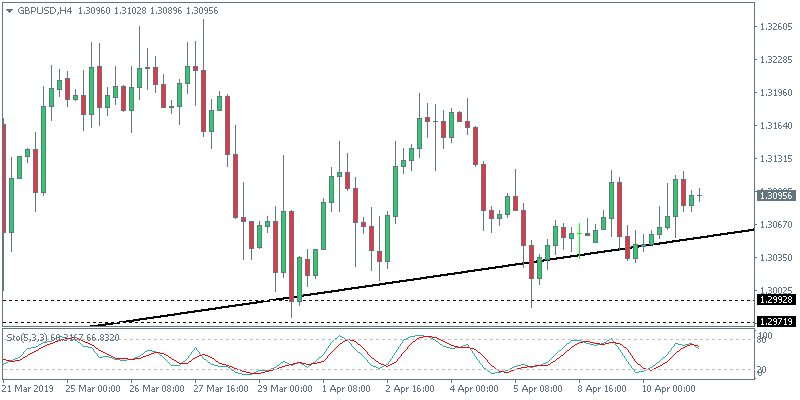
The cable managed to post a strong reversal just off the rising trend line which falls above the support area of 1.2998 – 1.2971. While price action remains flat for the moment, the range-bound activity is likely to continue. As long as the trend line holds, GBPUSD could be seen attempting to push higher. GBPUSD will be looking to target the previous highs of 1.3177.
FOMC Minutes – Rate Hikes Not Completely Ruled Out
The Federal Reserve Bank released its monetary policy meeting minutes on Wednesday. The minutes from the March meeting showed that Fed officials kept the options open for rate hikes if the economy improves. However, the majority of the policymakers were of the view that the current economic outlook and risks would require no change to interest rates for the remainder of the year.
Will XAUUD Reverse Gains?
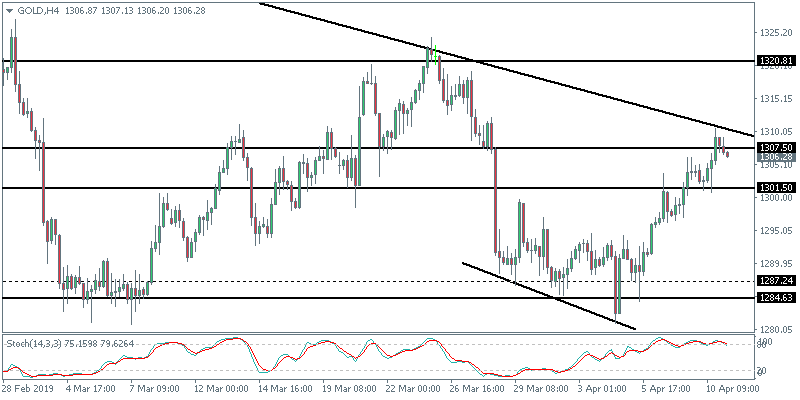
XAUUSD rallied to a fresh two-week high on Wednesday but price retreated after touching intraday highs of 1310. Price action remains stuck in the resistance area of the 1307 – 1301 region. If we see a reversal lower, then gold could be potentially turning lower. However, the support at 1285 will be a key level in determining further declines
ECB Keeps Policy Steady As Expected
The European central bank held its monetary policy meeting on Wednesday. The central bank maintained a dovish policy view but refrained from making any major policy changes. The ECB is set to reinvest its QE debt for an extended period of time even after the first rate hike, which is due only next year. The common currency initially fell but managed to recover by the close.
Can the EURUSD Breakout Higher?
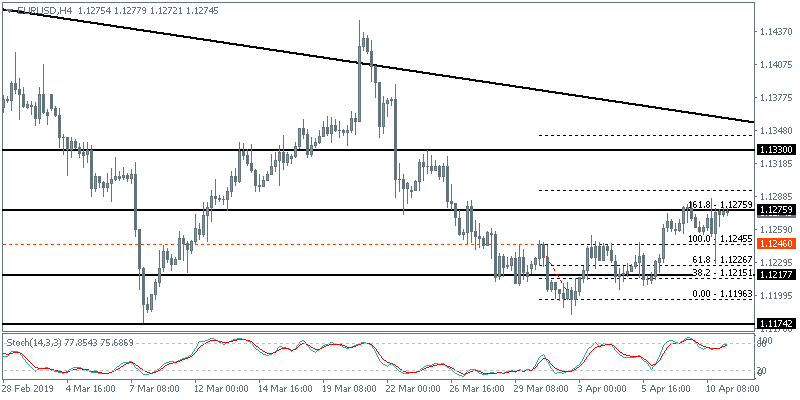
While the ECB meeting sent the euro lower on the day, price quickly retraced those losses. The EURUSD tested the lower support at 1.1245 as mentioned yesterday and is now trading near the resistance level of 1.1275. A breakout higher is required for the EURUSD to continue the gains to the upside. The next main target is seen at 1.1300, followed by a move to 1.1330.
Central Banks Fail To Support Equities As Brexit Delay Fails To Boost Sterling
Equity markets across Asia are trading in red on Thursday as investors digest the latest updates on the global economic outlook and central bank decisions. ECB chief Mario Draghi reiterated that risks to the Eurozone economy remain to the downside as the central bank pledged to keep interest rates at current levels at least through to the end of 2019. Minutes from the Federal Reserve's March monetary policy meeting showed no indication of a rate cut, but several officials noted that next move may be in either direction.
The boost provided to equity markets from the shift in central banks seems to be exhausted with the S&P 500 standing 1.7% away from an all-time high. Investors hoping for an interest rate cut may not see one coming any time soon, suggesting that they shouldn't continue betting on monetary policy to push equities further.
Investors need to shift their attention to the earnings season which unofficially kicks off tomorrow. With the impact of tax cuts and government spending boosts from 2018 fading, it's time to see how companies will perform when left on their own. Earnings are estimated to decline by 4.2% in the first quarter of 2019 according to FactSet. However, if 65-70% of corporates, as usual, managed to beat Wall Street estimates, we may still see a slight growth in earnings.
One of the critical metrics investors need to watch is profit margins, especially given the spike in wage growth in Q1. If companies are not able to pass the additional cost to consumers, it may indicate further weakness to come in the upcoming quarters.
Guidance is also going to be critical for the S&P 500's next move. The index has risen 15.2% so far year- to-date, and for the rally to be sustained, investors need assurance that we're not going to hit an earnings recession. A dovish Fed won't be enough to keep the party on.
Brexit delay failed to boost Sterling
A second Brexit delay has been granted until October 31 with a review to be conducted on June 30. The good news is a no-deal Brexit has been averted for now; the bad news is no one knows what will happen next. So far, it seems that the can is just being kicked further down the road. This has led to a steep decline in the Pound's implied volatility but has done little to lift the currency. That's because the risks have just been extended and not vanished. Predicting Sterling's next move is going to be a tough task as all options remain open, including a no-deal Brexit and no Brexit at all.
USDJPY Bearish Below 110.90
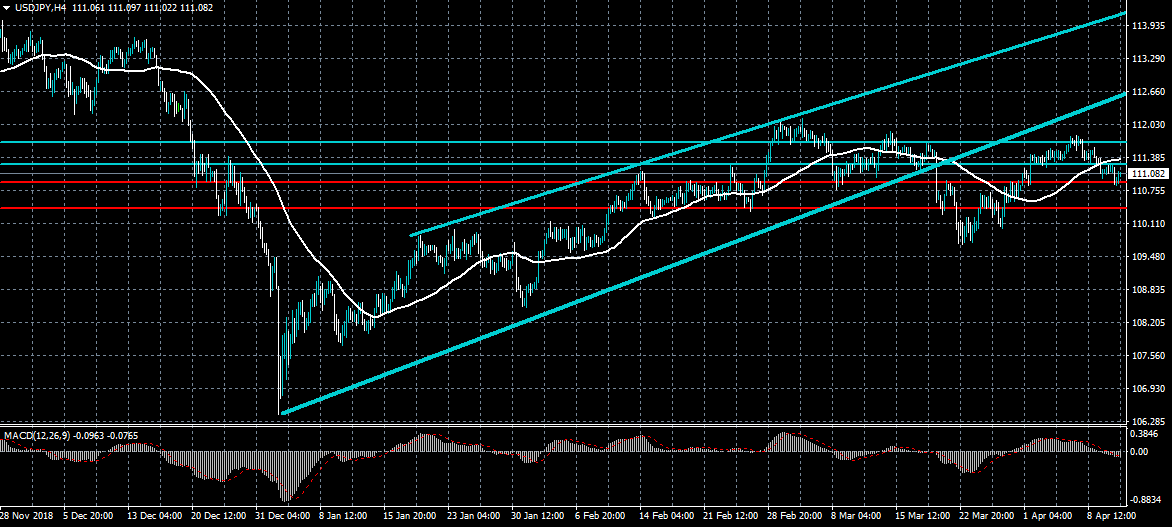
The US dollar has fallen to a new monthly trading low against the Japanese yen currency after the FOMC meeting minutes showed that US policymakers remained dovish towards interest rates. The USDJPY briefly traded below the 110.90 support level, with a sustained price close now needed to turn the weekly sentiment towards the pair bearish. Technical indicators on the daily time frame suggest that the USDJPY pair can still trade lower over the medium-term.
If the USDJPY pair trades below the 110.90 level, sellers may test towards the 110.65 and 110.40 levels.
If the USDJPY pair trades above the 110.90, key intraday resistance is found at the 111.10 and 111.30 levels.
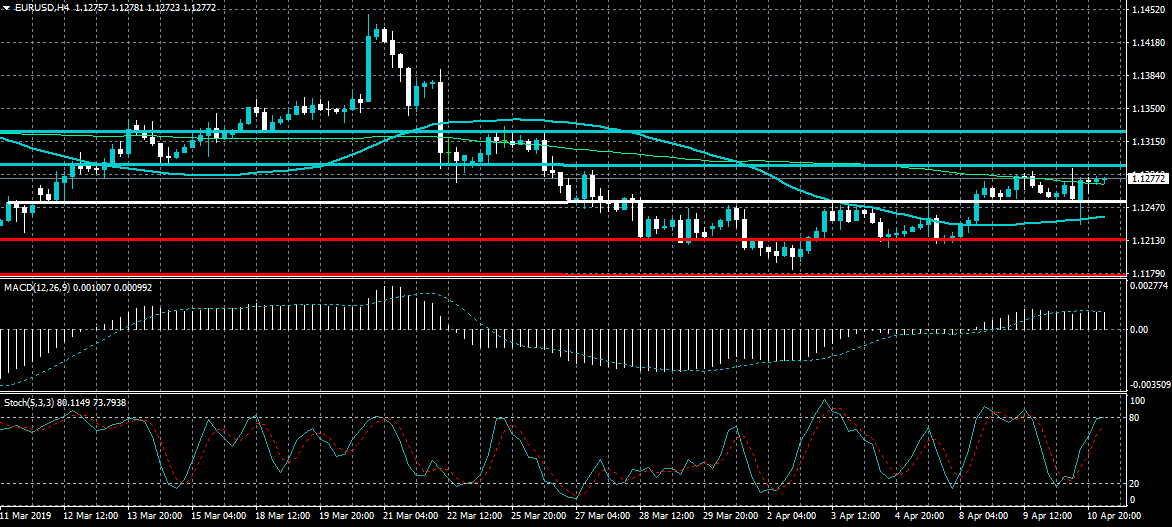
EURUSD 1.1290 Strong Resistance
The euro is trading towards the best levels of the week against the US dollar, despite more bearish commentary from ECB President Mario Draghi during yesterday’s policy meeting. The 1.1290 levels remains strong resistance, with bulls needing to break above this area for further gains toward the 1.1330 level. Sellers need to hold price below the 1.1250 support level to shift the bullish intraday sentiment surrounding the EURUSD pair.
The EURUSD pair is only bullish while trading above the 1.1250 level, key technical resistance is found at the 1.1290 and 1.1330 levels.
If the EURUSD pair trades below 1.1250 level, key intraday support is found at the 1.1216 and 1.1170 resistance levels.
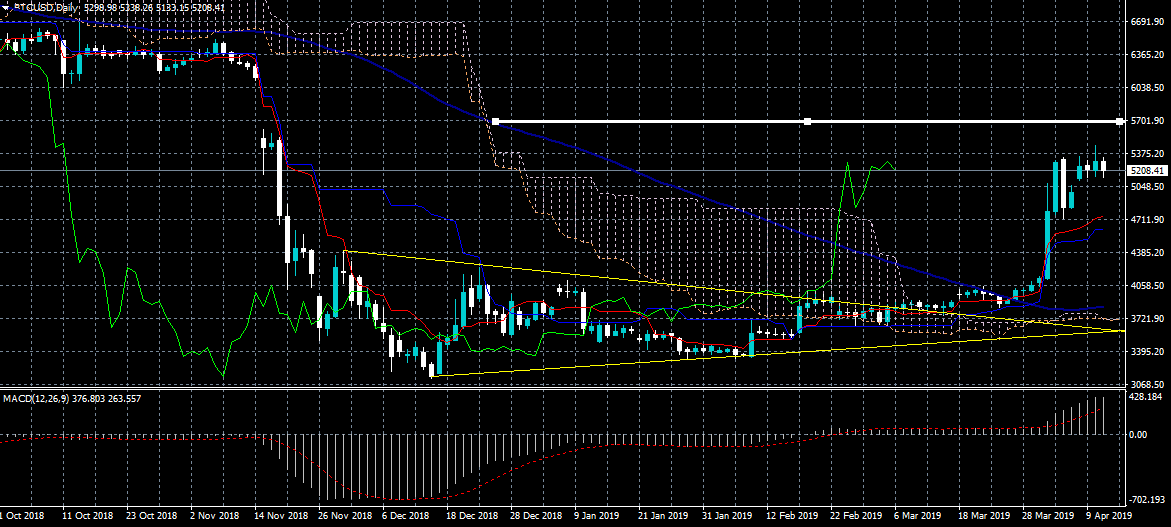
BTCUSD Still Intraday Bullish
Bitcoin has spiked to a fresh monthly trading high, hitting $5,454, as the BTCUSD pair continues to build bullish momentum above the $5,200 level. The $5,454 and $5,700 levels currently offer the strongest forms of technical resistance if the number one cryptocurrency advances higher. The MACD indicator on the four-hour time frame is currently showing bearish price divergence extending down to the $4,700 level.
The BTCUSD pair is bullish while trading above the $4,900 level, key intraday resistance is found at the $5,454 and $5,700 levels.
If the BTCUSD pair trades under the $4,900 level, sellers may test towards the $4,700 and $4,450 support levels.
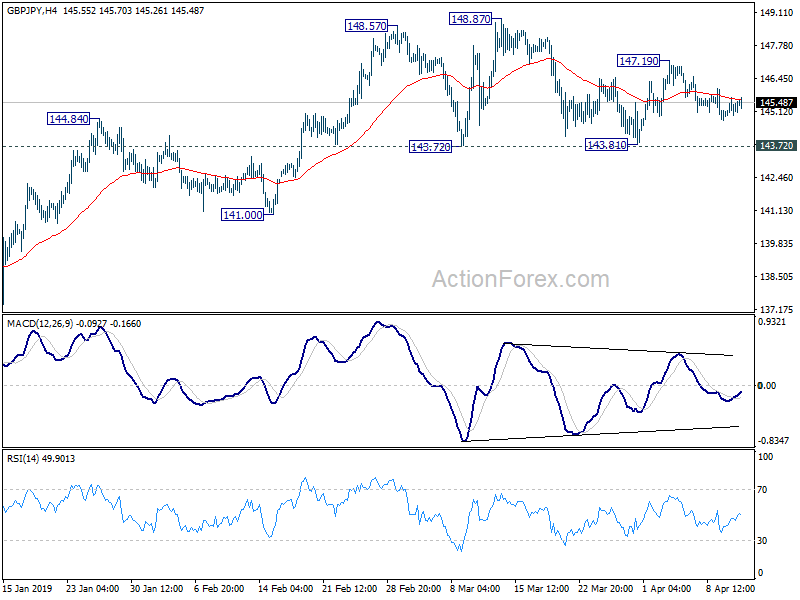
GBP/JPY Daily Outlook
Daily Pivots: (S1) 144.95; (P) 145.32; (R1) 145.69; More...
GBP/JPY's sideway trading from 148.87 is extending and intraday bias remains neutral for the moment. On the downside, sustained break of 143.72 will indicate near term reversal, after rejection by 149.48 key resistance. In that case, intraday bias will be turned to the downside for 141.00 support first. On the upside, decisive break of 149.48 key resistance will carry larger bullish implication and target 156.58 resistance next.
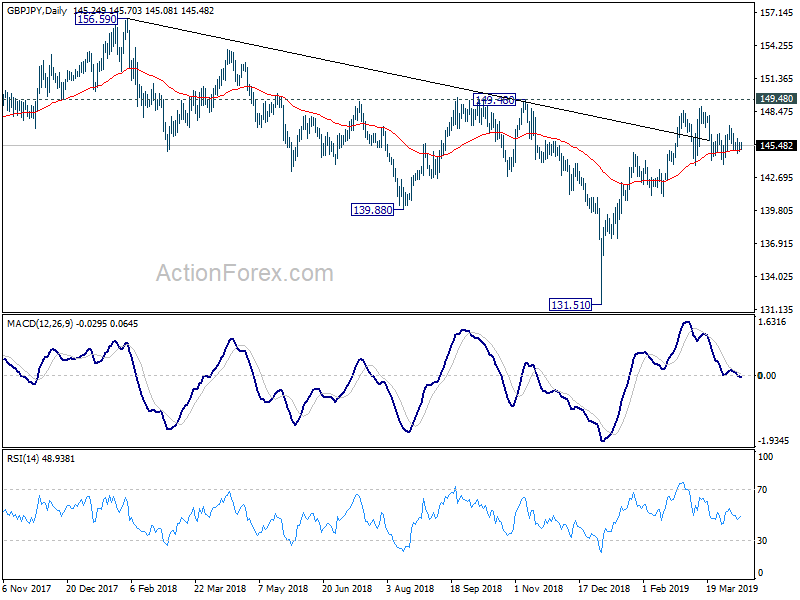
In the bigger picture, focus is now staying on 149.98 key resistance. Decisive break there should confirm that medium term fall from 156.59 (2018 high) has completed at 131.51 already. Rise from 131.51 is then seen as the third leg of the corrective pattern from 122.36 (2016 low). GBP/JPY should then target 156.59 and above. However, rejection by 149.98 will retain medium term bearishness and could extend the fall from 156.59 through 131.51 to 122.36.
More Uncertainty For Sterling As EU Gives A Long Brexit Extension
Sterling was relatively unmoved as EU leaders accepted a new Brexit delay. The deadline will be extended until the end of October, with a review in June. Angela Merkel and other EU leaders were prepared to offer a much longer delay, a move that was rejected by Emmanuel Macron. In addition, the EU will continue to monitor UK guarantees to prevent it from interfering with long-term EU plans including the election of the next EU Commission President and the EU budget. This new extension means that Brexit uncertainty will continue, which presents more risks to the UK. For example, companies will be afraid to invest in the country because of the uncertainty.
After initially gaining, the USD stabilized after the Fed released minutes from the March meeting. In the meeting, officials kept their options open regarding interest rates. This is as they weighed the significant uncertainties over the US and global economic growth. This was a change of tone after the previous hawkish statements by the bank. The reason for the change of direction is that the US economy has shown signs of slowdown. The same is true for the world economy. Indeed, on Tuesday, the IMF announced that it was lowering its global economic outlook to 3.3%. In addition, the Fed is facing increased pressure from the US President, who has called for rate cuts and more quantitative easing.
The price of crude oil remained near YTD highs after the EIA released its weekly inventories data. Data from the organization showed that inventories rose by more than 7 million barrels. This was much higher than the 2.29 million barrels that traders were expecting. Last week, this data showed an increase of more than 7.2 million barrels. Previously, data from API had showed that inventories increased by more than 2 million barrels. Today, traders will continue to monitor the situation in Libya. They will also receive the monthly report from the EIA.
EUR/USD
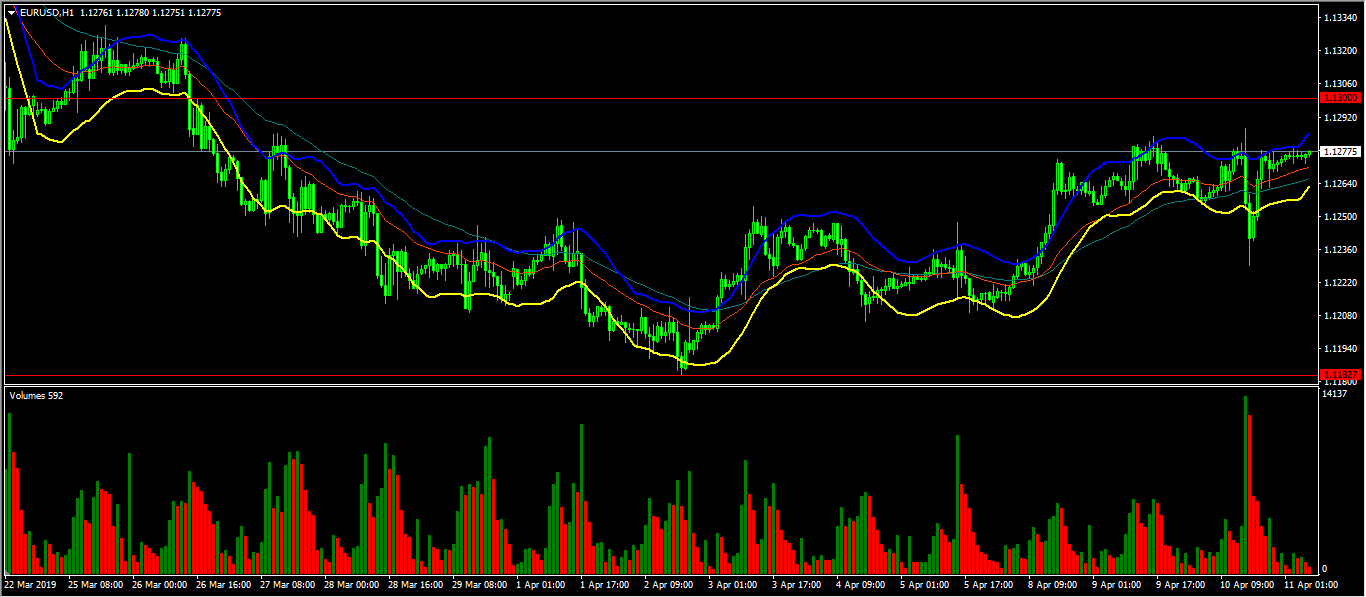
The EUR/USD pair declined to a low of 1.1228 after the Fed released its minutes. It then stabilized and is currently trading at 1.1277 as traders wait for more economic data from Europe. The current price is above the 25-day and 50-day moving averages and closer to the upper line of the Envelopes indicator. After rising sharply after the FOMC meetings, the volumes have returned to yesterday’s lows. There is a likelihood that the pair will continue moving higher as it tries to test the important resistance of 1.1300.
EUR/CHF
The EUR/CHF pair started an upward trend on Monday last week, when it traded at the 1.1160 level. Overnight, the pair reached a high of 1.1305, which is the highest level since March 22. On the hourly chart, this price is closer to the upper line of the Bollinger Bands, while the RSI has remained below the overbought level. In addition, the Average Directional Index (ADX) has declined from a high of 60 to the current 27. Therefore, the pair could find some resistance in these levels.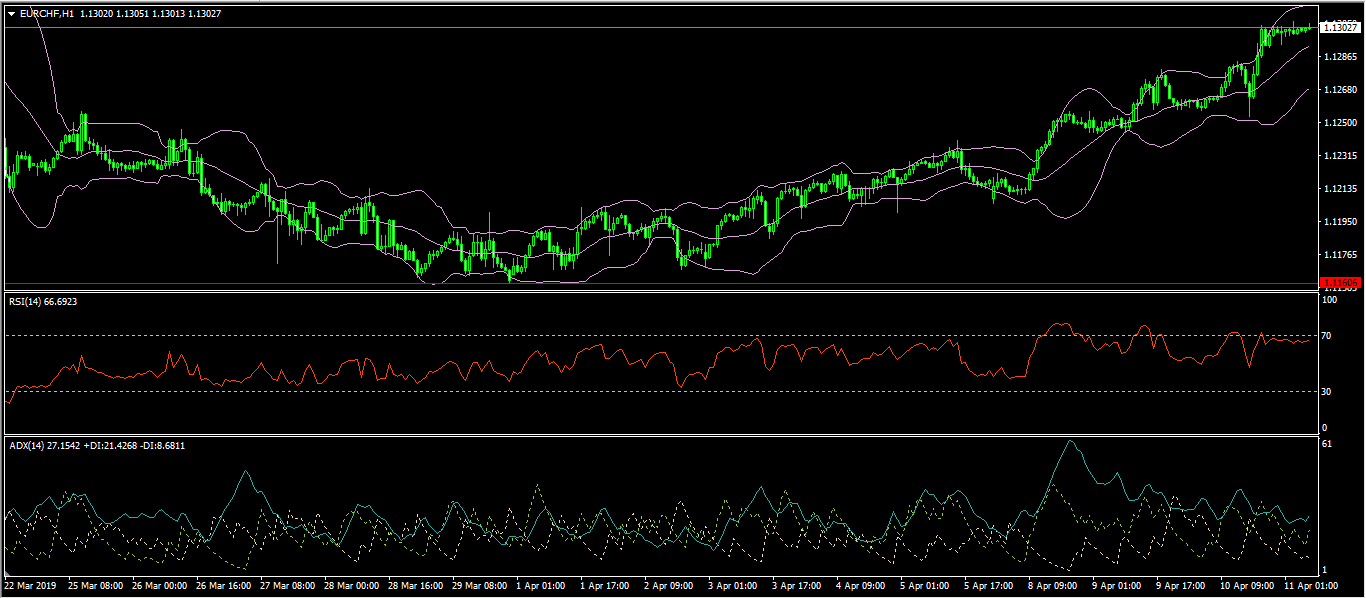
XTI/USD
The XTI/USD pair remained near the YTD highs after the inventory numbers from the US. The pair is now trading at 64.29, which is close to the high of 64.70. On the hourly chart, this price is along the 25-day EMA and slightly above the 50-day EMA while the Bulls Power has turned negative. The accumulation and distribution indicator has remained near YTD highs. There is a likelihood that the pair will continue moving upwards as it attempts to test the important resistance level of 70.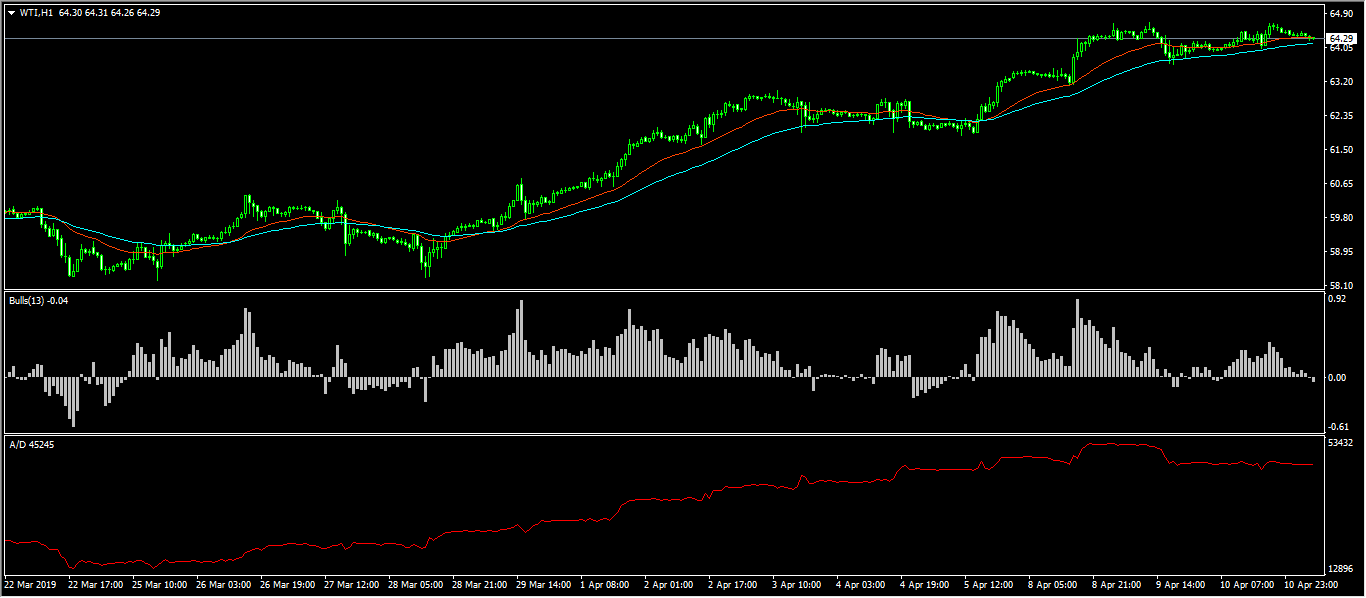
ECB Review – Reinforcing Dovish Tone. TLTROs Details to be Announced in Coming Months
ECB shrugged off the improvement in the economic data since the last meeting, reinforcing its dovish stance and raising the likelihood of further easing measures. The focus of the meeting was arrangements for TLTRO III and the tiered deposit rate system. For the former, President Mario Draghi has suggested the criteria for pricing the operations and pledged to announce the technical terms in forth coming meetings. Few was disclosed regarding the latter as this remained in discussion Draghi also refrained from explicitly commenting whether the system would pave the way for further reduction in interest rates. At the meeting, ECB decided to leave the main refi rate, the marginal lending rate and the deposit rate unchanged at 0%, 0.25% and -0.40%, respectively. It would also continue to reinvest the proceed from maturing securities purchased during the QE program which was completed in December 2019.
Targeted Longer-Term Refinancing Operations (TLTROs III)
The central bank suggested that the details of the operation would “be communicated at one of our forthcoming meetings”. We expect to hear the announcement in June or July, given the measure would take effect in September. At noted in the statement, ECB would consider two criteria for the pricing of the operation. First, it will take into account a thorough assessment of the bank-based transmission channel of monetary policy. Second, it will consider further developments in the economic outlook.
Tiered deposit Rate System
Regarding whether introduction of the system implies lower interest rates in the futures, President Draghi noted that the Committee had no discussion about the issue. Yet, the central bank would likely leave the policy rate in negative territory for an extended period of time. At the press conference, President Draghi reiterated his comments at the Watchers’ speech that “we will also consider whether the preservation of the favourable implications of the negative rates”. Meanwhile, proposing the Tiered deposit rate system is to mitigate “the possible side-effects, if any, [of negative interest rates] on bank intermediation”.
Forward Guidance
ECB made no change in the forward guidance in April, reiterating that the policy rates would “remain at their present levels at least through the end of 2019, and in any case for as long as necessary to ensure the continued sustained convergence of inflation to levels that are below, but close to, 2% over the medium term”. Meanwhile, it would “continue reinvesting, in full, the principal payments from maturing securities purchased under the asset purchase program for an extended period of time”. We expect ECB could adjust the forward guidance to signal that the policy rates would stay unchanged for a longer period of time in coming months, unless there are significant improvement in the economic conditions.