

Sample Category Title
FX Rumbles As The Street Slumbers
FX rumbles as the street slumbers
The currency markets awoke from their brooding slumber overnight, if only to sit up and stretch, leaving the running shoes and gym gear sitting in the corner untouched. The eternal optimism in equity and energy markets finally spilled over as traders slowly but steadily sold the greenback, with the dollar index falling 0.37% to 97.04. Notable gainers were the euro (EUR) which rose 50 points to 1.1260 and the British pound (GBP), shrugging off Brexit-induced selling to rise 40 points to 1.3065, having dipped dangerously below 1.3000 on Friday.
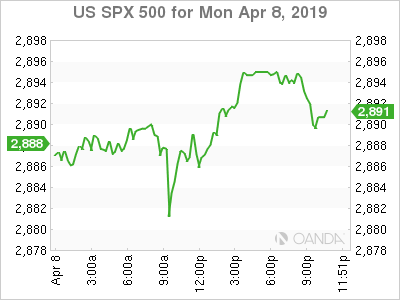
There was definitely a slow-news-day-look to the markets ahead of tomorrow’s European Central Bank rate decision and the FOMC minutes for March. Wall Street’s S&P and Nasdaq indices eked out minuscule 0.1% gains, while the Dow Jones fell 0.35%, weighed down by industrial heavyweights Boeing and General Electric.
Escalating Libyan violence caused a bright spot for all the wrong reasons, fueling oil prices higher and lifting gold of the bottom of its weekly range.
With the overnight session having a definite wait-and-see look about it across all three time zones, we can expect more of the same today as the data desert continues until tomorrow’s main event. Global recovery bulls can take comfort that the street appears to be choosing mild optimism rather than pessimism in the quiet times. It’s likely Asian markets will follow cautiously today.
FX
Following the gentle dollar sell-off overnight, as traders rotated into global growth plays from safe havens, we anticipate a positive start for regional currencies. Oils continuing ascent could see the Malaysian ringgit and Indonesian rupiah outperform during the session. Australian home loans are released this morning, and with a wobbly housing market, the number could cause short-term volatility in the Aussie dollar.
Equities
The cautiously optimistic Wall Street session could see Asian traders collectively dipping their toes and sending stocks higher today. With no meaningful data on the calendar today, the markets will be vulnerable to news-headline-induced volatility.
Oil
The escalating violence in Libya threw more fuel on oil’s fire overnight, with Brent Crude climbing 1.04% to USD71.10 a barrel. WTI rocketed 2.20% to USD64.60 a barrel as data showing falling deliveries to the Cushing oil terminal. Iran and Venezuela sanctions, Libya, Saudi Arabian production cuts; the list goes on of supportive geopolitical factors overriding the grossly overbought technical picture. Throw in optimism on global growth (real or imagined), and picking a high in black gold is a fruitless task for now.
Gold
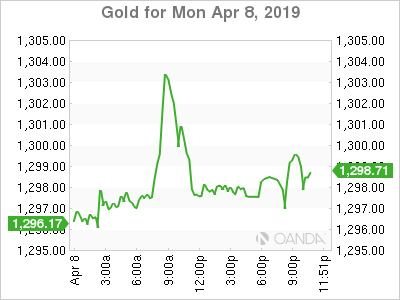
Gold staged an impressive comeback overnight fueled by a weaker dollar and increased China holdings, rising from USD1,292.00 an ounce to USD1,303.50 at one stage, before an equity comeback late in the New York session saw the yellow metal settle at USD1,297.50.
If anything, this demonstrates that gold is moving on factors outside its control at the moment and the recent week’s price movements are not a gold story per se. Nonetheless, for embattled gold traders, the critical support level of USD1,280.00 withstanding the selling onslaught once again is a positive technical development.
USD/CAD Canadian Dollar Higher On Crude Oil Boost
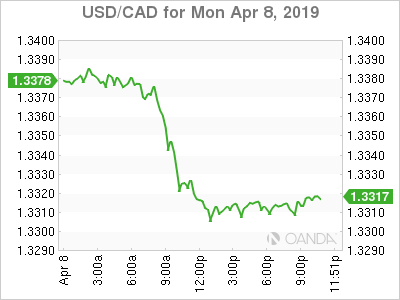
The USD/CAD dropped 0.54 percent on Monday. The Canadian dollar rose on the back of a strong oil rally after armed conflict in Libya continues to escalate. US sanctions and the OPEC+ have lifted oil prices, and with a potential disruption to Libya’s output crude reached 5-month highs.
The greenback lost its edge against majors as investors ahead of the Fed’s March FOMC minutes, which are expected to bring even more dovish comments from the central bank. The loonie has been under pressure with mixed economic indicators and the ghost of NAFTA 2.0 not being ratified hanging over the currency.
The economic calendar for this week is light on domestic events with housing data already out with some improvement, the next highlight will be Deputy Governor Wilkins speech on Thursday.
The OPEC meeting in Vienna will have some influence on crude prices as Saudi Arabia could use the opportunity to signal its willingness to extend the OPEC+ crude output cut before the group’s meeting in May.
OIL – Libyan Conflict Escalation Triggers Supply Anxiety
Oil rose at the start of the week with the dollar on the back foot and the escalation of the armed conflict in Libya. Supply concerns are keeping crude prices bid with US sanctions and the OPEC+ agreement being the factors pushing crude higher.
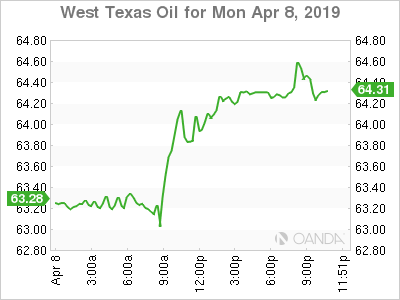
Energy demand remains stable and with the US-China trade deal close to an official announcement a rebound is expected. Rising US production is the main factor putting downward pressure against rising crude, but for now supply anxiety has more weight on investors as spot pricing showed contango.
The fighting in Libya is not near oil producing fields, but if the conflict continues it could end up reducing crude supply. The largest oil field Sharara is near its normal production after being shut down for three months due to a salary dispute.
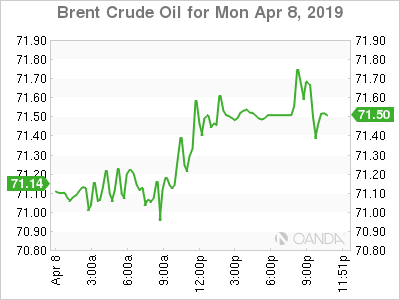
Saudi energy minister reassured markets on Monday that the OPEC+ ministerial meeting in May will be crucial to reach a decision to extend the production cut agreement. The OPEC has been the target of pressure from the White House in order to stop limiting production and let prices go lower. Rumour circulated that Saudi Arabia could retaliate by diversifying oil prices away from the US dollar, but those statements were denied by the Saudi energy ministry.
GOLD – Gold Rises on Dollar Weakness
Gold rose 0.49 percent on Monday after the US dollar lost momentum ahead of heavy expectations the FOMC minutes from the March meeting will bring more dovish rhetoric forward. The softness of the dollar was a positive for gold, but with macro risk events this week the metal will be bid in case investors need a safe haven.
Gold prices broke the $1,300 price level but are once again under it despite a full economic and geopolitical agenda this week. Brexit fatigue and continued dovish rhetoric from central banks will not add volatility to the market.
Central banks have been large buyers of gold and stats released this week showed the People’s Bank of China added 360,000 ounces last month to add its reserves now clocking 60.62 million ounces. Gold is seen by some central banks as an alternative to diversify their reserves away from the US dollar. In the case of China, bold purchases could add some leverage in the ongoing trade negotiations with the US.
STOCKS – Stocks on Wait-and-see Ahead of Earnings
Stocks were uninspired on Monday as lack of data and no word on a US-China trade deal breakthrough puts investors in wait-and-see mode. The Fed minutes to be released this week will bring more dovish details on the reasons for the central bank to pause its interest rate hike path, but no new developments. Global growth concerns are easing as US-China appear to be close to a deal, but without details and with veiled threats if the deal is not best markets are threading carefully.
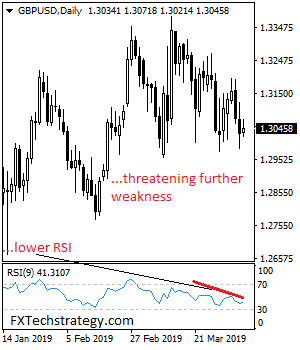
GBPUSD Retains Downside Pressure, Eyes 1.2986
GBPUSD retains downside pressure with eyes on 1.2986 zone. Below that level will open the door for more towards 1.2950 level. Further down, support comes in at the 1.2900 level where a break will turn focus to the 1.2850 level. Further down, support lies at the 1.2800 level. Below here will set the stage for more weakness towards the 1.2750 level. On the upside, resistance stands at the 1.3100 with a turn above here allowing for additional strength to build up towards the 1.3150 level. Further out, resistance stands at the 1.3200 level followed by the 1.3250 level. On the whole, GBPUSD retains downside pressure with eyes on 1.2986 zone.
Eco Data 4/9/19
[php_everywhere instance="1"]
UK Growth Likely Grind to a Halt in February as Markets Await Brexit Decisions
Economic indicators due out of the United Kingdom on Wednesday (08:30 GMT) are anticipated to show GDP growth stalling in February amid the heightened uncertainty around Brexit. But it will be happenings in the Brexit sphere that will once again grab the bulk of traders’ attention. EU leaders will meet for an emergency summit on Wednesday to decide whether to grant the UK another extension to the exit date, otherwise a no-deal Brexit would be the default option when the current extension expires on April 12.
While the UK economy managed to withstand the initial shock and impact of the Brexit referendum outcome in June 2016, the prolonged period of uncertainty and the political chaos that has ensued in Westminster has finally started to weigh heavily on Britain’s growth prospects. That was evident in the latest services PMI from IHS Markit/CIPS which fell to contraction territory in March.
Flat GDP growth expected in February
Wednesday’s data is expected to confirm the worrying trend in the dominant services sector with forecasters predicting total UK economic output stood still in February even as industrial production benefited from Brexit stockpiling. The year-on-year GDP picture is expected to improve somewhat, however, rising from 1.4% to 1.7% in February. The manufacturing sector is forecast to have posted month-on-month growth of 0.2% in February, adding to January’s 0.8% gain, while overall industrial output is anticipated to have increased by 0.1%.
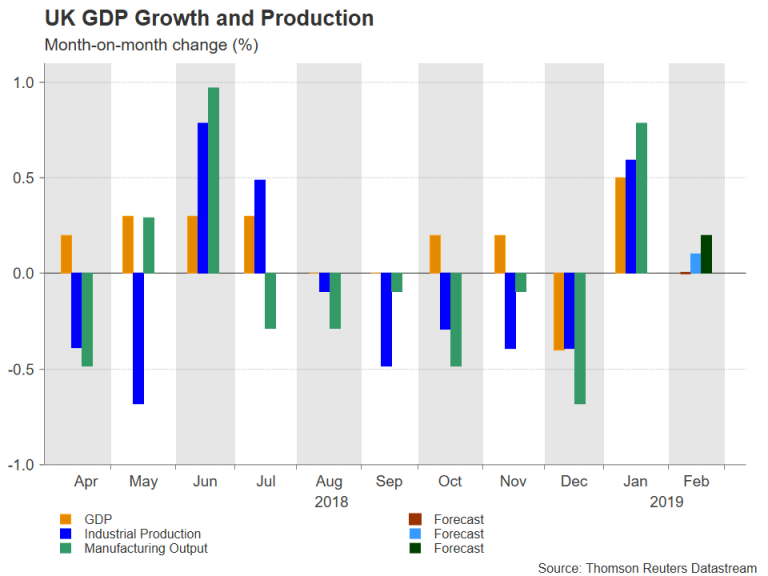
Manufacturers and retailers have intensified stockpiling in recent months on fears that a possible disorderly Brexit could result in customs delays at the border, leading to shortages of many goods. For that reason, markets have been unimpressed by the rebound in manufacturing output and any further boost is unlikely to provide the pound much support.
May turns to Labour to push through a Brexit deal
Instead, all eyes this week will be on London and Brussels. British PM Theresa May is desperately trying to find some common ground with Labour leader, Jeremy Corbyn, to forge an amended Brexit deal that could win the support of opposition MPs. May will need to make significant progress in her discussions with Labour in order to be able to persuade EU leaders at an emergency Brexit summit on Wednesday to approve her request for a further extension of Article 50 until June 30.
After Parliament rejected May’s deal for a third time on March 29 – the day Britain was meant to leave the EU – the current extension is due to expire on Friday. However, despite some doubts whether the EU will grant the UK a second extension if May fails to make a convincing case, markets are still pricing a very low probability of a no-deal Brexit.
Markets think EU will extend Brexit deadline
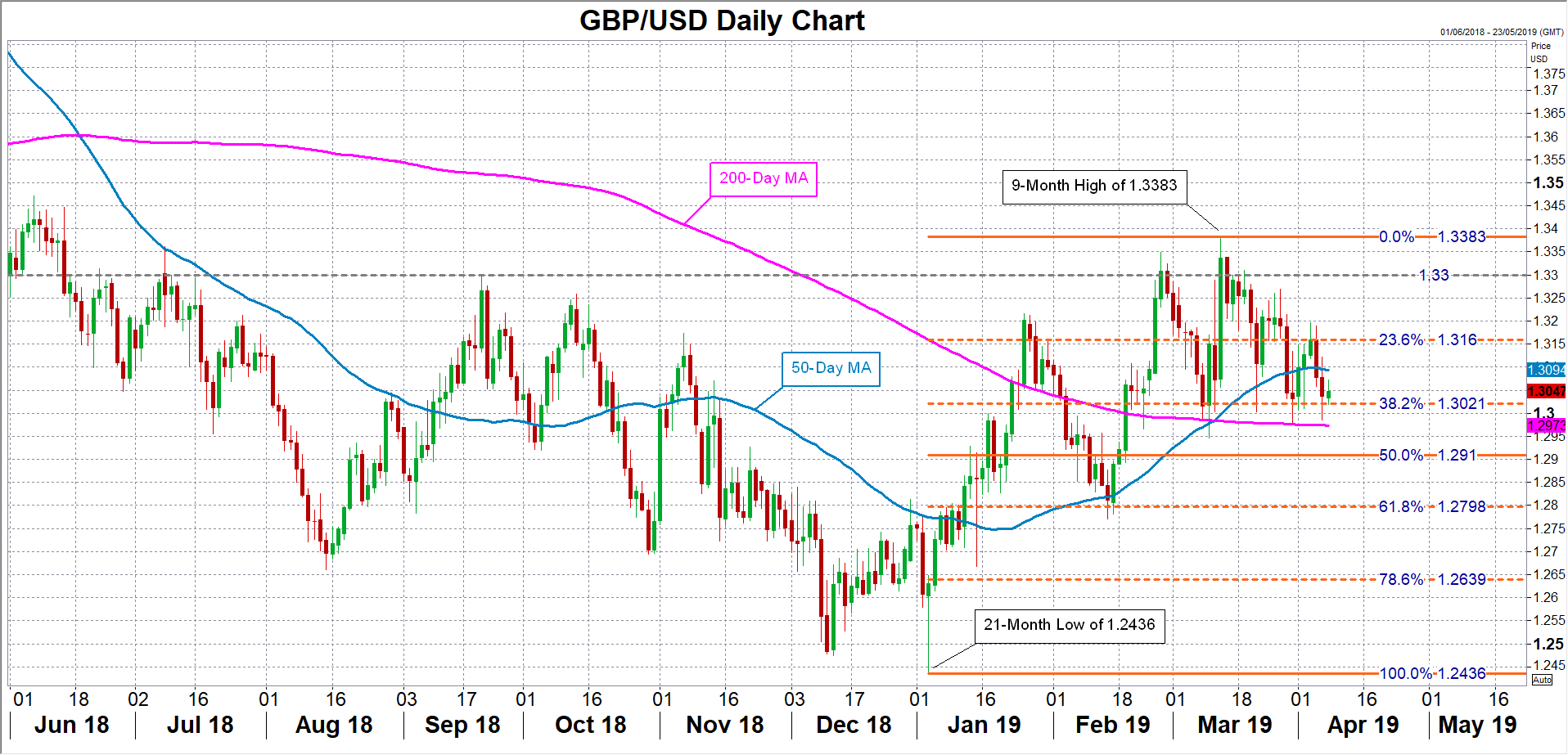
The reduced odds of a no-deal scenario, following MPs’ intervention to block the government from going down that road, have kept cable supported above its 200-day moving average in the $1.2975 region. But with chances of a near-term breakthrough of any sort still looking fairly remote, that support barrier could easily be broken if talks between May and Corbyn collapse and the EU refuses to provide a second extension. Such an outcome would open the way for the $1.28 handle, which is the 61.8% Fibonacci of the 1.2436-1.3383 upleg.
The more probable outcome, however, is that the EU will approve another delay to the Brexit deadline. The question is, whether it will be another short one, to June 30, or a much longer extension that could keep the UK in the EU until at least the end of the year, which would likely require the country to participate in upcoming European Parliament elections.
Another extension would ease the immediate downside pressure on the pound and help it recover above the 50-day moving average, currently at $1.3093. But for the currency to advance substantially beyond this point in the short term, traders would need to see positive headlines coming from the talks between May and Corbyn. Signs that the two leaders are able to narrow their differences on their vision of Brexit could propel the pound above the $1.33 level, bringing the March top of 1.3383 back into view.
Japanese Yen Improves on Strong Current Account Surplus
USD/JPY has lost ground in the Monday session. In the North American session, the pair is trading at 111.37, down 0.31% on the day. Japan’s current account surplus surged to JPY 1.96 trillion, up from JPY 1.83 trillion a month earlier. However, consumer confidence continues to decline, falling to 40.5 in March. This marked a sixth straight drop, as consumers remain very pessimistic about the economic outlook. In the U.S., factory orders declined 0.5%, matching the forecast. On Tuesday, the U.S. releases JOLTS Jobs Openings and Japan posts core machinery orders and PPI.
Weak global demand has taken a toll of Japanese exports and manufacturing output. This was reflected in a Bank of Japan forecast on Monday, which downgraded its assessment for three of the country’s nine regions. All three regions are dependent on electronic exports to China, which has been gripped by an economic slowdown in recent months. Despite the pessimistic report, BoJ Governor Haruhiko Kuroda remained optimistic, saying that stronger domestic demand would offset the decline in exports, which would enable the economy to grow at a moderate pace. Kuroda also said that he was confident that inflation would gradually accelerate towards the BoJ’s target of 2 percent.
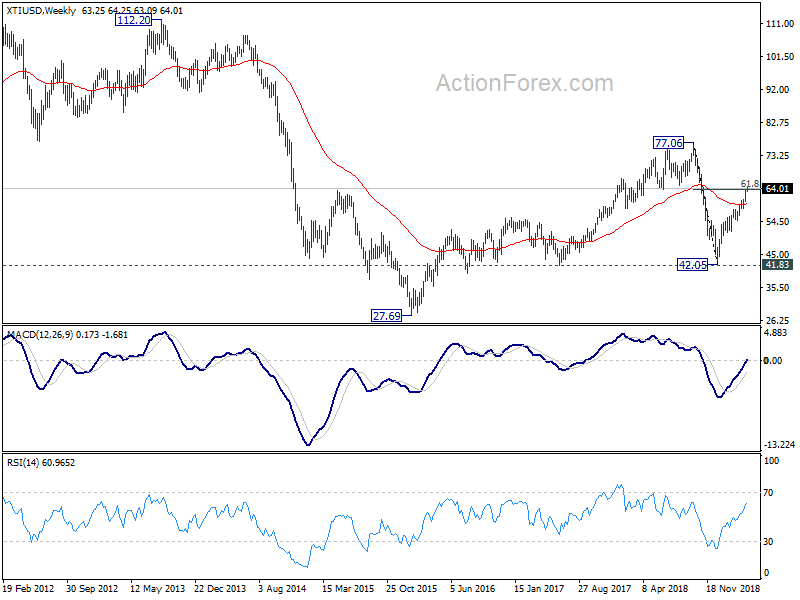
WTI crude oil breaks 63.68 fibonacci resistance, eyeing 77.06 in medium term
WTI crude oil's rally accelerates again today and reaches as high as 64.24 so far. 61.8% retracement of 77.06 to 42.05 at 63.68 is taken out.
Also, 55 week EMA is considered firmly taken out after last week's rise. The rally from 42.05 is at least considered as part of a sideway pattern from 77.06. Or, it could even be resuming the up trend from 27.69.
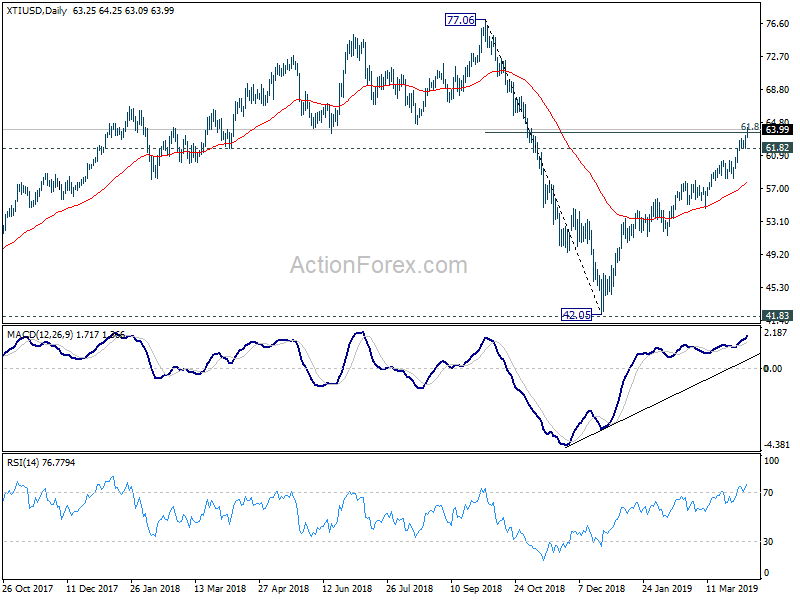
Thus, sustained trading trading above 63.68 will pave the way to retest 77.06 high next. And in any case, near term outlook will remain bullish as long as 61.82 support holds, in case of retreat.
MARKET WRAP: Stocks Moved Lower, Euro and Gold Reclaimed Victory
*Stocks failed to keep the momentum going *Gold moved higher ahead of the FOMC minutes * Sterling and Euro back in the positive territory
Stocks
- The S&P 500 Index fell 0.21 percent as 15:43 London time, failed to build on the momentum from the last week.
- The Stoxx Europe 600 Index dropped 0.28 percent ahead of the ECB meeting due on Wednesday.
- Germany’s DAX Index fell 0.4 percent, breaking its five consecutive days of rally.
- The MSCI Emerging Market Index jumped 0.2 percent, touching the strongest mark in nearly eight months.
Currencies
- The Dollar Spot Index slumped 0.40 percent ahead of the FOMC minutes.
- The Euro moved higher 0.5 percent to $1.1269, the highest level in almost two weeks.
- The British pound increased 0.11 percent to $1.3052.
- The Japanese yen moved higher 0.31 percent to 111.39 per dollar.
Bonds
- The yield on 10-year Treasuries jumped one basis point to 2.51 percent.
- Germany’s 10-year yield dropped one basis point to 0.004 percent.
- Britain’s 10-year yield dropped one basis point to 1.104 percent.
Commodities
- West Texas Intermediate crude continued its uptrend and jumped 1.76 percent to $64.18 a barrel, the strongest in five months.
- Gold reclaimed its 1300 mark and advanced 0.71 percent to $1,304 an ounce.
USD/TRY Outlook: Turkish Lira Falls Further in Post-Election Turmoil; Jobs Data in Focus
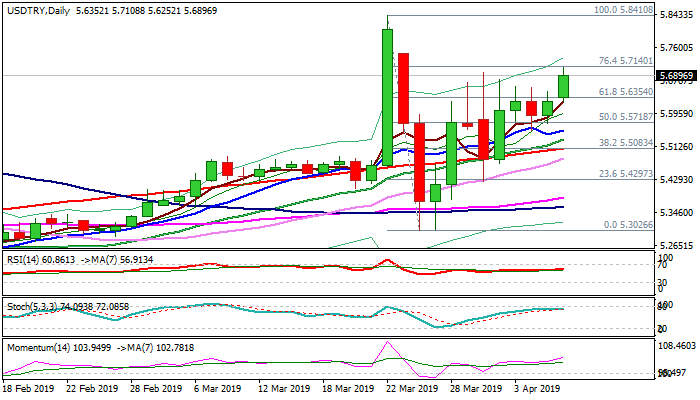
The USDTRY rallied on Monday too new two-week high, signaling eventual break above strong Fibo barrier at 5.6354 (61.8% of 5.8410/5.3026), below which the action was congested for over one week, unable to clearly break higher, despite strong upticks.
Fresh lira's weakness comes under fresh pressure after President Erdogan showed strong doubts about election results in Istanbul (where the opposition won majority) and requested full recount of votes in this town.
Another hit to lira came from announcement of Erdogan's plans to discuss with Russia possible Turkish military operations in Syria. Turkish jobs data will be released on 15 Apr and market eyes results which are expected to show downbeat results (previous release showed jobless at 13.5%, the highest since global financial crisis) Another weak result could signal Turkey's recession, as CBRT's ultra-tight policy is not boosting lira but pressuring the economy.
Eventual close above 5.6354 Fibo barrier would generate strong bullish signal for extension of rally from 5.3026 (26 Mar) which would look for retest of key 5.8410 high (22 Mar) and attack at 5.8868 (Fibo 38.2% of 7.1074/5.1323 fall).
Res: 5.7140; 5.7460; 5.8410; 5.8732
Sup: 5.6625; 5.6354; 5.5718; 5.5535
Gold jumps on Dollar weakness, defended 1280 support
Riding on broad based weakness in Dollar, gold stages a strong rebound today. The solid break of 4 hour 55 EMA suggests that fall from 1324.49 has completed at 1280.85, after hitting 1280.85 support. Further recovery could now be seen back to 1324.49 resistance.
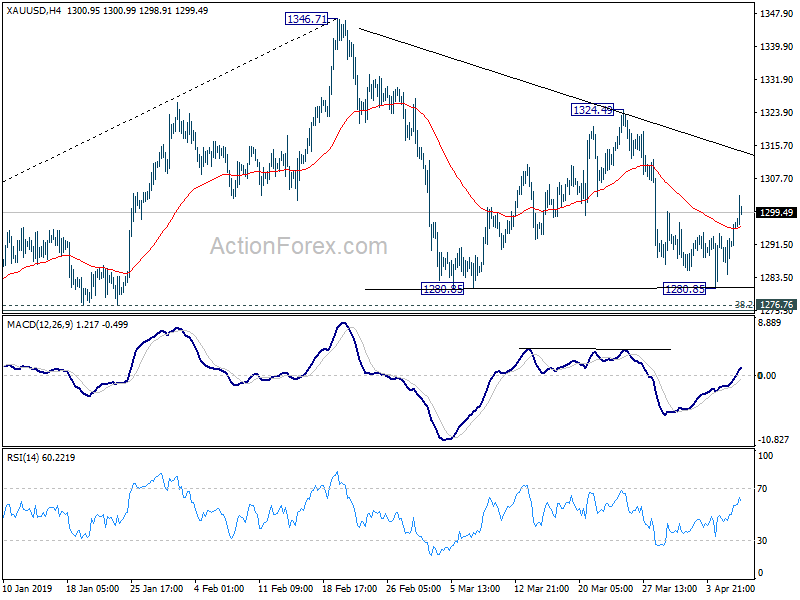
At this point, 1276.76 cluster support (38.1% retracement of 1160.17 to 1346.17 at 1275.45) remains intact. Thus, there is no confirmation of medium term bearish reversal. Firm break of 1324.49 resistance will suggest that the consolidation pattern from 1346.71 has completed. And larger rise from 1160.17 could be resuming through 1346.71 high.
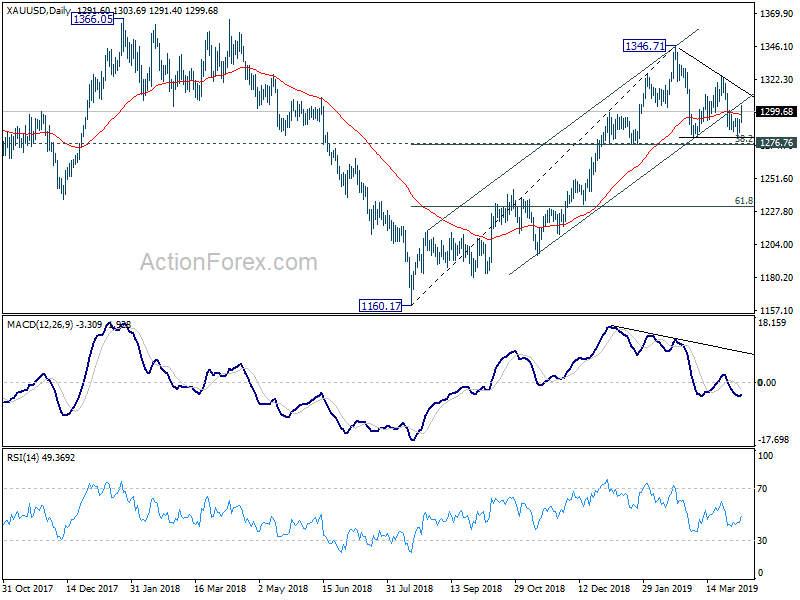
Nevertheless, just in case, sustained break of 1275.45/1276.76 should also confirm completion of whole rise from 1160.17. Deeper decline should then be seen to 61.8% retracement at 1234.42 and below.