

Sample Category Title
EURNZD Extends Bullish Actions Despite Overstretched Stochastic
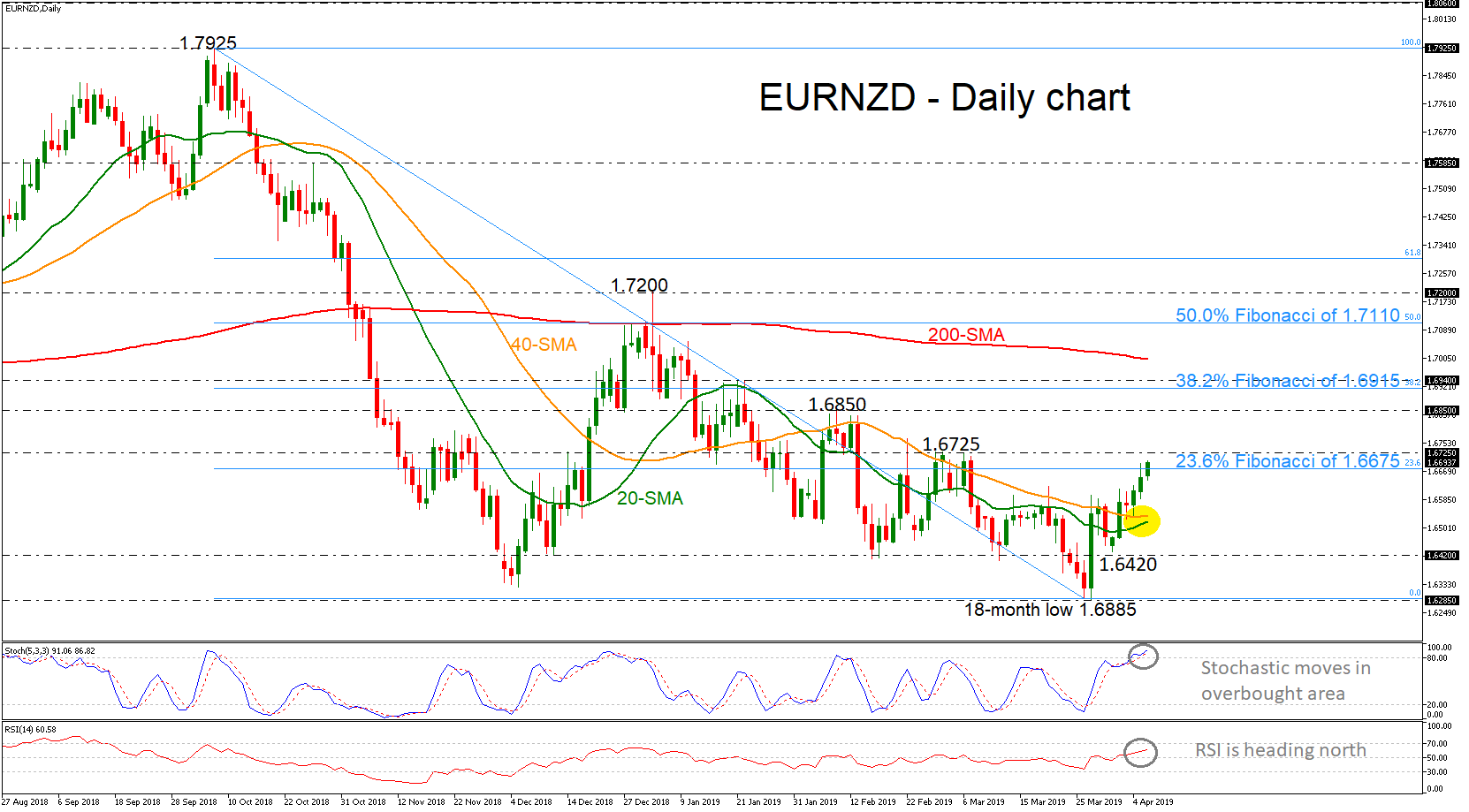
EURNZD reached overbought levels according to the stochastic oscillator as the price hovers above the 23.6% Fibonacci retracement level of the downward movement from 1.7925 to 1.6885, around 1.6675, recording a fresh one-month high, today.
While the aforementioned technical indicator continues to stand above 80, mirroring the market’s bullish behavior over the past couple days, it is also flagging that a recovery could reemerge in the short term. The RSI is also holding above its 50 level, which supports the positive view as well, while the 20-day simple moving average keeps approaching the 40-day SMA for a bullish cross.
In case the pair maintains its medium-term direction to the upside, the bulls will probably challenge the previous top at 1.6725. A break higher, could last until 1.6850 ahead of the 38.2% Fibonacci mark of 1.6915.
Alternatively, declines may drive the price towards the 20- and 40-SMAs near 1.6530 before the 1.6420 support comes into view. Beneath the latter, the 18-month low of 1.6885 which rejected the market’s bearish action recently could be another level in focus.
Concluding, in the short-term, if the price surpasses 1.6725 and have a daily close above this level, it could open the door for more bullish orders until the next resistance.
Sunset Market Commentary
Markets:
Global core bonds are little changed in a low-volume trading, as investors are in wait-and-see modus ahead of the ECB meeting and the special EU-Brexit summit later this week. Market sentiment was fragile overnight with Asian equities closing mixed, setting EU equities up for more of the same. German Bunds opened neutral. Germany’s trade surplus rose to €17.9bn euros in February, more than expected (€16.0bn). However, the increase is caused by a larger drop in imports than the decline in exports, confirming investors’ concerns on international trade. The German Bund is gyrating near opening levels. The EMU Sentix Investor Confidence rebounded to -0.3 in April, up from -2.2 a month ago and above expectations (-2.0) but had little impact on trading. The German yield curve is edging a little lower with changes varying up to -1.0 bp (30-yr). US Treasuries are treading water today ahead of US factory orders for February but the report isn’t expected to have a big impact on trading. The US yield curve is bear steepening with changes up to +1.4 bps (30-yr). Peripheral spreads over the German 10-yr yield are little changed with Greece (-4 bps) and Portugal (-2 bps) outperforming.
There were few eco data to guide USD (EUR/USD) trading. The German February trade surplus widened more than expected. However, as both imports and exports declined more than expected, the report can hardly be considered good news for Europe’s biggest economy or for the euro. There quite some market headlines mentioning a building of euro shorts ahead of this week’s ECB meeting, but they also proved no good guide for EUR/USD trading. After a cautious start, EUR/USD drifted higher in the 1.12 big figure in technical trade. European equities opened lower but were no factor of significance in EUR/USD trading. In a daily perspective, the dollar is losing modest ground against the euro (EUR/USD 1.1250 + area) and the yen (111.40 area). Maybe there is still some fall-out from Friday’s disappointing wage data as USD traders continue to ponder the chances for Fed rate cuts further down the road. Later this week, US CPI data might show whether there is more reason to walk that road. The BOJ downgrading its economic assessment on 3 regions was largely ignored by yen-traders as a less positive risk sentiment dominated.
Sterling trading developed in remarkably calm conditions even as a ‘decisive’ EU summit on Brexit is coming ever closer. A German government spokesmen announced a meeting between UK PM May and German Chancellor Merkel on Tuesday. Later PM May will also meet French president Macron. Sterling traders didn’t know what conclusion to make. Sterling traded with a tentative negative bias. EUR/GBP is changing hands in the 0.8620 area. Cable hovers in the mid 1.30 area as USD softness is keeping the cross rate more or less in balance. At least for now, there is also no indication that the talks between the UK conservative party and Labour is yielding any progress.
News Headlines:
The Turkish lire hit its weakest level since mid last month. EUR/TRY rises towards 6.4. The Turkish currency got a double whammy. First, the central bank decided to unwind emergency measures installed two weeks ago to prop up the currency. Second, Turkish President Erdogan urged the election board to investigate irregularities in Istanbul’s local elections, refusing to concede the race in the country’s largest city.
The Bank of Japan has downgraded the growth outlook for three of its nine regions, the biggest number of downgrades in six years. The move fuels growing consensus that the economy continues to weaken. The BOJ points to slowing overseas demand to weaken exports and factory output, but expects the economy to continue expanding moderately.
Canada: March Housing Starts Rebound from Last Month’s Deep Freeze
Canadian housing starts advanced 16% m/m to 192.5k (annualized) units in March. This follows a downwardly revised 166.3k print in February (prior: 173.2k). On a six month moving average basis, starts came in at 202.0k units, almost exactly on par with February.
Both single-detached and multi-family starts were higher during the month. Urban single-detached starts advanced 10% m/m to 52.9k units while construction of urban multi-family units increased 18% m/m to 139.7k units.
Homebuilding was higher in six of ten provinces. Starts jumped 60% m/m to 60.4k units in Quebec – the highest level since 2012. Meanwhile, starts increased but remained relatively low in Ontario (+5.0k to 61.8k units). Starts were also higher in Manitoba (+0.3k to 6.1k), Saskatchewan (+0.3k to 1.9k), Nova Scotia (+1.3k to 4.9k units) and New Brunswick (+0.1k to 1.3k). On the other hand, starts dropped in BC (-3.4k to 35.4k units) – the second straight decline. Starts also declined for the second straight month in Alberta (-0.3k to 19.9k units). Housing construction was flat in Newfoundland and Labdrador while dropping by 0.3k units PEI.
Key Implications
As expected, homebuilding shook off February's weather induced chill, with starts bouncing back nicely in March. Still, the prior month's soft print left housing starts at 187.3k annualized units for Q1 overall – the softest showing since 2015.
Looking ahead, we expect the pace of homebuilding to pick up slightly in the near-term, buoyed by ultra-strong population growth, low rental vacancy rates in key markets, and past gains in pre-construction sales. Our expectation is consistent with permits, which remain healthy despite the decline in February reported this morning.
We look for homebuilding to trend lower in 2020, as more recent softness in home sales and an inventory overhang in the Prairies causes it to pull back.
Canadian Housing Starts Rebounded in March
- Housing starts rose to 193k annualized units in March after slowing to 166k in February
- The rebound was in line with market expectations and supports our view that February’s decline was due to wintry weather
- Starts for the quarter came in at their slowest pace since 2015, though that speaks more to the strength of homebuilding in recent years than it does weakness to start 2019
- In a separate report, building permit issuance slowed in February but remained robust at a 229k annualized pace, suggesting starts could return to above the 200k mark in the near-term
Homebuilding activity held up well last year in the face of a slower resale market. That doesn’t appear to have changed early this year, despite starts clocking in at a four-year low in the first quarter. Wintry weather weighed on activity in February, and the pace of permit issuance suggests starts will pick up in the second quarter. We doubt last year’s 213k pace will be repeated in 2019, but demand for new homes, particularly in the multi-unit segment remains strong. The Bank of Canada’s shift to the sidelines—we think they’re done raising interest rates for a while—should assist that trend.
USD/JPY Mid-Day Outlook
Daily Pivots: (S1) 111.60; (P) 111.71; (R1) 111.83; More...
USD/JPY is staying in range above 111.18 minor support despite today's dip. Intraday bias remains neutral for the moment. Another rise is mildly in favor as long as 111.18 minor support holds. On the upside, decisive break of 112.13 will resume whole rally from 104.69 and target 114.54 resistance next. However, on the downside, break of 111.18 will likely extend the consolidation from 112.13 with another fall to 109.71 and possibly below, before completion.
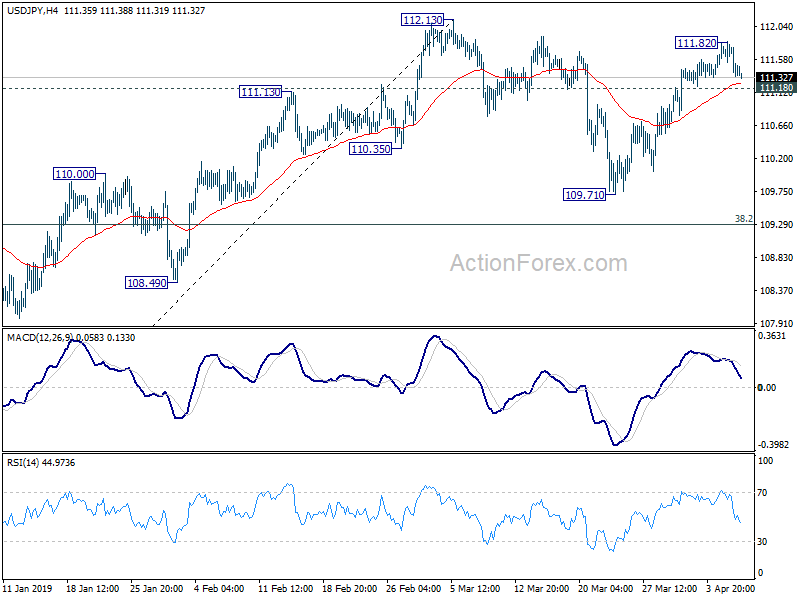
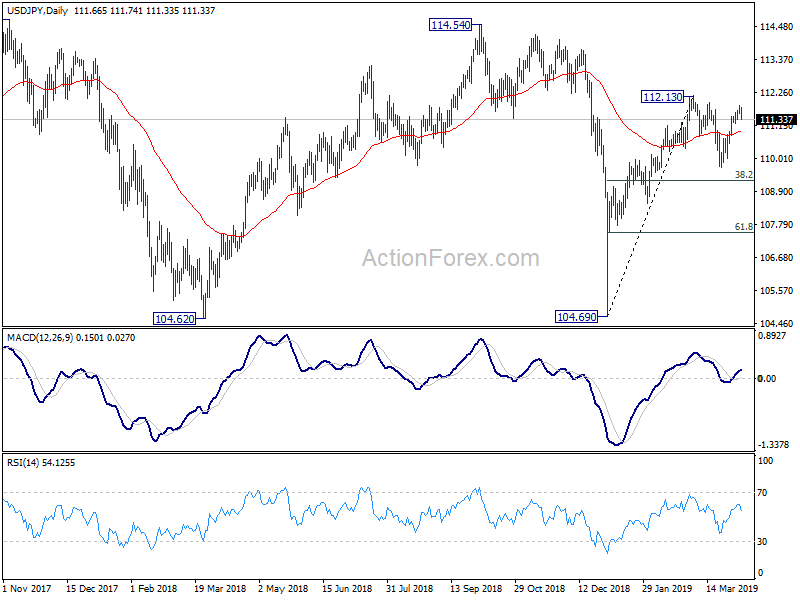
In the bigger picture, medium term outlook in USD/JPY remains a bit mixed as it's staying inside falling channel from 118.65, but there are signs of bullish reversal. On the upside, break of 114.54 resistance will revive the case the corrective fall from 118.65 has completed with three waves down to 104.69. And whole rise from 98.97 (2016 low) is resuming for 118.65 and above. But before that, outlook stays neutral first.
USD/CHF Mid-Day Outlook
Daily Pivots: (S1) 0.9986; (P) 0.9999; (R1) 1.0017; More...
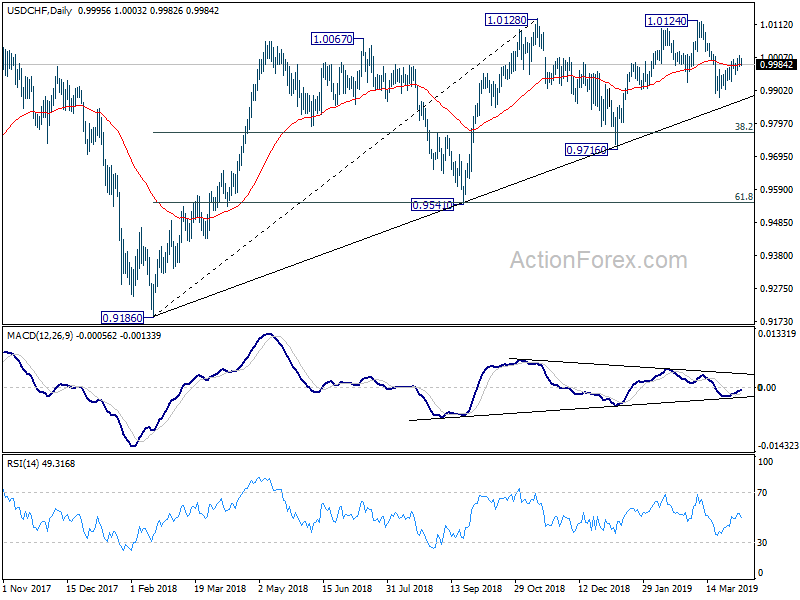
Intraday bias in USD/CHF remains neutral for now and more consolidative trading could be seen. On the upside, sustained break of 1.0010 will suggest that pull back from 1.0124 has completed. Intraday bias will be turned back to the upside for 1.0124/28 resistance zone. However, break of 0.9953 minor support will indicate rejection by 1.0010 and turn bias to the downside for 0.9879. Break there will resume the fall from 1.0124 to 0.9716 key support.
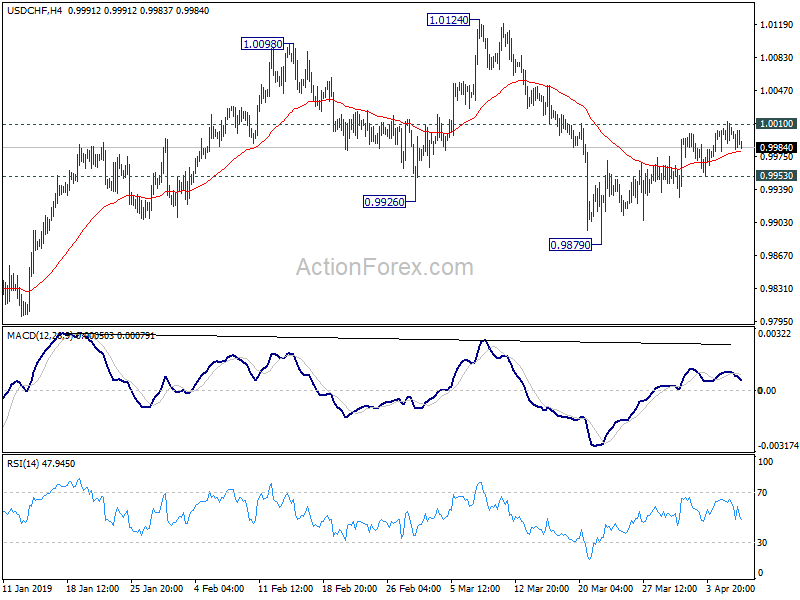
In the bigger picture, focus is back on medium term trend line (now at 0.9865). Decisive break there will argue that whole rise from 0.9186 has completed. Further break of 0.9716 will confirm reversal and target next support level at 0.9541. Nevertheless, there is still a chance that price action from 1.0128 are forming a consolidative pattern with fall from 1.0124 as third leg. If this is the case, stronger support should be seen between 0.9716 and the trend line to contain downside.
GBP/USD Mid-Day Outlook
Daily Pivots: (S1) 1.2975; (P) 1.3048; (R1) 1.3110; More....
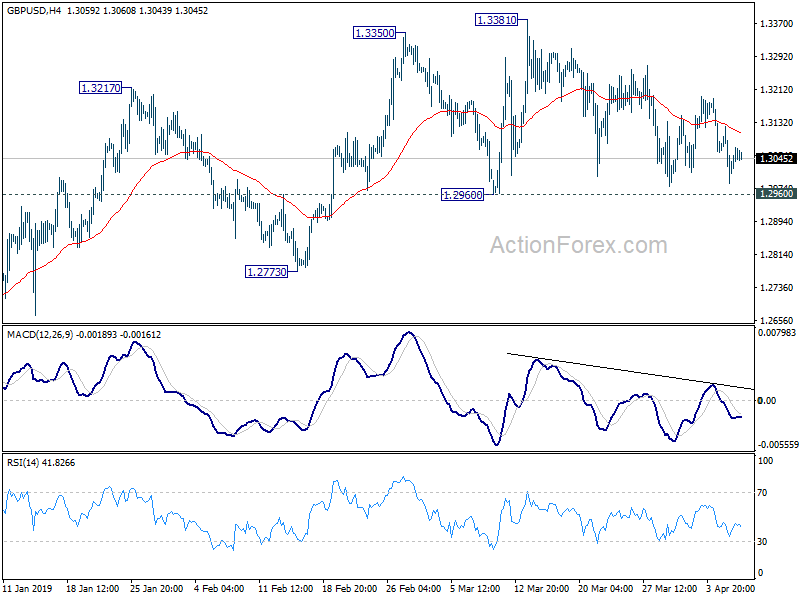
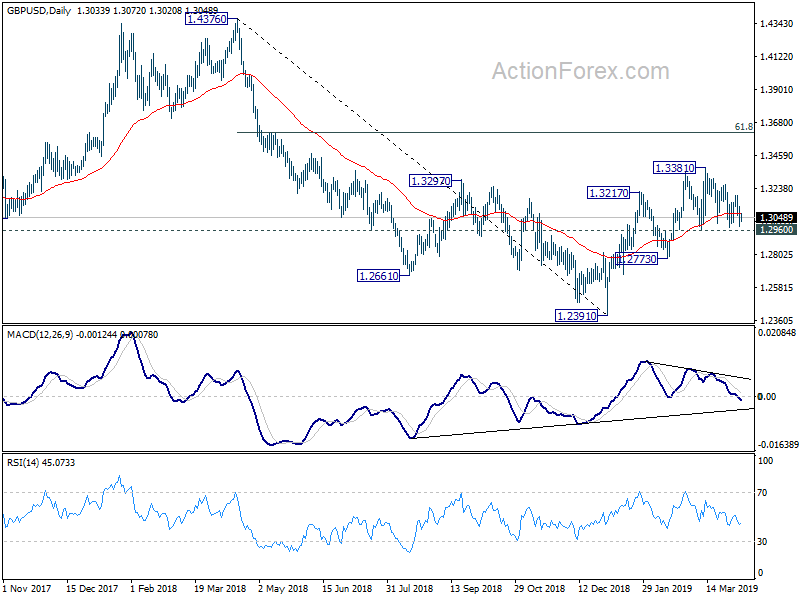
Intraday bias in GBP/USD remains neutral for the moment. Consolidation from 1.3381 is still in progress and could extend further. For now, further rise is still mildly in favor as long as 1.2960 support holds. On the upside, decisive break of 1.3381 will extend the rise from 1.2391 and target 61.8% retracement of 1.4376 to 1.2391 at 1.3618 next. However, on the downside, sustained break of 1.2960 will indicate that rebound from 1.2391 has completed earlier than expected. Deeper fall would then be seen to 1.2773 support for confirmation.
In the bigger picture, medium term decline from 1.4376 (2018 high) should have completed at 1.2391. Rise from 1.2391 is seen as the third leg of the corrective pattern from 1.1946 (2016 low). Further rise could be seen through 1.4376 in medium term. On the downside, though, break of 1.2773 support will dampen this view. Focus will be turned back to 1.2391 low and break will resume the fall from 1.4376 to 1.1946.
Canadian Dollar Subdued on Mixed Canadian Construction Data
The Canadian dollar is steady in the Monday session. Currently, USD/CAD is trading at 1.3358, down 0.20% on the day. On the release front, Canadian construction numbers were a mix.
On Friday, the U.S. and Canada posted key employment numbers. U.S. nonfarm payrolls came in at 196 thousand, easily beating the estimate of 172 thousand in March. Still, this release is significantly lower than the December and January releases, both of which were above the 300-thousand level. Wage growth dipped to 0.1%, shy of the estimate of 0.3%. In Canada, employment declined by 7.2 thousand in March, after a huge increase of 55.9 thousand in February.
The Canadian economy has been affected by the trade war between the U.S. and China, especially the manufacturing and export sectors. With talks between the two super-economies continuing, there is optimism that China and the U.S. will reach a deal, and that could boost the Canadian dollar. There were reports this week that an agreement is 90% complete, with the remaining issues including enforcement mechanisms and the removal of trade tariffs.
EUR/USD Mid-Day Outlook
Daily Pivots: (S1) 1.1202; (P) 1.1223; (R1) 1.1237; More.....
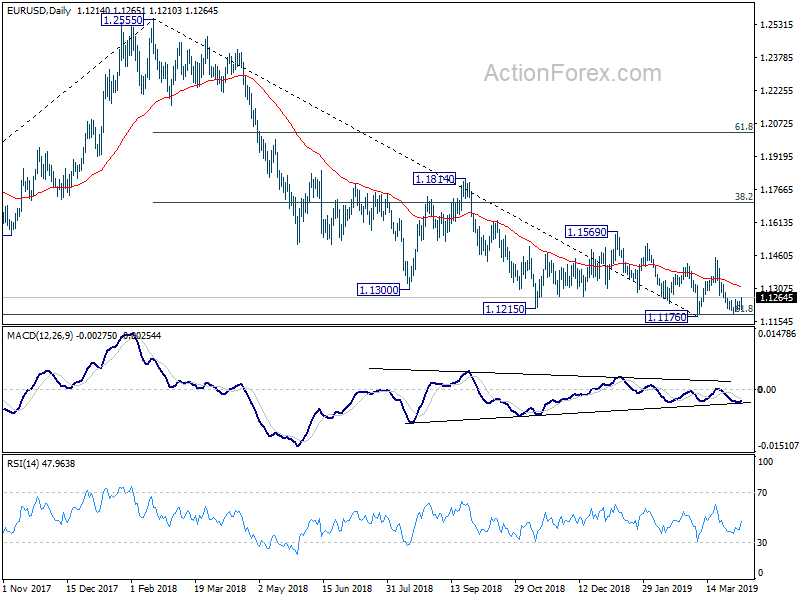
EUR/USD recovers strongly today but stays below 1.1273 minor resistance. Intraday bias remains neutral first. on the upside, break of 1.1273 support turned resistance will indicate short term bottoming at 1.1183. Intraday bias will be turned back to the upside for 1.1448 resistance. On the downside, decisive break of 1.1176 will resume the down trend from 1.2555.
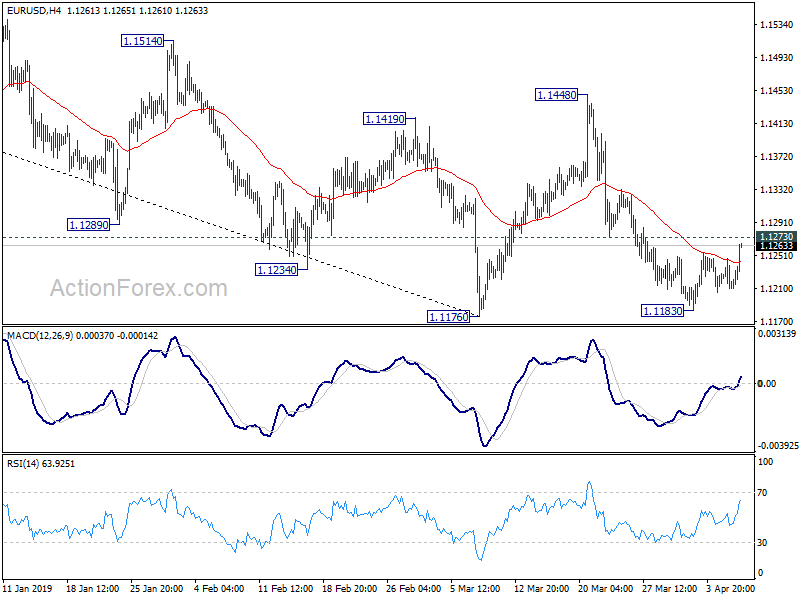
In the bigger picture, medium term weakness was revived as the weak rebound from 1.1176 was rejected well below 55 week EMA and failed to sustain above 55 day EMA. Focus is back on 1.1176 low, with 61.8% retracement of 1.0339 (2016 low) to 1.2555 (2018 high) at 1.1186. Decisive break there will resume whole down trend from 1.2555. Such decline target 1.0339 low next. On the upside, firm break of 1.1569 resistance is needed to be the first sign of medium term bottoming. Otherwise, downside breakout will be in favor.
Euro Higher as Investor Confidence Improves, Yen also Recovers as Risk Markets Turned Mixed
Euro receives a wave of buying in European session, partly as lifted by improving investor confidence data. EUR/USD's break of last week's high is a positive development. Yet, the rally is not strong enough to warrant near term bullishness yet. Meanwhile, the common currency remains bounded in familiar range against Sterling, Yen and Aussie. More is needed to prove it's underlying strength.
Staying in the currency markets, Yen is currently the strongest one as risk markets turned mixed. There is no follow through buying in the stock markets after last week's rally. Sterling is mixed as markets await fresh development in Brexit. For now, EU's granting of long extension before April 12 cliff edge seems to be the base case. New Zealand Dollar is the weakest one for now, followed by Dollar and then Aussie.
Technically, EUR/USD is now looking at 1.1273 minor resistance with today's rise. Break will indicate short term bottoming for strong rebound back to 1.1448 resistance. USD/JPY could have a take on 111.18 minor support and bring will pave the way back to 109.71 support.
In Europe, currently, FTSE is up 0.09%. DAX is down -0.25%. CAC is up 0.05%. German 10-year yield is down -0.0034 at 0.007, staying positive. Earlier in Asia, Nikkei dropped -0.21%. Hong Kong HSI rose 0.47%. China Shanghai SSE dropped -0.05%. Singapore Strait Times dropped -0.22%. Japan 10-year JGB yield dropped -0.017 to -0.046.
Eurozone Sentix investor confidence improved on Asia upswings, Germany cannot keep up
Eurozone Sentix Investor Confidence rose to -0.3 in April, up from -2.2 and beat expectation of -2.0. That's already the highest figure since November 2018. Expectations Index rose for the third month in a row to -4.3, highest since May 2018. However, Current situation index dropped for the eighth month to 3.8, lowest since February 2015.
Sentix noted that "signs in China are increasingly pointing to an upswing". And, should there be an additional settlement in US-China trade negotiations, European economy could also see a turn around. Also, since both US and China are still in the upswing, "positive feedback to Europe is not expected to be absent in the coming months"
However, Germany's Overall Index dropped to 2.1, lowest since August 2012. Current Situation index dropped to 10.5, sixth decline in a row and lowest since April 2010. Expectations index rose for the third month 10 -6.0, highest since March 2018. Germany is now "one of the regions with the weakest economic momentum". "Collapse" of situation values is "worrying". Sentix added that "it would be positive if Germany did not rely on China and the USA alone, but sought to make its own contributions to economic stabilization.
Also from Eurozone, German trade surplus rose slightly to EUR 18.7B in February, below expectation of EUR 19.0B.
UK May to meet Merkel and Macron ahead of EU summit
UK Prime Minister Theresa May is scheduled to meet German Chancellor Angela Merkel and French President Emmanuel Macron tomorrow, just a day ahead of the EU summit. She'll also hold calls with other EU leaders today. May is generally expected to try to make her case for a Brexit extension till June 30.
But ahead of that, May needs to handle opposition Labour leader Jeremy Corbyn first. The two could meet against to find a compromised Brexit solution to get through the parliament. But May's spokesman reiterated her insistence for UK to have independent trading policy after Brexit. And that is clearly in conflict with Labour's requests for staying in the customs union.
Labour's Keir Starmer also said "Both us and the government have approached this in the spirit of trying to find a way forward. We haven't found that yet."He added "the ball is in the government's court" and "we need to see what they come back with and, when they do, we will take a collective position on that."
BoJ downgraded economic assessment of Tohoku, Hokuriku and Kyushu-Okinawa
In its Regional Economic Report, BoJ J still painted a much weaker economy. On the whole, assessment on three of the nine regions – Tohoku, Hokuriku and Kyushu-Okinawa – were downgraded. BoJ also pointed to "effects of the slowdown in overseas economies on exports and production" for the changes. Only Hokkaido was upgraded thanks to dissipation of downward pressure from 2018 earthquake.
Though, BoJ noted that "domestic demand had continued to show firm developments, with a virtuous cycle from income to spending operating in both the corporate and household sectors." Business investment was not affected by the oversea slowdown and "has continued on an increasing trend, with corporate profits staying at a favorable level on the whole.". Private consumption has been "increasing moderately".
BoJ Kuroda: Core CPI to gradually accelerate toward 2 percent
BoJ Governor Haruhiko Kuroda maintained his view on the economy in a speech at a quarterly meeting of regional branch managers. He said Japan's economy was expected to continue expanding moderately, even though slowdown overseas is affecting exports.
Also, "core consumer inflation is expected to gradually accelerate toward 2 percent as the output gap remains positive, and medium- to long-term inflation expectations heighten."
But for now, BoJ will continue to expand monetary base until consumer inflation exceeds 2% target stably. And, short- and long-term interest rates will be kept at current very low levels for an extended period of time.
Also from Japan, consumer confidence dropped to 40.5 in March, below expectation of 41.5. Eco watchers sentiment dropped to 44.8, missed expectation of 47.6. Current account surplus widened to JPY 1.96T in February.
EUR/USD Mid-Day Outlook
Daily Pivots: (S1) 1.1202; (P) 1.1223; (R1) 1.1237; More.....
EUR/USD recovers strongly today but stays below 1.1273 minor resistance. Intraday bias remains neutral first. on the upside, break of 1.1273 support turned resistance will indicate short term bottoming at 1.1183. Intraday bias will be turned back to the upside for 1.1448 resistance. On the downside, decisive break of 1.1176 will resume the down trend from 1.2555.
In the bigger picture, medium term weakness was revived as the weak rebound from 1.1176 was rejected well below 55 week EMA and failed to sustain above 55 day EMA. Focus is back on 1.1176 low, with 61.8% retracement of 1.0339 (2016 low) to 1.2555 (2018 high) at 1.1186. Decisive break there will resume whole down trend from 1.2555. Such decline target 1.0339 low next. On the upside, firm break of 1.1569 resistance is needed to be the first sign of medium term bottoming. Otherwise, downside breakout will be in favor.
Economic Indicators Update
| GMT | Ccy | Events | Actual | Forecast | Previous | Revised |
|---|---|---|---|---|---|---|
| 23:50 | JPY | Current Account (JPY) Feb P | 1.96T | 1.96T | 1.83T | |
| 05:00 | JPY | Consumer Confidence Index Mar | 40.5 | 41.5 | 41.5 | |
| 06:00 | JPY | Eco Watchers Survey Current Mar | 44.8 | 47.6 | 47.5 | |
| 06:00 | EUR | German Trade Balance (EUR) Feb | 18.7B | 19.0B | 18.5B | 18.6B |
| 08:30 | EUR | Eurozone Sentix Investor Confidence Apr | -0.3 | -2 | -2.2 | |
| 12:15 | CAD | Housing Starts Mar | 193K | 193K | 173K | 166K |
| 12:30 | CAD | Building Permits M/M Feb | -5.70% | 2.00% | -5.50% | -6.00% |
| 14:00 | USD | Factory Orders Feb | -0.50% | 0.10% |