Sample Category Title
Eurozone Sentix investor confidence improved on Asia upswings, Germany cannot keep up
Eurozone Sentix Investor Confidence rose to -0.3 in April, up from -2.2 and beat expectation of -2.0. That's already the highest figure since November 2018. Expectations Index rose for the third month in a row to -4.3, highest since May 2018. However, Current situation index dropped for the eighth month to 3.8, lowest since February 2015.
Sentix noted that "signs in China are increasingly pointing to an upswing". And, should there be an additional settlement in US-China trade negotiations, European economy could also see a turn around. Also, since both US and China are still in the upswing, "positive feedback to Europe is not expected to be absent in the coming months"
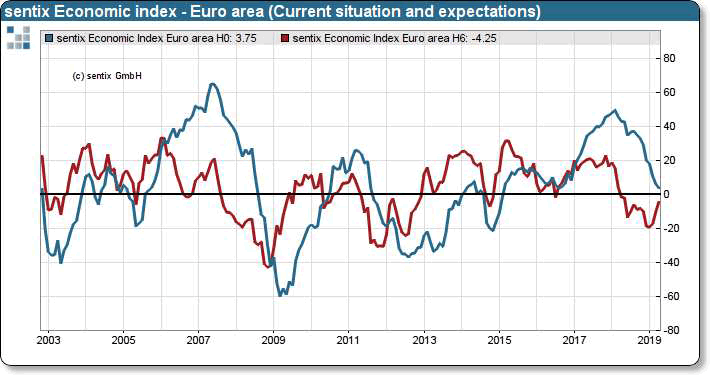
However, Germany's Overall Index dropped to 2.1, lowest since August 2012. Current Situation index dropped to 10.5, sixth decline in a row and lowest since April 2010. Expectations index rose for the third month 10 -6.0, highest since March 2018. Germany is now "one of the regions with the weakest economic momentum". "Collapse" of situation values is "worrying". Sentix added that "it would be positive if Germany did not rely on China and the USA alone, but sought to make its own contributions to economic stabilization.
EUR/JPY Set For Breakout
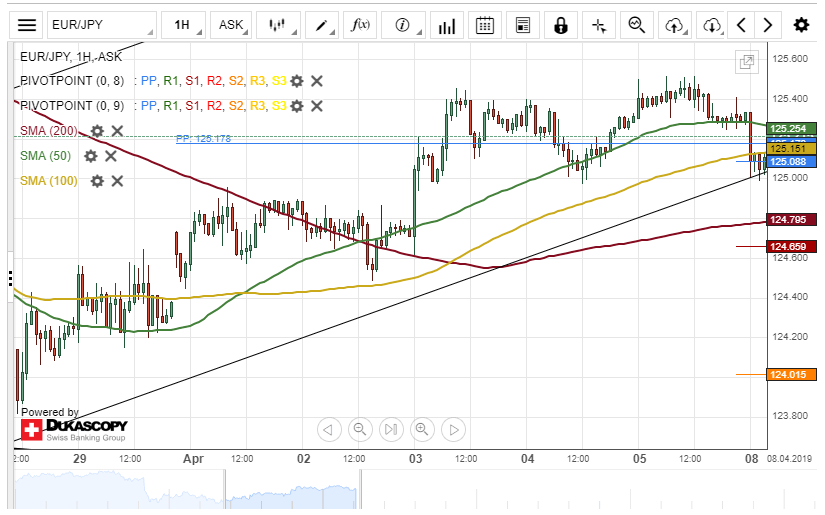
The common European currency versus the Japanese Yen traded with low volatility on Friday. The 50-hour simple moving average provided support for the currency pair during Friday's trading session.
Today's session began with bearish sentiment, and by the middle of the trading session, the exchange rate has tested the bottom border of an ascending channel pattern at 125.14 and could be set for a breakout.
If this breakout occurs, the currency exchange rate will target a support level formed by the 200-hour SMA and the weekly S1 at 124.65.
On the other hand, if the bottom border of the channel pattern holds, a surge towards the 125.60 mark could be expected today.
AUD/USD Tests Monthly PP At 0.7090
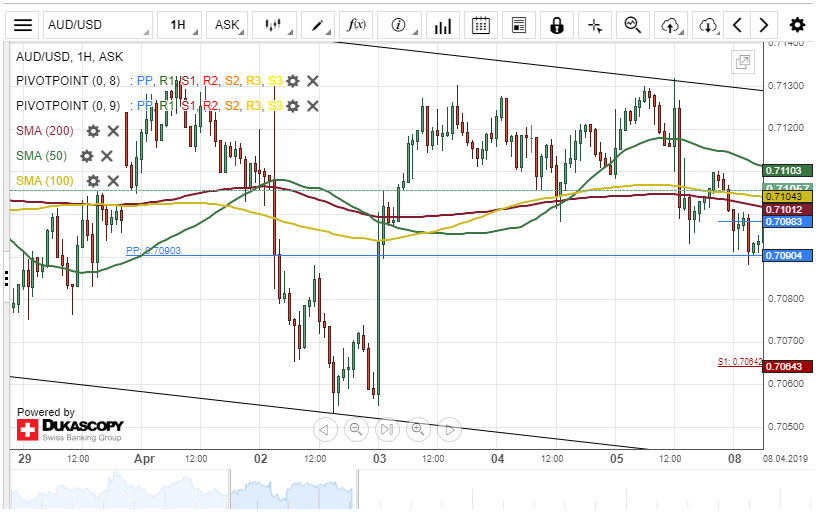
Downside risks prevailed in the market on Friday, thus allowing the Australian Dollar to declined about 40 base points against the US Dollar. The currency pair breached the 50-, 100– and 200-hour SMAs during Friday's trading session.
A traditional monthly pivot point at 0.7090 provided support for the exchange rate during the morning hours of Monday's session.
If this support level holds, bullish traders will aim for a resistance line at 0.7143 within this session.
However, if the currency exchange rate passes the support level as mentioned earlier, the next target for the pair will be near the weekly S1 at 0.7064.
USD/CAD Supported By 200-Hour SMA
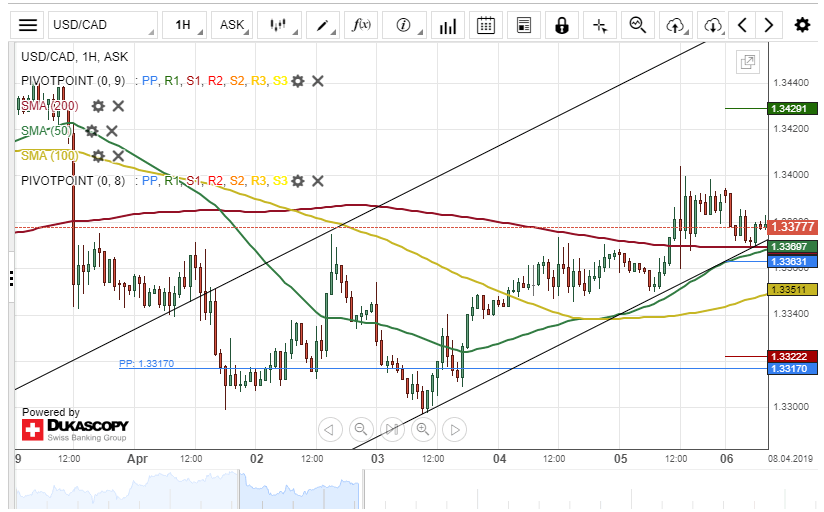
The US Dollar edged up by about 52 base points against the Canadian Dollar on Friday. The currency pair breached the 200-hour simple moving average during Friday's trading session.
The exchange rate was trading near the lower boundary of an ascending channel pattern at 1.3378 during the first half of Monday's trading session and could be set for a breakout.
If this breakout occurs, the USD/CAD currency exchange rate will aim for the 100-hour SMA at 1.3348.
However, technical indicators suggest that the breakout might not occur today.
NZD/USD Finds Support At 0.6724
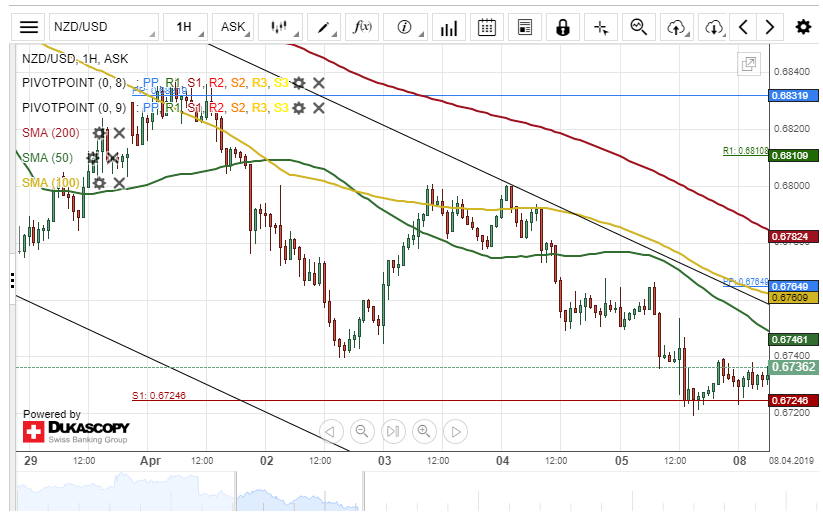
The New Zealand Dollar depreciated about 46 base points against the US Dollar on Friday. The decline was stopped by a traditional monthly pivot point at 0.6724 during Friday's trading session.
If the traditional monthly PP holds, the currency exchange rate will surge towards a resistance cluster formed by the combination of the 100-hour simple moving average and the weekly PP at 0.6764 within this session.
However, if the NZD/USD currency pair passes the monthly S1, the next target for bearish traders will be at the 0.6700 mark in the short-term.
BoJ downgraded economic assessment of Tohoku, Hokuriku and Kyushu-Okinawa
In its Regional Economic Report, BoJ J still painted a much weaker economy. On the whole, assessment on three of the nine regions - Tohoku, Hokuriku and Kyushu-Okinawa - were downgraded. BoJ also pointed to "effects of the slowdown in overseas economies on exports and production" for the changes. Only Hokkaido was upgraded thanks to dissipation of downward pressure from 2018 earthquake.
Though, BoJ noted that "domestic demand had continued to show firm developments, with a virtuous cycle from income to spending operating in both the corporate and household sectors." Business investment was not affected by the oversea slowdown and "has continued on an increasing trend, with corporate profits staying at a favorable level on the whole.". Private consumption has been "increasing moderately".
Elliott Wave Analysis: Interesing Pattern On USD/CHF Points Lower, 0.990 In View
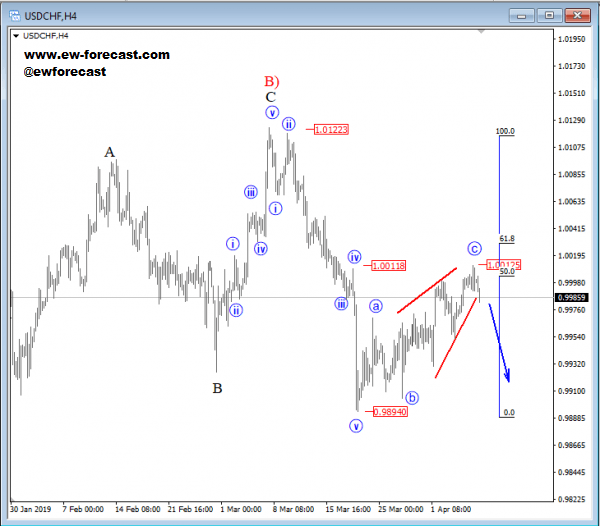
USDCHF is trading bearish, down from 1.012 level where a higher degree wave B) found a top, and wave C) started to develop. We can see that price unfolded a five-wave drop down to 0.9894 level, from where a temporary, three-wave pullback showed up. This three-wave pullback is now trading at potential resistance and reversal zones at 1.00-1.004 area, where a new turn lower may follow. At the mentioned zone, former swing high of wave iv and Fibonacci ratios can also react as reversal zones for the pair.
Also be aware that we labelled a Elliott wave ending diagonal within wave c of a three-wave rally, which can once completed push price into a sharp drop, below the 0.990 region.
USDCHF, 4h
Fed Rate-Cut Bets Grow, Oil Climbs On Libya Woes
- Dollar little changed after NFP, but Fed rate-cut odds rise
- In the UK, reports suggest PM May could accept a customs union compromise
- Oil touches five-month high as Libyan production is threatened
Dollar snoozes after mixed jobs data, but rate-cut bets grow
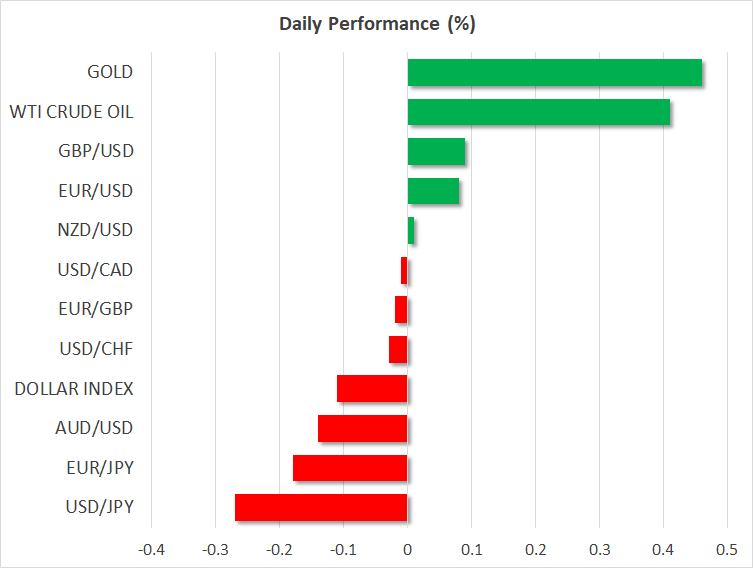
The US employment report for March was a mixed bag. Nonfarm payrolls clocked in at 196k, higher than the consensus for 180k, but wage growth disappointed, with average earnings slowing to 3.2% in annual terms, from a cycle-high of 3.4% in February. The unemployment rate held steady, as expected. The dollar was little changed, but upon closer inspection, it appears the market saw this as a soft report overall, something evident by the implied probability for a Fed rate cut by December jumping to ~80% in the aftermath.
Stock markets, for their part, liked the weak data. The S&P 500 (+0.46%) index is now less than 2% away from reaching its all-time high, even despite signs the US economy is slowly but surely losing steam. While this is owed to growing expectations for looser monetary policy, it also implies cause for caution, as economic fundamentals and equity prices seem to be diverging – something that can’t continue indefinitely. Looking ahead, the next key event for both the dollar and stocks may be the release of US inflation data on Wednesday, though any updates in the trade saga could also prove critical.
Reports suggest May could accept customs union – pound doesn’t ‘buy it’
It will be a big week for the British pound as well. EU leaders will meet on Wednesday to approve or disapprove another extension to Brexit. Theresa May has requested a short extension to June 30, but the EU is quite unlikely to accept that, and may instead only offer a long extension until the end of the year.
Meanwhile, talks between May and opposition leader Corbyn continue in an attempt to find common ground and break the deadlock. Reports this morning suggest that May could compromise and accept a customs union arrangement. The pound has so far not reacted much, perhaps due to the risk of a no-deal exit on April 12 still lurking beneath the surface, but any clear signs for either a customs union or a long extension could still benefit the currency.
Oil records more gains as escalation in Libya threatens supply
The oil market has been on a tear in recent weeks, with both Brent and WTI prices extending their recent gains to touch fresh five-month highs on Monday, helped mainly by supply factors. OPEC officials have been vocal that they stand ready to extend their supply cuts, US sanctions against Iran are set to come into full effect next month, and US production itself has been rising slower than previously expected.
Separately, the situation in Libya remains highly unstable, with the capital Tripoli currently under siege. Libya’s oil production had been slowly recovering in recent months and the ongoing conflict poses the risk that it may fall drastically again, which spells upside risks for oil prices in the near term.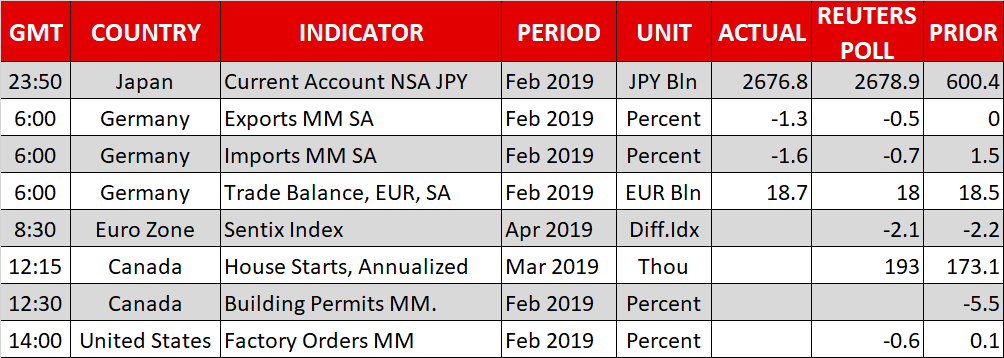
Gold Advances Near 1,300, Indicators Look Positive
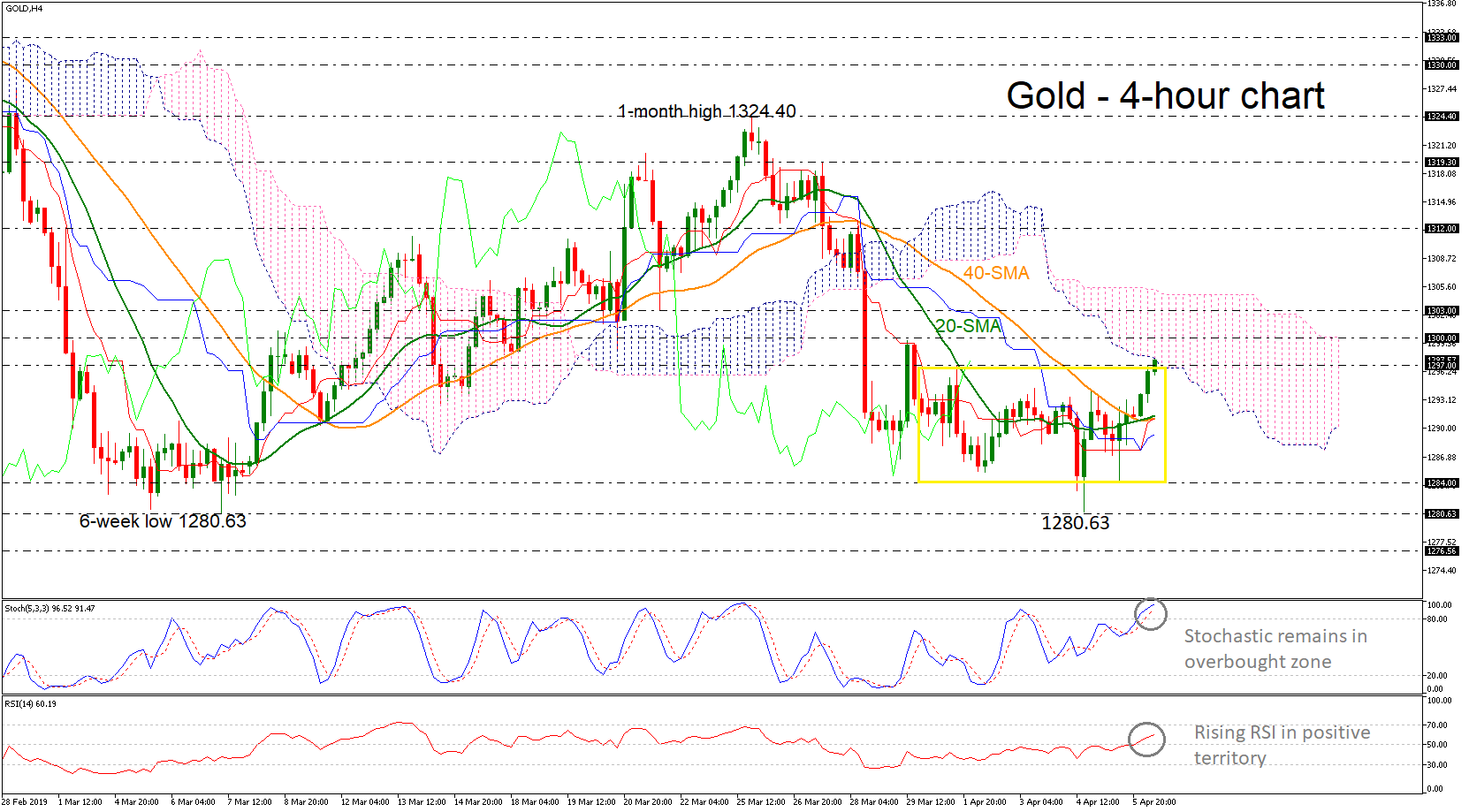
Gold is extending its gains today and is currently trading near the 1297 resistance level. The price has also increased distance above the bullish cross of the 20- and 40-simple moving averages (SMAs), indicating that the recent upside move might hold for longer.
Momentum signals are bullish as well as the red Tenkan-sen line, which is above the blue Kijun-sen line, looks to be heading north, while the RSI has reversed higher after surpassing its 50 neutral mark last week. Also, the stochastic oscillator is flirting with the overbought territory, giving signals for more strength structure on price action.
Should the price extend advances, the 1300 round-level could be of psychological significance and therefore act as a strong barrier for bulls. Above that, the focus could shift straight to 1303 into the Ichimoku cloud in the 4-hour chart. If the latter permits for further positive actions, the next stop could be around 1312, identified by the peak on March 28.
On the other hand, a recovery could retest the bullish cross of the SMAs around 1291 before returning lower until the 1284 support. Moving lower, the six-week low of 1280.63 should attract attention as the price paused bearish movement at this level several times in the past month.
Overall, the yellow metal is edging higher in the near term, gaining some ground, however, in the medium-term the price is still trading in a neutral mode.
GBP/JPY Daily Outlook
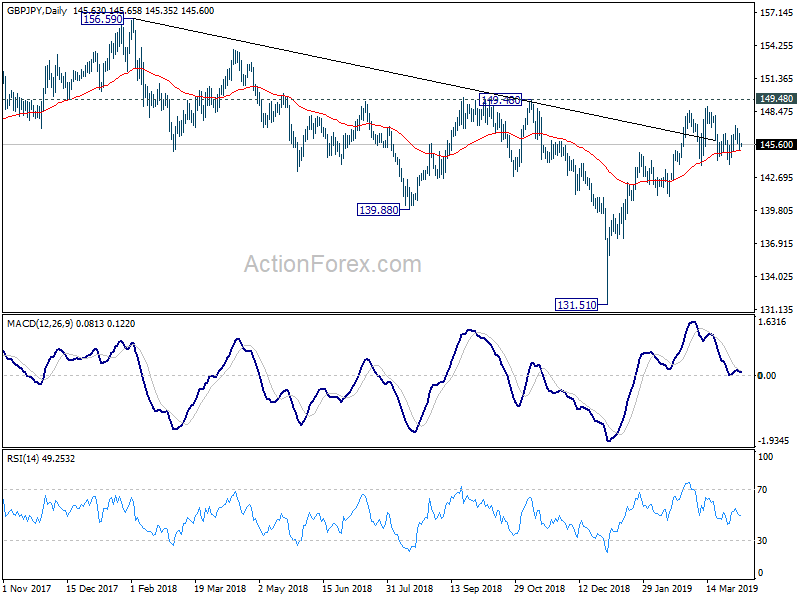
Daily Pivots: (S1) 144.97; (P) 145.76; (R1) 146.43; More...
Intraday bias in GBP/JPY remains neutral and more sideway trading could be seen. On the downside, sustained break of 143.72 will indicate near term reversal, after rejection by 149.48 key resistance. In that case, intraday bias will be turned to the downside for 141.00 support first. On the upside, decisive break of 149.48 key resistance will carry larger bullish implication and target 156.58 resistance next.
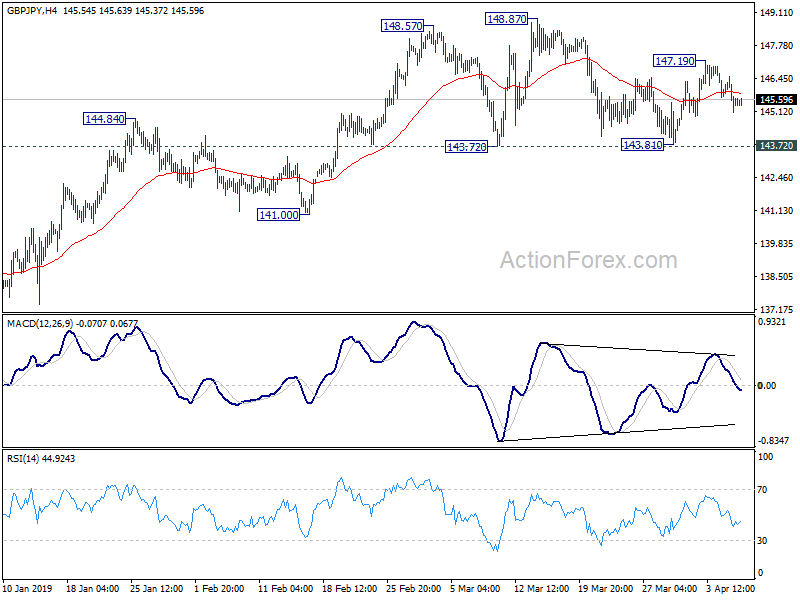
In the bigger picture, focus is now staying on 149.98 key resistance. Decisive break there should confirm that medium term fall from 156.59 (2018 high) has completed at 131.51 already. Rise from 131.51 is then seen as the third leg of the corrective pattern from 122.36 (2016 low). GBP/JPY should then target 156.59 and above. However, rejection by 149.98 will retain medium term bearishness and could extend the fall from 156.59 through 131.51 to 122.36.