

Sample Category Title
Fed Williams: Recession risks not elevated, yield curve inversion points to modest growth
New York Fed President John Williams said overnight that the "most likely case" was for US economy to grow 2%, with low unemployment. To him, the probability of recession this year or next was "not elevated relative to any year". He also downplayed the significance of yield curve inversion. He added "there's a lot of reasons to think that it has been a recession predictor for reasons in the past that kind of don't apply today." And, it only "telling us that growth will be pretty modest".
On monetary policy, Williams said short-term interest rate is "around neutral". Meanwhile, "any development in the economy, whether it's on the employment side or on the inflation side, that moved in a persistent way away from our objectives, one way or the other, would be a reason to rethink the path of policy going forward."
USD/JPY Could Struggle Near 111.00 Resistance
Key Highlights
- The US Dollar found support near 109.70 and recently rebounded higher against the Japanese Yen.
- A crucial resistance is formed near the 111.00 zone on the 4-hours chart of USD/JPY.
- The US Initial Jobless Claims for the week ending March 23, 2019 declined from 216K to 211K.
- The US Personal Income for Feb 2019 is likely to increase 0.3% (MoM).
USDJPY Technical Analysis
After a major drop, the US Dollar found support near 109.70 level against the Japanese Yen. The USD/JPY pair started a solid recovery and traded above the 110.00 and 110.20 resistance levels.
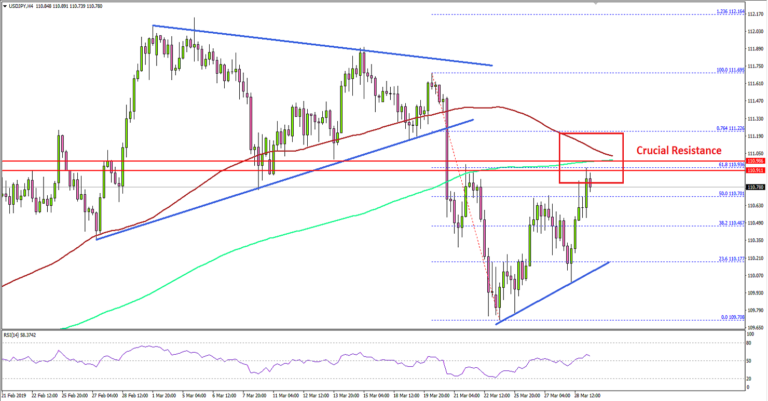
Looking at the 4-hours chart, the pair traded above the 110.50 resistance and the 50% Fib retracement level of the last drop from the 111.69 high to 109.70 low.
To the topside, there is a strong resistance waiting near the 111.00 level, the 200 simple moving average (4-hours, green), and 100 simple moving average (4-hours, red). Besides, the 61.8% Fib retracement level of the last drop from the 111.69 high to 109.70 low is also near 111.00.
Therefore, it won't be easy for buyers to clear the 111.00 resistance level. The next key resistance is near the 111.20 level, followed by 111.45. On the downside, there is a decent support formed near 110.15 and a short-term bullish trend line on the same chart.
Fundamentally, the US Initial Jobless Claims figure for the week ending March 23, 2019 was released by the US Department of Labor. The market was looking for a minor increase in claims from 221K to 225K.
The actual result was better than the forecast, as there was a decline in claims to 211K. Besides, the last reading was revised down from 221K to 216K.
The report added:
The 4-week moving average was 217,250, a decrease of 3,250 from the previous week's revised average. The previous week's average was revised down by 4,500 from 225,000 to 220,500.
Overall, USD/JPY is likely to struggle near the 111.00 barrier, above which there could be a sharp upward move. On the downside, the 110.20 and 110.00 levels are decent support levels.
Economic Releases to Watch Today
- Germany's Unemployment Change for March 2019 – Forecast -10K, versus -21K previous.
- Germany's Unemployment Rate for March 2019 – Forecast 4.9%, versus 5.0% previous.
- UK GDP for Q4 2018 (QoQ) – Forecast +0.2%, versus +0.2% previous.
- US Personal Income for Feb 2019 (MoM) – Forecast +0.3%, versus -0.1% previous.
- US New Home Sales for Feb 2019 (MoM) – Forecast +1.3% versus -6.9% previous.
- Chicago Purchasing Manager's Index for March 2019 – Forecast 61.0, versus 64.7 previous.
Markets Rally On Trade Talk Hopes
Markets rally on trade talk hopes
Wall Street looked to the future and not the past overnight, ignoring a lower than expected 4th quarter US GDP print, choosing instead to focus on possible concessions by China in the ongoing trade talks with the US. Apparent shifts by China on technology transfers and intellectual property saw the US dollar surge, stocks rise, and oil shrug off a President Trump-induced intraday sell-off. Bond yields rose and gold slumped in what turned out to be a trading-101 response to a potential positive growth news day.
The Dow Jones and S&P both rose 0.36%, and the Nasdaq jumped 0.34% setting up a potentially positive start for Asian trading. The dollar index rose a respectable 0.48% to 97.24 led by gains against the euro (EUR) and sterling (GBP) as US bond yields rose slightly.
Data highlights today include German unemployment this afternoon followed by one of the Federal Reserve’s favourite indicators, the US core personal consumption expenditure (PCE) numbers, however, it’s likely these will be swept along in the tide of the US-China trade talks. Although the markets should see a positive start in Asia, investor eyes will be glued to news feeds looking for any more details – rumoured or true – emerging from the talks. This could cause some abrupt intra-day volatility across the markets. On the same note, with negotiations continuing through the weekend, any news could make for a frisky start in Wellington’s notoriously illiquid opening session on Monday.
FX
The US dollar reigned supreme overnight with notable gains against the EUR, which fell to 1.1250, and the GBP, which tanked by 1.2%, falling from 1.3200 to 1.3035 on Brexit travails. Despite the noise, the GBP remains locked in its recent 1.3000/1.3300 range. With the global markets having long since taken a hard Brexit off the table, it’s difficult (although not impossible) to see a sustained GDP drop below 1.3000 in the near term.
The New Zealand dollar fell through 0.6800 overnight in a worrying technical development as the fall-out from the Reserve Bank of New Zealand rate decision continues.
The positive trade sentiment shown by the greenback overnight should continue into Asia where we would expect it to outperform against regional currencies today.
Equities
Wall Street’s trade-induced rally may turn out to be a case of where-hope-meets-reality, but near term, sentiment should see a bright start to Asian equities.
While the feel-good factor from China may see stock markets in the green, traders should exercise caution. Short-term sentiment will be highly vulnerable to headlines coming out of the talks, which could cause aggressive short-term volatility, bullish or bearish.
Oil
President Trump’s itchy Twitter trigger finger was back in action overnight. After the President tweeted OPEC should increase production, Brent and WTI quickly tanked by more than 1% each. The sell-off did not last though as trade sentiment saw both contracts regain their losses to finish flat for the session.
The bounce bank will cheer energy bulls even though oil will likely take a supporting role in Asian trading. Again, like equities, oil will be hypersensitive to any news coming from Beijing.
Gold
Gold slumped by 1.50% to USD1,290.50 an ounce overnight on resurgent risk appetite, rising bonds and a strong dollar. The precious metal slid through 1,300.00 as stale long positioning hit the sell button. Technically, gold’s key medium-term support lies in the 1,275.00/1,280.00 region.
GBPUSD Pound Falls On Brexit With Too Many Options Too Little Time
The British pound fell 1.05 percent on Thursday ahead of Friday’s vote on the Brexit agreement. The third time is not likely to be the charm for British PM Theresa May who has each time picked up marginal wins. She went all in this week declaring she would step down if her deal is approved in an effort to get political rivals to back the deal. It worked but given the size of earlier defeats it could be too little too late.
Failure for the third time could push the United Kingdom into a remain limbo, where a credible exit could not be engineered
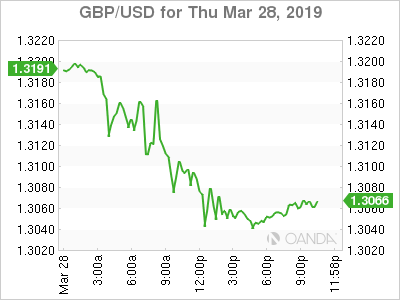
The US dollar rose across the board versus major pairs on Thursday. Global growth concerns rose as central banks keep the dovish rhetoric on hand and recession indicators are making investors seek safe havens.
US GDP for the fourth quarter of 2018 was lower than expected at 2.2 percent. The U.S. Federal Reserve has taken off the table, via dot-plot, the possibility of a rate hike this year, but now probabilities of a rate cut are rising. The Fed was net dove at the end of the FOMC meeting with the only hawkish comments to praise the solid US economy. The data is not backing up that optimism which could mean a return to stimulus via lower rates.
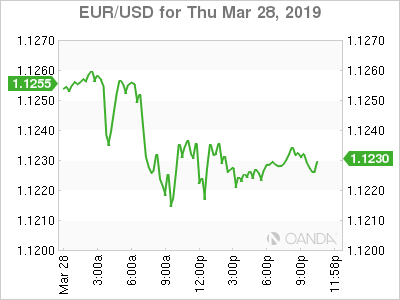
Despite the downgrade US growth is head and shoulders above the other major economies which are struggling to gather momentum, but this poses another problem as the US dollar remains strong reducing American competitiveness when it is needed the most.
STOCKS – Stocks Rise on Trade Hope, Ignore Brexit Drama
Stocks were higher on Thursday despite soft US fundamentals. Equities also managed to ignore Brexit anxiety as UK politicians are not ready to reach a consensus resulting in extending, and maybe dooming the Brexit process.
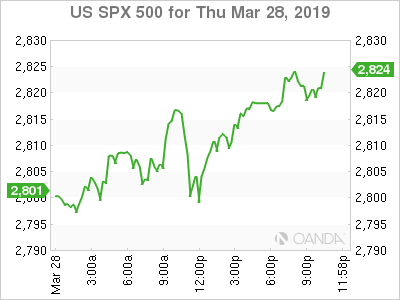
US-China headlines put a positive spin on negotiations and were the major force pushing stocks higher. Dovish Fed speakers continue to put the central bank in the sidelines for 2019 even as rate cut probabilities rise.
USD/CAD Canadian Dollar Falls On Dollar Strength And Soft Commodities
The Canadian dollar lost 0.25 percent on Thursday as the US dollar rose on safe haven flows boosting the greenback. Commodities offered no support for the loonie with gold and oil under pressure from the advance of the US dollar as investors liquidated assets and repatriated funds in the American currency.
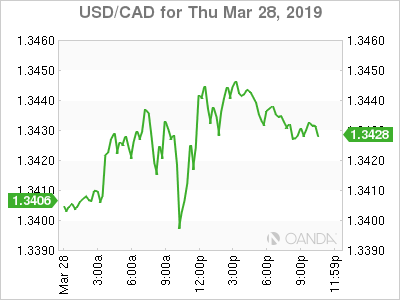
US GDP for the fourth quarter of 2018 was lower than expected and strengthened the narrative of slowing down global growth. Canadian GDP will be posted on Friday with a small rebound of 0.1 percent of monthly data expected.
The Bank of Canada (BoC) joined the choir of dovish central banks with no hikes expected this year and the rising probability of a cut if economic indicators don’t improve. Recession alarms have gone off, but for now it would be early as confirmation is lacking as positive signs remains such as employment.
OIL – Crude Recovers Ground After Trump Puts Spotlight on OPEC
Oil had a volatile session on Thursday as supply concerns were put on the back seat as US President Donald Trump took to twitter to put pressure on the OPEC to pump more crude. The OPEC+ agreement to limit production has been the major factor behind price stability considering rising US output. This is not the first time Trump uses social media to ask oil producers to lower the price of oil by introducing more supply into the market.
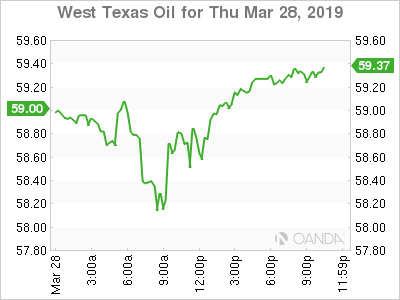
WTI flirted with the $60 price level but did not make a compelling case to breakthrough and is now back at around $59.15. The rise of the US dollar as macro headwinds pick up force after Brexit and trade negotiations between the US and China keep investors on alert. The weaker than expected US Q4 GDP sent a negative energy demand signal as global growth concerns rise as recession indicators keep flashing red. 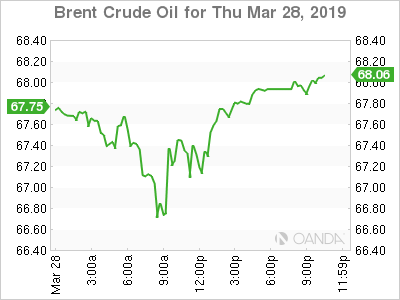
Higher inventories this week piled on pressure on crude, even as the situation in Venezuela could spin out of control as blackouts and political pressure from the opposition could be the undoing of President Nicolas Maduro.
The threat of less waivers for Iranian crude purchases and longer sanctions against Venezuela will keep pushing prices higher alongside the efforts of the OPEC+ to keep soaking up excess supply with their agreement.
GOLD – Dollar Puts Pressure on Gold Ahead of Brexit and Trade Developments
Gold dropped more than 1 percent on Thursday as the US sucked the air out of the market putting pressure on the yellow metal. With the US-China trade negotiations ongoing and Brexit outcomes losing clarity by the minute the greenback was higher as investors preferred it as a safe haven above gold.
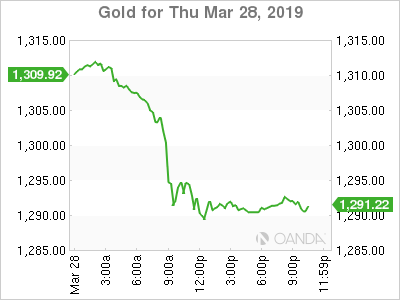
It is too early to count gold out for the week, given the British parliament could vote for the third time for Theresa May’s proposal on Friday. The British PM’s option remains the only one firmly on the table after MPs failed to reach consensus on a plan B as the factions remain too far apart to compromise.
May’s proposal despite being more tangible option, it is likely to fail, and with it Brexit itself as it opens the door for remaining if the Conservative government cannot deliver on the drawn-out process.
Eco Data 3/29/19
[php_everywhere instance="1"]
Gold completed corrective recovery, heading back to 1280
Follow up on yesterday's comment, Gold's sharp fall today and firm break of 1303.25 minor support confirms completion of corrective recovery from 1280.85, at 1324.49. Further decline is now expected as long as 1306.72 minor resistance holds. Based on current downside momentum, 1280.85 should at least be breached.
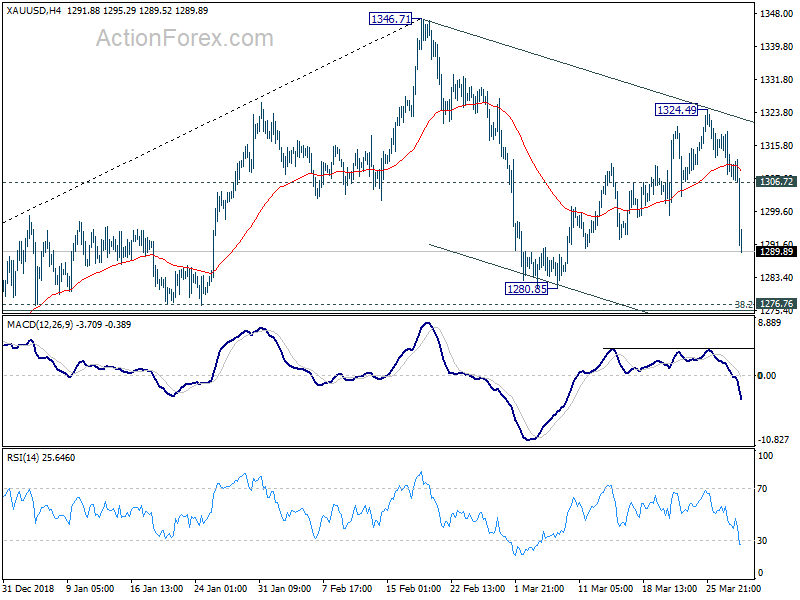
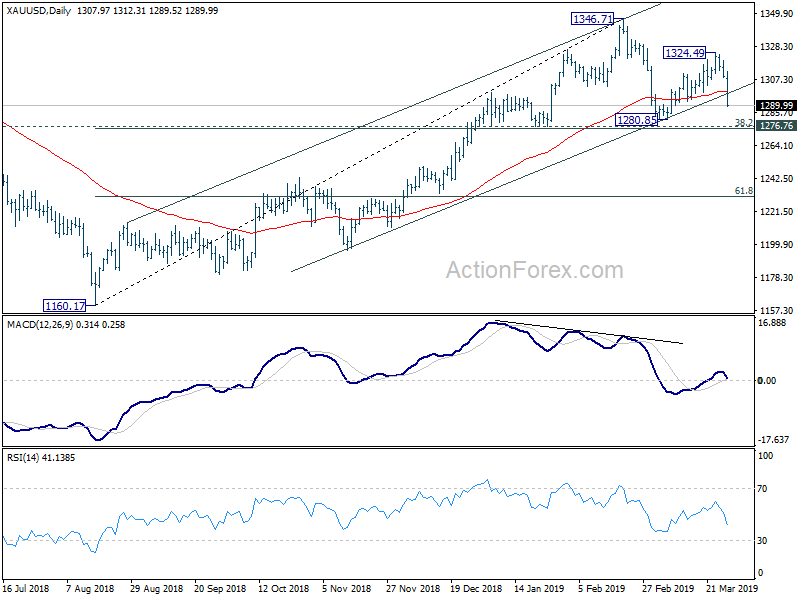
Key focus is indeed on 1276.76 cluster support (38.1% retracement of 1160.17 to 1346.17 at 1275.45). The break of medium term channel now affirms that 1346.71 is a medium term bottom on bearish divergence in daily MACD. Decisive break of 1275.45/1276.76 should also confirm completion of whole rise from 1160.17.
In that case, gold should have started another falling leg inside the long term range pattern. Deeper fall should then be seen back towards 61.8% retracement at 1234.42 and below.
Fed Clarida: Policymakers cannot ignore a number of prominent downside global risks
Fed Vice Chair Richard Clarida gave a speech at a symposium in France today. There he noted that the US economy's integration with the rest of the word has risk substantially over the past 60 years. That heightened US exposures to external shocks through channels of direct trade links, foreign exchange markets and contagion in financial markets.
Clarida added recently, US and other financial markets are "attuned to a number of prominent downside global risks", including Brexit, a sharp slowdown in growth and trade tensions. He noted that Fed policymakers can "hardly ignore these risks". Indeed, he pointed out three of the most recent FOMC statements have highlighted concerns about global economic and financial developments.
He also reiterated Fed's stance that "in the presence of these risks and with inflation pressures muted, we can afford to be patient and data dependent as we assess in future meetings what adjustments in our policy rate might be necessary to sustain growth, employment, and price stability in the U.S. economy."
US Core PCE Inflation to Reinforce Fed’s Patience
Fed chairman, Jerome Powell, said at his press conference following the March FOMC policy meeting that as long as inflation holds close to the target the central bank has room to remain “patient”. The core PCE price index delivered on Friday at 1230 GMT is expected to support Powel’s comments, while personal consumption and personal income readings published alongside price figures could restore some optimism for the US economy.
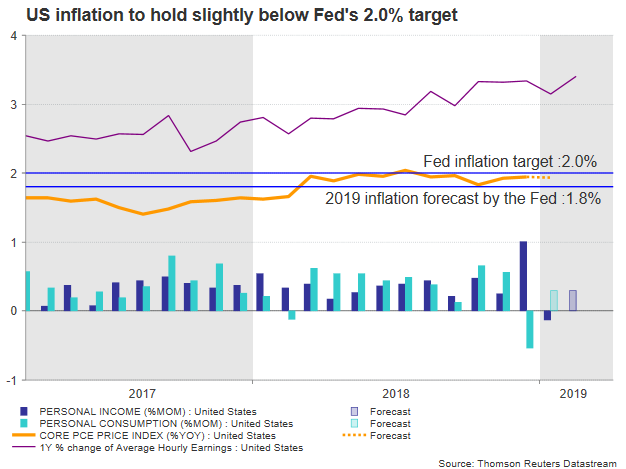
The core PCE index, the Fed’s most favorite inflation measure, is anticipated to remain unchanged at 0.2% month-on-month in January, leaving the yearly gauge steady at 1.9% and marginally below the central bank’s 2.0% inflation goal.
On the other hand, personal consumption which declined by 0.5% in December – the biggest pullback since 2009 – is forecast to return to normal levels and mark a growth of 0.3% m/m in January, while the value of income from all sources by consumers is also projected to rise by an equivalent familiar percentage in February after decelerating by 0.1% in the preceding month. Note that the collection of income data are more up-to-date than the consumption numbers which are still lagging by one month due to the latest government shutdown.
Despite wages advancing at the highest annual pace in almost a decade and the unemployment rate hovering around 18-year lows in March, the Fed decided surprisingly to leave its rate hike plans aside for the remainder of the year and downgrade its 2019 inflation forecasts from 1.9% y/y in December to 1.8% amid concerns that the economy could face more headwinds in the near future as negative risks abroad are heating up. Growth projections for 2019 were also revised lower from 2.3% y/y to 2.1%. Besides, with the effects from Trump’s tax cuts dissipating and consumer and business confidence measures slowing from their solid levels in 2018, the Fed has no reason to raise borrowing costs until the data suggest so.
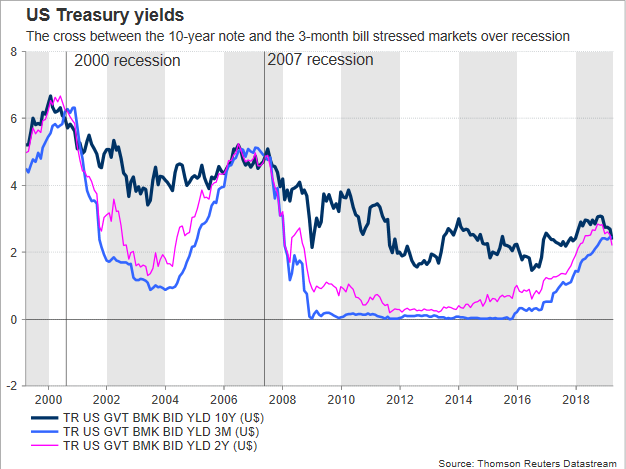
Last Friday, the US 10-year treasury yield slipped below the 3-month bill for the first time since 2007 and has remained below it since then, unsettling Wall Street and the dollar over a possible recession as the phenomenon has preceded every economic downfall in the past 50 years. But unlike previous times, the 10-year yield did not bridge the 2-year note first, relieving markets that the signal may not be as reliable as it seems in the end. This week’s S&P/ Case-Shiller House price index, having already fallen ten months in a row, sparked worries as well after the figure deviated sharply below expectations in January, stretching its downtrend even further south.
Should Friday’s inflation data or/and personal consumption and income stats disappoint too, investors would view a potential rate cut as soon as this Autumn more seriously, pushing funds away from the dollar and towards safer assets. In this case, USDJPY could retest the 110 round level, while lower, the sell-off could turn more severe if the price violates support around 109.80. Yet, with the Eurozone struggling to recover economic and political momentum and the UK unable to find a common ground on the Brexit front, investors’ preference may be more skewed to the dollar than to the euro and the pound given the greenback’s safe-haven behavior as well.
Alternatively, better than expected readings could add legs to the dollar and lift it up to the 110.80 area. A breach of the 111-110.20 restrictive area, however, could prove more valuable to the market.
Japanese Yen Lower Despite Soft U.S GDP
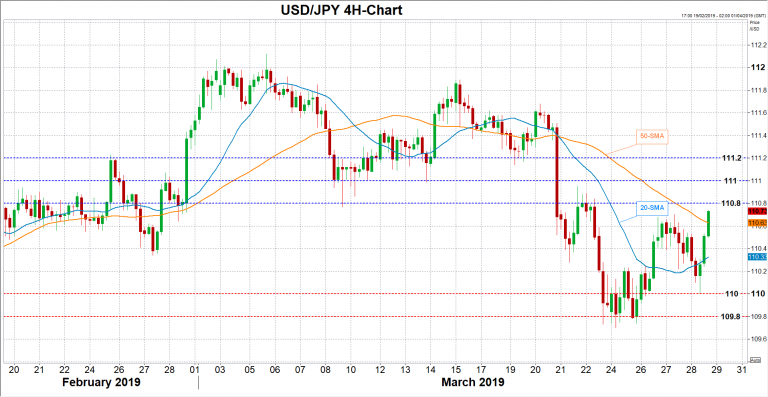
USD/JPY has recorded slight losses on Thursday. In the North American session, the pair is trading at 110.70, up 0.16% on the day. On the release front, In the U.S., Final GDP for the fourth quarter posted a 2.2% gain, shy of the estimate of 2.4%. Unemployment claims fell to 211 thousand, easily beating the estimate of 221 thousand. Later in the day, Japan releases key consumer data. Tokyo Core CPI is expected to remain steady at 1.1%. Retail sales are projected to rise to 0.9% in February, after a gain of 0.6% in January. Friday will also be busy, as the U.S. releases consumer spending and inflation data.
Global trade tensions have weighed on inflation levels in the developed economies, and the U.S. is no exception. However, with the Fed saying it will put a hold on rates until 2020, could that change? At the Fed policy meeting, policymakers lowered their inflation forecast for 2020, citing weakness in the Chinese and European economies. However, the chief economist of Credit Suisse, James Sweeney, has taken a different tack, saying that U.S. inflation could climb as high as 2.3% next year, in response to the lack of rate hikes. Sweeney said that although inflation remains below the Fed target of 2.0%, there are signs in the services sector of inflation picking up.
The nasty trade war between the U.S. and China has hit Japan hard, as both countries are major trading partners with Japan. The weaker global climate has resulted in weaker demand for Japanese exports, and there are growing concerns that the fragile economy could be heading for a recession. Earlier in the week, the BoJ released the summary of opinions from the March policy meeting. Policymakers debated whether to ramp up stimulus in order to boost growth. Inflation levels remain sluggish, and the scheduled tax hike in October, which is certain to weigh on growth, poses another headache for policymakers.