Sample Category Title
GBP/JPY Daily Outlook
Daily Pivots: (S1) 143.69; (P) 144.83; (R1) 145.43; More...
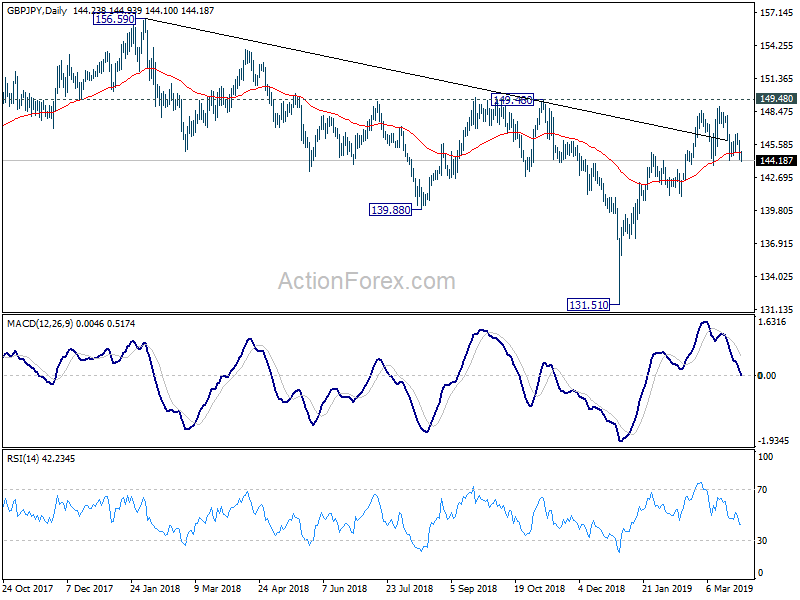
Intraday bias in GBP/JPY remains neutral at this point. On the downside, decisive break of 143.72 support will indicate near term reversal, after rejection by 149.48 key resistance. In that case, intraday bias will be turned to the downside for 141.00 support first. On the upside, decisive break of 149.48 key resistance will carry larger bullish implication and target 156.58 resistance next.
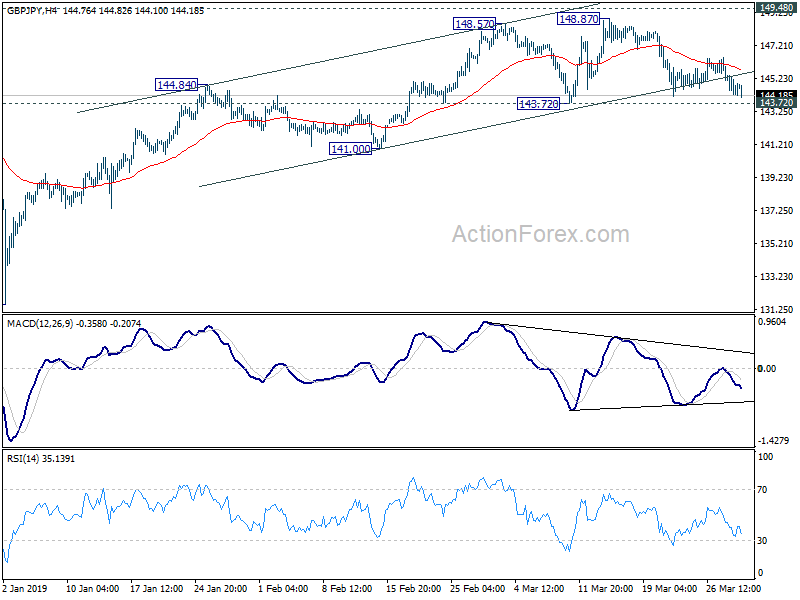
In the bigger picture, focus is now staying on 149.98 key resistance. Decisive break there should confirm that that medium term fall from 156.59 (2018 high) has completed at 131.51 already. Rise from 131.51 is then seen as the third leg of the corrective pattern from 122.36 (2016 low). GBP/JPY should then target 156.59 and above. However, rejection by 149.98 will retain medium term bearishness and could extend the fall from 156.59 through 131.51 to 122.36.
EUR/JPY Daily Outlook
Daily Pivots: (S1) 123.75; (P) 124.09; (R1) 124.53; More....
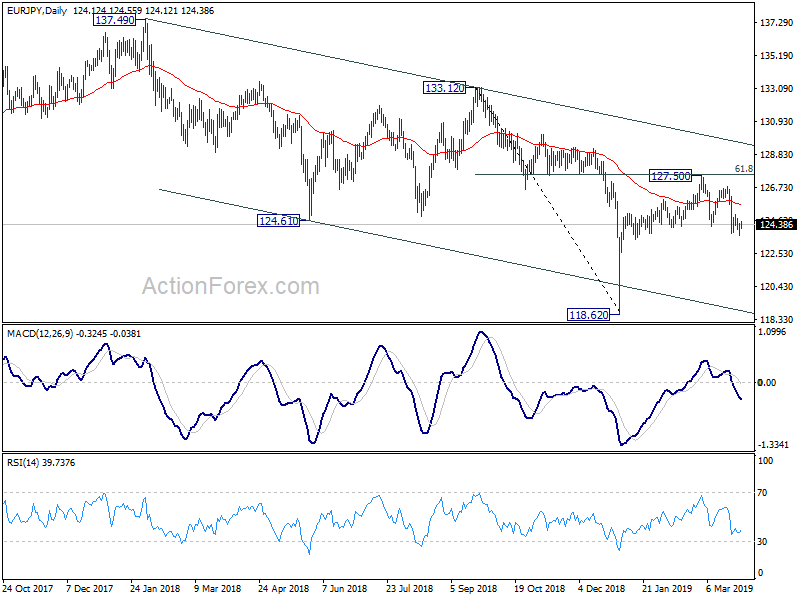
Despite unconvincing downside momentum, further fall is expected in EUR/JPY with 125.01 minor resistance intact. Fall from 127.50 would target 61.8% retracement of 118.62 to 127.50 at 122.01. However, break of 125.01 will turn bias back to the upside for 126.78/127.50 resistance zone.
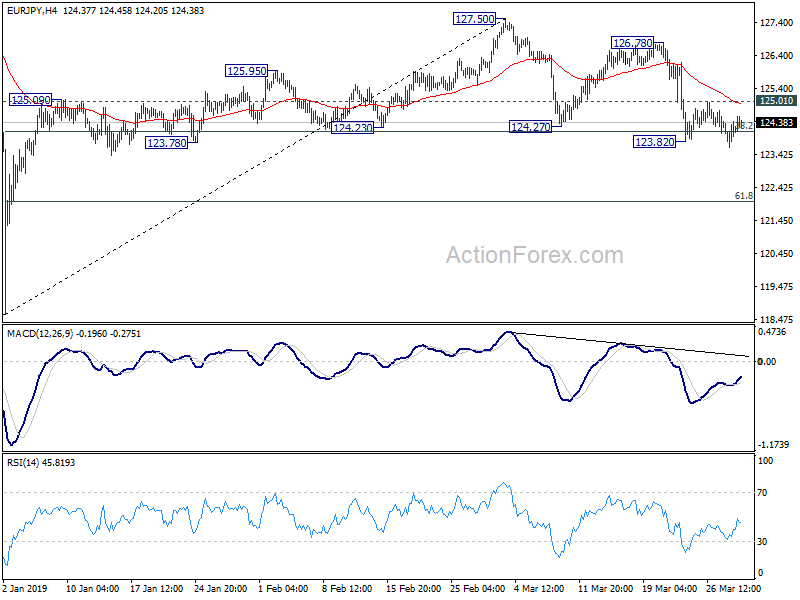
In the bigger picture, rebound from 118.62 might have completed earlier than expected at 127.50. EUR/JPY is held well inside medium term falling channel, and below 55 week EMA (now at 127.86). That is, the down trend from 137.49 (2018 high) might still be in progress. Break of 118.62 will target 109.03/114.84 long term support zone. On the upside, however, break of 127.50 will extend the rebound from 118.62 to 133.12 key resistance instead.
EUR/GBP Daily Outlook
Daily Pivots: (S1) 0.8543; (P) 0.8576; (R1) 0.8641; More...
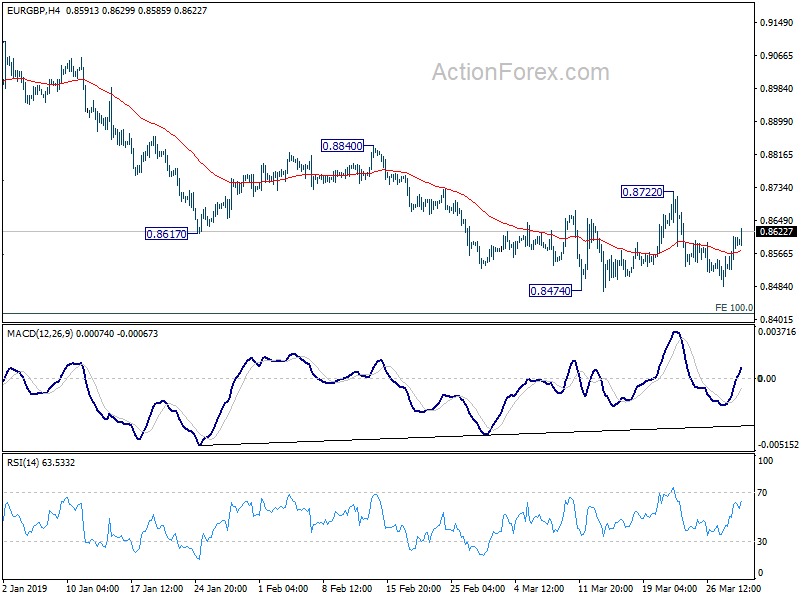
EUR/GBP rebounded strongly just ahead of 0.8474 and remains bounded in range. Intraday bias remains neutral first. Larger fall is expected to resume as long as 0.8722 resistance holds. On the downside, break of 0.8474 low will resume recent down trend and target 0.8416 long term projection next. On the upside, though, break of 0.8722 will resume the rebound from 0.8474 to 0.8840 resistance first.
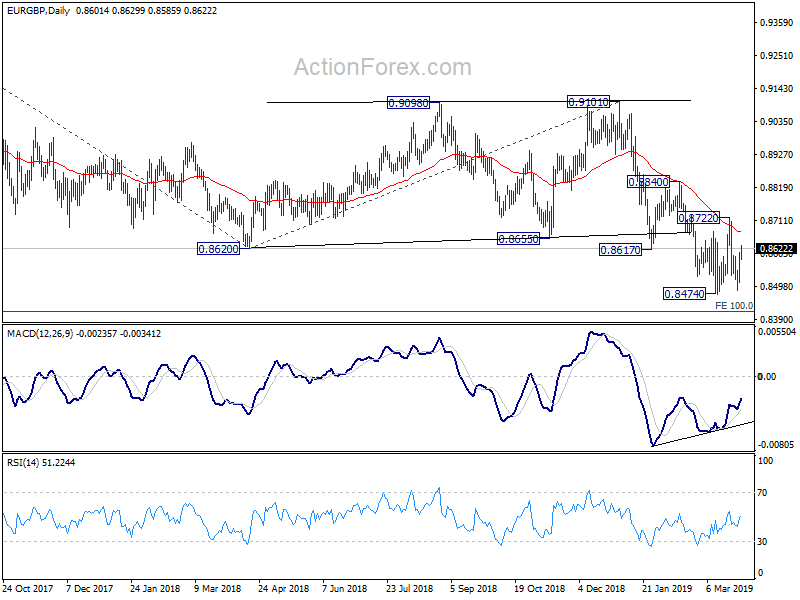
In the bigger picture, EUR/GBP is seen as staying in long term range pattern started at 0.9304 (2016 high). Current fall from 0.9305 (2017 high), is a falling leg inside the pattern. Such decline could extend to 100% projection of 0.9305 to 0.8620 from 0.9101 at 0.8416 and possibly below. But for now, we'd expect strong support around 0.8312 support to contain downside and bring rebound.
EUR/AUD Daily Outlook
Daily Pivots: (S1) 1.5830; (P) 1.5867; (R1) 1.5901; More...
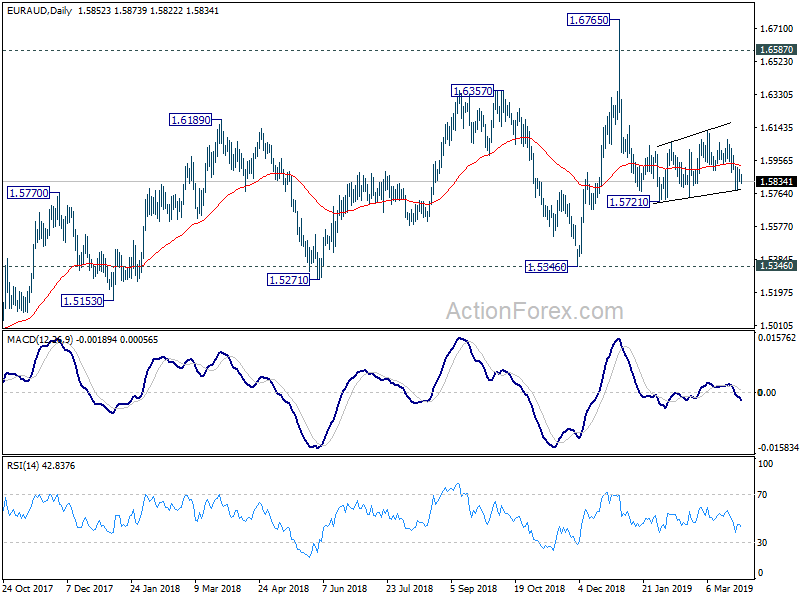
EUR/AUD is staying in consolidation from 1.5721 and intraday bias remains neutral first. On the downside, break of 1.5721 low will resume the fall from 1.6765 and target 1.5346 support next. On the upside, though, break of 1.6122 will extend the pattern from 1.5721 with another rise.
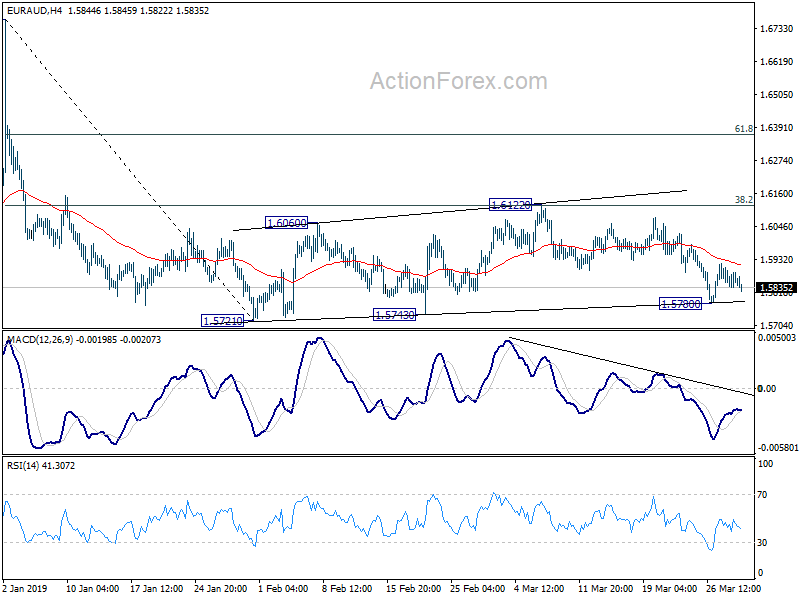
In the bigger picture, as long as 1.5346 support holds, outlook will remain bullish. Uptrend from 1.1602 (2012 low) is expected to resume sooner or later. Break of 1.6765 will target 61.8% retracement of 2.1127 (2008 high) to 1.1602 at 1.7488 next. However, firm break of 1.5346 key support will indicate trend reversal, with bearish divergence condition in weekly MACD, and turn outlook bearish.
EUR/CHF Daily Outlook
Daily Pivots: (S1) 1.1161; (P) 1.1188; (R1) 1.1201; More...
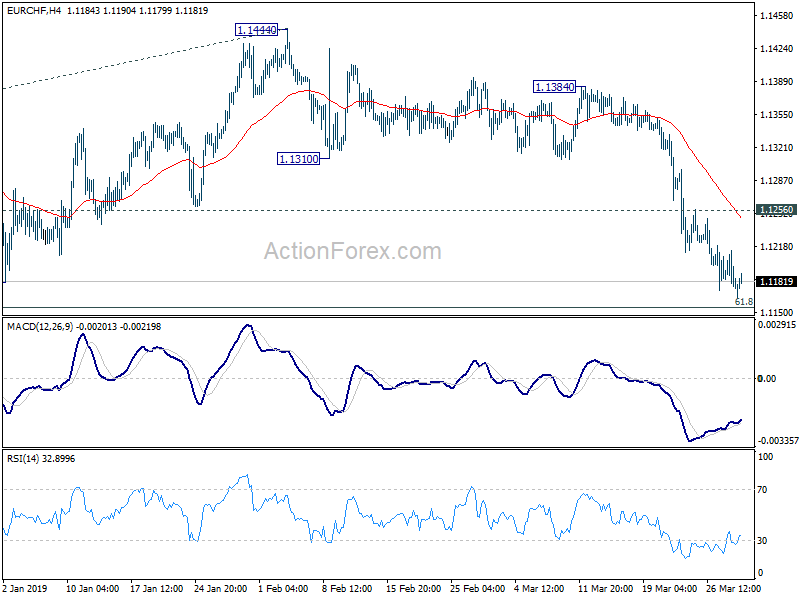
While EUR/CHF is losing some downside momentum as seen in 4 hour MACD, further decline is expected as long as 1.1256 minor resistance holds. Decisive break of 1.1173 low (inside 1.1154/98 key support zone) will carry larger bearish implication and could trigger downside acceleration. Next downside target will be 61.8% projection of 1.2004 to 1.1173 from 1.1444 at 1.0930. On the upside, though, break of 1.1256 minor resistance will turn bias back to the upside for recovery to 1.1310 support turned resistance.
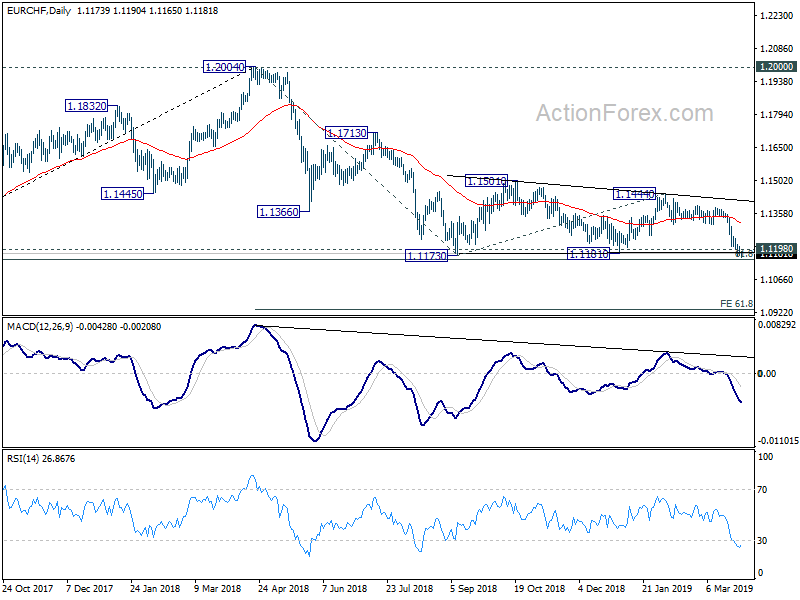
In the bigger picture, multiple rejection by 55 week EMA indicates medium term bearishness. Focus remains on 1.1154/98 support zone (2016 high and 61.8% retracement of 1.0629 to 1.2004 at 1.1154). Decisive break there will confirm resumption of whole down trend from 1.2004 and long term bearish reversal. EUR/CHF should then target 1.0629 support and below. This will now remain the favored case as long as 1.1444 resistance holds.
Equities Rise Into The End Of Q1 Amid Focus On Trade Talks
General Trend:
- Shanghai Composite rises over 2%, property index out performs in early trade
- Hong Kong Property index trades near record high
- Chinese liquor maker Kweichow Moutai rises over 4% post earnings
- China bank earnings remain in focus, Bank of China and Agbank expected to report later today
- Marine/Transportation sector out performs in Japan, Softbank rises over 1%
- Daiichi Sankyo rises over 15% in Japan, announced collaboration agreement with Astrazeneca
- DowDuPont declines over 2% in the afterhours, cut Q1 guidance
- US/China trade talks in China due to conclude later today
- China Vice Premier Liu He is expected to visit the US in early April for trade talks
- China’s March official PMI data is due for release on March 31st (Sunday). Manufacturing PMI is expected to contract for the 4 straight month, according to analysts.
- Japan’s Q1 Tankan survey is due to be released on April 1st (Monday)
- Bank of Japan (BOJ) is expected to release its April bond purchase schedule after today’s close
- S&P delegation to visit South Korea April 1-3 as part of its annual review (current rating AA, outlook Stable)
- Reserve Bank of Australia (RBA) cash rate decision expected on April 2nd (Tuesday)
- China yuan denominated government bonds and policy bank bonds will be phased into the Barclays Global Aggregate Bond Index in April
Headlines/Economic Data
Australia/New Zealand
- ASX 200 opened +0.1%
- (AU) Australia Feb Private Sector Credit M/M: 0.3% v 0.2%e; Y/Y: 4.2% v 4.2%e
- (NZ) RBNZ Gov Orr: On reaction to policy review, pleased markets have shown they understand what we are focused on; Easing bias is the starting point for the MPC
China/Hong Kong
- Shanghai Composite opened +0.2%, Hang Seng +0.1%
- Huawei: Reports FY18 (CNY) Net 59.3B, +25% y/y; Rev 721.2B, +19.5% y/y; Business Groups had double digit growth in first two months of 2019
- (US) White House economic advisor Kudlow: China trade talks are policy driven, not driven by any timetable; some but not all China tariffs may stay in place - ExIm Bank
- (US) US Treas Sec Mnuchin: We had very productive working dinner last night, look forward to today
- (CN) China Deputy Head of FX: China has room to maneuver on debt but will be very serious about tackling deb risks
- (CN) China NDRC: To cut electricity tariffs for industrial and commercial use from April 1st; cites VAT rate cut
- (CN) China NDRC: To adjust trans-provincial natural gas pipeline tariffs, effective from April 1st; cites VAT rate changes
- (CN) China NDRC: To lower gasoline and diesel prices, effective from April 1st; cites VAT cuts
- (CN) China NDRC urges price cuts at state-owned scenic areas
Japan
- Nikkei 225 opened +0.9%
- (JP) JAPAN FEB JOBLESS RATE 2.3% V 2.5%E (lowest since Sept 2018)
- (JP) Japan Feb Preliminary Industrial Production M/M: 1.4% v +1.4%e; Y/Y: -1.0% v -1.1%e
- (JP) JAPAN FEB PRELIMINARY RETAIL SALES M/M 0.2% V +1.0%E; RETAIL TRADE Y/Y: 0.4% V 1.0%E
- (JP) Japan Mar Tokyo CPI Y/Y 0.9% v 0.9%e; CPI Ex-Fresh Food Y/Y: 1.1% v 1.1%e
- (JP) Japan Fin Min Aso: No change in view global economy is recovering 'moderately; not considering extra economic measures at this time
Korea
- Kospi opened +0.5%
- (KR) South Korea Feb Industrial Production M/M: -2.6% v -0.7%e; Y/Y: -2.7% v -0.5%e
- (KR) South Korea Feb Retail Sales M/M: -0.5% v +0.2% prior
- (KR) South Korea Pres Moon to visit the US April 10-11th; US President Trump to meet with Moon at April summit
- (KR) South Korea Pres Moon falls to 43% v 45% prior (record low)- Gallup Poll
Other
- (VN) Vietnam Q1 GDP Y/Y: 6.8% v 6.5%e
North America
- (US) Fed's Williams (moderate, voter): US economy is in a very good place; Not worried about the chance of recession as some in the private sector are - comments in Puerto Rico
- (US) Fed's Clarida (moderate, voter): Fed can be patient amid global risks and muted inflation; Fed must pay ever closer attention to global growth risks
- (US) US Fed's Bullard (Dove, voter): premature to contemplate rate cut here
Europe
- (UK) UK govt source: votes on Friday will not be meaningful vote number three
- (UK) UK BBC Political Editor Kuenssberg: Gov source confirms they are laying motion now to give MPs vote tomorrow on only the withdrawal agreement – tweet
- (UK) Parliamentary Speaker Bercow accepts new Brexit deal vote; govt's motion will cover only withdrawal agreement
- (UK) Mar GfK Consumer Confidence: -13 v -14e
- (UK) Mar Lloyds Business Barometer: 10 v 4 prior
Levels as of 1:20 ET
- Nikkei 225, +0.8%, ASX 200 +0.1%, Hang Seng +0.9%; Shanghai Composite 2.5%; Kospi +0.5%
- Equity Futures: S&P500 +0.2%; Nasdaq100 +0.3%, Dax +0.1%; FTSE100 +0.3%
- EUR 1.1236-1.1220 ; JPY 110.93-110.53 ; AUD 0.7091-0.7072 ;NZD 0.6789-0.6774
- Gold -0.1% at $1,294/oz; Crude Oil +0.6% at $59.63/brl; Copper +0.7% at $2.897/lb
RBA Preview – Expecting a Dovish Shift on Monetary Policy Stance
The lack of momentum in economic activities would soon dent RBA's hope of higher household consumption (and eventually higher inflation), as a result of further decline in the unemployment rate. We expect the central bank to turn more cautious at next week's meeting. Although the members agreed in March that there's no strong case for near-term move in rates, they will soon acknowledge the need to shift from the "neutral" stance to a more "dovish" one.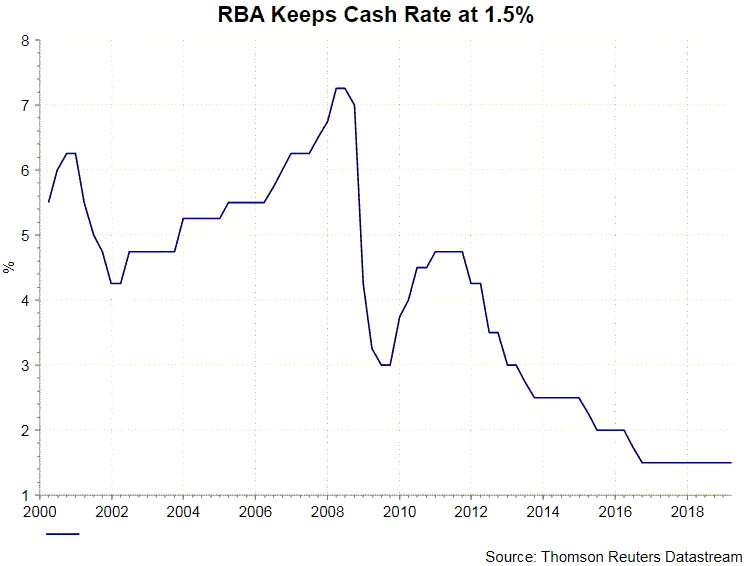
Australia’s GDP expanded +0.2% q/q in 4Q18, missing consensus of, and prior quarter’s +0.3%. Household consumption grew +0.8% q/q while business investment contracted -1% during the period. Growth of +%2.3% for the full year of 2018 is below RBA forecast. Worse still, the country has technically entered recession on per capita basis. Per capita GDP contract -0.2% in 4Q18, exacerbating from -0.1% in the prior quarter.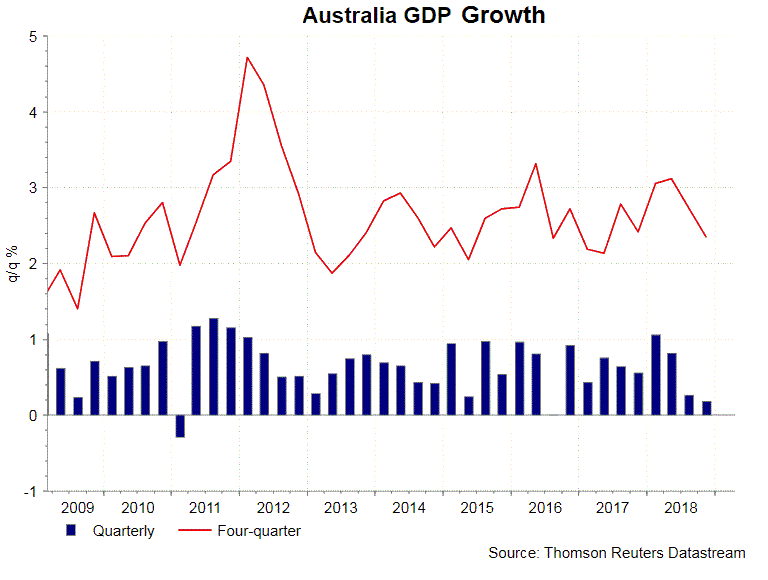
At the minutes for the March meeting, RBA suggested that the job market is a key area it is monitoring. We find that the employment situation has shown signs of fatigue recently. Unemployment rate slipped -0.1 percentage point to 4.9% in February. While this appeared a strong figure, the number payrolls increased only +4.6K, weaker than consensus of +14K and January’s increase of +39.1K. Worse still, full time positions fell -7.3K in February, after gaining +65.4K in the prior month. Although RBA has been denying the rising proportion of part-time jobs in total employment is a problem, historical data in the US shows that a sharp rise in part time jobs usually accompanies with economic recession. Part time jobs use provide less welfare and job security. This could hamper incentive to spend. Indeed, consumer sentiment fell -4.8% in March, after a +4.3% increase a month ago. Meanwhile, softening in housing prices is yet another factor restraining household expenditure.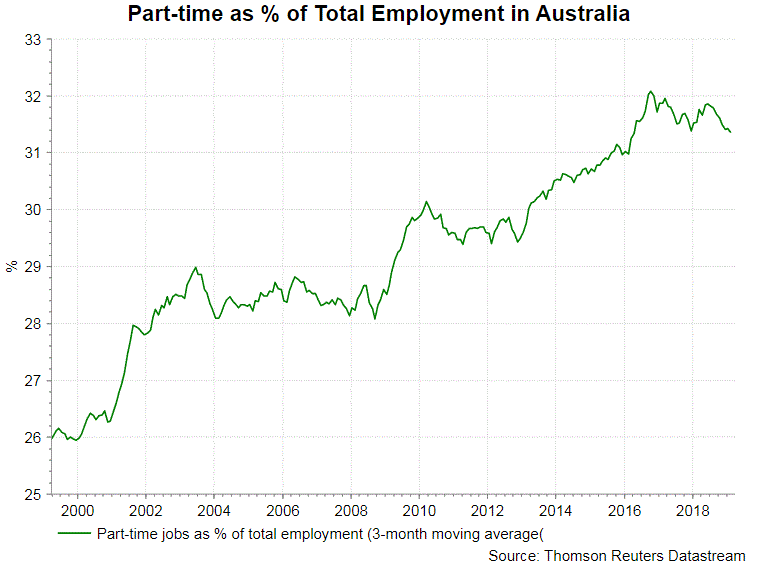
Markit’s PMI has provided a gloomier insight of the country’s economic developments in the first quarter of this year. The composite index climbed +0.9 point higher to 50 in March, following a decline to the contractionary territory in February. Services activities stayed in contraction for two consecutive months in March, while growth in the manufacturing sector decelerated. As suggested in the report, while the overall business activity “stabilized” in March, following a decline in February, the services sector “continued to fall” while growth in the manufacturing sector “softened”. It also noted that “job creation was the slowest in the 35-month survey”. Meanwhile “relatively weak demand conditions led to softer business sentiment, with confidence around the 12-month outlook the lowest since June 2016”. We expect to see growth in 1Q19, as well as the rest of the year, to moderate.
In March, RBA indicated that "the main domestic uncertainty continues to be the strength of household consumption in the context of weak growth in household income and falling housing prices in some cities”. Yet, the members still judged that further decline in the unemployment rate could lift wage growth, which could in turn boost consumption and inflation. We find this wishful thinking difficult to materialize without more accommodative monetary measures.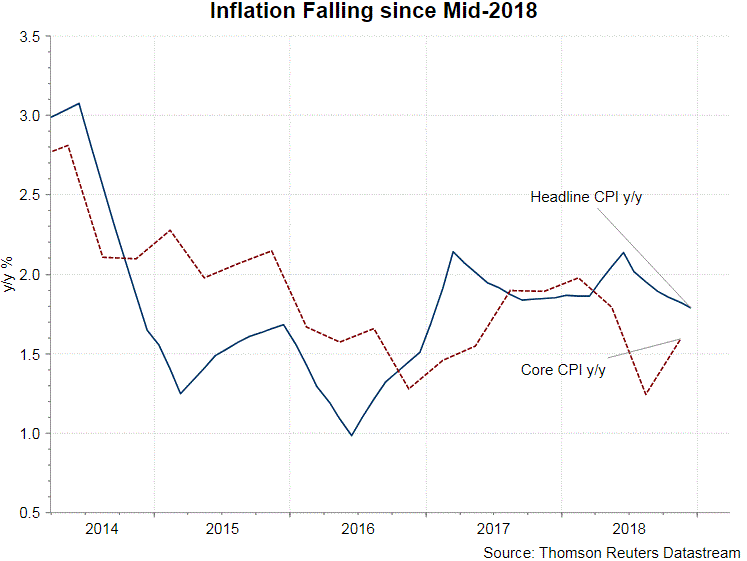
US-China Trade Talks Resume
Market movers today
Today we get a lot of important numbers in Scandi, the US and Japan. Brexit will also draw attention with today's vote at 15:30 CET on the withdrawal agreement without the political declaration. We expect the withdrawal agreement to be voted down again and the question remains; how does the EU react to this?
The US PCE headline and core inflation numbers for January are due today and we expect the core print at 0.2% m/m and unchanged at 1.9% y/y, just below the Fed's 2% target.
In Norway, we also get labour market figures and we expect (seasonally adjusted) NAV unemployment for March to be unchanged at 2.3%. This report is more important than the LFS measure that disappointed on Wednesday. The day also brings Norwegian retail sales figures where we anticipate cautious growth of 0.3% m/m in February (see page 2 for more details).
Selected market news
Risk sentiment recovered somewhat overnight with Asian stocks trading up after a tough week. The US equity indices also gained yesterday, while the rally in fixed income markets halted. Yesterday, several Fed speakers sounded cautiously optimistic about the outlook, with St. Louis Fed President James Bullard, saying 'it's premature to consider a rate cut', adding -much in line with our view - that he expects growth to pick up in the second quarter. In addition, New York Fed Chief John Williams was also modestly optimistic, saying that while growth is slowing, 'right now the US economy overall is in a very good place'.
Trade talks between the US and China resumed yesterday. The US delegation led by finance minister Mnuchin and trade representative Lighthizer had a 'productive' dinner with the Chinese delegation ahead of a full day of talks today between the two sides. Meanwhile, Larry Kudlow, Trumps economic advisor, tempered expectations, saying the US is willing to extend the process for weeks or months in order to get the right deal for the US. We think that discussions are proceeding well, but that we may see hiccups on the final stretch of talks given the difficulties in finding an adequate enforcement mechanism in a potential deal. However, we expect the discussions to be completed before the end of Q2 ahead of the beginning of the US electoral campaign.
In Europe, financial markets yesterday digested the indications from the ECB that a tiered deposit system is under consideration. We provide a detailed discussions of the possible facility in our piece published yesterday: ECB Research - ECB Watchers conference: is a tiering system really the answer? Yesterday, German HICP inflation fell to 1.3% in March from 1.5% in February), driven by lower food and core inflation. In our view the numbers do not bode well for next week's euro area core inflation release.
Euro-Zone’s Consumer Confidence Index Rose As Estimated In March
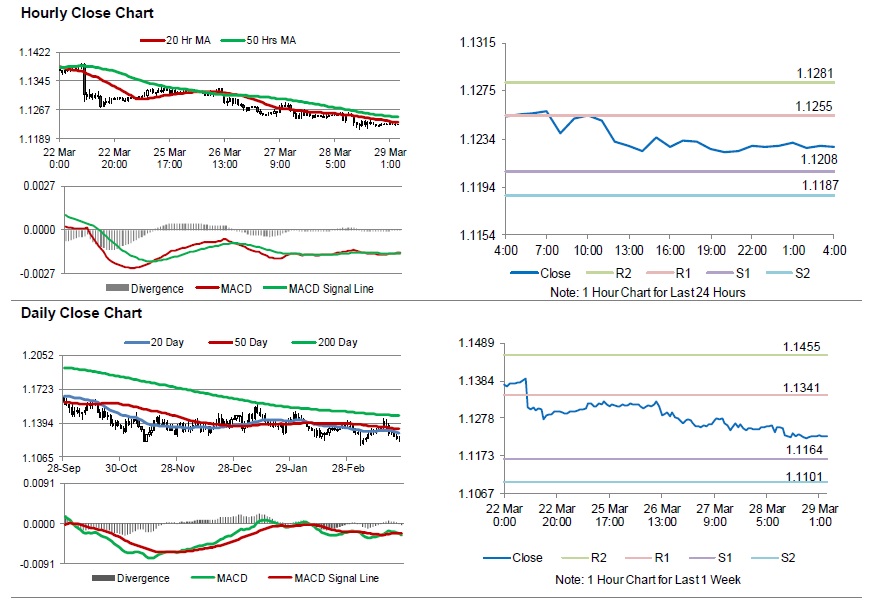
For the 24 hours to 23:00 GMT, the EUR declined 0.20% against the USD and closed at 1.1228.
On the macro front, the Euro-zone's business climate indicator fell to a level of 0.53 in March, more than market expectations for a drop to a level of 0.53. The business climate indicator had recorded a reading of 0.69 in the previous month. Moreover, the nation's economic sentiment indicator slid to a level of 105.5 in March, marking its lowest level since 2016 and compared to a revised reading of 106.2 in the previous month. Market participants had envisaged the indicator to fall to a level of 105.9. On the other hand, the region's final consumer confidence index advanced to a level of -7.2 March, in line with market expectations and confirming the preliminary figures. In the prior month, the index had registered a reading of -7.4.
Separately, in Germany, the flash consumer price index (CPI) climbed 1.3% on an annual basis in March, less than market expectations for an advance of 1.5%. The CPI had advanced 1.5% in the prior month.
In the US, data indicated that the US final annualised gross domestic product rose 2.2% on a quarterly basis in 4Q 2018, undershooting market expectations for an advance of 2.3%. The preliminary figures had recorded an advance of 2.6%, while the GDP had registered a rise of 3.4% in the previous quarter. Additionally, the seasonally adjusted initial jobless claims unexpectedly fell to a level of 211.0K in the week ended 23 March 2019, defying market expectations for a gain to a level of 220.0K. In the previous week, initial jobless claims had recorded a revised reading of 216.0K. Meanwhile, the nation's pending home sales dropped 5.0% on a yearly basis in February, more than market forecast. In the previous month, pending home sales had registered a revised decline of 3.3%.
In the Asian session, at GMT0400, the pair is trading at 1.1228, with the EUR trading flat against the USD from yesterday's close.
The pair is expected to find support at 1.1208, and a fall through could take it to the next support level of 1.1187. The pair is expected to find its first resistance at 1.1255, and a rise through could take it to the next resistance level of 1.1281.
Going forward, traders would closely monitor Germany's retail sales for February and unemployment rate for March, slated to release in a few hours. Later in the day, the US personal income and personal spending for January along with new home sales for February, will keep investors on their toes. Additionally, the Chicago purchasing managers' index and the Michigan consumer sentiment index, both for March, will be on investors' radar.
The currency pair is showing convergence with its 20 Hr moving average and trading below its 50 Hr moving average.
British Pound Reverses Its Losses In The Morning Session
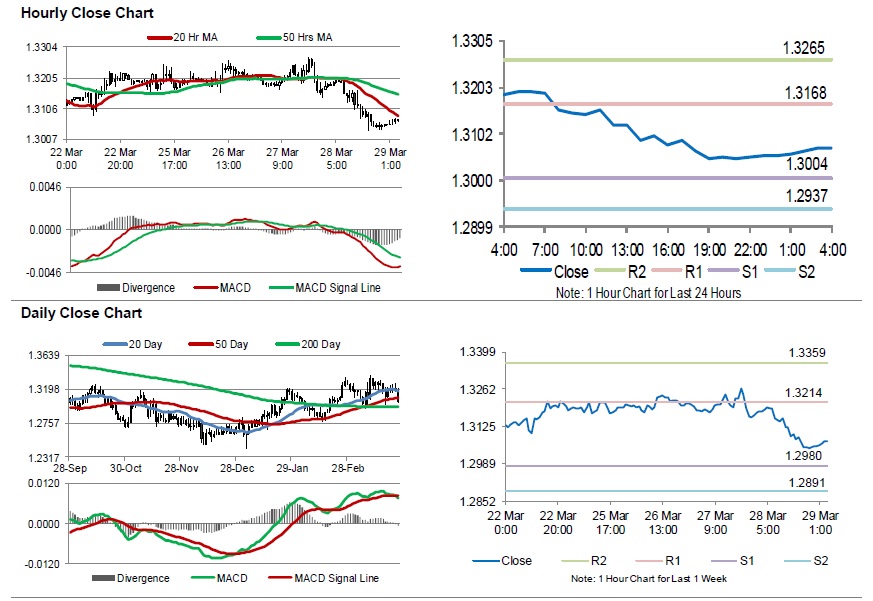
For the 24 hours to 23:00 GMT, the GBP declined 0.78% against the USD and closed at 1.3055, amid news that the British government ruled out a meaningful vote scheduled today.
In the Asian session, at GMT0400, the pair is trading at 1.3070, with the GBP trading 0.11% higher against the USD from yesterday’s close.
Overnight data showed that the GfK consumer confidence remained unchanged at -13.00 in March.
The pair is expected to find support at 1.3004, and a fall through could take it to the next support level of 1.2937. The pair is expected to find its first resistance at 1.3168, and a rise through could take it to the next resistance level of 1.3265.
Moving ahead, traders would await UK’s Nationwide house price index for March, net consumer credit and mortgage approvals, both for February along with gross domestic product for the fourth quarter, scheduled to release in a few hours.
The currency pair is trading below its 20 Hr and 50 Hr moving averages.