Sample Category Title
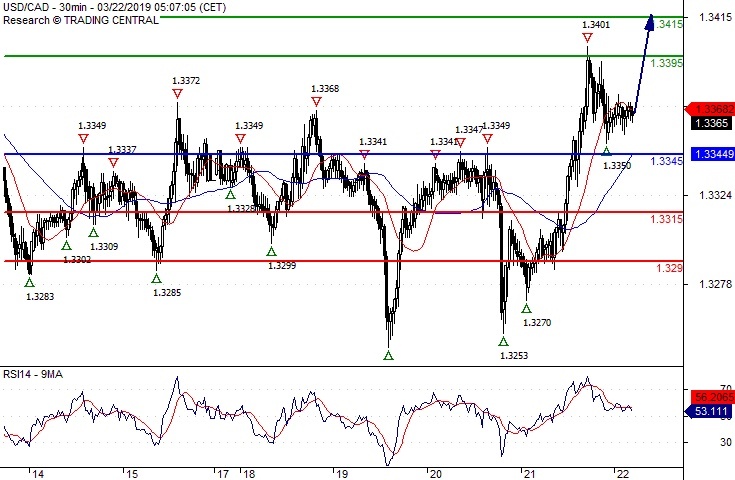
USD/CAD Limited Upside
Pivot (invalidation): 1.3345
Our preference Long positions above 1.3345 with targets at 1.3395 & 1.3415 in extension.
Alternative scenario Below 1.3345 look for further downside with 1.3315 & 1.3290 as targets.
Comment The RSI is mixed to bullish.
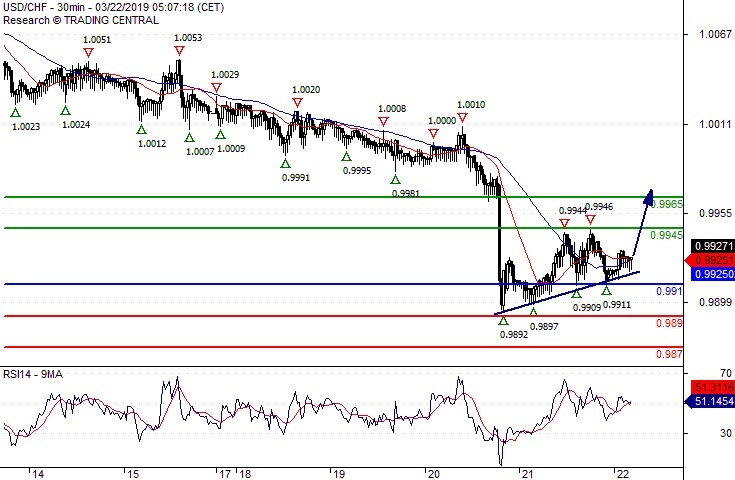
USD/CHF Bullish Bias Above 0.9910
Pivot (invalidation): 0.9910
Our preference Long positions above 0.9910 with targets at 0.9945 & 0.9965 in extension.
Alternative scenario Below 0.9910 look for further downside with 0.9890 & 0.9870 as targets.
Comment A support base at 0.9910 has formed and has allowed for a temporary stabilisation.
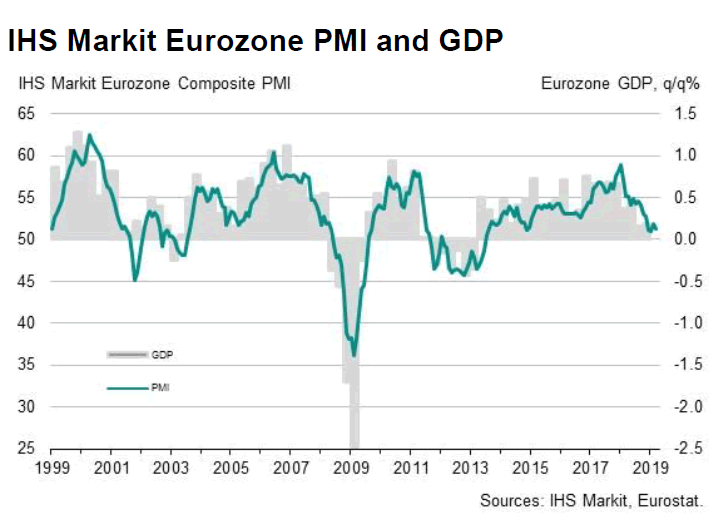
Eurozone PMI manufacturing dropped to 47.6, 71-month low with sharp contraction in trade flows
In March, Eurozone PMI manufacturing dropped to 47.6, down from 49.3 and missed expectation of 49.5. That's also the lowest level in 71 months. PMI services dropped slightly to 52.7, down from 52.8, matched expectations. PMI composite dropped to 51.3, down from 51.9.
Commenting on the flash PMI data, Chris Williamson, Chief Business Economist at IHS Markit said:
"The eurozone economy ended the first quarter on a soft note, with the flash PMI running at one of the lowest levels seen since 2014. The survey indicates that GDP likely rose by a modest 0.2% in the opening quarter, with a decline in manufacturing output in the region of 0.5% being offset by an expansion of service sector output of approximately 0.3%.
"A rebound in February from one-off factors such as the yellow vest protests in France appears to have already lost momentum. Most worrying is the plight of the manufacturing sector, which is now in its deepest downturn since 2013 as trade flows contracted at the sharpest rate since the debt crisis-ridden days of 2012. The service sector is showing more resilience, notably in Germany, but remains in one of its worst growth patches since 2016.
"Forward-looking indicators such as business optimism and backlogs of work suggest that growth could be even weaker in the second quarter. Worryingly, with order book backlogs shrinking at the steepest rate since late-2014, more and more companies are pulling back on hiring, and likely reviewing their investment spending.
"Any such further loss of growth momentum in the second quarter compared to the 0.2% GDP rise signalled for the first three months of the year would raise doubts on the economy's ability to grow by more than 1% in 2019."
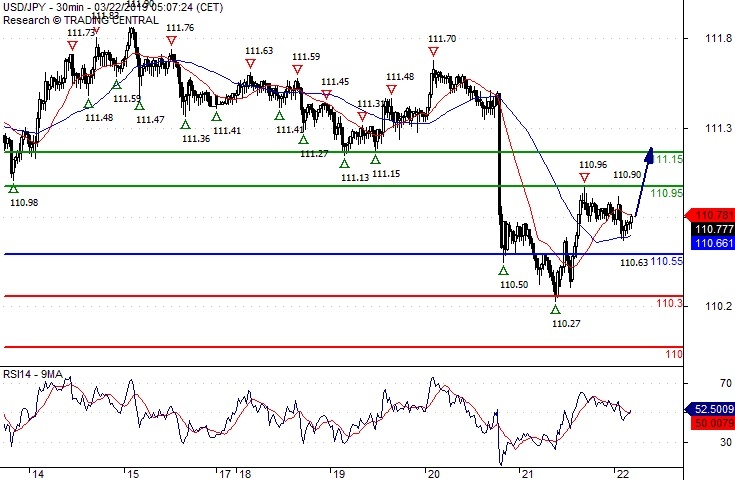
USD/JPY The Bias Remains Bullish
Pivot (invalidation): 110.55
Our preference Long positions above 110.55 with targets at 110.95 & 111.15 in extension.
Alternative scenario Below 110.55 look for further downside with 110.30 & 110.00 as targets.
Comment The RSI lacks downward momentum.
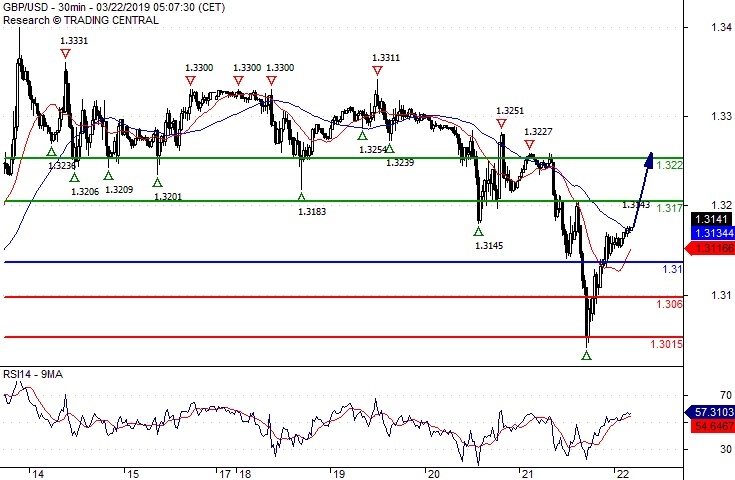
GBP/USD Turning Up
Pivot (invalidation): 1.3100
Our preference Long positions above 1.3100 with targets at 1.3170 & 1.3220 in extension.
Alternative scenario Below 1.3100 look for further downside with 1.3060 & 1.3015 as targets.
Comment The RSI calls for a new upleg.
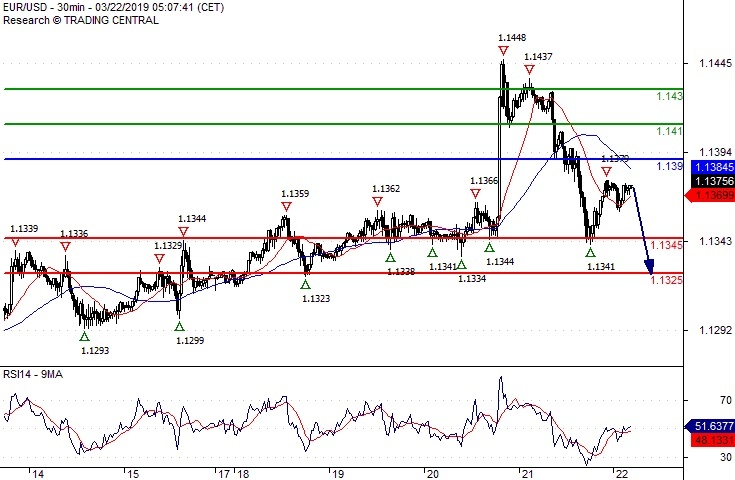
EUR/USD Key Resistance At 1.1390
Pivot (invalidation): 1.1390
Our preference Short positions below 1.1390 with targets at 1.1345 & 1.1325 in extension.
Alternative scenario Above 1.1390 look for further upside with 1.1410 & 1.1430 as targets.
Comment The upward potential is likely to be limited by the resistance at 1.1390.
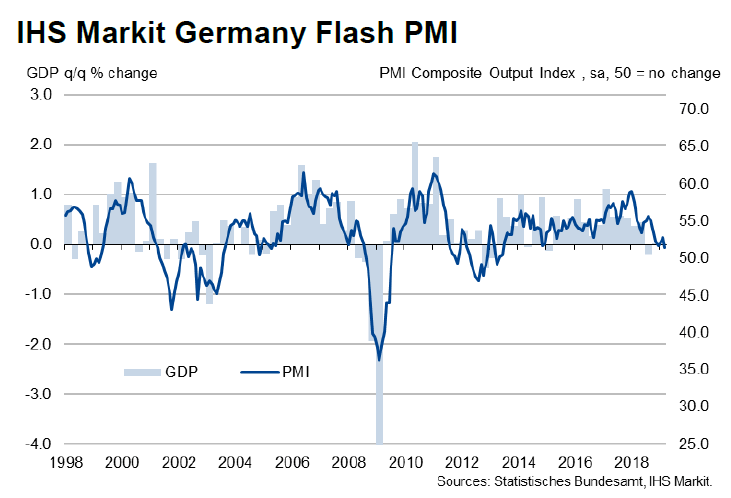
Germany PMI manufacturing dived to 44.7, entrenched downturn with steepest contraction since 2012
In March, Germany PMI manufacturing dropped sharply to 44.7, down from 47.6 and missed expectation of 48.0. That's also the lowest level in 79 months. PMI services dropped to 54.9, down from 55.3 but beat expectation of 54.8. PMI composite dropped to 51.5, down from 52.8, hit a 69-month low.
Commenting on the flash PMI data, Phil Smith, Principal Economist at IHS Markit said:
"The downturn in Germany's manufacturing sector has become more entrenched, with March's flash data showing accelerated declines in output, new orders and exports. Uncertainty towards Brexit and US-China trade relations, a slowdown in the car industry and generally softer global demand all continue to weigh heavily on the performance of the manufacturing sector, which is now registering the steepest rate of contraction since 2012.
"The domestic market remains strong, which continues to be reflected in wage pressures and robust growth across the services sector of the economy, but the question is whether it can withstand a protracted downturn in manufacturing. The first decrease in factory employment for three years is perhaps a warning sign for the health of domestic demand, with overall job creation now running at its lowest since May 2016.
"The overall rate of output price inflation has shown little change in March, but this masks starkly different trends at the sector level. The combination of robust domestic demand and wage pressures has seen services charges increase at a rate exceeded only once in the series history, while a near-stagnation in manufacturing input costs is reflected in the weakest rise in factory gate prices in almost two-and-a-half years."
France PMIs: Contraction in both manufacturing and services
In March, France PMI manufacturing dropped to 49.8, down from 51.5 and missed expectation of 51.4. PMI services dropped to 48.7, down from 50.2 and missed expectation of 50.6. PMI composite dropped to 48.6, down from 50.4.
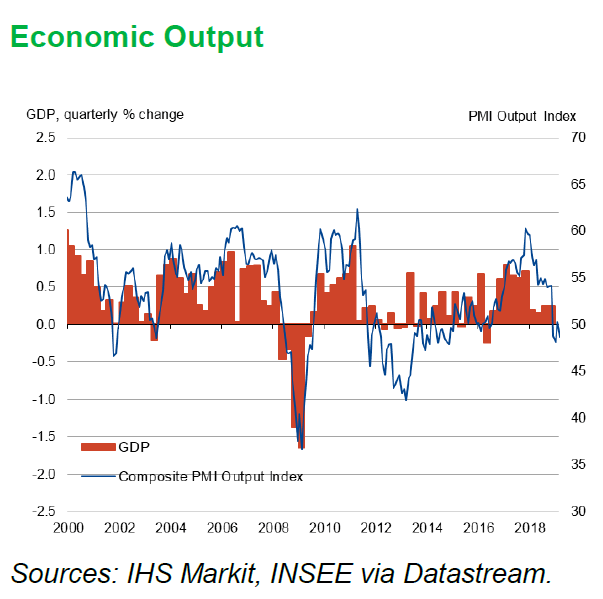
Commenting on the Flash PMI data, Eliot Kerr, Economist at IHS Markit said:
"At the end of the first quarter, the French private sector was unable to continue the recovery seen in February, as both the manufacturing and service sectors registered contractions in business activity.
"Worryingly, new orders continued to tumble amid a slowdown in demand and downward momentum in new export business. New work from abroad fell at the fastest pace for nearly three years, with a broad-based decline across both sectors.
"There was some respite in that input price inflation continued to soften, particularly in the manufacturing sector. However, the private sector looks fragile, with the latest data consistent with a stagnation of economic growth. Firms subsequently increased employment at the slowest pace since December 2016."
USDCAD Bulls Find Wall Near 1.34, Retains Bullish View
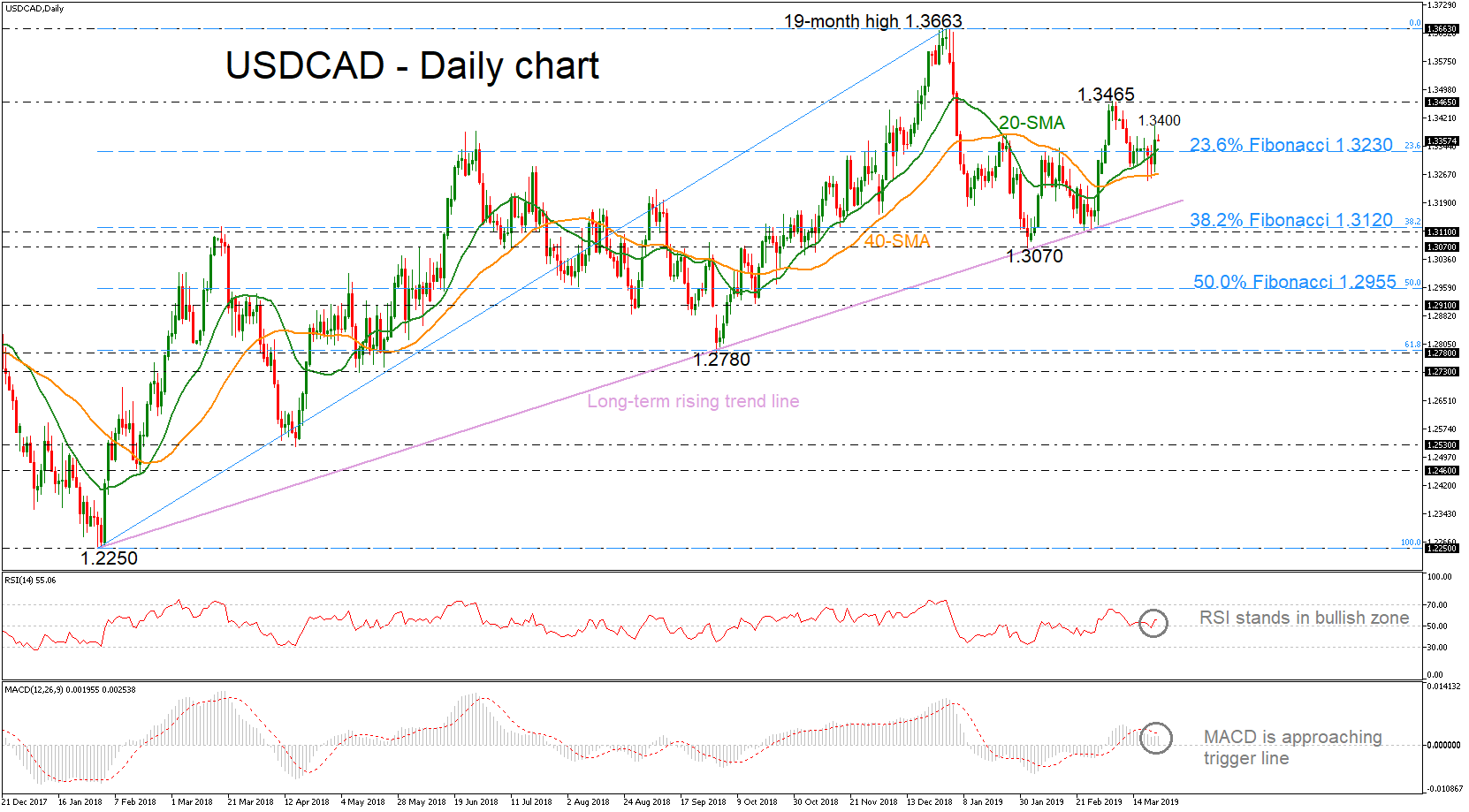
USDCAD is stretching its positive momentum above the 23.6% Fibonacci retracement level of the upleg from 1.2250 to 1.3663, near 1.3230 and the 20- and 40-simple moving averages (SMAs) in the daily timeframe. During yesterday’s session, the pair touched the 1.3400 handle, but failed to hold those gains and returned to slightly lower figures. Currently, the price remains strongly bullish in the long-term, touching the ascending trend line several times and pushing the price even higher.
Returning to the near term, the technical indicators seem to be neutral to bullish. The RSI is holding above the neutral threshold of 50, while the MACD is in progress to complete a positive crossover with its trigger line.
The immediate resistance of 1.3465 could be a trigger point for steeper bullish action if the pair manages to continue its upside tendency. More advances could drive the price until the 19-month high of 1.3663, though more buyers could be waiting for a daily close above this level to initiate additional long positions.
Overall, in the long-term timeframe, the market has been developing in an upside movement since February 2018, completing higher highs and higher lows.
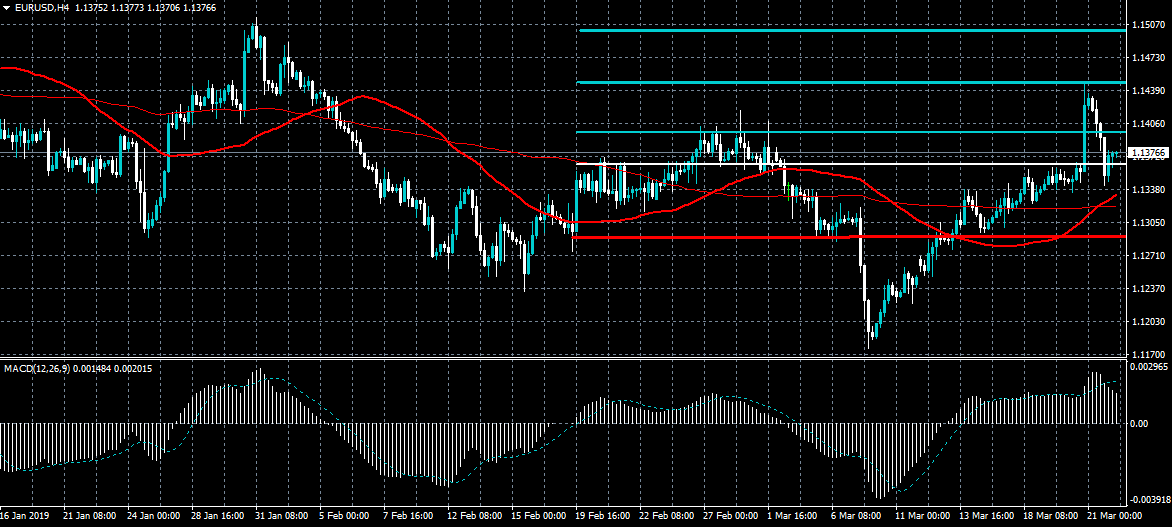
EURUSD Bearish Below 1.1360
The euro currency is losing ground against the greenback on Friday, following a strong technical reversal in the US dollar index. The EURUSD pair has a bearish intraday bias while trading below the 1.1360 level, whilst the 1.1400 level is former key support now turned resistance. Sellers will likely target the 1.1290 level if price continues to trade beneath the 1.1360 level.
The EURUSD pair is only bullish while trading above the 1.1360 level, key technical resistance is found at the 1.1400 and 1.1450 levels.
If the EURUSD pair trades below the 1.1360, sellers may test back towards the 1.1290 and 1.1260 support levels.