Sample Category Title
EURGBP Runs To 1-Month Highs, Tests Upper Bollinger Band
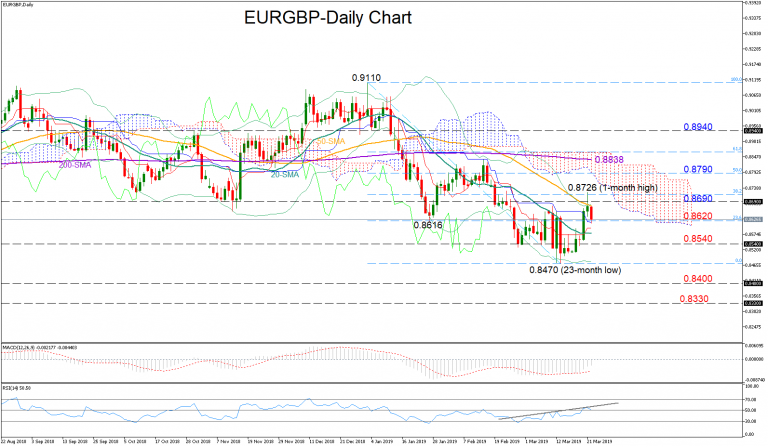
EURGBP pierced the 50-day moving average and a key support and resistance area around 0.8690 on Thursday to reach a one-month high of 0.8726. Gains though appeared short-lived, with the price starting Friday’s trading in negative mood.
Meanwhile in momentum indicators, the RSI has posted a new higher high along its uptrend line and is now heading lower, while the MACD continues to strengthen steadily above its red signal line and towards positive territory, both framing a positive-to neutral picture. It is also worth noting that the price action is currently taking around the upper Bollinger band, therefore room for improvement could be limited.
Breaching the previous high of 0.8726 and therefore the 38.2% Fibonacci of the downward wave from 0.9110 to 0.8470, could send the price up to the 0.8790-0.8838 familiar area, encapsulated by the 50% Fibonacci and the 200-day MA respectively. Beyond that, the 61.8% Fibonacci of 0.8865 could halt upside movements ahead of a stronger barrier placed around 0.8940.
An extension lower could meet immediate support from the 23.6% Fibonacci of 0.8620. Dropping below this mark, attention would reasonably shift to 0.8540, which has been quite challenging for the bears this month. If the decline continues, then the 23-month low of 0.8470 will be crucial for the sell-off to pick up steam towards 0.8400 and 0.8330, last visited in 2017.
In the medium-term picture EURGBP is trading in a downtrend since the start of the year. A close under the 0.8470 bottom would make the downleg more concrete in investors’ eyes.
EUR/JPY Declines After German Data Release
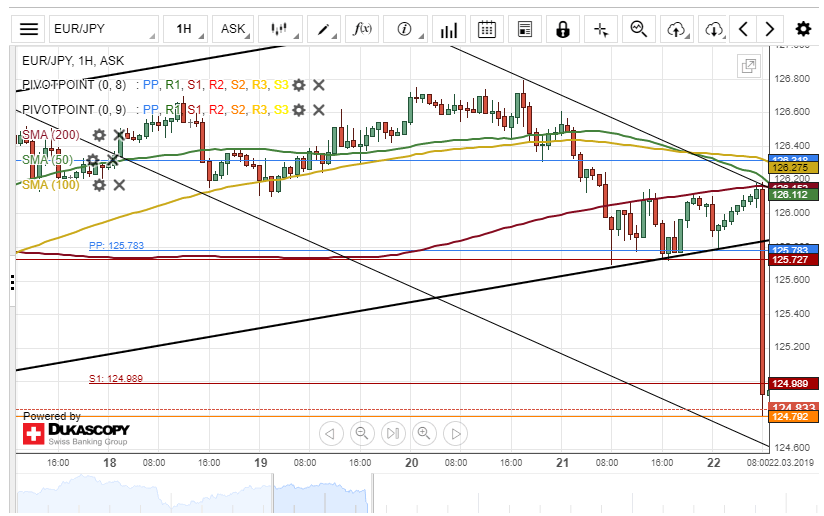
Downside risks have continued to dominate the single European currency against the Japanese Yen since yesterday's trading session. The currency pair has revealed a new junior descending channel pattern.
Today's trading session began with strong bearish momentum, and by the middle of the day, the exchange rate has lost about 1.11% in value.
The currency exchange rate is currently testing a support cluster formed by the weekly and the monthly PPs at 124.98.
If the support cluster is unable to hold, a breakout through the lower boundary of the descending channel pattern is likely to occur within this session.
AUD/USD Finds Support At 0.7090
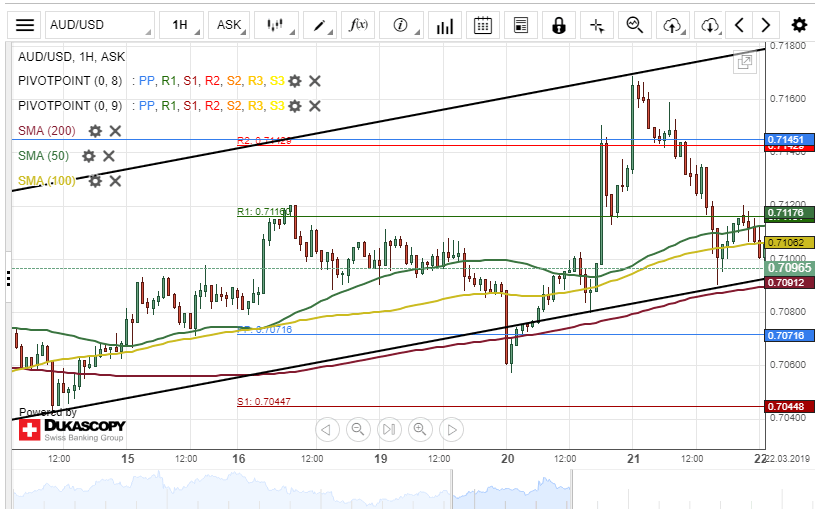
Downside risk dominated the Australian Dollar against the US Dollar on Thursday. The Aussie depreciated about 1.07% in value against the Greenback during yesterday's trading session.
The currency pair is currently testing a resistance level formed by the 200-hour simple moving average at 0.7090.
If the exchange rate passes the 200-hour SMA, the next target for bearish traders within this session will be at 0.7071.
Although, if the support level as mentioned earlier holds, the currency exchange rate will aim for a re-tests of a resistance cluster at 0.7145.
USD/CAD Moving Towards Target
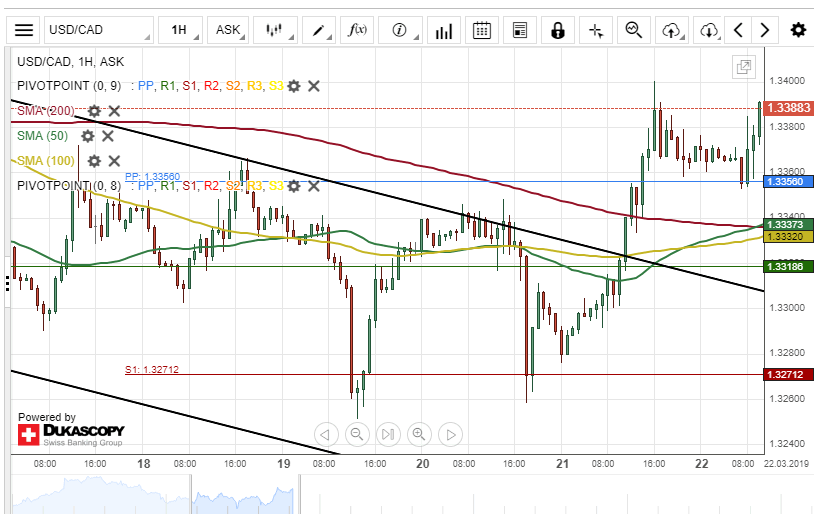
Upside risks dominated USD/CAD on Thursday. The currency pair bounced off a support level formed by the weekly S1 at 1.3271 during the Asian session on Thursday. The pair ended yesterday's trading session with 124 base points gains.
The exchange rate was trading above a weekly pivot point at 1.3356 during the first half of today's trading session.
If the weekly PP holds, the currency exchange rate could target the upper boundary of a medium-term ascending channel pattern at 1.3465.
However, if the rate passes the support level, a decline towards the 50-, 100– and 200-hour SMAs could be expected.
NZD/USD Decline Likely To Continue
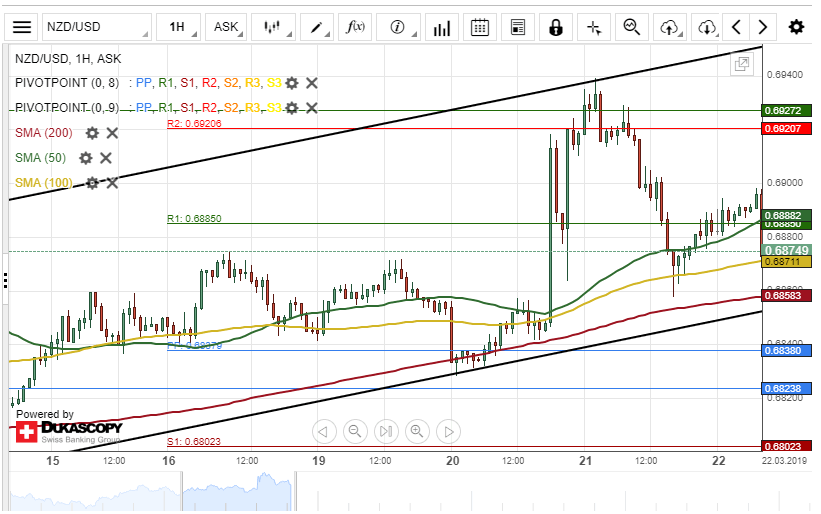
The New Zealand Dollar depreciated about 78 base points against the US Dollar on Thursday. The decline was temporarily stopped by a support level formed by the 100-hour simple moving average at 0.6871.
Friday's trading session started with a bearish sentiment. By the middle of the day, the exchange rate was trading near the lower boundary of an ascending channel pattern at 0.6871 and could be set for a breakout.
If this breakout occurs, the next target for bearish traders will be near the weekly pivot point at 0.6838.
However, it is important to note that the 200-hour SMA at 0.6858 could provide support for the pair today.
AUD/USD Outlook: Aussie Extends Weakness After Bulls Were Strongly Rejected
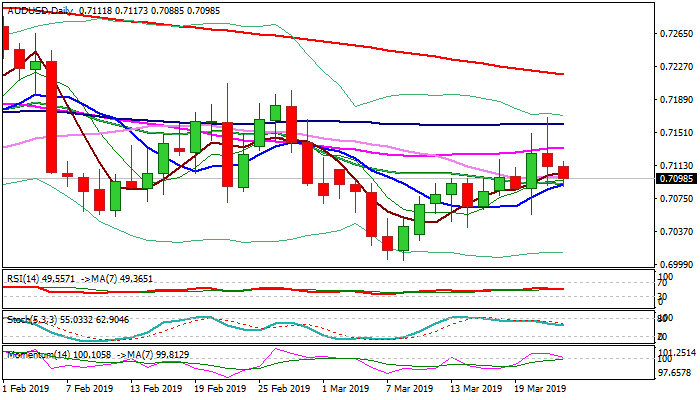
The Aussie dollar remains in red on Friday and cracks significant technical support at 0.7095 (converged 10/20SMA's, following strong upside rejection on Thursday.
Recovery leg from 0.7003 (08 Mar low) stalled at strong barriers provided by 100SMA and daily cloud top (0.7160/71 respectively) and subsequent pullback resulted in repeated daily close below 55SMA (0.7132), weakening near-term structure.
Fresh strength of the US dollar in early European trading on Friday, further pressured its Australian counterpart.
Weakening daily momentum and south-heading stochastic add to negative near-term outlook.
Sustained break below 10/20 SMA's would open other pivotal supports at 0.7066/56 (Fibo 61.8% of 0.7003/0.7168/Wednesday's low before Fed) and risk retest of key 0.70 support on stronger bearish acceleration.
Focus turns towards US Manufacturing PMI and housing data, due later today, that could provide fresh signals. Holding above 10/20SMA's would delay bears, but only return and close above 55SMA would neutralize downside risk for renewed attacks at 100SMA/daily cloud top.
Res: 0.7105, 0.7117, 0.7132, 0.7160
Sup: 0.7088, 0.7066, 0.7056, 0.7041
EUR In The Doldrums As Risk Sentiment Worsens
Risky assets on sale as German PMI slides
The last FOMC meeting left undeniable after-effects on investors’ mind-set. The last two days of trading clearly shows that market participants don’t know where to stand. Equities rallied sharply yesterday afternoon with the S&P 500 climbing more than 1% to around 2,854, gold sliding 1.30% to $1,305 and US yields going nowhere. On Friday, it is a completely different story, investors shifted to risk-off mode and got rid of risky assets and bought treasuries as well as the Japanese yen and a bit of the yellow metal. European equities bore the brunt of the sell-off with the German DAX erasing 0.70%, the Footsie -1.10% - thanks to Brexit’s two weeks reprieve (only) – while the EuroSTOXX 50 gave up 0.95%.
In Europe, the last batch of manufacturing PMIs fell short of expectations. France’s manufacturing PMI printed below the neutral threshold at 49.8 in March, while economists expected a reading closer to 51.4. In Germany, the picture is even gloomier as March manufacturing PMI collapsed to 44.7 compared to 48 expected; this is the lowest reading since August 2012. This doesn’t bode well for economic growth.
We find is quite fascinating that that both soft and hard data are pointing towards a slowdown of the global economy, while at the same time investors keep buying stocks. It looks like things are changing course. Following the publication of the manufacturing PMI, the German 10-year treasury yield quickly dip below 0% this morning. The single currency is free falling and gave up 0.90%. The greenback is rising across the board with the dollar index up 0.25%. Only the Japanese yen managed to edge higher, up 0.25% against the buck.
Brexit extension?
Not much is moving in markets today. Drivers have been on repeat for so long investors are suffering from boredom. FX volatility has declined significantly of the past week but GBP volatility remains least effected. Cleary the lower pace fall is due to critical political premiums still relevant. PM May has requested that Brexit would be official postponed to 30th June from 29th March. This offer is again dependent on UK Parliament approving a Brexit withdrawal agreement next week. This should increase the likelihood that UK Parliaments approved a deal in its third attempt.
It important to note in our view that European policymakers would like to dodge an economically catastrophic “hard” exit. In addition, the extra time gives “remainer” time develop a new strategy. By breaking the hard deadline, the rational that other absolutes are flexible becomes material. With over 2 million people signing an online petition to cancel Brexit the possibly of “No Brexit” has increase significantly. The pace of signatures surged after May statement on Thursday. Interestingly the petition is only focused to “Revoke Article 50 and remain in the EU” and remains well meaningfully number in reality. However, it might be just enough to convince political to put the decision to the people. Finally, figures from the poll indicates that signatories were not only from the UK. We remain skeptical on long GBP bet despite the supportive development. We should see fall in volatility as an opportunity to reload long vol positions. The Brexit chaos is far from over.
Dollar Supported By Risk Aversion Trading
Friday March 22: Five things the markets are talking about
Global equities are trading mixed after the European Union agreed Thursday to a short Brexit delay. Investors are also weighing up further signs of a sluggish global economy as a plethora of G7 central banks reassess normalizing their monetary policies. U.S treasury yields have fallen back to a 12-month low, while the 10-year German Bund is flirting with negative territory.
In FX, sterling (£1.3103) remains very volatile as EU leaders have moved to stop a “chaotic no-deal Brexit” from happening next week by handing PM Theresa May an extra fortnight unconditional extension. The U.K must decide by April 12 what it will do next. They can either decide whether to hold European Parliament elections or leave the bloc on May 7, with or without a divorce deal with Brussels.
Elsewhere, the EUR (€1.1289) has dropped to a one-week low, after weak French, German and Eurozone purchasing managers’ surveys prints for March this morning.
1. Stocks mixed performance
In Japan, the Nikkei closed out the week little changed as chip-related stocks offset weakness in financial stocks. The Nikkei share average closed up +0.1%. The index rose +0.8% for the week, while the broader Topix rose +0.2% overnight.
Down-under, Aussie stocks rallied on Friday, led by financial and healthcare stocks as the market mirrored Wall Street after strong U.S economic data eased worries about a slowing economy. The S&P/ASX 200 index climbed +0.45%. The benchmark gained +0.3% on the week. In S. Korea, the Kospi index ended flat overnight on heavy profit taking. For the week, the index gained +0.5%.
In China, stocks closed out almost flat ahead of a new round of Sino-U.S trade talks next week (Mar 28-29), but posted weekly gains of about +2.5% on expectations of more policy measures to spur domestic growth. The blue-chip CSI300 index fell -0.1%, while the Shanghai Composite Index was flat. It was a similar story in Hong Kong as stocks closed the week unchanged.
In Europe, regional indices trade sharply lower, reversing earlier gains, after both France and Germany manufacturing PMI’s (see below) missed forecasts and entered into contractionary territory.
U.S stocks are set to open in the ‘red’ (-0.4%)
Indices: Stoxx600 -0.44% at 379.04, FTSE -0.75% at 7,299.85, DAX -0.58% 11,482.52, CAC-40 -0.78% at 5,336.94, IBEX-35 -0.67% at 5,336.94, FTSE MIB -0.85% at 21,190.50, SMI -0.34% at 9,421.90, S&P 500 Futures -0.40%
2. Oil trades atop 2019 highs on OPEC+ supply cuts, U.S sanctions, gold lower
Oil hovers just shy of this year’s high, supported by ongoing supply cuts led by OPEC+ and by U.S sanctions on Iran and Venezuela. However, market worries about an economic slowdown is capping crude prices from rallying further.
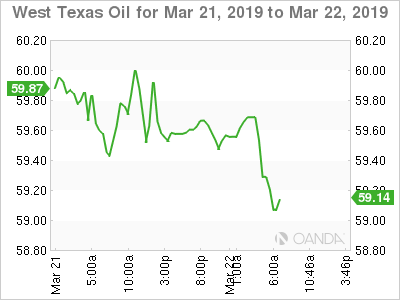
Brent crude oil futures are at +$67.92 per barrel, +6c above Thursday’s close. Brent hit a four-month high of +$68.69 per barrel yesterday. U.S West Texas Intermediate (WTI) futures are at +$60.04 per barrel, up +5c. WTI printed a 2019 high in Thursday’s session at +$60.39.
Market consensus believes that OPEC is likely to extend its current supply cut deal for the duration of 2019 when they next meet in Vienna in June. Russia has been a reluctant partner in the supply cuts but is expected to opt to preserve the deal and retain a leadership role within the group that accounts for +45 % of total global oil output.
Support for the ‘black stuff’ has also come from U.S sanctions against OPEC-members Iran and Venezuela.
Note: Iranian crude oil shipments have averaged just over +1M bpd this month, down from +1.3M bpd in February, while in Venezuela, production has plummeted from +3M bpd in 2000 to +1M bpd in 2019.
Ahead of the U.S open, gold has extended its losses, moving further away from its three-week high print from yesterday, as appetite for some risk improved on upbeat U.S economic data. The ‘yellow’ metal remains on course for a third consecutive weekly gain.
Spot gold is down -0.1% at +$1,308.26 per ounce, after touching its highest since Feb. 28 at +$1,320.22 Thursday. The metal has rallied +0.5% so far this week. U.S gold futures are flat at +$1,307.50 an ounce.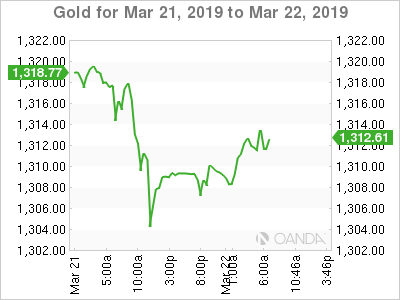
3. German Bunds yields turn negative
The German 10-year Bund yield turned temporarily negative this morning for the first time in three-years (October 2016), after poor manufacturing data (see below) fuelled concerns about slowing growth in the eurozone’s largest economy.
The German 10-year government bond yield hit a day’s low of -0.001% Germany’s manufacturing sector had contracted for the third consecutive month.
Elsewhere, the yield on 10-year Treasuries fell -1 bps to +2.53%, while in Japan the 10-year JGB yield dipped -3 bps to -0.069% on the biggest pullback in three-months after disappointing data overnight.
Note: Japan’s National CPI came in a tad light – +0.2% vs. +0.3%e y/y; CPI ex-fresh food +0.7% vs. +0.8%e vs. +0.8% prior. Japan’s March Preliminary PMI Manufacturing was 48.9 vs. 49.9e (second consecutive contraction).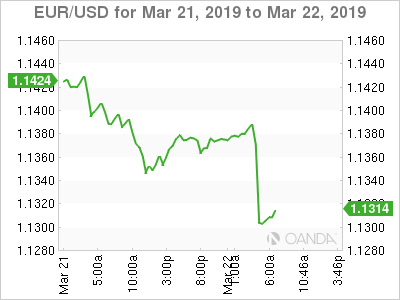
4. Dollar supported by risk aversion trading
Weaker EU PMI data this morning – French, German and Eurozone all in contraction – has encouraged risk aversion flows. The EUR has declined over -0.63% outright ahead of the U.S open to probe back below the psychological €1.13 to a one-week low of €1.1289.
GBP/USD continues its volatile Brexit ways. The pound saw its initial gains eroded back to test below £1.31, where it has found some support after EU stepped up to avoid a hard Brexit from occurring next week and gave the U.K an extra two week of an ‘unconditional extension’ now set at Apr 12. If the U.K parliament agrees on PM May’s deal, the U.K. will leave the EU on May 22. If it doesn’t, the U.K. will either ask for a longer Brexit extension or crash out without a deal on April 12, the new deadline for Brexit.
USD/JPY is lower on safe-haven flows to test ¥110.48 in the session.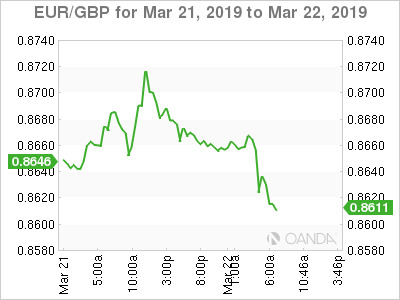
5. German manufacturing contracts further
Data this morning from IHS Markit showed that Germany’s export-heavy manufacturing sector fell deeper into contraction this month.
Its German manufacturing PMI fell to 44.7 from 47.6 in February, which marks the lowest level in over six-and-a-half years. The index has now fallen in 14 of the past 15 months.
“The downturn in Germany’s manufacturing sector has become more entrenched, with March’s flash data showing accelerated declines in output, new orders and exports,” IHS Markit economist Phil Smith says.
The latest set of national and eurozone purchasing managers’ data should certainly add to downside risks for the EU’s economy and increase further pressure on the ECB.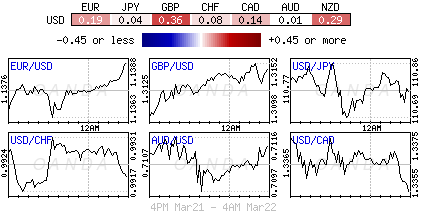
EUR/USD Analysis: Trades Sideways
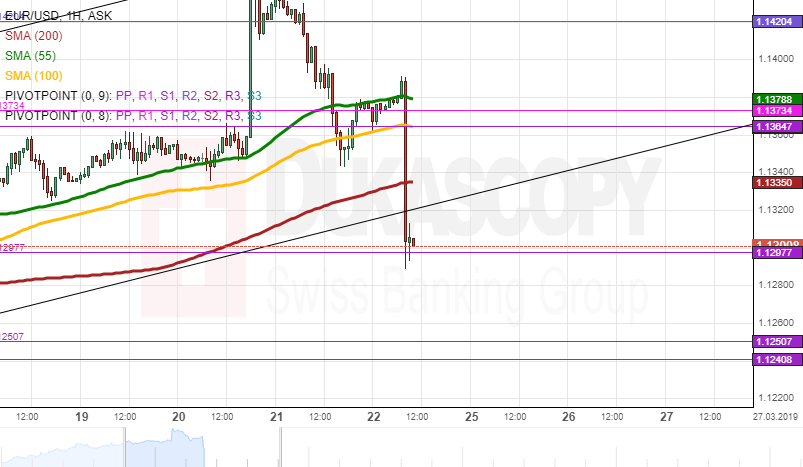
During Thursday's trading session, the European Single Currency passed the support levels of the 55-hour and the 100-hour simple moving averages to end the trading session at 1.3800. On Friday morning, the rate passed through the support level of the 200-hour SMA to trade at the 1.1324 mark.
In regards to the near-term future, most likely, the rate will trade sideways to stay at the 1.1300 level. Besides, the rate might slump to the weekly PP at 1.2977.
On the other hand, the currency exchange rate might get retraced by the 200-hour SMA to pass the support level of the weekly pivot point.
GBP/USD Analysis: Highly Volatiles
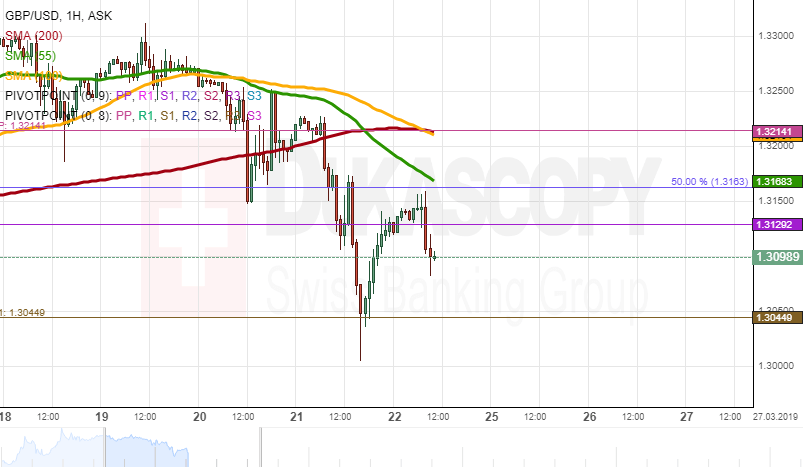
During Thursday's trading session, the currency exchange rate dropped by 107 pips or 0.81% to reach the weekly S1 at 1.3044. On Friday morning, the rate was retraced by the 50.00% Fibo to the 1.3115 mark.
It is challenging to predict movements of the GBP/USD currency pair due to high volatility caused by Brexit deal uncertainties.
Most likely, the British Pound will keep depreciating against the US Dollar towards the weekly S1 at the 1.3044 mark. It is expected that the rate could stay at the 1.3050 level until the end of the trading session.