

Sample Category Title
Sunset Market Commentary
Markets
Global core bonds put in another strong performance today. Disastrous EMU PMI’s personify European (and US) central bankers’ biggest growth slowdown fears. Manufacturing gauges sank to 7-yr lows, deep into contraction territory. Forward looking indicators don’t bode well for the start of Q2. The Bund started a new upleg, dipping the German 10-yr yield into negative territory for the first time since October 2016. US yields followed swiftly. The decline accelerated as the US 10-yr yield fell through the key 2.5% support area. The US 3-month/10-yr yield spread turned negative for the first time since 2007. The past cycles, this proved to be a harbinger for a coming recession. Other markets followed the risk-off trade resulting in losses on stock markets, a firmer dollar and wider peripheral bond spreads. The German yield curve bull flattens at the time of writing with yields declining 1.1 bp (2-yr) to 8.9 bps (30-yr). The US yield curve shifts 6.7 bps (2-yr) to 8.4 bps (10-yr) lower. Peripheral yield spread changes vs Germany widen by 3 bps (Spain) to 9 bps (Greece).
As was the case for most other markets, trading in the major FX cross rates was driven by the publication of the EMU March PMI’s this morning. The manufacturing PMI’s in France, Germany and the entire EMU unexpectedly printed in contraction territory. The move in the first place affected EMU assets. European equities, core yields and the euro nosedived. However, the data also fueled fears on global growth triggering a broad-based risk-off reaction. EUR/USD dropped a full big figure and filled bids in the 1.1290 area. The risk-off and the decline in global core yields also hit USD/JPY and EUR/JPY. The former declined to currently trade in the low 110 area. EUR/JPY was hit hard an tumbled from the 126+ levels to the 124.30 area. So, the EUR/USD cross rate had a roller-coaster ride as investors were pushed back and forth by both a soft Fed and weak EMU eco data. However, in a weekly perspective, the EUR/USD cross rate is trading little changed compared to where it was this time last week. So, maybe there is still some kind of balance in the relative expectations on EMU and US growth and the consequences for monetary policy of the Fed and the ECB. Both are seen as having ever more reason to take a soft wait-and-see approach.
The poor EMU PMI’s also outweighed Brexit as a driver for EUR/GBP trading today. The pair traded in in the 0.8670 area early in European dealings as investors pondered to consequences of the short Brexit delay (from 29 March to 12 April) that UK PM May received from the EU if she fails to get her deal approved in Parliament. However, the market focus turned from GBP-doubts to an outright euro sell-off after the publication of the EMU PMI’s. EUR/GBP is currently trading in the 0.8565 area. Regarding the sterling side of the story, the UK currency again showed quite resilience in the wake of yesterday’s EU summit. The UK buying some time to reconsider its Brexit options also gave sterling some comfort short-term. Cable traded with a cautious upward intraday bias. The pair is trading in the 1.3190 area.
News Headlines
Canadian headline inflation accelerated slightly to 1.5% YoY (0.7% MoM) in February vs. 1.4% last month, beating expectations. Core measures (on average) slowed marginally compared to January. January retail sales disappointed, triggering a brief loss of the loonie before recovering soon after.
EMU PMI confidence nosedived in March. With the exception of France, the services sector (52.7) in the EMU holds op fairly well but manufacturing confidence (47.6) is waning fast. More worryingly is the sharp deterioration of forward looking subcomponents. Fading business optimism, stagnating hiring intentions and depleted backlogs do not bode well for growth going forward.
US PMI manufacturing dropped to 21-month low, gap opening up with services
In March, US PMI manufacturing dropped to 52.5, down from 53.0 and missed expectation of 53.6. That's the lowest level in 21 months. PMI services dropped to 54.8, down from 56.0 and missed expectation of 55.8. PMI composite dropped to 54.3, down from 55.5. That's a 6-month low too.
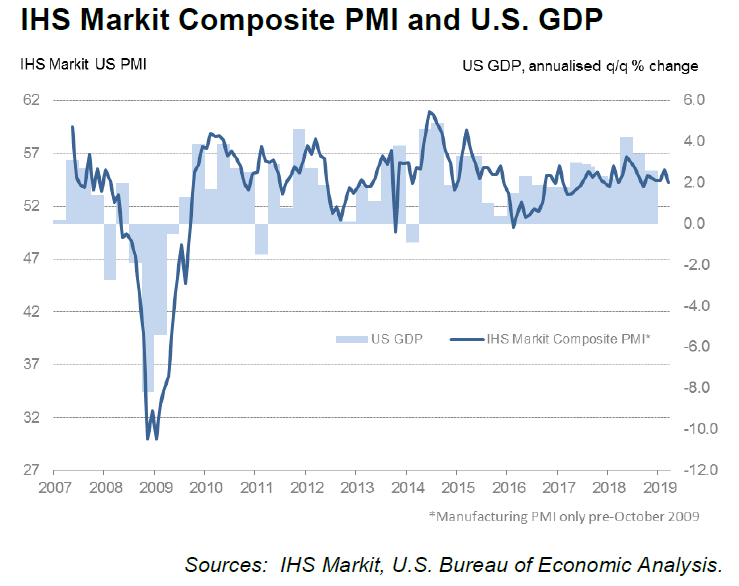
Commenting on the flash PMI data, Chris Williamson, Chief Business Economist at IHS Markit said:
"US businesses reported a softer end to the first quarter, with output growth easing to the second lowest recorded over the last year. The PMI survey data nevertheless remain encouragingly resilient, indicative of the economy growing at an annualised rate in excess of 2% in the first quarter, suggesting some potential upside to many current growth forecasts.
"A gap has opened up between the manufacturing and service sectors, however, with goods-producers and exporters struggling amid a deteriorating external environment and concerns regarding the impact of trade wars. The survey is consistent with the official measure of manufacturing production falling at an increased rate in March and hence acting as a drag on the economy in the first quarter.
"At the moment, the service sector appears to be holding up relatively well. But the worry is that manufacturing woes are spreading to service providers, via reduced demand for services such as transport and storage as well as deteriorating business optimism about the outlook – which fell to the lowest for nearly three years in March – and a cooling of the labour market. The survey showed hiring across both manufacturing and services hit the weakest for just under two years in March.
"Price pressures have meanwhile cooled alongside the slowdown. Input prices – a key leading indicator of inflation trends – rose at the slowest rate for two years."
Canadian CPI Edged Higher in February But Remains Well Short of 2%
- Headline CPI edged up to 1.5% year-over-year from 1.4% in January, slightly ahead of market expectations.
- The BoC’s core inflation measures were little changed, though the average dipped to 1.8% after rounding. After rising to 2% in early-2018, these measures have shown little upward momentum—consistent with the economy reaching capacity but not going much beyond its limits.
- There were few surprises in the details. We saw the usual seasonal increases in travel services and clothing prices. Rent and airfares, which have been volatile due to methodology changes, didn’t stand out in February.
- The drag from energy lessened as gasoline prices rose month-over-month in February (for the first time since last July). Disinflationary pressure from energy prices should continue to ease but headline inflation will likely remain below 2% through the summer.
- Food price inflation hit a nearly 3-year high, with fresh vegetable prices rising double digits from a year earlier.
Headline inflation may have found its near-term bottom, but we don’t expect a lot of upward pressure in the coming months. That’s a bit of good news for Canadian households who, according to this morning’s retail numbers, have been reluctant to spend. Not only does low inflation mean their incomes will go further; steady core inflation will make for a patient Bank of Canada. That means less upward pressure on borrowing costs this year. Still, higher debt payments than in recent years will remain a headwind for consumer spending.
Canadian Retail Sales Still Soft in January
- Retail sales dipped 0.3% in January as auto sales fell and gasoline prices declined.
- Excluding prices, volume sales were unchanged for a second straight month in January. They are still up 1.8% year-over-year but have been essentially unchanged over the last 6 months.
Our Take:
The January retail numbers were mixed. Declines were only posted in 4 subsectors, and sales inched up slightly excluding motor vehicle sales. But volume sales were unchanged, and have been essentially unchanged over the last 6 months. Stronger reports for the manufacturing and wholesale sectors still mean that overall GDP growth may have moved back into the positive column in January – even with a pullback in oil production with mandated production cuts in Alberta kicking in. But the retail numbers add to the evidence that rising debt service costs and slower housing markets are slowing household spending growth. We still don’t expect a repeat of the Q4 softness – when consumer spending rose just 0.7% (at an annualized rate) and residential investment fell almost 15%. But household spending can no longer be counted on to drive above-trend economic growth in Canada.
USD/JPY Mid-Day Outlook
Daily Pivots: (S1) 110.43; (P) 110.69; (R1) 111.09; More...
USD/JPY's decline continues and reaches as low as 110.00 so far. Break of 110.35 support indicates that rebound from 104.69 has completed at 112.13 already. Intraday bias is now on the downside for 38.2% retracement of 104.69 to 112.13 at 109.28 first. Break will target 61.8% retracement at 107.53 next. On the upside, break of 110.95 minor resistance will turn bias back to the upside for retesting 112.13 instead.
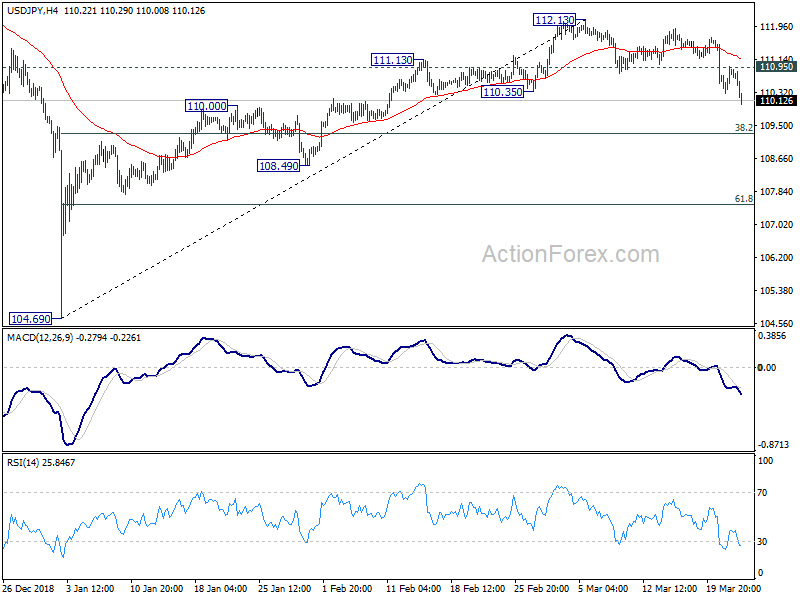
In the bigger picture, strong rebound from 104.69 argues that decline from 118.65 (2016 high) has completed with three waves down to 104.69, after failing 104.62. More importantly, the rise from 98.97 (2016 low) could be resuming. Decisive break of 114.54 resistance will add more credence to this bullish case and target 118.65. This will now be the favored case as long as 110.35 support holds. However, sustained break of 110.35 will mix up the medium term outlook again and turn focus back to 104.69 low.
USD/CHF Mid-Day Outlook
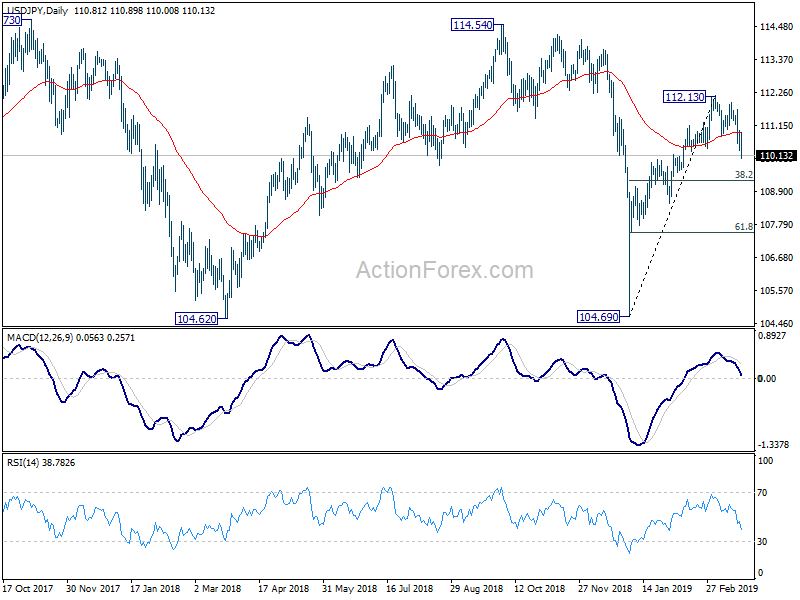
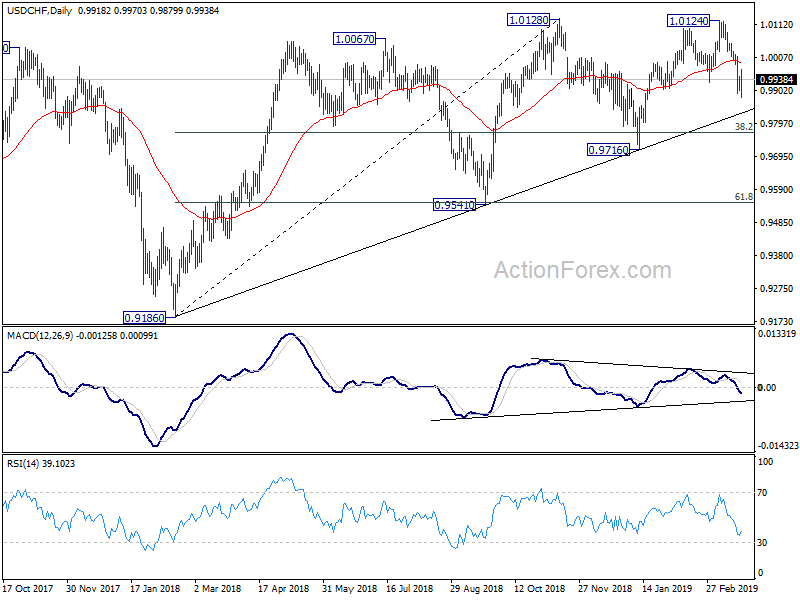
Daily Pivots: (S1) 0.9900; (P) 0.9923; (R1) 0.9943; More.....
With 4 hour MACD crossed above signal line, intraday bias in USD/CHF is turned neutral first. Another fall is mildly in favor with 1.0010 minor resistance intact. On the downside, below 0.9879 will resume the fall from 1.0124 to 0.9716 key support. Nevertheless, break of 1.0010 will turn bias back to the upside for 1.0124/28 resistance zone.
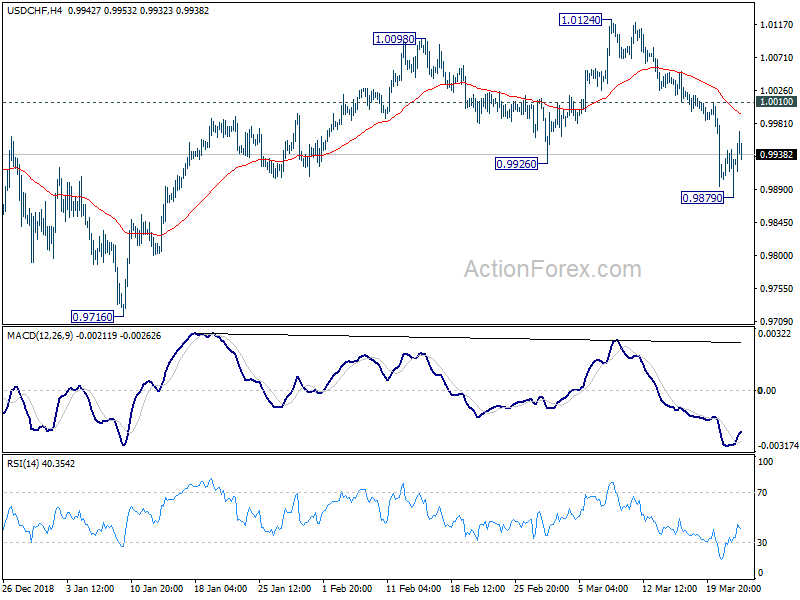
In the bigger picture, focus is back on medium term trend line (now at 0.9803). Decisive break there argue that whole rise from 0.9186 has completed. Further break of 0.9716 will confirm reversal and target next next support level at 0.9541. Nevertheless, there is still a chance that price action from 1.0128 are forming a consolidative pattern with fall from 1.0124 as third leg. If this is the case, stronger support should be seen between 0.9716 and the trend line to contain downside.
GBP/USD Mid-Day Outlook
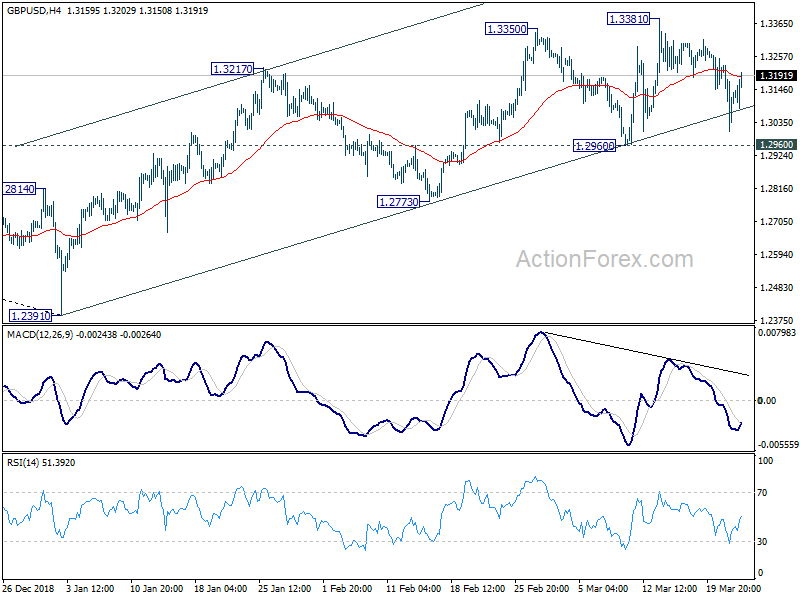
Daily Pivots: (S1) 1.2999; (P) 1.3114; (R1) 1.3223; More....
GBP/USD recovers ahead of 1.2960 support but upside is limited below 1.3381 resistance. Intraday bias remains neutral first and more consolidation could be seen. But with 1.2960 intact, further rise is in favor. On the upside, firm break of 1.3381 will target 61.8% retracement of 1.4376 to 1.2391 at 1.3618 next. However, on the downside, firm break of 1.2960 will indicate that rebound from 1.2391 has completed earlier than expected. Deeper fall would then be seen to 1.2773 support for confirmation.
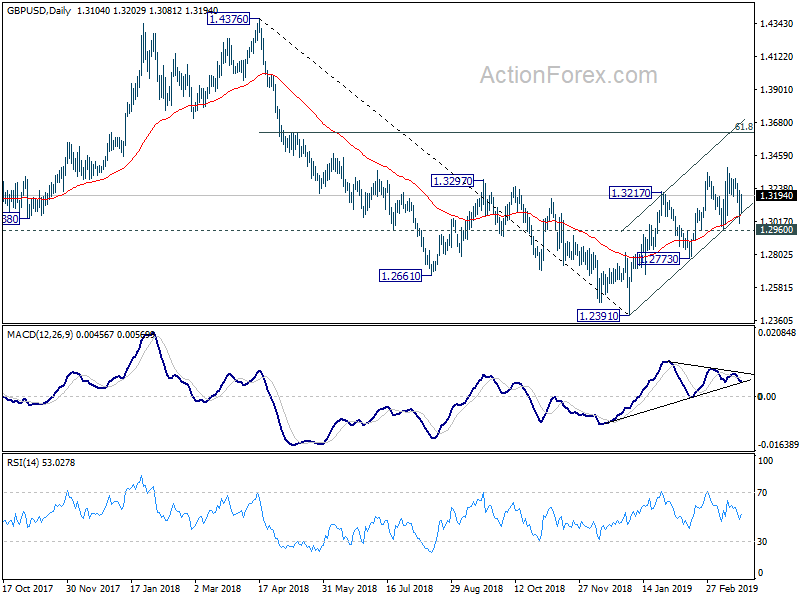
In the bigger picture, medium term decline from 1.4376 (2018 high) should have completed at 1.2391. Rise from 1.2391 is now seen as the third leg of the corrective pattern from 1.1946 (2016 low). Further rise could be seen through 1.4376 in medium term. On the downside, though, break of 1.2773 support will dampen this view. Focus will be turned back to 1.2391 low and break will resume the fall from 1.4376 to 1.1946.
EUR/USD Mid-Day Outlook
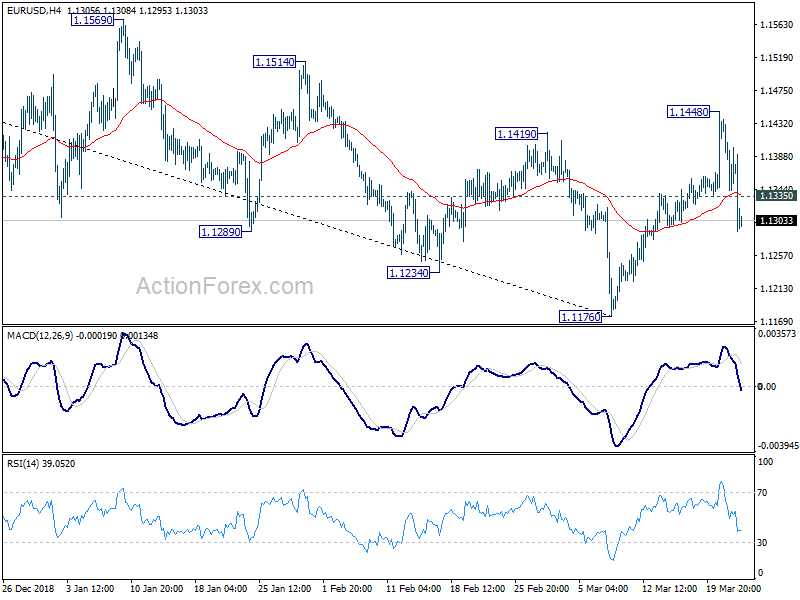
Daily Pivots: (S1) 1.1329; (P) 1.1384; (R1) 1.1429; More.....
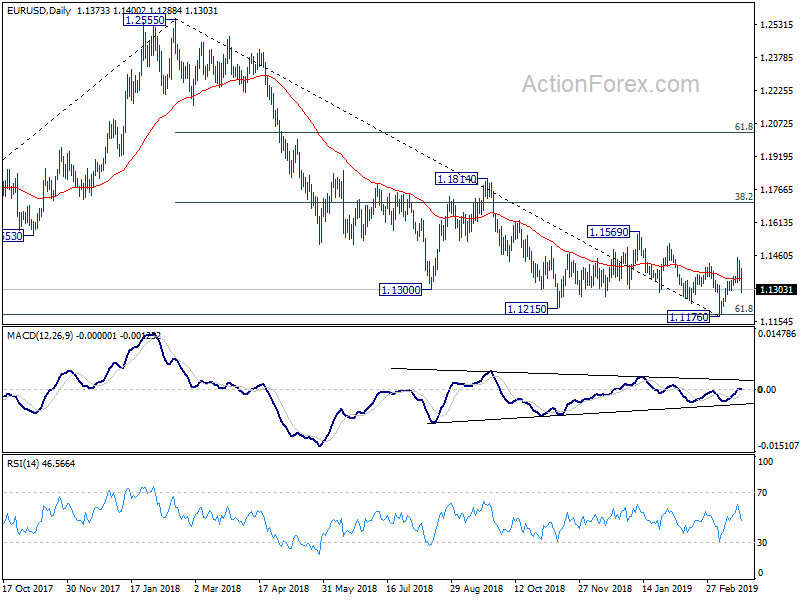
EUR/USD's sharp decline today and break of 1.1335 minor support suggests that rebound from 1.1176 has completed at 1.1148. The development dampened prior bullish view. Intraday bias turned back to the downside for retesting 1.1176 low first. On the upside, break of 1.1448 will extend the rebound to 1.1514/1569 resistance zone first.
In the bigger picture, current development suggests that a medium term bottom could be formed at 1.1176 already. That came after hitting 61.8% retracement of 1.0339 (2016 low) to 1.2555 (2018 high) at 1.1186, on bullish convergence condition in daily MACD. Further rally could be seen back to 38.2% retracement of 1.2555 to 1.1176 at 1.1703. It's a bit early to confirm medium term bullish reversal. The structure of the rise from 1.1176 and reaction to 1.1703 fibonacci level will be watched for making an assessment later. But in any case, decisive break of 1.1176 is needed to confirm resumption of down trend. Otherwise, outlook is neutral at worst.
Euro Dives as German Data Prompts Recession Fear, 10-Year Bund Yield Turned Negative
Fears of global recession intensify after shockingly poor German manufacturing data. Major European indices are all trading in red while DOW is down more than 100 pts at initial trading. More importantly, German 10-year bund yield turns negative for the first time since 2016. The most accurate indicator of US recession, 3-month to 10-year US yield curve, inverts, as 10-year yield drops through 2.5 handle. Risk aversion will likely be a major theme before weekly close.
In the currency markets, Euro is the weakest one today as selloff accelerates after German data. Canadian Dollar is the second weakest, suffering some pressure after poor retail sales data. Swiss Franc is the third weakest, as dragged down by Euro. Yen is the strongest one today so far on risk aversion naturally. Sterling is the second strongest for today, as supported by the two extra week of Brexit lifeline granted by EU. Dollar is the third strongest, mainly thanks to weakness elsewhere.
In Europe, FTSE is down -1.26%. DAX is down -0.81%. CAC is down -1.34%. German 10-year bund yield is down -0.050 at -0.006. It hit as high as 1.2 just earlier this week. Earlier in Asia, Nikkei rose 0.09%. Hong Kong HSI rose 0.14%. Singapore Strait Times dropped -0.05%. Japan 10-year JGB yield dropped -0.037 to -0.072.
Eurozone PMI manufacturing dropped to 47.6, 71-month low with sharp contraction in trade flows
In March, Eurozone PMI manufacturing dropped to 47.6, down from 49.3 and missed expectation of 49.5. That's also the lowest level in 71 months. PMI services dropped slightly to 52.7, down from 52.8, matched expectations. PMI composite dropped to 51.3, down from 51.9.
Chris Williamson, Chief Business Economist at IHS Markit said: "The survey indicates that GDP likely rose by a modest 0.2% in the opening quarter, with a decline in manufacturing output in the region of 0.5% being offset by an expansion of service sector output of approximately 0.3%... Most worrying is the plight of the manufacturing sector, which is now in its deepest downturn since 2013 as trade flows contracted at the sharpest rate since the debt crisis-ridden days of 2012.
Also: "Forward-looking indicators such as business optimism and backlogs of work suggest that growth could be even weaker in the second quarter... Any such further loss of growth momentum in the second quarter compared to the 0.2% GDP rise signalled for the first three months of the year would raise doubts on the economy's ability to grow by more than 1% in 2019."
Germany PMI manufacturing dived to 44.7, entrenched downturn with steepest contraction since 2012
In March, Germany PMI manufacturing dropped sharply to 44.7, down from 47.6 and missed expectation of 48.0. That's also the lowest level in 79 months. PMI services dropped to 54.9, down from 55.3 but beat expectation of 54.8. PMI composite dropped to 51.5, down from 52.8, hit a 69-month low.
Phil Smith, Principal Economist at IHS Markit said: "The downturn in Germany's manufacturing sector has become more entrenched, with March's flash data showing accelerated declines in output, new orders and exports. Uncertainty towards Brexit and US-China trade relations, a slowdown in the car industry and generally softer global demand all continue to weigh heavily on the performance of the manufacturing sector, which is now registering the steepest rate of contraction since 2012.
France PMIs: Contraction in both manufacturing and services
In March, France PMI manufacturing dropped to 49.8, down from 51.5 and missed expectation of 51.4. PMI services dropped to 48.7, down from 50.2 and missed expectation of 50.6. PMI composite dropped to 48.6, down from 50.4.
Eliot Kerr, Economist at IHS Markit said: "At the end of the first quarter, the French private sector was unable to continue the recovery seen in February, as both the manufacturing and service sectors registered contractions in business activity. Worryingly, new orders continued to tumble amid a slowdown in demand and downward momentum in new export business. New work from abroad fell at the fastest pace for nearly three years, with a broad-based decline across both sectors."
EU approved short Brexit extension, cliff edge delayed to April 12
At the European Council meeting in Brussels yesterday, EU approved a short Brexit extension for UK to decide which way they'd choose to go. If not Brexit deal is approved by the House of commons, The extension will be until April 12, when UK has to indicate a way forward. If a Brexit deal is approved, the extension will be until May 22. The offer is accepted by UK Prime Minister Theresa May.
EU President Donald Tusk said "the cliff edge will be delayed", adding that "I was really sad before our meeting, now I'm much more optimistic." He also noted, until April 12, "all options will remain open" and "the UK government will still have a choice between a deal, no deal, a long extension or revoking Article 50 "
May said after the summit that "what the decision today underlines is the importance of the House of Commons passing a Brexit deal next week so that we can bring an end to the uncertainty and leave in a smooth and orderly manner". She added "tomorrow morning, I will be returning to the U.K. and working hard to build support for getting the deal through."
Canadian retail sales dropped -0.3%, CPI ticked up to 1.5%
Canadian Dollar weakens after weaker than expected retail sales data. Headline sales dropped -0.3% mom in January, below expectation of 0.4% mom. Ex-auto sales rose 0.1% mom, matched consensus.
Headline CPI accelerated to 1.5% yoy, up from 1.4% yoy and beat expectation of 1.4% yoy. CPI core-common slowed to 1.8% yoy, down from 1.9% yoy, matched expectations. CPI core-media was unchanged at 1.8% yoy. CPI core-trim was unchanged at 1.9% yoy.
Trump said he won't drop auto tariffs to zero even if EU proposes so
In a Fox Business interview, Trump repeated that EU is treating the US as bad as China in terms of trade. And, asked if he would agree to zero tariffs on autos if the EU proposed so, Trump said "no". He added, "I would do it for certain products, but I wouldn't do it for cars." Trump is again inconsistent with what he said before. Apparently, he's not that much of a free trade advocate as he proclaimed.
In the G7 summit last June, Trump surprised other leaders and called for dropping all tariffs, trade barriers and subsidies. He said that "Ultimately that's what you want, you want tariff free, no barriers, and you want no subsides because you have some countries subsidizing industries and that's not fair". And, "so you go tariff free, you go barrier free, you go subsidy free, that's the way you learned at the Wharton School of Finance."
Economic advisor Larry Kudlow also aid "I don't know if they were surprised with President Trump's free trade proclamation, but they certainly listened to it and we had lengthy discussions about that... "As the president said, reduce these barriers, in fact go to zero, zero tariffs, zero non-tariff barriers, zero subsidies, and along the way we're going to have to clean up the international trading system."
Japan CPI core slowed to 0.7% yoy, drifting away from BoJ's target
Japan national CPI core (all items less fresh food) slowed to 0.7% yoy in February, down from 0.8% yoy and missed expectation of 0.8% yoy. CPU core-core (all items less food and energy) remained sluggish at 0.4% yoy, unchanged from January. Headline all items CPI was unchanged at 0.2%.
Despite BoJ's massive monetary stimulus, there is no sign for CPI core to achieve the 2% target. And even worse, it's actually moving farther away from the goal. Sluggish core-core reading is providing no help too. Moreover, there are risks of drag by slowdown in overseas economy. For now, there is practically no case for BoJ to exit ultra-loose policy any time soon.
Japan PMI manufacturing unchanged at 48.9, sustained downturn
Japan PMI manufacturing was unchanged at 48.9 in March, missed expectation of 48.9. Markit noted there are "further production cutbacks amid weaker new order inflows". Also, "business confidence remains below long-run average".
Joe Hayes, Economist at IHS Markit, said: "Further struggles for Japanese manufacturers were apparent at the end of Q1, with latest flash PMI data showing a sustained downturn. Slack demand from domestic and international markets prompted the sharpest cutback in output volumes for almost three years. With input purchasing falling, firms appear to be anticipating further troubles in the short-term. Indeed, concern of weaker growth in China and prolonged global trade frictions kept business confidence well below its historical average in March."
EUR/USD Mid-Day Outlook
Daily Pivots: (S1) 1.1329; (P) 1.1384; (R1) 1.1429; More.....
EUR/USD's sharp decline today and break of 1.1335 minor support suggests that rebound from 1.1176 has completed at 1.1148. The development dampened prior bullish view. Intraday bias turned back to the downside for retesting 1.1176 low first. On the upside, break of 1.1448 will extend the rebound to 1.1514/1569 resistance zone first.
In the bigger picture, current development suggests that a medium term bottom could be formed at 1.1176 already. That came after hitting 61.8% retracement of 1.0339 (2016 low) to 1.2555 (2018 high) at 1.1186, on bullish convergence condition in daily MACD. Further rally could be seen back to 38.2% retracement of 1.2555 to 1.1176 at 1.1703. It's a bit early to confirm medium term bullish reversal. The structure of the rise from 1.1176 and reaction to 1.1703 fibonacci level will be watched for making an assessment later. But in any case, decisive break of 1.1176 is needed to confirm resumption of down trend. Otherwise, outlook is neutral at worst.
Economic Indicators Update
| GMT | Ccy | Events | Actual | Forecast | Previous | Revised |
|---|---|---|---|---|---|---|
| 23:30 | JPY | National CPI Core Y/Y Feb | 0.70% | 0.80% | 0.80% | |
| 00:30 | JPY | PMI Manufacturing Mar P | 48.9 | 49.2 | 48.9 | |
| 08:15 | EUR | France Manufacturing PMI Mar P | 49.8 | 51.4 | 51.5 | |
| 08:15 | EUR | France Services PMI Mar P | 48.7 | 50.6 | 50.2 | |
| 08:30 | EUR | Germany Manufacturing PMI Mar P | 44.7 | 48 | 47.6 | |
| 08:30 | EUR | Germany Services PMI Mar P | 54.9 | 54.8 | 55.3 | |
| 09:00 | EUR | Eurozone Manufacturing PMI Mar P | 47.6 | 49.5 | 49.3 | |
| 09:00 | EUR | Eurozone Services PMI Mar P | 52.7 | 52.7 | 52.8 | |
| 09:00 | EUR | Eurozone Current Account (EUR) Jan | 36.8B | 17.3B | 16.2B | |
| 12:30 | CAD | Retail Sales M/M Jan | -0.30% | 0.40% | -0.10% | -0.30% |
| 12:30 | CAD | Retail Sales Ex Auto M/M Jan | 0.10% | 0.10% | -0.50% | -0.80% |
| 12:30 | CAD | CPI M/M Feb | 0.70% | 0.60% | 0.10% | |
| 12:30 | CAD | CPI Y/Y Feb | 1.50% | 1.40% | 1.40% | |
| 12:30 | CAD | CPI Core - Common Y/Y Feb | 1.80% | 1.80% | 1.90% | |
| 12:30 | CAD | CPI Core - Median Y/Y Feb | 1.80% | 1.80% | 1.80% | |
| 12:30 | CAD | CPI Core - Trim Y/Y Feb | 1.90% | 1.80% | 1.90% | |
| 13:45 | USD | US Manufacturing PMI Mar P | 53.6 | 53 | ||
| 13:45 | USD | US Services PMI Mar P | 55.8 | 56 | ||
| 14:00 | USD | Wholesale Inventories M/M Jan | 0.10% | 1.10% | ||
| 14:00 | USD | Existing Home Sales Feb | 5.10M | 4.94M |
Canada: Retail Spending Starts 2019 on the Back Foot
- Retail sales fell 0.3% month-on-month in January. This matched the (downwardly revised) drop in December, and came in below the consensus call for a 0.4% rise. Stripping out price movements, sales volumes were essentially unchanged (-0.0%), with December's initially reported gain revised into negative territory as well.
- Part of the story was down to the auto sector: stripping out sales at auto dealers (-1.5%) and gas stations (-0.4%), sales were up 0.2% in nominal terms. However, the details here were somewhat mixed. The sizeable food and beverage store category was up 0.4% (but flat on a volumes basis), and building material/garden equipment store sales rose 1.4% in both dollar and volume terms.
- On the other side were furniture and home furnishings stores, down 0.4% in dollar terms, and general merchandise store sales were down 2.4%, with the latter creating the largest drag outside of auto dealers.
- Looking across the provinces, Ontario drove much of the decline (down 1.0%), with Manitoba (-2.0%) and Alberta (-1.0%) also notable contributors. Conversely, British Columbia saw a healthy month, with sales up 1.5%.
Key Implications
- Not the best start to the year. Not only did retail sales stumble out of the gate, we also received revisions pointing to less strength than originally reported to close out last year. The culprit again seems to be elevated borrowing costs, with rate sensitive sectors such as auto dealers and furniture stores down on the month.
- This should come as no surprise, and, after some decent reports elsewhere (wholesale trade, manufacturing sales), today's data re-affirms our view that the Canadian economy likely stood still at the beginning of the year (current Q1 GDP tracking: -0.2%). Past interest rate increases seem to be doing their job, sending consumer spending on a softer trajectory as households adjust to higher borrowing costs.
- Indeed, to the extent that today's data hits the Bank of Canada's radar, it will likely serve to provide comfort on their recent shift back to wait and see mode. Our latest Quarterly Economic Forecast sees only modest growth ahead, so Governor Poloz and company may be waiting and seeing for quite a while.