

Sample Category Title
USD/CHF Weekly Outlook
USD/CHF dropped sharply to as low as 0.9879 last week but formed a temporary low there and recovered. Initial bias remains neutral this week first. Another fall is mildly in favor with 1.0010 minor resistance intact. On the downside, below 0.9879 will resume the fall from 1.0124 to 0.9716 key support. Nevertheless, break of 1.0010 will turn bias back to the upside for 1.0124/28 resistance zone.
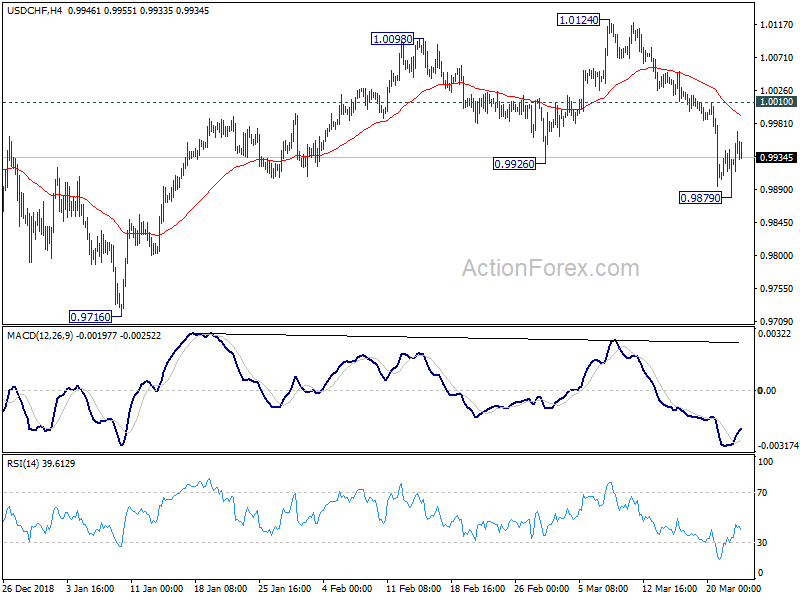
In the bigger picture, focus is back on medium term trend line (now at 0.9846). Decisive break there will argue that whole rise from 0.9186 has completed. Further break of 0.9716 will confirm reversal and target next support level at 0.9541. Nevertheless, there is still a chance that price action from 1.0128 are forming a consolidative pattern with fall from 1.0124 as third leg. If this is the case, stronger support should be seen between 0.9716 and the trend line to contain downside.
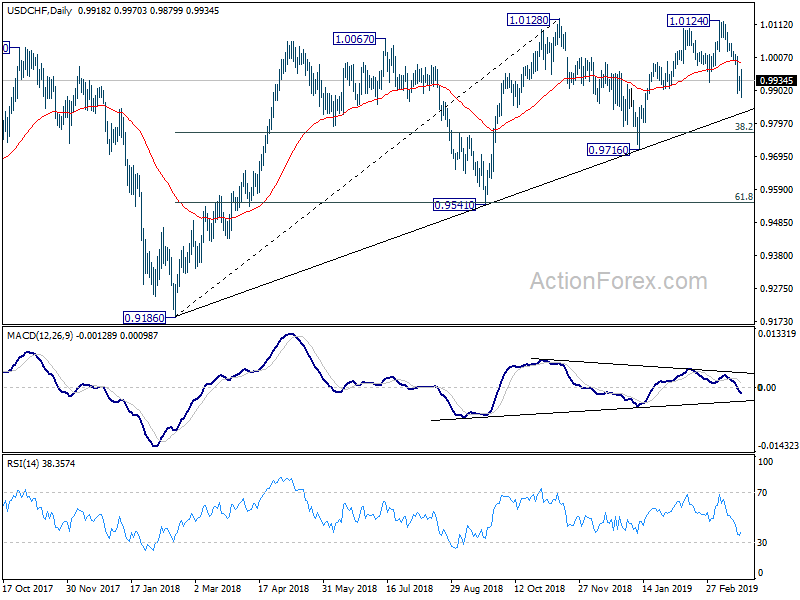
In the long term picture, price actions from 0.7065 (2011 low) are not clearly impulsive yet. Thus, we'll treat it as developing into a corrective pattern, at least, until a firm break of 1.0342 resistance.
AUD/USD Weekly Outlook
AUD/USD rebounded to as high as 0.7168 last week but failed to sustain above 55 day EMA and retreated sharply. Initial bias is neutral this week first. On the downside, break of 0.7056 minor support will turn bias to the downside for 0.7003 first. Break will resume the whole decline from 0.7295. On the upside above 0.7168 will resume the rebound from 0.7003 towards 0.7295 high instead.
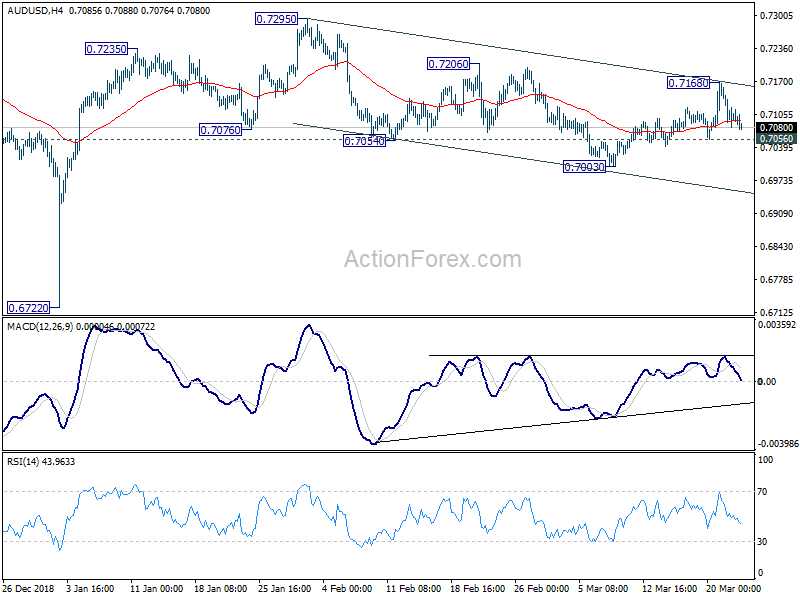
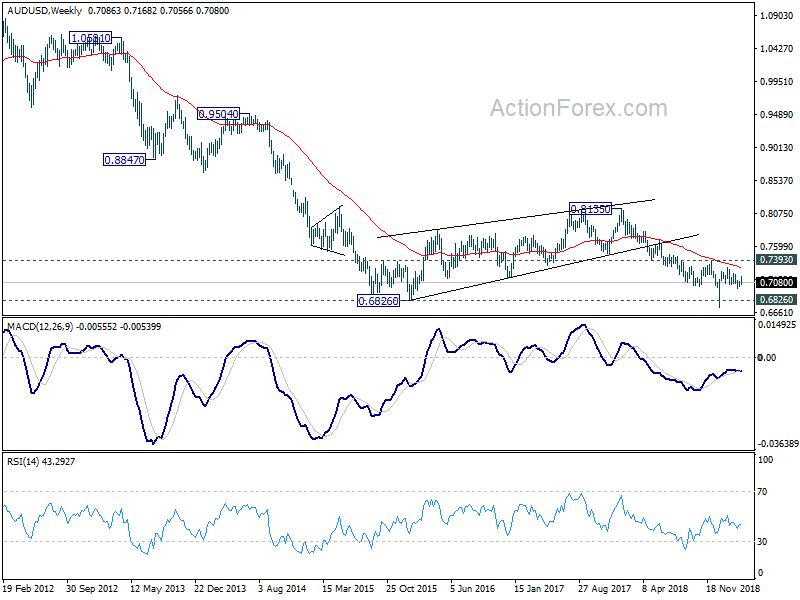
In the bigger picture, as long as 0.7393 resistance holds, we'd treat fall from 0.8135 as resuming long term down trend from 1.1079 (2011 high). Decisive break of 0.6826 (2016 low) will confirm this bearish view and resume the down trend to 0.6008 (2008 low). However, firm break of 0.7393 will argue that fall from 0.8135 has completed. And corrective pattern from 0.6826 has started the third leg, targeting 0.8135 again.
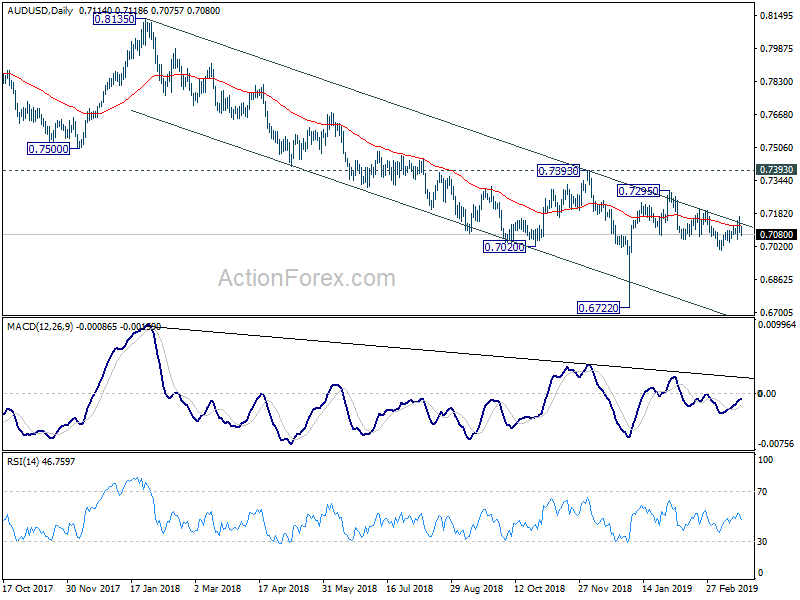
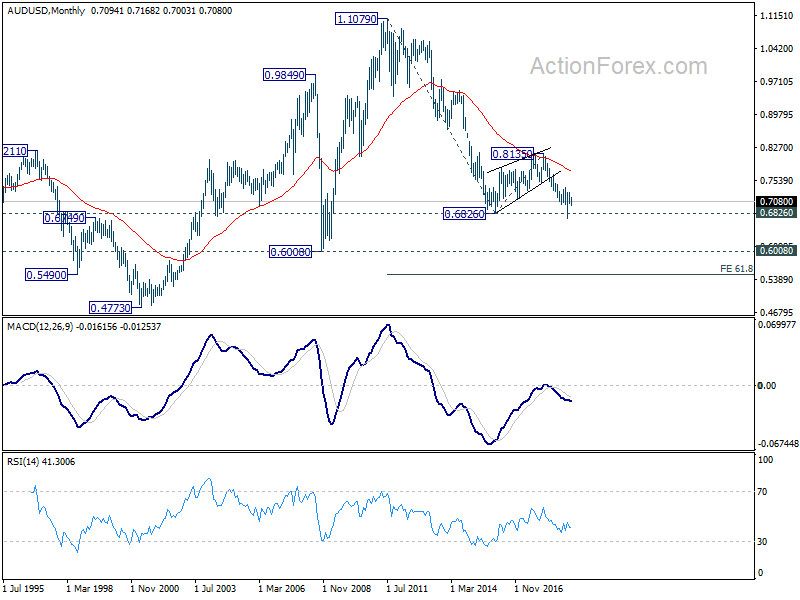
In the longer term picture, prior rejection by 55 month EMA maintained long term bearishness in AUD/USD. That is, down trend from 1.1079 (2011 high) is still in progress. Sustained break of 0.6826 will target 0.6008 low and then 61.8% projection of 1.1079 to 0.6826 from 0.8135 at 0.5507.
USD/CAD Weekly Outlook
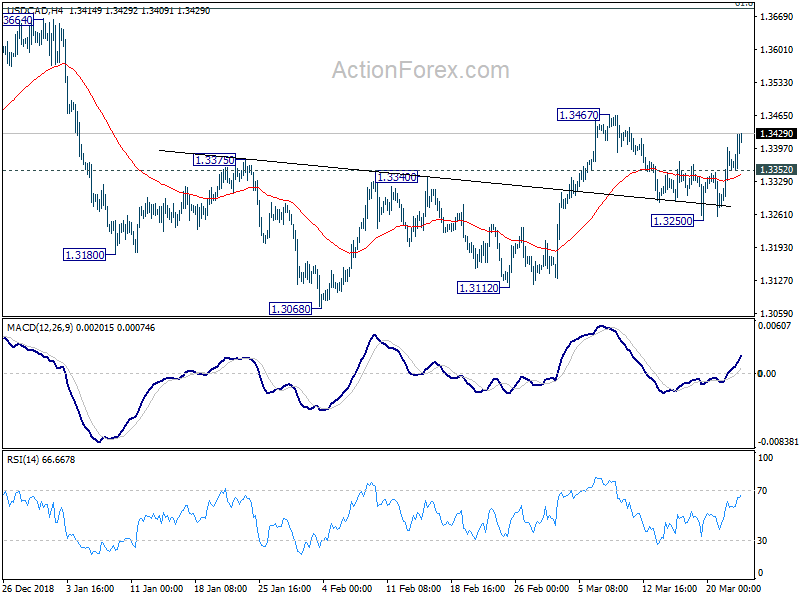
USD/CAD dipped to 1.3250 last week but rebounded strongly afterwards. The development revived near term bullish view that the corrective pull back from 1.3664 has completed at 1.3068. Initial bias is back on the upside this week for 1.3467 resistance first. Break will extend the rise from 1.3068 to retest 1.3664 high. On the downside, break of 1.3352 minor support will turn intraday bias neutral again.
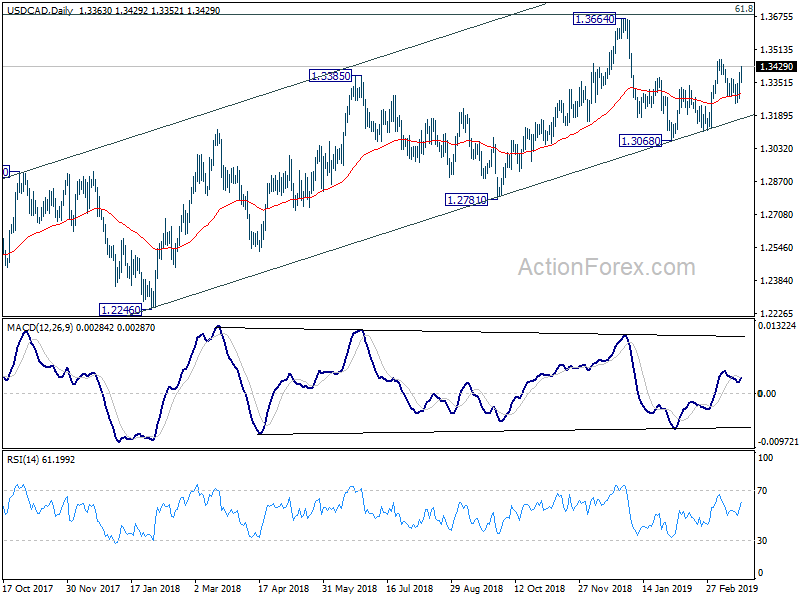
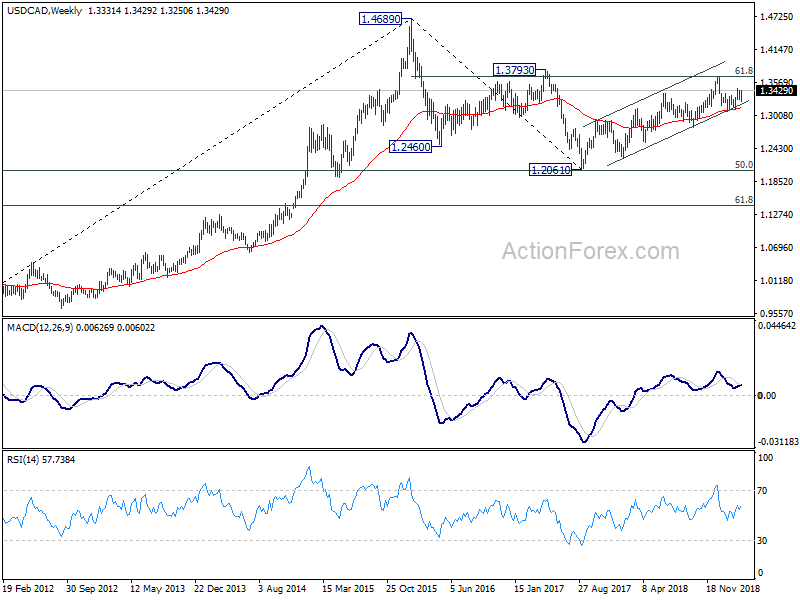
In the bigger picture, structure of the medium term rise from 1.2061 (2017 low) to 1.3664 is not clearly impulsive. Hence, we'd stay cautious on strong resistance from 61.8% retracement of 1.4689 (2016 high) to 1.2061 at 1.3685 and 1.3793 resistance to limit upside, and bring medium term topping. But in any case, medium term outlook will stay bullish as long as channel support (now at 1.3192) holds. Sustained break of 1.3793 will pave the way to retest 1.4689 (2015 high). However, firm break of the channel support should confirm reversal and target 1.2061 low again.
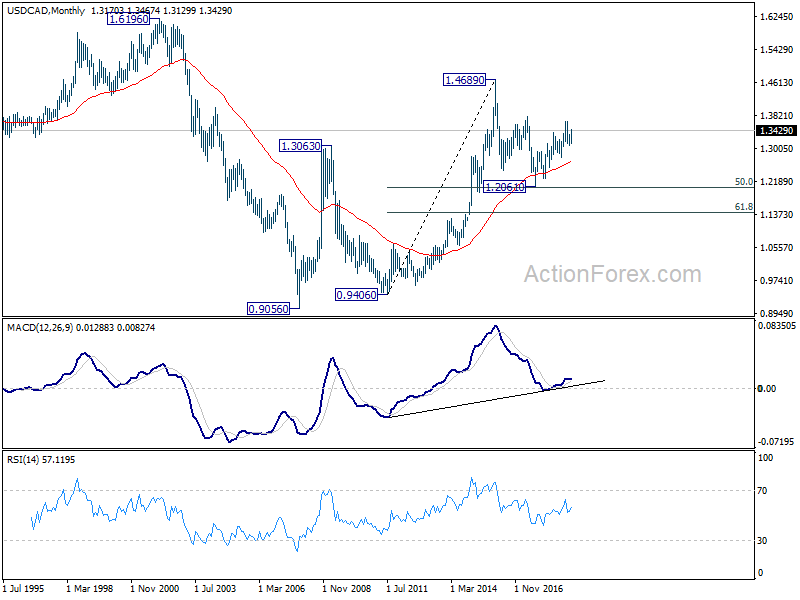
In the longer term picture, corrective fall from 1.4689 (2015 high) should have completed with three waves down to 1.2061, just ahead of 50% retracement of 0.9406 (2011 low) to 1.4689 (2015 high) at 1.2048. The development keeps long term up trend from 0.9406 and that from 0.9056 (2007 low) intact. For now, there is still prospect of extending the long term up trend through 1.4689.
GBP/JPY Weekly Outlook
GBP/JPY's decline from 148.87 extended lower last week but after all, the cross stays above 143.72 support. Initial bias remains neutral this week first. On the upside, decisive break of 149.48 key resistance will carry larger bullish implication and target 156.58 resistance next. On the downside, though, break of 143.72 support will indicate near term reversal and turn outlook bearish for 141.00 support.
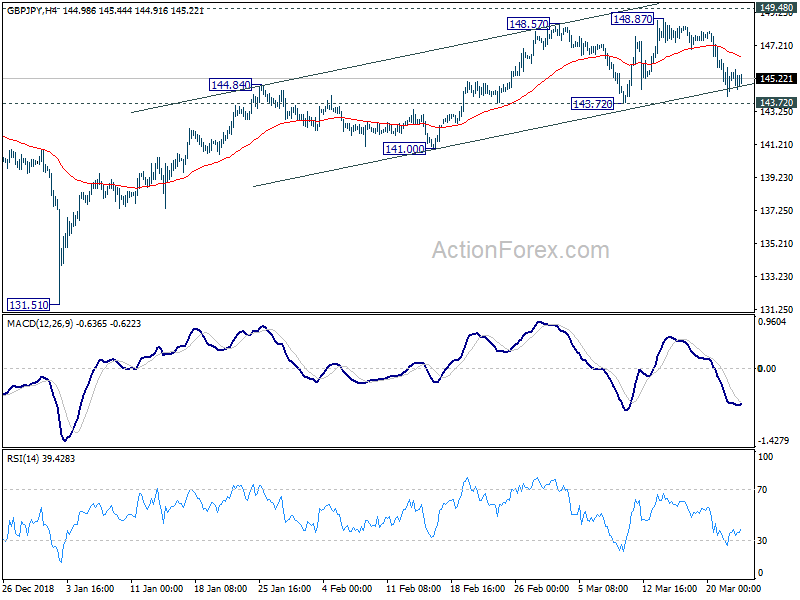
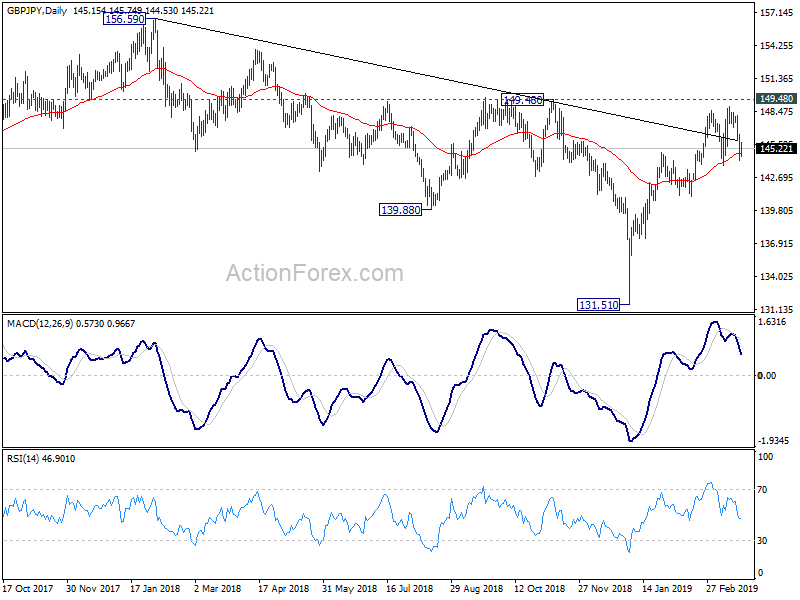
In the bigger picture, focus is now staying on 149.98 key resistance. Decisive break there should confirm that that medium term fall from 156.59 (2018 high) has completed at 131.51 already. Rise from 131.51 is then seen as the third leg of the corrective pattern from 122.36 (2016 low). GBP/JPY should then target 156.59 and above. However, rejection by 149.98 will retain medium term bearishness and could extend the fall from 156.59 through 131.51 to 122.36.
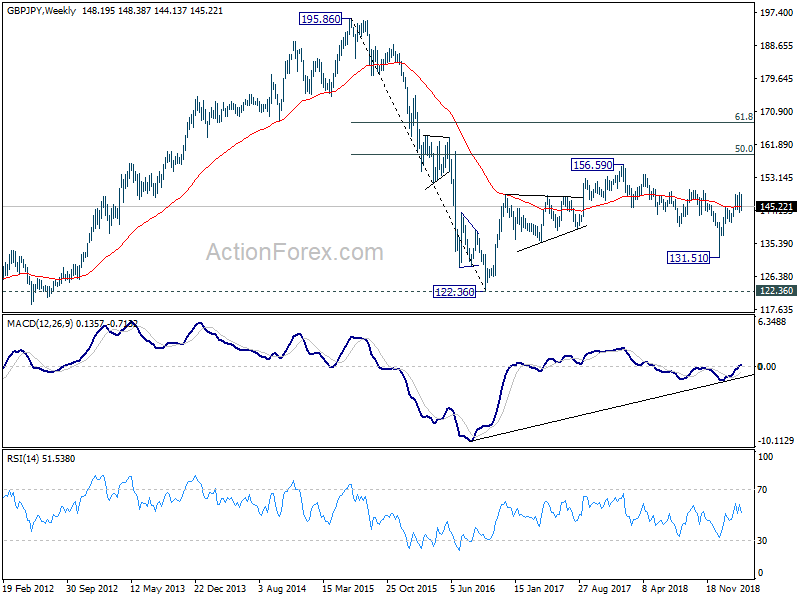
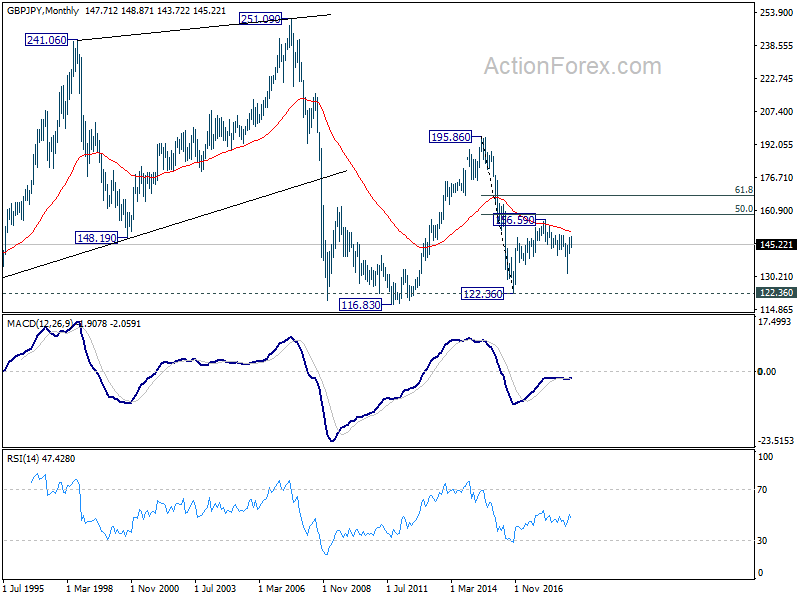
In the longer term picture, the rise from 122.36 (2016 low) to 156.59 (2018 high) doesn't display a clear impulsive structure. Thus, we're treating price actions from 122.36 as a corrective pattern. In case of an extension, strong resistance is likely to be seen at 50% retracement of 195.86 (2015 high) to 122.36 at 159.11 to limit upside. On the downside, break of 131.51 support will bring 122.26 low back into focus.
EUR/JPY Weekly Outlook
EUR/JPY recovered to 126.78 last week but dropped sharply since then. Break of 124.27 support firstly indicates resumption of fall from 127.50. Secondly it argues that rebound from 118.62 might be completed. Initial bias is now on the downside this week for 61.8% retracement of 118.62 to 127.50 at 122.01. On the upside, above 125.08 minor resistance will turn intraday bias neutral first.
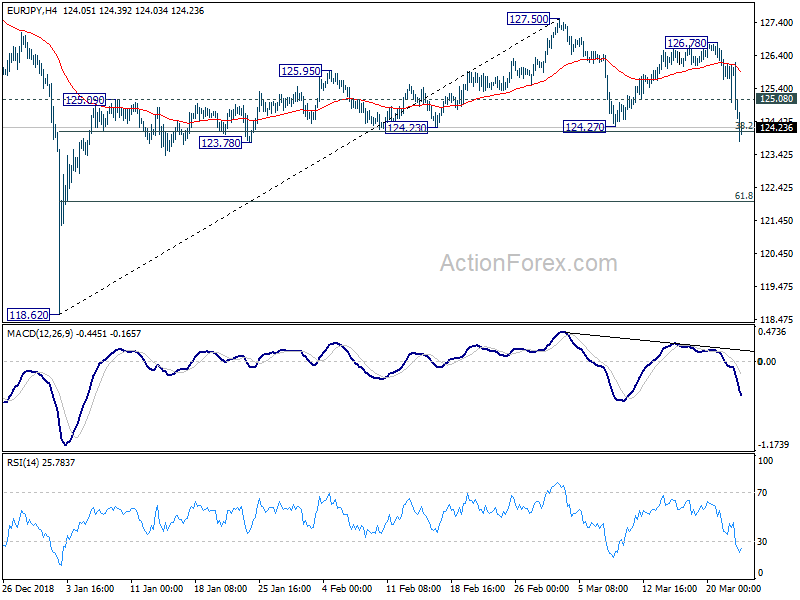
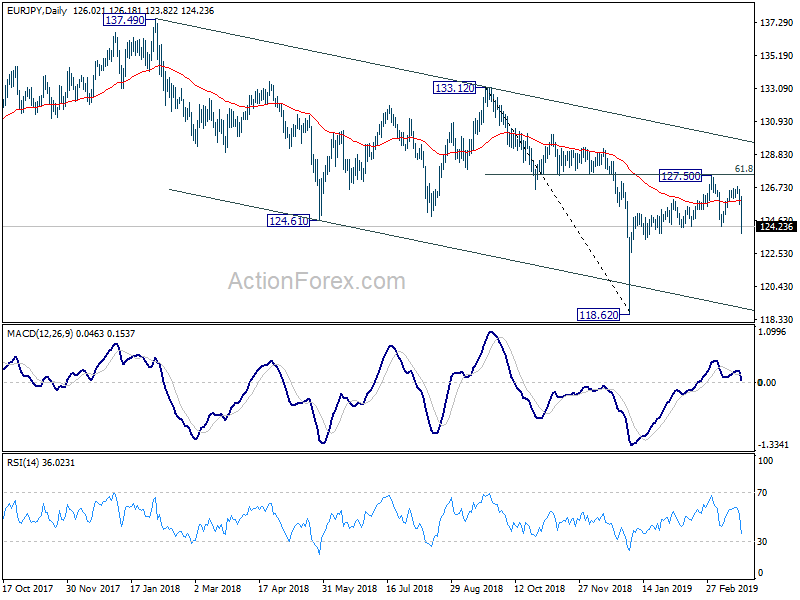
In the bigger picture, rebound from 118.62 might have completed earlier than expected at 127.50. EUR/JPY is held well inside medium term falling channel, and below 55 week EMA (now at 127.86). That is, the down trend from 137.49 (2018 high) might still be in progress. Break of 118.62 will target 109.03/114.84 long term support zone. On the upside, however, break of 127.50 will extend the rebound from 118.62 to 133.12 key resistance instead.
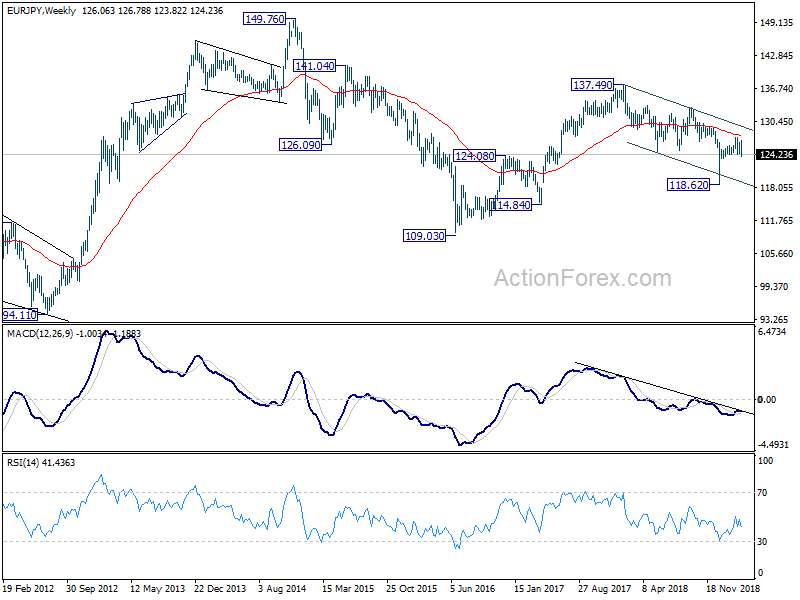
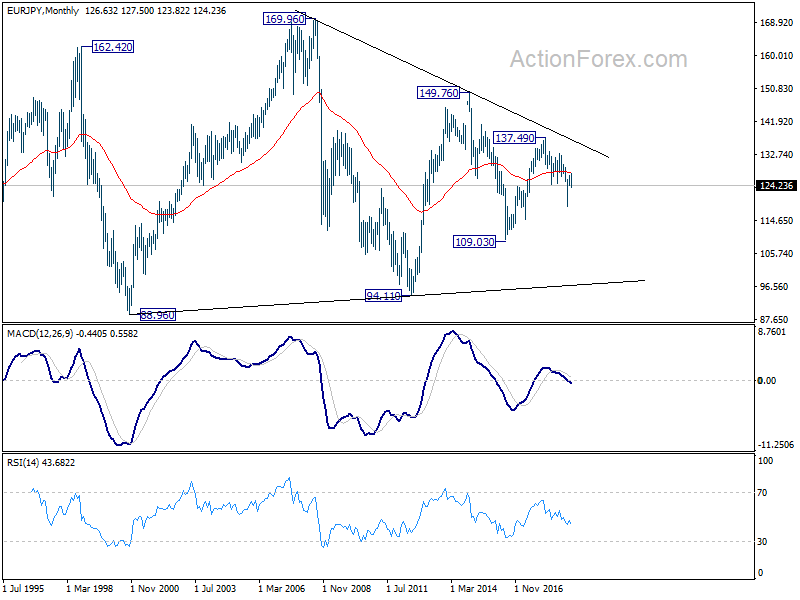
In the long term picture, EUR/JPY is staying in long term sideway pattern, established since 2000. Fall from 137.49 is seen as a falling leg inside the pattern. Break of 118.62 will extend this falling leg through 109.03 low. On the upside, break of 133.12 resistance bring retest of 149.76 (2014 high).
EUR/GBP Weekly Outlook
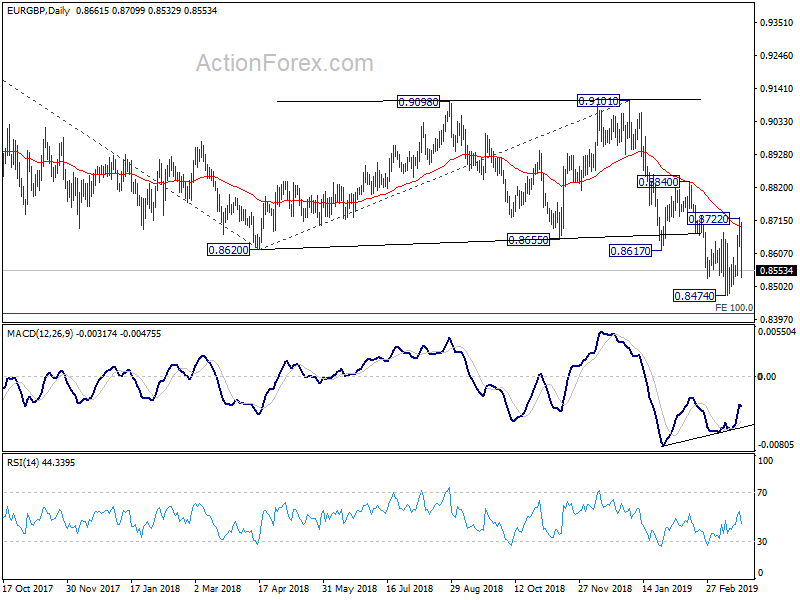
EUR/GBP rebounded to as high as 0.8722 last week. But it was rejected by 55 day EMA and quickly reversed. Initial bias is neutral this week first for some consolidative trading. On the downside, break of 0.8474 low will resume recent down trend and target 0.8416 long term projection next. On the upside, though, break of 0.8722 will resume the rebound from 0.8474 to 0.8840 resistance first.
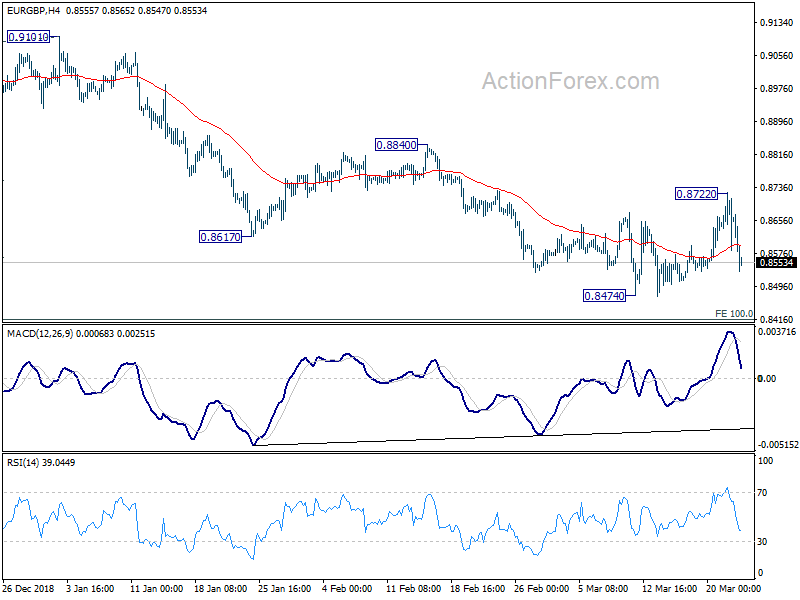
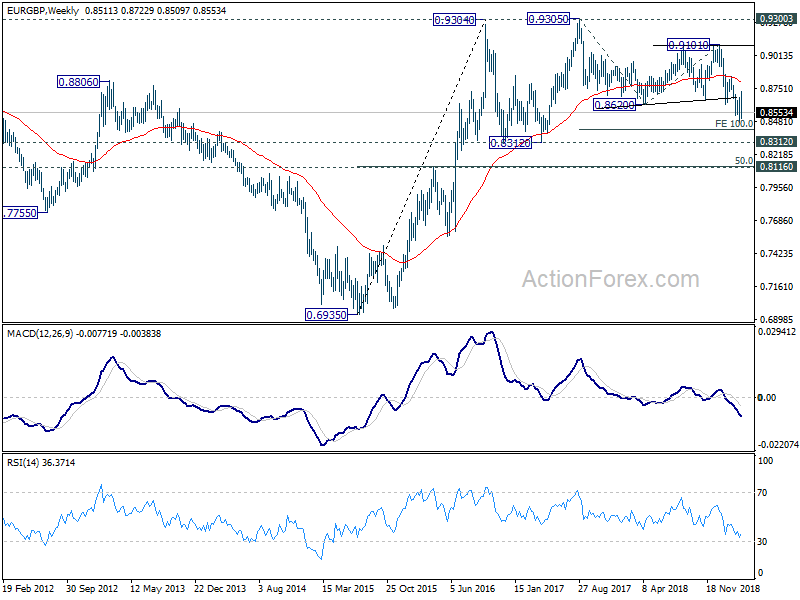
In the bigger picture, EUR/GBP is seen as staying in long term range pattern started at 0.9304 (2016 high). Current fall from 0.9305 (2017 high), is a falling leg inside the pattern. Such decline could extend to 100% projection of 0.9305 to 0.8620 from 0.9101 at 0.8416 and possibly below. But for now, we'd expect strong support around 0.8312 support to contain downside and bring rebound.
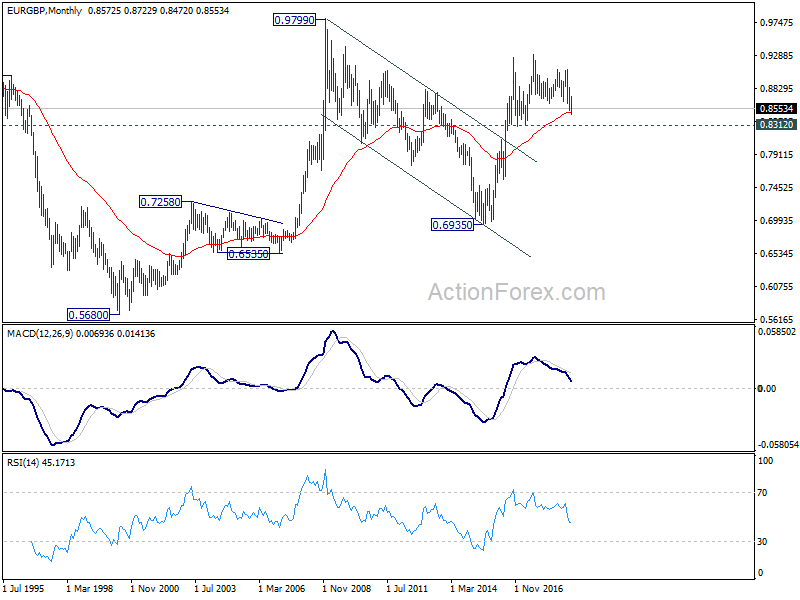
In the long term picture, we're holding on to the view that rise from 0.6935 (2015 low) is resuming the up trend from 0.5680 (2000 low). As long as 50% retracement of 0.6935 to 0.9304 at 0.8120 holds, further rise should be seen through 0.9305 to 0.9799 and above down the road.
EUR/AUD Weekly Outlook
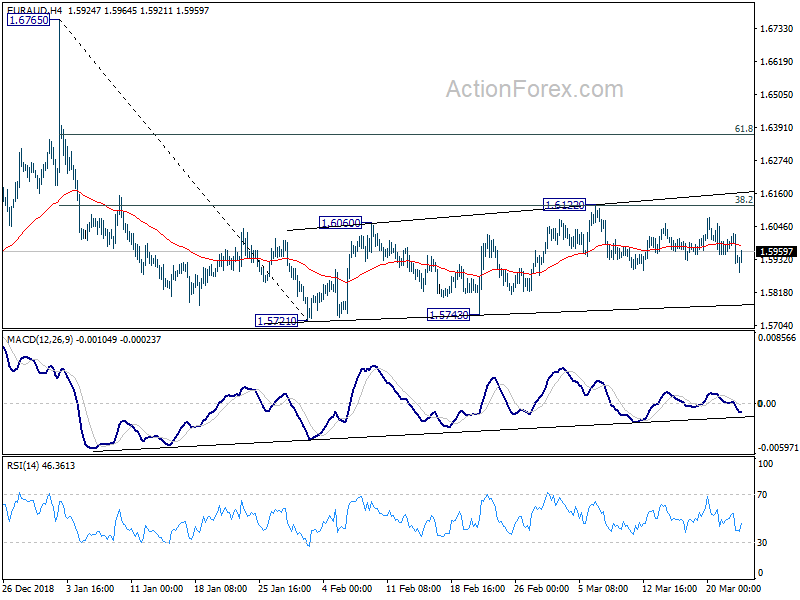
EUR/AUD gyrated in range of 1.5721/6122 last week and outlook is unchanged. Initial bias remains neutral this week first. Price actions from 1.7521 are seen as a consolidation pattern and thus, fall from 1.6765 is in favor to resume later. On the downside, break of 1.5721 low will confirm this case and target 1.5346 support next. On the upside, though, break of 1.6122 will extend the pattern from 1.5721 with another rise.
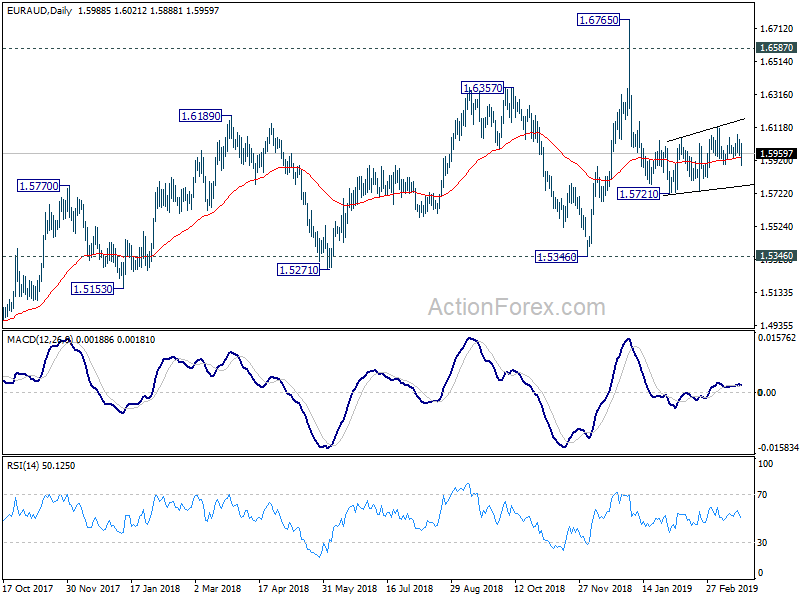
In the bigger picture, as long as 1.5346 support holds, outlook will remain bullish. Uptrend from 1.1602 (2012 low) is expected to resume sooner or later. Break of 1.6765 will target 61.8% retracement of 2.1127 (2008 high) to 1.1602 at 1.7488 next. However, firm break of 1.5346 key support will indicate trend reversal, with bearish divergence condition in weekly MACD, and turn outlook bearish.
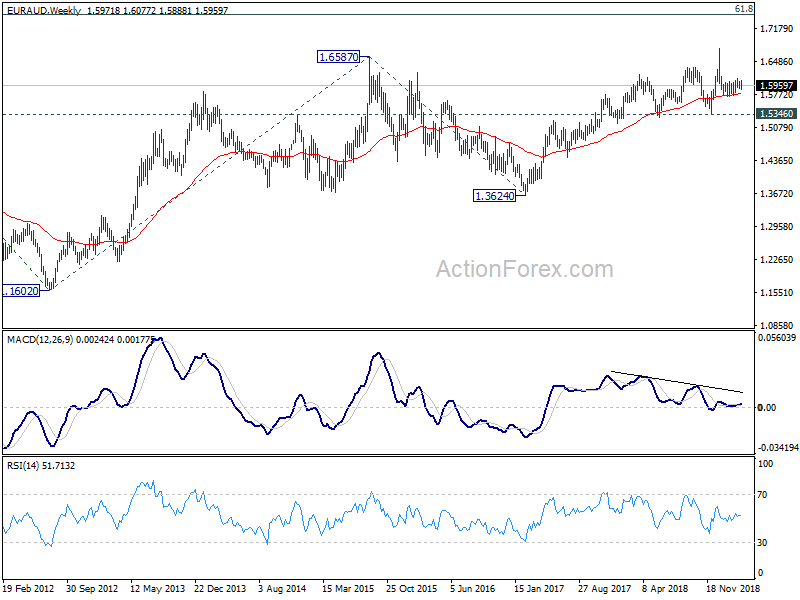
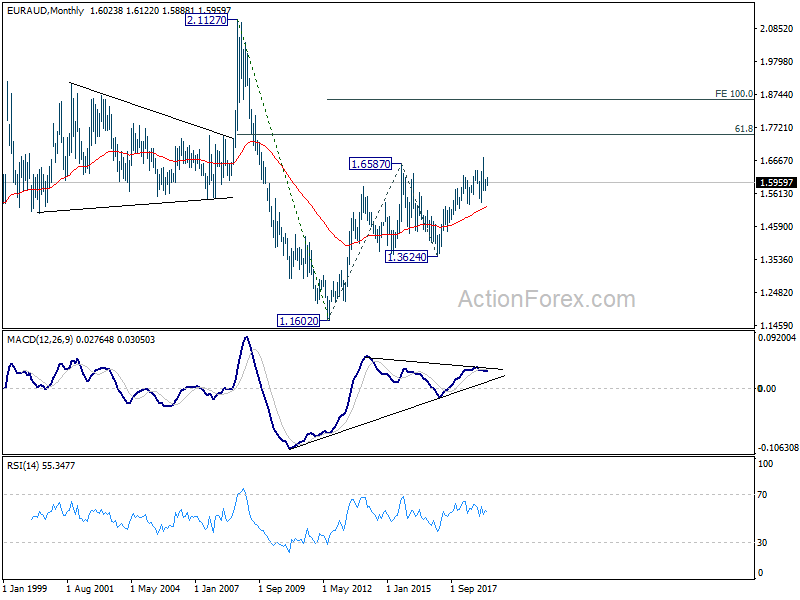
In the longer term picture, the rise from 1.1602 long term bottom (2012 low) is still in progress for 61.8% retracement of 2.1127 to 1.1602 at 1.7488. Firm break there will pave the way to 100% projection of 1.1602 to 1.6587 from 1.3624 at 1.8069. This will remain the favored case as long as 1.5346 remains intact.
EUR/CHF Weekly Outlook
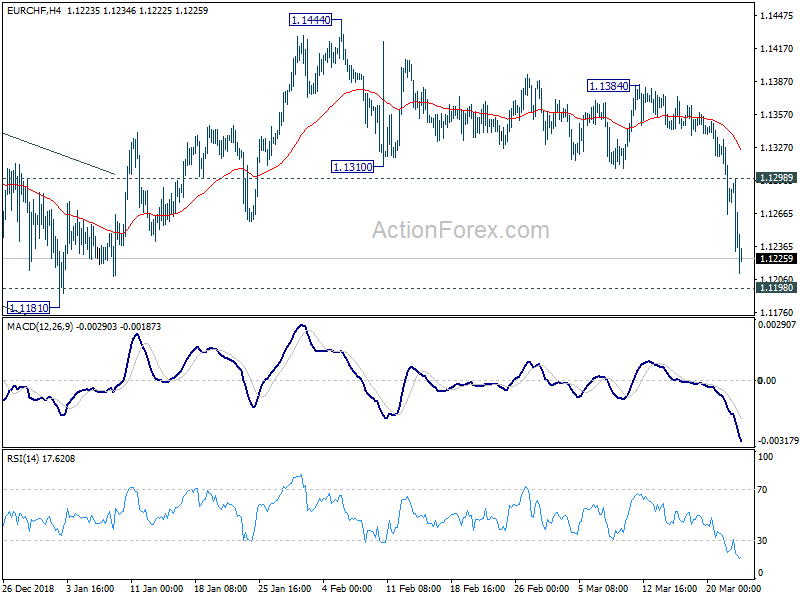
EUR/CHF dropped sharply to as low as 1.1212 last week. The strong break of 1.1310 support confirmed that rebound from 1.1181 has completed at 1.1444. Initial bias remains on the downside this week for retesting 1.1173 low, as well as 1.1154/98 key support zone. We'd look for strong support from there to bring rebound. But decisive break will carry larger bearish implication. On the upside, above 1.1298 minor resistance will turn bias back to the upside for rebound.
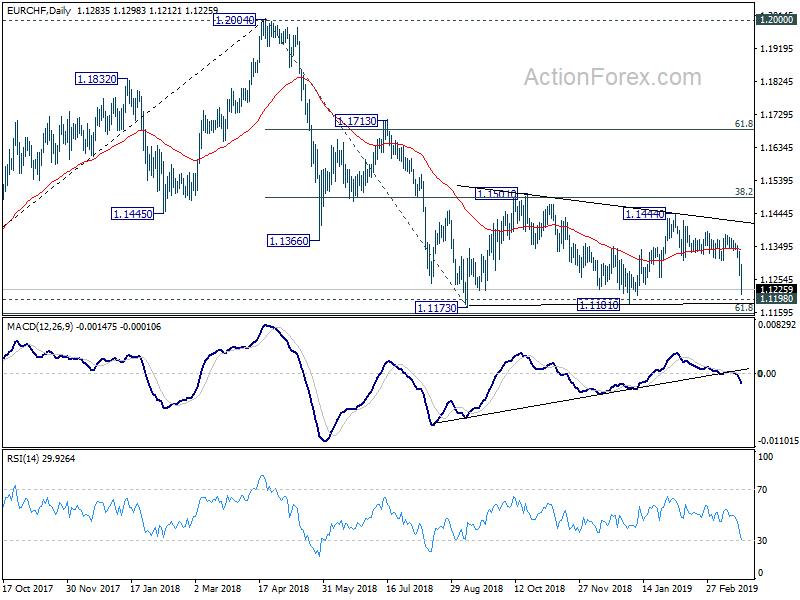
In the bigger picture, with last week's sharp decline, price actions from 1.1173 are now looking more like a consolidation that's completed at 1.1444. Bearishness is also reflected in multiple rejection by 55 week EMA. Immediate focus is back on 1.1154/98 support zone (2016 high and 61.8% retracement of 1.0629 to 1.2004 at 1.1154). Decisive break there will confirm resumption of whole down trend from 1.2004 and long term bearish reversal. 1.0629 support will be next target.
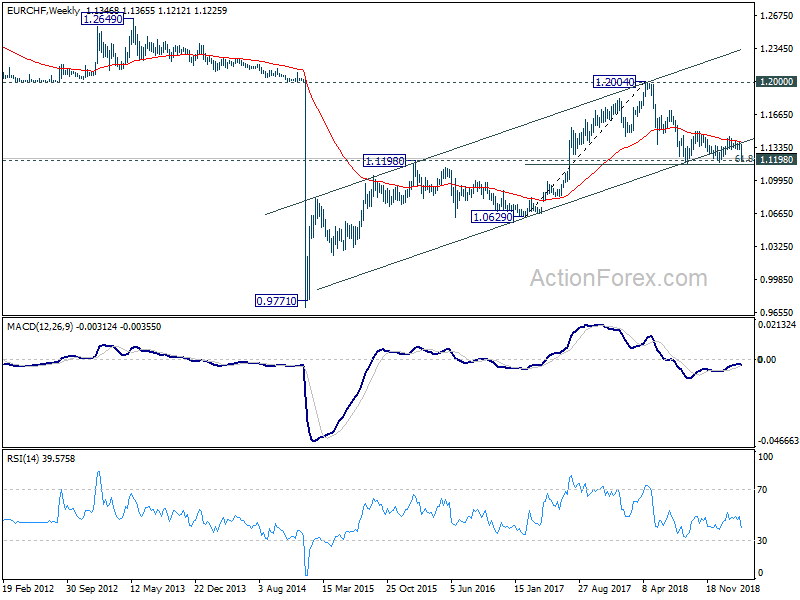
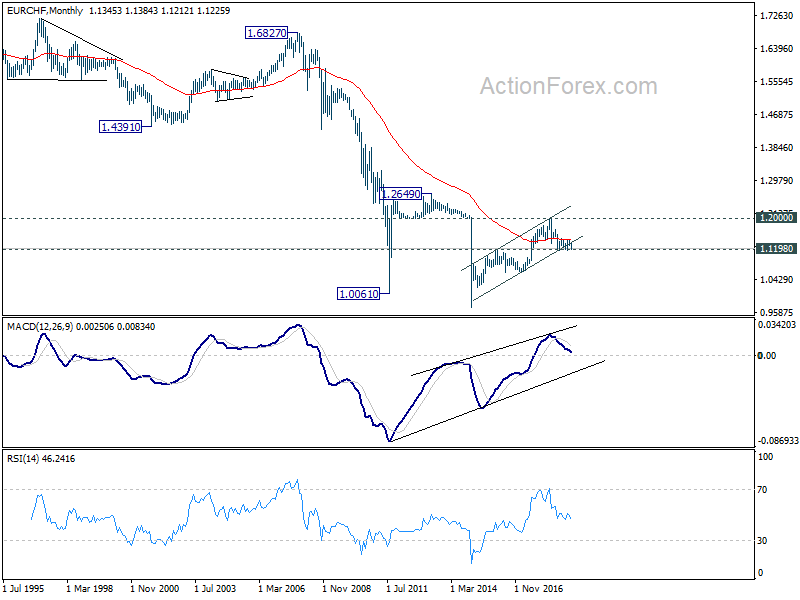
In the long term picture, the current development argues that long term up trend has completed at 1.2004 after rejection of 1.2 key resistance. Sustained break of 1.1198 support will confirm this bearish case and target 1.0629 and possibly below.
CFTC Commitments of Traders – Short Bets on Crude Oil Price Fell Sharply Last Week
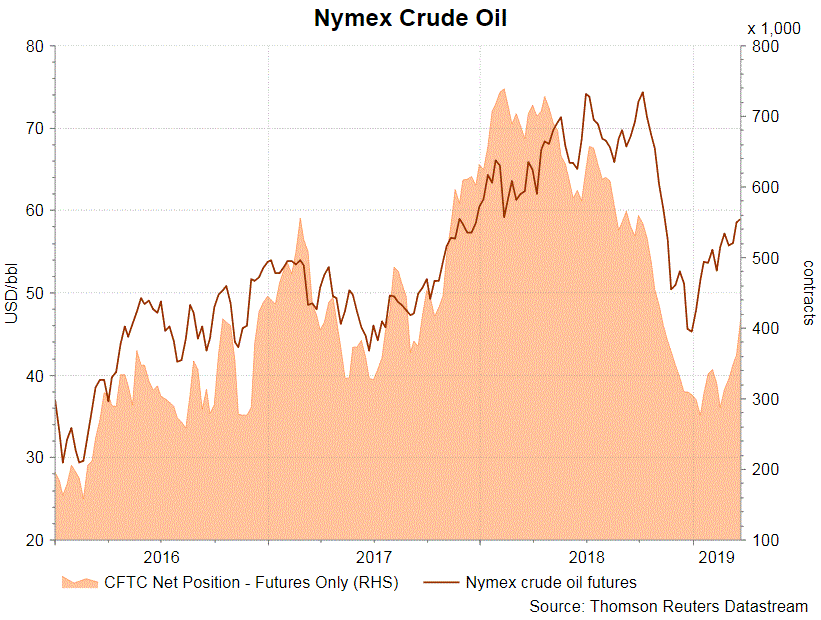
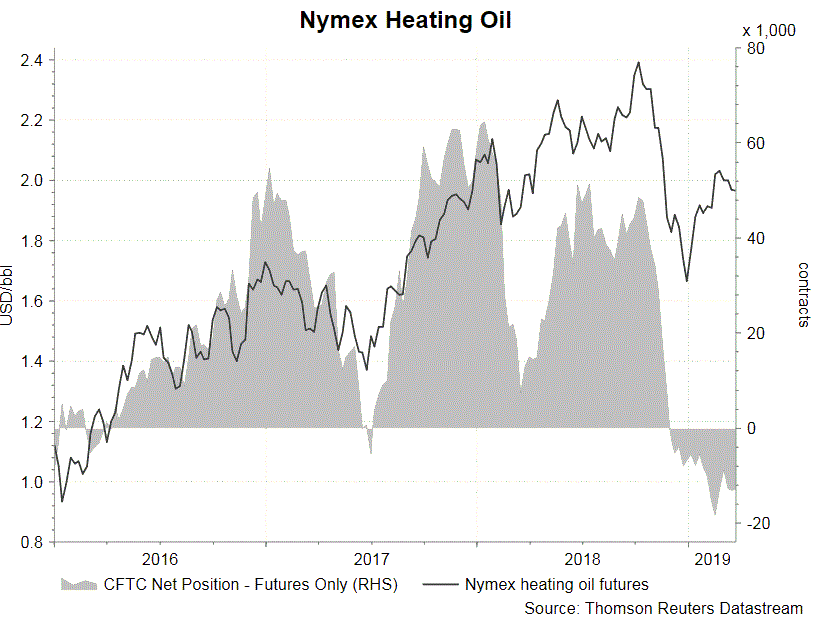
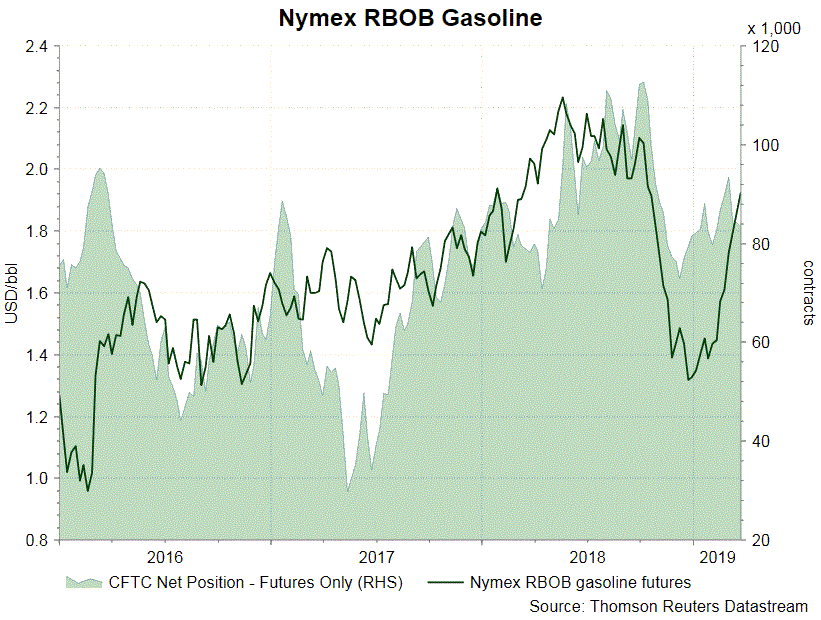
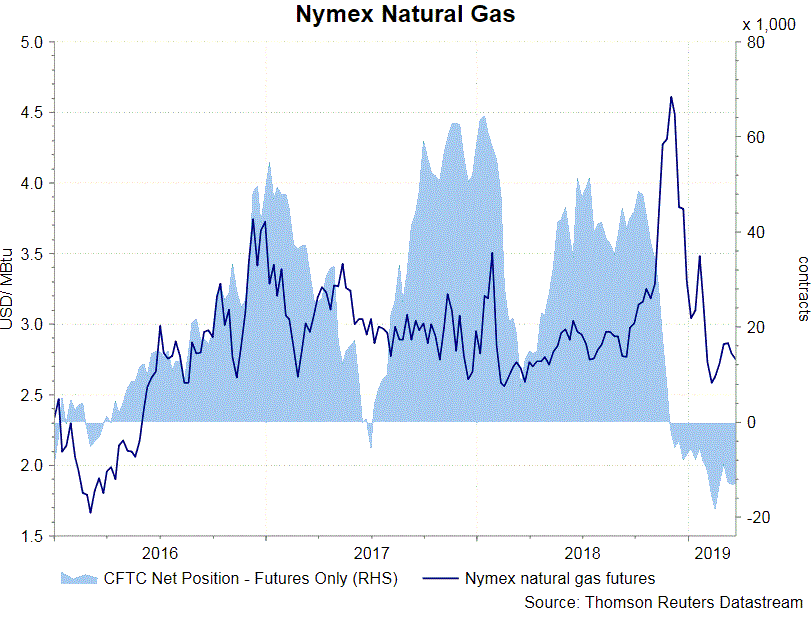
According to the CFTC Commitments of Traders report for the week ended March 19, NET LENGTH for crude oil futures jumped +52 481 contracts to 414 746 for the week. Speculative long positions rose +34 394 contracts while shorts plunged-18 087. Crude oil prices strengthened during the week on expectations that sanctions against Iran and Venezuela would reduce global oil supply. Meanwhile, the market was thrilled by OPEC+'s improved compliance to output cut in February. However, our report suggests that the headline compliance level have masked the underlying the lack of solidarity among the producers agreed in the output cut deal. For refined oil products, NET LENGTH for gasoline dropped -863 contracts to 83 428, while NET SHORT for heating oil slipped +206 contracts to 12 963 contracts for the week. NET SHORT for natural gas futures gained -4 654 contracts to 30 235 contracts for the week.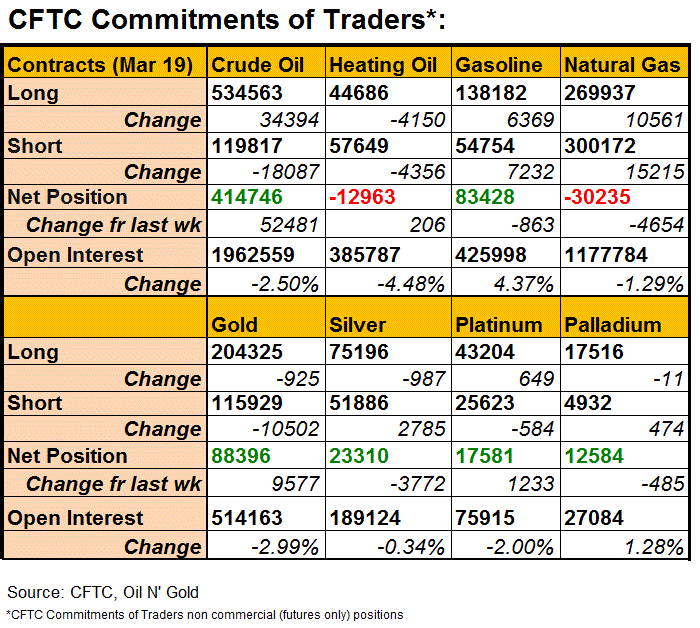
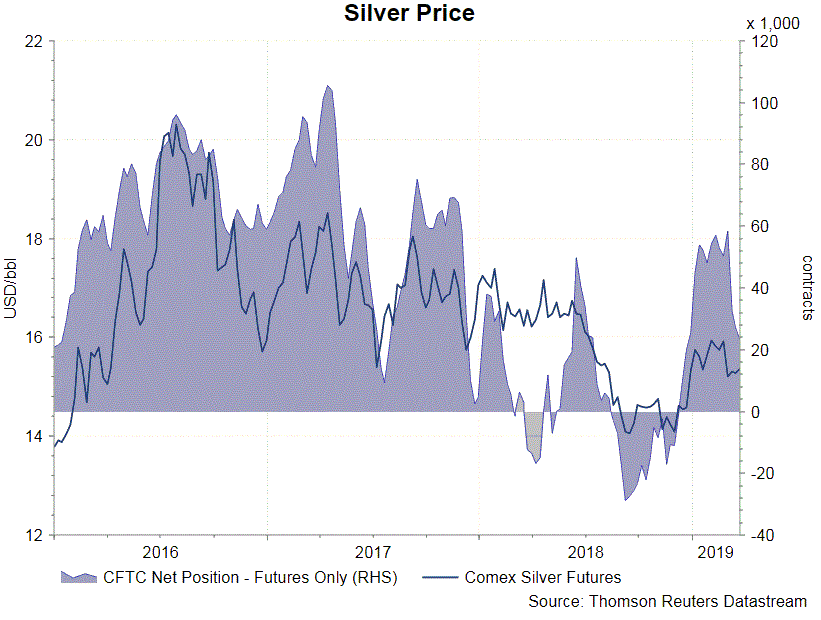
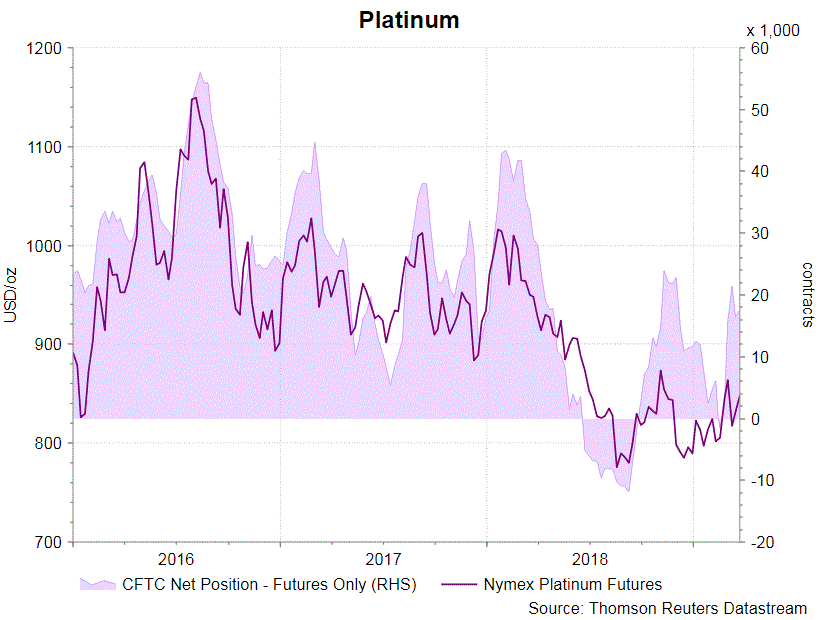
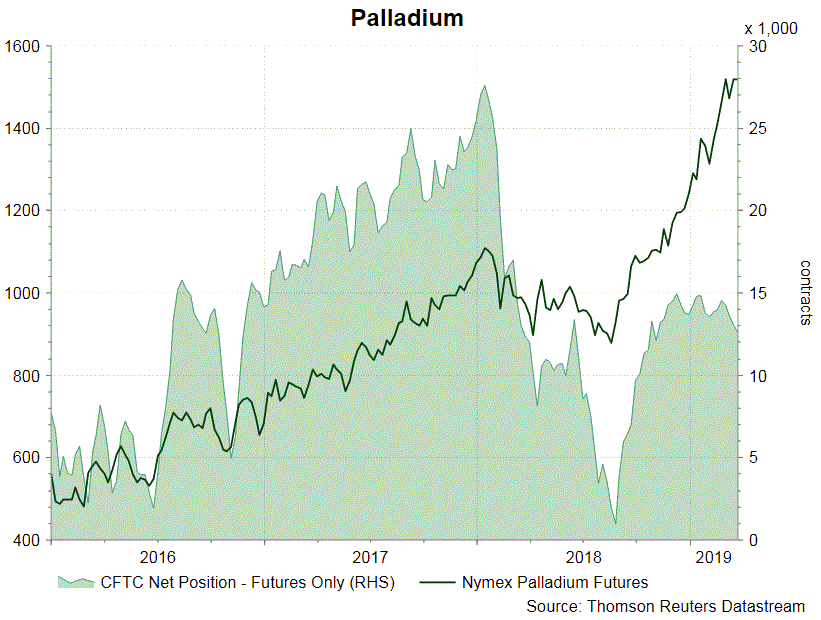
 On the precious metal complex, NET LENGTH for gold futures increased, by +9 577 contraction, to 88 396 last week. Speculative long positions rose slipped -925 contracts, while shorts declined -10 502, resulting in a rise in NET LENGTH. For silver futures, speculative long positions dipped -987 contracts while shorts gained +2 785. These resulted in a fall in NET LENGTH, by -3 772 contracts, to 23 310 contracts. For PGMs, NET LENGTH of Nymex platinum futures increased -1 233 contracts to 17 581 while that for palladium slid -485 contracts to 12 584.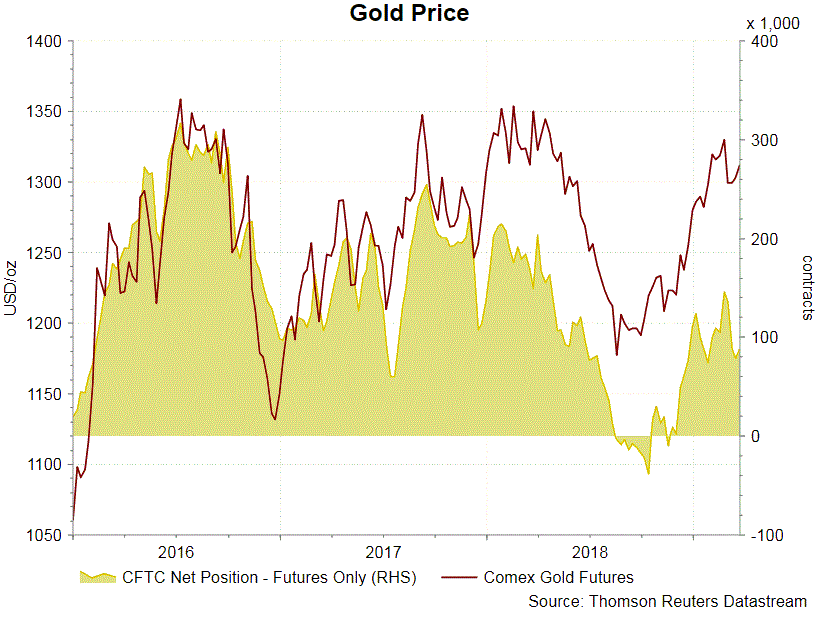
European Recession Revisited
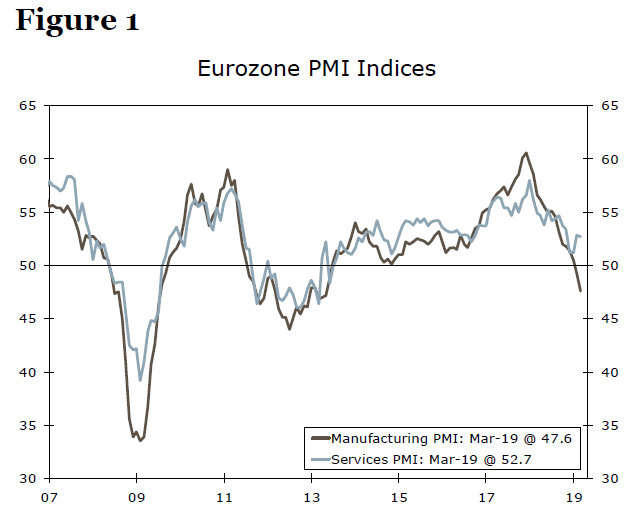
Fears of a Eurozone recession are back in the headlines today after a series of disappointing PMI figures from the currency bloc. The March manufacturing PMI declined more than expected to 47.6, the lowest level since 2013 (Figure 1). Some individual countries fared even worse, as Germany's manufacturing PMI plunged to 44.7. The weak data from Europe's manufacturing sector have been piling up for months. Factory orders in the Eurozone have declined in eight of the past 12 months, while manufacturing output fell roughly 3% year-over-year in the three months through January. The continued decline in the manufacturing PMI in the first three months of 2019 suggest the weakness in the hard data for the sector probably persisted in the first quarter.
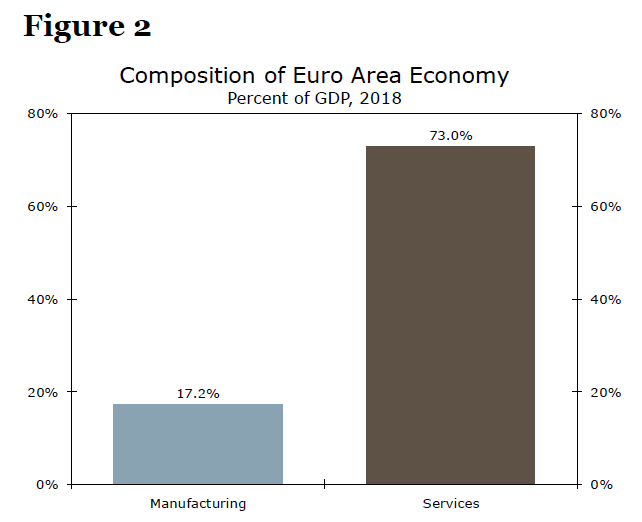
Fortunately, the Eurozone economy is primarily based on services, which account for roughly 75% of total value added in the economy, rather than manufacturing, which accounts for less than 20% (Figure 2). The services PMI for the overall Eurozone economy has been more resilient in recent months, recovering to 52.8 in February and edging only slightly lower in March to 52.7. A separate measure of confidence in the services sector published by the European Commission has also stabilized in recent months, while retail sales—arguably the most closely followed highfrequency measure of activity in the services sector—have also been fairly steady despite weakness in the manufacturing. Strong wage growth and low inflation are likely underpinning consumers in the Eurozone, and may remain a key element of the narrative of a resilient services sector.
Still, we find it hard to get excited about European economic prospects. Despite its relative resilience, the services PMI still remains low at just 52.7, while the composite PMI at 51.3 is consistent with GDP growth of just over 0.1% quarter-over-quarter. Preliminary Q1-GDP data for the Eurozone are not released until April 30, but a 0.1% quarter-over-quarter print would substantially raise the risk of a recession, particularly if the composite PMI were to fall even further. Our lack of enthusiasm for the Eurozone economy extends to the euro, as we currently look for the euro to remain essentially flat-line over the next few months. We still look for some modest euro gains by year-end and into 2020, but that view is predicated on the Eurozone economy avoiding recession and the European Central Bank eventually normalizing interest rates.