Sample Category Title
Calm Down Everybody
Calm down everybody
I don’t think I’ve heard the word “inverted” used as often as it has been in the last few days since I started learning aerobatics during flight training in the Air Force. As fresh-faced young men (sorry, no female pilots in those days) inversions were a daily occurrence. The lesson we learned was simple: being inverted for a short period of time is ok, but staying inverted for a long period of time means bad things are going to happen.
The same rule can be applied to the US bond markets. A couple of basis points inversion between three-month and 10-year yields does not an impending economic Armageddon make. A casual look at the official US Department of Treasury yield curve page shows, in fact, that the yield curve on 1 January was almost flat out to the seven-year mark. However, since 7 March, the five- and seven-year yields have been “inverted” (lower) than the three-month yield, making the US yield curve actually bowl-shaped for most of March. The markets happily ignored this warning sign for weeks and continued buying equities in a Federal reserve afterglow as if there was no inversion in sight.
Like a first attempt at a pottery workshop, the 10-year side of the bowl has been slipping, giving it a lopsided look, but is that worthy of the global hand-wringing we’ve seen in the last few days? Probably not, because for most of the year, the markets have been flip-flopping on news – or lack thereof – of a clear US-China trade deal. As I’ve said before, a deal or no-deal remains the only real game in town.
Friday’s inversion perversion came on the back of poor German, French and US purchasing manager indices (PMIs), which sent the equity markets, who had been buying all week, plunging and bond markets rallying. Realistically, the European data has generally been poor for most of the year anyway, so this in itself isn’t news. The US data has been middling, but both confirm what everyone already knew, the global economy is slowing down after a 10-year quantitative-easing-induced bull run.
A recession doesn’t necessarily mean a depression, however, and they can be either harsh or gentle slowdowns. I’ve repeatedly stated that bond markets globally, along with dovish central banks, have been telling us a slowdown is on the way. Some parts of the world will be better equipped than others to handle this. The US can at least cut rates and apply monetary tools while things could be worse for Europe and Japan, where they cannot. Until the US-China trade talks conclude for better or worse, it’s too soon to predict how deep the coming slowdown will be or even when it will occur.
The US Treasury Secretary Steve Mnuchin and Trade Negotiator Robert Lighthizer head back to Beijing for talks this week. In the meantime, the markets need to invert less and calm down.
FX
Emerging markets felt the brunt of the equity market fall out as investors cut risk and rushed into developed market bonds. The Turkish lira (TRY) crumbled by 5% as foreign currency reserves unexpected fell. The Central bank has since clarified this was due to debt and energy payments, which could set the TRY up for a recovery in Asian trading.
Elsewhere the Brazilian reals, Mexican peso, South African rand and Russian ruble led emerging markets lower, dropping between 1-3%. And with the BRICs looking like sicks, sentiment may overflow into regional Asia Pacific currencies today.
The Euro held around 1.1300 supported by bund inflows, and the pound (GBP) reclaimed 1.3200 as the European Union granted a short extension. One of the conditions of the extension, however, is that the UK Parliament must vote this week whether to accept the same deal they rejected last week. And given the UK Speaker of the House has invoked a law created when people thought the earth was flat to block this (thereby perfectly summing up Brexit thus far), the picture is far murkier on Brexit than the street is pricing in. Being long GBP above 1.3300 could remain a very dangerous game.
Equities
The S&P and Dow Jones fell 1.8% on Friday while the Nasdaq dropped 2.5%. Soft US PMI data compounded even-worse PMI data from Germany and especially France, which saw European equities hung, drawn and quartered.
With investors dumping equities on Friday and running to the apparent safety of G-7 bond markets, it’s hard to see anything but a sea of red this morning in Asia Pacific. Things may calm down if we feel some good vibrations from the trade talks in Beijing later this week, but it could be a rocky few days to start.
Thailand may see some extra spice as the results of their first election since 2014 are revealed. However, they have been delayed by a day and won’t be released until later today.
Oil
Oil plunged on Friday amid global growth fears. Brent crude fell 1.40% to USD66.90 a barrel and WTI dropped 1.80% to USD58.90 a barrel. Although hardly surprising given both were very overbought technically, oil may actually find a few friends this morning.
Reuters is reporting that two Russian Airforce planes carrying troops have landed in the Venezuelan capital Caracas. With the markets in mountains-out-of-molehills mode, this could give some geopolitical support to both contracts in Asia this morning.
Gold
Gold rose just 0.40% to USD1,313.50 per ounce on Friday – a very disappointing result for the yellow metal on a tumultuous risk aversion day. Gold bulls would have expected a much stronger performance given the equity and emerging-market sell-off, but for now, safe haven flows appear to be strongly favouring the bond markets.
Gold’s outlook is still very constructive from a technical aspect, and it’s likely Asia will be an enthusiastic buyer on any dips today.
EURUSD Expects More Weakness On Price Rejection
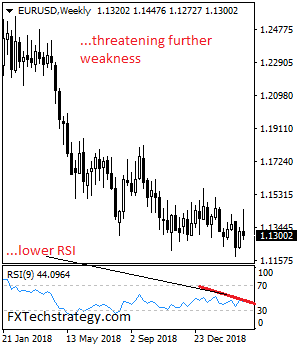
EURUSD expects more weakness on price rejection following its lower close the past week. Support stands at the 1.1250 where a break will turn attention to the 1.1200 level. A break below that level will target the 1.1150 level. Further down, support lies at the 1.1100. Its weekly RSI is bearish and pointing lower suggesting further weakness. On the upside, resistance resides at 1.1350 level with a break through there opening the door for further upside towards the 1.1.1400 level. Further up, resistance comes in at the 1.1450 level where a violation will expose the 1.1500 level. All in all, EURUSD continues to threaten further downside pressure.
GOLD Looks To Pullbacks On Corrective Weakness
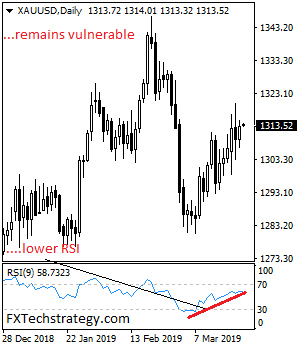
GOLD looks to pullback on corrective weakness. While the commodity trades below the 1,320.35 level, risk of more decline remains. The commodity looks to move higher towards the 1,320.00 resistance zone. Further out, resistance resides at the 1,330.00 level where a break will aim at the 1,340.00 level. A turn above there will expose the 1,350.00 level. Further out, resistance stands at the 1,360.00 level. On the downside, support comes in at the 1,300.00 level where a break will turn attention to the 1,290.00 level. Further down, a cut through here will open the door for a move lower towards the 1,280.00 level. Below here if seen could trigger further downside pressure targeting the 1,270.00 level. All in all, GOLD looks to move further lower on correction.
Eco Data 3/25/19
[php_everywhere instance="1"]
Forex Forecast and Cryptocurrencies Forecast
EUR/USD. The Federal Reserve has left the interest rate unchanged, at 2.5%, and is no longer going to raise it this year. The Fed also lowered its forecasts for US GDP and inflation and raised the unemployment forecast for 2019-2021.
Such actions and statements of the American regulator confirm the start of a recession, which should negatively affect the US currency. As a result, the dollar fell to the mark of $1.1447 for 1 euro on Thursday, March 20. But then, instead of continuing to decline, it recovered in relation to almost all major currencies, and, above all, in relation to the euro. This happened due to disappointing data from Germany – PMI (business activity index in the manufacturing sector) in February was only 44.7 instead of the expected value of 48.0. This news caused concern about the global economic crisis once again and led not only to a depreciation of the euro, but also to a sharp drop in stocks and bonds. The pair EUR/USD lost 175 points in two days, and then, after a small rebound, completed the week at 1.1300;
GBP/USD. The Brexit final stage is delayed. The pitiable finale for the pound is delayed as well. The British currency lost about 300 points in the first four days of the week, coming close to the level of 1.3000. However, the pigeon rhetoric of the US Federal Reserve Head Jerome Powell and the “help” from the EU, which gave Prime Minister Teresa May time until April 12 to resolve the issue of accepting her deal, allowed the pound to move a little away from the brink of abyss and finish the five-day close to a strong support /resistance level 1.3200;
USD/JPY. Unlike its European “colleagues”, the past week was successful for the yen. Against the backdrop of expectations of a recession, a revision of macroeconomic forecasts and a fall in the value of stocks and bonds in the United States and Europe, the pair dropped to 109.70 by mid-Friday, March 22, and the final chord sounded at 109.90;
Cryptocurrencies. All sorts of gurus continue to hypnotize the public with predictions of an upcoming rise of digital currencies. So, famous American venture investor Tim Draper believes that the massive transition to cryptocurrency will begin in about two years' time. And Tom Lee, a financial analyst and co-founder of Fundstrat Global Advisors, has given a shorter-term forecast, having said in an interview to CNBC that the bearish sentiment on the bitcoin market will be replaced by the bullish one within six months. The turning point, in his opinion, will be in August, and the BTC rate can easily reach $10-20,000.
In contrast to this, yet virtual, optimism, quite real pessimistic notes are heard. For example, the Chicago Board Options Exchange (CBOE), which once launched Bitcoin futures trading, has now refused to add new contracts.
On such a news background, as we predicted, the BTC/USD did not manage to break above the $4,150 horizon. The only hope for investors can be the fact that the pair did not fall below $4,000 for almost the entire week, which allows us to go on talking about an uptrend, albeit a weak one.
Also, the Litecoin (LTC/USD) has not left the limits of the ascending channel, the Ethereum (ETH/USD) is consolidating near the $139.00 horizon, and for the Ripple (XRP/USD), a 10-week Pivot Point can be considered the level of $0.318.
As for the forecast for the coming week, summarizing the opinions of a number of analysts, as well as forecasts made on the basis of a variety of methods of technical and graphical analysis, we can say the following:
EUR/USD. The situation with this pair can be described as a complete ... uncertainty. On the one hand, the slowdown in US GDP, on the other - disappointment with the prospects for the German economy. The Fed’s refusal to raise the interest rate is playing against the dollar, and the endless uncertainty with the UK leaving the EU is playing against the euro. The yield on 10-year US Treasury bonds touched more than a year's bottom, but the yield on 10-year German bonds is on the verge of falling below 0%. US futures S&P 500 fell by 0.5%, and European stocks are in the red, approaching as for the main indexes to a loss of 1%.
This swing can be swung indefinitely. That is why the votes of experts this week have been evenly divided, 50 to 50. It should be noted that in the transition to the medium-term forecast, 70% of analysts are already on the side of bulls.
The graphical analysis on H4 draws first the rise to the level of 1.1380 for the coming days, then the fall to the level of 1.1175, after which the pair should return to the limits of the medium-term corridor 1.1215-1.1570.
As for the events of the coming week, we can note the speech of the ECB Head Mario Draghi on Wednesday, March 27, as well as the publication of the German consumer price index and annual data on US GDP on Thursday, March 28. Moreover, according to the forecast, the real value of GDP may be 0.2% lower than the previous one.
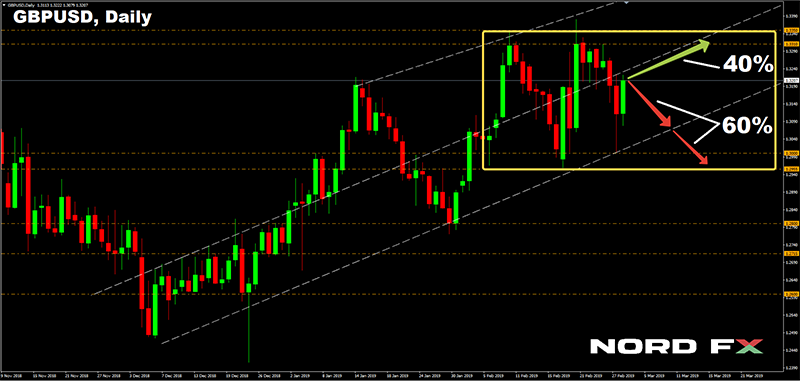
GBP/USD. Prime Minister Theresa May asked the European Union to delay the exit of Britain from the EU until June 30, 2019. However, the EU has already said that the delay should be longer. Otherwise, there should be no delay at all. The transfer of Brexit for such a short time is a very undesirable option, as it simply prolongs the ambiguity, of which everyone is already rather tired, and which constantly puts pressure on the pound.
At the moment, most experts (60%) believe that the pair should test the level of 1.3000 again, and, in case of its breakdown, reach the bottom at the level of March 11 low, 1.2955.
An alternative point of view will be realized at the release of positive news regarding Brexit, in which case the pair can rise to the height of 1.3310. The following resistance levels are 1.3350 and 1.3 445;
USD/JPY. The overwhelming majority of both trend indicators and oscillators on H4 and D1 are colored red. However, already 15% of oscillators on both timeframes signal that the pair is oversold. The graphical analysis on D1 speaks About a possible reversal of the trend to the north, according to its readings, the pair can return to the zone 110.75-112.15.
The opinions of the experts are divided as follows: 50% have voted for the pair to fall further, 30% are for its upward reversal and 20% are for its lateral movement. The formation of trends , as this have been happening recently, will be influenced by news regarding the course of the US-China negotiations and macroeconomic indicators from Europe and the USA, supporting or refuting the possibility of a new global economic crisis;
Cryptocurrencies. The total capitalization of the crypto market has slowly grown to the value of last November, checking out on Wednesday March 20 at the height of $141.6 billion. It is possible that this is why, for the first time in a long time, 70% of the experts have not given gloomy forecasts, and limited to moderate optimism. In their opinion, the BTC/USD pair will not fall below $3,900 next week but will try to overcome the resistance of $4,200. However, in the transition to the medium-term forecast, the balance of powers changes, and here, as before, 70% of analysts side with the bears, voting for the decline of the pair in spring below $3,000.
Sentiments Turned Very Fragile as Recession Fears Intensified
After the much more dovish than expected Fed economic projections and shockingly poor Eurozone manufacturing data, it looks like major world economies are at the brink recessions. German 10-year bund yield turned negative for the first time since 2016, and it was as high as 0.12 during the week. US yield curve between 3-month and 10-year is now inverted, with 10-year yield in free fall. While the market reactions might be exaggerated, sentiments are undoubtedly very fragile at the moment.
In the currency markets, Yen and Swiss Franc ended as the strongest ones of falling global yield and risk aversion. That's not much a surprise. On the other hand, Canadian Dollar was the weakest ones, partly because WTI crude oil failed to sustain above 60 and retreated. But more importantly, it was argued that Canadian economy is facing more intense-than-expected moderation in the economy. If US would be in recession, Canada will only be worse. Sterling was the second weakest while Euro was the third. Despite very dovish Fed, Dollar ended the week mixed only.
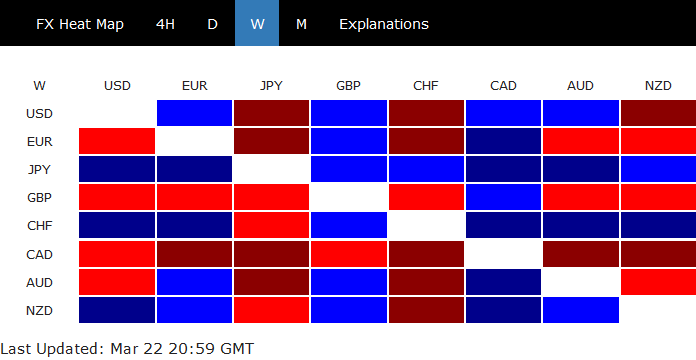
Let's have a recap some of the key events last week first.
Fed took 2019 rate hike off table, revised down growth and job outlook
Fed left federal funds rate unchanged at 2.25-2.50% as widely expected. The statement offered no surprise at the committee will remain "patient" regarding future adjustments to interest rates. Fed also decided to terminate the balance sheet reduction plan in September this year.
The shocks came from the all-round, deeply dovish economic projections. According to median projections, there will be no more rate hike in this year. Indeed, within the forecast horizon, there is at most one hike to 2.6%, by end of 2021, which would be lower than longer run rate at 2.8%. GDP forecasts for 2019 and 2020 are revised down. Unemployment rate for 2019, 2020, and 2021 are all revised up. Core PCE inflation projections were left unchanged. Overall the projections suggested that Fed is rather worried about growth outlook.
High-level US-China trade talks to resume, but tariffs will likely stay long
Talking about growth outlook, a key risk is prolonged trade tensions and tariffs. US Trade Representative Robert Lighthizer and Treasury Secretary Steven Mnuchin will visit China on March 28-29 to resume high level trade talks. Chinese Vice Premier is expected to travel to Washington in early April. Ahead of that, there were reports that China is pushing back against US demands on intellectual property protection as well as other major issues. While such reports were unconfirmed, they're still consistent with the fact that there has been basically no leaked information on the core issues, including IP theft, forced technology transfer, subsidies on state-owned enterprises, and enforcement of the agreement.
On the other hand, Trump openly said that he's considering to leave tariffs on Chinese products there for a "substantial period of time" even if a deal is agreed. Trump got his point that China "had a lot of problems living by certain deals." Also keeping the tariffs there could force China to deliver what were agreed. However, without US stopping the punitive tariffs, China will certainly not agree to correcting its unfair trade practice while lifting its own retaliatory tariffs at the same time. The US won't have it all. That is, even if there is an eventual agreement and China will speed up it's reforms, tariffs from both sides will stay there for much longer.
And as we pointed out before, tariffs are the "cannons" of trade war and they are bombing both economies everyday right now. Believe it or not, other world economies, including Germany and Japan, who were on brink of recessions, have been dragged down by slowdown in global trade growth. US-China tariffs on each other are hurting the world too and will continue to do so for a long period of time, even if there is finally a deal, as Trump indicated.
Recession risks in Eurozone, in particular Germany, intensified
The impact of trade on Eurozone manufacturing sector is rather evident. Eurozone PMI manufacturing dropped to 47.6 in March, a 71-month low. Offset by resilience in services, PMI composite just dropped 0.6 to 51.3. Markit noted that the data pointed to just 0.2% growth in Q1. More worryingly, forward-looking indicators suggested that growth could be even weaker in Q2. A reversal in services could drag Eurozone into contraction.
Looking into the steam engines, both manufacturing and services in France were already in contraction. Germany PMI manufacturing even dived to 44.7, a 79-month low. Services in Germany was resilient but even so, PMI composite dropped to 51.5. It should be noted that Germany narrowly avoided recession with 0% growth in Q4. But risks didn't dissipate since then. The poor set of PMI data serve German 10-year bund yield negative for the first time since 2016.
Brexit cliff edged delayed for two weeks
News on Brexit were relatively positive. At the European Council meeting in Brussels, EU approved a short Brexit extension. If no Brexit deal is approved by the House of commons in UK. the extension will be until April 12, when UK has to indicate a way forward. If a Brexit deal is approved, the extension will be until May 22. But the cliff edge was just delayed. UK still still have to make a decision between a deal, no deal, a long extension or revoking Article 50.
The above discussed developments all played a hand in the financial markets last week. The collective impacts have been rather negative.
Most accurate US recession indicator triggered for the first time since 2007.
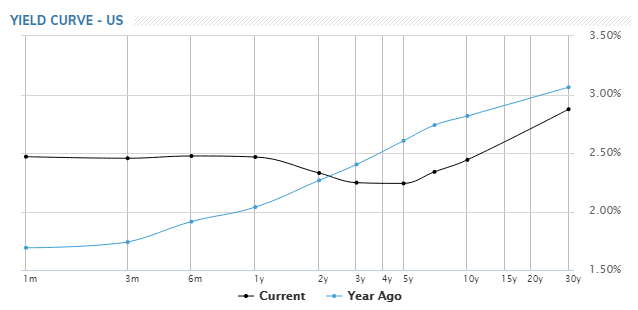
One of the most important development was yield curve between 3-month and 10-year is now inverted, after steep decline in long yields. It happened for the first time since 2007. This part of the yield curve is seen as having strong predictive power of recessions. Indeed, San Francisco Fed had published a economic letter "Information in the Yield Curve about Future Recessions" detailing some research on the topic.
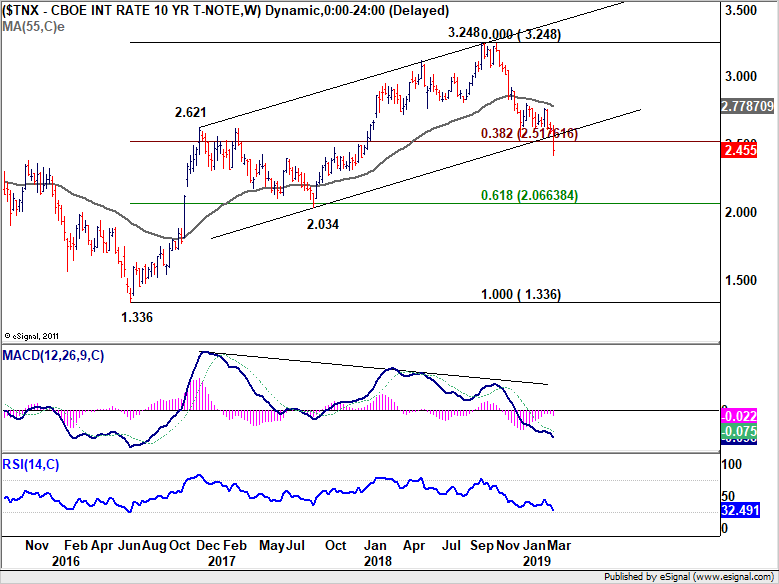
More importantly, the technical development in 10-year yield suggests that the worst is yet to come. TNX dropped sharply to close at 2.455 last week. Both long term channel support and 38.2% retracement of 1.336 to 3.248 were taken out decisively. TNX was also rejected below 55 week EMA before, adding to its bearishness. In the relative bullish case, fall from 3.248 is merely correcting the up trend from 1.336. But even so, the case is now open for deeper decline to 61.8% retracement at 2.066 which is close to 2.034 support and 2.0 psychological level.
Futures pricing in more than 50% chance of Fed cut in 2019
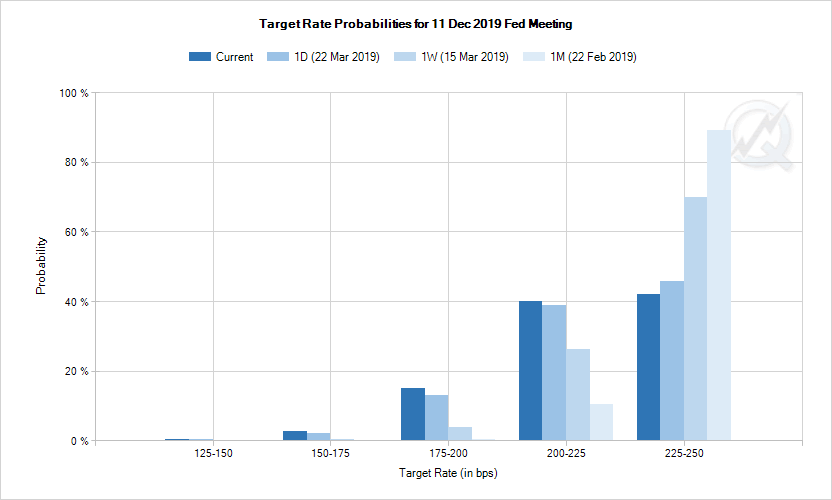
With dovish Fed projections and rising risk of recession in the US, traders raised their bet on a Fed rate cut by the end of the year drastically. Fed fund futures now imply 57.9% chance of having one rate 25bps cut (or more) by December meeting to 2.00-2.25%. It was just around 30% a week ago and 11% a month ago.
Dollar index staying in consolidation, medium term bullish
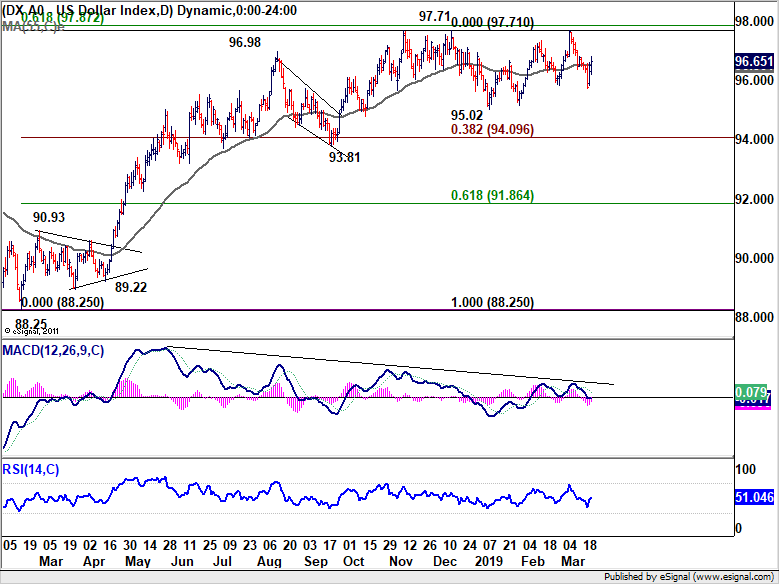
Dollar index's performance was not too back last week. Despite dipping to 95.74, it quickly recovered to close at 96.65. Overall outlook is unchanged. that consolidation pattern from 97.71 might extend. In case of another fall, we'd expect strong support from 94.09 (38.2% retracement of 88.25 to 97.17) to contain downside. Meanwhile. decisive break of 97.71/87 resistance zone will confirm resumption of whole rise from 88.25.
Position trading
Our AUD/USD short (sold at 0.7050) was stopped out at 0.7120 last week as the pair rebounded to 0.7168 after FOMC. We'll keep our hands off first and come back with another strategy (if any) in Q2.
EUR/CHF Weekly Outlook
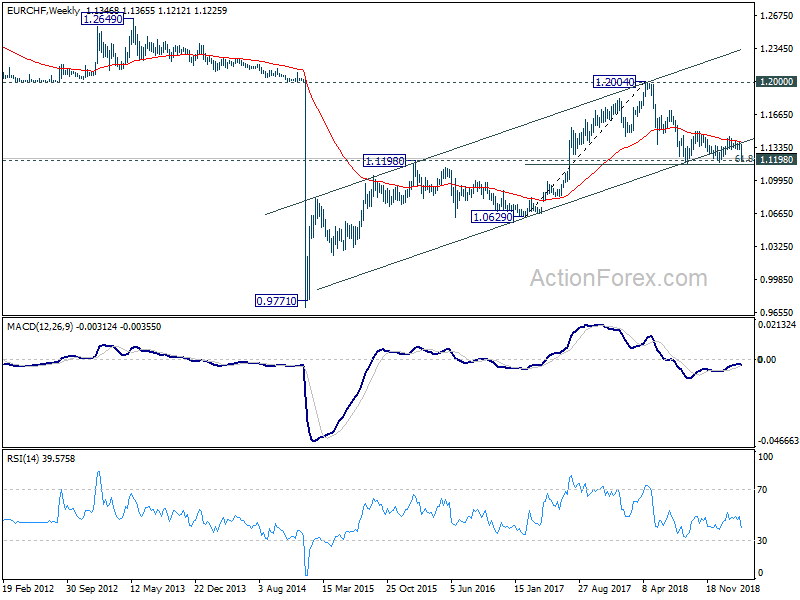
EUR/CHF dropped sharply to as low as 1.1212 last week. The strong break of 1.1310 support confirmed that rebound from 1.1181 has completed at 1.1444. Initial bias remains on the downside this week for retesting 1.1173 low, as well as 1.1154/98 key support zone. We'd look for strong support from there to bring rebound. But decisive break will carry larger bearish implication. On the upside, above 1.1298 minor resistance will turn bias back to the upside for rebound.
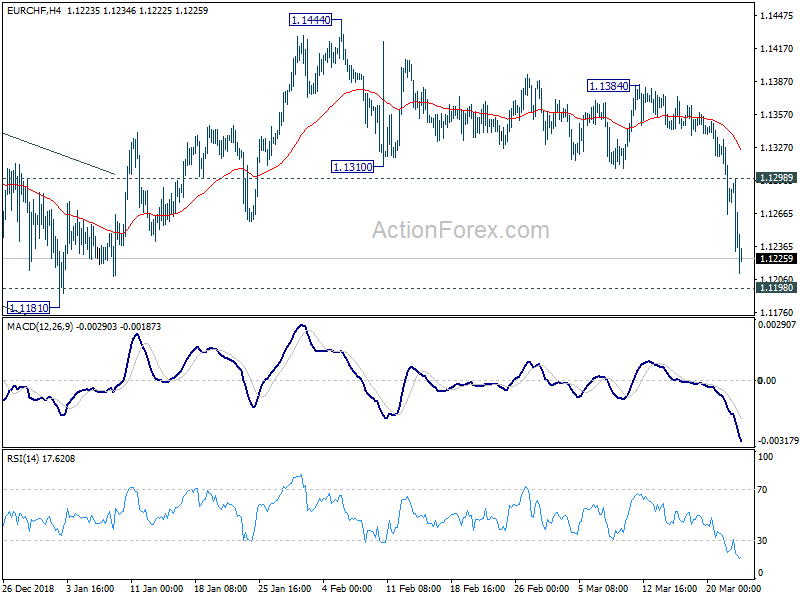
In the bigger picture, with last week's sharp decline, price actions from 1.1173 are now looking more like a consolidation that's completed at 1.1444. Bearishness is also reflected in multiple rejection by 55 week EMA. Immediate focus is back on 1.1154/98 support zone (2016 high and 61.8% retracement of 1.0629 to 1.2004 at 1.1154). Decisive break there will confirm resumption of whole down trend from 1.2004 and long term bearish reversal. 1.0629 support will be next target.
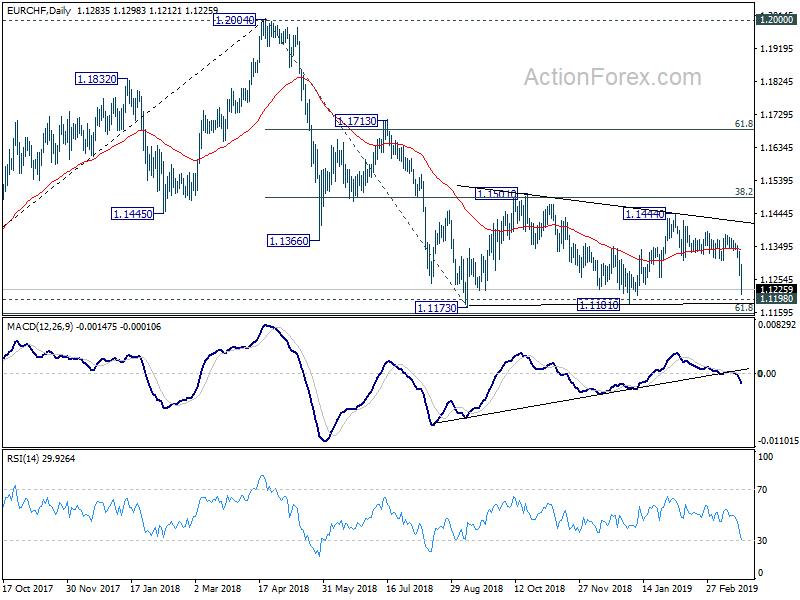
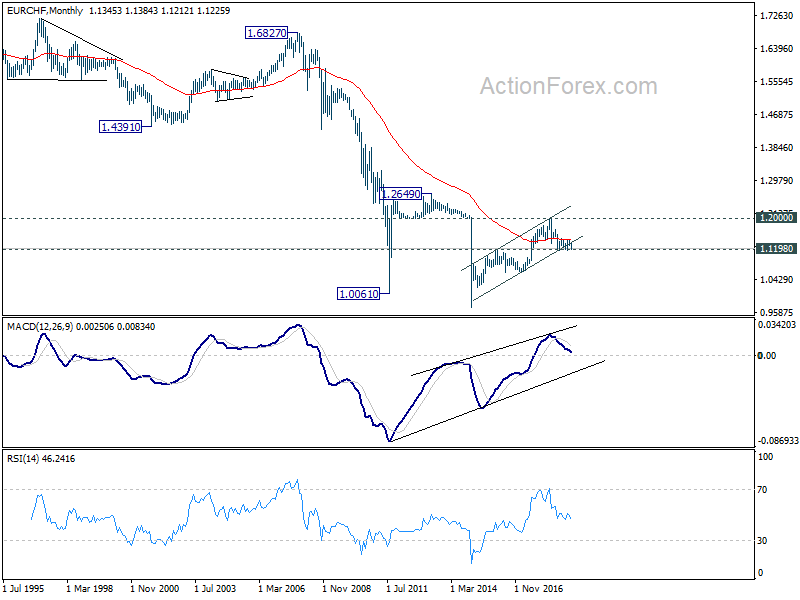
In the long term picture, the current development argues that long term up trend has completed at 1.2004 after rejection of 1.2 key resistance. Sustained break of 1.1198 support will confirm this bearish case and target 1.0629 and possibly below.
EUR/USD Weekly Outlook
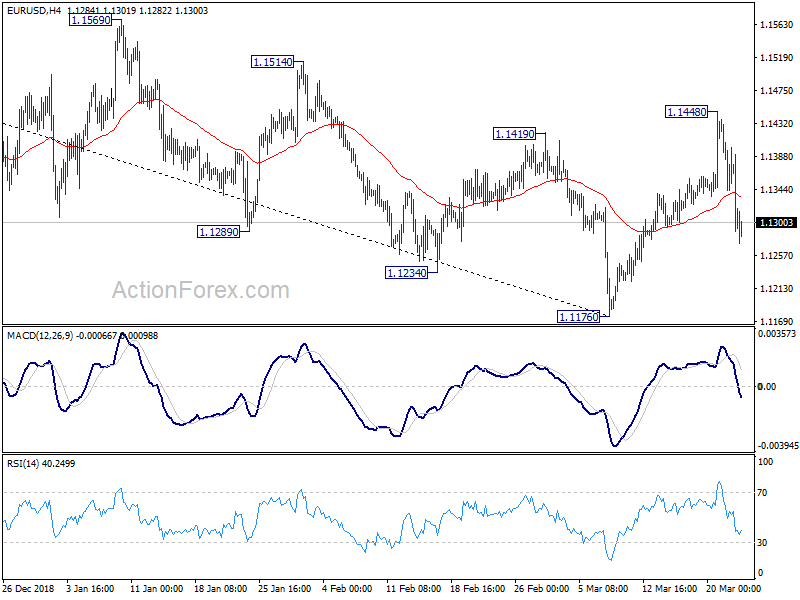
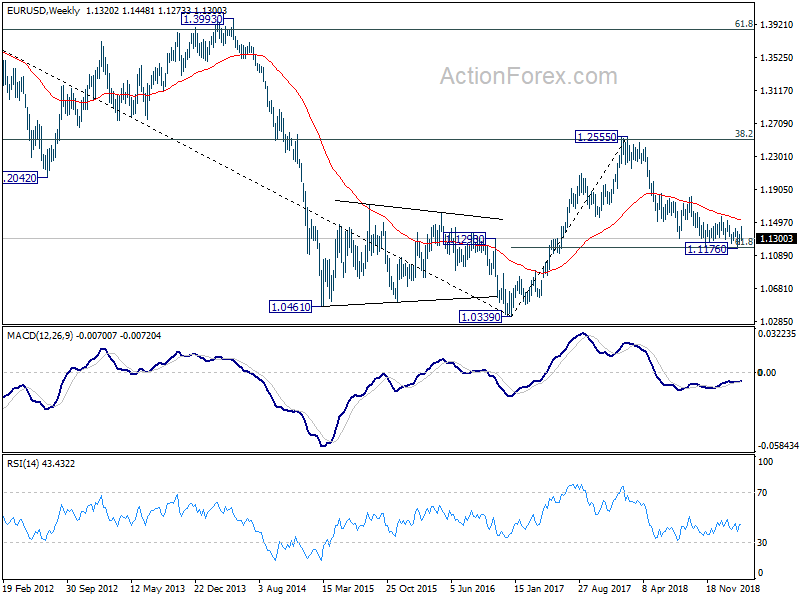
EUR/USD rebounded to as high as 1.1448 last week but failed to sustain above 55 day EMA and reversed. It's also kept well below 55 week EMA too. Initial bias is now on the downside this week for retesting 1.1176. Decisive break there will resume whole decline from 1.2555. On the upside, above 1.1448 will resume the rebound from 1.1176 to 1.1569 resistance instead.
In the bigger picture, medium term outlooks is a bit mixed for now as there are conflicting signals. We'll turn neutral first. On the downside, decisive break of 61.8% retracement of 1.0339 (2016 low) to 1.2555 (2018 high) at 1.1186 will resume the whole down trend from 1.2555. Next target will be 1.0339 low. Nevertheless, break of 1.1569 resistance should confirm medium term bottoming. Stronger rebound should be seen back to 38.2% retracement of 1.2555 to 1.1176 at 1.1703. In that case, the structure of the rise from 1.1176 and reaction to 1.1703 fibonacci level will be watched for making an assessment on whether medium term trend has reversed, or rebound form 1.1176 is merely a correction.
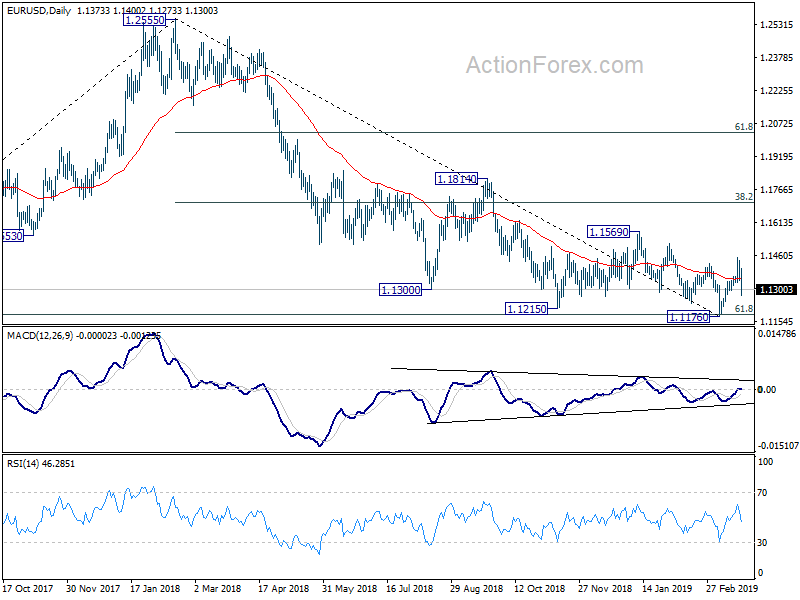
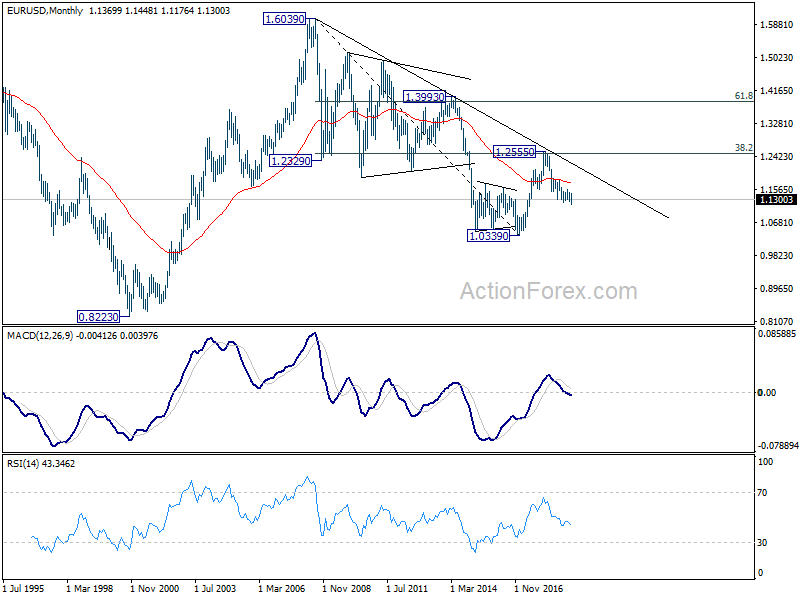
In the long term picture, the rejection from 38.2% retracement of 1.6039 to 1.0339 at 1.2516 argues that long term down trend from 1.6039 (2008 high) might not be over yet. EUR/USD is also held below decade long trend line resistance. Firm break of 61.8% retracement of 1.0339 to 1.2555 at 1.1186 should at least bring a retest on 1.0339 low. This will remain the favored case as long as 1.1569 resistance holds.
CFTC Commitments of Traders – NET SHORT for GBP Declined Significantly Despite Brexit Crossroads
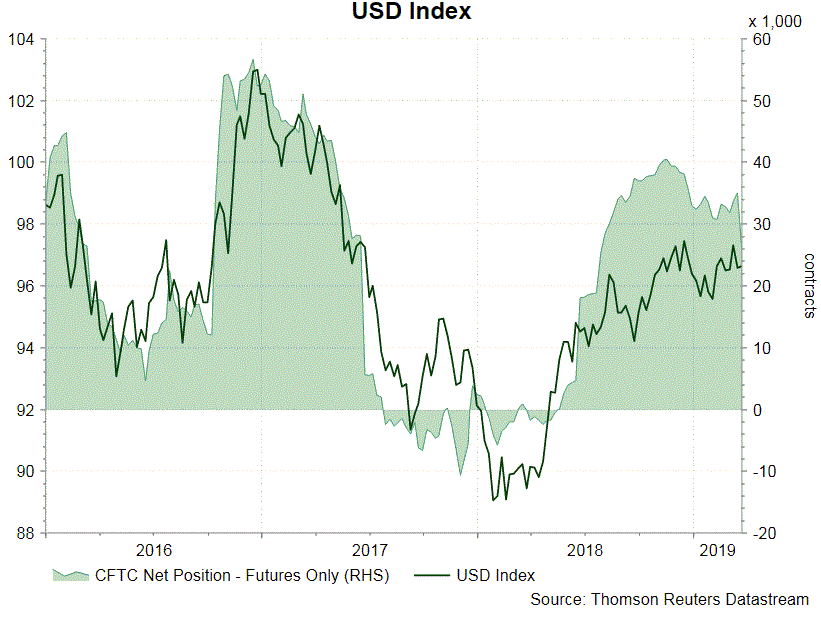
As suggested in the CFTC Commitments of Traders report in the week ended March 19, NET LENGTH in USD Index fell as speculative long positions dropped while shorts gained. NET LENGTH for USD index declined -9 139 contracts, to 25 935. All major currencies were in in NET SHORT positions. 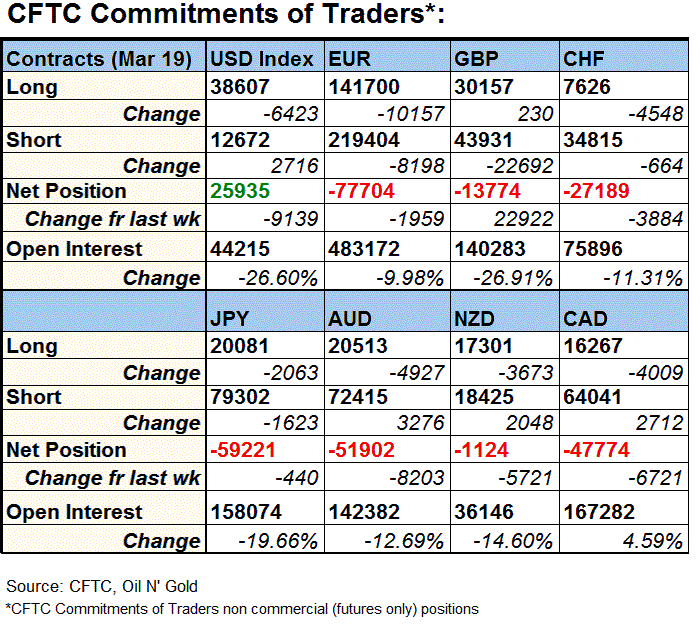
Concerning European currencies, NET SHORT for euro futures gained +1 959 contracts to 77 704. Traders trimmed bets on both sides. Yet, reduction in longs outweighed that in shorts. NET SHORT for GBP futures declined -22 922 contracts to 13 774. Speculative long positions climbed +230 contracts while speculative shorts plunged -22 692 contracts for the week. UK parliament voted to extend Article 50. However, EU parliament rejected PM Theresa May's request to delay Brexit to June 30. The EU indicated that the UK can officially leave on May 22 the latest if there is a Withdrawal Agreement (deal) approved by MPs. If no deal is approved, the UK would have to leave by April 12. This suggests that the scenario of a no-deal Brexit is not eliminated. On the other hand, a petition calling on the UK to revoke Article 50 has got over 4 million signatures in under three days, while protesters gathered in London calling for another EU referendum. We expect the British pound to remain volatile in coming weeks.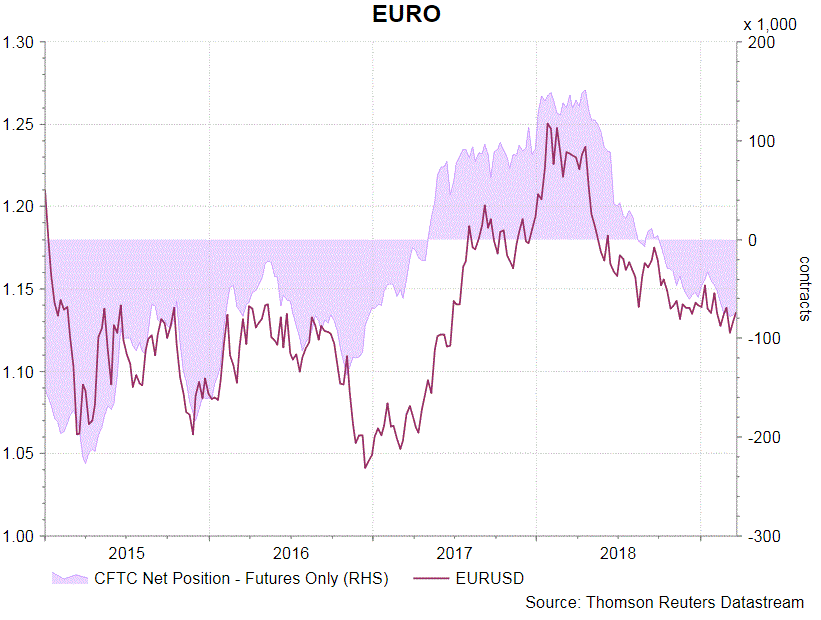
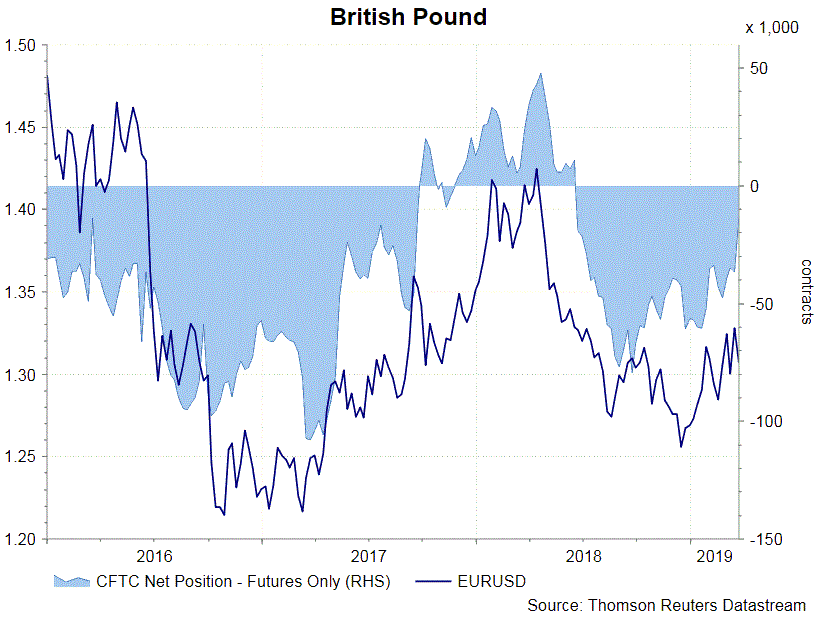
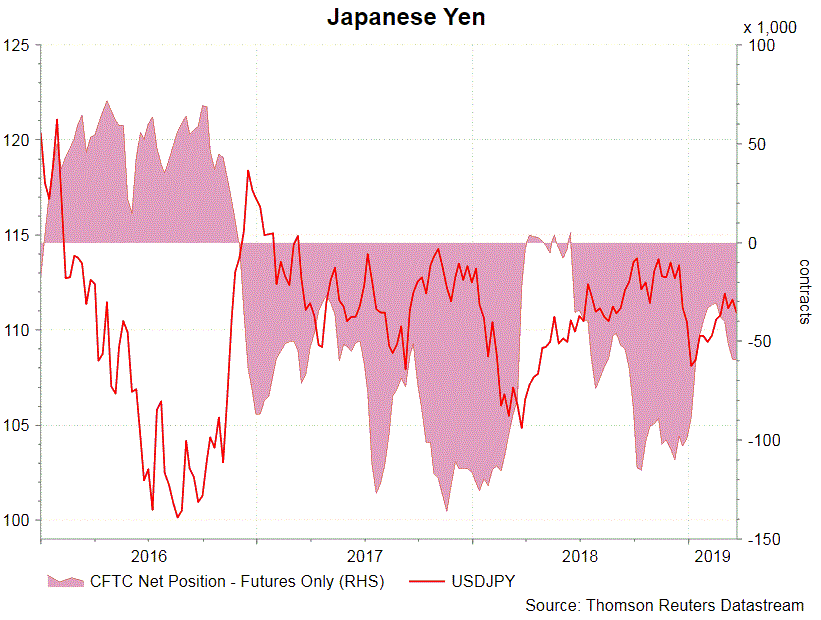
On safe-haven currencies, Net SHORT for CHF futures rose +3 884 contracts to 27 189. NET SHORT for JPY futures gained +440 contracts to 59 221 during the week. Bets fell on both sides.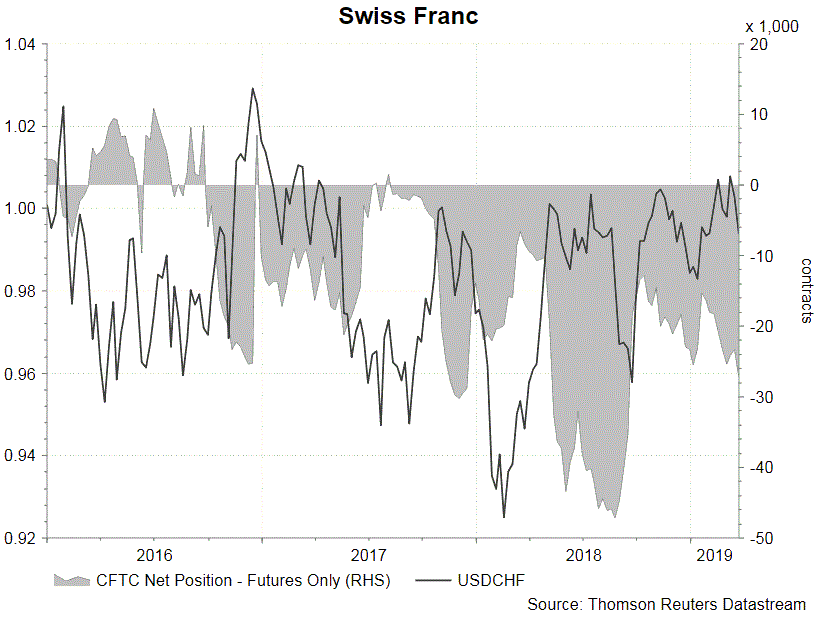
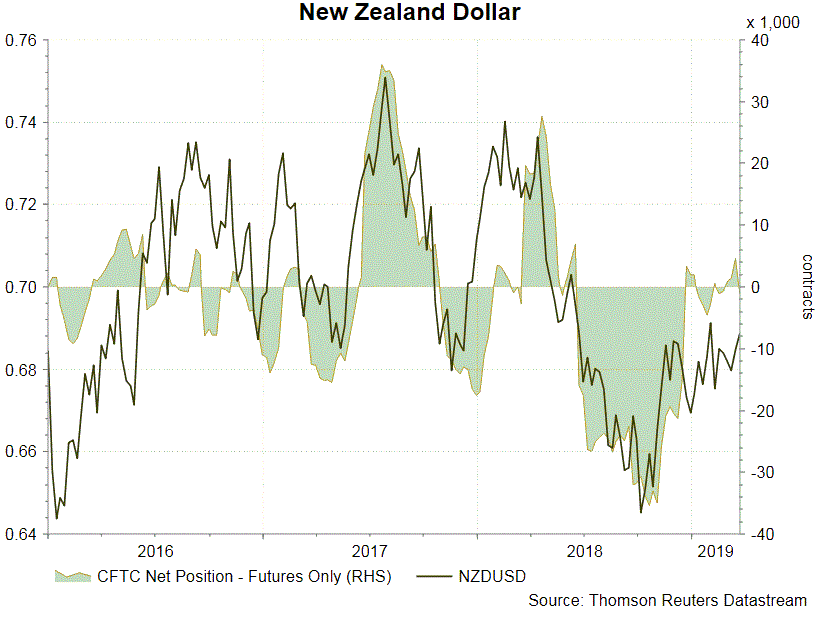
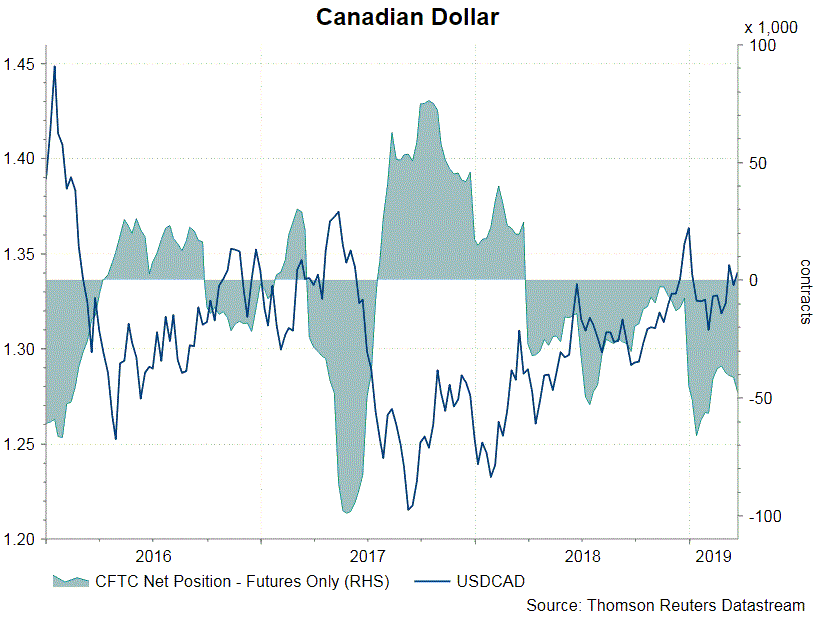
 On commodity currencies . NET SHORT for AUD futures rose +8 203 contracts to 51 902. Speculative long positions fell -4 927 contracts while shorts rose +3 279 contracts. NZD recorded NET SHORT of 1 124 contracts last week, amidst decrease in speculative long positions and increase in shorts. NET SHORT for CAD futures climbed +6 721 contracts to 47 774. Traders turned more bearish over the loonie with speculative longs falling while shorts rising.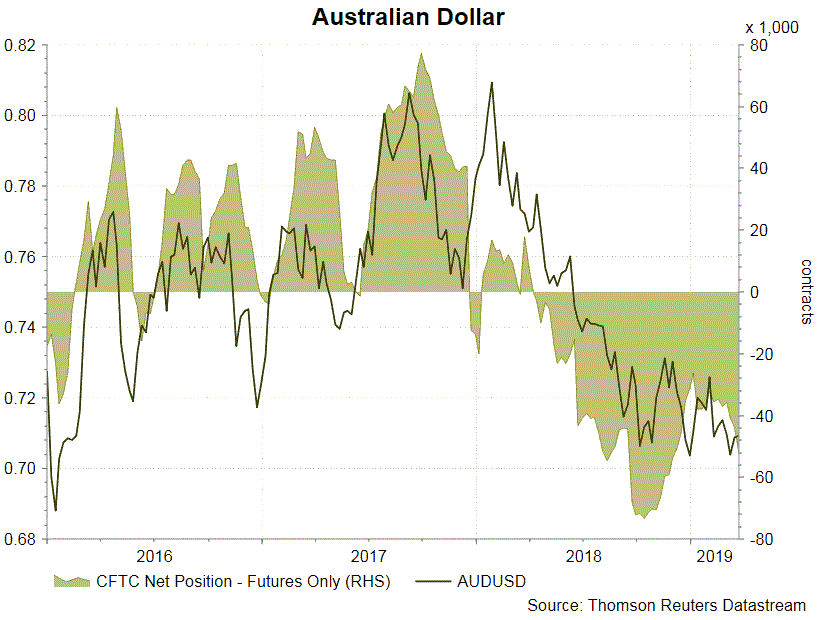
USD/JPY Weekly Outlook
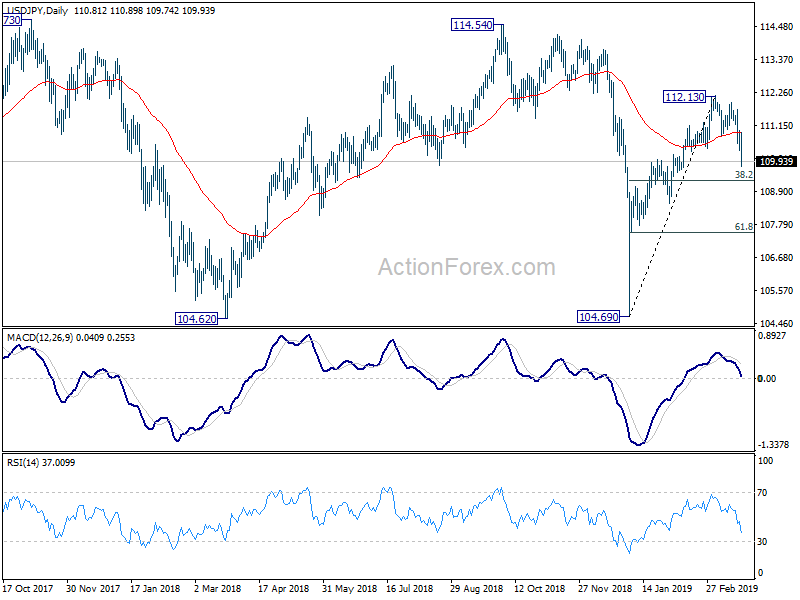
USD/JPY's decline from 112.13 accelerated last week and break of 110.35 support argues that rebound from 104.69 is completed. Initial bias remains on the downside this week for 38.2% retracement of 104.69 to 112.13 at 109.28 first. Break will target 61.8% retracement at 107.53 next. On the upside, break of 110.95 minor resistance will turn bias back to the upside for retesting 112.13 instead.
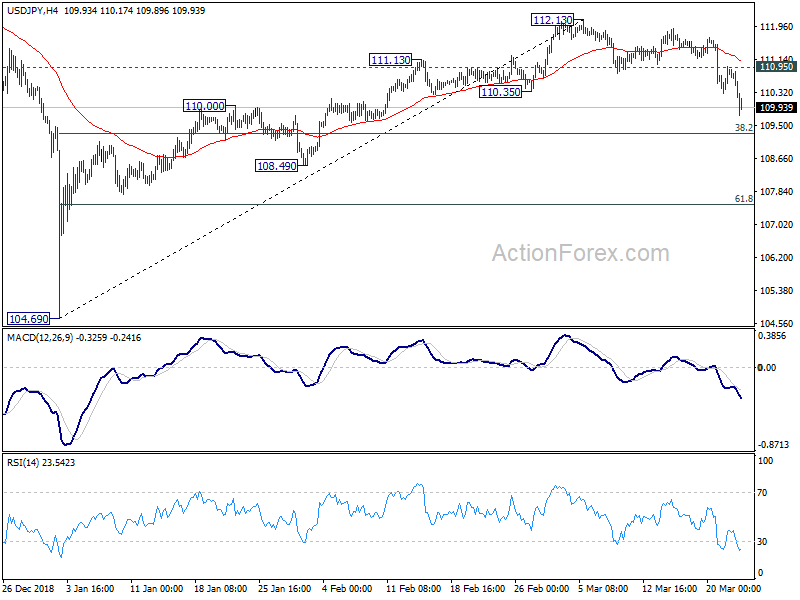
In the bigger picture, while the rebound from 104.69 was strong, USD/JPY failed to sustain above 55 week EMA (now at 110.91), and was kept well below 114.54 resistance. Medium term outlook is turned mixed and we'll wait for the structure of the fall from 112.13 to unveil to make an assessment later. For now, more range trading is expected between 104.69 and 112.13 first.
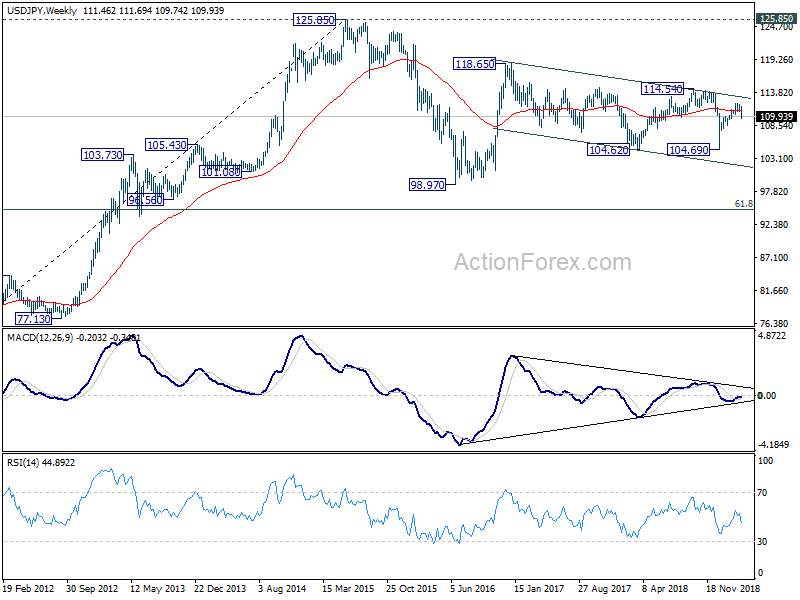
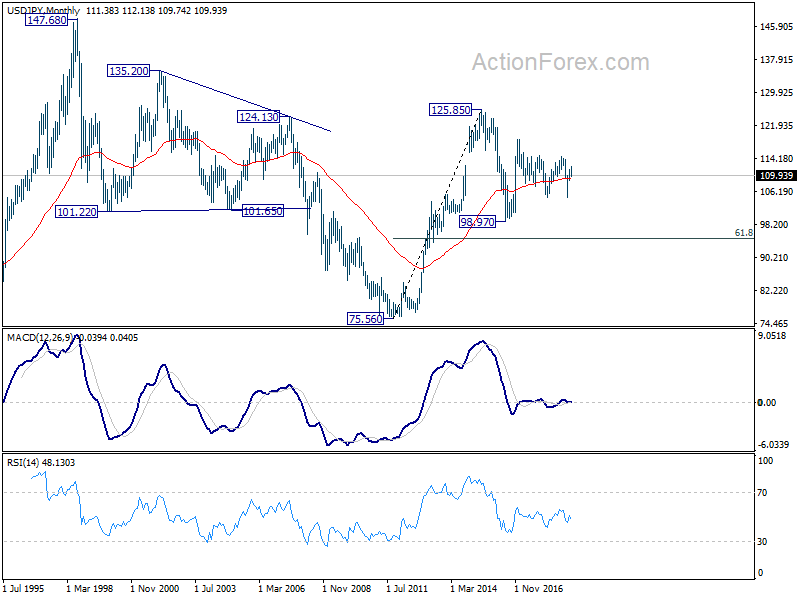
In the long term picture, the rise from 75.56 (2011 low) long term bottom to 125.85 (2015 high) is viewed as an impulsive move, no change in this view. Price actions from 125.85 are seen as a corrective move which could still extend. In case of deeper fall, downside should be contained by 61.8% retracement of 75.56 to 125.85 at 94.77. Up trend from 75.56 is expected to resume at a later stage for above 135.20/147.68 resistance zone.
GBP/USD Weekly Outlook
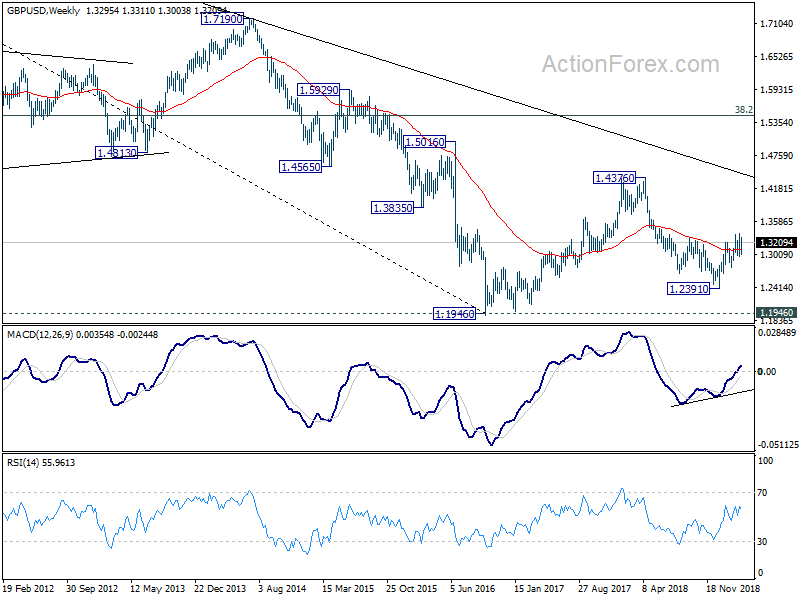
GBP/USD stayed in consolidation from 1.3381 last week and initial bias remains neutral this week first. With 1.2960 intact, further rise is still in favor. On the upside, firm break of 1.3381 will target 61.8% retracement of 1.4376 to 1.2391 at 1.3618 next. However, on the downside, firm break of 1.2960 will indicate that rebound from 1.2391 has completed earlier than expected. Deeper fall would then be seen to 1.2773 support for confirmation.
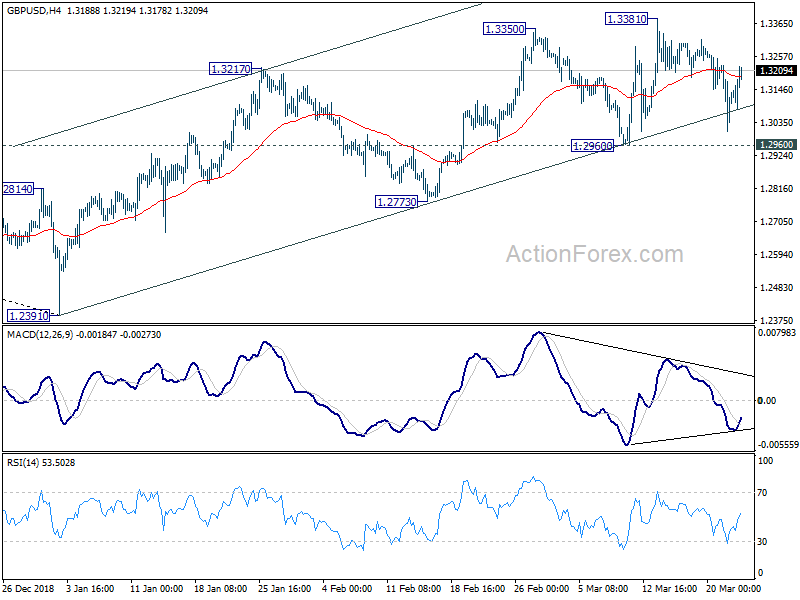
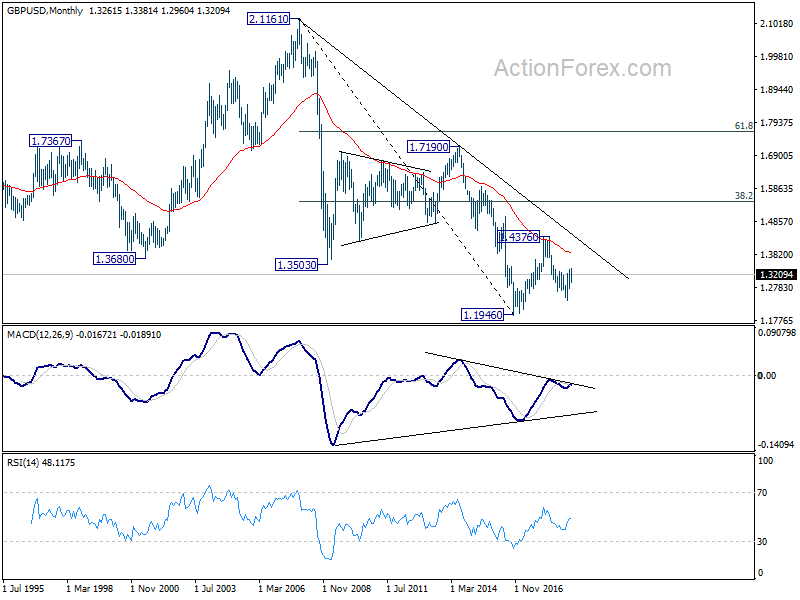
In the bigger picture, medium term decline from 1.4376 (2018 high) should have completed at 1.2391. Rise from 1.2391 is now seen as the third leg of the corrective pattern from 1.1946 (2016 low). Further rise could be seen through 1.4376 in medium term. On the downside, though, break of 1.2773 support will dampen this view. Focus will be turned back to 1.2391 low and break will resume the fall from 1.4376 to 1.1946.
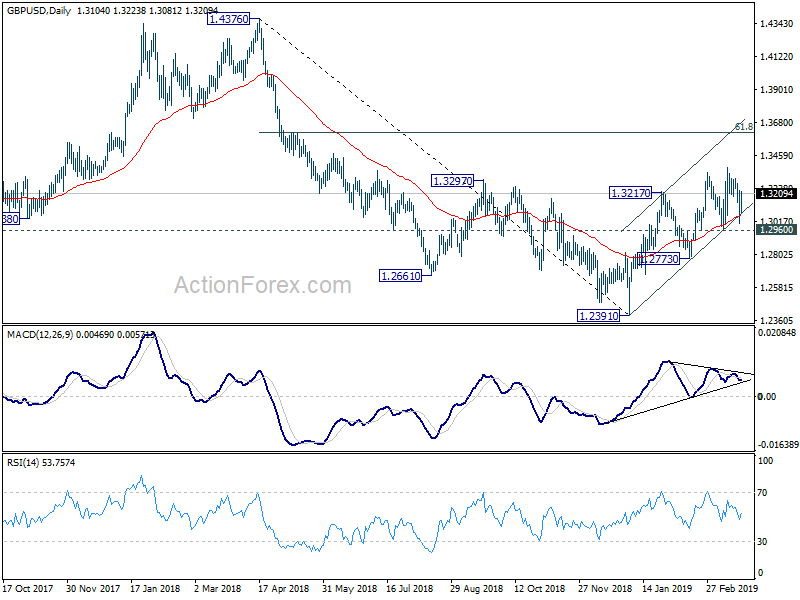
In the longer term picture, current development argues that corrective pattern from 1.1946 (2016 low) is extending with another rise. But there is no change in the long term bearish outlook as long as 38.2% retracement of 2.1161 (2007 high) to 1.1946 at 1.5466 holds. An eventual downside breakout through 1.1946 is still in favor in the long term.