

Sample Category Title
Risk Aversion Continues With Focus on German Ifo and Brexit
Risk aversion dominates in the Asian markets today as recession fears spread. But the currency markets are steady though. Major pairs and crosses are bounded inside Friday's range at the time of writing, with mild weakest in Sterling and Swiss Franc. After last week's poor Germany PMI manufacturing, investors will look into Ifo business climate today to gauge overall sentiments in the growth engine in Eurozone. Meanwhile, Brexit drama will resume in the Commons, after campaigns for second referendum gained momentum.
Technically, USD/JPY broke 110.35 support, EUR/JPY broke 124.27 support, CAD/JPY broke 82.41 support last week. All suggested near term bullish reversal in Yen. Yen crosses will be watched closely this week to validate this case. Levels to watch include 143.72 in GBP/JPY and 77.44 in AUD/JPY. Also, EUR/CHF's steep decline last week raised the chance of medium term down trend resumption. Focus will be on 1.1173 low.
In Asia, Nikkei is down -3.13%. Hong Kong HSI is down -1.78%. China Shanghai SSE is down -1.37 at 3061, still holding on to 3000 handle. Singapore Strait Times si down 01.39%. Japan 10-year JGB yield is down -0.0114 at -0.084.
Fed Evans: No rate hike until H2 2020
Chicago Fed President Charles Evans said at a conference in Hong Kong that he now doesn't expect a rate hike until second half of next year. He noted the US economy is in a strong position. Fed funds rate is seen as close to neutral. And it's good time to pause and be cautious. Yet, that's a rather abrupt turn as just back in January, he expected Fed could hike as many as three times this year, assuming the economy remains reasonably strong.
Evans described the inversion of 3-month to 10-year yield curve as "pretty narrow". But he also noted that there's be a "secular decline" in long term interest rates. Some of his is "structural" having to do with "lower trend growth, lower real interest rates." Hence, "in that environment, it's probably more natural that yield curves are somewhat flatter than they have been historically."
ECB Rehn: Markets too relaxed on Brexit risks
ECB Governing Council member Olli Rehn warned that the risks of no-deal Brexit are underestimated by the markets. Talking to Germany's Die Welt newspaper, he said "in the short term Brexit is surely the biggest threat". And, "financial markets seem to be too relaxed and appear to underestimate the risk."
On Eurozone economy, Rehn said "growth has indeed slowed down significantly and we must be worried about the economy."
UK to resume Brexit debate as campaigns for second referendum and Bremain gather momentum
Brexit debate will resume in the House of Commons today to find a majority for a way forward that breaks the current impasse. Prime Minister Theresa May said she hopes to hold a vote on her deal again this week. But so far, there is no signs the twice-defeated deal could make a turnaround. Instead, May could unveil plans to hold indicative votes.
The push for second referendum gained momentum over the weekend with with over a million people joined the "Put It To The People" March in London. Speakers at the rally included Labour's deputy leader Tom Watson, Scotland's First Minister Nicola Sturgeon, London Mayor Sadiq Khan. Separately, the "Revoke Article 50 and remain in the EU" petition now gathered over 5.3M signatures.
It appears that Chancellor of Exchequer Philip Hammond doesn't object to a referendum. He said: "I'm not sure there's a majority in parliament in support of a second referendum... Many people will be strongly opposed to it, but it's a coherent proposition and it deserves to be considered along with the other proposals."
However, Brexit Minister Stephen Barclay warned that "at its logical conclusion, the risk of a general election increases because you potentially have a situation where parliament is instructing the executive to do something that is counter to what it was elected to do."
Meanwhile, the Sunday Times reported that 11 unidentified senior ministers could try to oust May today as she has become a toxic and erratic figure whose judgment has "gone haywire". Two leading candidate Cabinet Minister David Lidington and Environment Secretary Michael Gove backed May though. Also, it's reported that hardline Brexiteer including Jacob Rees-Mogg & Iain Duncan Smith demanded May to set a timeline to step done for get their support on the Brexit deal.
With short Article 50 extension granted by EU last week, if UK parliament could approve a deal, Brexit is delayed to May 22. If no deal is approved, UK will have to leave with no withdrawal agreement on April 12, or provide an alternative.
The week ahead
RBNZ is the only central bank that's meeting this week. It's widely expected to keep OCR unchaged at 1.75%. Recent developments have been pretty much in line with the central bank's expectations. Thus, there is little reason for its to change its monetary stance. RBNZ will very likely reiterate: "We expect to keep the OCR at this level through 2019 and 2020. The direction of our next OCR move could be up or down." BoJ will provide another central bank activity with release of March meeting summary of opinions.
Recession fear is the main theme in the financial markets now. Economic data, in particular from Eurozone, will be closely watched. Germany Ifo business climate, CPI flash retail sales and unemployment will catch most attention. US consumer confidence, personal income and spending will be watched too. Though, US and UK Q4 GDP final will likely be ignroed. Canada GDP is another piece of market moving data.
Here are some highlights for the week:
- Monday: Japan all industry index; Germany Ifo business climate
- Tuesday: New Zealand trade balance; BoJ summary of opinions, Japan corporate service prices; Geramny Gfk consumer sentiment; UK BBA mortgage approvals; US housing starts and building permits, house price indices, consumer confidence
- Wednesday: RBNZ rate decision; UK CBI realized sales; Canada trade balance; US trade balance;
- Thursday: New Zealand ANZ business confidence; Germany CPI flash; Eurozone M3 money supply; US Q4 GDP final, jobless claims, pending home sales
- Friday: New Zealand building consent; Japan Tokyo CPI, jobless claims, industrial production, retail sale, housing starts, Australia private sector credit; Germany import price, retail sales, unemployment; Swiss KOF economic barometer; UK Q4 GDP final, current acount, M4 money supply, mortgage approvals; Canada GDP, IPPI and RMPI; US personal income and spending, Chicago PMI, new home sales.
USD/JPY Daily Outlook
Daily Pivots: (S1) 109.45; (P) 110.18; (R1) 110.64; More...
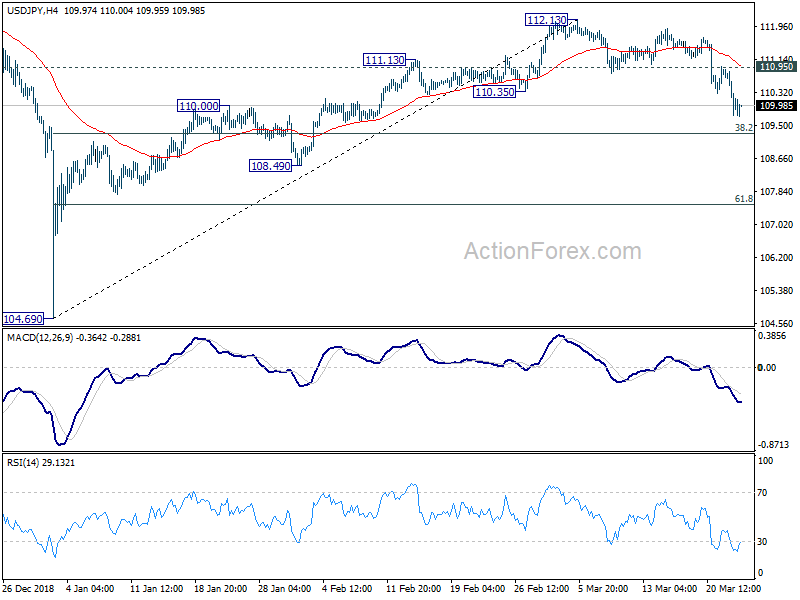
Intraday bias in USD/JPY remains on the downside at this point. Prior break of 110.35 support argues that rebound from 104.69 is completed at 112.13 already. Further decline should be seen to 38.2% retracement of 104.69 to 112.13 at 109.28 first. Break will target 61.8% retracement at 107.53 next. On the upside, break of 110.95 minor resistance will turn bias back to the upside for retesting 112.13 instead.
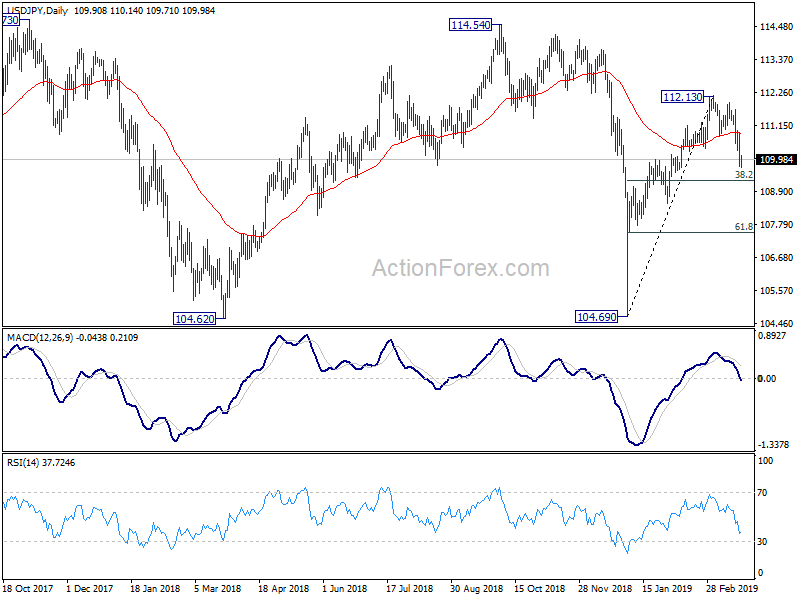
In the bigger picture, while the rebound from 104.69 was strong, USD/JPY failed to sustain above 55 week EMA (now at 110.91), and was kept well below 114.54 resistance. Medium term outlook is turned mixed and we'll wait for the structure of the fall from 112.13 to unveil to make an assessment later. For now, more range trading is expected between 104.69 and 112.13 first.
Economic Indicators Update
| GMT | Ccy | Events | Actual | Forecast | Previous | Revised |
|---|---|---|---|---|---|---|
| 4:30 | JPY | All Industry Activity Index M/M Jan | -0.20% | -0.40% | -0.40% | |
| 9:00 | EUR | German IFO Business Climate Mar | 98.5 | 98.5 | ||
| 9:00 | EUR | German IFO Current Assessment Mar | 102.9 | 103.4 | ||
| 9:00 | EUR | German IFO Expectations Mar | 94 | 93.8 |
UK to resume Brexit debate as campaigns for second referendum and Bremain gather momentum
Brexit debate will resume in the House of Commons today to find a majority for a way forward that breaks the current impasse. Prime Minister Theresa May said she hopes to hold a vote on her deal again this week. But so far, there is no signs the twice-defeated deal could make a turnaround. Instead, May could unveil plans to hold indicative votes.
The push for second referendum gained momentum over the weekend with with over a million people joined the "Put It To The People" March in London. Speakers at the rally included Labour's deputy leader Tom Watson, Scotland's First Minister Nicola Sturgeon, London Mayor Sadiq Khan. Separately, the "Revoke Article 50 and remain in the EU" petition now gathered over 5.3M signatures.
It appears that Chancellor of Exchequer Philip Hammond doesn't object to a referendum. He said: "I'm not sure there's a majority in parliament in support of a second referendum... Many people will be strongly opposed to it, but it's a coherent proposition and it deserves to be considered along with the other proposals."
However, Brexit Minister Stephen Barclay warned that "at its logical conclusion, the risk of a general election increases because you potentially have a situation where parliament is instructing the executive to do something that is counter to what it was elected to do."
Meanwhile, the Sunday Times reported that 11 unidentified senior ministers could try to oust May today as she has become a toxic and erratic figure whose judgment has "gone haywire". Two leading candidate Cabinet Minister David Lidington and Environment Secretary Michael Gove backed May though. Also, it's reported that hardline Brexiteer including Jacob Rees-Mogg & Iain Duncan Smith demanded May to set a timeline to step done for get their support on the Brexit deal.
With short Article 50 extension granted by EU last week, if UK parliament could approve a deal, Brexit is delayed to May 22. If no deal is approved, UK will have to leave with no withdrawal agreement on April 12, or provide an alternative.
EUR/USD Could Extend Losses Before Fresh Increase
Key Highlights
- The Euro faced a strong resistance near 1.1450 and later corrected lower against the US Dollar.
- EUR/USD traded below a major bullish trend line with support at 1.1365 on the 4-hours chart.
- The US Manufacturing PMI for March 2019 (Prelim) declined from 53.0 to 52.5.
- The German IFO Business Climate Index for March 2019 could rise from 98.5 to 98.7.
EURUSD Technical Analysis
This past week, the Euro followed a solid bullish path and traded above 1.1400 against the US Dollar. However, the EUR/USD pair faced a strong resistance near 1.1450 and recently started a downside correction.
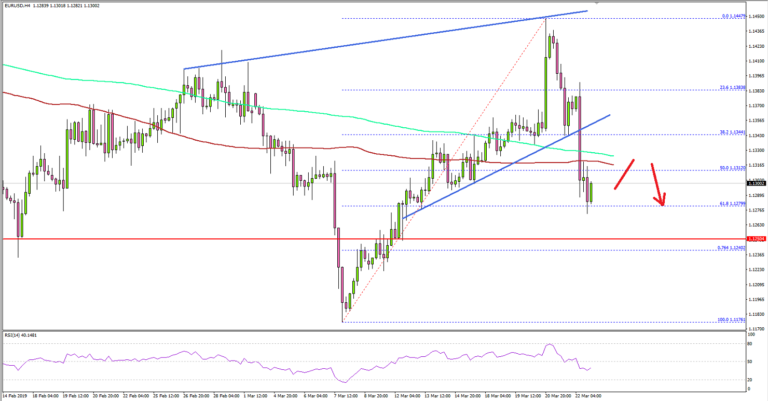
Looking at the 4-hours chart, the pair traded as high as 1.1447 and later declined below the 1.1420 and 1.1400 support levels. There was a break below the 50% Fib retracement level of the last wave from the 1.1176 low to 1.1447 high.
Besides, the pair traded below a major bullish trend line with support at 1.1365, the 200 simple moving average (4-hours, green), and 100 simple moving average (4-hours, red).
On the downside, an immediate support is near the 1.1250 level and the 76.4% Fib retracement level of the last wave from the 1.1176 low to 1.1447 high. If the pair continues to decline, it could find a strong buying interest near the 1.1250 level.
On the upside, an initial resistance is near the 1.1340 level and the 100 SMA. If buyers push the pair above the 1.1340 and 1.1350 levels, the pair may perhaps revisit the 1.1400 area.
Fundamentally, the US Manufacturing PMI for March 2019 (Prelim) was released this past Friday. The market was looking for a rise from the last reading of 53.0 to 53.6.
However, the actual result was lower than the forecast, as the US Manufacturing PMI declined to 52.5, instead of a rise to 53.6.
The report added:
March data revealed a slowdown in U.S. private sector output growth, with manufacturing firms experiencing a particularly subdued end to the first quarter of 2019.
Overall, the EUR/USD pair moved into a short term bearish and it could retest the 1.1250 support, where buyers are likely to emerge.
Economic Releases to Watch Today
- German IFO Business Climate Index for March 2019 – Forecast 98.7, versus 98.5 previous.
- German IFO Current Assessment Index March 2019 – Forecast 103.0, versus 103.4 previous.
- German IFO Expectations Index for March 2019 – Forecast 94.4, versus 93.8 previous.
- Dallas Fed Manufacturing Business Index for March 2019 – Forecast 7.0, versus 13.1 previous.
ECB Rehn: Markets too relaxed on Brexit risks
ECB Governing Council member Olli Rehn warned that the risks of no-deal Brexit are underestimated by the markets. Talking to Germany's Die Welt newspaper, he said "in the short term Brexit is surely the biggest threat". And, "financial markets seem to be too relaxed and appear to underestimate the risk."
On Eurozone economy, Rehn said "growth has indeed slowed down significantly and we must be worried about the economy."
Market Morning Briefing: Euro-Yen Has Fallen Breaking Below Support Near 125.20-124.40
STOCKS
Overall equities have declined sharply and look bearish for the near term.
Dow (25502.32, -460.19, -1.77%) tumbled breaking below the key support level of 25650 and looks vulnerable for a fresh fall to 21200-21180.
DAX (11364.17, -185.79, -1.61%) declined breaking below the support at 11450 which we had expected to hold. Next supports are at 11280 and 11230 which are likely to be tested while it trades below the 11450-11500 resistance region.
Nikkei (20930.27, -697.07, -3.22%) has failed to sustain above the 21-MA support near 21470 as mentioned last week and has instead opened with a gap down today. Near to medium term looks bearish with a possible fall towards 20750-20500.
Shanghai (3072.72, -31.68, -1.02%) has broken below 3100 contrary to our expectation of a trigger towards 3150-3180. Although there is immediate support near 3025, the index is trading near important resistance on the 3-day candles and could come off sharply towards 3000-2950 if the resistance holds.
The uptrend in the Sensex (38164.61, -222.14, -0.58%) and Nifty (11456.90, -64.15, -0.56%) may take a pause this week. A corrective fall is on the cards. Sensex can fall to 37960 in the near term. A break below it can drag the index to 37725. Nifty can test 11320, a break below which can see the fall extending to 11250.
COMMODITIES
Gold (1314.80) has supports at 1310 and 1305 which are likely to limit the downside in the near term. While above 1305, a fresh rally 1320 and 1330 is possible in the coming days.
Silver (15.45) is slightly mixed. An immediate support is at 15.35. A bounce from there can take the prices higher to 15.55 and 15.60 again. But a break below 15.35 can drag silver to 15.20.
Copper (2.8515), as against our expectation has tumbled breaking below the support level of 2.88. A fall below 2.84 can drag the prices further lower to 2.82 and 2.81 in the near term. Resistances are at 2.86 and 2.88.
WTI (58.45) has failed to get follow-through buyers above 60. It may remain range bound between 58 and 60. The bias remains bullish for WTI to break 60 and rise to 61-62 in the short term.
Similarly, Brent (66.45) has failed to sustain above 68 and has come-off sharply towards the end of last week. It can remain range bound between 66 and 68 for some time and a breakout on either side of 66 or 68 will decide the next move.
FOREX
Volatile movements seen in the currency pairs since the last 1-2 sessions. Dollar looks strong and could continue to remain so for the near term.
Dollar-Index (96.62) has bounced well from 95.75 and while that holds, the index looks strong towards 97.50/75 levels. However, 97 could act as an interim resistance and push the index back towards 96.00-95.75 before the index resumes a rise back towards 97 or higher.
For Euro (1.1299), 1.1450 has been holding well for the last 2-sessions and a test of 1.1250 looks likely in the near term. A break below 1.1250, if seen and sustained could be bearish towards 1.12 in the medium term. Overall Euro looks bearish while below 1.1450.
Euro-Yen (124.028) has fallen breaking below support near 125.20-124.40. While below 124.40, the pair could fall towards lower support at 123 before again bouncing back towards 126 in the medium term.
Dollar Yen (109.79) is also looking strongly bearish and may fall towards 109-108.5 in the near term. Interim bounce is possible from 109.80/75 levels but could be short lived with higher chances of a gradual fall targeting 109.
Aussie (0.7077) is almost stable and has been coming off from resistance near 0.7150. While the daily trend resistance holds, Aussie could fall targeting 0.70-0.6950 in the coming sessions.
Pound (1.3197) is likely to trade within 1.30-1.34 region over the next few sessions. While above 1.30, it looks bullish towards 1.34.
USDCNY (6.7124) has immediate resistance near 6.73 and while that holds, we could see some consolidation within 6.68-6.73 levels for some time. A break below 6.68 or above 6.73/74 would initiate fresh movement on either side. For now we may consider ranged movement for the next few sessions.
Dollar-Rupee (68.96) has bounced well last week. While the momentum looks strong, USDINR could continue to move up targeting 69.20. A break above 69.20 would open up chances of testing 69.40/50 on the upside. Else a rejection from 69.20 could push the pair back towards 68.80/60 levels. Preference is for the upside just now.
INTEREST RATES
Part of the US Treasury yield curve tuned negative as the 3-month yield (2.45%) trades higher than the 10Yr yield (2.44%) indicating possibly decline in the economy. If the yield rates do not recover immediately, the markets could take it as a possible signal of easing from the FED and potential recession.
The US yields look strongly bearish for the near to medium term. The 10Yr could come down towards 2.25%.
The US-JGB 10Yr (2.53%) is trading lower and could head towards 2.45% indicating further bearishness in Dollar-Yen in the coming sessions.
The German-US 10Yr (-2.45%) is trading just below resistance and while that holds, it could come off sharply back towards -2.52% indicating Euro weakness to continue.
The 10YR GOI (7.5045%) could move up towards 7.55% today.
Fed Evans: No rate hike until H2 2020
Chicago Fed President Charles Evans said at a conference in Hong Kong that he now doesn't expect a rate hike until second half of next year. He noted the US economy is in a strong position. Fed funds rate is seen as close to neutral. And it's good time to pause and be cautious. Yet, that's a rather abrupt turn as just back in January, he expected Fed could hike as many as three times this year, assuming the economy remains reasonably strong.
Evans described the inversion of 3-month to 10-year yield curve as "pretty narrow". But he also noted that there's be a "secular decline" in long term interest rates. Some of his is "structural" having to do with "lower trend growth, lower real interest rates." Hence, "in that environment, it's probably more natural that yield curves are somewhat flatter than they have been historically."
Daily Markets Broadcast
Wall Street drops on slowdown fears
Weak sets of data out of Europe and the US stoked fears of a faster, deeper economic slowdown and pressured Wall Street on Friday. EU granted a Brexit extension to the UK as long as they approve PM May’s deal this week.
US30USD Daily Chart
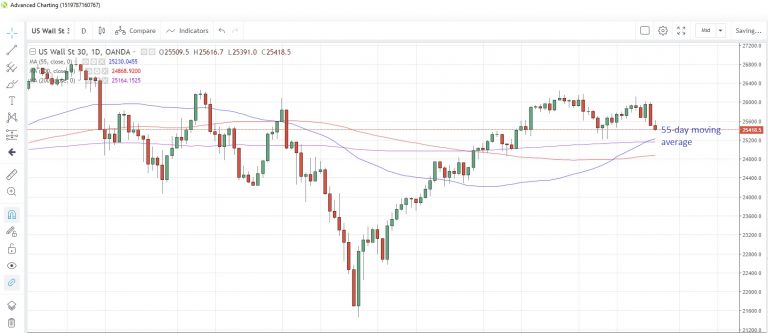
The US30 index fell the most since January 3 on Friday amid weaker flash PMI readings for March
The index is slipping toward the 55-day moving average at 25,230 with the 200-day moving average below at 25,164
The Markit flash manufacturing PMI for March fell to 52.5, weakest since August 2017, and below economists’ estimates of 53.6. Today we have speeches from Fed’s Evans and Harker.
DE30EUR Daily Chart
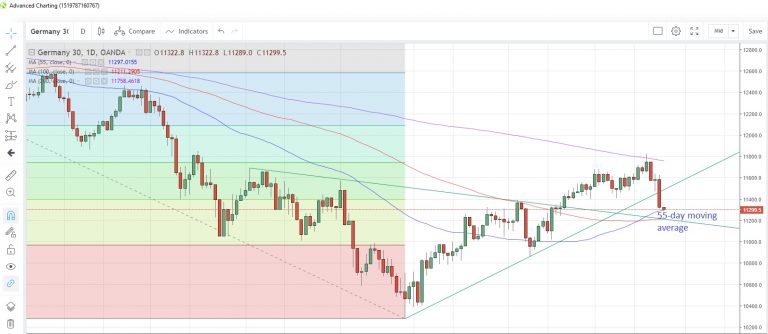
The Germany30 index suffered the biggest daily drop since February 7 on Friday as the flash manufacturing PMI fell to the lowest since 2012 in March
The index is testing the 55-day moving average at 11,297, which has supported prices on a closing basis since February 8
German IFO surveys for March are due today, with the expectations index seen improving to 94.4 from 93.8. Given the poor PMI readings, a lower-than-expected print could happen.
UK100GBP Daily Chart
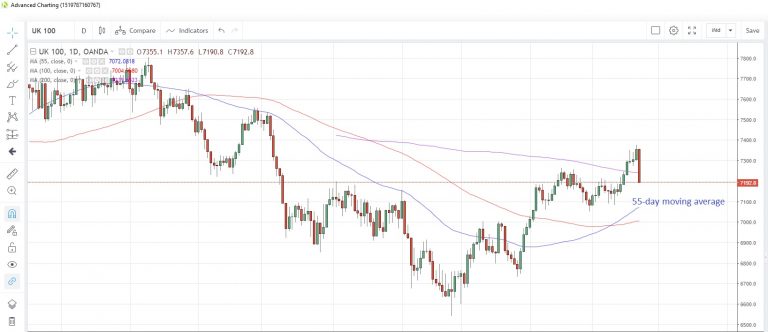
The UK100 index tumbled by the most in nine months on Friday as data and Brexit uncertainties pressured
The index breached the 200-day moving average at 7,239 on Friday. The 55-day moving average is at 7,072
The EU granted a short-term extension to the UK’s Brexit to May 22 IF last week’s rejected deal from PM May is approved. This seems unlikely, in which case the extension would only apply to April 12.
Dollar Rebounds With Market Focused On Apple’s Event
The dollar is higher in the Asia session after US Attorney General said the Muller report did not find sufficient evidence against President Donald Trump. Safe havens retreated slightly but will be on hand as another week filled with risk events begins.
The U.S. Federal Reserve went full dove, leaving no interest rates hikes in 2019 as per the dot-plot published as part of the end of March's FOMC meeting. Global growth has failed to regain momentum as US-China trade and Brexit concerns have been joined with disappointing indicators out of Germany.
An inversion in the 3 month and 10-year yields has investors worried that a recession could be near. Fed Chair gave a mixed outlook where the central bank will be on pause this year but trying to maintain a positive long-term outlook.
STOCKS – Apple to Announce Subscription Service But Market Expects One More Thing…
Global stocks are under pressure at the start of the week. Fed members will be on board to reiterate that the central bank will not lift interest rates in 2019, but geopolitical risk events are still pressuring equities as the inversion in the short- and long-term US benchmark yields has increased investor anxiety as it could signal a recession.
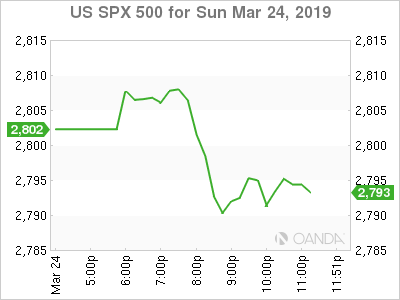
Apple will kick off the week with its much-anticipated event on Monday. The fact that the company built up the event by announcing updates to its iPad, iMac and Air Pods has investors anxious on the March 25 event. The subscription service might be the worst kept secret in the market, but the devil is in the details and if Apple confirms rumours of quality content partnerships it could create a complete package as Tim Cook has put together a media, software and hardware package that will be tough to beat.
GOLD – Gold Opens Flat Ahead of Busy Week
Gold is flat at the start to the Asian session; the rebound of the dollar is keeping the yellow metal under pressure until geopolitical risk events trigger a rise in demand. Brexit is high on the agenda, as Prime Minister May came back to the UK with an extension on hand but might need more to get Eurosceptic MPs to her side.
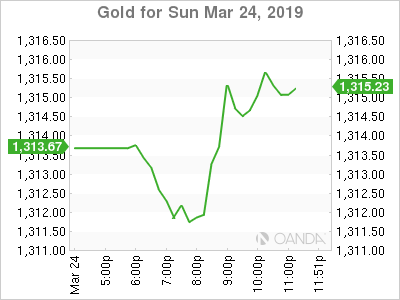
May's tenure as Prime Minister could be short lived, but even potential candidates to replace her backed her as a change of leadership at this point in time could be disastrous as the Brexit countdown was expanded but marches on with a lot of work still on the table in order to rule out a no-deal exit.
Gold is set to make another run for the $1,350 price level that has proved resilient. Volatility fuelled by uncertainty and with plenty of Fed speakers expected to reinforce the dovish rhetoric from the central bank the US dollar will be limited on the upside.
OIL – Oil Lower on Dollar Rebound
Energy prices are lower on Monday as the US dollar rebounds after the comments from the US Attorney General removed some uncertainty surrounding the White House. Oil rose after a surprise 9.6 million drawdown and the efforts of the OPEC+ to keep production lower.
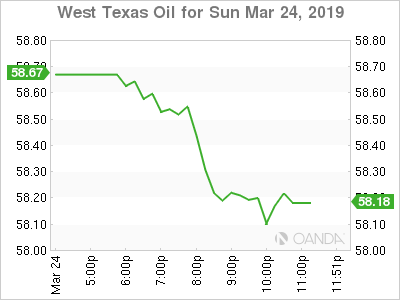
The cancellation of the April ministerial meeting pushed the focus to the end of the agreement in June, when a probable extension could be announced as the de facto leaders Saudi Arabia and Russia have hinted that the deal could still be in place until the end of the year.
The demand for energy continues to gather steam, even as global growth forecasts have been downgraded as mixed economic indicators and trade disputes impact investor confidence.
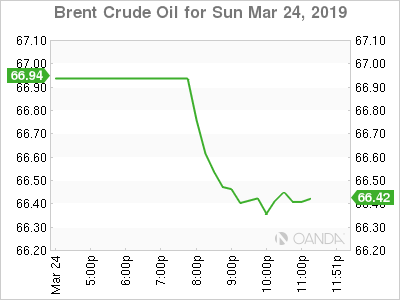
Oil markets continue to seesaw between the two main factors driving prices: US production and the OPEC+ agreement to cut output with disruptions such as the shock US drawdown tipping the scale in favour of a rise in prices.
Oil Lower On Dollar Rebound
Energy prices are lower on Monday as the US dollar rebounds after the comments from the US Attorney General removed some uncertainty surrounding the White House. Oil rose after a surprise 9.6 million drawdown and the efforts of the OPEC+ to keep production lower.
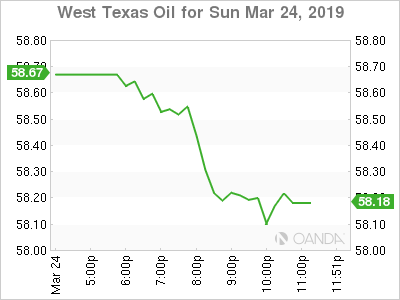
The cancellation of the April ministerial meeting pushed the focus to the end of the agreement in June, when a probable extension could be announced as the de facto leaders Saudi Arabia and Russia have hinted that the deal could still be in place until the end of the year.
The demand for energy continues to gather steam, even as global growth forecasts have been downgraded as mixed economic indicators and trade disputes impact investor confidence.
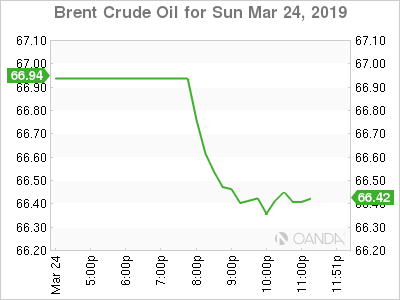
Oil markets continue to seesaw between the two main factors driving prices: US production and the OPEC+ agreement to cut output with disruptions such as the shock US drawdown tipping the scale in favour of a rise in prices.
Gold Opens Flat Ahead Of Busy Week
Gold is flat at the start to the Asian session; the rebound of the dollar is keeping the yellow metal under pressure until geopolitical risk events trigger a rise in demand. Brexit is high on the agenda, as Prime Minister May came back to the UK with an extension on hand but might need more to get Eurosceptic MPs to her side.
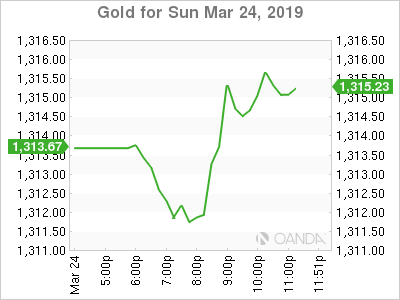
May's tenure as Prime Minister could be short lived, but even potential candidates to replace her backed her as a change of leadership at this point in time could be disastrous as the Brexit countdown was expanded but marches on with a lot of work still on the table in order to rule out a no-deal exit.
Gold is set to make another run for the $1,350 price level that has proved resilient. Volatility fuelled by uncertainty and with plenty of Fed speakers expected to reinforce the dovish rhetoric from the central bank the US dollar will be limited on the upside.