Sample Category Title
Terrible German PMI Data Sinks Global Stocks and Euro
- Stocks & USD – Terrible European data kills risk appetite
- EUR – Euro falls as German bunds go negative
- Brexit – EU throws UK a delay bone
- Oil – Stockpiles fell 9.6M even as imports rose 186K
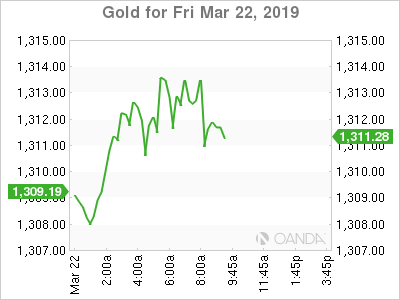
- Gold – Stronger on dovish Fed
Stocks & Dollar
US equities are off to a poor start on the final day of the week after a terrible round of data from both France and Germany, reminded traders that Europe needs the global growth outlook to improve. The worst decline in German manufacturing in over six years disappointed many expecting the data to stabilized. France also delivered sour results as the Gilets Jaunes protests continue to weigh on French business.
The Fed’s dovish commitment this week locks them in a corner of keeping rates on hold for the rest of the year. Global growth has yet to see a benefit from accommodative stances that are now firmly in place by the ECB, RBA, RBNZ, BOC, and the PBOC. One key reason growth can’t stabilize just yet stems from concerns about trade wars. While optimism is high, albeit fading, that a trade deal will get done with China and the US, concerns are brewing that the transatlantic trade war will keep Europe down. While the China/US trade war is well over a year long, expectations should not be for the US and Europe trade war to be nearly as long. President Trump’s best chances of getting elected are if the economy does not fall apart by election time and that will not happen if he does not have a quick resolution with Europe. This morning, Trump noted, “he does not want zero tariffs on cars from Europe.
Investors are still processing the Fed’s decision to push back one last rate hike to 2020 along with the wrath of softer global data. The dollar’s strength is likely to start to worry the US and we should not be surprised if we hear the President complain.
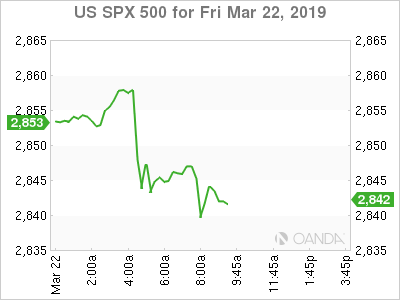
S&P 500 futures are lower by 0.6%, while the dollar is mixed against the majors, with gains against the euro and loonie, while falling to cable and Aussie-dollar.
EUR
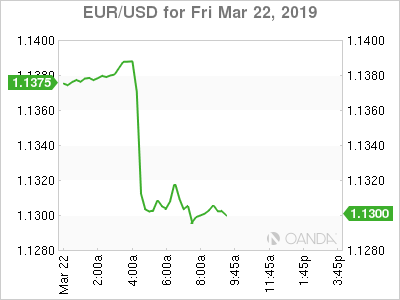
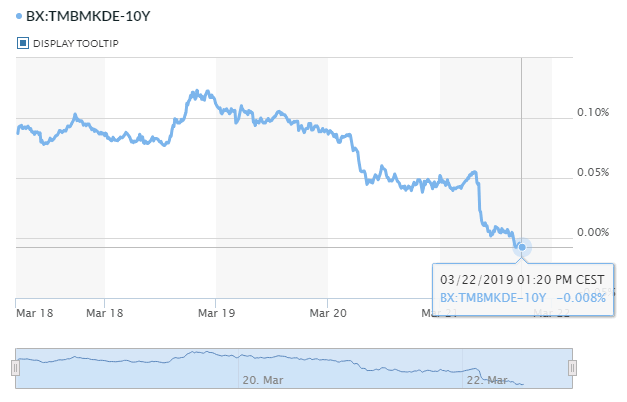
The euro fell hard after the terrible German PMI miss. The bloc’s largest economy is still showing weakness and that drove the German 10-year government yield below zero for the first time since 2016. Bunds were not expected to fall back to zero and momentum could see yields have further declines if investors want to hold insurance against a severe slowdown.
The euro is now approaching last week’s low and if we see further weakness price may target the lower boundaries of the range that has been in place since the fall.
Brexit
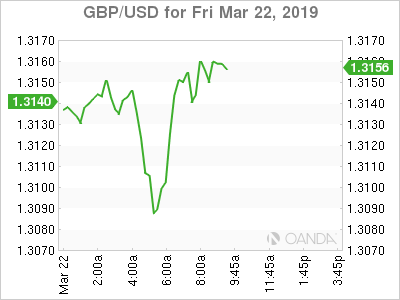
A week to the March 29th Brexit day, but that probably does not matter as much. The EU has given the UK an extra two weeks unconditional extension to April 12th. The same story remains, PM May will try to push her deal forward with a meaningful vote some time next week. The first step for May is for speaker Bercow to accept another vote on her deal, it is not expected to have too many changes, so he could not allow it.
If May’s deal is blocked or defeated, the UK will have to decide if they will want to hold European Parliament elections. Until we see some Brexit deal, the risk of a hard exit will keep the British pound’s gains capped.
Oil
Crude prices are under pressure as global growth concerns spark fears that demand might be softer than expected. Higher oil prices have been supported by the OPEC + production cuts, sanction effects on Iran and Venezuela, along with other contributing factors, and decline with US inventories, but that may not last if demand declines. Rising production from the US is expected to make fresh record highs and ultimately be a headwind for higher crude prices.
Gold
The precious metal is higher on the day, but not as high as much as one would expect with the cloud of global growth concerns. While the data has been weak in Europe, optimism is still high that US/China trade deal will get done and the trickle down effect will eventually provide a boost for both the rest of Asia and Europe. Gold may be rangebound unless risk aversion takes over.
Trump said he won’t drop auto tariffs to zero even if EU proposes so
In a Fox Business interview, Trump repeated that EU is treating the US as bad as China in terms of trade. And, asked if he would agree to zero tariffs on autos if the EU proposed so, Trump said "no". He added, "I would do it for certain products, but I wouldn't do it for cars." Trump is again inconsistent with what he said before. Apparently, he's not that much of a free trade advocate as he proclaimed.
In the G7 summit last June, Trump surprised other leaders and called for dropping all tariffs, trade barriers and subsidies. He said that "Ultimately that's what you want, you want tariff free, no barriers, and you want no subsides because you have some countries subsidizing industries and that's not fair". And, "so you go tariff free, you go barrier free, you go subsidy free, that's the way you learned at the Wharton School of Finance."
Economic advisor Larry Kudlow also aid "I don't know if they were surprised with President Trump's free trade proclamation, but they certainly listened to it and we had lengthy discussions about that... "As the president said, reduce these barriers, in fact go to zero, zero tariffs, zero non-tariff barriers, zero subsidies, and along the way we're going to have to clean up the international trading system."
Canada Inflation Climbs, While Retail Sales Decline
Canadian inflation climbs
Canadian inflation rose last month at a slightly faster-than-expected pace, pushed higher by increased costs associated with mortgage payments and fresh vegetables.
According to Stats Canada, Canada’s CPI climbed +1.5% y/y in February, up from a +1.4% rise in January. Market expectations were for a +1.4% increase.
Meanwhile, the Bank of Canada (BoC) preferred measures for underlying inflation was unchanged m/m, with the average core-CPI rate for February at +1.83%.
Canada Retail Sales Decline
Canadian retail sales fell for a third consecutive month in January on decreased demand for new and used cars.
Stats Canada said retail sales decreased -0.3% in January m/m to a seasonally adjusted C$50B. Market expectations were for a +0.4% increase.
In volume terms, January sales were unchanged from the previous month.
On a y/y basis, January retail receipts rose +1.1% vs. December’s +1.5% annual advance.
The level of retail sales now sits at a nine-month low and mostly weighed down by the auto component. Sales at motor vehicles and parts dealers fell -1.5% to C$13.47B. Ex-auto’s, Canadian retail sales advanced +0.1%.
Loonie
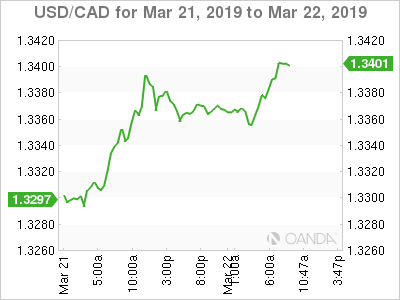
The CAD is now trading at the low of the day, down -0.37% at C$1.3416
Canadian retail sales dropped -0.3%, CPI ticked up to 1.5%
Canadian Dollar weakens after weaker than expected retail sales data. Headline sales dropped -0.3% mom in January, below expectation of 0.4% mom. Ex-auto sales rose 0.1% mom, matched consensus.
Headline CPI accelerated to 1.5% yoy, up from 1.4% yoy and beat expectation of 1.4% yoy. CPI core-common slowed to 1.8% yoy, down from 1.9% yoy, matched expectations. CPI core-media was unchanged at 1.8% yoy. CPI core-trim was unchanged at 1.9% yoy.
Into US session: Recession fears intensify, US yield curve inversion, German benchmark yield turns negtaive
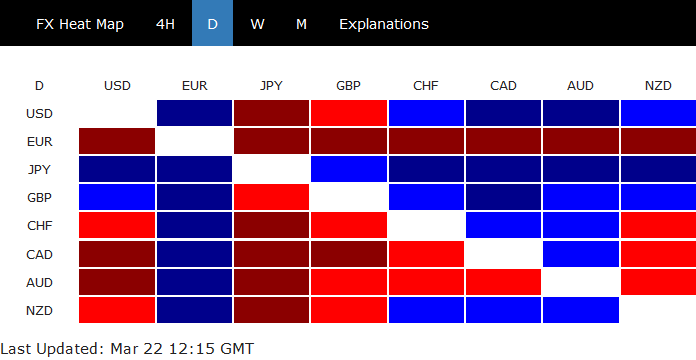
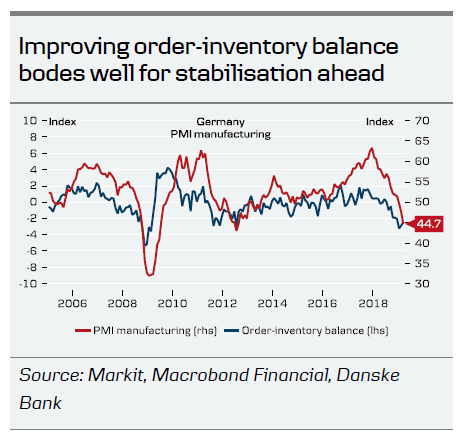
Entering into US session, Euro is overwhelmingly the weakest one today after shockingly poor German PMI manufacturing, which dropped to 71-month low at 44.7. Australian Dollar follows closely as second on risk aversion while Canadian is the third weakest.
For the same reasons, Yen is the strongest one for today. Sterling is the second strongest after EU granted UK more weeks to get the Brexit deal through the parliament, until April 12. Dollar is the third weakest.
Development in the bond markets are particularly worth nothing. Firstly, German 10-year bund yield hit at low as -0.01, turned negative for the first time since 2016. Secondly, the most accurate indicator of recession in US, yield curve between 3-month and 10-year, inverts. US 10-year yield is down -0.064 at 2.469 now. 3-month yield is at 2.474.
In Europe:
- FTSE is down -1.32%.
- DAX is down -0.72%.
- CAC is down -1.19%.
Earlier in Asia:
- Nikkei rose 0.09%.
- Hong Kong HSI rose 0.14%.
- Singapore Strait Times dropped -0.05%.
- Japan 10-year JGB yield dropped -0.037 to -0.072.
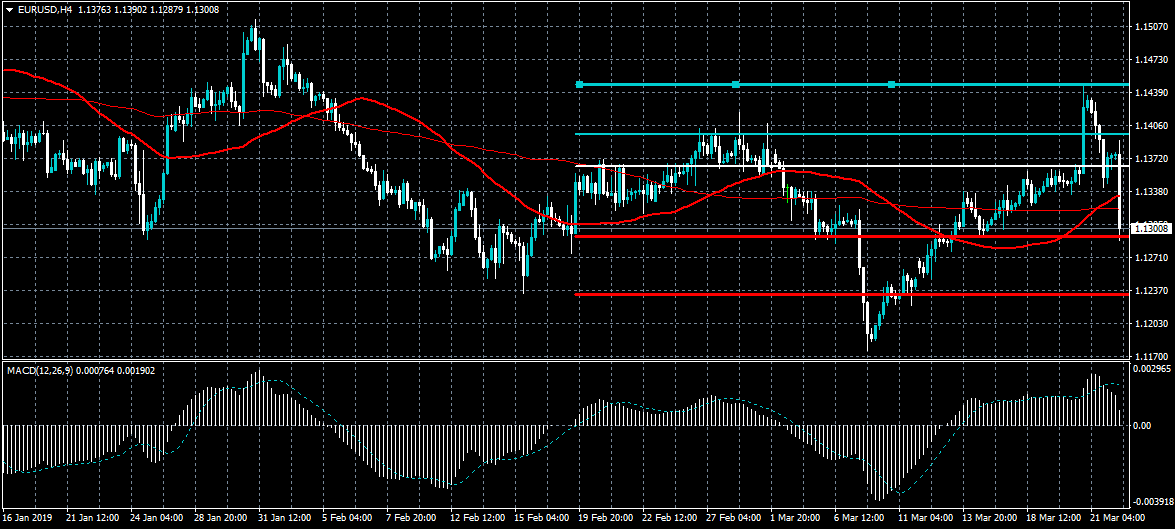
EURUSD 1.1290 Critical Support
The euro currency has tumbled lower against the US dollar on Friday, following much weaker than expected PMI Manufacturing data from the German economy. If the EURUSD pair falls below the 1.1290 level traders should expect heavy technical selling to resume. The MACD indicator on the four-hour time frame is also signaling further intraday losses for the EURUSD pair.
The EURUSD pair is heavily bearish while trading below the 1.1290 level, key technical support is found at the 1.1237 and 1.1215 levels.
If the EURUSD pair trades above the 1.1360, buyers may test back towards the 1.1390 and 1.1410 resistance levels.
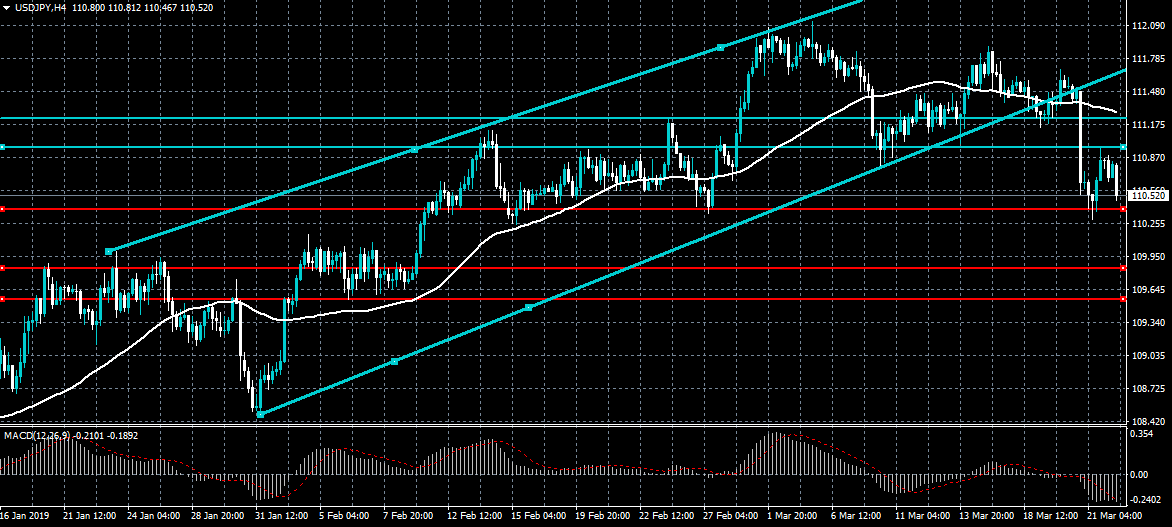
USDJPY Back To Major Support
The US dollar has moved back towards major weekly support against the Japanese yen currency after a brief correction back to the 111.00 level. A sustained move below the 110.40 support level should signal the next bear move towards the 109.80 level. Bulls need to move price above the 111.20 resistance level to negate the strong bearish sentiment surrounding the USDJPY pair.
The USDJPY pair is heavily bearish while trading below the 110.40 level, key support is found at the 109.80 and 109.50 levels.
If the USDJPY pair trades above the 111.00 level, buyers may test towards the 111.20 and 111.50 resistance levels.
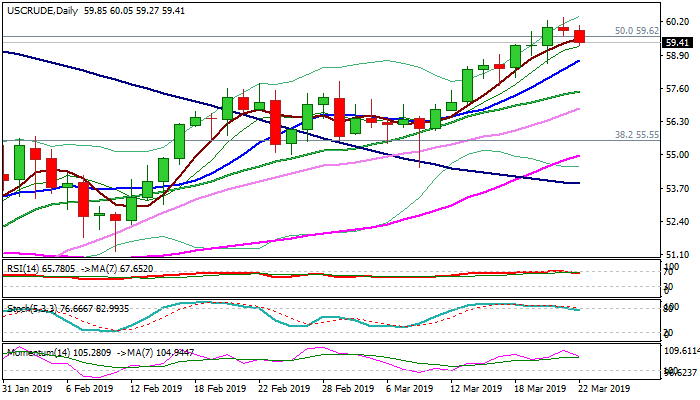
WTI Oil Outlook: Bulls May Correct Further After Initial Failure At Psychological $60 Barrier
WTI oil stands at the back foot on Friday and eases to $59.30 after bulls ran out of steam and failed to close above cracked $60 barrier in repeated attempt.
Overbought daily studies and bearish divergence on slow stochastic suggest consolidative / corrective action in coming sessions, as traders take profit from rally of past two-weeks.
Doji reversal pattern is forming on daily chart and today’s close in red is needed to complete the pattern and signal further easing.
Corrective action would face initial support at $58.67 (10SMA) which should ideally contain, however deeper dips cannot be ruled out and should find ground above rising 20SMA ($57.47) to keep larger bulls intact and prevent deeper correction.
Oil prices remain supported by production cut by main oil exporters, as well as US sanctions on Iran and Venezuela, while stronger than expected draw in US oil inventories last week, further inflated the price.
WTI contract is on track for the second straight bullish week, but weekly close above cracked Fibo barrier at $59.62 (50% of $76.88/$42.36) is needed to signal bullish continuation.
Res: 59.62, 60.05, 60.37, 61.00
Sup: 59.27, 58.67, 57.47, 56.80
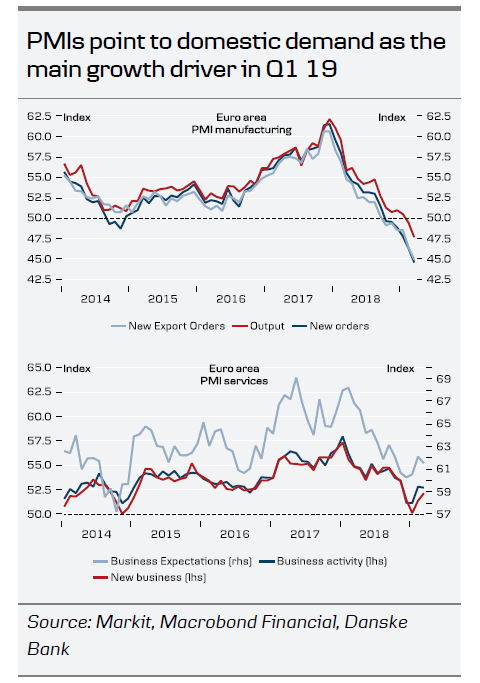
Flash Comment: Growing Manufacturing Abyss Challenges Eurozone Outlook
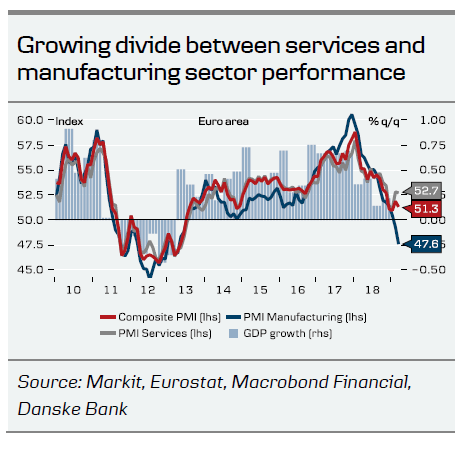
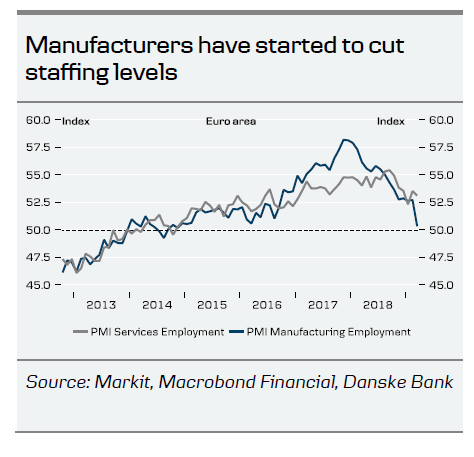
Today's eurozone March PMI survey brought another negative surprise. The outlook for manufacturing in particular is becoming increasingly dark in many eurozone countries. The weakness is still led by Germany, where manufacturing new orders fell to the lowest level (40.1) since the financial crisis and signs are rising that manufacturers have also started to reduce staffing on the back of lower external demand. France saw a similar - though less pronounced - fall back in manufacturing activity from 51.5 to 49.8, led by weaker export business, making it unlikely that the economy has gained much speed from Q4's 0.3% q/q.
On a positive note the euro area service sector continues to prove relatively resilient to the manufacturing slowdown, with service PMI holding steady at 52.7 in March and incoming new business remaining on an upward trend. Domestic demand hence looks to have remained the growth driver in Q1 on the back of rising real wage growth and fiscal stimulus, while the industrial sector is likely to have been a drag.
Nevertheless, PMIs paint a lacklustre picture of the underlying euro area growth momentum, which is disappointing news for the ECB. The ECB opened the door to further accommodation at the March meeting and today's PMI data on balance strengthens the case for further easing steps ahead. That said, we think it is unlikely that the ECB will react to single data points, and we still think there is some way to go before the ECB would take the next step on the easing ladder by restarting QE.
Looking ahead, we still expect private consumption to drive the eurozone growth rebound – and we are seeing signs of that in the rising service PMIs – but to get euro area activity ‘back to speed' manufacturing PMI also needs to break out of its downward spiral – a US-China trade deal, Chinese fiscal and monetary stimulus and an orderly Brexit, remain important ingredients for that. In light of today's figures we revise down our Q1 growth forecast for Germany to 0.2% q/q (was 0.3%). However, we stick to our forecast of annual euro area growth at 1.3% in 2019 and still attach a low probability (c.15%) to the euro area entering a recession in the foreseeable future (see Euro Area Research: Is the euro area heading for recession?, 4 March).
GBPJPY Loses Ground, Neutral In Near Term
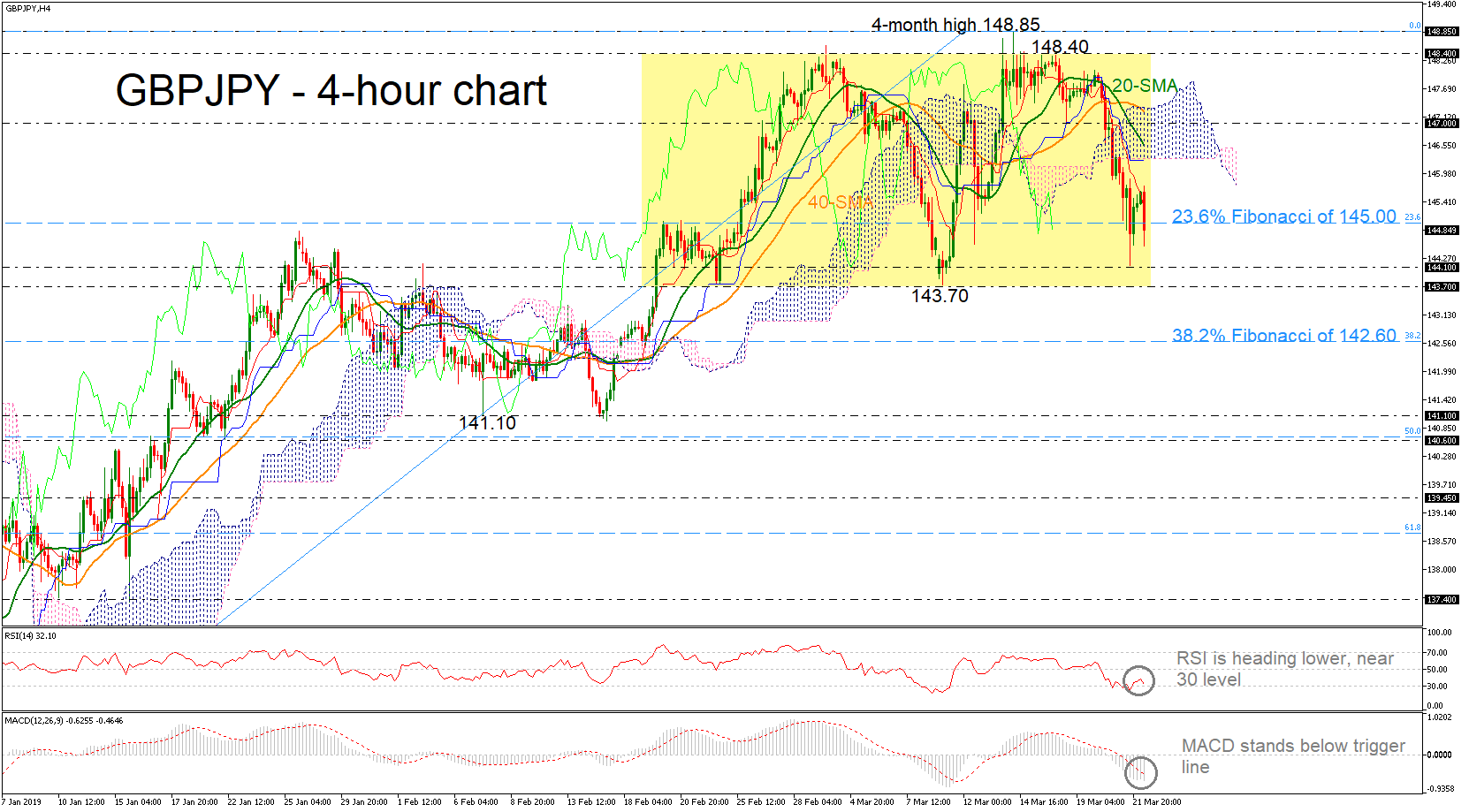
GBPJPY had another bearish start on Friday, with the price breaking the crucial 23.6% Fibonacci retracement level of the upleg from 132.48 to 148.85, around 145.00. The technical indicators in the 4-hour chart are endorsing this view, with the RSI reversing back down to its 30 oversold mark and the MACD keep stretching in negative area and below its trigger line. Also, the price is trading well below the Ichimoku cloud and particularly below the red-Tenkan sen line, suggesting more losses ahead.
More southward movement could meet the 144.10 support area, taken from the latest low. A failure to hold above this level, could open the way towards the 143.70 area which if broken could trigger a more aggressive sell-off towards the 38.2% Fibonacci of 142.60.
In the positive scenario, an improvement has the potential to retest the blue Kijun-sen line and the lower band of the Ichimoku cloud near 146.25, while slightly above this hurdle the 20-simple moving average (SMA) currently at 146.53, could be also in focus. Further up, the 147.00 handle and the 40-SMA around 147.20 could halt upside movements as well.
Summarizing, looking over the market’s last one-month performance, the pair has been neutral within the 148.40 resistance and the 143.70 support levels, while in the bigger picture, GBPJPY remains bullish.