Sample Category Title
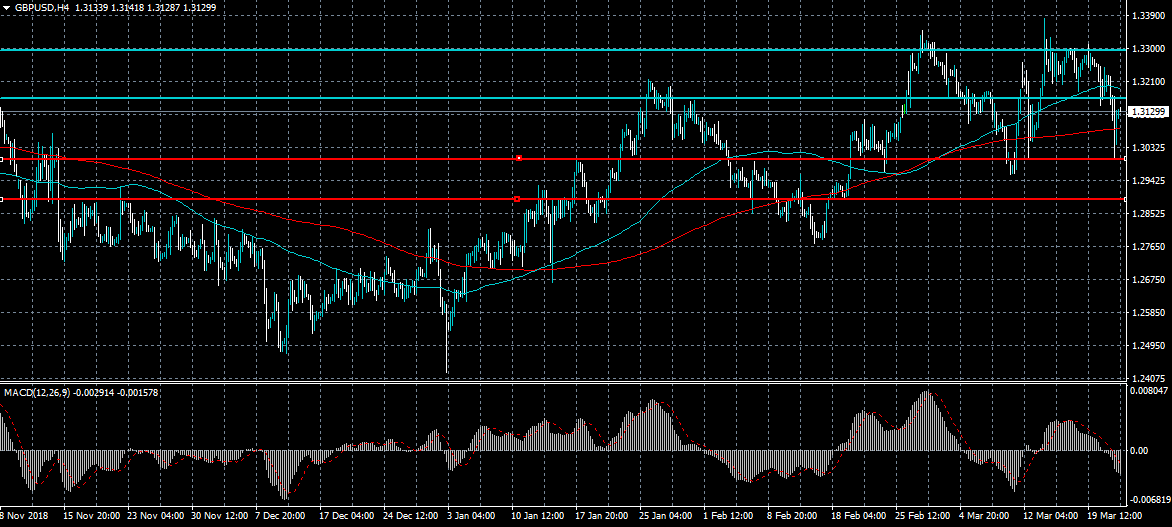
GBPUSD 1.3100 Critical Support
The British pound is under pressure against the US dollar as the United Kingdom still faces the prospect of leaving the EU without a deal in just seven days time. If the GBPUSD pair once again falls below the 1.3100 support level, the bearish sentiment will increase. Bulls now need to move price above the 1.3200 resistance level in order to stabilize the GBPUSD pair.
The GBPUSD pair is heavily bearish while trading below the 1.3100 level, key technical support is found at the 1.3000 and 1.2970 levels
If the GBPUSD pair trades above the 1.3155 level, buyers may test towards the 1.3200 and 1.3250 resistance levels.
LTCUSD Price Divergence Building
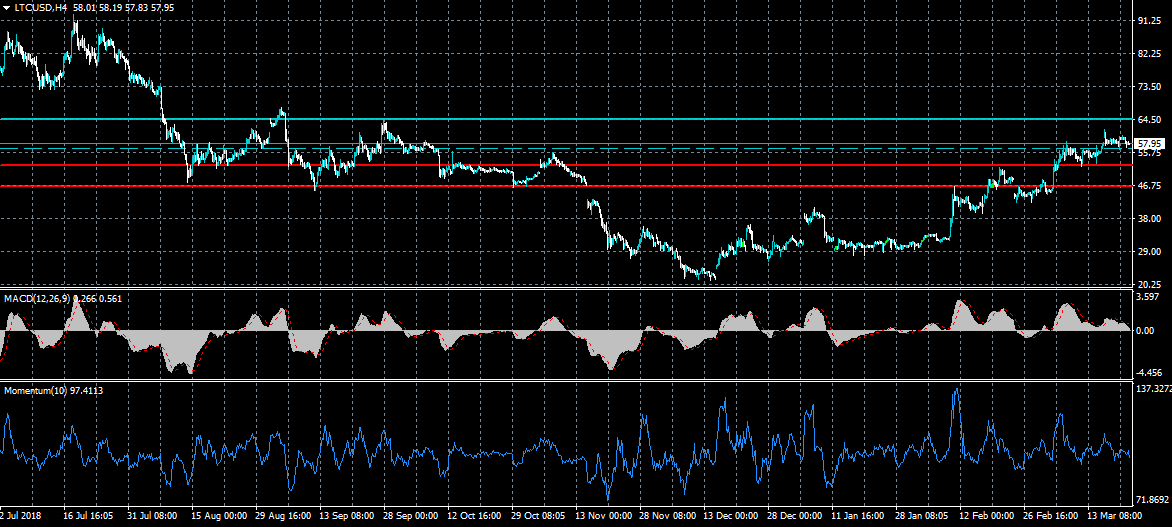
Litecoin is testing interim support on Friday, as the fourth largest cryptocurrency struggles to make gains above the $60.00 resistance level. Bearish price divergence is also building on the Momentum and MACD indicators on the four-hour time frame. A sustained break under the $53.00 support level should accelerate technical selling back towards the important $46.50 level.
The LTCUSD pair is only bullish while trading above the $53.00 level, key technical resistance remains at the $60.00 and $65.00 levels.
If the LTCUSD pair moves under the $53.00 level, sellers may test towards the $46.50 and $36.00 support levels.
Sterling Rises After EU Grants Theresa May Article 50 Extension
The British pound rose in overnight trading after European leaders accepted Theresa May’s request for an article 50 extension. The premier was given until May 22 to come up with a solution. This was a shorter period than she was asking. The extension comes at a time when the prime minister has faced a number of defeats in the Tory-controlled parliament. Just last week, the members rejected her deal and this week, the speaker denied her a chance for another vote. European leaders too are frustrated because the uncertainty on Brexit has been cited as one of the leading factors affecting the global economy.
The Japanese yen declined after Japan released weaker inflation numbers. The national CPI rose by a mere 0.2%, which was the same as that of January but lower than the 0.3% that traders were expecting. On a monthly basis, the rate of inflation was unchanged. The national core CPI, which excludes the volatile food and energy products, increased by 0.7%, which was lower than the expected 0.8%. More negative news from the country was that the manufacturing PMI in February was at 48.9, which was lower than the expected 49.2.
Today, traders will focus on key economic numbers from Europe. The French manufacturing PMI is expected to remain at 51.4 while the composite PMI is expected to remain unchanged at 50.7. In Germany, the manufacturing PMI is expected to improve slightly to 48 while the services PMI is expected to drop to 54.8. For the European Union as a whole, the manufacturing PMI is expected to improve slightly by increasing from 49.3 to 49.5. The composite PMI is expected to improve slightly from 51.9 to 52.
Other key data expected today are the interest rates decision by the Russian central bank, which is expected to leave rates unchanged at 7.75%. In Canada, the CPI numbers will be released, with the headline CPI expected to remain unchanged at 1.4%. The core CPI is expected to remain at 1.5%. In the United States, traders will receive the PMI numbers, with the manufacturing PMI expected to increase slightly to 53.5. The existing home sales numbers will also be released.
EUR/USD
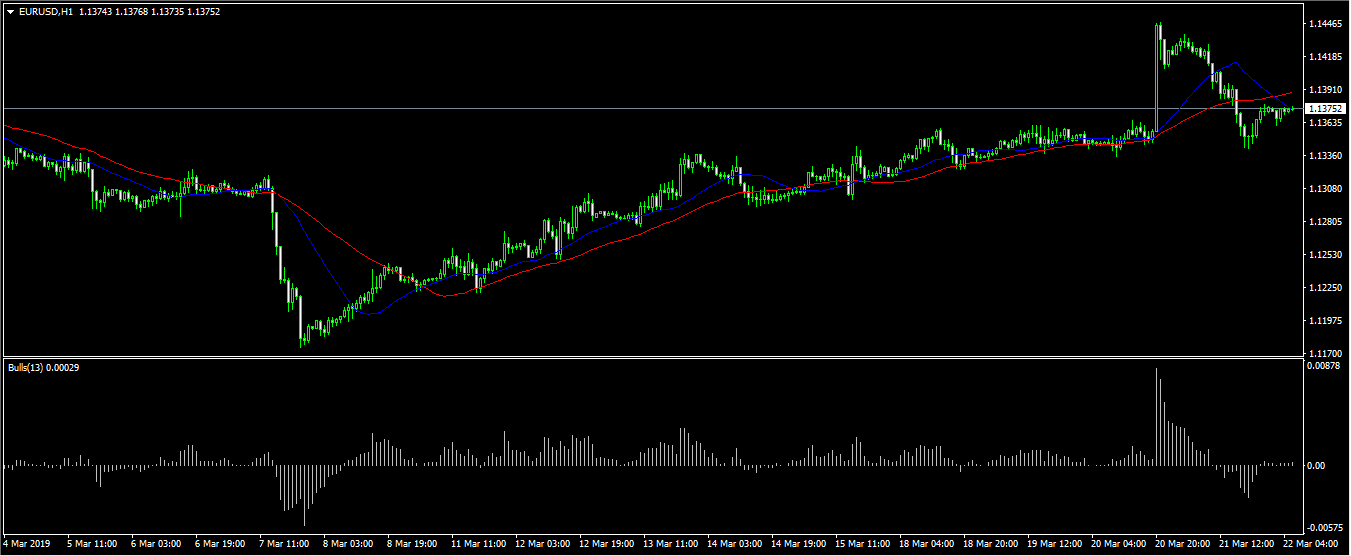
On Wednesday, the EUR/USD pair rose sharply after the FED released its decision. The pair reached a high of 1.1448. Yesterday, the pair pared those gains and dropped to the previous lows. In overnight trading, the pair rose slightly after the EU leaders gave Theresa May a new lifeline on Brexit. The pair is now trading at 1.1375. The price is along the three-week exponential moving average but lower than the 6-week average while the Bulls Power has eased the momentum. Today, the pair could have another breakout depending on the PMI numbers.
USD/JPY
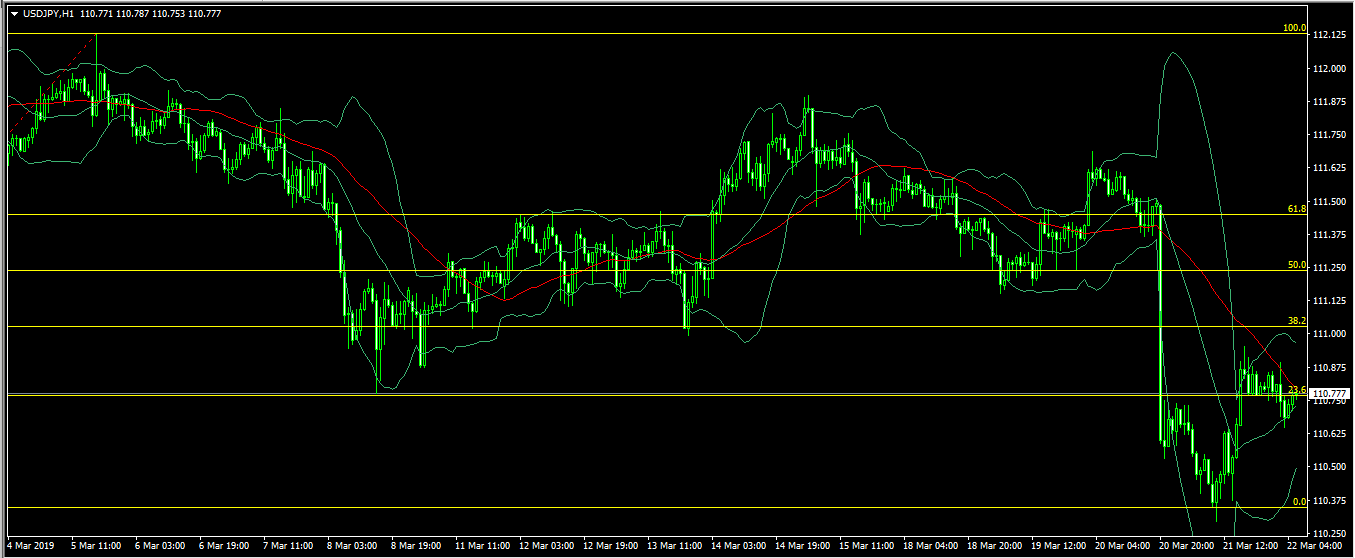
The USD/JPY pair was little changed today after Japan released its inflation numbers. The pair is now trading at 110.77, which is along the 23.6% Fibonacci Retracement level. It is also along the middle line of the Bollinger Bands indicator and along the 5-week moving average. The pair could move up as traders reflect on the weak inflation numbers from Japan. If it does, it will test the 38.2% Fibonacci Retracement level at 111.0.
USD/CAD
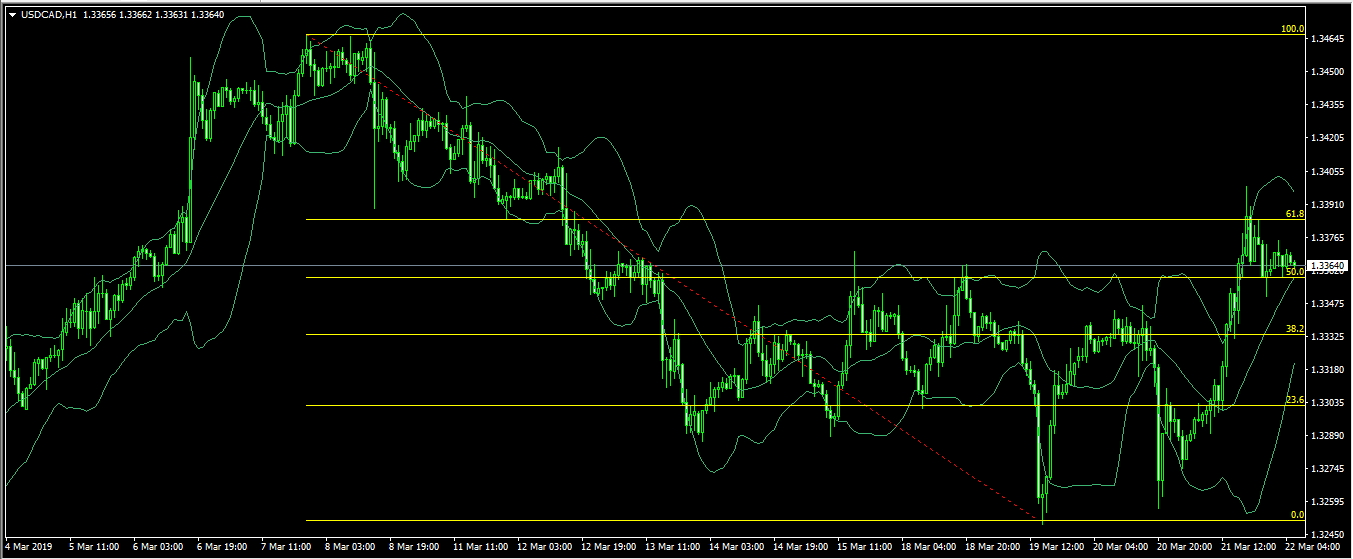
After reaching a high of 1.3400 yesterday, the USD/CAD declined to a low of 1.3365. This price is along the 50% Fibonacci Retracement level and along the middle line of the Bollinger Bands. Since the pair will likely move in either directions, the key points to watch will be the 61.8% and 38.2% Fibonacci Retracement levels at 1.3385 and 1.3330 respectively.
Currencies: Dollar Sell-Off Halted. Will Better EMU PMI’s Support The Euro?
- Rates: First test of key 2.5% support in US 10-yr yield
The US 10-yr yield bounced off the key 2.5% support area yesterday, but we label the test as ongoing following the Fed's dovish turn. Today's eco calendar contains EMU PMI. We see upside risks vs consensus, but fear an asymmetric market reaction: core bond gains in case of disappointment against inaction in case of a positive surprise. - Currencies: dollar sell-off halted. Will better EMU PMI's support the euro?
USD trading was driven by conflicting factors yesterday. In the end, the US currency regained part of its post-Fed loss. Today, the EMU PMI's might determine daily sentiment for EUR/USD trading. However, we don't expect the pair to break out of established ranges, whatever the outcome. Sterling suffers as Brexit uncertainty intensifies
The Sunrise Headlines
- US stocks roared yesterday with the tech heavy Nasdaq outperforming (1.42%). Asian markets are trading mixed. China staged a strong intraday comeback but remains the region's laggard (-0.4%)
- The US imposed the first new North Korea sanctions since the failed summit last month. They said to have identified two Chinese companies helping North Korea to evade current economic sanctions and froze any US assets they have.
- If PM May gets her deal approved next week, EU leaders are willing to let the UK remain in the bloc until May 22 to wrap up formalities. If she can't pull it off, May has until April 12 to leave with no deal or request a much longer extension.
- Japanese February inflation disappointed. Headline data stabilized at 0.2% YoY vs. 0.3% expected. Core measures ex. food (and energy) showed a 0.7% (0.4%) rate vs. 0.8% (0.4%) expected. March's manufacturing PMI stabilized at 48.9.
- Trump recognized the Golan Heights as Israeli territory after the country annexed the area in 1981, a move not recognised internationally. The move is seen as a bid to support Israeli president Netanyahu's re-election next month.
- The White House rejected a congressional Democrats' request for information about Trump's communications with his Russian counterpart Putin in an investigation of possible obstruction of justice or abuse of power.
- Today's economic calendar contains US's existing home sales and Canadian inflation data. Markets will also watch for EMU PMI's to show signs of bottoming out in line with other recent data
Currencies: Dollar Sell-Off Halted. Will Better EMU PMI's Support The Euro?
Will better PMI's support EUR/USD further?
FX markets weighed the consequences of Wednesday's Fed communication yesterday. The dollar won't receive Fed interest rate support in the foreseeable future, but that is also the case for the euro. The picture for USD (EUR/USD) trading was a bit puzzling. The US currency gradually fought back on Wednesday's sell-off. This rebound occurred even as US yields remained well below the pre-Fed levels. At the same time, US equities rebounded which is usually also no USD supportive. US data were mixed, at best. Still, at some point, EUR/USD completely erased the post-Fed rebound. The pair closed at 1.1374 (1.1413 Wednesday). The intraday rebound of the dollar against the yen was more modest. The pair closed at 110.82 (from 110.70).
This morning, Asian markets show a mixed picture. Japan inflation (0.2% Y/Y headline, 0.4% ex fresh food) is drifting ever further away from the BoJ inflation target. The Japan 10-j yield (-0.07%) is touching the lowest levels since end 2016. Still, the impact on the yen is limited (USD/.JPY 110.75 area). EUR/USD also stabilizes in the 1.1380 area.
Today's EMU PMI's are interesting. Markets will look out for signs of improvement, confirming the hypothesis that the slowdown at the end of 2018/early this year might be temporary. A single positive surprise won't change expectations on the ECB interest rate trajectory. Still, a surprise in either direction might guide the intraday euro sentiment. We see a slightly higher chance for positive surprise. If so, it might help EUR/USD to return north of 1.14, but we don't expect a breach of important technical levels. This week's soft Fed communication evidently was USD negative and helps to put a floor for EUR/USD. That said, in a broader perspective, the Fed and the ECB are now a similar soft, wait-and-see modus. The euro had already a good run. In this respect, a sustained break beyond the 1.1514 resistance is not evident. Such a test/break probably needs US data to deteriorate further. We assume it's too early for that.
The BoE kept a cautious positive assessment on the economy yesterday. Markets evidently didn't react as the BoE's view is conditional on an orderly Brexit. The latter looks ever further away. At the EU summit, EU leaders gave UK PM May until April 12 to decided what to do if she doesn't get the deal approved in Parliament. EUR/GBP briefly jumped above 0.87 yesterday evening. With visibility on the Brexit process becoming foggier rather than clearer, the era of erratic sterling trading also risks to be prolonged for another two weeks
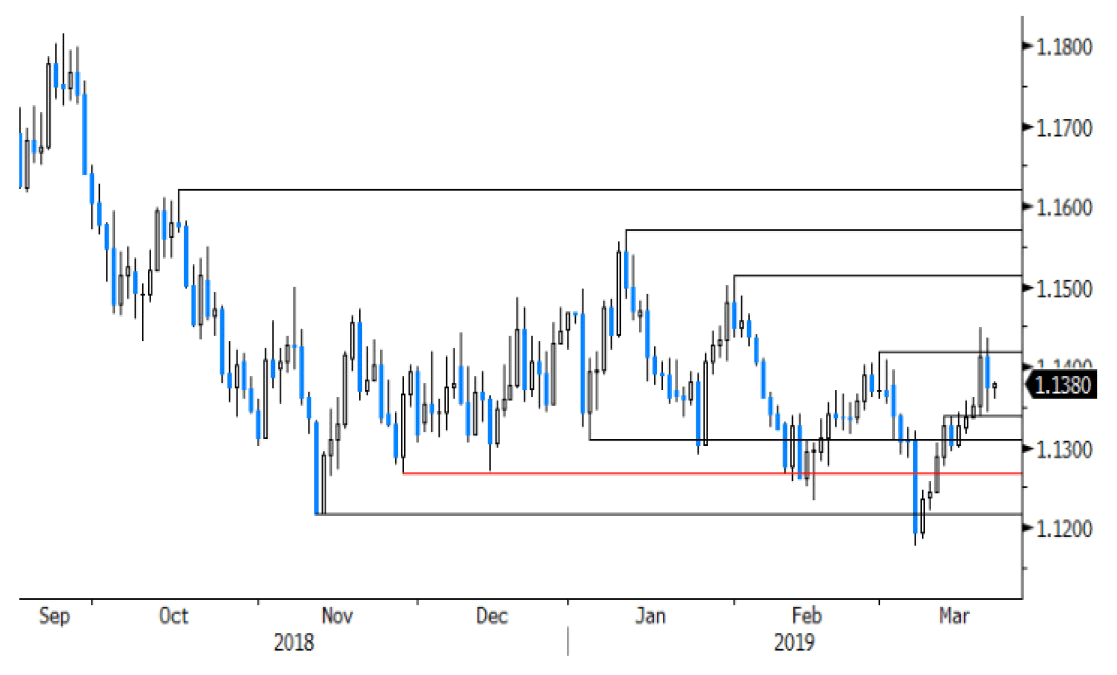
EUR/USD: holding firmly within the 1.12/1.16 range. Will better EMU PMI's provide some additional support
Sterling Recovers On Deadline Extension As Dollar Takes A U-Turn
The EU has given UK Prime Minister Theresa May a final chance to pass her Brexit deal. She was offered a Brexit delay until May 22under the condition of MPs approving the withdrawal deal. If no decision is taken by April 12, the remaining options will be a no-deal Brexit, a long extension, or revoking Article 50 according to European Council President Donald Tusk. The deadline extension provided a boost to Sterling, which recovered more than 100 pips from yesterday’s lows.
Despite the chances of exiting without a deal having risen significantly, traders do not believe that this is the base case scenario. Sterling remains the top performing major currency in 2019 and has been stuck in the range of 1.3 – 1.33 against the USD in March. The UK parliament may no longer kick the can further and should come up with a decision before April 12. This is likely to lead to volatile moves in the Pound, but it’s difficult to bet on one direction.
The Bank of England remained in a “wait and see” mode at yesterday’s monetary policy meeting. The MPC voted unanimously to keep interest rates at 0.75%, but Sterling benefited slightly as the central bank held the option of a gradual limited tightening in policy. However, all that matters now is what happens over the next two weeks. If chances of a no-Brexit deal increase, expect Sterling to trade significantly below 1.30.
The Dollar was little changed Friday morning after a strong rebound yesterday. After dipping below the 200-days moving average, the DXY index recouped all losses from Wednesday’s session to trade near 96.4. While the steep declines in US Treasury Yields are not supportive to the US currency, bond yields elsewhere are also falling with the 10-Year German Bund Yields getting closer to 0%. The Greenback also received some support from better-than-expected data on Thursday with initial jobless claims, Philly Fed manufacturing survey and leading indicators all beating estimates.
The Euro will be in play today with a raft of key manufacturing and services PMI releases. German manufacturing PMI is likely to have the biggest impact on the single currency given the recent disappointment in manufacturing activity from the Euro’s largest economy.
GBP/JPY Daily Outlook
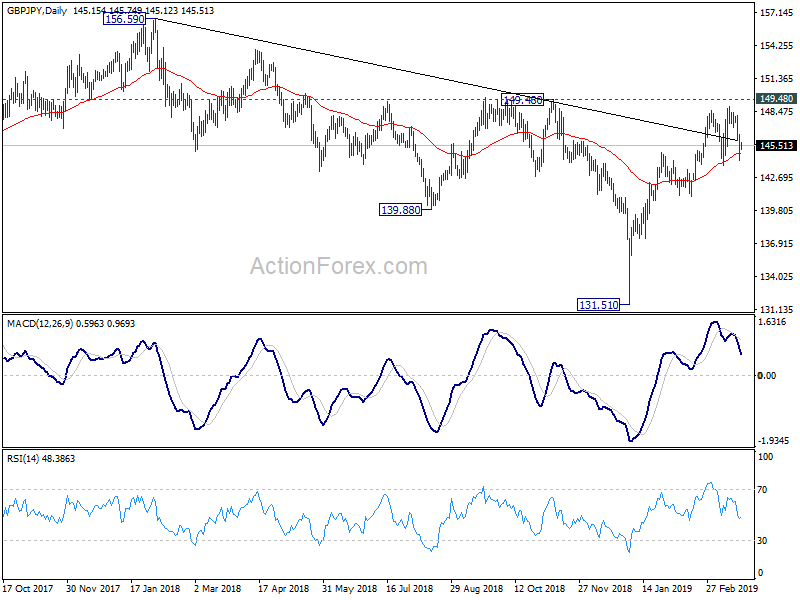
Daily Pivots: (S1) 144.13; (P) 145.26; (R1) 146.39; More...
Intraday bias in GBP/JPY remains neutral first. On the upside, decisive break of 149.48 key resistance will carry larger bullish implication and target 156.58 resistance next. On the downside, though, break of 143.72 support will indicate near term reversal and turn outlook bearish for 141.00 support.
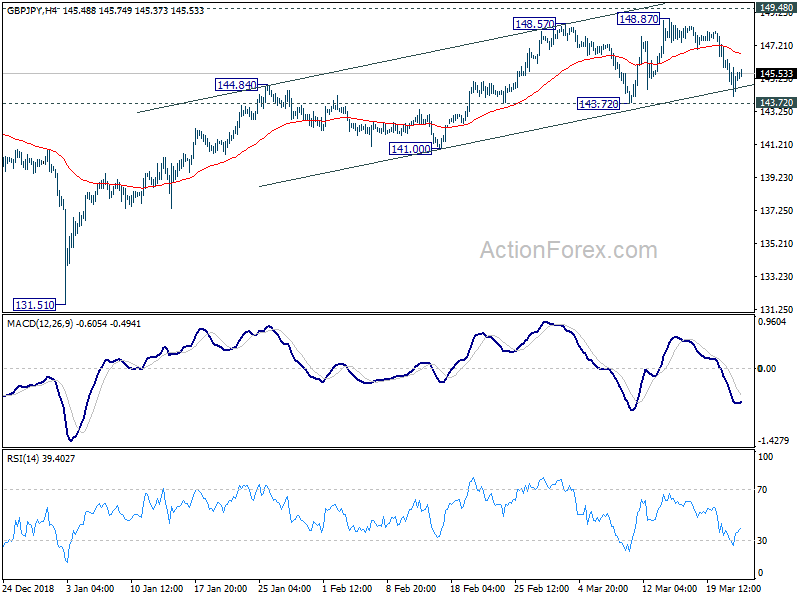
In the bigger picture, the strong rebound from 131.51 suggests that medium term fall from 156.59 (2018 high) has completed already. The corrective structure of such decline in turn argues that it's the second leg of the corrective pattern from 122.36 (2016 low). And this pattern is starting the third leg. On the upside, decisive break of 149.48 will pave the way to 156.59 resistance and above. However, firm break of 141.00 support will dampen this view and turn focus back to 131.51 low instead.
EUR/JPY Daily Outlook
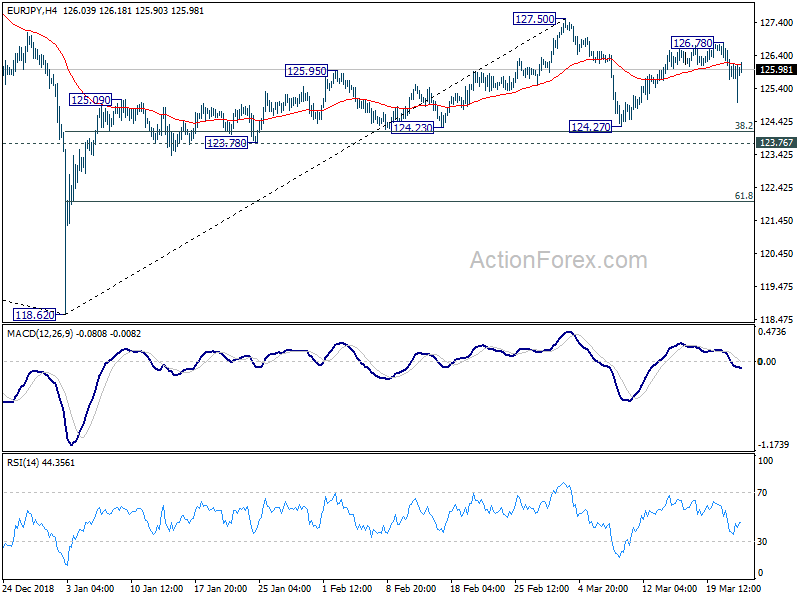
Daily Pivots: (S1) 125.62; (P) 126.11; (R1) 126.54; More....
EUR/JPY is staying in sideway consolidation below 127.50 and intraday bias remains neutral. Near term outlook will remain bullish as long as 124.23 cluster support (38.2% retracement of 118.62 to 127.50 at 124.10) holds. On the upside, decisive break of 127.50 will resume whole rise from 118.62 and target 129.50 resistance next.
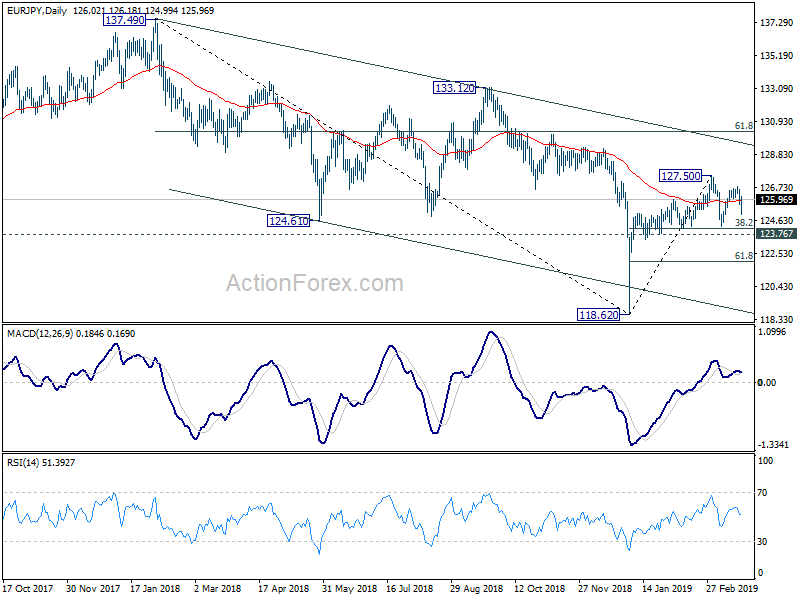
In the bigger picture, current development argues that medium term decline from 137.49 (2018 high) has completed with three waves down to 118.62 already. Decisive break of 133.12 resistance will confirm this bullish case. And whole up trend from 109.03 (2016 low) might resume through 137.49 in that case. On the downside, break of 124.23 support will invalidate this case. And in such case, the down trend from 137.49 could possibly resume through 118.62.
EUR/GBP Daily Outlook
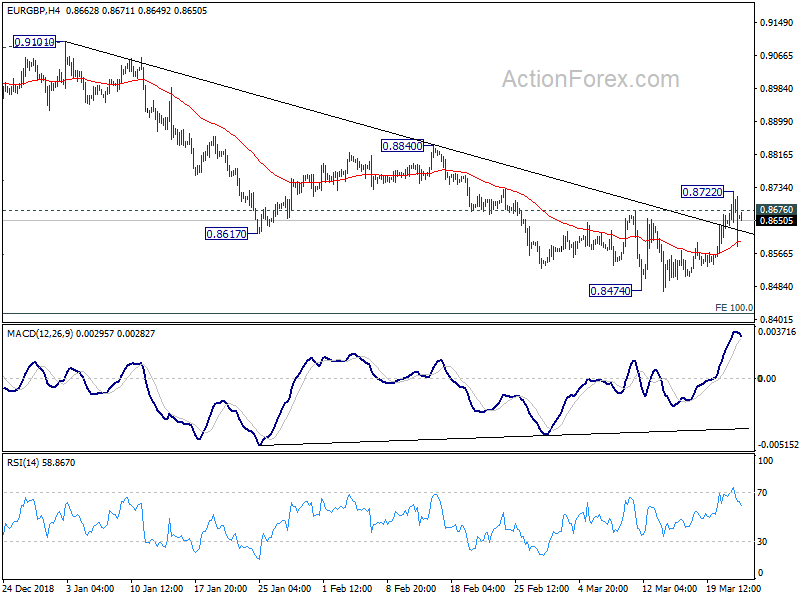
Daily Pivots: (S1) 0.8636; (P) 0.8680; (R1) 0.8722; More...
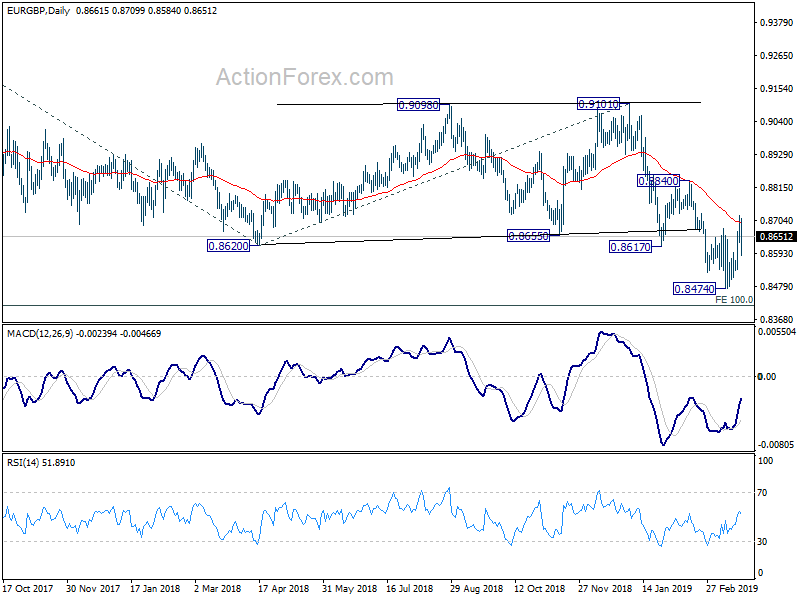
EUR/GBP breached 0.8676 resistance to 0.8722 but failed to sustain gains. Intraday bias is turned neutral first. A short term bottom could be formed at 0.8474 already. Above 0.8722 will extend the rebound to 0.8840 resistance and above. However, break of 0.8474 will resume larger down trend to 0.8416 long term projection next.
In the bigger picture, EUR/GBP is seen as staying in long term range pattern started at 0.9304 (2016 high). Current fall from 0.9305 (2017 high), is a falling leg inside the pattern. Such decline is now targeting 100% projection of 0.9305 to 0.8620 from 0.9101 at 0.8416 and possibly below. But for now, we'd expect strong support around 0.8312 support to contain downside and bring rebound.
EUR/AUD Daily Outlook
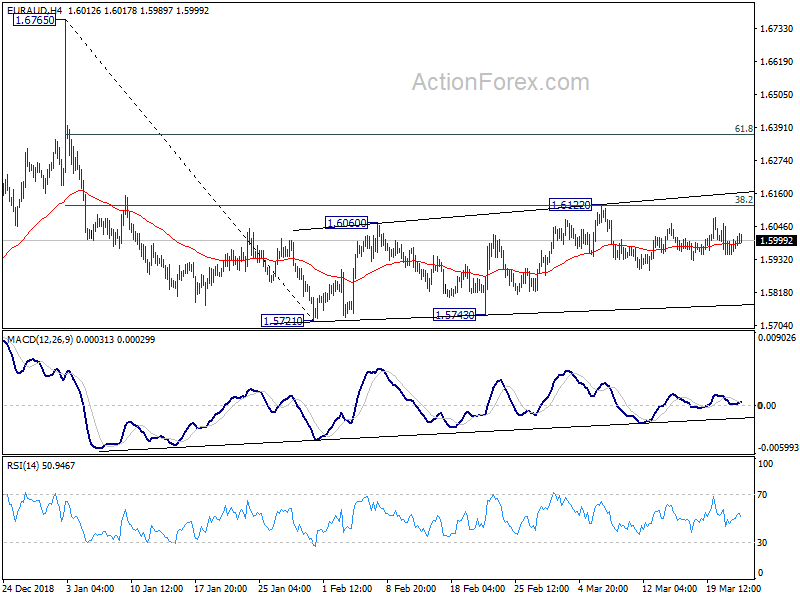
Daily Pivots: (S1) 1.5942; (P) 1.6000; (R1) 1.6053; More...
Intraday bias in EUR/AUD remains neutral and consolidation from 1.5721 could extend. On the downside, break of 1.5721 low will resume the decline from 1.6765 and target 1.5346 support. On the upside, above 1.6122 will resume the corrective rise from 1.5721 instead.
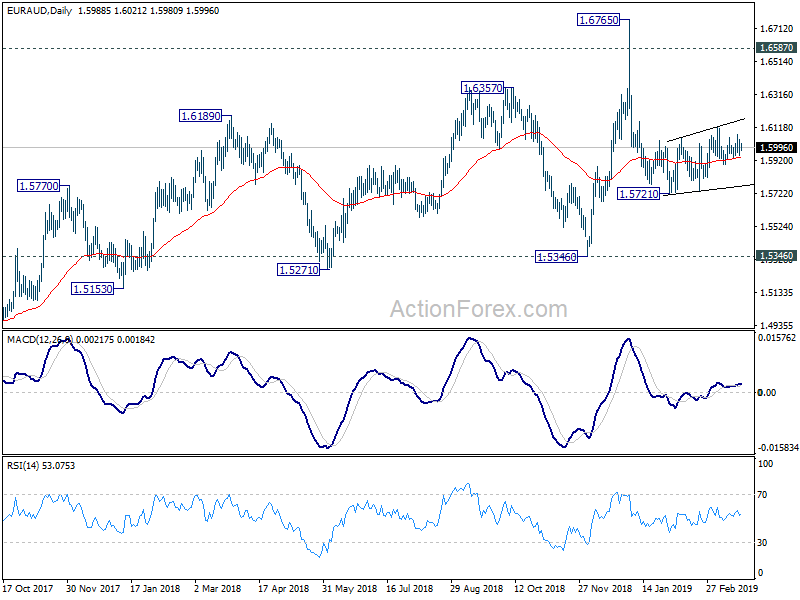
In the bigger picture, as long as 1.5346 support holds, outlook will remain bullish. Uptrend from 1.1602 (2012 low) is expected to resume sooner or later. Break of 1.6765 will target 61.8% retracement of 2.1127 (2008 high) to 1.1602 at 1.7488 next. However, firm break of 1.5346 key support will indicate trend reversal, with bearish divergence condition in weekly MACD, and turn outlook bearish.
EUR/CHF Daily Outlook
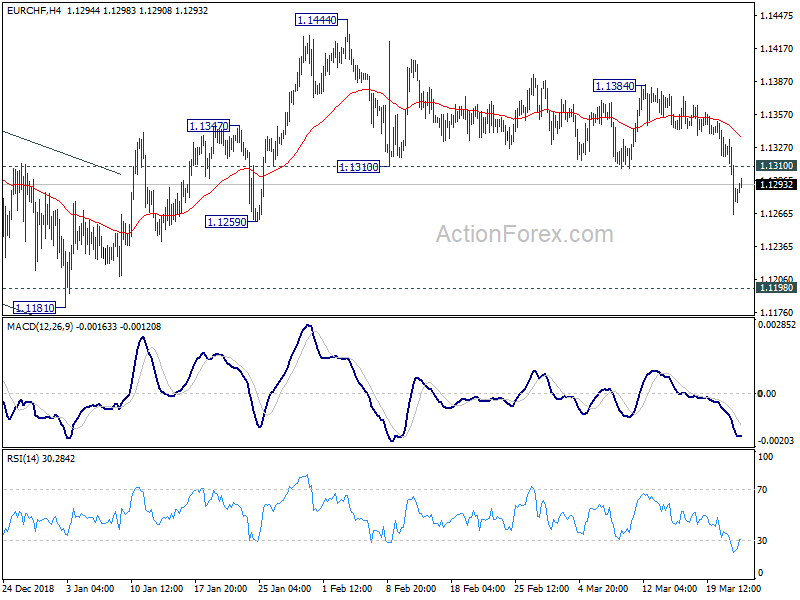
Daily Pivots: (S1) 1.1256; (P) 1.1295; (R1) 1.1325; More...
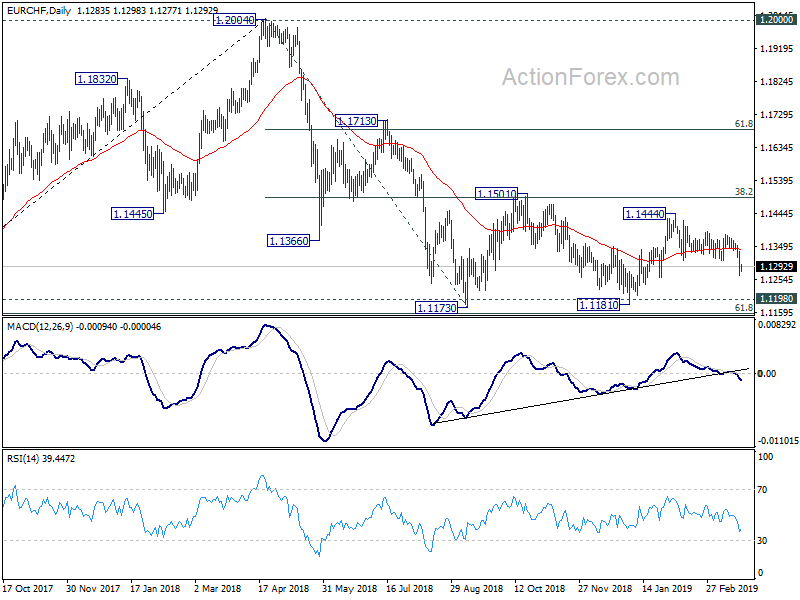
EUR/CHF dropped sharply to as low as 1.1266. The break of 1.1310 support confirms resumption of fall from 1.1444. Intraday bias is back on the downside for retesting 1.1181 low next. On the upside, break of 1.1384 resistance is needed to confirm completion of the decline. Otherwise, further fall remains in favor in case of recovery.
In the bigger picture, price actions from 1.2004 medium term top is seen as a correction only. Downside should be contained by 1.1154/98 support zone to complete it and bring rebound. Decisive break of 1.1501 (38.2% retracement of 1.2004 to 1.1173 at 1.1490) will confirm completion of the correction. Further rise should be seen to 61.8% retracement at 1.1687 and above next.