

Sample Category Title
RBA Minutes Reiterated No Strong Case For Near-Term Rate Change
General Trend:
- Property shares decline in early trading in Shanghai
- Tencent speculated to consider job cuts ahead of Q4 earnings report
- Australian coal miner New Hope declines after H1 earnings
- Australian Q4 housing prices decline at the fastest rate in years
- Aussie bond yields decline after RBA minutes and housing figures
- After RBA minutes, focus shifts to Aussie monthly employment data due on Thursday, includes more comments than typical on China/US trade dispute
- US dollar trades generally weaker ahead of Fed meeting
- US Fed to hold policy meeting March 19-20 (Tuesday-Wed)
- China’s Bank of Communications (BOCOM) said to plan to reduce convertible issuance by ~50%
- Brexit expected to be delayed by 9-12 months, EU expected to make formal announcement this week
Headlines/Economic Data
Australia/New Zealand
- ASX 200 opened +0.1%
- (AU) Australia RBA Assistant Gov Kent: The past year in Australia was a bit of a mixed bag in terms of issuance of fixed income securities – Bonds and Benchmarks at the KangaNews DCM Summit
- WBC.AU Moves wealth and insurance units into expanded business and consumer divisions; initial estimates include one-off costs of A$250-300M
- (AU) AUSTRALIA RBA MEETING MINUTES FROM MARCH 5TH: REITERATES SEES NO STRONG CASE FOR NEAR TERM ADJUSTMENT IN POLICY; `CONSIDERABLE UNCERTAINTY' AROUND CONSUMPTION OUTLOOK
- (AU) Australia 3-yr yield has fallen below RBA cash target rate of 1.50% for the first time since 2016
- (AU) AUSTRALIA Q4 HOUSING PRICE INDEX Q/Q: -2.4% V -2.0%E; Y/Y: -5.1% V -5.0%E (multi year low)
- GCY.AU Trading halted: Reviewing FY19 guidance, operational performance for the quarter to date being below expectation; progressing potential funding options and will provide an update on progress later this week
- (NZ) New Zealand to repurchase April 2020 bonds
Japan
- Nikkei 225 opened -0.1%
- (JP) Japan monthly Cabinet report expected Wednesday expected to repeat that the economy is assessed as "recovering at a moderate pace" and highlight overseas risks – Nikkei
- (JP) Japan to cap leverage in crypto margin trading – Nikkei
- (JP) Japan Fin Min Aso: Base pay is definitely heading upwards
- (JP) Japan Q4 Flow of Funds: Household Assets ¥1,830T (-1.3% y/y) - BOJ
- (JP) Japan Econ Min Motegi: Hope the BOJ will keep doing its upmost towards reaching price target
- (JP) Some BOJ members said to see that achieving the 2% price traget by 2021 seemed unlikely - financial press
- (JP) Japan MoF sells ¥1.0T v ¥1.0T indicated in 0.50% (prior 0.50%) 20-yr bonds; avg yield 0.391% v 0.419% prior; bid to cover 4.84x v 4.67x prior
Korea
- Kospi opened +0.2%
- 005380.KR Several US state to investigate "spontaneous fires" of Hyundai and Kia vehicles – Yonhap
- (KR) South Korea Foreign Min Kang: Should consider an envoy to North Korea
- 005380.KR With Kia to invest $300M in India's Ola a mobility service provider
China/Hong Kong
- Hang Seng opened flat; Shanghai Composite opened +0.1%
- (US) White House Hassett: still working hard on reaching deal with China but still facing differences on oversight - CNBC
- Hong Kong Monetary Authority (HKMA) purchased HK$2.01B as the Hong Kong dollar (HKD) traded at the weak end of its trading band versus the US dollar
- (CN) China PBoC head of financial stability Wang Jingwu: Stability of yuan exchange rate and forex reserves faces pressure; “gray rhino” risks in China’s financial sector are rising and regulators will step up efforts to control them - financial press
- (CN) China Assistant Commerce Min Ren Honghin said to take array of measures to support foreign trade in 2019 – Xinhua
- (CN) China PBoC Open Market Operation (OMO): To inject CNY50B in 7-day reverse repos v CNY60B in 7-day prior; Net: CNY50B injection v CNY60B injected prior
- (CN) China PBoC sets yuan reference rate: 6.7062 v 6.7088 prior
- (CN) China Feb FX Net Settlements (CNY): -102.3B v +103.1B prior (update)
- (CN) US Senate introduces bill to ban rolling stock (railroad, bus) manufactured by Chinese companies with state ties; claims China poses clear and present danger to national security and has infiltrated rail and bus manufacturing - SCMP
- 0728.HK Reports FY18 (CNY) Net 21.2B v 20.4Be; EBITDA 104.2B v 105Be; Rev 377.1B v 380.8Be
- 700.HK To target 10% of managers for job cut, demotion; cuts expected to focus on low performers
North America
- SPDR Gold Trust holdings +1.1% to 779.3 metric tons
- (CA) Alberta Canada to increase crude production limit by 25.0K bps starting in May and an additional 25.0K in June (prior had called for cut to production starting June 1st) - press citing local Govt
- BA CEO Dennis Muilenburg: Based on facts from the Lion Air Flight 610 accident and emerging data as it becomes available from the Ethiopian Airlines Flight 302 accident, we're taking actions to fully ensure the safety of the 737 MAX. We also understand and regret the challenges for our customers and the flying public caused by the fleet's grounding
- CBOE Will no longer offer bitcoin futures when last contract expires in June - press
Europe
- (UK) Reportedly Ministers are expecting EU to grant a 9-month extension of Article 50 on Brexit; 9-months seen as the maximum delay that will be allowed – ITV
- (UK) EU to formally agree on Brexit delay this week – Guardian
- (UK) PM May said to have requested a 9-12 month delay to Brexit – press
- (UK) Parliament Speaker Bercow: PM May must change Brexit deal to hold third 'meaningful vote'; May CANNOT put the same Brexit deal to a third vote
- (FR) France raises counter cyclical capital buffer for banks to 0.5% from 0.25% - press
Levels as of 01:20ET
- Hang Seng -0.1%; Shanghai Composite -0.1%; Kospi -0.1%; Nikkei225 -0.1%; ASX 200 -0.1%
- Equity Futures: S&P500 +0.1%; Nasdaq100 +0.1%, Dax flat; FTSE100 +0.1%
- EUR 1.1350-1.1333 ; JPY 111.15-111.46 ; AUD 0.7112-0.7089 ;NZD 0.6863-0.6840
- Commodity Futures: Gold +0.5% at $1,307,/oz; Crude Oil -0.1%at $59.34/brl; Copper +0.1% at $2.915/lb
RBA awaits more data to resolve tensions in domestic data
In the March meeting minutes, RBA noted the "tension" between ongoing improvement in job data and slowdown in output growth in H2 2018. Leading indicators pointed to further tightening in the job market and wages growth picked up in Q4. Growth slowed but business and public spending remained positive. However, there continued to be "considerable uncertainty" around consumption outlook, given fall in house prices.
Taken into account the available information, RBA judged that current monetary policy stance was "supporting jobs growth and a gradual lift in inflation". But "significant uncertainties around the forecasts remained". The scenarios of a rate hike and rate hike were "more evenly balanced" than over the preceding year. And, "it would be appropriate to hold the cash rate steady while new information became available that could help resolve the current tensions in the domestic economic data."
(RBA) Minutes of the Monetary Policy Meeting of the Reserve Bank Board
Sydney – 5 March 2019
Members Present
Philip Lowe (Governor and Chair), Guy Debelle (Deputy Governor), Mark Barnaba AM, Wendy Craik AM, Philip Gaetjens, Ian Harper, Allan Moss AO, Carol Schwartz AM, Catherine Tanna
Others Present
Luci Ellis (Assistant Governor, Economic), Christopher Kent (Assistant Governor, Financial Markets), Alexandra Heath (Head, Economic Analysis Department), Marion Kohler (Head, Domestic Markets Department)
Anthony Dickman (Secretary), Andrea Brischetto (Deputy Secretary)
International Economic Conditions
Members commenced their discussion of the global economy by noting that new information had been somewhat limited over the preceding month because of the government shutdown in the United States and the Lunar New Year holiday period across Asia. The global economy had grown above trend in 2018, although it had slowed in the second half of the year and the more recent data that had been received had been consistent with a continuation of slower global growth in the fourth quarter of 2018 and early 2019, particularly in the euro area and parts of Asia. Notwithstanding the slower growth in output, labour markets in the major advanced economies had remained tight and there had been ongoing signs of upward pressure on wages. However, this had not translated into materially higher inflation. Core inflation had remained around target in the United States and a few other advanced economies, but had remained below target in many other economies. Headline inflation had generally declined because of the substantial fall in oil prices in late 2018.
Trade tensions had remained a continued source of uncertainty for the global outlook. The delay in tariff increases previously scheduled for 1 March had generated some optimism that tensions could ease. However, the increases in tariffs implemented in 2018 had continued to weigh on trade between the United States and China, and there had been spillover effects on some other economies. Notably, a decline in Chinese imports, both to meet domestic demand and facilitate export production, had been apparent in export growth in the September quarter in east Asia. Intra-regional export growth had also eased, although exports from east Asia to the major advanced economies had been relatively resilient, and survey measures of new export orders in east Asia had declined sharply to be below average early in 2019. The prospect of further tariff increases on automobile imports into the United States had received considerable media attention; Germany and Japan were likely to be particularly affected.
In the major advanced economies, GDP growth had diverged over 2018. The large fiscal stimulus had boosted GDP growth in the United States over 2018 to well above estimates of potential. Growth in consumption had been supported by strong employment growth and the pick-up in wages growth. Investment, particularly in machinery & equipment and intellectual property, had also contributed significantly to growth in output. Key surveys of US manufacturing indicated that conditions had eased in recent months.
By contrast, growth in the euro area had eased in the second half of 2018. Members observed that this slowing had been quite broadly based across countries. Some of the loss of momentum had come from weaker external demand, particularly from China; survey measures of export orders suggested that the weakness in external demand had continued into early 2019. Disruptions to German automotive production related to compliance issues around emissions standards had also contributed to the weaker growth and, while these were expected to be temporary, they had persisted at least into January.
Output growth in Japan had picked up in the December quarter, following subdued growth in the September quarter, which was partly attributable to natural disasters. Members noted that domestic demand had held up well in Japan, despite weaker external demand, particularly from China.
In China, the authorities had announced a range of new fiscal easing measures and had also taken steps to ease financial conditions in recent months in response to concerns about slower growth in output in the second half of 2018. Members noted that the effect of this policy easing on economic activity was difficult to determine because the Chinese New Year holiday had affected the timing of data releases for January and February. The available data, such as surveys of business conditions, had pointed to subdued conditions in the manufacturing sector early in 2019. Price pressures had also remained low.
In commodity markets, the price of Brent crude oil had increased since the previous meeting, but remained around 25 per cent below its peak in October 2018. Coking coal prices had also risen since the previous meeting, reflecting disruptions to supply from Queensland. Iron ore prices had been little changed. The outlook for Australian coking and thermal coal prices had become more uncertain in light of reports that there had been an increase in customs processing times for Australian coal at some Chinese ports and a build-up of inventories.
Domestic Economic Conditions
Members observed that labour market conditions had continued to improve, despite a slowing in the momentum of output growth in the second half of 2018. Members noted that the national accounts for the December quarter would be released the day after the meeting. They were expected to show that GDP growth over 2018 had been a little lower than anticipated at the time of the February Statement on Monetary Policy, and were likely to confirm a markedly slower pace of growth in the second half of 2018 than in the first half.
Business investment was expected to have increased modestly in the December quarter, led by the non-mining sector. Mining investment was expected to have declined, consistent with the construction phase of the remaining liquefied natural gas projects nearing completion.
The ABS capital expenditure (Capex) survey had provided an updated estimate of investment intentions for 2018/19 and the first estimate for 2019/20.
In the non mining sector, the Capex survey and other forward-looking indicators pointed to modest growth in investment over 2018/19. The gradual pick-up was projected to continue into 2019/20 for expenditure on buildings and structures. This projection was consistent with the high level of non-residential construction work yet to be done, although building approvals for non-residential construction had declined over preceding months. Members noted that activity in segments of the commercial property sector had been quite strong. Some of the recent strength in non-mining investment had been in structures, which includes investment in roads and renewable energy, and this was expected to continue. However, the Capex data suggested that there may be less expenditure on machinery & equipment investment in the non-mining sector in 2019/20, although members noted that these early estimates were quite uncertain. Members also noted some of the limitations in the coverage of the Capex survey: it excludes the investment intentions of a range of sectors, including health and education, and investment in certain types of assets, such as computer software. More broadly, survey measures of business conditions had ticked up to be slightly above average across most states and industries in early 2019, but were lower than a year earlier.
The Capex data were consistent with mining investment reaching a trough in 2018/19 and increasing gradually in 2019/20 as firms invest to sustain production. This increase in sustaining investment was expected to support resource export volumes over the forecast period. By contrast, conditions in the agricultural sector were expected to remain difficult in the near term, limiting rural exports from some regions. Rainfall in south-eastern Queensland had been close to the lowest on record between December and February, at the same time as northern Queensland had experienced flooding.
The available data indicated that established housing prices in Sydney, Melbourne and Perth had declined further since the beginning of 2019, although both price and non-price indicators for housing were difficult to interpret during the seasonal lull in sales activity over January. In Sydney, housing prices were 13 per cent lower than their July 2017 peak, while in Melbourne housing prices were 10 per cent lower than their November 2017 peak. Auction clearance rates in Sydney and Melbourne had picked up over February. In Perth, housing prices had declined to 2006 levels, although rental vacancy rates had fallen to around average and newly advertised rents had been rising. Members noted that the Perth housing market was still adjusting to lower population growth and higher unemployment rates, but that the increase in mining investment was likely to have a positive effect.
Dwelling investment was expected to have decreased in the December quarter; preliminary data suggested that investment in both new dwellings and alterations and additions had declined in the quarter. Members noted that the pipeline of work to be done remained large and was expected to support dwelling investment through 2019, particularly in New South Wales and Victoria. However, residential building approvals and information from the Bank's liaison program pointed to a marked slowing in dwelling investment in one to two years' time, unless pre-sales increased significantly in the following few quarters. The recent weakness in sales of detached new houses had been most pronounced in Sydney and Melbourne, but had also been evident in other locations. Contacts had reported that tighter access to credit for off-the-plan and project homes had been constraining buyer demand.
Consumption was expected to have contributed more to growth in the December quarter than in the September quarter, when consumption growth had been soft. Consumer sentiment had been broadly stable, supported by ongoing strength in the labour market, but the momentum in consumption growth had remained a key source of uncertainty given its variability over recent quarters. Retail sales volumes had increased by just 0.1 per cent in the December quarter and growth had eased to 1.6 per cent in year-ended terms. Information from liaison indicated that retail conditions had softened in December because some Christmas spending had been brought forward to November, but had remained stable since then. Growth in retail sales had been particularly weak in New South Wales and for large discretionary items such as household goods and furnishings. Members noted that sales of motor vehicles to households had also fallen over recent months. Some part of the slowdown in retail and motor vehicle spending in New South Wales was likely to have been related to declines in housing prices and, in particular, lower turnover in the housing market. Members noted that retail sales growth had not slowed to the same extent in Victoria despite similar declines in housing prices.
In contrast to the slowdown in GDP growth, conditions in the labour market had continued to improve. The national unemployment rate had been steady at 5.0 per cent in January, but had fallen to around 4 per cent in trend terms in New South Wales. The unemployment rate in Victoria had also declined to low levels, while the unemployment rate in Western Australia had increased in recent months to be around 6½ per cent. The heads-based underemployment rate had declined in trend terms to be around its mid-2014 levels. Employment had increased by 0.3 per cent in January and by 2.2 per cent over the preceding 12 months, which was well above growth in the working-age population. The number of full-time jobs had increased strongly in January, following a couple of months of small declines, and employment-to-population ratios had increased across most age categories. Members noted that both outcomes were consistent with strong labour market conditions. The participation rate had been stable at a high level. Overall, leading indicators continued to suggest that employment growth was likely to remain above average, although some indicators had turned down a little recently.
Growth in the wage price index (WPI) had been broadly as expected in the December quarter, and unchanged at 2.3 per cent over the year. Year-ended wages growth in the private sector had picked up to its fastest pace in four years. Members noted that this increase was more pronounced once bonuses and commissions were included. Wages growth had been higher than a year earlier in most industries and states. The strongest growth in wages had been in Victoria, at 2.7 per cent, consistent with the decline in the unemployment rate as well as relatively stronger public sector wage outcomes in that state. Growth in the WPI in Western Australia had remained low at 1.6 per cent over the year. Western Australia was the only state where year-ended wages growth had remained below 2 per cent. By industry, wages growth had been relatively weak in the retail, construction and professional, scientific & technical industries, consistent with information from micro-level WPI data that wage freezes had been more common in these industries in recent years than had been the case previously.
Financial Markets
Members commenced their discussion of financial market developments by noting that global financial conditions had generally eased in prior weeks, reflecting the recent moderation in market expectations for future central bank policy rates, some optimism around US–China trade negotiations and resilience in corporate earnings. The easing in financial conditions had also been seen in Australian markets. Members observed that overall financial conditions remained accommodative globally and in Australia.
Expectations for monetary policy in the advanced economies had been little changed over the month, following the downward shift in policy expectations around the turn of the year. Federal Open Market Committee (FOMC) officials had continued to state that, with the federal funds rate close to estimates of neutral, they will be patient in making any changes to policy and will be closely guided by incoming data. Members noted, however, that some FOMC officials had continued to indicate that US monetary policy might need to be tightened further. Financial market pricing indicated that the next move in the federal funds rate was expected to be down, although not until late 2020 or early 2021. Members noted, however, that this might reflect market participants' views that risks had become more skewed to the downside, rather than that an interest rate reduction was the most likely outcome.
Financial market pricing continued to indicate that accommodative monetary policy was expected to be maintained in the euro area and Japan for some time, with central bank officials having recently noted a weakening in the outlook for economic activity and inflation in those economies.
In Australia and New Zealand, financial market pricing indicated that policy rates were expected to be lowered by early 2020, following the earlier shift from expected future increases in policy rates.
Members noted that long-term bond yields in the major global markets remained below their levels late in 2018, consistent with the more subdued outlook for inflation and the lowering of expectations for future policy rates in the major advanced economies. Australian long-term bond yields had declined further in February, in line with the shift down in policy expectations following the previous meeting, to be at their lowest levels since late 2016. As a result, government bond yields in Australia had moved further below those in the United States. In China, long-term government bond yields had also declined over recent months in the context of the easing in financial conditions by the authorities.
Global equity markets had rebounded over the first two months of 2019, following a sharp fall in late 2018. Members observed that these swings in equity prices had been driven largely by shifting risk premiums, and had been disproportionate to the changes in corporate earnings. In the United States, share prices were now only 4 per cent below the peak of 2018. In Australia, on an accumulation basis (which takes account of dividend payments) share price indices were back to around their 2018 peak. Chinese share prices had risen particularly strongly since the start of 2019 – most likely reflecting optimism around US–China trade negotiations and recent and expected future policy easing – but had underperformed relative to other markets over the preceding year.
Forecasts for corporate earnings in 2019 in the major markets, as well as in Australia, had been lowered in recent months, consistent with the downward revisions to the outlook for growth and inflation in several economies. Nevertheless, some growth in earnings was still expected in Australia and abroad. Underlying profits for listed companies in Australia had been little changed in the second half of 2018. Profits in parts of the resources sector had been supported by higher commodity prices, while profits in sectors exposed to property had tended to decline.
Members noted that the easing in global financial conditions had also been evident in corporate bond spreads, which had declined recently, and that corporate bond yields had remained close to historically low levels.
In China, growth in total social financing had increased a little in recent months, after declining steadily over the preceding year. The slowing in growth in total social financing since late 2017 had reflected policy measures to reduce non-bank lending activity, which had been an important source of funding for private firms, in order to reduce overall risks in the financial system. More recently, the pace of contraction in non-bank lending had abated somewhat, as the authorities wanted to ensure financing was readily available for smaller private firms. Growth in corporate bond issuance had also picked up over the preceding year. Members noted that the Chinese authorities were continuing to balance their priorities of supporting growth while addressing financial stability risks.
Financial conditions in other emerging markets had continued to ease, after tightening over 2018. Equity prices had unwound some of their earlier falls and the increase in bond spreads had also been partly retraced. Exchange rates of emerging market economies had stabilised, and appreciated in some cases, and inflows of foreign capital had resumed. Policy adjustments in some economies, as well as the easing in global financial conditions and associated depreciation in the US dollar, had contributed to the easing in financial conditions in emerging markets.
In foreign exchange markets, members noted that the Chinese renminbi had appreciated slightly since late 2018. The Australian dollar had been broadly steady over preceding months and remained within the relatively narrow range of recent years.
Turning to domestic financial markets, members noted that growth in housing lending to owner-occupiers had slowed to 5 per cent in six-month-ended annualised terms, while growth in lending to investors in housing had stabilised at a rate of around 1 per cent. Housing loan approvals data indicated that the slowing in housing lending growth had been largely accounted for by the major banks, but members noted that, more recently, loan approvals by other smaller lenders had also declined.
Liaison with banks and other lenders suggested that the requirements for more thorough verification of income and expenditure data had led to an increase in loan approval times in 2018, but subsequent investments in people and technology had reduced approval times. The typical time from application to approval was reported to be currently around one week. It was reported that approval times for loans for house and land packages remained significantly longer (closer to around one month) than for loans for established property, because of careful management of the greater risks involved in this form of lending. Overall, liaison with lenders suggested that loan approval rates were little changed and that reduced demand from borrowers, particularly investors, largely explained the slower growth in lending.
Nevertheless, members noted that there had been some reduction in the supply of credit as lending practices had been tightened over the previous year. Members discussed a number of additional factors that could influence credit supply in 2019, including: the Melbourne Institute's household expenditure measure, which plays some role in lending assessments, had increased by more than it had in recent years; tighter lending policies on debt-to-income ratios; and the broadening of comprehensive credit reporting, which might reveal under-reporting of applicants' other liabilities. While these factors could affect the maximum amount offered to a borrower, only a small proportion of borrowers borrow up to their limits.
Members noted that banks continued to compete for borrowers of high credit quality by offering lower interest rates on new loans than those offered on existing loans.
Growth in business credit had remained robust, with both the major banks and other lenders having contributed to the growth over the preceding year, although the major banks account for a smaller share of business lending than before the onset of the global financial crisis. Members observed, however, that the growth in business lending had been entirely to large businesses, with one estimate suggesting that lending to small businesses had declined slightly over the preceding year. There had been greater caution around lending to small businesses in response to the Royal Commission into Misconduct in the Banking, Superannuation and Financial Services Industry. Lower housing prices had also reduced the value of collateral for loans to small businesses.
Members noted that interest rates in the Australian short-term money market had recently declined from the persistently high levels around the turn of the year, in line with developments in international markets, although they remained a little above their levels of earlier years. Members had a detailed discussion of the Bank's operations in repurchase and foreign exchange swap markets and their role in achieving the Board's target for the cash rate. Banks' longer-term funding costs had declined a little over recent months, consistent with lower long-term government bond yields, even though spreads on bank bonds had increased over the preceding year. Overall, the marginal cost of banks' wholesale funding had declined a little from 2018 levels, to be only slightly higher than in 2017. At the same time, the major banks' retail deposit rates had continued to drift down.
Financial market pricing implied that the cash rate was expected to remain unchanged during 2019, but that a reduction in the cash rate was expected by early 2020.
Considerations for Monetary Policy
In considering the stance of monetary policy, members observed that growth in the global economy had been above trend in 2018, although it had slowed over the second half of the year and timely indicators suggested that this moderation had extended into 2019. Nonetheless, output growth had remained sufficient in most advanced economies for labour markets to remain tight, putting upward pressure on wages. Members noted the tension in a number of economies between slower GDP growth and resilient labour markets. The transmission of tighter labour market conditions to inflation pressures was taking longer than might be expected, based on historical experience.
The authorities had responded to slowing growth in China by putting in place policies to increase the flow of credit to the private sector and easing fiscal policy in a targeted way to support growth, while continuing to pay close attention to risks in the financial sector. Slowing growth in China and ongoing trade tensions had led to lower growth in global trade, and continued to be a source of uncertainty for the outlook for global growth.
The tightening of global financial conditions, associated with higher risk premiums required by investors around the turn of the year, had eased. Members assessed that global financial conditions remained accommodative, with financial market pricing indicating that little change to the accommodative stance of monetary policy in the advanced economies was expected over the following year or so. The terms of trade for Australia were expected to have remained above their trough in early 2016 and the Australian dollar had remained within its narrow range of recent times.
Domestically, there continued to be tension between the ongoing improvement in labour market data and the apparent slowing in the momentum of output growth in the second half of 2018. Leading indicators of conditions in the labour market, such as vacancies and hiring intentions, pointed to further tightening in the labour market in the near term. Private sector wages growth had picked up further in the December quarter, consistent with the Bank's forecasts and survey evidence that a significant share of firms were finding it difficult to attract suitable labour.
Although output growth had slowed in the second half of 2018, the outlook for business investment and spending on public infrastructure had remained positive. Growth in consumption was expected to be supported by an increase in growth in household disposable income. However, there continued to be considerable uncertainty around the outlook for consumption given the environment of declining housing prices in some cities, low growth in household income and high debt levels. Dwelling investment was expected to subtract from growth in output over the forecast period and, unless pre-sales volumes started to increase, this decline could be sharper than currently expected.
The process of adjustment in the housing market had continued. Housing prices in Sydney, Melbourne and Perth had declined further, and turnover in the housing market had fallen significantly. Rent inflation had remained low across most of the country despite declines in rental vacancy rates over the previous year, except in Sydney, where rental vacancy rates had been increasing. Credit conditions had tightened for some borrowers and the demand for housing credit had slowed noticeably as conditions in the housing market had changed. Mortgage rates had remained low and there was strong competition for borrowers of high credit quality.
Members noted that the sustained low level of interest rates over recent years had been supporting economic activity and had allowed for gradual progress to be made in reducing the unemployment rate and returning inflation towards the midpoint of the target. While the labour market had continued to strengthen, less progress had been made on inflation. Looking forward, the central forecast scenario was still for growth in GDP of around 3 per cent over 2019 and a further decline in the unemployment rate to 4¾ per cent over the next couple of years. This further reduction in spare capacity underpinned the forecast of a gradual pick-up in wage pressures and inflation. Given this, members agreed that developments in the labour market were particularly important.
Taking account of the available information on current economic and financial conditions and how they were expected to evolve, members assessed that the current stance of monetary policy was supporting jobs growth and a gradual lift in inflation. However, members noted that significant uncertainties around the forecasts remained, with scenarios where an increase in the cash rate would be appropriate at some point and other scenarios where a decrease in the cash rate would be appropriate. The probabilities around these scenarios were more evenly balanced than they had been over the preceding year.
Members agreed to continue to assess the outlook carefully. Given that further progress in reducing unemployment and lifting inflation was a reasonable expectation, members agreed that there was not a strong case for a near-term adjustment in monetary policy. Rather, they assessed that it would be appropriate to hold the cash rate steady while new information became available that could help resolve the current tensions in the domestic economic data. Members judged that holding the stance of monetary policy unchanged at this meeting would enable the Bank to be a source of stability and confidence, and would be consistent with sustainable growth in the economy and achieving the inflation target over time.
The Decision
The Board decided to leave the cash rate unchanged at 1.5 per cent.
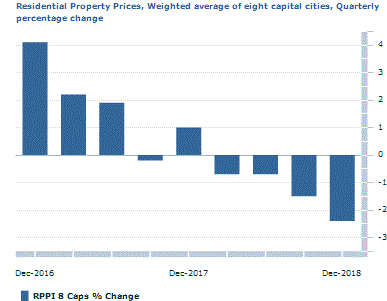
Australia house price dropped -2.4% qoq, -5.1% yoy in Q4
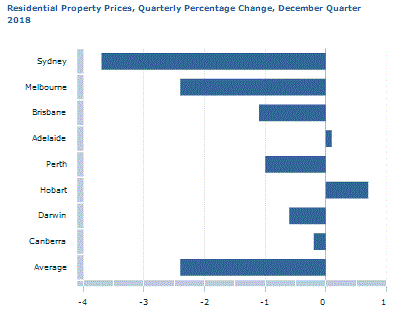
Australia house price index dropped -2.4% qoq in Q4, deepened from Q3's -1.5% qoq and missed expectation of -2.0% qoq. Sydney led the way by dropped -3.7% qoq, followed by Melbourne at -2.4%. Hobart (up 0.7%) and Adelaide (up 0.1%) bucked the trend.
Through the year growth in residential property prices fell -5.1% yoy in the December quarter 2018. Falls were recorded in Sydney (-7.8 per cent), Melbourne (-6.4% yoy), Darwin (-3.5% yoy), Perth (-2.5% yoy) and Brisbane (-0.3% yoy).
Chief Economist for the ABS, Bruce Hockman said: "While property prices are falling in most capital cities, a tightening in credit supply and reduced demand from investors and owner occupiers have had a more pronounced effect on the larger property markets of Sydney and Melbourne."
Elliott Wave View: IBEX Shows Bullish Structure
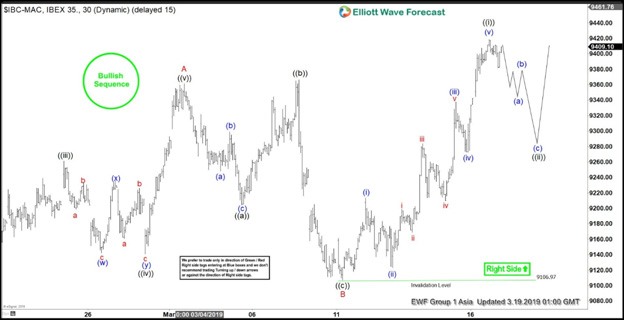
IBEX Elliott Wave sequence from 12.28.2018 low remains bullish, favoring further upside. Near term, the rally from Feb 11, 2019 low (8834.3) is unfolding as a zigzag Elliott Wave structure. The first leg of this zigzag wave A ended at 9361.4 as a 5 waves impulse structure. Wave B pullback ended at 9106.97 as a Flat Elliott Wave structure. Down from 9361.4, wave ((a)) ended at 9204.4, wave ((b)) ended at 9366.2, and wave ((c)) of B ended at 9106.97.
The index has resumed wave C rally higher and broken above previous peak on 9366.2. The internal of wave C is also unfolding as a 5 waves impulse where wave ((i)) is proposed complete at 9418.8. If Index breaks above 9418.8, that suggests wave ((i)) remains in progress but doesn’t change the overall outlook. Near term, while wave ((ii)) pullback stays above 9106.97, expect Index to extend higher. We don’t like selling the Index and expect buyers to appear in 3, 7, or 11 swing as far as pivot at 9106.97 stays intact. Potential target to the upside comes at 9652 – 9771 area where wave C is equal to wave A in length.
1 Hour IBEX Elliott Wave Chart
USDJPY Risk Remains Lower On More Weakness
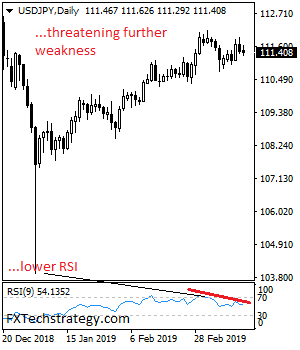
USDJPY risk remains lower on more weakness as it closed lower on Monday. On the upside, resistance comes in at 111.50 level. Above this level will turn attention to the 112.00 level. Further out, we expect a possible move towards the 112.50 level. A cut through here will open the door for more gain towards the 113.00. On the downside, support comes in at the 111.00 level where a break will target the 110.50 level. Below that level will turn focus to the 110.00 level and then lower towards the 109.50 level. On the whole, USDJPY faces further upside pressure.
Sterling clueless on Brexit chaos
Sterling recovers broadly today after knee-jerk reactions to new Brexit chaos overnight. But overall, the Pound is probably as clueless as the UK government on what's next. Commons Speaker John Bercow invoked a rule to forbid Prime Minister Theresa May to bring back the same Brexit deal for another meaningful vote, unless there are substantial changes in the proposition. The 415-year-old Parliamentary convention is for "sensible use of the House's time and proper respect for the decisions that it takes". Without being forewarned, the government just said: "We note the speaker's statement. This is something that requires proper consideration", without further elaboration.
Now, it's near impossible for a Brexit deal to be passed this week and hence, Article 50 extensions won't be a short one. The Sun newspaper reported that May is drafting a letter to European Council President Donald Tusk to request a delay of 9 to 12 months. Some suggested one way to bring back the Brexit deal for another vote is having EU granting another Brexit date than March 29, thus, making the proposition substantially different. Another way is to end the current parliamentary session early without dissolving it, and start a new session. The same deal could then be voted for in "another" session.
But then, the fundamental question is not solved. That is, is there enough votes to the current Brexit deal through?
Market Morning Briefing: Pound Is Stuck In The 1.34-1.34 Region
STOCKS
Global indices are broadly positive and are likely to move higher in the near term. The pace of upmove could be slow though. Dow has risen above a key resistance. Shanghai is gaining strength and seems to be gearing up for a fresh leg of upmove. Nikkei and DAX has supports which can limit the downside and retain the uptrend. Indian indices on the other hand looks vulnerable for an intermediate corrective fall before moving further higher.
Dow (25,914.10, +65.23, +0.25%) has risen above the 21-day moving average (21,823). A rise to 26,100-26,200 is possible as long as it sustains above the 21-day moving average which will now act as a good support. The index will come under pressure only if it declines decisively below 21,740.
The upmove in DAX (11,657.0, -28.63, -0.25%) paused yesterday. However, with support at 11,600, the outlook remains positive for a test of 11,780 and 11,840.
Nikkei (21,528.38, -56.12, -0.26%) has a support at 21,440 (21-day moving average) which can limit the downside in the near term. While above this support, the outlook is bullish for Nikkei to test 21,900-22,000 in the coming days.
Shanghai (3,088.43, -7.98, +0.26%) has risen sharply yesterday and is trading at the key resistance level of 3,100. A strong break above 3,100 will pave way for the next targets of 3,150 and 3,180. But a pull-back from 3,100 can keep the index in the 2,950-3,100 range for some more time.
Sensex (38,095.07, +70.75, +0.19%) and Nifty 50 (11,462.20, +35.35, +0.31%) moved further higher yesterday, but has closed on a mixed note. This keeps open the possibility of seeing an intermediate corrective fall before resuming the uptrend. Nifty can fall to 11,300 or 11,200 while below 11,500. Sensex can test 37,900 and 37,600 while below 38,400
COMMODITIES
Oil seems to be gaining strength and keeps the possibility high to rise further in the near term. Gold, Silver and Copper could consolidate sideways for a few sessions, may be until the outcome of the US Fed meet on Wednesday.
Gold (1,305) is managing to sustain above 1,300 but is not gaining momentum. As mentioned yesterday, a range bound move between 1,290 and 1,310 can be seen for some time. A breakout on either side of 1,290 or 1,310 will then determine the next move. Silver (15.36) on the other hand can trade between 15.10 and 15.50 in the near term.
Copper (2.91) continues to consolidate between 2.89 and 2.95 and has equal chances of rising to 2.95 or dipping to 2.89-2.88 from current levels.
The dip to 57-56.85 mentioned yesterday did not happen in WTI (59.13). Instead, it has held very well above 58 and seems to be gaining strength slowly. WTI is likely to test 60.7 on a strong break above 59.5
Brent (67.6) is inching higher towards the upper end of its 66-68 range. The bias continues to remain positive for Brent to break 68 and rise to 70.
FOREX
Overall currencies are mixed. While Dollar-Index has near term support and could bounce back, the other major pairs have been trading in narrow and small range. Some volatility could come in by next week.
Dollar-Index (96.44) has dipped slightly and may test support at 96.25 over today or tomorrow followed by a bounce towards 97 in the near term. Failure to bounce from 96.25, could indicate bearishness towards 96.00-95.75 levels.
Euro (1.1341) saw a decent rise yesterday and is currently trading higher. A test of 1.14 is likely on the upside before falling back towards 1.13-1.1250 again.
Euro-Yen (126.11) has dipped a bit and while resistance near 126.80 holds, Euro-Yen could fall towards 125.20 in the near term.
Dollar Yen (111.15) has fallen a bit. There is 21-D Ma support near 110.90 which could produce a bounce back to 112.50. Sustained break below 110.90, if seen would be bearish for the medium term, opening up lower targets of 110.
Aussie (0.7102) has resistance above current levels and could have limited upside just now with a possible fall towards 0.7050-0.700 in the near term.
Pound (1.3275) is stuck in the 1.34-1.34 region and could spend some time within this zone. 1.34 is an important resistance just now and could hold for the medium term, pushing the currency towards 1.31.
USDCNY (6.7152) is trading near important level just now. If support at 6.72 holds, the pair could be pushed higher towards 6.72/74 else a fall below 6.70, if seen and sustains could be bearish towards 6.65. While a bounce from 6.70 looks more likely, we cannot negate a fall just now.
Dollar-Rupee (68.5275) may head towards 68.20/00 this week. At the same time we need to be cautious of a possible corrective upmove from current levels back towards 68.75/80.
INTEREST RATES
The US yields are stable. The 2YR (2.45%), 5Yr (2.41%), 10Yr (2.60%) and the 30YR (3.01%) are trading near levels seen yesterday. As mentioned yesterday, we may look for a further rise in the yields towards 2.67% (10Yr), 3.10% (30Yr) and 2.5% (5Yr).
The 10YR GOI (7.4802%) has bounced from support at 7.45%. If the rise sustains, the yield could eventually move up towards 7.55% else a fall towards 7.35% is possible.
The German yields could test resistance levels and may fall in the near term. The 10YR (0.09%) could fall towards 0.04%.
RBA Minutes Emphasize Importance of Data Releases
The RBA Board has taken a step closer to cutting rates by emphasising the near-term importance of data releases. Westpac sees this approach as consistent with its expected timetable of rate cuts in August and November.
The Minutes of the March Reserve Bank Board meeting emphasise the Board’s uncertainty around the slowdown in output data while labour market data remains robust.
In the final paragraph of the section on the policy outlook, the Board noted “they assessed that it would be appropriate to hold the cash rate steady while new information became available that could help resolve the current tensions in the domestic economic data”.
Presumably, the release of the December quarter national accounts the day after the Board meeting will have further accentuated this tension. In the minutes, the Board speculated that “GDP growth over 2018 had been a little lower than anticipated at the time of the February Statement on Monetary Policy”. In fact, annual GDP growth in 2018 printed 2.3% compared to the RBA’s estimate in February of 2.75% - hardly consistent with the description “a little lower”. The minutes also noted that the accounts were likely to confirm a “markedly slower pace of growth in the second half of 2018 than in the first half”. In fact, the accounts printed a 4% annualised pace in the first half, down to a 1% annualised pace in the second half.
The tension that the minutes refer to is around conditions in the labour market, which “had continued to improve”, while “leading indicators continued to suggest that employment growth was likely to remain above average, although some indicators have turned down a little recently”.
Based on the key policy conclusion, developments in the monthly labour market series and associated lead indicators will be very important for the policy response, although the sharper than expected slowdown in 2018 H2 will probably make the RBA more prepared to act than appears to be the mindset in these minutes.
Because the forecasts are only reviewed every three months, it is entirely unsurprising that the minutes confirm the current GDP growth forecast in 2019 of 3 per cent and a further decline in the unemployment rate to 4 ¾ per cent over the next couple of years. With the momentum in the economy having slowed to a 1% pace in the second half of 2018, it remains a courageous call that growth could lift to 3% in 2019. Westpac expects that the RBA will lower its forecast for 2019 to 2.75% and to 2.5% in 2020 in its May Statement on Monetary Policy and adopt a specific easing bias.
We are disappointed to note that the RBA is persisting with a view that “the pipeline of work to be done remained large and was expected to support dwelling investment through 2019”. It appears that dwelling investment peaked in mid-2018 with around a 6 per cent fall in the second half of 2018. We support the RBA’s expectation for a “marked slowing in dwelling investment”, but expect that this has come earlier than their expectation of “in 1-2 years’ time”.
Nervousness around consumer spending remains a consistent theme in these minutes. Indeed, the expectation was that “consumption was expected to have contributed more to growth in the December quarter than in the September quarter”. In fact, December’s consumption growth of 0.4% was only slightly greater than the 0.3% reported for September. A 1.5% annualised growth pace for consumption is around half the expected trend.
The discussion around housing remains quite understated, “the process of adjustment in the housing market had continued”, although there is some recognition of the spill-over of housing prices to activity, “some part of the slowdown in retail and motor vehicle spending in NSW was likely to have been related to declines in housing prices”.
We are always interested in how the Board describes market pricing. According to our pricing model, the market was giving an 88% probability of a rate cut of a full 25bps by December 2019 as at 4 March. In contrast, the minutes note “financial market pricing implied the cash rate was expected to remain unchanged in 2019, but a reduction in the cash rate was expected by early 2020”.
Finally, it is important to note that “members noted significant uncertainties around the forecasts remain, with scenarios where an increase in the cash rate would be appropriate at some point, and other scenarios where a decrease in the cash rate would be appropriate”. As the Federal Reserve likes to emphasise, policy has become “data-dependent”.
Conclusion
The Board has raised the importance of data releases over the next few months and has left open the possibility to cut rates should those releases disappoint. Certainly, the December quarter national accounts would have fitted into that category, although the emphasis remains on the labour market data.
Westpac does expect that consistent with the slowdown in spending and deterioration in both business and consumer confidence, we will see emerging evidence of a slowing labour market over the course of the next six months.
Westpac’s timetable for policy action remains a 25bps cut in August to be followed by a second 25bps cut in November. These dates will give the RBA appropriate scope to explain their decisions in the context of weaker growth, employment and inflation forecasts in an orderly fashion, rather than be seen to overreact to any particular data report.
Daily Markets Broadcast
Wall Street continues its rally
Wall Street indices extended last week’s gains into Monday, fueled by positive news on trade talks in the agricultural sector. The energy sector was boosted by higher oil prices.
US30USD Daily Chart
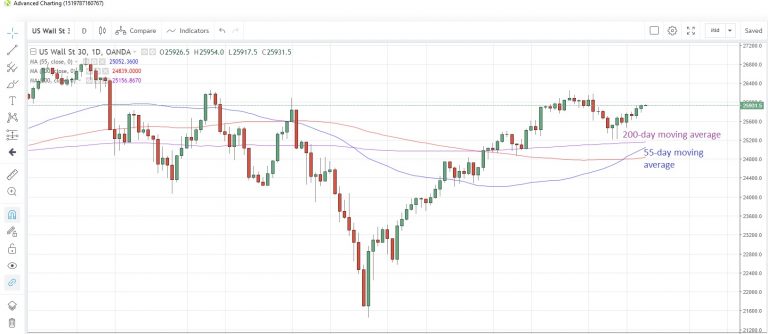
The US30 index rallied for a second straight day yesterday, though still lagged advances in other indices due to under-performance by Boeing
The 55-day moving average at 25,052 is heading toward the 200-day moving average at 25,157. It crossed above the 100-day moving average on March 13
China has offered the US some “very attractive numbers” for purchases of farm goods as part of the trade negotiations, the U.S. Agriculture Secretary said yesterday. On the data front, January factory orders are seen rising 0.3% m/m.
DE30EUR Daily Chart
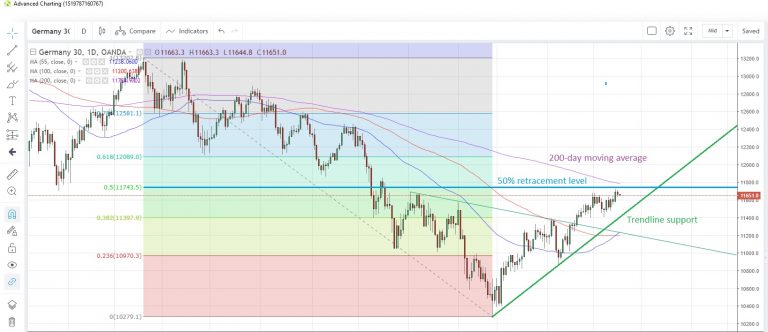
The Germany30 index retreated from a five-month high yesterday amid news of consolidation in the banking sector
The index remains capped by the 50% retracement level of the May-December drop at 11,743 and the 200-day moving average at 11,785. Rising trendline support could be found near 11,410
The German ZEW economic sentiment survey for March is expected to show an improvement to -11.3 from -13.4 but the current situation is seen deteriorating to 11.2 from 15.0.
CN50USD Daily Chart
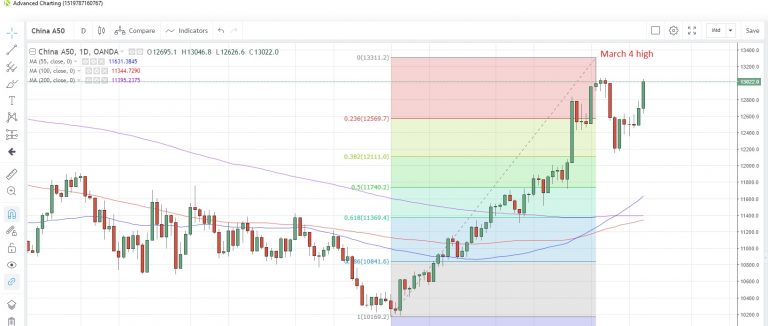
The China50 index advanced for a second consecutive day yesterday, extending the rebound to test the March 6 high of 13,060
The nearest resistance point could be the March 4 high of 13,311, which was the highest in almost a year
The index could advance further today given the progress announced in the trade talks.