Sample Category Title
Currencies: Is Enough USD Softness Discounted Ahead Of Tomorrow’s Fed Meeting?
Rates: Wait-and-see mode prolonged
Global core bonds tread water ahead of tomorrow's FOMC meeting. Today's thin eco/event calendar suggests more of the same. Risk sentiment faces a small setback on Asian stock markets overnight, but spillover effects to other markets are limited. A speech by ECB Praet is a wildcard.
Currencies: Is enough USD softness discounted ahead of tomorrow's Fed meeting?
The dollar continued trading with a tentative negative bias yesterday, but in the end USD losses were modest. Today, an improving ZEW confidence might be a modest euro supportive, but we don't expect important USD support levels to be broken as quite soft news is already discounted. Sterling remains resilient even as political visibility on Brexit remains low.
The Sunrise Headlines
- US equities finished a choppy trading session in green yesterday with gains varying from 0.25% (DJI) to 0.37% (S&P). Stocks are trading mixed in Asia as markets await tomorrow's Fed decision
- Speaker Bercow thwarted May's brexit strategy by blocking her plans to bring the unchanged deal to Parliament for a 3th time, arguing a same motion cannot be put to a vote repeatedly to “ensure the sensible use of the House's time”.
- The IMF is to unlock another $11b. funding for Argentina after it concluded its third review of the country's economic progress. Both parties reached a $56.3b financing deal last year to help Argentina recover from a severe economic crisis.
- The German government pencilled in a 1.7% spending increase in its 2020 budget. The Finance department relies on ministries cutting costs to balance the budget instead of issuing debt given the projected growth slowdown.
- The head of ECB's bank supervision branch (SSM) Enria criticised the idea of creating national champions. He declined to comment on Deutsche and Commerzbank merger talks but added the SSM only cares about “sustainability”.
- France's financial stability board has instructed banks to raise the counter-cyclical buffer from 0.25% to 0.5% of their French risk-weighted assets. The measure is aimed at ensuring lending if the credit cycle turns to bust.
- Today's economic calendar contains German ZEW investor confidence, (final) US durable goods orders and the UK Labour market report. The UK Parliament's third meaningful vote has been cancelled. ECB's Praet is scheduled to speak
Currencies: Is Enough USD Softness Discounted Ahead Of Tomorrow's Fed Meeting?
Enough Fed softness discounted ahead of the Fed?
USD trading was mostly technical in nature yesterday. NAHB housing confidence was softer than expected but had no noticeable impact the US dollar. Initially EUR/USD was supported by underlying USD softness ahead of tomorrow's Fed meeting. The pair touched a ST correction top near 1.1360, but lost momentum as the US equity rally stalled. The pair closed at 1.1337 (from 1.1326). The limited intraday equity correction also weighed on USD/JPY. The pair finished at 111.43 (from 111.48).
This morning, Asian equities are running into resistance as there is no additional good news to extend the recent up-leg of the risk rebound. For now, some tentative US softness persists. USD/JPY drifting lower in the 111 big figure. EUR/USD is trading in the mid 1.13 area. AUD/USD hovers near the 0.71 level. The Australian 3-year bond yield dropped below the RBA policy rate (1.50%) as markets anticipate the next rate move of the RBA will be a rate cut. Investors in EMU will look at the ZEW investor confidence today. The current conditions index is expected to remain weak. Expectations are expected to show further signs for bottoming. A decent report might add to the feeling that the worst is behind for the German/European economy, but the jury is still out. At least the report should be good enough not undermine recent EUR/USD rally. Still, USD trading might developed in a guarded way as investors await tomorrow's Fed policy decision/guidance. Yesterday, US yields didn't decline any further. Is this a sign that enough Fed softness is ancipated for now? If so, the dollar decline might slow today, resulting in technical, directionless EUR/USD trading.
Last week, EUR/USD traders soon forgot the soft message from the ECB meeting. EUR/USD profited from an improving risk sentiment and expectations on a soft Fed meeting. The technical picture for EUR/USD become more stable. The 1.12 range bottom survived on USD softness. Any further sustained rebound probably also needs better EMU data. As long as the EMU picture remains foggy, more EUR/USD consolidation might be in the cards (1.12/1.14 area). Sterling traded with a negative bias early in the session yesterday. The UK currency touched intraday lows as the speaker of the House ruled out another vote on PM May's Brexit deal. Sterling reversed part of the losses later, as UK official stressed they will ask for a Brexit delay at the EU summit later this week. Today, UK labour market data are interesting, but probably be overshadowed by Brexit headlines. We don't expect the brexit process to be clarified soon and stay cautious on sterling. The 0.8490/0.85 area might become a ST floor for EUR/GBP.
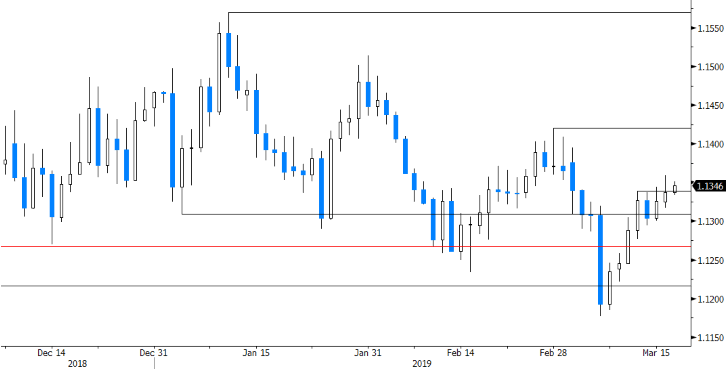
EUR/USD: has the dollar discounted enough pre-Fed softness?
EUR/AUD Daily Outlook
Daily Pivots: (S1) 1.5929; (P) 1.5963; (R1) 1.5996; More...
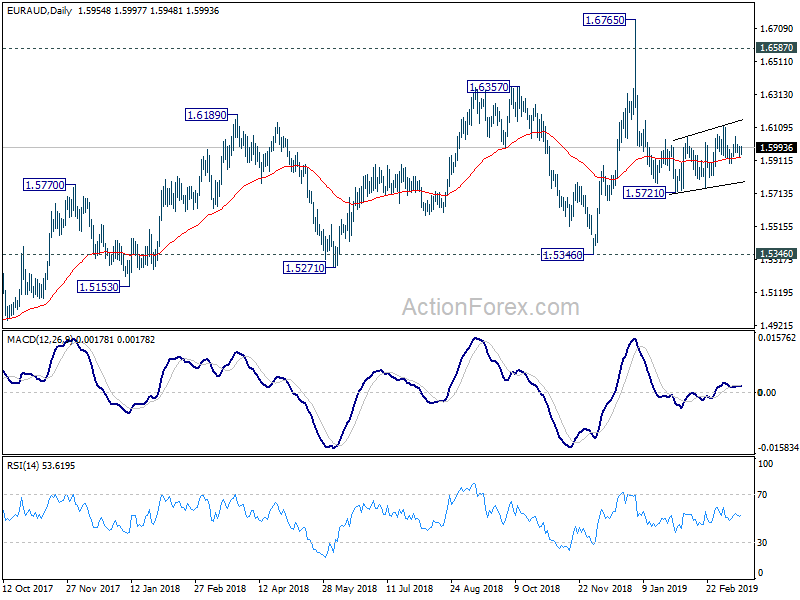
EUR/AUD is staying in consolidation from 1.5721 and intraday bias remains neutral. On the downside, break of 1.5721 low will resume the decline from 1.6765 and target 1.5346 support. On the upside, above 1.6122 will resume the corrective rise from 1.5721 instead.
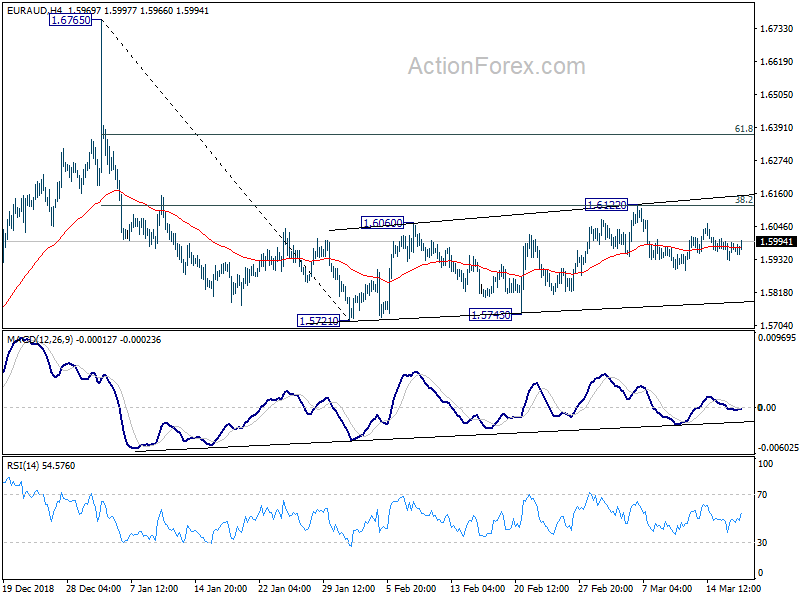
In the bigger picture, as long as 1.5346 support holds, outlook will remain bullish. Uptrend from 1.1602 (2012 low) is expected to resume sooner or later. Break of 1.6765 will target 61.8% retracement of 2.1127 (2008 high) to 1.1602 at 1.7488 next. However, firm break of 1.5346 key support will indicate trend reversal, with bearish divergence condition in weekly MACD, and turn outlook bearish.
EUR/CHF Daily Outlook
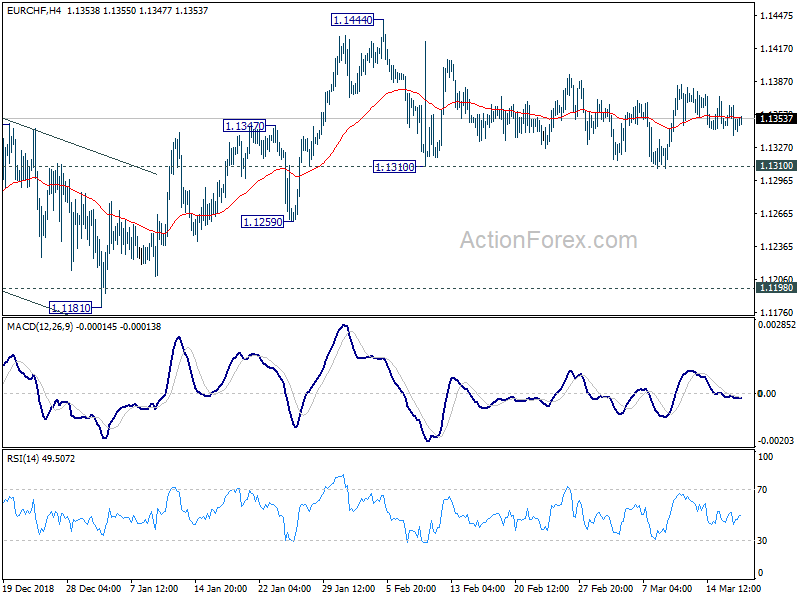
Daily Pivots: (S1) 1.1337; (P) 1.1351; (R1) 1.1364; More...
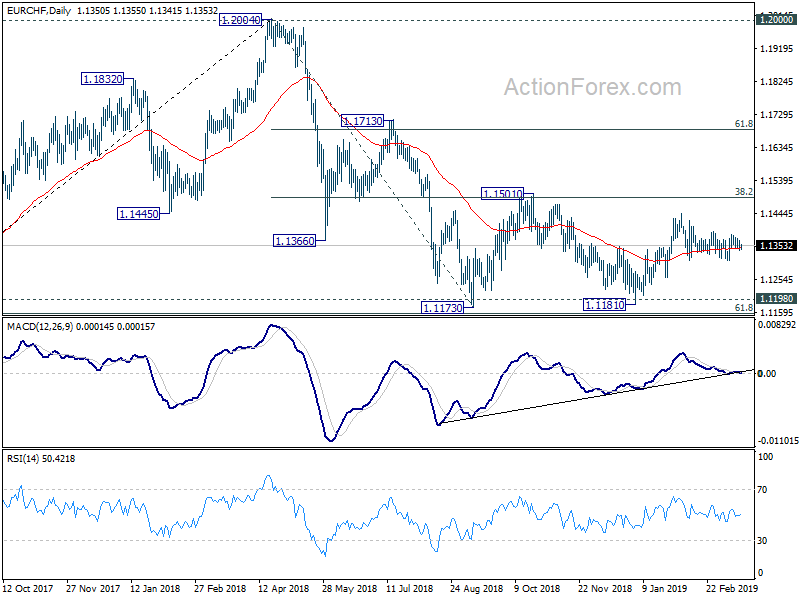
Intraday bias in EUR/CHF remains neutral for the moment. Consolidation from 1.1444 is still in progress and could extend further. With 1.1310 support intact, further rise is still expected. On the upside, firm break of 1.1444 resistance will resume the rebound from 1.1181 and target 1.1501 key resistance next. On the downside, firm break of 1.1310 will indicate completion of the rebound. In that case, intraday bias will be turned back to the downside for 1.1181 low again.
In the bigger picture, price actions from 1.2004 medium term top is seen as a correction only. Downside should be contained by 1.1154/98 support zone to complete it and bring rebound. Decisive break of 1.1501 (38.2% retracement of 1.2004 to 1.1173 at 1.1490) will confirm completion of the correction. Further rise should be seen to 61.8% retracement at 1.1687 and above next.
EUR/USD First Signal Of Large Bullish Correction?
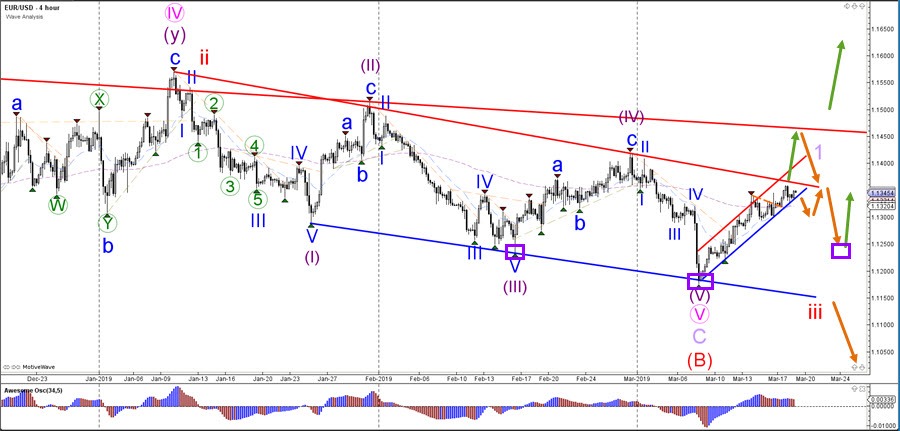
The strong EUR/USD rebound could indicate the end of wave B (red) and a larger bullish reversal despite the larger downtrend channel that is in play. For the moment a bearish bounce at the resistance trend line (red) near 1.14 and a break below the support (blue) line of the smaller channel seems the mostly scenarion. This could indicate a bearish retracement back to the inverted head and shoulders support level (purple box) at around 1.1250, which in turn could be a bouncing spot for a bullish reversal.
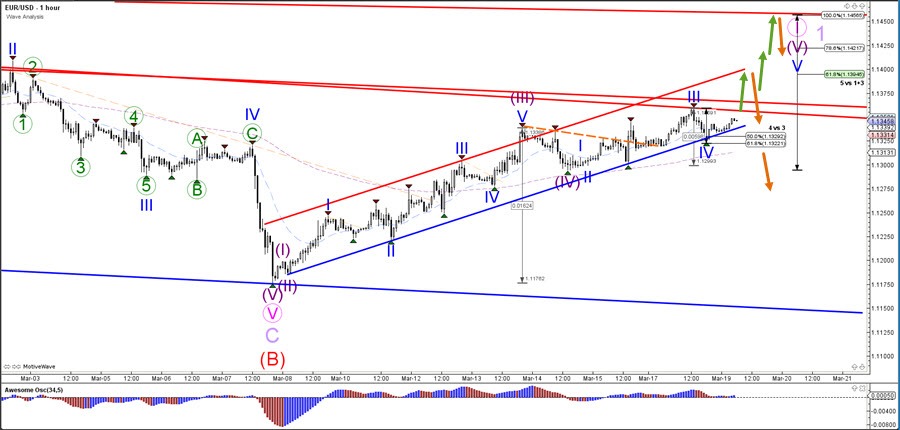
The EUR/USD could be building a final wave 4 – 5 (blue) pattern within the bullish push up. A bearish break below the 61.8% Fibonacci , however, could indicate the start of larger bearish retracement. A bullish wave 5 could aim for 1.14 but a break above this level could indicate an extension towards 1.15.
May’s Deal Or A Long Extension
Market movers today
The data release calendar is rather thin again today. Markets will follow political discussions in the UK and the EU countries on an Article 50 extension (see more below).
In Germany, the ZEW index is released, where we look for further signs of stabilisation in business expectations, in spite of the falling trend currently.
Riksbank Governor Skingsley will speak on Monetary Policy at a seminar in Stockholm, 14.00 CET. Market focus is likely to be on SEK comments
Selected market news
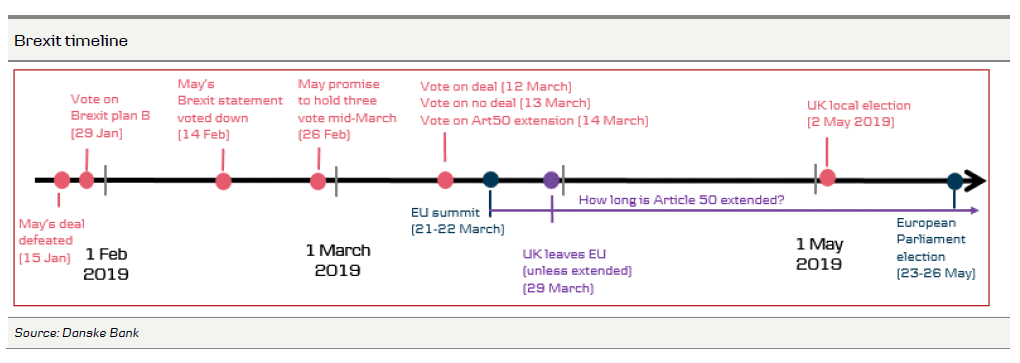
Yesterday, the market focus was yet again on Brexit. After a relatively quiet day in terms of other market-moving events, Speaker John Bercow ‘stole the show' as he made it clear that he will (at least in principle) not allow for a third vote unless there are "substantial changes" to the current deal.
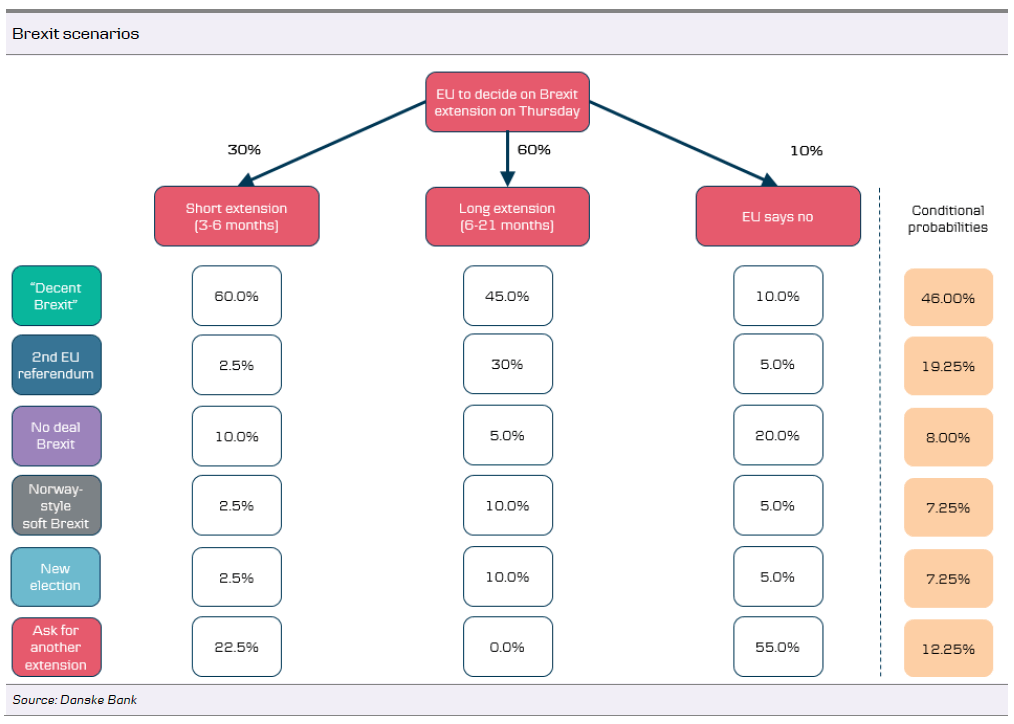
Therefore, it seems unlikely that there will be a third vote in the House of Commons on May's Brexit deal before the EU summit starts on Thursday (21 March). The big question now is whether the EU27 leaders will grant an extension when they meet on Thursday (the decision has to be unanimous but the EU council tends to work by consensus). While we previously thought a short extension was likely, we have changed our minds and now expect a long extension (60% likely versus 30% probability of a short extension). We would be more concerned if the EU leaders were not able to reach a consensus around an extension (10% probability). This clearly increases the chance of a no deal Brexit but from a legal perspective, the extension can be granted right up until the deadline.
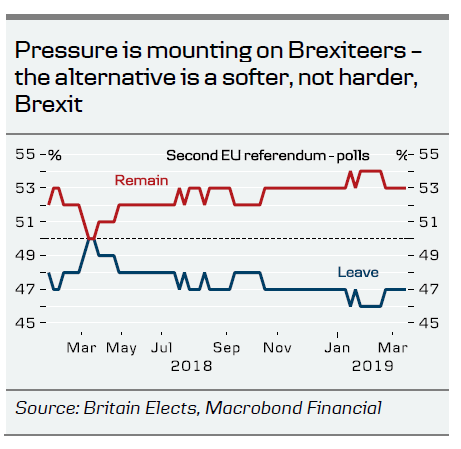
A long extension may increase the pressure on the Brexiteers to such a degree that they end up backing the deal. Some are speculating, despite Bercow's reservations, that May may try bring the deal forward for a vote next week, if her strategy works. A long extension would mean that the high uncertainty is prolonged for a longer period, which would continue to have damaging effects on the economy.
Overall, it seems like we will get a long extension or May's deal will pass soon. We still think May's deal passing is the most likely final outcome and that a second EU referendum (after a long extension) is the second most likely final outcome. See Brexit Monitor: 60% probability of a long Brexit extension, 19 March.
In the US, former NY Fed president Dudley called for caution as the Fed is waiting for further data, although he still expects a hike later this year. Inflation holds the key here. We published our Fed preview yesterday, where we outlined our expectations for the Fed to stay on hold while lowering the 'dot' signal for 2019 to one hike (from two). We would not be surprised if the Fed signals "one and done". Our base case with two hikes this year will be under pressure if the Fed confirms it has changed its reaction function by looking more at inflation expectations. We expect the Fed to announce it will end a shrinking of the balance sheet in Q4 19. The impact on fixed income markets should be limited even if the Fed completely removes all hikes from the dots.
AUD/USD Daily Outlook
Daily Pivots: (S1) 0.7081; (P) 0.7101; (R1) 0.7123; More...
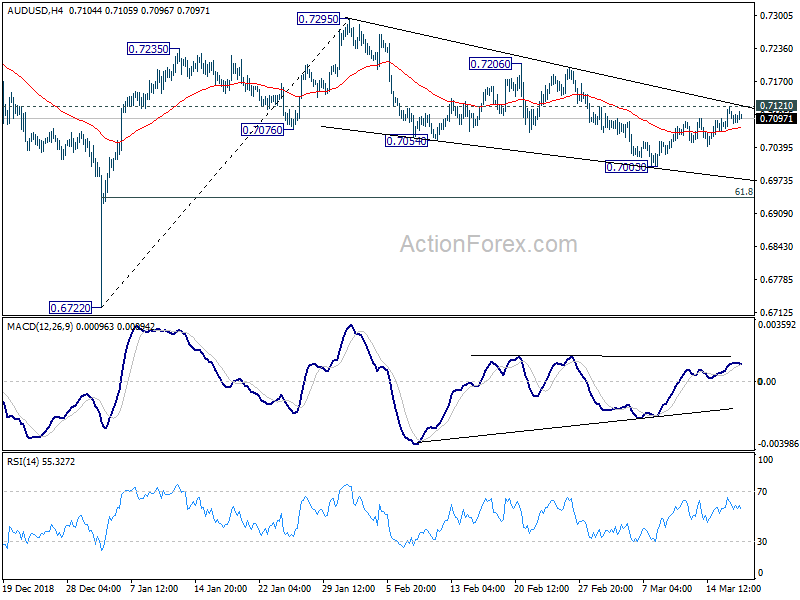
AUD/USD stays below 0.7121 minor resistance despite recovery. Intraday bias remains neutral first. Further fall remains in favor with 0.7121 intact. On the downside, break of 0.7003 will extend the fall from 0.7295 to 61.8% retracement of 0.6722 to 0.7295 at 0.6941 and below. However, firm break of 0.7121 will argue that decline from 0.7295 has completed at 0.7003. In that case, further rise should be seen to 0.7206 resistance to confirm. More importantly, in that case, corrective three wave structure of the fall from 0.7296 to 0.7003 would suggest that rise from 0.6722 low is extending through 0.7295.
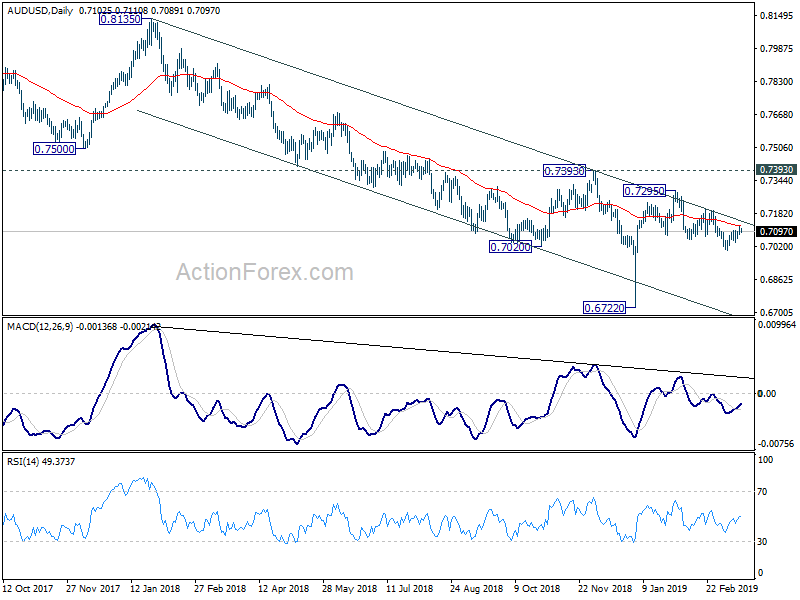
In the bigger picture, as long as 0.7393 resistance holds, we'd treat fall from 0.8135 as resuming long term down trend from 1.1079 (2011 high). Decisive break of 0.6826 (2016 low) will confirm this bearish view and resume the down trend to 0.6008 (2008 low). However, firm break of 0.7393 will argue that fall from 0.8135 has completed. And corrective pattern from 0.6826 has started the third leg, targeting 0.8135 again.
USD/CAD Daily Outlook
Daily Pivots: (S1) 1.3303; (P) 1.3334; (R1) 1.3368; More...
Intraday bias in USD/CAD remains neutral but further decline is expected with 1.3371 minor resistance intact. Break of 1.3289 will extend the fall from 1.3467 to 1.3068/3112 support zone. Nevertheless, on the upside, above 1.3371 will suggest that pull back from 1.3467 has completed. That will also revive the bullish case that rise from 1.3068 is still in progress. In such case, intraday bias will be turned back to 1.3467 resistance and above.
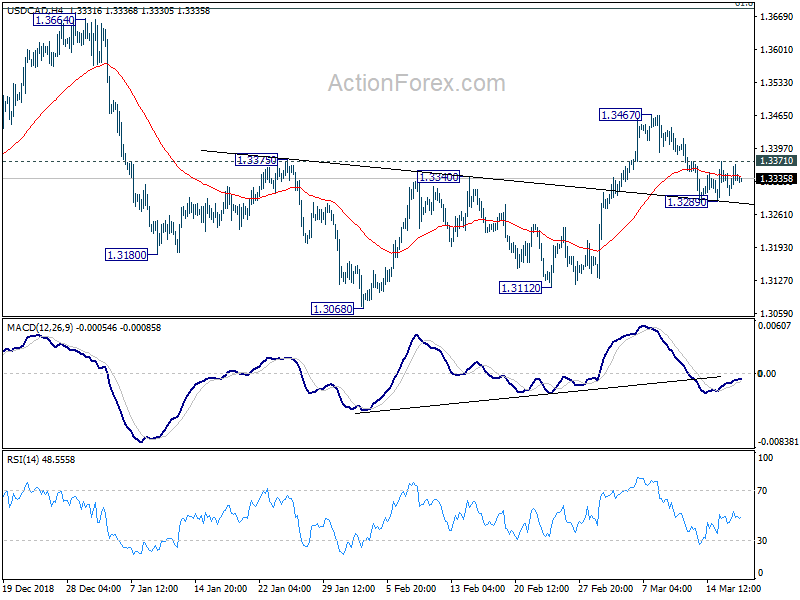
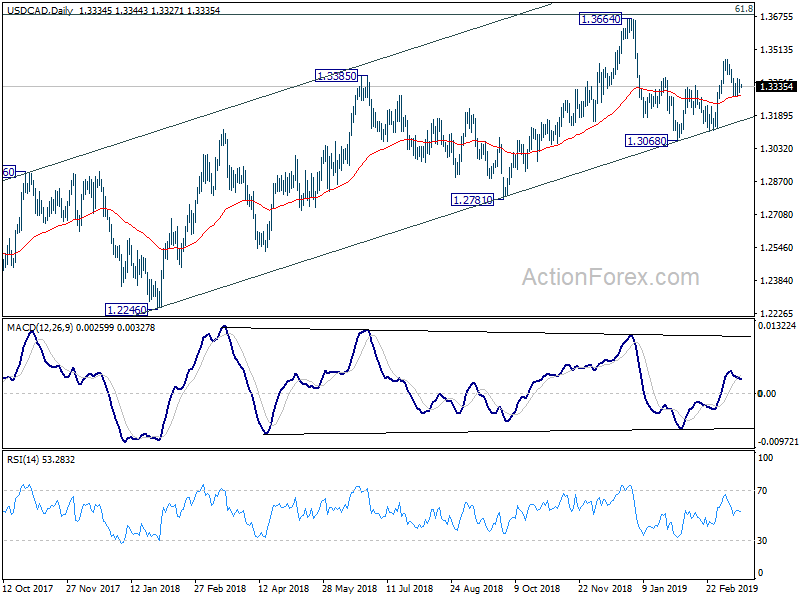
In the bigger picture, structure of the medium term rise from 1.2061 (2017 low) to 1.3664 is not clearly impulsive. Hence, we'd stay cautious on strong resistance from 61.8% retracement of 1.4689 (2016 high) to 1.2061 at 1.3685 and 1.3793 resistance to limit upside, and bring medium term topping. But in any case, medium term outlook will stay bullish as long as channel support (now at 1.3157) holds. Sustained break of 1.3793 will pave the way to retest 1.4689 (2015 high). Firm break of the channel support should confirm reversal target 1.2061 low again.
USD/JPY Daily Outlook
Daily Pivots: (S1) 111.28; (P) 111.45; (R1) 111.61; More...
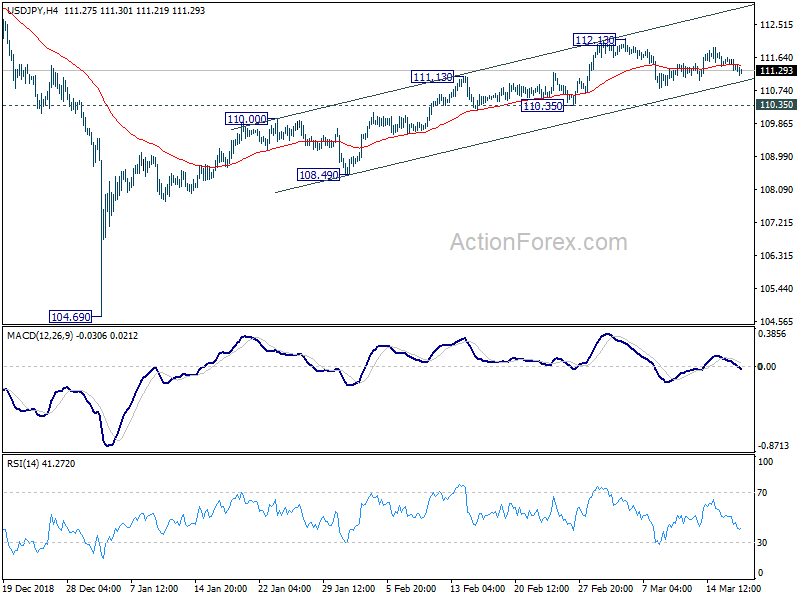
Intraday bias in USD/JPY remains neutral as consolidation from 112.13 is extending. As long as 110.35 support hold, near term outlook remains bullish. On the upside, break of 112.13 will resume the rally from 104.69 to 114.54 resistance next. However, firm break of 110.35 should confirm near term reversal and turn outlook bearish for 108.49 support and below.
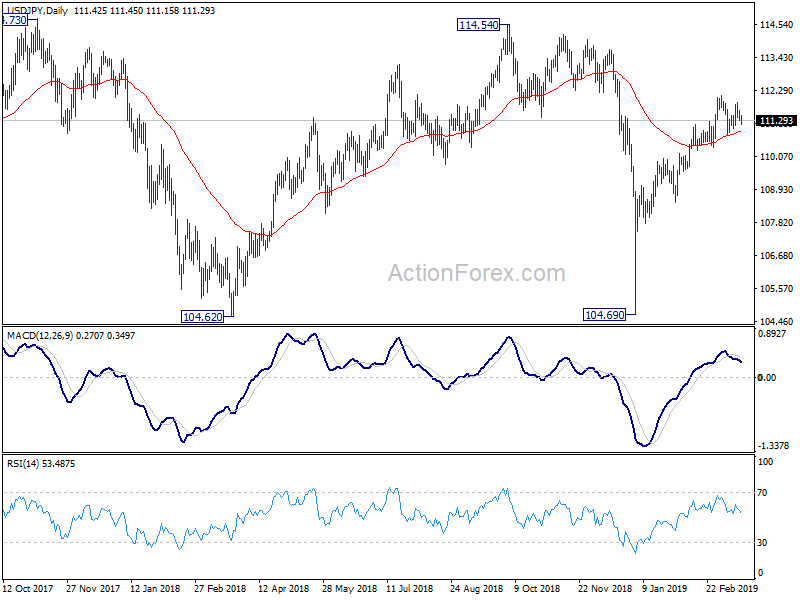
In the bigger picture, strong rebound from 104.69 argues that decline from 118.65 (2016 high) has completed with three waves down to 104.69, after failing 104.62. More importantly, the rise from 98.97 (2016 low) could be resuming. Decisive break of 114.54 resistance will add more credence to this bullish case and target 118.65. This will now be the favored case as long as 110.35 support holds. However, firm break of 110.35 will mix up the medium term outlook again and turn focus back to 104.69 low.
EUR/USD Daily Outlook
Daily Pivots: (S1) 1.1319; (P) 1.1340; (R1) 1.1362; More.....
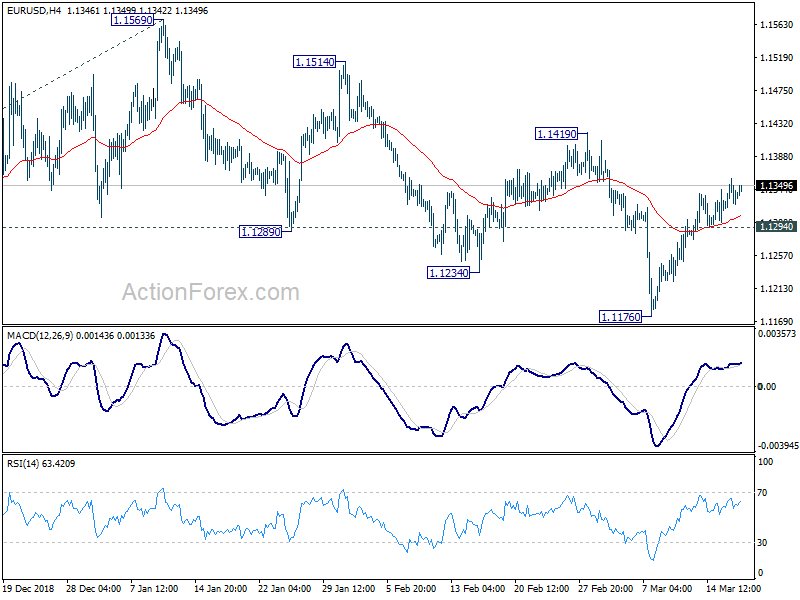
EUR/USD's rebound from 1.1176 could extend higher but it's still viewed as a corrective move. Hence, upside should be limited below 1.1419 resistance to bring down trend resumption. On the downside, below 1.1294 minor support will turn bias to the downside for 1.1176 low first. Break of 1.1176 will target 100% projection of 1.1814 to 1.1215 from 1.1569 at 1.0970 next.
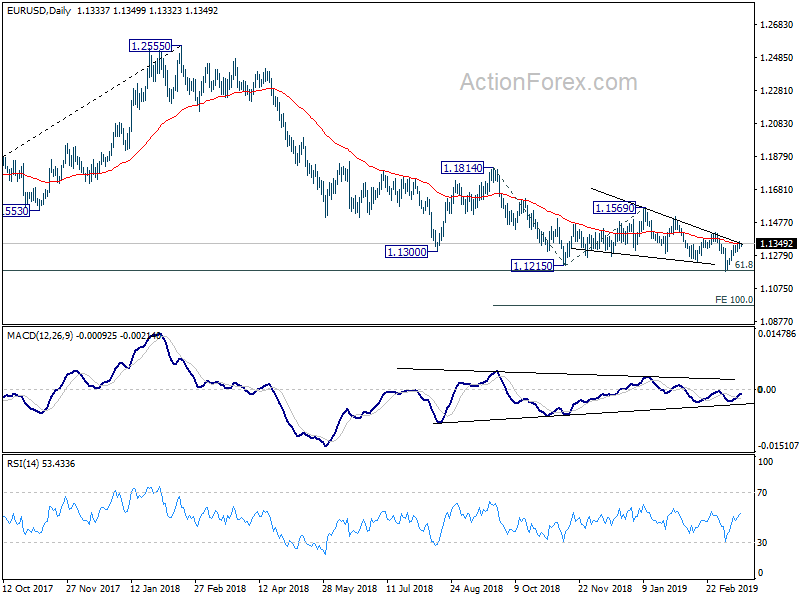
In the bigger picture, down trend from 1.2555 medium term top is still in progress. Bearishness is affirmed by sustained trading below falling 55 week EMA. 61.8% retracement of 1.0339 (2017 low) to 1.2555 at 1.1186 is met. Sustained break there will pave the way to retest 1.0339. On the upside, break of 1.1569 resistance will now indicate completion of such down trend and turn medium term outlook bullish.
Brexit Monitor: 60% Probability Of A Long Brexit Extension
Key takeaways
- Most likely no vote on the full Brexit deal before EU summit on Thursday
- We now believe that a long Brexit extension is more likely than a short one (60% and 30%, respectively). Higher chance of no deal by accident if EU leaders do not grant the extension (10% probability of this not happening).
- A long extension may increase the pressure on the Brexiteers to such a degree that they end up backing the deal. Deal may be put forward for a vote again next week – if the Speaker allows it.
- Overall, it seems like we will get a long extension or May’s deal will pass soon. We still think May’s deal passing is the most likely final outcome and a second EU referendum (after a long extension) is the second most likely final outcome.
EU to decide unanimously on Thursday
After the many votes last week, we think it is a good idea to take stock of Brexit again (see updated game tree page 3). As of today, it seems unlikely that there will be a third vote in the House of Commons on May’s Brexit deal before the EU summit starting on Thursday, 21 March. This is not only because of the lack of support but also because Speaker John Bercow has made it clear that he will (at least in principle) not allow for a third vote unless there are “substantial changes” to the current deal. The reason is that two votes on the same motion are not allowed during the same “session” (parliamentary year). The current session ends this summer. Of course, there are workarounds but all else being equal, it does not make life easier for Theresa May, as she may need to wait until July before putting it forward to a vote again. A clear workaround would be if May suddenly found a majority backing her deal, which would demonstrate to the Speaker that there is demand for voting on the deal again. Another, but less likely, workaround would be if the exit date were changed to a later deal.
The big question is how the EU27 leaders will respond when they meet on Thursday. Against what many thought before Brexit negotiations (and may still think), the EU leaders have been the real Brexit hawks, while Juncker, Tusk and Barnier have been more willing to compromise. It is clear that the EU27 leaders are annoyed about spending time on Brexit, as they have also other things to deal with, also domestically. Still, we think the EU27 leaders will end up grating the UK an extension. Yes, Brexit may be annoying and time-consuming and an extension is not only for the better, but probably still better than adding a no deal Brexit to the current mix of a slowing economy and politics turning violent (including outright terror attacks) in some countries.
If we are right, it is more about whether the EU27 will accept a short (3-6 months) or long extension (perhaps even as long as lasting until year-end 2020). The decision has to be taken unanimously by the EU27 leaders. While we previously thought a short extension was in the case, we have changed our minds and now expect a long extension (60% likely versus 30% probability for a short extension). The EU leaders will probably recognise that the benefits of a long extension are greater than for a short one.
By giving a long extension, the EU would make sure that they will not get the blame for a no deal Brexit, companies would still have free access to the UK market (the second biggest in the EU28), the UK would continue contributing to the EU budget, there would be more time to discuss the future relationship (which may end up making the much-hated Irish backstop redundant) and would increase the likelihood of the UK choosing to remain in the EU. Alternatively a long extension may increase the pressure on the Brexiteers to such a degree that they end up backing the deal and hence the long extension by itself makes clarity more likely (this also seems to be PM Theresa May’s strategy). We have already seen former Brexit Secretary David Davis now backing the deal and Jacob Rees-Mogg also seems to know that the hard Brexiteers risk the whole project by not passing May’s deal, despite thinking it is flawed. A big game changer continues to be if the DUP backs the deal, as it would be what is needed for many Brexiteers to back the deal as well. The problem for Theresa May is, however, that die hard remainers and Brexiteers will still vote against the deal, so she is still relying on support from Labour Brexiteers. They will not likely jump on board before the deal is passed. Some are speculating, despite Bercow’s reservations, that May may try bring the deal forward for a vote again next week, if her strategy works.
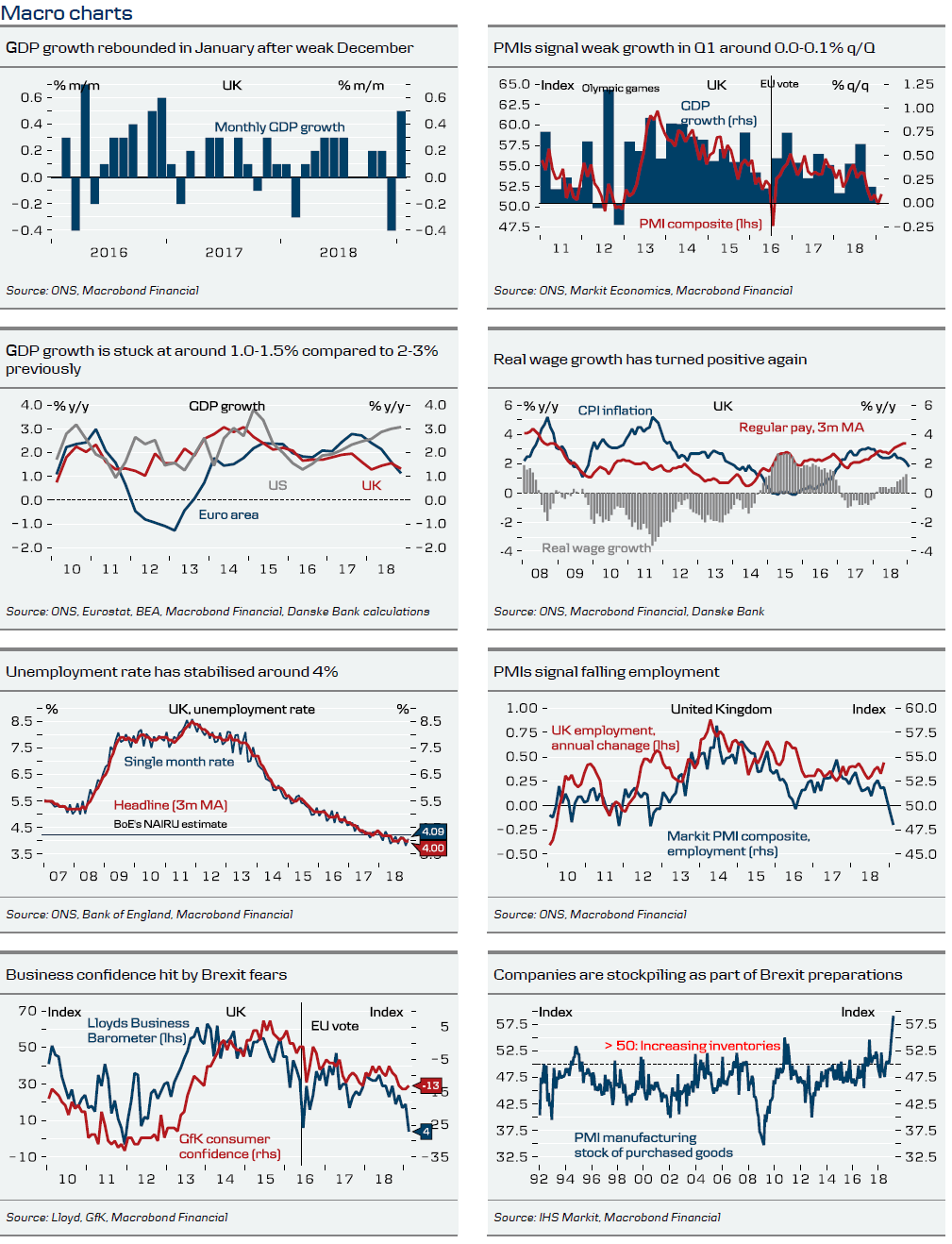
The problem is that a long extension is problematic for the UK. It means the UK needs to participate in the European elections (which is of course weird but perhaps not as big of a problem as some are making it out to be) and for the Conservatives it is probably not the best way to start the local election campaigns (local elections take place on 2 May). Seen from May’s perspective, it also increases the chance that her government falls if the hard Brexiteers think it is better to bring down the government as a result. Alternatively, they can just paralyse British politics by voting down everything the government puts forward. There is higher risk of a government collapse and hence also snap elections in this scenario. Another problem with a long extension is that the period with high uncertainty for companies is prolonged, which would continue to have damaging effects on the economy. As we argued in our latest Brexit Monitor: Brexit goes to overtime, 11 March, the UK economy has slowed due to Brexit fears, which is why we lowered our GDP forecasts to just 1% this year, increasing to 1.3% next year (previously 1.2% and 1.4%, respectively). Business investments in the UK fell in all four quarters last year, as companies have postponed or cancelled investment projects and businesses have started stockpiling as part of the preparations for Brexit. An extension would only prolong this and is damaging the economy, most notably in the UK, but also the EU27 companies are referring to Brexit uncertainties in e.g. businesses surveys.
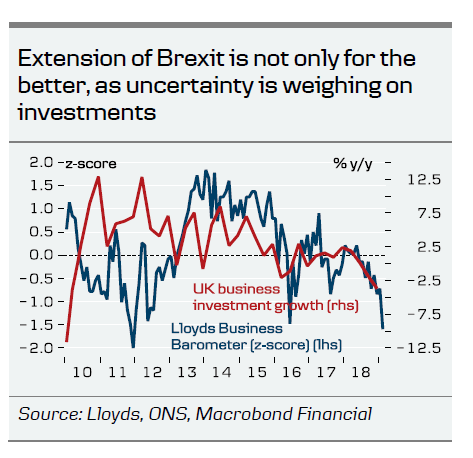
Overall, it seems like we will get a long extension or May’s deal will pass soon. We still think May’s deal passing is the most likely final outcome and a second EU referendum (after a long extension) is the second most likely final outcome. See our updated game tree on page 3.
We would be more concerned if the EU leaders are not able to reach a consensus on an extension. We think the likelihood of this scenario is 10%. This would clearly increase the chance of a no deal Brexit happening but from a legal perspective, the extension can be granted until right up until the deadline.
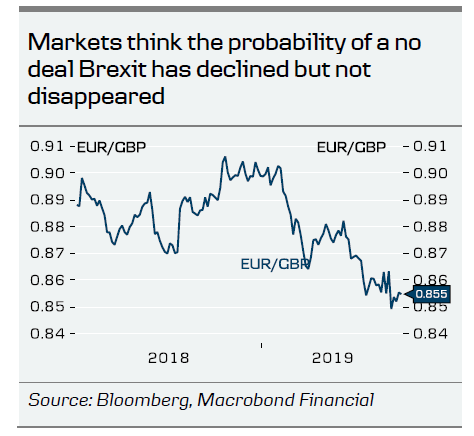
We have published our new EUR/GBP forecasts in our FX Forecast Update: ECB stance reintensifies the FX carry hunt, 18 March. Here we argue that both May’s deal passing soon and a long extension of Brexit would eventually be positive for the GBP. Nearterm, we think EUR/GBP will remain in the 0.85-0.87 range, as an extension is probably more or less priced in at this point