Sample Category Title
AUD/USD Outlook: AUD/USD Eventually Broke Above 20SMA But Dovish Fed Would Result In Limited Advance
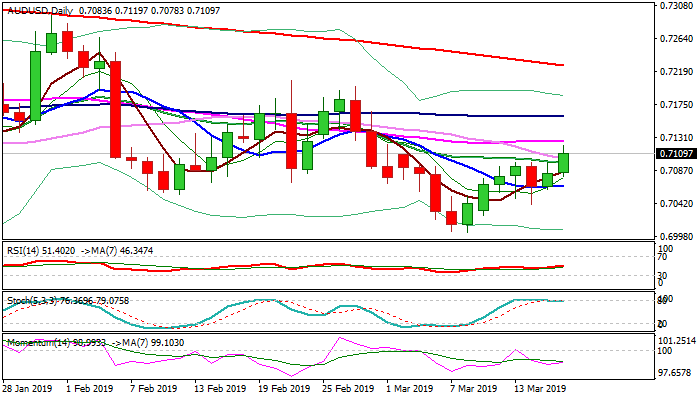
The Aussie advanced through 20SMA barrier (0.7098) that capped last week's action and hit new recovery high at 0.7119 on Monday.
Weaker greenback on soft US data on Friday that also raised concerns about dovish stance of the US central bank on two-day policy meeting (Tue/Wed), helped recovery.
Bulls now eye 55SMA (0.7127) but require eventual close above 20SMA to confirm improved structure.
However, bulls may struggle to regain 55SMA barrier, as daily momentum remains weak and slow stochastic is reversing from overbought territory and overall picture is bearish. Also, widely expected dovish tone from Fed is expected to boost Australian dollar, but the currency may weaken against its US counterpart, on lower liquidity and yields that requires caution.
Return below 20SMA would weaken near-term tone, while extension and close below 10SMA (0.7067) would confirm reversal.
Res: 0.7119, 0.7127, 0.7159, 0.7199
Sup: 0.7097, 0.7078, 0.7067, 0.7041
USD/JPY Outlook: USD/JPY Holds Within Tight Range And Slight Bullish Bias Ahead Of Fed
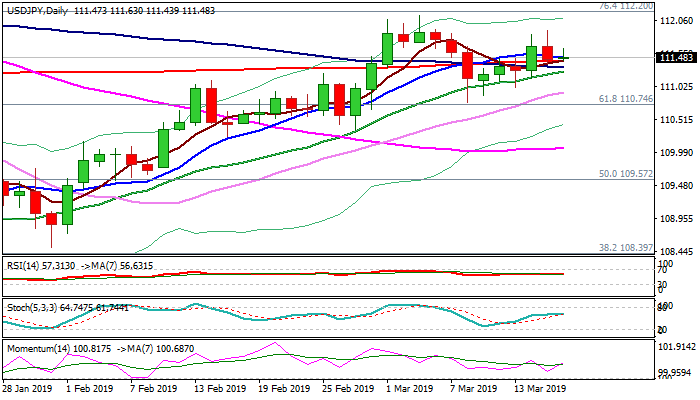
The pair holds within tight range on Monday but maintains bullish bias, following Friday's close above 200SMA and bullish weekly close.
Bulls face headwinds at strong 112 resistance zone (Friday's high at 111.90 / 2019 high at 112.13, posted on 5 Mar and Fibo 76.4% at 112.20), but daily techs remain in bullish setup and immediate focus would remain shifted higher while 200SMA (111.42) holds.
The greenback remains firm against yen despite the biggest weekly fall in few months, registered last week and awaiting the outcome from Fed's meeting on Wednesday for clearer signals.
Failure to hold gains above 200SMA and close below, would sour the sentiment, but extension through supports at 111.25 (20SMA) and 110.93 (30SMA) is needed to confirm negative scenario and open way for deeper fall.
Conversely, sustained break above 112.20 would signal continuation of recovery from 104.59 (2019 low).
Res: 111.63, 111.90, 112.20, 112.60
Sup: 111.42, 111.25, 110.93, 110.78
Sterling, Yields And Stocks Set For A Volatile Week
Monday March 18: Five things the markets are talking about
Global equities start Monday on the front foot in a week that is packed with geopolitical (Brexit, E.U summit – Mar 21/22), economic releases and central bank meetings (FOMC, BoE, SNB), events that are expected to have a significant impact on both markets and volatility.
Last week, U.K parliament rejected for the second time PM May’s exit deal and also voted to delay the final Brexit deadline, currently set for March 29. However, any extension needs to be agreed by all 27 EU member governments. Nevertheless, May is expected to put ‘her’ withdrawal agreement to a third vote, as early as tomorrow, only if she’s able to incite consensus amongst her party.
On the central banks front, the Fed (Mar 20), BoE and SNB (Mar 21) are all expected to sound ‘dovish’ when they make interest rate decisions. Fed officials are not expected to signal any appetite for rate increases this year and how long this pause will last is what the market is after. The BoE is likely to suggest interest rates staying put as Brexit uncertainty continues.
On the trade front the meeting between China President Xi and US president Trump is now delayed to June. Thus far, it has had little impact on markets.
On tap: RBA minutes (Mar 18), U.K average earnings (Mar 19), U.K CPI, FOMC monetary policy meeting, U.K Brexit vote, NZD GDP, Japan bank holiday & AUD employment (Mar 20), SNB monetary policy assessment, U.K retail sales & BoE monetary policy summary (Mar 21), EUR German flash PMI, CAD CPI & retail sales (Mar 22).
1. Stocks get the green light
In Japan, the Nikkei rallied overnight as chip-related stocks tracked their U.S counterparts higher, but weak February export data capped gains. The Nikkei share average ended +0.6% higher, while the broader Topix rose +0.7%.
Down-under, Aussie shares rose, as mining stocks tracked gains in iron ore prices after Brazil indicated it would cut output, although broader gains were capped by a jaded performance in bank stocks. The S&P/ASX 200 index closed +0.25% higher. The benchmark was little changed on Friday. In S. Korea, stocks rose for a third session, but the advance was modest. The Kospi only climbed +0.2% as index giant Samsung Electronics fell -1.1%.
In China, stock indexes closed atop of their six-month highs overnight, as sentiment was supported by an expected ‘dovish’ Fed stance this week and Beijing’s policy boost for growth. At the close, the blue-chip CSI300 index settled +2.9% higher, while the Shanghai Composite Index ended up +2.5%.
In Hong Kong, stocks tracked the mainland Chinese markets higher and closed at a nine-month peak. The Hang Seng index rose +1.4%, while the China Enterprises Index gained +1.5%.
In Europe, regional bourses trade mostly higher across the board tracking their Asian peers higher and mixed U.S Index futures this morning.
U.S stocks are set to open little changed (+0.0%).
Indices: Stoxx600 +0.15% at 381.66, FTSE +0.70% at 7,278.75, DAX -0.03% at 11,682.54, CAC-40 +0.08% at 5,409.55, IBEX-35 +0.40% at 9,379.81, FTSE MIB +0.61% at 21,173.50, SMI +0.01% at 9,484.20, S&P 500 Futures 0.00%
2. Oil prices caught between supply and demand constraints, gold higher
Oil prices are mixed, weighed down by concerns that an economic downturn may reduce fuel consumption, but supported by OPEC+ supply cuts and U.S sanctions against Iran and Venezuela.
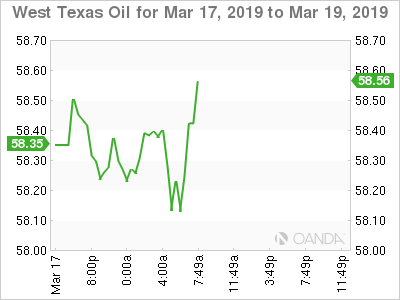
Brent crude oil futures are at +$67.24 per barrel, up +8c from Friday’s close, while U.S West Texas Intermediate (WTI) futures are at +$58.43 per barrel, down -9c from their close.
OPEC announced this morning that’s it’s set to scrap its planned meeting in April and decide instead whether to extend oil output cuts in June – members want to be able to assess the full impact of U.S sanctions on Iran and the crisis in Venezuela.
OPEC and a group of 10 oil-producing nations led by Russia are deepening their crude production cuts but remain split on whether the curbs should remain in place through the end of the year. The next regular talks would be held on June 25-26.
Note: On Sunday, Saudi energy minister Khalid al-Falih said “the job of OPEC and its allies was not done yet” and indicated that the group of oil producers needed to “stay the course” at least until June when the current global supply cut agreement is due to expire.
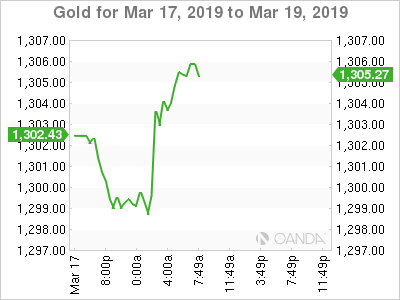
Ahead of the U.S open, gold prices are a tad higher for a second consecutive session, as the ‘big’ dollar slipped after recent toned-down U.S data increased chances that the Fed will signal a ‘dovish’ policy stance this week. Spot gold has rallied +0.2% to +$1,303.92 per ounce, while U.S gold futures have gained +0.1% to +$1,303.80.
3. German Bund yields little changed ahead of summit
The German 10-year Bund yield is little changed ahead of this week’s critical EU summit (Mar 21/22), with UK PM May set for a visit to Brussels on Thursday to request an extension to Brexit negotiations beyond the scheduled departure date of March 29. Investors should expect headline noise to have an impact on yields. Trading atop of their record low yields, the danger remains to the upside in yield – on any sign for a benign exit plan. The yield on Germany’s 10-year Bund currently trades at +0.087%.
Elsewhere, the yield on 10-year Treasuries increased +1 bps to +2.59%, while in the U.K the 10-year Gilt yield advanced less than +1 bps to +1.214%. In Italy, the 10-year BTP yield is lower by -5 bps to test a fresh 10-month low around the +2.44%, on market relief that the credit rating agency Moody’s did not take any action on Italy late last week.
4. Sterling dips on Brexit concerns
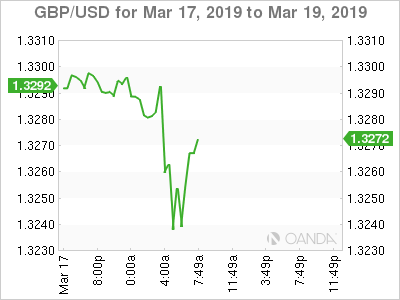
GBP/USD is softer by -0.4% at £1.3238 as the market begins to focus on a possible third meaningful vote on PM May’s Brexit deal, which could happen tomorrow. PM May is trying to bring her already twice defeated “Withdrawal Agreement” back to the House of Commons. However, this move would depend on whether the Northern Irish DUP party agree to back it.
Sterling is under pressure with reports suggesting that the PM is unlikely to garner enough support to get her deal through Parliament.
What then? If the meaningful vote failed for a third time, it’s over to the EU at their council summit on Mar 21/22 to decide what length of extension they would offer the UK to Article 50 and what the conditions will be.
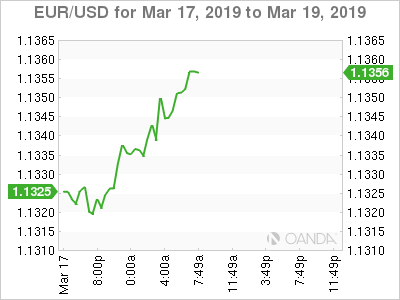
EUR/USD (€1.1339) trades atop of its fortnight high with focus now on the Fed. A “no change” in policy is expected and many expect the meeting should reinforce the message that the Fed would remain patient for the foreseeable future.
Note: German flash PMI is released on Mar 22.
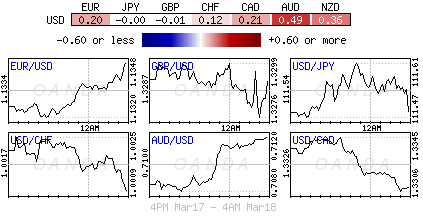
With the Fed expected to reduce its forecasts for future interest-rate rises, investors should expect this to boost appetite for risk assets later this week, which could be positive for high yield and EM FX, while the ‘big’ dollar should be able to hold its own against low-yielding currencies.
5. Euro trade data
Data from Eurostat this morning showed that the EU’s trade surplus with the U.S and its deficit with China both increased in January, serving as potential fuel for trade conflicts between the world’s largest economies.
The EU surplus in goods trade with the U.S expanded to +€11.5B in January, from +€10.1B in January 2018, while with China, the EU deficit also increased to +€21.4B, from €20.8B a year earlier.
As a whole, the EU trade deficit in goods was -€24.9B in January from -€21.4B in January 2018. For the eurozone, its trade surplus dropped to -€1.5B from -€3.1B.
Note: President Trump has complained about Europe’s trade surplus, imposing tariffs to curb imports of EU steel and aluminum and threatening to do the same for the much larger trade in cars and car parts.
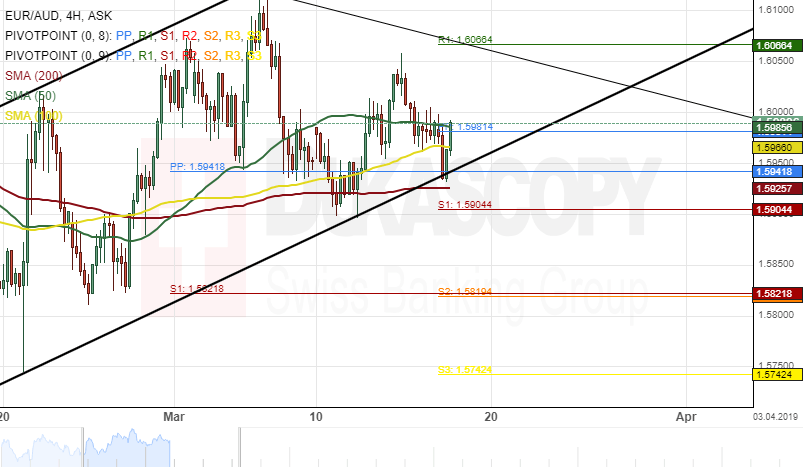
EUR/AUD 4H Chart: Breaches Medium-Term Channel
The single European currency maintained its medium-term ascending channel pattern during the past week. The currency pair appreciated about 154 base points during last week's trading sessions.
The exchange rate re-tested the bottom border of the medium-term ascending channel pattern during the Asian session on Monday.
If the support level formed by the lower boundary of the channel pattern at 1.5925 holds, the currency exchange rate will aim at a swing high of 1.6143 during the following trading sessions.
However, if the pair passes the support line as mentioned earlier, the next target for bearish traders will be at 1.5821.
EUR/CAD 4H Chart: Short-Term Surge Likely
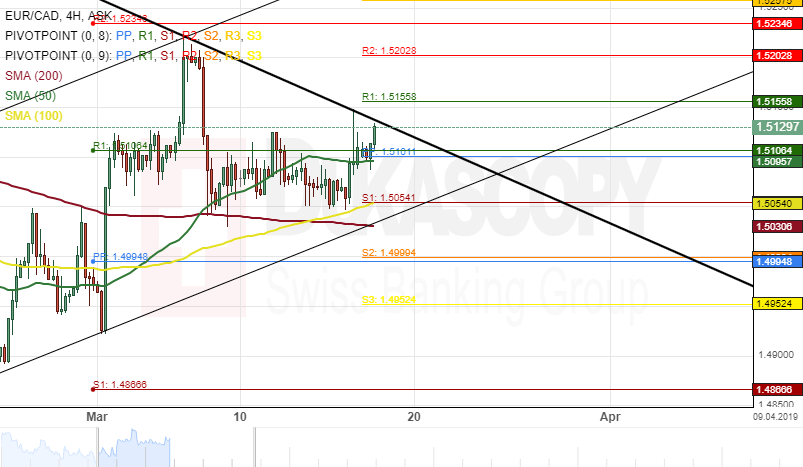
The Eurozone single currency traded sideways movement against the Canadian Dollar during last week trading sessions. The currency pair re-tested the upper boundary of a medium-term descending channel pattern at 1.5155 during Friday's trading session.
Most likely, the currency exchange rate will maintain the medium-term descending channel pattern during this week's trading sessions. The potential downside target will be at 1.4952.
Although, technical indicators flash buy signals on the 4(H) time frame chart. From a theoretical point of view, a surge could be expected in the short-term.
Bundesbank: German growth subdued in Q1 as consumption offset by weak manufacturing
Bundesbank said in the monthly report that German economic growth remained subdued in Q1. The main reasons include weak industrial production, falling auto exports and deteriorating manufacturing sentiment. Manufacturing sector would drag down overall economic performance for the third straight quarter.
On the other hand, construction and private consumption should provide support to the economy. Employment also continues to rise despite slowdown. Bundesbank added that private consumption could pickup significantly as signaled by strong increase in retail sales.
EUR/USD – Euro Slightly Higher As Trade Surplus Jumps
EUR/USD has edged higher on Monday. Currently, the pair is trading at 1.1352, up 0.26% on the day. On the release front, the focus is on inflation data. It’s a slow data calendar to start the week. In the eurozone, the trade balance climbed to EUR 17.2 billion, marking a 9-month high. There are no major U.S. events on the schedule. On Tuesday, Germany releases ZEW Economic Sentiment, which is expected to remain mired in negative territory.
In the eurozone, there were no surprises from February inflation numbers. Eurozone CPI edged up from 1.4% to 1.5%, matching expectations. With inflation below the ECB target of around 2 percent, the bank is unlikely to raise rates until there is a significant improvement in economic data out of Germany and the eurozone. Back in 2018, the ECB had projected raising interest rates later this year, but the worsening economic landscape has forced the bank to push back its forecast for future rate hikes. At its March policy meeting, the ECB said it would not raise rates prior to 2020 and this dovish stance soured investors on the euro and sent the currency lower.
With the U.S-China trade war showing signs of easing, there were expectations that President Trump and Chinese President Xi might hold a summit in late March. However, it was reported last week that the two leaders will not meet before April. President Trump has said that there will be news in the next 3-4 weeks, which has raised hopes that China and the U.S. will hammer out an agreement. If there are positive developments in the trade war, risk appetite will rise and could propel EUR/USD to higher levels.
Brexiteer Rees-Mogg hints he might back May’s deal, as it’s better than no Brexit
One of the most influential Brexiteer hinted today that the might back Prime Minister Theresa May's Brexit deal because a bad deal is better than no Brexit. Rees-Mogg, chairman of the European Research Group told LBC Radio that "no deal is better than a bad deal but a bad deal is better than remaining in the European Union in the hierarchy of deals."
Mogg warned that "a two-year extension is basically remaining in the European Union." But he also noted: "The question people like me will ultimately have to answer is: can we get to no-deal instead? If we can get to no-deal instead, that is a better option... but I am concerned the prime minister is determined to stop a no-deal."
Separately, Foreign Minister Jeremy Hunt said there were "cautious signs of encourage" regarding May's deal. And the government would "hope" to have another meaningful vote tomorrow. But he emphasized "we need to be comfortable that we'll have the numbers". Hunt of said "the risk of no-deal, at least as far as the UK parliament is concerned, has receded somewhat but the risk of Brexit paralysis has not."
GBPUSD Key Support Holding
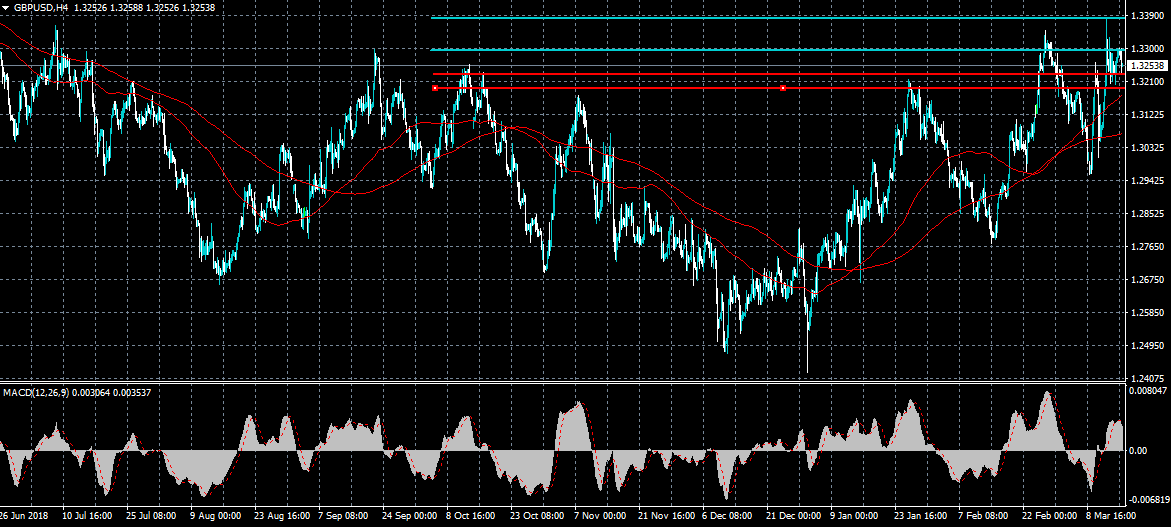
The British pound has fallen back towards key intraday support against the US dollar as uncertainty gathers, ahead of the third vote for British PM Theresa May’s Brexit bill. Bulls have so far defended the ey k1.3240 support level, although the MACD indicator on the four-hour time frame shows scope for further downside. Bulls must break above the 1.3300 resistance level to encourage the next wave of technical buying in the GBPUSD pair.
The GBPUSD pair is only intraday bullish while trading above the 1.3240 level, key technical resistance is found at the 1.3300 and 1.3388 levels
If the GBPUSD pair trades below the 1.3240 level, sellers may test towards the 1.3200 and 1.3155 support levels.
USDJPY Testing Weekly Pivot
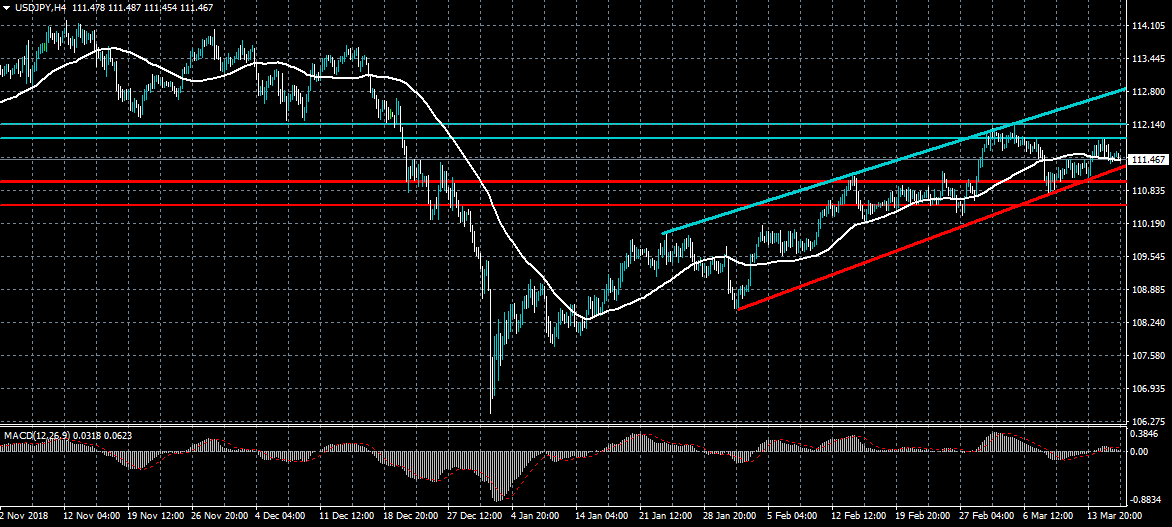
The US dollar is testing back towards its key weekly pivot point against the Japanese yen currency, as the greenback slips lower on Monday. The USDJPY pair will likely come under increasing technical selling pressure below the 111.45 level, with major trendline support located just below. Bulls need to force price the pairs former weekly trading high to encourage fresh buying interest.
The USDJPY pair is only bullish while trading above the 111.60 level, key resistance is found at the 111.80 and 112.15 levels.
If the USDJPY pair trades below the 111.45 level, sellers may test towards the 111.30 and 110.90 support levels.