

Sample Category Title
EUR/USD Outlook: Extended Recovery Eyes Key Barriers, But Risk Of Stall Exists
The Euro advances at the beginning of the week, in extension of last week's rally (the biggest weekly rise since Nov), gaining additional support from weaker dollar, hit by soft US data on Friday, which raised concerns about dovish stance from Fed at the end of two-day policy meeting on Wednesday.
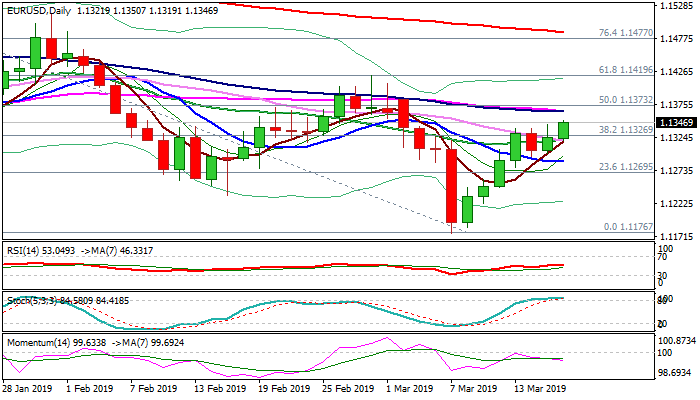
Fresh bullish acceleration probes above tops of last three days and eyes strong barriers at 1.1364/72 (converged 55/100SMA's/50% retracement of 1.1569.1.1176).
Daily cloud twists today at 1.1418 and attracts bulls, with fresh boost of positive sentiment on negative expectations from Fed, adding to bullish near-term outlook.
On the other side, negative momentum continues to rise on daily chart, while slow stochastic crests in overbought territory and warn that bulls may run out of steam, ahead of key barriers.
Converged 20/30SMA's (1.1318) mark solid support which is expected hold and maintain bullish bias. Conversely, break and close below would weaken near-term structure and risk dip towards next pivotal support at 1.1288 (10SMA).
Res: 1.1350, 1.1364, 1.1372, 1.1382
Sup: 1.1338, 1.1318, 1.1288, 1.1263
The US Currency Is Still Under Pressure. Investors Expect Central Banks Meetings
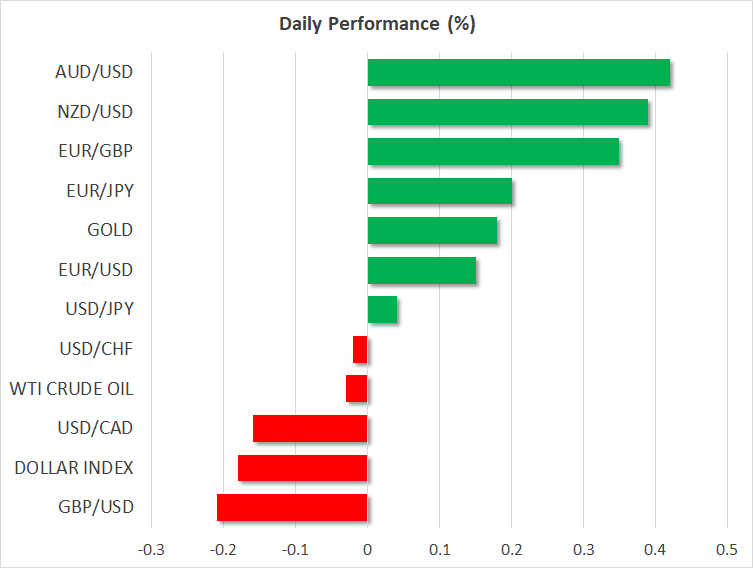
On Friday, the US dollar weakened slightly against a basket of major currencies. Ambiguous data on the US economy were published. Thus, the number of JOLTS job openings increased to 7,581M in January, while experts expected 7,310M. However, the volume of industrial production increased by only 0.1% in February instead of the expected growth by 0.4%. The US currency is under pressure due to a decline in the US government bonds yield. The dollar index (#DX) closed the trading session in the negative zone (-0.18%).
This week, investors will be focused on trade relations between the US and China. As it became known, a meeting between US President Donald Trump and Chinese President Xi Jinping to sign the final trade agreement may be rescheduled for June, although it was previously planned to be signed in April. Financial market participants expect the Fed, the Swiss National Bank and the Bank of England meetings. It is expected that the regulator will keep the key marks of monetary policy at the same level.
Investors are still focused on the situation concerning Brexit. On Thursday, March 21, the EU summit will start, at which representatives should vote for the Brexit delay.
The "black gold" prices have moved away from local highs. At the moment, futures for the WTI crude oil have approached $58.50 per barrel.
Market Indicators
- On Friday, purchases prevailed in the US stock market: #SPY (+0.05%), #DIA (+0.31%), #QQQ (+0.93%).
- The 10-year US government bonds yield has decreased. Currently, the indicator is at the level of 2.59-2.60%.
The news feed on 18.03.2019:
- Today, the publication of important economic news is not expected. At 12:00 (GMT+2:00) data on the trade balance of the Eurozone will be published.
FOMC Preview – Fed To Signal One More Rate Hike
- Fed will stay on hold while lowering the 'dot' signal for 2019 to one hike (from two). We will not be surprised if the Fed signals "one and done".
- Our base case with two hikes this year will be under pressure if the Fed confirms it has changed its reaction function by looking more at inflation expectations.
- We expect the Fed to announce it will end shrinking the balance sheet in Q4 19.
- Impact on fixed income should be limited even if the Fed completely remove all hikes from the dots.
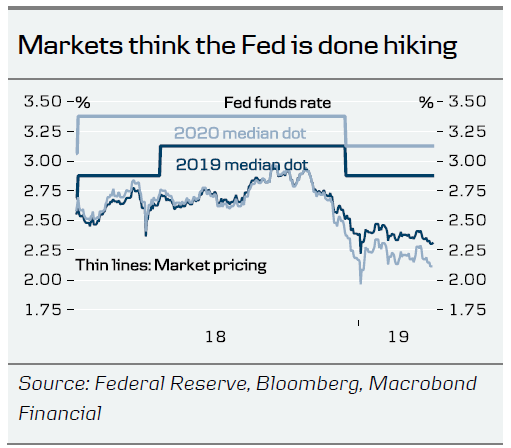
Fed outlook: Fed is likely to signal just one more rate hike
We expect the Fed will keep the target range unchanged at 2.25-2.50% and make no major changes to the statement.
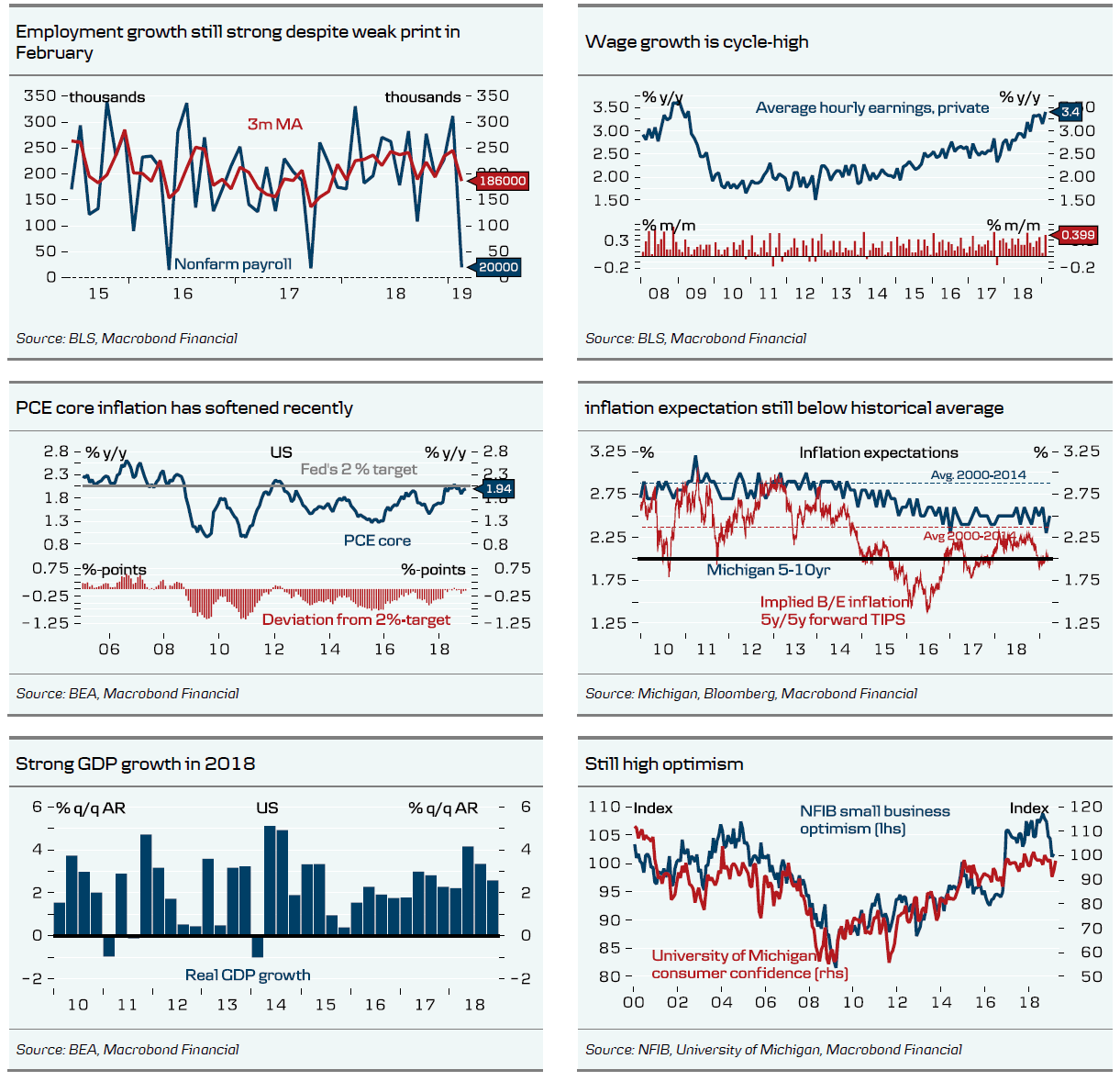
Powell & Co have emphasised that they will be "patient" in raising hikes but the question is what that means in terms of the "dots", which are released alongside the rate decision. The U.S. macro outlook is still positive but Fed stated already in December it wants to see it confirmed before continuing its hiking cycle. In addition, the Fed is concerned about possible spill-over effects from the slowdown in China and Europa, and therefore also want to wait and see how things evolve in the global economy. The Fed also wants to make sure the rebound in risk appetite so far in Q1 19 is robust. We expect Fed to lower its 'dot' signal further to just one rate hike in 2019 (down from two). We expect them to be revised lower also for 2020 and 2021 and we will not be surprised if the Fed signals "one and done". We expect the longer-run dot is to be unchanged at 2.75%. That said, Fed has begun downplaying the importance of the dots given the increased uncertainty around the base case, so be careful putting too much weight on them going forward.
Our current base case is two Fed hikes (in June and December) based on our overall positive economic outlook. Economic growth is strong, unemployment rate is moving lower, wage growth is moving gradually higher and risk sentiment in markets has rebounded. PCE core inflation, however, has softened in recent months. However, if the Fed confirms it has changed its reaction function by looking more at inflation expectations and less on the unemployment rate, a June hike seems less likely, as marked-based inflation expectations remain well below historical average.
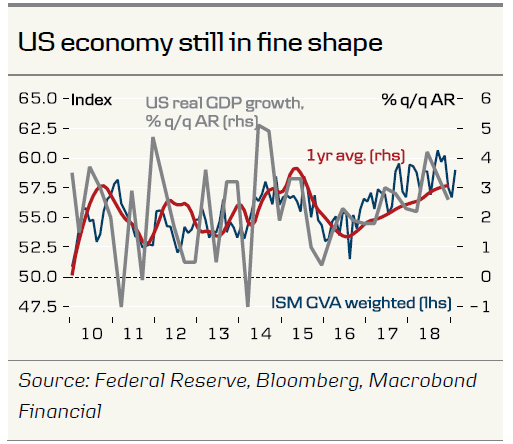
Still, markets are pricing the Fed too dovish at the moment, as they think the Fed is on hold for the rest of the year. A change in Fed's rhetoric can happen fast. A good example is the rate increase in March 2017 where the market was not expecting a rate hike until Fed signalled it three weeks in advance.
We believe the Fed will announce it will end shrinking its balance sheet in Q4 .
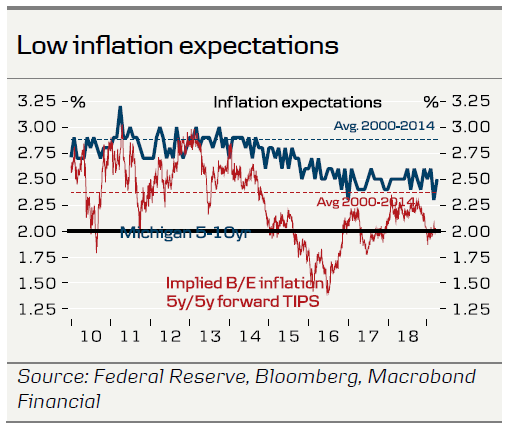
Fixed Income: The market has priced Fed on hold
The market is already pricing that the Fed will stay on hold at the March meeting and the market impact should be limited even if the Fed completely remove all hikes from the dots. Even if the pencil in one more hike during 2019 the market will probably ignore it for now. But if we are correct we might see a small bearish repricing of the US money market curve. The market is pricing some 5bp of rate cut in 2019 and a full 25bp rate cut in 2020.
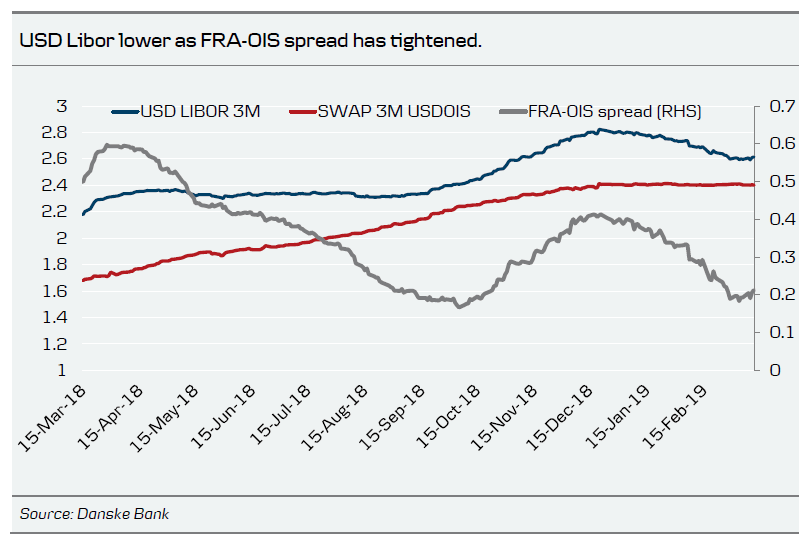
During 2019 we have seen the FRA-OIS spread (3M USD Libor – 3M OIS Swap) tightening some 20bp since mid-December 2018. It has helped pushing 3M USD Libor down from 2.82% to currently 2.61%. The lower 3M USD Libor has been a result of the market pricing an end to QT, as there is now less fear of a tight dollar liquidity situation in 2019 due to QT. Hence, if Fed does not announce an end to balance shrinking, as we expect, the FRA-OIS spread could widen again
USDJPY Loses Momentum As Trade Talks Continue
The March deadline for the US-China trade talks is likely to be extended with no clear outcome from the negotiations held so far. Reports from China showed that the vice- Premier, Liu He spoke to US Treasury secretary Mnuchin and with other trade representatives. Meanwhile, the Chinese premier retired the government's policies to support growth including tax cuts.
USDJPY Showing Exhaustion Near the Top
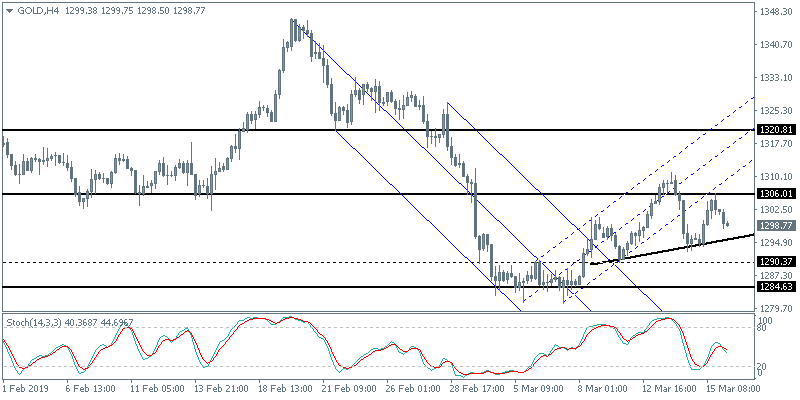
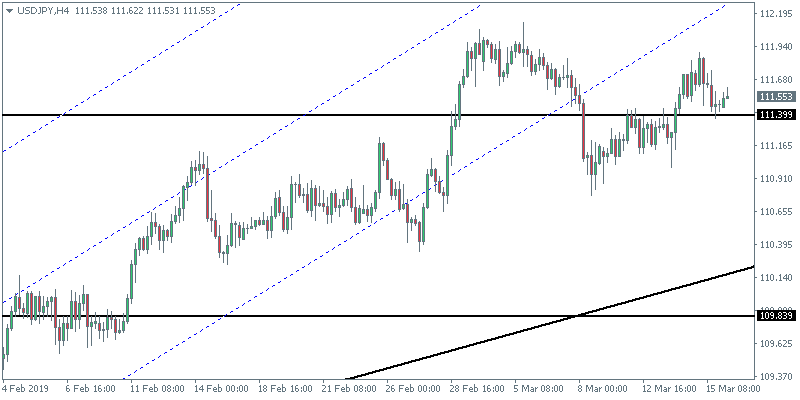
The USDJPY currency pair posted a rebound last week, and this sent prices briefly higher. However, failure to break past the March 5th highs at 112.13 resulted in the USDJPY posting a lower high. A follow through to the downside from here could put USDJPY at risk of retesting the lower support at 109.83. However, price will need to clear past the initial support at 111.40 level for the downside to be validated.
USDJPY Loses Momentum As Trade Talks Continue
The March deadline for the US-China trade talks is likely to be extended with no clear outcome from the negotiations held so far. Reports from China showed that the vice- Premier, Liu He spoke to US Treasury secretary Mnuchin and with other trade representatives. Meanwhile, the Chinese premier retired the government's policies to support growth including tax cuts.
USDJPY Showing Exhaustion Near the Top
The USDJPY currency pair posted a rebound last week, and this sent prices briefly higher. However, failure to break past the March 5th highs at 112.13 resulted in the USDJPY posting a lower high. A follow through to the downside from here could put USDJPY at risk of retesting the lower support at 109.83. However, price will need to clear past the initial support at 111.40 level for the downside to be validated.
EURUSD Forms A Double Top Pattern
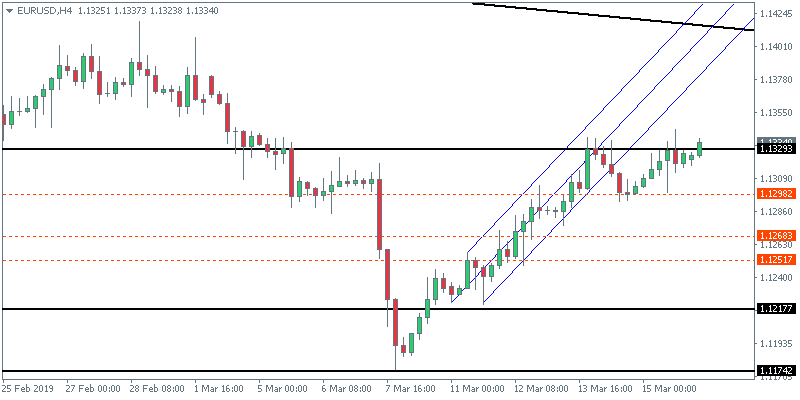
The euro posted modest gains on Friday as price action settled near March 13 highs of 1.1329, forming a double top pattern. The gains came as final inflation figures for February showed that consumer prices rose 1.5% on the headline. Meanwhile, core CPI rose 1.0% as seen from the flash estimates a few weeks ago.
EURUSD could extend lower
If the current double top pattern is validated, then a break down below 1.1289 could trigger declines in the common currency. The minimum downside objective is at 1.1268, but price could extend lower to retest support near 1.1251 level. This comes as various oscillators are singling a hidden bearish divergence giving support to the downside move.
GBP/USD Outlook: Stands At The Back Foot At The Beginning Of The Week, Weighed By Latest Brexit Comments
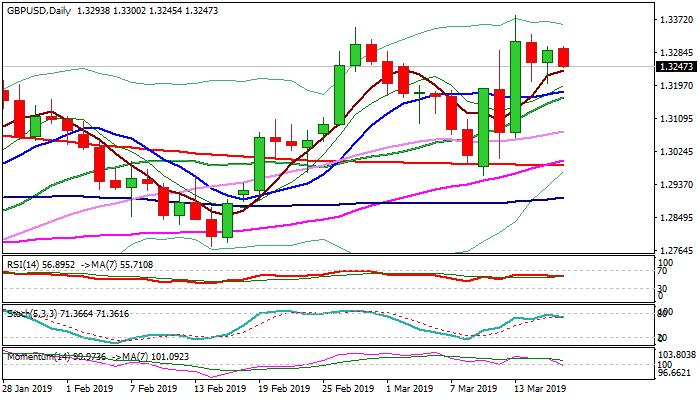
Cable fell to the session low at 1.3245 in early European trading on Monday, following tight range in Asia. The action at the beginning of the week was capped by 1.33 barrier, weighed by latest comments from British former Foreign Minister Johnson, who expressed his caution regarding the third vote on Brexit plan and suggested that there is enough time to work on real changes on PM May's plan. Sterling stands at the back foot, despite weaker dollar on soft US data on Friday, which raised concerns about dovish stance from Fed on Wednesday, with Brexit story being the key driver. Daily techs are losing momentum and point lower, which increases risk of retesting last Thu/Fri spike lows at 1.3207/02 (strong downside rejections) and extension towards pivotal supports at 1.3181/65 (converging 10/20SMA's) violation of which would signal deeper pullback from new 2019 high at 1.3381. Ability to hold above 1.32 handle would keep the price in extended consolidation, with bullish bias and the upside in focus. This scenario is supported by strong bullish signals, generated on weekly chart on close within weekly cloud and weekly bullish engulfing candle
Res: 1.3300, 1.3330, 1.3349, 1.3381
Sup: 1.3245, 1.3202, 1.3181, 1.3165
Dollar Softens As Fed Meeting Looms, Stocks Climb
- US stocks rally to six-month highs but perhaps on option expiries – implying some cause for caution
- Dollar retreats in a quiet session; looks to Fed meeting on Wednesday
- Sterling catches its breath ahead of potentially decisive week
US equities cruise to six-month highs on ‘quad witching’
In an otherwise quiet session, US stock markets rallied on Friday, with the benchmark S&P 500 (+0.50%) index breaking above a critical resistance zone around 2,820 that capped several rallies in recent months, to close at levels last seen in October. This, without any fresh catalyst or news. Second-tier US data released on the day were mixed, while incoming headlines were discouraging, with North Korea threatening to exit the nuclear talks and restart missile tests, for instance.
Indeed, considering also that US Treasury yields fell across the maturity spectrum, something typically associated with risk aversion, it seems the upbeat mood in stocks may have been owed mainly to positioning adjustments. Namely, Friday was a ‘quadruple witching’ day, where futures and options on stocks and indices all expire, often leading funds and money managers to recalibrate their exposure to equities. Hence, major moves can occur almost solely on flows, which implies some cause for caution as technical breaks recorded on such sessions – like the S&P’s – may not necessarily reflect investor sentiment, but rather some ‘forced’ rebalancing.
In this sense, the real test for the S&P 500 may be whether it can remain above the key 2820 area today, when things are back to ‘normal’.
Softer dollar, but otherwise all quiet in FX as traders await key events
In the currency market, there wasn’t anything standout, with most pairs remaining confined in relatively narrow ranges. The exception to this pattern was the US dollar, which surrendered ground against a basket of six major currencies on Friday and continues to retreat early on Monday, though admittedly, the magnitude of this move wasn’t massive either.
This week, the main event for the US currency will be the much-anticipated Fed policy decision on Wednesday, where markets will scrutinize by how much policymakers will revise down their rate-path projections. Specifically, will the new ‘dot plot’ keep a single rate increase in 2019 on the table, or will the median dot be marked down more severely to indicate no hikes at all? With market pricing now pointing to rate cuts this year, even signals for one rate increase could come as a ‘hawkish surprise’, and potentially put some wind back into the dollar’s sails.
Outside of the US, policy meetings by the Bank of England (BoE) and the Swiss National Bank (SNB) on Thursday, coupled with a flurry of crucial economic data out of all regions, should keep traders busy.
Pound catches its breath ahead of another Brexit chapter
After Cable soared to a fresh 9-month high, the British pound briefly moved out of the spotlight at the end of last week. That won’t last though, as this week brings several key events for sterling, both in the economic and political arenas. Besides the BoE meeting and several data releases, the Brexit process will also be back in the limelight, as PM May could make a third attempt of pushing her deal through Parliament, before the EU summit on Thursday.
Interestingly, reports over the weekend suggest she may avoid another vote altogether if it’s clear there’s no support for the deal, and that she could simply ask the EU for an extension. However, this may be a relatively bearish outcome for the pound in the near term, as May would probably only ask for a brief extension until June, keeping uncertainty heightened for a few more months. For the next leg higher to materialize, traders may need to see either a long extension that fuels hopes for another referendum, or UK lawmakers warming up to May’s deal.
The Greenback On The Retreat After Friday’s Weak Data
The US dollar was on the retreat yesterday and during today’s Asian session, as a number of soft data were released. Investors seem to expect that the soft data may dovishly affect the Fed’s interest rate decision, later this week. The USD weakness was also underscored by a drop of the 10 year treasury yield, which took off some of greenback’s shine. Analysts point out that market focus is now expected to be on how dovish the Fed will be sounding. We expect the USD to be data driven until the FOMC interest rate decision as well as by any statements of Fed officials. EUR/USD rose on Friday, testing the 1.1340 (S1) resistance line. We could see the pair maintaining a bullish outlook should the USD continue to weaken. Should the pair find fresh buying orders along its path, we could see it breaking the 1.1340 (R1) resistance line and aim for the 1.1390 (R2) resistance hurdle. Should on the other hand the pair come under the selling interest of the market, we could see it aiming if not breaking the 1.1300 (S1) support line.
Pound gets some support yet remains in check.
The pound got some support on Friday as markets seem to be relieved that a no deal Brexit could be avoided. It remains uncertain is UK’s PM Theresa May, can get her Brexit deal approved by the UK Parliament, hence any gains remained in check. May has only three days to win an approval before the EU summit and substantial pressure is being exercised on hard Brexiteers and the DUP. The main argument seems to include the possibility of a long delay of the Brexit date, and possibly taking part in the EU’s parliamentary elections. We expect volatility for the pound to continue in the coming week as Brexit anxiety escalates. Cable rose on Friday breaking the 1.3265 (S1) resistance line (now turned to support) and during today’s Asian session stabilised above it. We could see the pair prove volatile to any further Brexit developments and should positive headlines reel in, we could see the pair rising and aiming if not breaking the 1.3350 (R1) resistance line. Should the bears take over, we expect cable to break the 1.3265 (S1) support line and aim for the 1.3265 (S2) support barrier. Please be advised that volatility could be sudden, to either direction and high, always depending on Brexit developments.
Other economic highlights today and early tomorrow
In today’s European session we get Eurozone’s trade balance for January and just before Tuesday’s Asian session we get New Zealand’s Westpac Consumer Sentiment for Q1. In tomorrow’s Asian session, we get Australia’s House Price Index for Q4 and the minutes of RBA’s last meeting will be released. As for speakers, RBA’s assistant governor Kent will be speaking.
As for the week ahead:
On Tuesday we get the UK employment data for January, Germany’s ZEW economic Sentiment for March and the US Factory orders for January. On Wednesday UK’s inflation data for February are due out while at the same time the UK Parliament will be having another vote on Brexit, the FOMC is to release its interest rate decision and New Zealand’s GDP for Q4 is due out. On Thursday we get from Australia the employment data for February, from Switzerland the SNB interest rate decision, from Norway the Norgesbank interest rate decision, from the UK the retail sales growth rates for February and BoE’s interest rate decision, from the US the Philly Fed Mfg Index for March and from the Eurozone the Consumer Sentiment for March. Also be advised that on Thursday the EU summit will be starting and could affect the pound substantially. On Friday, we get Japan’s CPI rates for February, Germany’s preliminary Mfg PMI and Eurozone's preliminary Composite PMI, both for March, while from Canada we get the inflation data for February and the retail sales growth rate for January.
GBP/USD
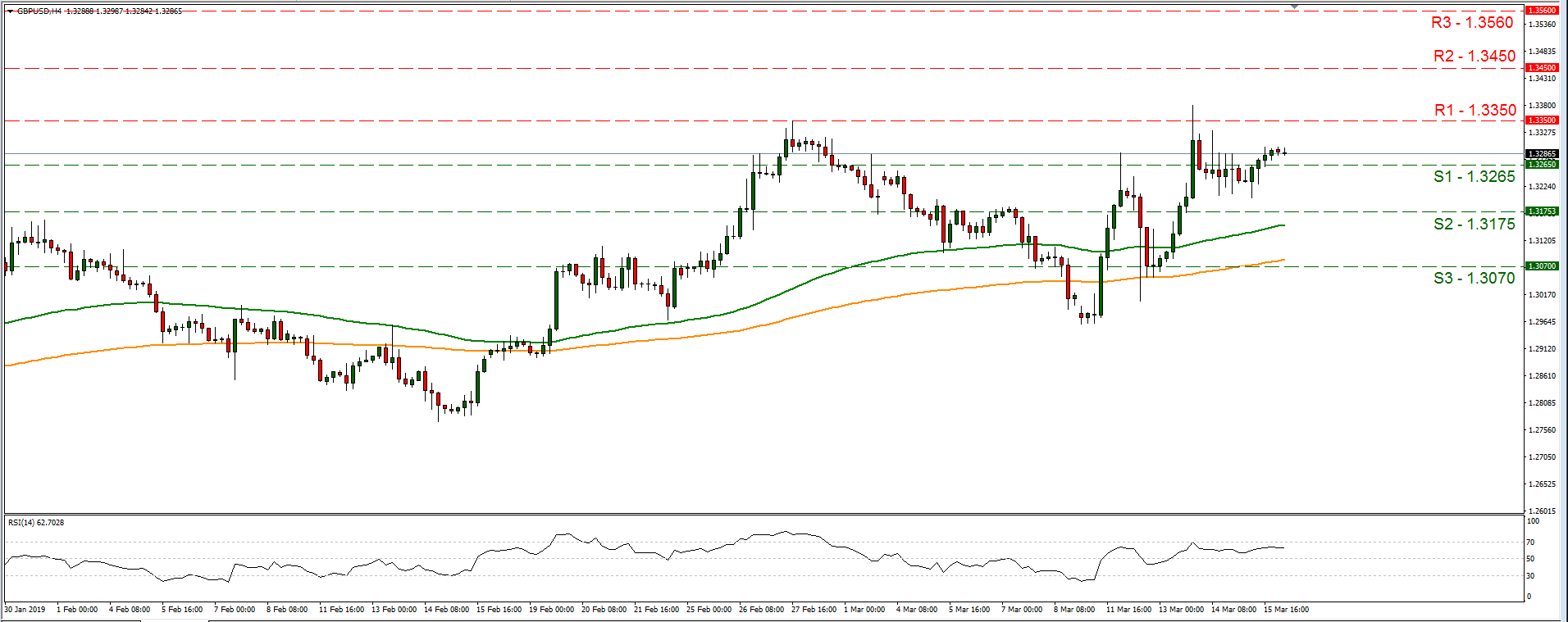
Support: 1.3265 (S1), 1.3175 (S2), 1.3070 (S3)
Resistance: 1.3350 (R1), 1.3450 (R2), 1.3560 (R3)
EUR/USD H4
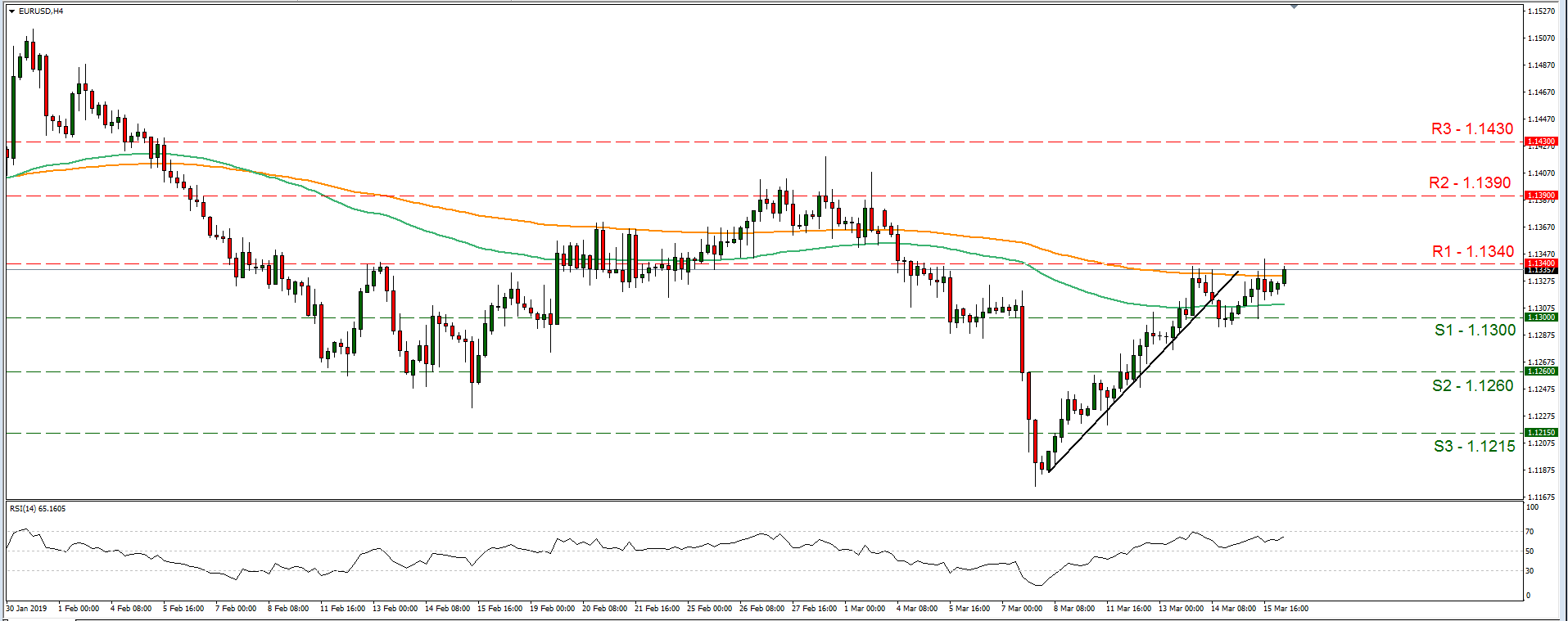
Support: 1.1300 (S1), 1.1260 (S2), 1.1215 (S3)
Resistance: 1.1340 (R1), 1.1390 (R2), 1.1470 (R3)
Currencies: Dollar Trading With A Soft Bias Going Into Wednesday’s Fed Decision
Rates: Focus on Fed meeting
Markets might be paralyzed ahead of Wednesday's FOMC verdict. A dovish outcome is expected which should keep US yields under modest downward pressure. The US 10-yr yield lost 2.61% intermediate support. The Belgian debt agency holds its first regular bond auction of the year following two successful syndications.
Currencies: Dollar trading with a soft bias going into Wednesday's Fed decision
This morning's price action suggests a continuation of last week's trends. Declining yields and a soft dollar support a positive risk-on bid on global markets. EUR/USD is trending further off the 1.12 range bottom. Sterling shifted to a wait-and-see modus as a next set of key Brexit event risks are lining up.
The Sunrise Headlines
- US stocks finished a strong week in green last Friday, registering gains ranging from 0.50% (S&P) to 0.76% (Nasdaq). Asian equities start this week on positive footing with China outperforming (+1.75%).
- Rating agency S&P has raised Portugal's rating from BBB- to BBB with a stable outlook, citing the country's steady economic growth and primary budget surpluses that keep the debt to GDP ratio “on a firm downward path”.
- Saudi Energy Minister Al-Falih said OPEC(+)'s job in restoring the oil market is “nowhere near complete” as the risk of oversupply in the short term is still present. Oil production curbs are to remain in place at least until May/June.
- Theresa May will meet with Tory rebels and the Northern Irish DUP. May seeks support for her beleaguered brexitdeal which she is to put for another (third) vote, possibly tomorrow, but only if there's a decent chance to get approved.
- Slovakia's first round of the presidential elections has resulted in a resounding victory for liberal lawyer Zuzana Caputova (40.6%). She is to face Smer-backed Sefcovic, who came in second (18.7%) in the next round in 2 weeks.
- The ECB is deeply concerned about the EU asserting power over clearing houses supervision, saying it strips them from powers to safeguard the houses' functioning which has a direct impact on bank's lending capacity..
- Today's economic calendar is little inspiring. The US publishes NAHB's housing market confidence. Belgium taps the bond market. Given the scant data we expect investors to focus on Wednesday's Fed meeting
Currencies: Dollar Trading With A Soft Bias Going Into Wednesday's Fed Decision
USD caution prevails as market await Fed decision
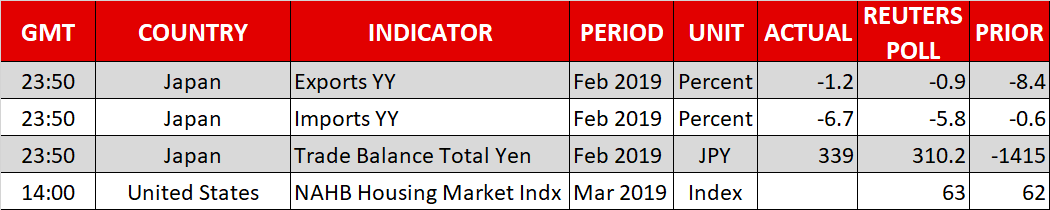
The EUR/USD quite easily retained most of its weekly gain on Friday. Initially, the EUR/USD rebound took a breather even as sentiment on risk remained positive. US data were mixed. The Empire manufacturing survey and production data disappointed. Michigan consumer confidence was solid. Still US yields tested/drifted below technical support levels and the dollar turned back south. EUR/USD again tested last week's peak levels in the 1.1340+ area (close at 1.1326). USD/JPY struggled not to fall below the 111.50 area (close at 111.48). This morning, Asian equities are taking a positive start to the week, with China outperforming. We didn't see any specific reason. Japanese exports (and imports) disappointed in February but didn't affect regional sentiment in a profound way. Expectations for a soft Fed (reducing its projected rate hikes on Wednesday) supports global risk taking. USD/JPY is little changed in the 111.55 area. EUR/USD is gaining a few ticks and is again changing hands the 1.1335 area. The global risk-on context and an improving sentiment on China also propelled the Aussie dollar this morning. AUD/USD regained the 0.71 handle. The EMU eco calendar is thin today. In the US, the NAHB housing index is interesting, but is no high profile market mover. It rebounded since the December dip, but the picture is still a bit fragile. A further loss of momentum might be seen as reinforcing the case for the Fed to keep a wait-and-see approach. There are few important data in EMU or the US before the Fed decision. German ZEW confidence is the exception to the rule. Brexit remains a source of global/euro uncertainty.
Last week, EUR/USD traders soon forgot the soft message from the ECB March meeting. EUR/USD profited from an improving risk sentiment. The risk-on and the EUR/USD rebound was at least partially supported by expectations on a soft Fed at this week's meeting. This morning's price action only confirms investors USD/caution ahead of Wednesdays Fed meeting. The technical picture for EUR/USD become more stable The 1.12 range bottom survived. Any further sustained rebound needs better EMU data. As long as the EMU eco picture remains foggy, more EUR/USD consolidation might be in the cards (1.12/1.14 area).
On Friday, sterling entered calmer waters as a series of key votes were out of the way. Still, sterling remained will bid given the high degree of uncertainty that still persists on the next steps in the brexit process. This week, UK PM May might still try to get her deal approved. Later she will probably ask for a brexit delay at the EU summit. We don't expect the brexit process to be clarified anytime soon and stay cautious on sterling. The 0.8490/0.85 area might become a ST floor for EUR/GBP.
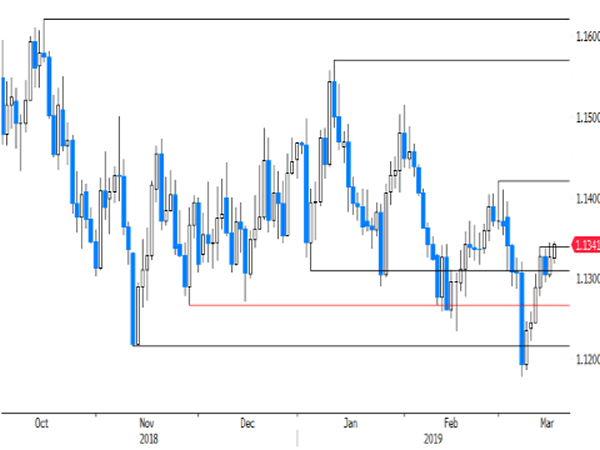
EUR/USD: Dollar softness prevails ahead of Wednesday's Fed decision