Sample Category Title
Pound Swings Wildly On May’s Brexit Defeat, More Votes To Come
- Pound edges up, recovering from earlier sharp losses, as UK Parliament expected to vote against no-deal Brexit
- May's yet another historic defeat leads equities into risk-off mood; global growth concerns and Boeing slump also weigh
- Aussie slips on weak consumer confidence
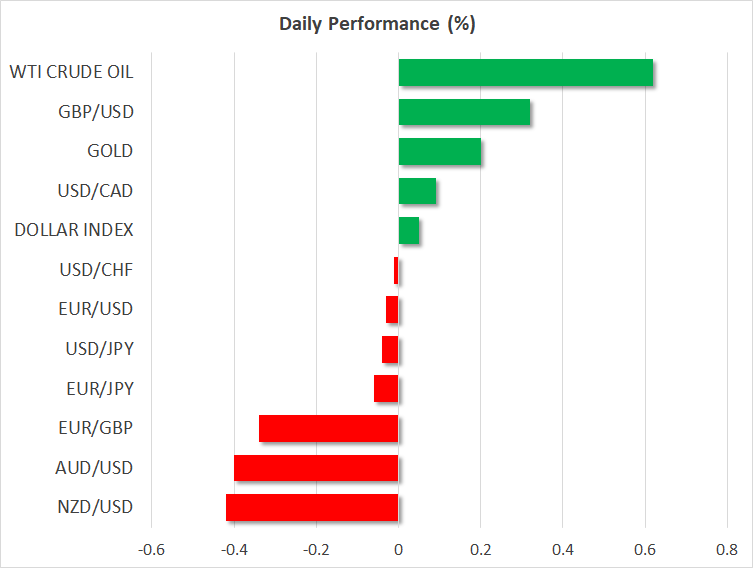
Sterling likely to remain volatile as British MPs to vote on no-deal and delaying Brexit
After rallying sharply to a high of $1.3288 yesterday, the pound dramatically reversed lower, hitting a low of $1.3003 as it became apparent that UK prime minister, Theresa May, was on course to suffer another crushing defeat on her Brexit deal. In a second meaningful vote on the deal, May lost by 391 to 242 votes – not as bad as the first vote but still one of the worst defeats by historical standards. Brexiteer Conservatives decided not to back the revised Withdrawal Agreement after the UK's attorney general said there was still a risk the UK could be stuck in the Irish backstop arrangement indefinitely despite the ‘legally binding' assurances May negotiated with the European Union at the last minute on Monday.
Having plunged the country deeper into a political crisis, Parliament will face another crucial vote today as MPs will get to decide whether they want to take a no-deal scenario off the table, which could tie the government's hands in the negotiations. Expectations are that lawmakers will reject leaving the EU without a deal, and this has helped the pound to recover back above the $1.31 handle. The vote is anticipated to take place around 1900 GMT. If MPs vote down a no-deal option, there will be another vote on Thursday on whether to extend Article 50 and delay Brexit.
Dollar on the backfoot after muted US inflation data
A softer US dollar was of some support to the euro and the pound amid the Brexit drama. The euro briefly topped the $1.13 level before easing to around $1.1285. Against the yen, the greenback kept to tight ranges, hovering around 111.25, but the dollar index was unable to hold onto the 97.0 level and last stood at 96.95.
Lower Treasury yields pressured the US currency on Tuesday, which fell on the back of weaker-than-expected inflation numbers. The US consumer price index declined to 1.5% on an annual basis in February, missing forecasts of 1.6% and reinforcing the view that the Fed will remain in ‘patient' mode for the foreseeable future.
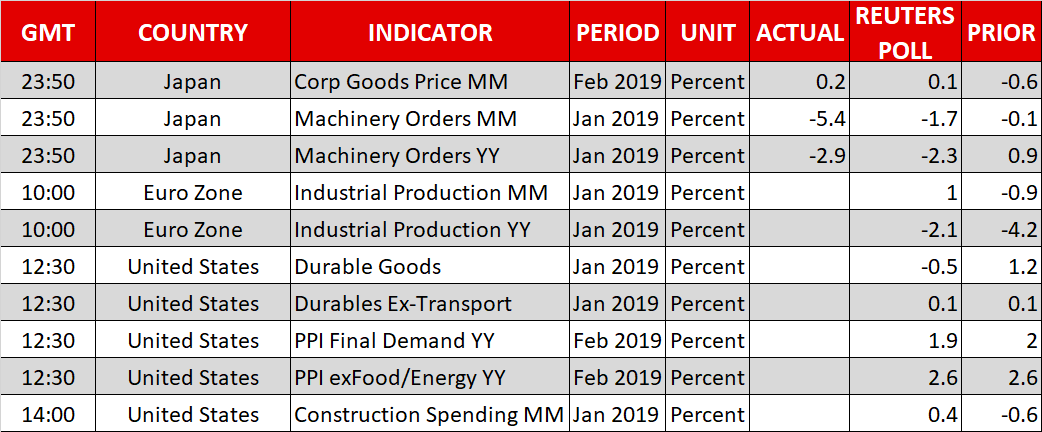
Durable goods orders will be the next US data to come under the spotlight. The January report is due at 1230 GMT.
Global equities back in the red
The muted inflation picture and expectations of a dovish Fed lifted Wall Street on Tuesday, with the exception of the Dow Jones, which was dragged lower by Boeing shares. The company's stock plunged after several countries banned its 737 Max aircraft following the second crash with the model in five months.
Japan's Nikkei 225 index also fell sharply after machinery orders – a closely-watched business spending gauge – unexpectedly slumped in January, heightening global growth fears. Major indices in Europe were mixed at the open on Wednesday, awaiting further developments in the Brexit saga and the US-China trade negotiations.
Aussie under pressure from RBA rate cut bets
Higher commodity prices were of little help to the Australian dollar, which slipped on data showing consumer confidence in Australia fell to the lowest since 2015 according to a widely viewed survey by Westpac. The aussie declined to around $0.7060 as the data bolstered expectations of an RBA rate cut later this year.
The aussie's weakness came despite a small bounce in commodity prices, with both oil and gold moving higher this week.
XAUUSD Intraday Analysis
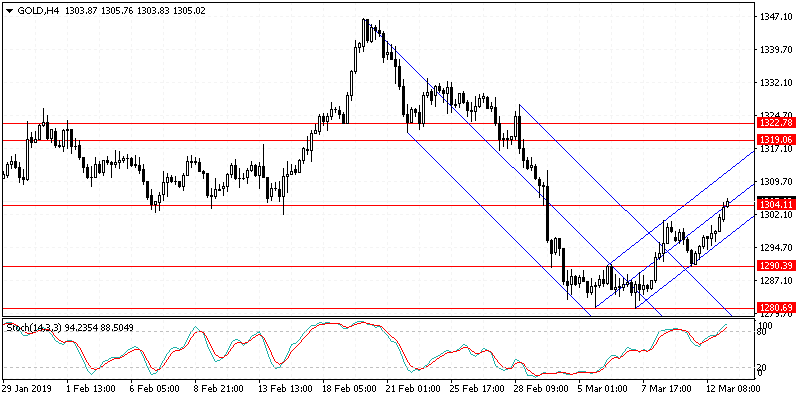
XAUUSD (1305.02): Gold maintained the gains on Tuesday as price action advanced to test 1305 level earlier today. The Stochastics oscillator is maintaining the hidden bearish divergence currently and could trigger a possible move to the downside. The lower support at 1290.39 could be tested more firmly if there is a reversal at the 1305 – 1306 level. If gold maintains the bullish momentum, we can expect the 1305 – 1306 level to clear, with further gains likely to push gold prices to the 1322 – 1319 level. There, resistance will be tested.
USDJPY Intraday Analysis
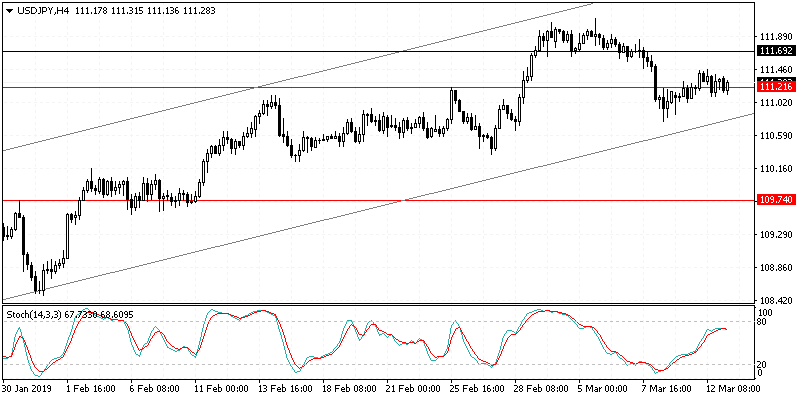
USDJPY (111.28): USDJPY has been trading subdued with a lot of consolidation taking place at the 111.21 level. Price action remains flat in the short term as the USD attempts to test the next main resistance level at 111.69. Price needs to break past this level and above the previous highs to maintain the bullish momentum. However, failure to do so could signal a possible move to the downside. A break down below the lows of 110.93 could signal a move towards the 109.74 region in the medium term.
EURUSD Intraday Analysis
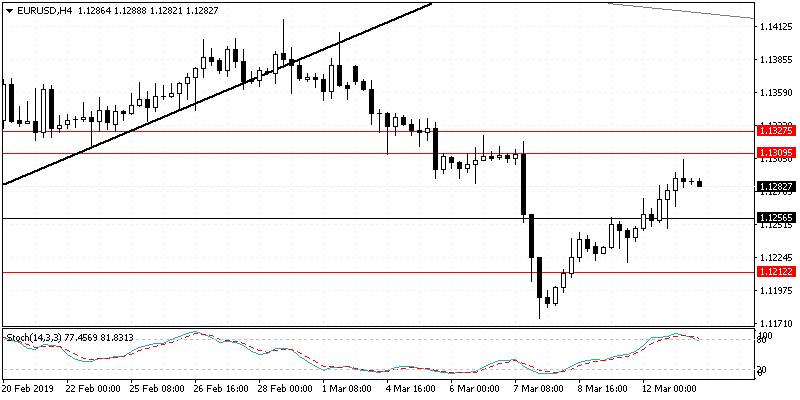
EURUSD (1.1282): The EURUSD currency pair continued its bullish reversal with prices advancing for the third daily session. Having cleared the minor resistance level at 1.1256, the common currency closed above this level. It is now nearing a retest of the next main resistance at 1.1327 – 1.1309. In the near term, any declines could be limited to 1.1256 where we could establish support. As long as the support level at 1.1256 is not breached, the EURUSD could maintain the bullish momentum.
Gold Maintains Gains As Brexit Uncertainty Continues
UK Data
Economic reports from the UK showed that the GDP rose 0.2% in the three months to January. On a quarterly basis, the economy picked up the pace, rising 0.5%. The gains came from an increase in IT, health services and wholesale trading. This offset the declines from manufacturing in metals, cars and construction repairs.
Manufacturing production rose 0.8% on the month beating estimates of a 0.2% increase. The gains came from increased output in the pharmaceuticals industry and followed a 0.7% decline.
Industrial production grew 0.6% from December after falling 0.5% previously. The data also beat estimates. The services output rose 0.3% while construction output grew 2.8% and reversed the declines from December.
Investors, however, overlooked the data as the UK parliament once again rejected the Brexit deal despite initial optimism. The Brexit bill was defeated by a majority of 142, with 391 members rejecting the deal and 242 approving it.
In the US, data from the Bureau of Labor statistics showed that February's headline inflation rose 0.2% as expected. This pushed down the annual inflation rate from 1.6% to 1.5% in February. Core CPI, excluding food and energy prices, rose 0.1%. This was the smallest increase since August last year.
Today's Schedule
The economic data today will see the release of the UK's annual budget. We now await the UK parliament to hold another vote on a no-deal Brexit later in the day.
Economic docket from the eurozone is quiet today. The NY trading session will see the release of durable goods orders. Core durable goods are forecast to rise 0.1% on the month. Meanwhile, headline durable goods orders are expected to fall 0.5% on the month.
The US PPI report is on the tap as well. Expectations are for headline producer prices to rise 0.2% after falling 0.1% previously. Core PPI will likely rise 0.2%, marking a slightly smaller pace of increase following a 0.3% increase the month before.
Forecasts indicate that construction spending data could rise by 0.4% on the month after falling 0.6% previously.
Currencies: EUR/USD Rebounds, Partially On USD Softness
Rates: US 10-yr yield tests 2.61% support
The US 10-yr yield is extensively testing 2.61% intermediate support following disappointing eco data and a strong 10-yr Note auction. A drop below this level suggests a return to the key 2.5% area. Eco data and supply suggest more outperformance of US Treasuries today.
Currencies: EUR/USD rebounds, partially on USD softness
EUR/USD rebounded further off the 1.12 support yesterday. This move was partially driven by soft US CPI data. However, last week's post-ECB euro negativism is also fading. The data in EMU and the US might be mixed to tentatively EUR/USD supportive today. Sterling suffered a moderate setback as the outcome of the Brexit process remains highly uncertain
The Sunrise Headlines
- US equity markets printed mixed yesterday with gains/losses varying between -0.38% (DJI) and +0.44% (Nasdaq). Asian equities are mixed with Japanese and Chinese indices underperforming.
- UK Parliament has largely rejected PM May's Brexit proposal again, with a vote of 391 to 242. Parliament will now vote on a no-deal withdrawal later today. If that is voted down too, a 3rd vote to extend Article 50 will take place tomorrow.
- US Trade Representative Robert Lighthizer warned US-Sino trade negotiations are at risk of failing, speaking to the Senate finance committee. He said “major, major issues” still needed to be resolved before an agreement can be reached.
- Italian PM Conte reassured that the Chinese 'Belt and Road' initiative in Italy is purely a business opportunity for the country. He said the proposition doesn't create legal obligations and pledged maximum attention on China telecoms.
- Japanese producer inflation rose 0.2% (M/M) in February after the -0.6% (M/M) decline in January and more than consensus (+0.1%). Core machine orders dropped -5.4% (M/M) in January, down from -0.1% in December.
- Australian consumer confidence declined -4.8% (M/M) in March, compared to the 4.3% increase of February. The Westpac Consumer conf. Index sharply declines to 98.8 in March vs. 103.8 in February. AUD loses limited ground.
- Today's US eco calendar contains February producer inflation data and January durable goods orders. The EMU prints January Industrial Production. ECB's Coeuré speaks and the US, Germany, Italy and Portugal tap the market
Currencies: EUR/USD Rebounds, Partially On USD Softness
EUR/USD rebounds off 1.12 support
EUR/USD showed some intraday swings yesterday, but the euro held an upward bias moving further away from the 1.12 support. Early in the session, the euro profited from the risk on due to the 'Brexit deal' between the EU and the UK. Later, the focus turned to soft US inflation data cementing expectations for the Fed to stay firmly on hold. They resulted in lower US yields and a modest USD decline. Remarkable, despite a flaring up of potential Brexit chaos, EUR/USD outperformed other major currencies against the dollar. EUR/USD closed at 1.1288. USD/JPY was less affected by the USD softness and closed at 111.36. Overnight in Asia, the risk rebound from earlier this week slowed. There were no important enough data to fuel investor hope that the global growth slowdown might be easing. The headlines on the (US-China) trade talks are mixed signals. Japan Machine orders disappointed and so did Australian consumer confidence. The Aussie dollar is losing a few ticks (AUD/USD 0.7050 area). USD/JPY (111.30) is trading little changed, EUR/USD is holding in the high 1.12 area.
The EMU January production, the US PPI and orders for durable goods will be published today. EMU production data are expected to rebound. The figure is a bit outdated. Even so, a constructive report might support the view that a cautious bottoming might be starting in EMU. In the US, market expectations for the durables are not that high, but PPI might be soft. Global sentiment and Brexit remain wildcards. At least yesterday, Brexit uncertainty didn't hurt the euro much. Earlier this week, the EUR/USD picture was rather cautious/diffuse as it is influenced both by domestic EMU related issues (ECB etc.) and by market sentiment on global growth. This week, post-ECB euro negativism eased. Sentiment on the dollar softened as markets look forward to next week's Fed meeting. The 1.12 range bottom is still close but looks again more solid. The euro has still no prospect on interest rate support anytime soon. However, better EMU eco data might moderate the euro negative sentiment. Sterling initially profited from the last minute EU-UK Brexit deal yesterday. However, GBP positivism evaporated as the advice from UK Attorney General Cox indicated that the deal would still be unacceptable for brexiteers. This was exactly what happened in the meaningful vote. EUR/GBP closed at 0.8650. Today, UK Parliament will vote whether or not to reject a no-deal Brexit. A rejection might be marginally supportive for sterling, but visiblity on the next poltical steps remains extremely low. We don't frontrun on positive news and stay cautious on sterling.
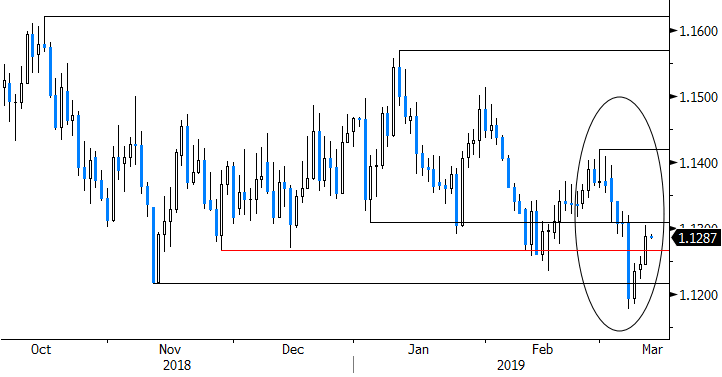
EUR/USD: rebounds from 1.12 range bottom, partially on USD softness
Brexit Crisis: No Deal Brexit Or Delay Brexit
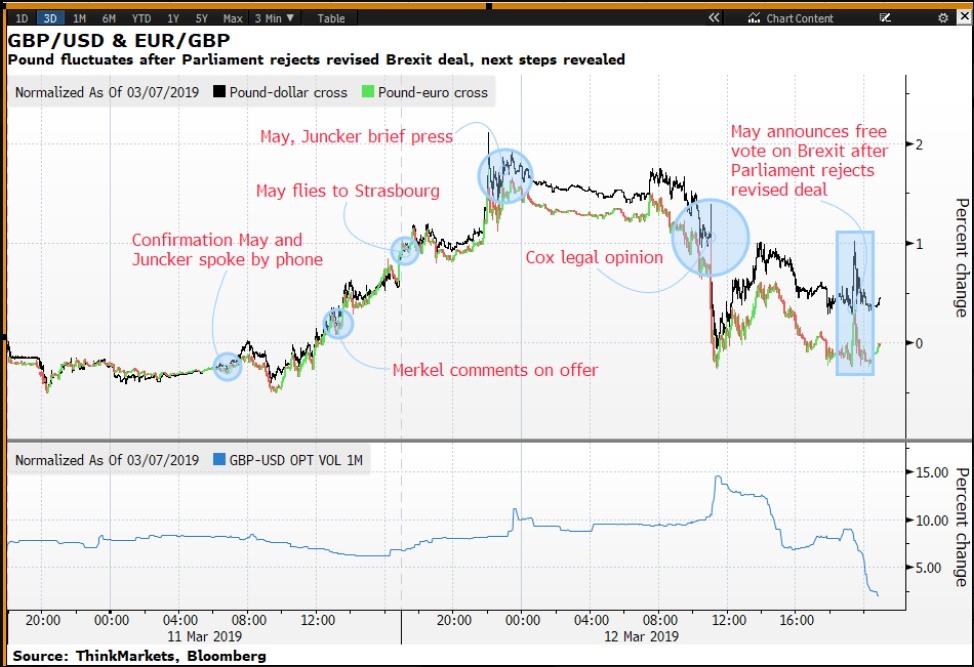
Theresa May, the British Prime Minister suffered another humiliating defeat in the parliament again yesterday. Her new deal, “legally binding”, was thrown out of the window by the British lawmakers. This created huge whipsaws for Sterling-dollar and Euro-Sterling pair. To put things in perspective, Sterling-dollar was trading at 1.3237 at 07:45 AM London time and it dropped 1.3010 at 11:15 AM, that is over 200 pip move in only a matter of a few hours. The below chart shows the journey for the sterling-dollar and Euro-sterling in terms of their percentage gain as the events unfolded yesterday. The most dramatic change is in the one-month volatility for Sterling-dollar which literally plunged yesterday.
So, how bad the defeat was for May?
The MPs in the parliament were clear that they had enough of Theresa May and her set of tactics are no longer going to work anymore. She has wasted two solid years and achieved nothing in this period. Thus, the result confirmed that her failure for the Brexit vote by 149 votes. The devastating fact for her is that 75 Conservative MPs voted against her deal.
What Now?
Later today, at 7 pm London time, the MPs will vote if they are going to take the scenario of a no deal Brexit off the table completely. Markets have certainly priced this as a positive outcome of this vote. This is the chief reason that we have not seen the intense sell off for sterling yesterday when the prime minister agonized a defeat. It could be true that market participants are completely oblivious. Perhaps, maybe they are getting ahead of themselves. This is because if no-deal Brexit becomes the reality, it would bring an unprecedented catastrophe for the markets.
Voting for a no deal Brexit would open the door for the extension of Article 50. In other words, the Brexit would be delayed. There are a number of issues with this. First of all, there is no clarity how long the extension would be, and most importantly, if the EU would be open to the option of renegotiation.
The fact is that today’s no deal Brexit vote isn’t that simple. There are some critical elements need to be taken care off before a no deal Brexit vote becomes a reality. Remember, the EU also need to agree with such an outcome, and we know that they are playing hardball with the UK, making sure the UK value any concession it gets from the EU. Jean Claude Juncker, the EU Commissioner has made it clear that he is no mood to re-open the negotiation process. He has also warned that a no deal Brexit is a high probability scenario, again something which the market is completely ignorant of. But anything coming out of politicians’ mouth should always be taken with a pinch of salt, they mostly do not follow what they say.
The Same Hole Again
The issue with the delay of Brexit is that we could be looking at the same hole in a few weeks or months. There is no assurance that another few months are going to resolve this issue given that the politicians have not achieved anything in the past two years.
It is this particular factor which I think the market participants are largely undermining. Kicking the can down the road doesn’t really resolve anything for this matter.
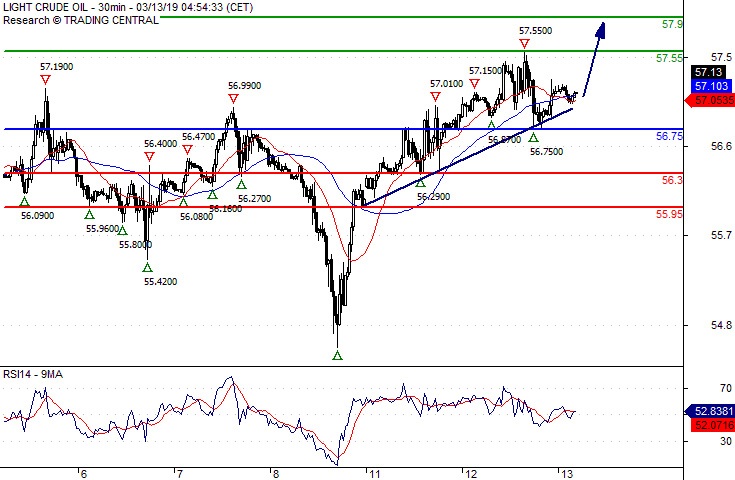
Crude Oil The Bias Remains Bullish
Pivot (invalidation): 56.75
Our preference Long positions above 56.75 with targets at 57.55 & 57.90 in extension.
Alternative scenario Below 56.75 look for further downside with 56.30 & 55.95 as targets.
Comment The RSI lacks downward momentum.
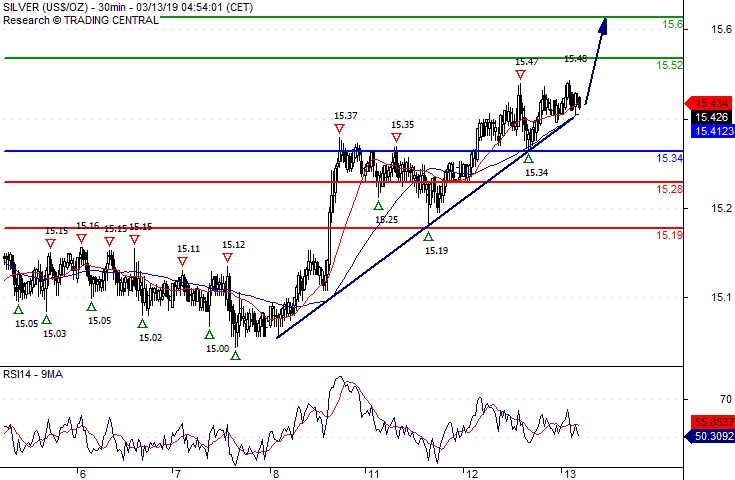
Silver Spot Supported By A Rising Trend Line
Pivot (invalidation): 15.3400
Our preference Long positions above 15.3400 with targets at 15.5200 & 15.6000 in extension.
Alternative scenario Below 15.3400 look for further downside with 15.2800 & 15.1900 as targets.
Comment The RSI lacks downward momentum
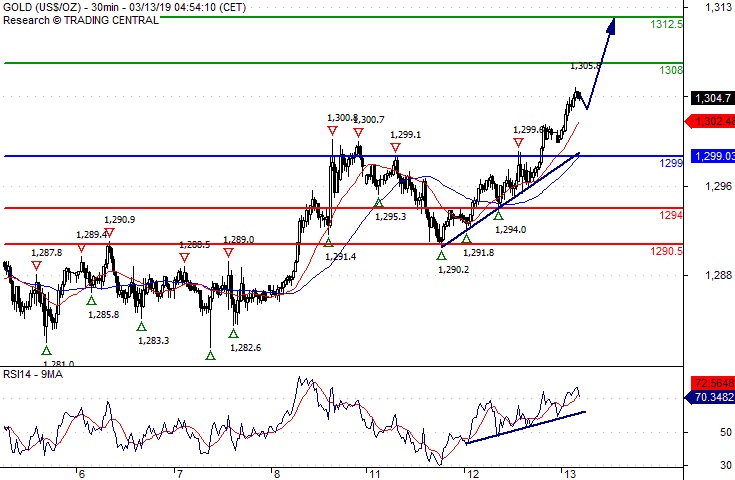
Gold Spot Towards 1312.50
Pivot (invalidation): 1299.00
Our preference Long positions above 1299.00 with targets at 1308.00 & 1312.50 in extension.
Alternative scenario Below 1299.00 look for further downside with 1294.00 & 1290.50 as targets.
Comment The RSI advocates for further upside.