

Sample Category Title
USD/JPY Mid-Day Outlook
Daily Pivots: (S1) 111.15; (P) 111.31; (R1) 111.51; More...
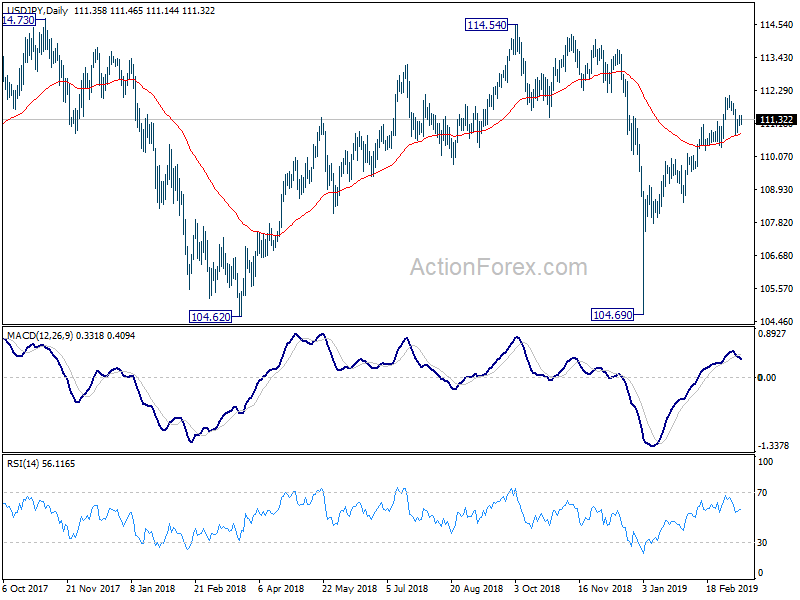
No change in USD/JPY's outlook as it's staying in consolidation in range below 112.13. Intraday bias remains neutral first. As long as 110.35 support holds, near term outlook remains bullish and rise from 104.69 is still in favor to resume. On the upside, break of 112.13 will target 114.54 resistance next. However, firm break of 110.35 should confirm near term reversal and turn outlook bearish for 108.49 support and below.
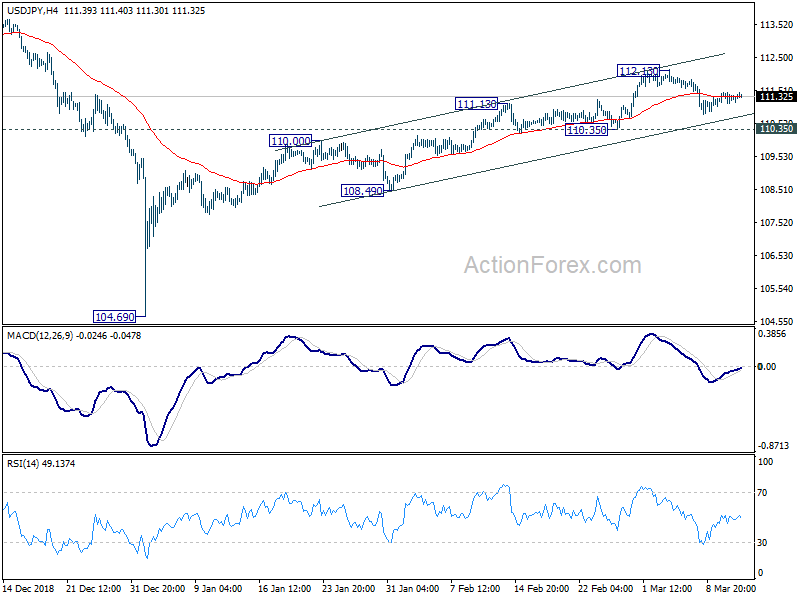
In the bigger picture, strong rebound from 104.69 argues that decline from 118.65 (2016 high) has completed with three waves down to 104.69, after failing 104.62. More importantly, the rise from 98.97 (2016 low) could be resuming. Decisive break of 114.54 resistance will add more credence to this bullish case and target 118.65. This will now be the favored case as long as 110.35 support holds. However, firm break of 110.35 will mix up the medium term outlook again and turn focus back to 104.69 low.
USD/CAD Mid-Day Outlook
Daily Pivots: (S1) 1.3332; (P) 1.3375; (R1) 1.3398; More...
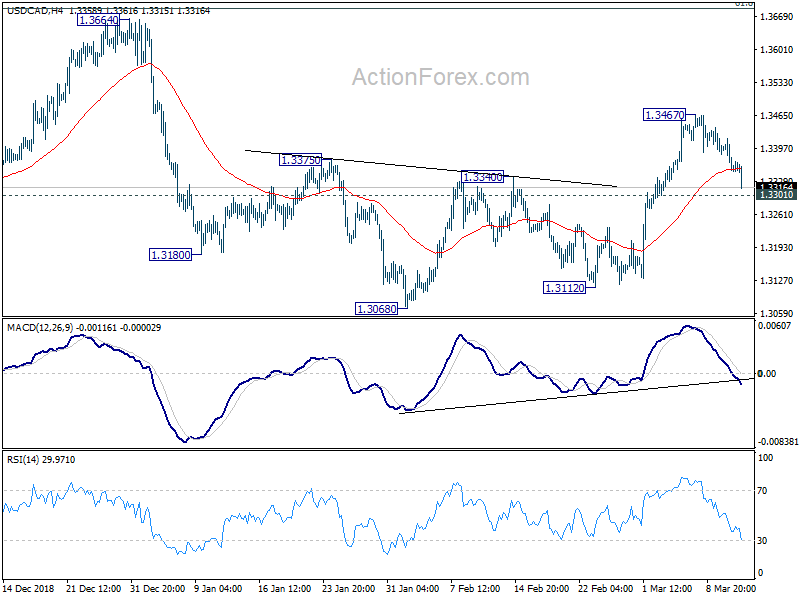
USD/CAD drops sharply today but stays above 1.3301 minor support. Intraday bias remains neutral first. As long as 1.3301 holds, we'd still expect another rally. Break of 1.3467 will resume the rise from 1.3068 to retest 1.3664 high. However, decisive break of 1.3301 will suggest that such rebound from 1.3068 has completed with three waves up to 1.2467. That will carry larger bearish implications and should turn bias to the downside for 1.3068/3112 key support zone.
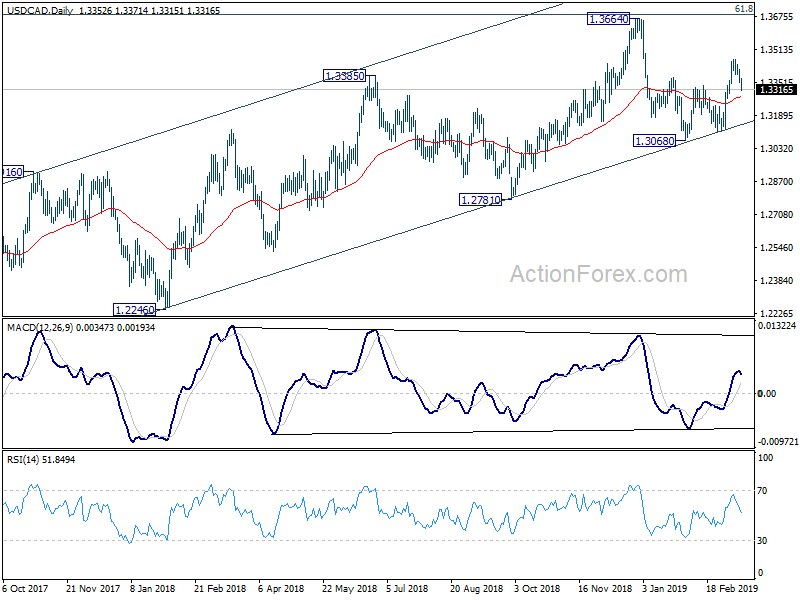
In the bigger picture, structure of the medium term rise from 1.2061 (2017 low) to 1.3664 is not clearly impulsive. Hence, we'd stay cautious on strong resistance from 61.8% retracement of 1.4689 (2016 high) to 1.2061 at 1.3685 and 1.3793 resistance to limit upside, and bring medium term topping. But in any case, medium term outlook will stay bullish as long as channel support (now at 1.3139) holds. Sustained break of 1.3793 will pave the way to retest 1.4689 (2015 high). Firm break of the channel support should confirm reversal target 1.2061 low again.
Canadian Dollar Jumps as WTI Crude Oil Breaks 58, Sterling Firmer ahead No-Deal Vote
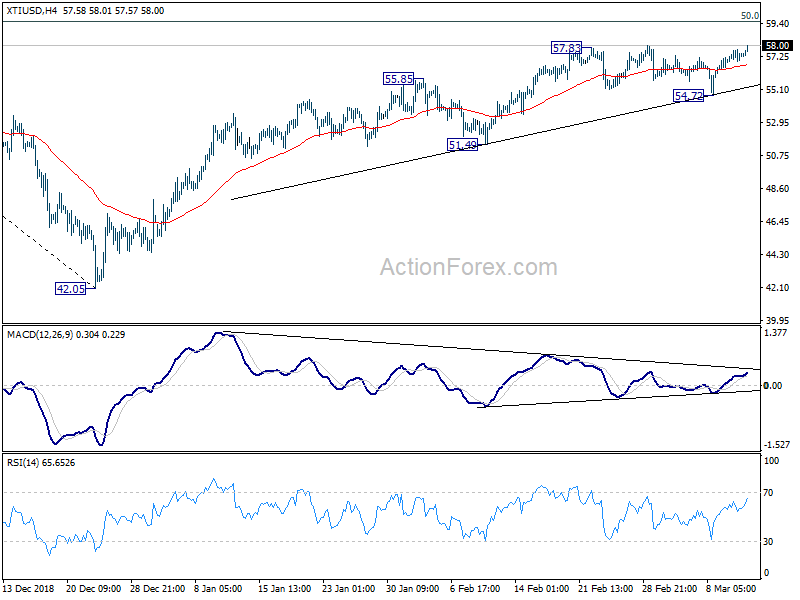
The financial markets are pretty directionless and traders await vote on no-deal Brexit in the UK parliament. Sterling remains the strongest one for now on recovery. But upside is limited below near term resistance against other major currencies. That is, the Pound is merely gyrating in recently established range. Canadian Dollar follows as the second strongest, as WTI crude oil jumps to as high as 58.01, resuming recent up trend. Nevertheless, other commodity currencies are left behind with New Zealand and Australian Dollar as the weakest ones.
Technically, an immediate focus will be on 1.3301 in USD/CAD. Break there will dampen the original view of bullish reversal. Instead, that will signal that USD/CAD has completed recent rebound from 1.3068 and deeper fall could be seen back to 1.3112 support. GBP/USD, EUR/GBP and GBP/JPY staying in familiar range. We're expecting sustained breakout today, unless UK votes for no-deal Brexit.
In other markets, FTSE is currently up 0.21%. DAX is up 0.02%. CAC is up 0.50%. German 10-year yield is up 0.015 at 0.068. Earlier in Asia, Nikkei dropped -0.99%. Hong Kong HSI dropped -0.39%. China Shanghai SSE dropped -1.09%. Singapore Strait Times dropped -0.52%. Japan 10-year JGB yield dropped -0.0151 to -0.045.
US PPI rose 0.1% mom, 1.9% yoy in February, versus expectation of 0.2% mom, 1.9% yoy. Core PPI rose 0.1% mom, 2.5% yoy, versus expectation of 0.2% mom 2.6% yoy. Durable goods orders rose 0.4% in January, above expectation of -0.5%. Ex-transport orders dropped -0.1%, below expectation of 0.1%.
EU Verhofstadt against even 24-hour Brexit extension
UK Parliament is set to vote on no-deal Brexit today at 1900GMT, which will likely be rejected. Then there will be another vote tomorrow for seeking Article 50 extensions. Responses from the EU so far are not very positive regarding an extension.
The European Parliament's lead Brexit spokesman Guy Verhofstadt warned that he would oppose to even 24-hour extension. He said " I am against every extension, whether an extension of one day, one week, even 24 hours, if it is not based on a clear opinion of the House of Commons for something, that we know what they want." Verhofstadt also warned that "An extension, where we go beyond the European elections, and the European elections will be hijacked by the Brexiters, and by the whole Brexit issues. We will talk only about that, and not about the real problems, and the real reforms we need in the European Union."
EU chief Brexit negotiator repeated his question that "extend this negotiation — what for?" And he reiterated that "if the UK still wants to leave the EU in an orderly manner, this treaty is — and will remain — the only treaty possible". Barnier also told the European parliament that "We are at a critical point. The risk of no-deal has never been higher. That is the risk of an exit - even by accident - by the UK from the EU in a disorderly fashion. I urge you please not to under-estimate the risk or its consequences."
Germany's Economy Minister Peter Altmaier expressed said After divisive debates & votes, today can become a turning point." "Rejecting No-deal-Brexit by a large cross-party majority will unite millions in the UK & in Europe."
European Union's Economic Commissioner Pierre Moscovici said "we have done everything we could do." And, "it is tome now for the British to say what they want, now that they said what they don't want."
UK announces modest liberalization of tariffs in case of no-deal Brexit
The UK government announces its temporary tariff regime for no-deal Brexit, designed to minimise costs to business and consumers while protecting vulnerable industries. The temporary regime would apply for up to 12 months as a full consultation and review on a permanent approach to tariffs is undertaken. Under the regime, 87% of imports to the UK by value would be eligible for tariff free access, up from current 80%. Tariffs would still apply to 13% of imports including some agricultural, dairy, auto and some other products.
Trade Policy Minister George Hollingbery said in the release that
- Our priority is securing a deal with the European Union as this will avoid disruption to our global trading relationships. However, we must prepare for all eventualities.
- If we leave without a deal, we will set the majority of our import tariffs to zero, whilst maintaining tariffs for the most sensitive industries.
- This balanced approach will help to support British jobs and avoid potential price spikes that would hit the poorest households the hardest.
- It represents a modest liberalisation of tariffs and we will be monitoring the economy closely, as well as consulting with businesses, to decide what our tariffs should be after this transitional period.
In addition, in case of no-deal Brexit, a temporary approach will be taken to "avoid new checks and controls on goods at the Northern Ireland land border". The temporary tariffs will also not apply to goods crossing from Ireland to Northern Ireland.
The tariffs will also apply equally to all other trading partners expect those who were in free trade agreement with the UK. And around 70 developing countries will benefit from preferential access to the UK markets.
UK CBI: Extending Article 50 to close the door on no-deal is now urgent
In a rather short statement, UK CBI Direct-General Carolyn Fairbairn expressed the frustration on the parliament's Brexit circus. She said:
"Enough is enough. This must be the last day of failed politics. A new approach is needed by all parties. Jobs and livelihoods depend on it. Extending Article 50 to close the door on a March no-deal is now urgent. It should be as short as realistically possible and backed by a clear plan. Conservatives must consign their red lines to history, while Labour must come to the table with a genuine commitment to solutions. It's time for Parliament to stop this circus."
Australia consumer sentiment dropped to 98.8, pessimists outnumbered again
Australia Westpac Consumer Sentiment dropped sharply by -4.9 to 98.8 in March, down from 103.8. That's the lowest level since September 2017. Also, with sub-100 reading, pessimists outnumbered optimists again. The release of the national accounts update is seen as a piece of news that triggered the deterioration. Data collected before the March 6 release showed reading of 100.7. Those collected after showed combined reading of 92.7, down -8. Westpac continues to expect a total of -50bps rate cut by RBA by the end of 2019. And they expect the hikes to happen in August and then November.
Also released in Asian session, Japan machine orders dropped -5.4% mom in January, domestic CGPI rose 0.8% yoy.
USD/CAD Mid-Day Outlook
Daily Pivots: (S1) 1.3332; (P) 1.3375; (R1) 1.3398; More...
USD/CAD drops sharply today but stays above 1.3301 minor support. Intraday bias remains neutral first. As long as 1.3301 holds, we'd still expect another rally. Break of 1.3467 will resume the rise from 1.3068 to retest 1.3664 high. However, decisive break of 1.3301 will suggest that such rebound from 1.3068 has completed with three waves up to 1.2467. That will carry larger bearish implications and should turn bias to the downside for 1.3068/3112 key support zone.
In the bigger picture, structure of the medium term rise from 1.2061 (2017 low) to 1.3664 is not clearly impulsive. Hence, we'd stay cautious on strong resistance from 61.8% retracement of 1.4689 (2016 high) to 1.2061 at 1.3685 and 1.3793 resistance to limit upside, and bring medium term topping. But in any case, medium term outlook will stay bullish as long as channel support (now at 1.3139) holds. Sustained break of 1.3793 will pave the way to retest 1.4689 (2015 high). Firm break of the channel support should confirm reversal target 1.2061 low again.
Economic Indicators Update
| GMT | Ccy | Events | Actual | Forecast | Previous | Revised |
|---|---|---|---|---|---|---|
| 23:30 | AUD | Westpac Consumer Confidence Mar | -4.80% | 4.30% | ||
| 23:50 | JPY | Domestic CGPI Y/Y Feb | 0.80% | 0.70% | 0.60% | |
| 23:50 | JPY | Machine Orders M/M Jan | -5.40% | -1.50% | -0.10% | |
| 04:30 | JPY | Tertiary Industry Index M/M Jan | 0.40% | -0.30% | -0.30% | -0.50% |
| 10:00 | EUR | Eurozone Industrial Production M/M Jan | 1.40% | 1.00% | -0.90% | |
| 12:30 | USD | PPI M/M Feb | 0.10% | 0.20% | -0.10% | |
| 12:30 | USD | PPI Y/Y Feb | 1.90% | 1.90% | 2.00% | |
| 12:30 | USD | PPI Core M/M Feb | 0.10% | 0.20% | 0.30% | |
| 12:30 | USD | PPI Core Y/Y Feb | 2.50% | 2.60% | 2.60% | |
| 12:30 | USD | Durable Goods Orders Jan P | 0.40% | -0.50% | 1.20% | 1.30% |
| 12:30 | USD | Durables Ex Transportation Jan P | -0.10% | 0.10% | 0.10% | 0.30% |
| 14:00 | USD | Construction Spending M/M Jan | 1.30% | 0.40% | -0.60% | -0.80% |
| 14:30 | USD | Crude Oil Inventories | 2.7M | 7.1M |
EURUSD Threatens Further Upside Pressure Towards 1.1340 Zone
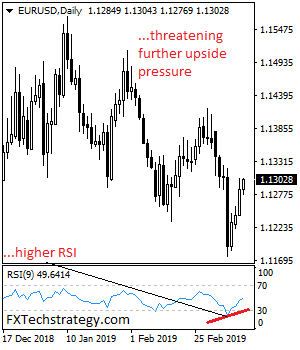
EURUSD threatens further upside pressure towards 1.1340 zone. This is coming on the back of its Tuesday gain. Support comes in at the 1.1250 where a break will aim at the 1.1200 level. A break below here will target the 1.1150 level. Further down, support lies at the 1.1100. On the upside, resistance resides at 1.1350 level with a break through there opening the door for further upside towards the 1.1400 level. Further up, resistance comes in at the 1.1450 level where a violation will expose the 1.1500 level. Its daily RSI is bullish and pointing higher suggesting further strength. All in all, EURUSD continues to threaten further upside pressure.
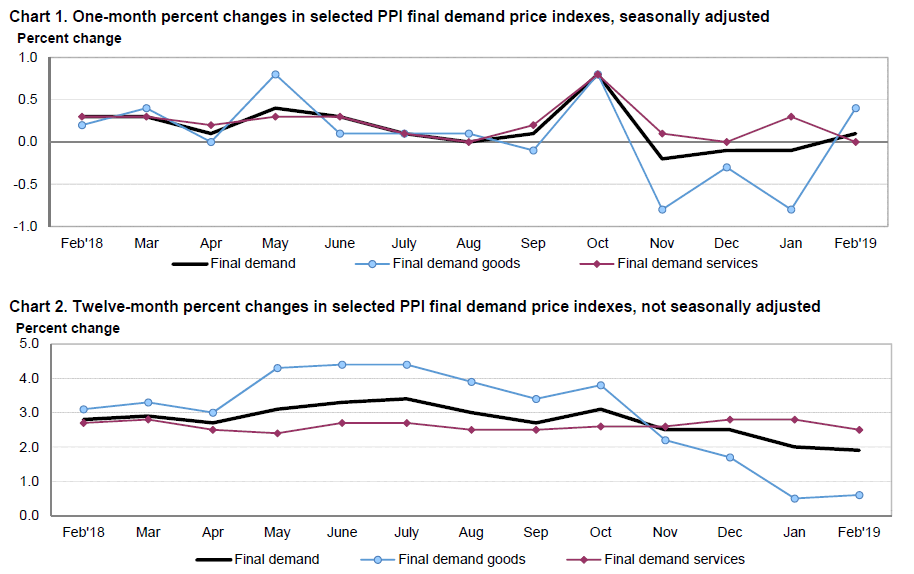
US PPI slowed to 1.9%, core PPI to 2.5%. Durable goods rose 0.4% but core dropped -0.1%
US PPI rose 0.1% mom, 1.9% yoy in February, versus expectation of 0.2% mom, 1.9% yoy. Core PPI rose 0.1% mom, 2.5% yoy, versus expectation of 0.2% mom 2.6% yoy.
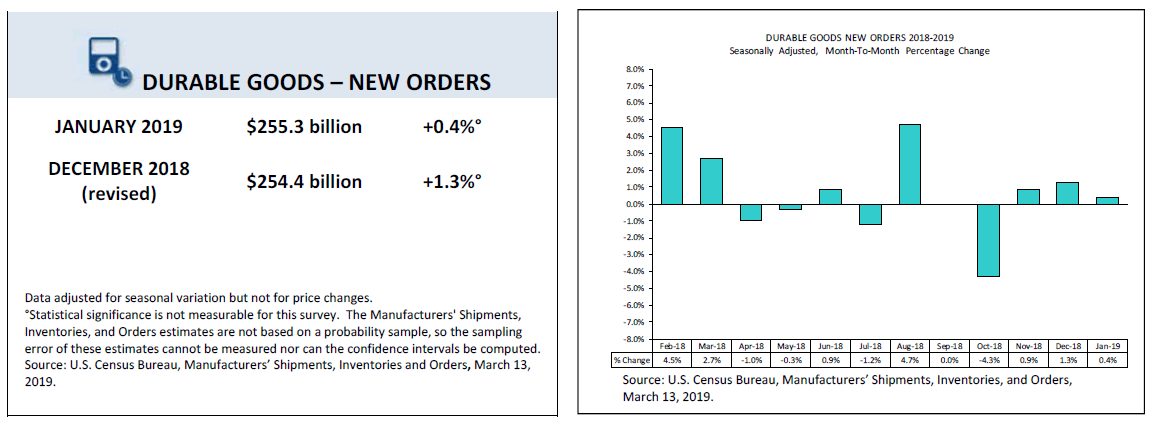
Durable goods orders rose 0.4% in January, above expectation of -0.5%. Ex-transport orders dropped -0.1%, below expectation of 0.1%.
Canadian Dollar Flat ahead of U.S. Durable Goods, Inflation Data
The Canadian dollar is unchanged in the Wednesday session. Currently, the pair is trading at 1.3354, unchanged on the day. On the release front, there are a host of key events. Core durable goods orders are expected to remain at 0.1%, while core durable goods is forecast to slide by 0.5%. On the inflation front, PPI and Core PPI are both projected to post a slight gain of 0.2%. There are no Canadian events on the calendar. On Thursday, the U.S. posts unemployment claims.
The Bank of Canada has been sending a dovish message to the markets, echoing the stance of the Federal Reserve. With Canada’s economy posting two straight declines, the economic slowdown appears deeper than the bank expected. The BoC hasn’t raised rates since October, and the freeze could continue until the second half of the year. If the economy does not rebound, policymakers will have to consider a rate cut, which could stimulate economic activity but would push the Canadian dollar downwards.
The Federal Reserve has been in dovish mode since the start of the year, and weak inflation data has meant there is little pressure on policymakers to raise rates in the near future. Core CPI edged down to 0.1%, while CPI remained steady at 0.2%. Consumer inflation remains well below the Federal Reserve’s target of 2.0 percent, so there is little pressure on the Fed to raise rates anytime soon. Policymakers have been signaling that the Fed could stay on the sidelines until the second half of 2019, and this stance was underscored by Fed Chair Powell in a television interview on Sunday. Powell left no doubt about where the Fed stands, saying that the Fed would remain patient and was in no hurry to change interest rate policy. The dovish stance of the Fed could weigh on the dollar, as a lack of rate hikes makes the greenback less attractive to investors.
Into US session: Sterling lacks direction as no-deal vote awaited
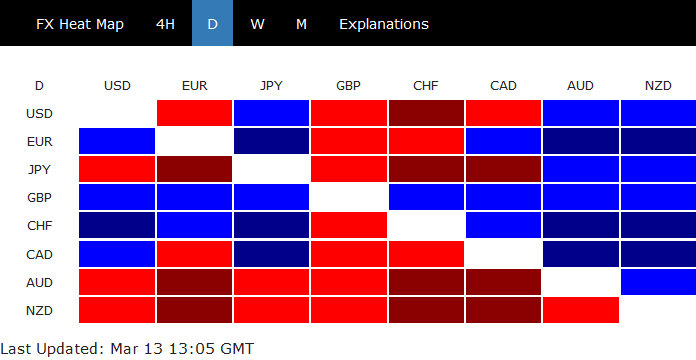
Entering into US session, Sterling is the strongest one for today so far. But it should be noted that the pound is just gyrating in range, as markets await no-deal Brexit vote in the parliament at 1900GMT. There will likely be no clearly direction until the UK Commons made up its mind on what it wants collectively. EU is also clearly that if they were to agree to an extension, they needed to know what for first. There was a rumor saying Attorney General Geoffrey Cox might modify his legal advice that could offer some help to PM May. But such rumor is quickly denied.
Staying in the currency markets, Swiss is currency the second strongest, followed by Euro. New Zealand Dollar is the weakest one, followed by Aussie and then Yen. Such combination shows that there is no clear direction in the market for today.
In Europe, currently:
- FTSE is up 0.12%.
- DAX is up 0.07%.
- CAC is up 0.42%.
- German 10-year yield is up 0.015 at 0.072.
Earlier in Asia:
- Nikkei dropped -0.99%.
- Hong Kong HSI dropped -0.39%
- China Shanghai SSE dropped -1.09%.
- Singapore Strait Times dropped -0.52%.
- Japan 10-year JGB yield dropped -0.0151 to -0.045.
EU Verhofstadt against even 24-hour Brexit extension
UK Parliament is set to vote on no-deal Brexit today at 1900GMT, which will likely be rejected. Then there will be another vote tomorrow for seeking Article 50 extensions. Responses from the EU so far are not very positive regarding an extension.
The European Parliament's lead Brexit spokesman Guy Verhofstadt warned that he would oppose to even 24-hour extension. He said " I am against every extension, whether an extension of one day, one week, even 24 hours, if it is not based on a clear opinion of the House of Commons for something, that we know what they want." Verhofstadt also warned that "An extension, where we go beyond the European elections, and the European elections will be hijacked by the Brexiters, and by the whole Brexit issues. We will talk only about that, and not about the real problems, and the real reforms we need in the European Union."
EU chief Brexit negotiator repeated his question that "extend this negotiation — what for?" And he reiterated that "if the UK still wants to leave the EU in an orderly manner, this treaty is — and will remain — the only treaty possible". Barnier also told the European parliament that "We are at a critical point. The risk of no-deal has never been higher. That is the risk of an exit - even by accident - by the UK from the EU in a disorderly fashion. I urge you please not to under-estimate the risk or its consequences."
Brexit And Trade Continue To Weigh On Growth Concerns
- Brexit – All scenarios remain on the table
- Riksbank – Bye Bye Hikes
- Stocks – Mixed as markets await Trade and Brexit clarity
- Oil – US trims crude output forecast for first time in 6 months
- Gold – Rising on tame inflation and trade deal uncertainty
Brexit
Following yesterday’s crushing rejection of Prime Minister May’s divorce deal, Parliament will vote on whether they will have a hard exit or allow themselves to vote on an extension and hope to negotiate a better deal. Current expectations are high for the UK members of Parliament to vote in support of blocking the UK leaving the EU without a deal on March 29th.
The EU believes May’s second defeat raises the risk of a no-deal Brexit. If Parliament’s votes go as planned, it will be up to the EU and all 27 members to approve an extension. This is the biggest uncertainty and we will find out exactly their position by the EU Summit on March 21st and 22nd.
PM May’s divorce bills have been defeated by margins of 230 and now 149. She has been resilient throughout Brexit and many are amazed she has last this long. There is no high certainty on how we will see the UK eventually agree on a divorce deal, but it may have to involve her offering to step down. The risk of second referendum is growing and Brexiteers do not want risk losing Brexit. After an extension is voted on, one scenario could see the UK agreeing on a deal in the coming months that is accompanied with May’s resignation. Everyone wants Brexit clarity, but a lengthy delay could see a second referendum that would take almost a couple of months to set up.
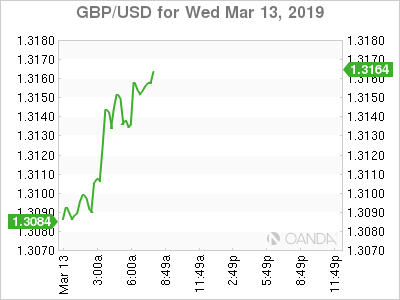
The British pound was the best performer this morning and could remain supported once Parliament rejects a no-deal Brexit and vote for an extension on Thursday.
Riksbank
The Riksbank was one of the last remaining central banks that were still expected to deliver a rate hike this year. That ship may have sailed as inflation fell below the bank’s 2% inflation target. This morning, the Swedish National Financial Management Authority (ESV) cut their growth forecasts for both 2019 and 2020. With the ECB unleashing new stimulus, slower growth concerns, and inflation that can’t stay above target, the Riksbank will need to push back rate hike expectations to the middle of next year.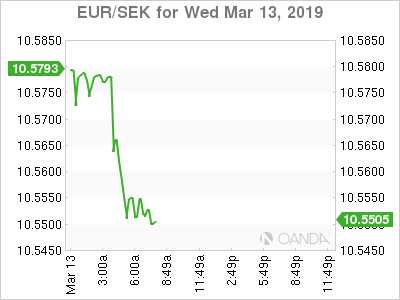
Stocks
European markets provided little excitement today following yesterday’s Brexit defeat and better than expected euro zone industrial production data. Asian equities were weighed down by disappointing Japanese core machinery order data and falling Australian consumer confidence. The global economy’s global growth concerns will unlikely be alleviated until we see further progress on both Brexit and the US-China trade war. Brexit remains a negative for business in Europe and any extended delays in yielding a conclusive outcome will continue to prevent growth returning somewhat to normal. The US-China trade war is still expected to be wrapped up soon, but if both sides can’t agree on enforcement, we could see this become a very negative catalyst for risk.
Tonight, Chinese data is expected to confirm global growth worries as industrial production and retail sales are expected to decline sharply. At the end of the week, the Bank of Japan is expected to keep policy unchanged, maintain both their JGB purchases and their forward guidance while possibly downgrading their views on the economy. Rate cut expectations are growing for the BOJ to act again this summer.
Even with some rising expectations that we could see an earnings recession, easy monetary policy is still the theme of 2019 and with most of the major central banks queuing up rates are going nowhere and that the next policy moves are likely to be cuts, equities may have support on any major selloff.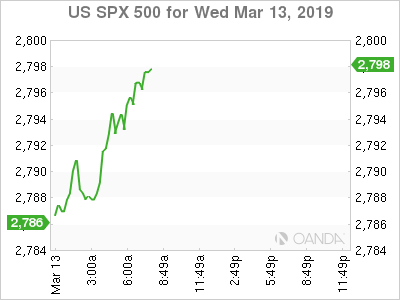
Oil
Crude prices are up for a third consecutive day and approaching the top of the range that has been in place since mid-February. Today’s rally was supported by the EIA cutting of both the 2019 and 2020 US production forecasts, which are still expected to deliver record levels. The reduction of just over 100,00 barrels is a sign that US production might see some headwinds as oil companies struggle being profitable with oil in the mid-$50s.
Continued rhetoric from OPEC members that production cuts will be extended to year end is still the main catalyst for keeping West Texas Intermediate crude above the $57.00 level. Ahead of today’s EIA crude inventory report, which is expected to deliver a build of 2.6 million barrels, the weekly API reading saw inventories decline by 2.6 million barrels. If today’s EIA reading shows inventories decline, that would be the second decline in three weeks. The longer we see crude unable to break above the February highs, the more impatient we could see bullish bets become.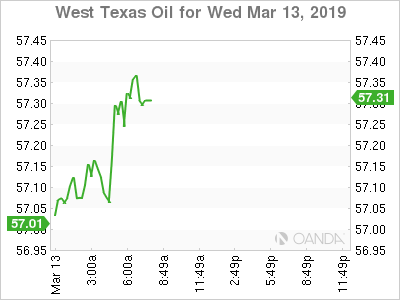
Gold
Benign inflation in the US was the spark plug needed to get gold back above the $1,300 an ounce level. The precious metal struggled for gains over the past couple weeks as optimism was high that we were going to see a trade deal delivered with a mid-March meeting between Presidents Trump and Xi. Financial markets are still pricing in a trade deal, but it appears the timeline is being pushed back towards April.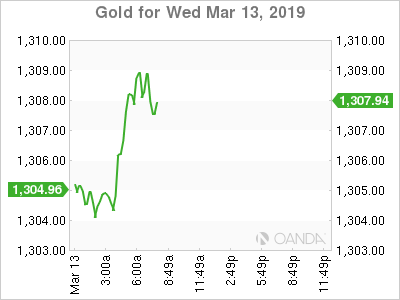
DAX Ticks Lower As Markets Digest Brexit Vote
The DAX is steady in the Wednesday session. Currently, the DAX is at 11,515, down 0.04% on the day. On the release front, eurozone industrial production was better than expected. The indicator jumped 1.4%, above the estimate of 1.0%.
The Brexit drama is in high gear this week, and investors are closely monitoring developments. On Tuesday, parliament again rejected the government’s withdrawal proposal by a huge margin, despite extensive lobbying by Prime Minister May. Many conservative lawmakers remain skeptical about the Irish backstop proposal, suspicious that the provision will prevent Britain from departing from the European Union. The action continues, with parliament voting on a no-deal Brexit on Wednesday. If this proposal is rejected, lawmakers would vote on Thursday on a request to extend Article 50, the mechanism for Brexit. However, it’s far from clear how long the delay would last, or if the E.U. would agree to an extension. Markets are allergic to uncertainty, and the chaos surrounding Brexit could trigger some volatility in European markets in the second half of the week.
The eurozone manufacturing sector has struggled, but there was some positive news on Wednesday, as the reading of 1.4% was the strongest gain since August 2017. Germany, the largest economy in the eurozone, has been posting weak manufacturing data. Industrial production fell 0.8% in January, missing expectations. The indicator managed only two gains in the second half of 2018 and has started 2019 with a decline. Last week, factory orders plunged 2.6%, marking a third successive decline. The U.S-China trade war has dampened global growth, which has reduced the demand for German exports and weighed heavily on manufacturing activity.