Sample Category Title
Getting What You Really Want
I used to do an exercise in the Peak Performance 101 workshop entitled "Getting What You Want". The exercise starts out with a question: If you could have anything in the universe, what would it be? Perhaps your answer might be $10 million dollars. However, the exercise doesn't end there. It just triggers another question: What would that get you? So to carry our example forward, you'd now ask, "What would the $10 million dollars get you?" Perhaps you might answer, "Security… I'd feel secure in my retirement."
It doesn't end with that answer. The second answer merely triggers another question: What would that get you? And to continue the example, you now ask, "What would security get you?"
This process continues at least five times. Each time you get an answer, the new question becomes, "What would that (i.e., the answer to the last question) get you? At the end of five iterations, I then survey the class for what they have come up with at the end of their questions What do you think everyone comes up with? The answer is important because it really says a lot about you. But before I give you the results, do the exercise for yourself. Answer each of the following questions:
- If you could have anything in the universe, what would it be?
- What would that (answer 1) get you?
- What would that (answer 2) get you?
- What would that (answer 3) get you?
- What would that (answer 4) get you?
- What would that (answer 5) get you?
I'm actually curious to know what percentage of you started out with "trading success." Perhaps a lot of you, but I doubt if anyone ended up there.
There are some universals about this exercise. With five repetitions of the question about 90% of all people end up with a mental state. Examples of mental states include security, freedom, confidence, happiness, etc. But we can take it further. If you do enough repetitions of the question, everyone ends up with a universal mental state such as Oneness, Love, Ultimate Happiness, etc. What's interesting about the exercise is that it flat out tells you what you really want! The final answer is always one of those universal mental states (and I'm not sure that they really are not all the same).
Yet what do we do with our lives? We spend it pursuing things such as money, power, career or perhaps trading success. But that's not what we really want. And that's true for everyone.
Now, what if there was a course that you could take that would give you as a result of doing the course, one of those ultimate states. Would you want to take that course?
Well, let me tell you a true story about a man named Lester Levinson. Lester had advanced degrees and was a very successful entrepreneur. In that sense, he was probably a lot like most of you. However, he was very unhealthy. One day his doctors basically said, "Lester, there is really nothing we can do for you. You are going to die in a few months." So Lester retreated to his Manhattan apartment to die. But before he did so, he did an exercise similar to the one I just took you through and concluded that what he really wanted out of life was LOVE. He looked at his life and concluded that he was the happiest when he was LOVING, rather than when he felt people loved him.
As a result, Lester started a series of mental exercises designed to help him be more loving. And as he continued to do those exercises over the next few months, he didn't die. Instead, some remarkable things happened:
First, all of the symptoms of his illness just disappeared. And whenever something happened to his body he could heal it instantly.
Second, he found that he could materialize whatever he wanted just by thinking about it. He played with this for a while, soon materializing millions of dollars worth of real estate. But knowing that he could get those material things any time he wanted them just by thinking about them, he soon lost interest in them and just gave them away. Besides, what he really wanted was LOVE and he was getting that by being LOVING.
Third, he basically started operating in the world at the level of a very advanced spiritual being.
In the spirit of being loving, Lester started to teach what he had learned. As a result we all have that core process that Lester went through to heal himself and become happy and loving available to us through a series of five books entitled "Happiness is Free." Each book is a seven week course, so the series is basically a 35 week course on attaining happiness. And if you do the course, I believe that you can attain a level of happiness that is way beyond what you experience today or probably what you've ever experienced.
However, I didn't write this article to sell these courses, but more to convey some very important points. Logically, if you decided, after doing the exercise, that what you ultimately wanted was love or happiness, then I would expect that we'd get at least 1,000 orders for the course. Of course, you'd have to believe that you'd actually get "ultimate happiness" out of doing the course to order it. And perhaps you don't think you really want happiness or perhaps you don't think the course will help you attain it. That's a personal choice.
Anyway, I was so impressed with this course initially, that I ordered a few sets and gave them to some very special people associated with my company. Later on, I then ordered ten more copies of the course to sell. And interestingly enough, we still have most (if not all) of them in stock. Most people either don't think that they want happiness or they don't believe that they can get it simply by completing a course (i.e., doing all the exercises). It's rather amazing. This is what people want but they are not likely to do anything about it.
I'm so fascinated by this process that I plan to interview each of the people I gave the course to just to see what they've done with it. I haven't done the interviews yet, but I think I know the results. I'll report the actual results to you later in another article for Tharp's Thought's. And I'll also tell you about the exercise that I just completed that motivated me to write this series of articles.
BoJ Meeting: No Action, But Perhaps a More Dovish Tune
The Bank of Japan (BoJ) will announce its decision during the early Asian session on Friday. No action is expected, so investors will once again look for any signals on how policy may evolve. The slowdown in global growth coupled with lackluster domestic data suggest little room for optimism, and if anything, the BoJ could instead join the chorus of dovish central banks globally and hint at more stimulus – not least for fear of yen appreciation if it doesn’t.
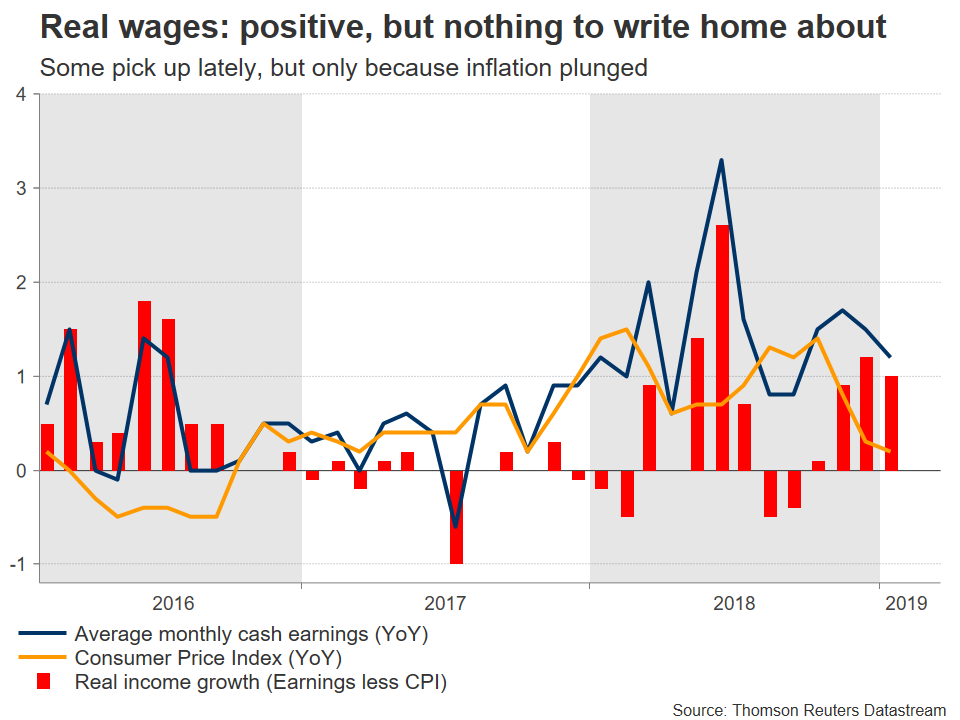
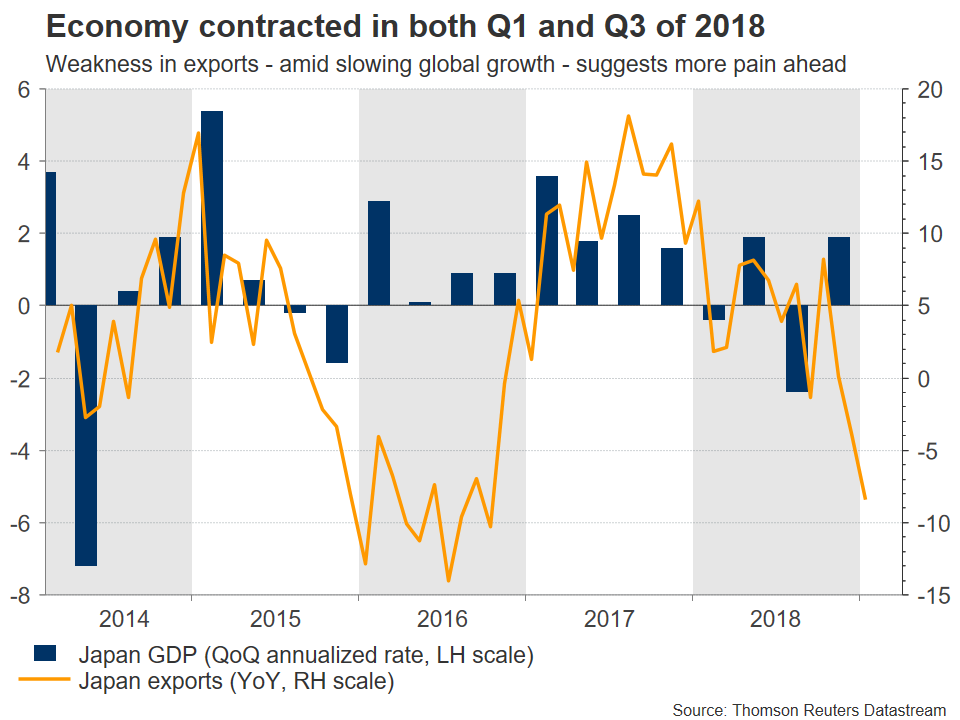
The Japanese economy continues to tread water. The labor market is still the bright spot, though the strength there has failed to translate into a sustained pick up in wages. Inflation remains muted while economic growth is on wobbly legs, with GDP contracting in two quarters of 2018 – albeit not consecutive ones, avoiding a technical recession.
Beyond the lackluster domestic environment, the global outlook is also bleak amid trade tensions and slowing growth in every major region, from the US to Europe to Asia. This is particularly worrisome for an exporting powerhouse like Japan, and true enough, the latest data showed exports collapsing in January. This spells downside risks for growth, and by extent suggests an even longer period of subdued inflation.
Meanwhile, Shinzo Abe’s government plans to raise the nationwide sales tax in October. The last time this tax was hiked back in 2014, a recession quickly ensued as consumption came to a screeching halt. Hence, the BoJ will probably stay cautious ahead of this tax hike, avoiding any bold policy moves, at least any hawkish ones. In other words, the Bank is highly unlikely to shrink its massive stimulus program with the threat of a recession looming, but could well expand it to cushion the economy from any negative impact.
Another factor to consider is the dovish shift in tone by central banks around the world lately. The Fed, the ECB, and many others have adopted a cautious stance amid local and global uncertainties, putting rate hikes on ice for the time being. Although not clearly, this has implications for the BoJ as well. Namely, if Japanese policymakers were to make any hawkish noises, for instance hinting at an eventual scaling back of stimulus, the yen could strengthen rapidly as it becomes more attractive relative to its peers.
A stronger currency, by extent, pushes down on the price of imports and therefore makes it harder for overall inflation to rise – an outcome the BoJ surely wants to avoid. Indeed, Governor Kuroda recently noted that if currency moves are having an impact on the economy and prices, the BoJ will ‘consider easing policy’ to counteract that.
Putting it all together, there’s little scope for the BoJ to appear hawkish in any manner, faced with a struggling domestic economy, slowing global growth, the threat of a recession, and the risk of a massive appreciation in the yen if its tone deviates from that of its dovish peers. If anything, the risk probably lies towards hints for more easing, not normalization.
Where does this all leave the yen? Assuming the BoJ keeps the door wide open for further easing, that would argue for a weaker Japanese currency, both on the decision and over time. That doesn’t mean any weakness will be abrupt or massive though. Instead, it may be a slow grind lower for the yen, much like price action so far this year.
The key risk to this view would be a risk-off event that drives safe-haven flows into the yen, which is considered a defensive asset. In contrast, such defensive inflows usually strengthen the currency suddenly and tremendously, often erasing weeks or months of losses. Therefore, while monetary policy may argue for gradual weakness in the yen, any major risk-off event could still trigger sporadic episodes of massive yen strength.
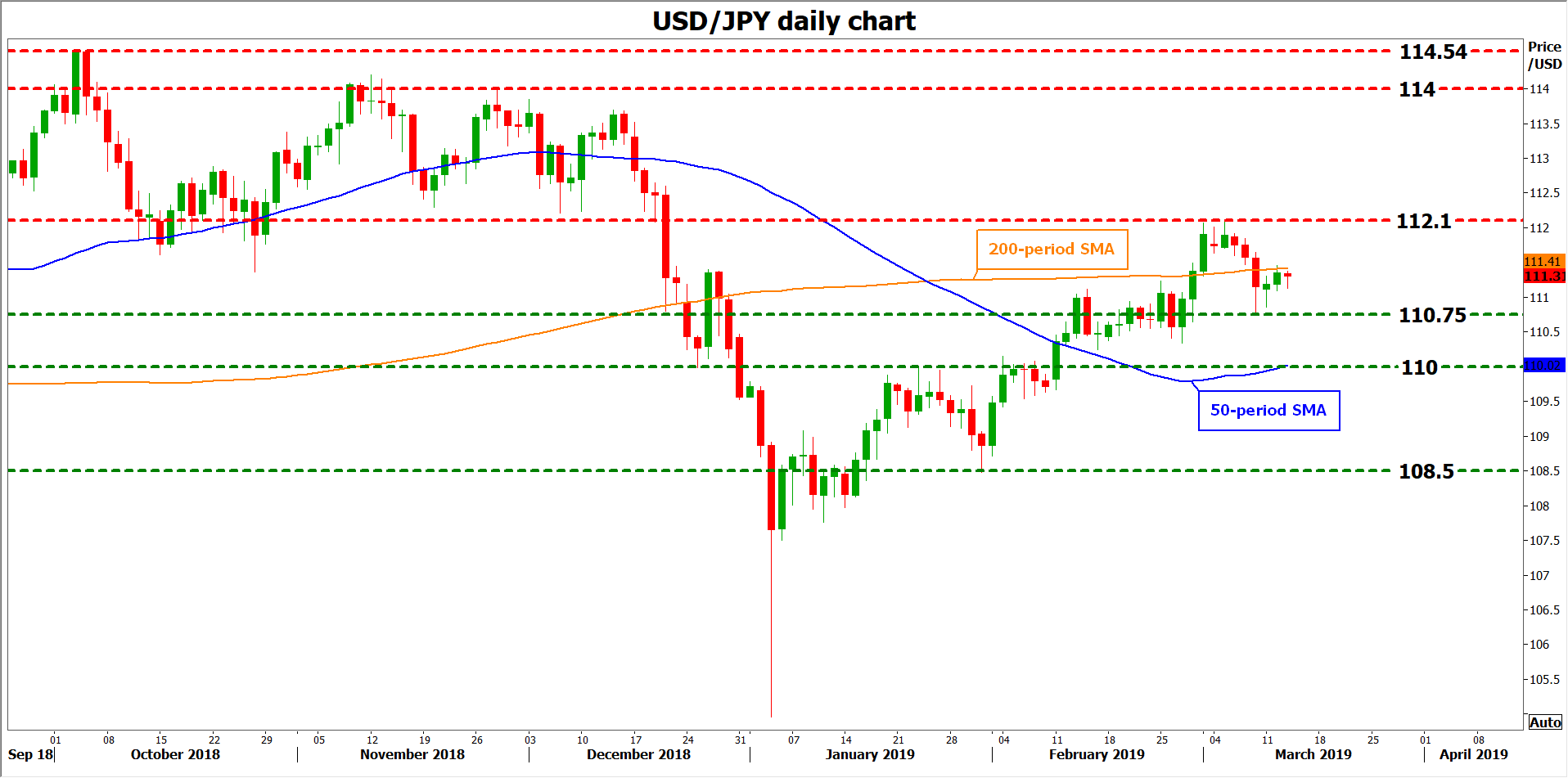
Taking a technical look at dollar/yen, resistance to advances may be found near 112.10, the March 5 peak, with an upside break opening the way for the 114.0 handle. On the other hand, support to declines could come near 110.75, which halted the pullback on March 8, before the 110.0 handle comes into view.
As a final note, it’s striking that the yen was the best performing major currency in 2018, outshining even the almighty dollar, despite the BoJ keeping its foot on the accelerator. This serves as a testament that monetary policy and rate differentials are not all that matters for the currency market. While the Japanese currency is currently tied with the euro as the worst performer in 2019 so far, that could all change quickly in case the global outlook darkens further.
Oil Climbs to Near 4-Month Highs after Crude Inventories Decline
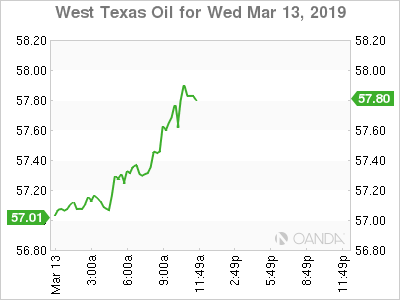
The EIA inventory report delivered its second decline in three weeks helping oil prices rise to the highest level in almost four months. The data confirms that the cutting of oil exports by the Saudis is making the US use up their inventories. The weekly EIA release showed a decline of 3.9 million barrels from the prior week, well below the median estimate of a build of 3.0 million barrels and exceeding the lowest estimate which called for a decline of 2.7 million barrels.
Oil prices may have cleared a key hurdle and while the risks to the downside remain, we could see bullish momentum accelerate here. Rising US production concerns remain but oil may not focus on that in the short-term as we may continue to see draws with inventories.
West Texas Intermediate crude tentatively broke above the $58.00 level and if the bullish breakout continues, price could target the psychological $60 handle. Major resistance will come from the 200-day SMA which currently trades at the $62.08 level.
MARKET WRAP: Markets Recovered Its Losses
Stocks moved higher but the focus remains on Brexit, expect higher volatility at 07:00 p.m London time
Stocks
- The S&P 500 Index jumped 0.6 percent, NASDAQ 0.86 percent, and Dow Jones 0.61 percent as of 15:41 in London.
- The Stoxx Europe 600 Index rose 0.3 percent.
- The MSCI All-Country World Index gained 0.4 percent.
- The VIX index fell 2.90 percent and VSTOX dropped -1.90 percent.
Currencies
- The Dollar Spot Index dropped 0.1 percent.
- The Euro jumped 0.2 percent to $1.1307, the highest level in a week.
- The British pound continued its upward move and jumped higher by 0.8 percent to $1.3181.
- The Japanese yen continued its sideway move and stayed at 111.36 per dollar.
Bonds
- The yield on 10-year Treasuries jumped one basis point to 2.61 percent.
- Germany’s 10-year yield soared one basis point to 0.06 percent.
- Britain’s 10-year yield also moved higher by three basis points to 1.19 percent.
Commodities
- West Texas Intermediate crude maintained its uptrend and soared 1.9 percent to $57.97 a barrel, the strongest in four months.
- Gold stayed above 1300-level and jumped 0.4 percent to $1,307.36 an ounce.
Sunset Market Commentary
Markets:
Global core bonds are modestly losing ground today as risk sentiment remained cautiously positive. Investors are weighing the chances of a disorderly Brexit, with the UK Parliament voting on a no-deal withdrawal tonight, and if it fails on an extension tomorrow. Meanwhile, the eurozone economic slowdown is showing further signs of stabilization as the EMU industrial production rose 1.4% (MoM) in January, beating expectations (1.0%) and turning positive again after a decline of 0.9% (M/M) in December. Heavy EMU bond supply (Germany, Portugal and Italy) was well digested. The German yield curve is moving higher with changes mounting up to +1.2 bps (30-yr). US producer inflation rose for the first time in three months (M/M) but printed below expectations, while US durable goods orders rebounded in January. The US data signals some improvement of the US economy, while lower inflation readings put little pressure on the Fed to raise interest rates. The US 10-yr yield still struggles with the intermediate support (2.61%) but didn’t pick a side yet. The US yield curve is moving higher with changes varying between +0.6 bps (2-yr) and +1.3 bps (10-yr). Peripheral spreads vs. the German 10-yr yield are close to unchanged with only Greece outperforming (-7 bps) after yesterday’s strong widening.
Economic data failed to inspire (currency) markets. US PPI missed estimates by an inch but durable goods data surprised on the upside. EMU industrial production topped consensus. Markets, however, were unimpressed. Today’s price action was instead driven by sentiment and technical considerations. The (yet fragile) risk on environment bodes well for the euro. The common currency also profited from Brexit spillovers as investors assume common sense will eventually prevail (see below). At the same time, EUR/USD enjoyed some technical support after it pushed through the first intermediate resistance close to 1.13. The move lacks clear momentum however, so it remains to be seen whether the couple will hold ground. EUR/USD is currently changing hands a few ticks north of 1.13.
Sterling entered calmer waters after it got hammered yesterday following UK’s attorney general warning. He concluded that May’s revised brexit deal does not formally prevent a possible permanent customs union with the EU from happening if the backstop is triggered. Parliament unsurprisingly rejected the deal later on, setting the stage for a second vote that will take place this evening. Members of Parliament will then decide whether to leave the EU without a deal. Markets widely expect the motion to be rejected, instead betting on an extension of the deadline. The latter is subject to a parliamentary vote tomorrow if a no deal scenario is discarded this evening. The UK government lowered growth projections for this year to 1.2%, kept 2020 stable at 1.4% but beefed up 2021 and 2022 to 1.6%, adding further to a constructive sterling sentiment. The pound rises, pushing EUR/GBP back below the 0.86-mark (0.857 at the time of writing). Cable edges higher, trading close to the 1.32-handle.
News Headlines:
Headline US durable goods orders rose by 0.4% M/M in January, beating expectations. Non-military capital goods shipments excluding aircraft, a proxy for business investment in GDP, increased by 0.8% M/M (vs -0.2% M/M expected). US producer price inflation slowed for both the headline (1.9% Y/Y) and core (2.5% Y/Y) readings.
The South African central bank’s deputy governor Naidoo warned that the country has no fiscal buffer to shield against a possible crisis. The country’s rising debt trajectory will make it difficult to weather a global economic downturn. The Treasury last month forecasted that net debt will pierce through the 50% of GDP threshold in coming months.
WTI oil rises further after fall in inventory, but upside to be caped below 60
WTI crude oil breaks 57.98 resistance earlier today to resume the rally from 42.05. Further rise is seen after EIA reports that US crude supplies dropped by -3.9m barrels in the week ending March 8, versus expectation of 2.7m barrels rise.
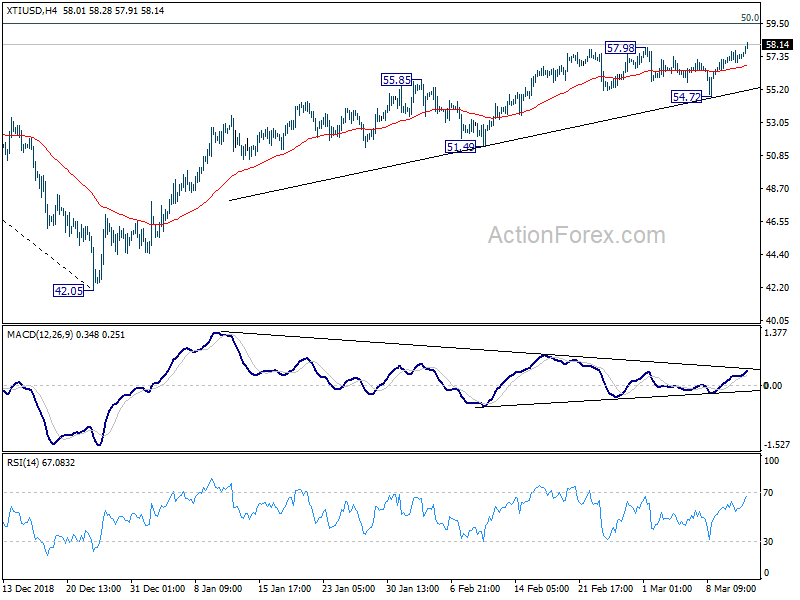
Technically the strong support from rising 55 day EMA is a bullish sign. But upside momentum is unconvincing as seen in daily and 4 hour MACD. Thus, we'd expect strong resistance from 50% retracement of 77.06 to 42.05 at 59.55 to limit upside.
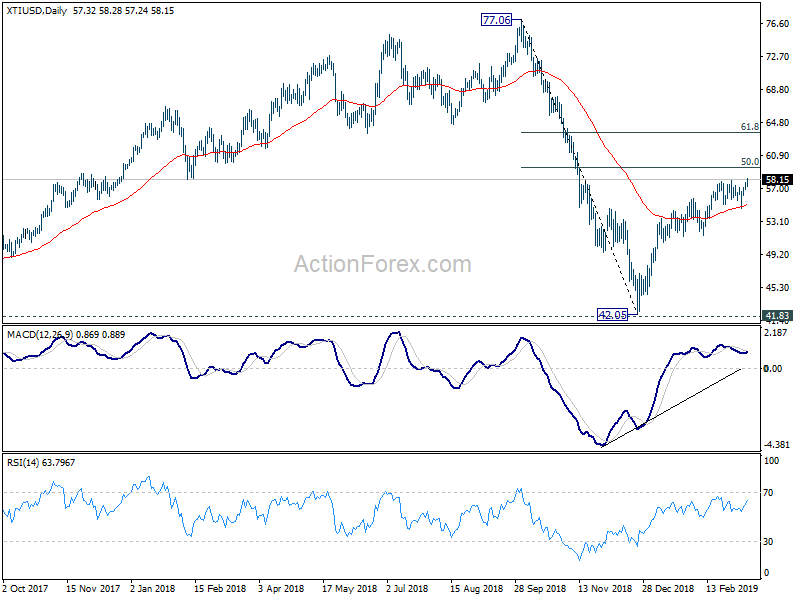
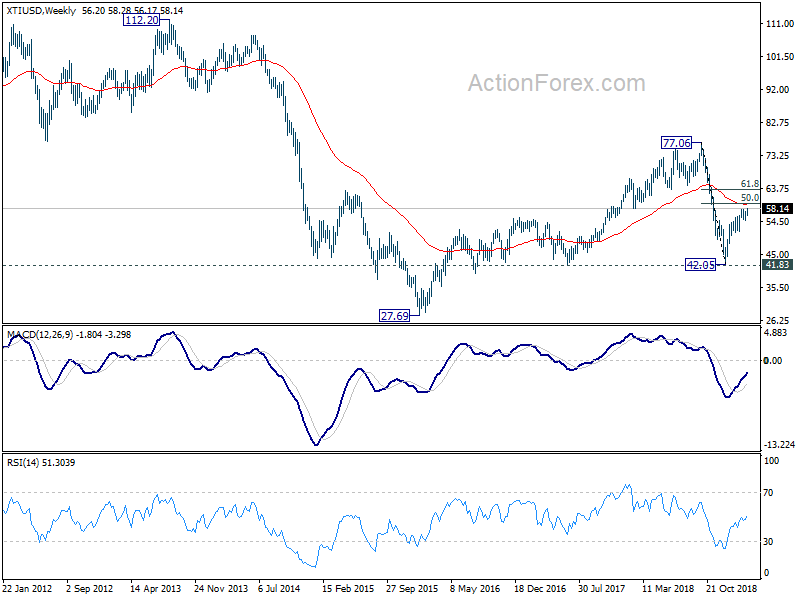
This level is also close to 55 week EMA at 59.23.
USD/JPY – Unchanged as U.S Posts Mixed Numbers
USD/JPY is drifting in Wednesday trade, as the pair continues to have a quiet week. In the North American session, the pair is trading at 111.32, down 0.01% on the day. On the release front, Japanese indicators were mixed. Core Machinery Orders plunged 5.4%, its sharpest drop in four months. This was much weaker than forecast of -1.6%. There was better news from PPI, which climbed 0.8%, edging above the estimate of 0.7%. In the U.S., durable goods orders gained 0.4%, compared to an estimate of -0.5%. Core durable goods orders declined by 0.1% shy of the estimate of 0.1%. Inflation indicators remain low, as PPI and Core PPI both came in at 0.2%. On Thursday, the U.S. releases unemployment claims and new home sales.
Consumer inflation remains soft, which means there is little pressure on policymakers to raise rates in the near future. In February, Core CPI edged down to 0.1%, while CPI remained steady at 0.2%. Consumer inflation remains well below the Federal Reserve’s target of 2.0 percent, so there is little pressure on the Fed to raise rates anytime soon. Policymakers have been signaling that the Fed could stay on the sidelines until the second half of 2019, and this stance was underscored by Fed Chair Powell in a television interview on Sunday. Powell left no doubt about where the Fed stands, saying that the Fed would remain patient and was in no hurry to change interest rate policy. The dovish stance of the Fed could weigh on the dollar, as a lack of rate hikes makes the greenback less attractive to investors.
The Bank of Japan meets for a policy meeting later this week. Will we see more of the same from the BoJ? There is little pressure on policymakers to raise interest rates, especially with the Federal Reserve and ECB putting a freeze on rate hikes for the time being. However, the BoJ is concerned that the Japanese yen could rise if the global economy takes a downturn in 2019, which would weigh on exports and push inflation levels lower. If the yen does move higher, the bank will have to consider additional stimulus in order to keep the currency in check. This means that it’s unlikely that the safe-haven yen will be posting significant gains in the next few months, barring geopolitical turmoil.
EUR/USD Mid-Day Outlook
Daily Pivots: (S1) 1.1252; (P) 1.1279; (R1) 1.1313; More.....
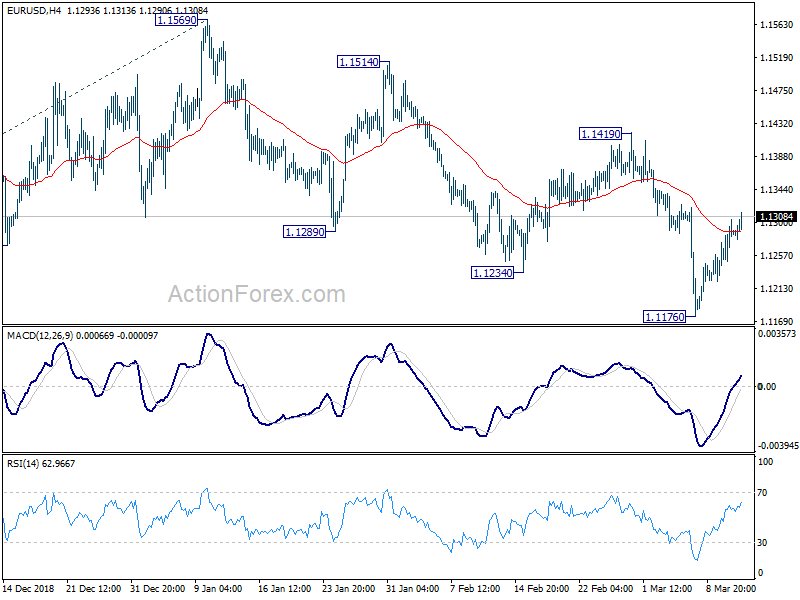
EUR/USD's rebound from 1.1176 is still in progress. But as it's seen as a corrective move, upside should be limited well below 1.1419 resistance to bring fall resumption. On the downside, break of 1.1176 will extend the down trend from 1.2555 and target 100% projection of 1.1814 to 1.1215 from 1.1569 at 1.0970 next.
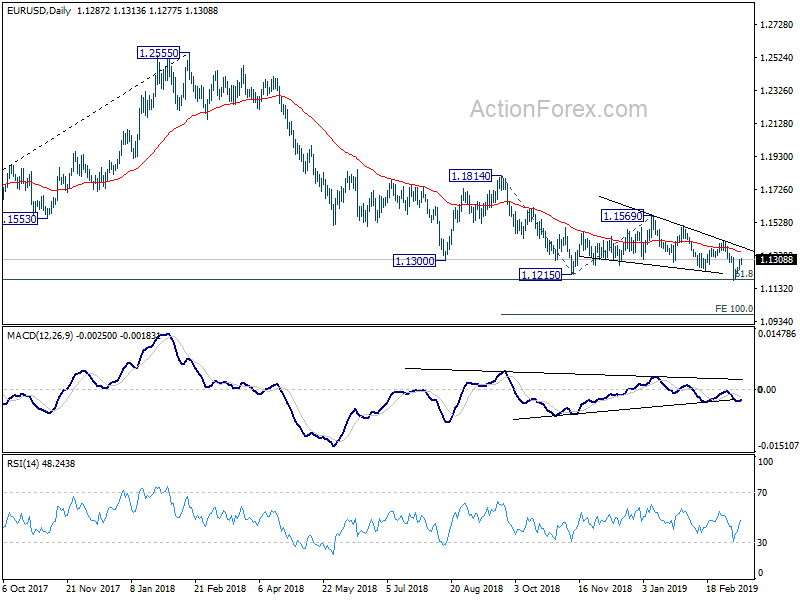
In the bigger picture, down trend from 1.2555 medium term top is still in progress. Bearishness is affirmed by sustained trading below falling 55 week EMA. 61.8% retracement of 1.0339 (2017 low) to 1.2555 at 1.1186 is met. Sustained break there will pave the way to retest 1.0339. On the upside, break of 1.1569 resistance will now indicate completion of such down trend and turn medium term outlook bullish.
GBP/USD Mid-Day Outlook
Daily Pivots: (S1) 1.2955; (P) 1.3122; (R1) 1.3239; More....
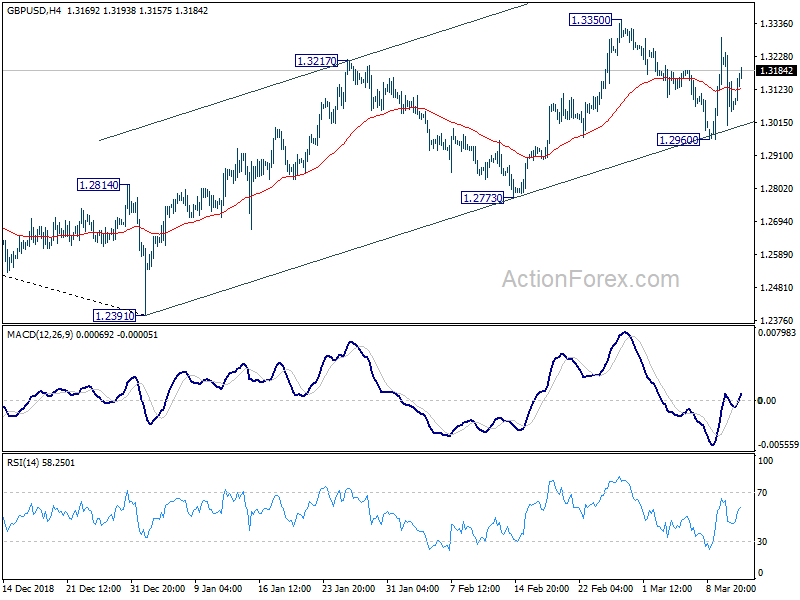
Intraday bias in GBP/USD remains neutral as it's staying in range of 1.2960/3350. On the upside, Break of 1.3350 will resume the rebound from 1.2391 low to 61.8% retracement of 1.4376 to 1.2391 at 1.3618 next. On the downside, again, sustained break of trend line support will argue that rebound from 1.2391 has completed earlier than expected at 1.3350. Deeper fall would then be seen to 1.2773 support for confirmation.
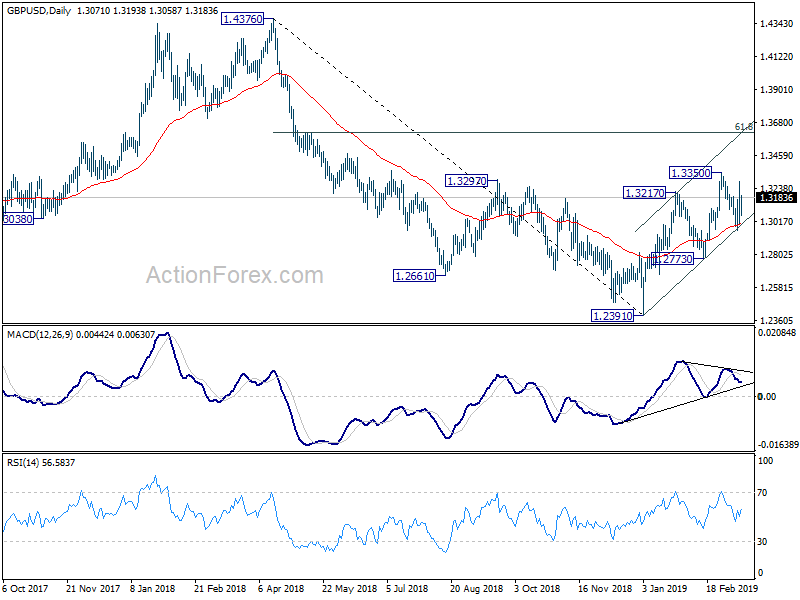
In the bigger picture, medium term decline from 1.4376 (2018 high) should have completed at 1.2391. Rise from 1.2391 is now seen as the third leg of the corrective pattern from 1.1946 (2016 low). Further rise could be seen through 1.4376 in medium term. On the downside, though, break of 1.2773 support will dampen this view. Focus will be turned back to 1.2391 low and break will resume the fall from 1.4376 to 1.1946.
USD/CHF Mid-Day Outlook
Daily Pivots: (S1) 1.0056; (P) 1.0085; (R1) 1.0107; More....
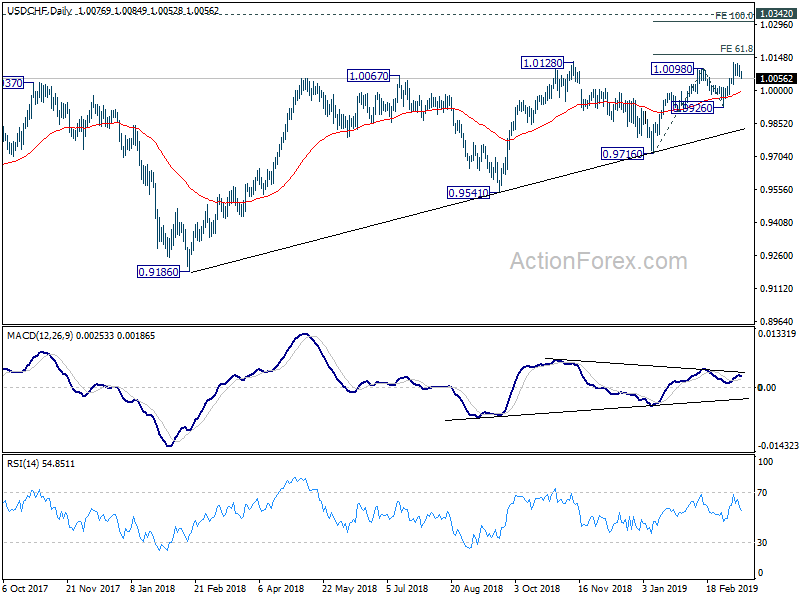
Intraday bias in USD/CHF remains neutral at this point. More consolidation could be seen but downside of retreat should be contained by 1.0027 minor support to bring another rally. On the upside, break of 1.0124 will target 61.8% projection of 0.9716 to 1.0098 from 0.9926 at 1.0162 and then 100% projection at 1.0308.
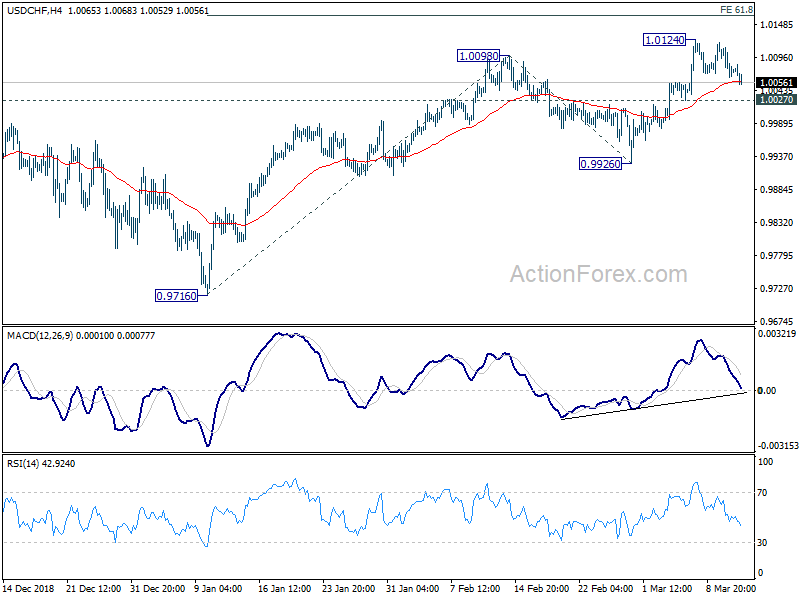
In the bigger picture, USD/CHF drew strong support from medium term trend line and rebounded. That suggests rise from 0.9186 is still in progress. Further break of 1.0128 will confirm up trend resumption and target 1.0342 key resistance. Nevertheless, break of 0.9926 support will be the first signal of medium term reversal and bring another test on the trend line.