Sample Category Title
EUR/AUD 4H Chart: Buy Signals Today
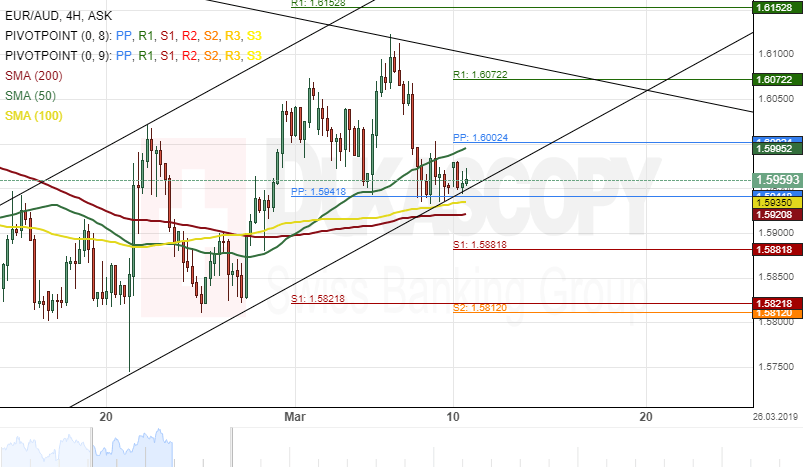
The common European currency depreciated about 1.14% against the Australian Dollar during the last week. However, the currency pair revealed a new junior ascending channel pattern during this period.
The exchange rate was stranded between SMAs during the first part of Monday's trading session. The 50-hour simple moving average was providing resistance for the rate at 1.5990, while the 100– and 200– hour SMAs was providing support at 1.5935.
Technical indicators suggest that the junior ascending channel pattern is likely to hold during the following trading sessions.
EUR/CAD 4H Chart: Remains Near Resistance Cluster
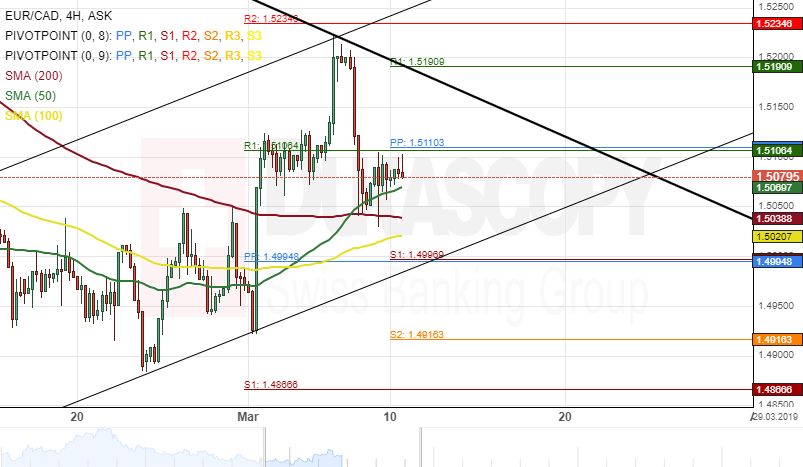
The single European currency depreciated about 182 base points against the Canadian Dollar during the past week. The decline was stopped by the 200-hour simple moving average at 1.5039.
The exchange rate is trading near a resistance cluster formed by the combination of the weekly and the monthly PPs at 1.5110.
If the currency exchange rate passes the resistance cluster, the next target for bullish traders will be near the weekly R1 at 1.5190.
On the other hand, if the resistance cluster as mentioned above holds, a decline towards the lower boundary of a junior ascending channel pattern at 1.4996 could be expected during the following trading sessions.
Focus On Upcoming Brexit Vote In UK Parliament This Week
Notes/Observations
- Key week for Brexit votes as little progress has been made on the Irish backstop issue; meaningful vote on Tuesday appears to be vote another huge loss for PM May
Asia:
- China Feb CPI data was in-line with expectations but hitting a 13-month low (YoY: 1.5% v 1.5%e)
- China Feb New Yuan Loans (CNY): 0.9B v 1.0Te
- China Feb Aggregate Financing (CNY): 0.7T v 1.45Te - China Feb M2 Money Supply data matched a record low (YoY: 8.0% v 8.4%e)
- The Chinese reportedly removed a trip to Mar-a-Lago from Pres Xi Jinping's calendar - South Korea said to be in close communication with US following reports related to North Korea restoring rocket site
Europe:
- UK MPs said to have warn PM May: Brexit meaningful vote must be put on hold as she could face another three-figure defeat if she went ahead with her plan. Advised her to halt the vote and replace it with a motion setting out the kind of Brexit deal that would be acceptable to Tory MPs to keep the party together and put pressure on EU
- UK PM May told she must quit in order to save Brexit as only 2 Cabinet members still support her.
- EU said to prepare multi-billion pound increase on divorce payment from the UK in return for Brexit delay
- EU Parliament Chief Tajani: We must avoid a chaotic no-deal Brexit that would be bad for UK economy and hurt the EU. Brexit date could be delayed by a few weeks at the most
- UK Commons leader Leadsom: If the EU pushed the UK to leave without a deal, it would be much harder to guarantee no border in Ireland
- Bank of England (BOE) tightened bank liquidity buffers before Brexit; banks should assume they will not be able to exchange dollars and pounds and model balance sheets accordingly. told some domestic lenders to triple their liquidity buffers so that they hold enough liquid assets to be able to deal with stress for a period of 100 days vs the regular 30 days under the BoE's Prudential Regulation Authority's rules.
Americas:
- Fed Chair Powell '60 Minutes' interview reiterated Fed did not feel any hurry to change interest rates again. Watching retail sales after weak Dec, some evidence sales rebounded in Jan. Rate policy was 'in a very good place right now' and now 'roughly neutral'
- President Trump to request avg of 5% cut to non-defense spending in FY2020 budget
- Ethiopian Airlines flying a new Boeing 737 Max, cashes shortly after takeoff, killing 157 people (2nd crash of the new 737 Max recently)
Macro
- (DE) Germany: According to German press the government has cut its growth forecast to 0.8%. The official forecast from the end of January was 1.0% but it appears latest revisions to production and orders data coupled with weak confidence numbers have prompted another downward revision. The finance ministry reportedly sees considerable negative risks, including global trade tensions, waning growth in the US, China end developing countries, as well as political risks in Europe.
- (DE) Germany: January trade surplus fell back to €18.5B with exports stagnating after rising 1.5% m/m in December, while import growth accelerated 1.5% from 0.7%. The three months trend improved, but unadjusted data also show sharply lower trade as well as current account surpluses in January compared with 2018, which will add to evidence that the German economy is struggling with ongoing trade uncertainty. Still export growth actually improved 1.7% y/y in January but risks appear to remain tilted to the downside.
- (UK) United Kingdom: Brexit negotiations continued over the weekend, but no progress to report. The second parliamentary vote on the government's Withdrawal Agreement, slated for tomorrow, will now likely be pulled, as it is near certainty it would be rejected again. If the vote is cancelled then a vote on whether to leave the EU without a deal would take place on Wednesday, which would almost certainly be voted down. The House of Commons would then vote on delaying Brexit which would almost certainly be voted for. Then it would be up to the EU to agree to a delay.
SPEAKERS/FIXED INCOME/FX/COMMODITIES/ERRATUM
Equities
- Indices [Stoxx600 +0.14% at 371.10, FTSE +0.76% at 7,158.75, DAX +0.14% at 11,474.16, CAC-40 +0.04% at 5,233.15, IBEX-35 -0.16% at 9,115.05, FTSE MIB +0.10% at 20,504.50, SMI +0.06% at 9,266.80, S&P 500 Futures +0.01%]
Market Focal Points/Key Themes:
Equities
- European Indices trade mostly higher across the board following a higher session in Asia overnight and slightly higher US futures. FTSE sharply outperforming other indices on the UK press report that PM May to most likely change the planned meaningful vote scheduled for Tuesday, Mar 12th to a provisional one. On the corporate front, French-listed Safran trades lower on Sunday's Boeing 737 Max jet jet crash as its JV with General Electric was responsible for engines production. Both Deutsche Bank and Commerzbank trade higher on new press speculation regarding potential merger. Elsewhere Renault trades higher as it confirms negotiations on new alliance with Nissan and Mitsubishi. To the downside, Cerved Information Solutions trades 13% lower in Italy on announcement that Advent decided not to go ahead of takeover bid. Norwegian Air trades down over 6% on new load factor data and plans to continue operation of Boeing 737 Max for now notwithstanding further crash investigation. Looking ahead, notable earners include Century Casinos, Athenex and Ituran Location & Control.
- Consumer discretionary: Norwegian Air [NAS.NO] -6% (load factor; to continue 737 MAX 8 jets operation)
- Financials: Deutsche Bank [DBK.DE] +3%, Commerzbank [CBK.DE] +4.5% (reports regarding DB's board opinion on Commerzbank merger), Banca IFIS [IF.IT] -12% (does not present CEO Giovanni Bossi in list to renew Board of Directors)
- Healthcare: Roche Holding [ROG.CH] n/c (FDA approval)
- Industrials: Safran [SAF.FR] -1.5% (JV with GE made engines to Boeing's crashed jet), Renault [RNO.FR] +2% (new alliance)
- Technology: Acando [ACANB.SE] +43% (to be acquired), Tecan [TECN.CH] +1.5% (earnings), Xaar [XAR.UK] -6% (trading update), Cerved Information Solutions [CERV.IT} -13% (Advent decided not to go ahead of takeover bid)
Speakers
- ECB's Coeure (France): Did not see need to restart asset purchases on markets. ECB didt see a recession in region at this time . Saw consistent growth but with less momentum. Italy was the only country in region in a technical recession, must be part of EU debate; country's problem was productivity not linked to the Euro.
- UK Govt spokesperson: PM May spoke with EU Juncker on Sunday, Mar 10th; no plans for her to visit Brussels. Reiterated that Brexit talks are deadlocked
- PM May said to most likely change the planned meaningful vote scheduled for Tuesday, Mar 12th to a provisional one. BBC political reporter noted that If PM May delayed the 'no-deal;' Brexit or Article 50 extension then she could face resignations and possible removal as leader
- German govt official said not to expect to unanimously agree to a digital tax at Tuesday's EcoFin meeting. Continuing to strive for a minimum tax at global level
- Czech Central Bank Gov Rusnok: domestic wage growth to slow notably after 2019
- South Korea Finance Ministry: IMF called for active fiscal and monetary polices. IMF concerned over pace of minimum wage hike
- Saudi Arabia official: To pump well below 10M bpd in April with exports below 7M bpd. Committed to oil market rebalancing and expect other producers to show similar commitment. April allocations were 635K bpd lower than volumes requested by its customers
- IEA: Global oil demand to reach 106.4M bpd in 2024. Saw global oil production rising by 5.9M bpd by 2024. US to dominate global oil supply growth through 2024 with a 2nd wave of shale revolution coming. US exports to surpass Russia. China and India to make up 44% of oil demand growth during period. OPEC capacity to decline by 400K bps by 2024 due to sanctions
Currencies/Fixed Income
- The GBP/USD was lower by 0.3% as the Brexit situation enters a key week as parliament was slated to vote this week on the plan to leave the EU. Lots of rumblings whether PM May would have the planned meaningful vote on Tuesday with speculation that it could be changed into a provisional one. Concerns bubbling too that if PM May delayed the 'no-deal;' Brexit or Article 50 extension votes then she could face resignations and possible removal as leader
- EUR/USD was slightly higher as dealers continued to focus on any divergence in central bank policies. The pair tested below the 1.12 level after the ECB pushed back its view for the 1st potential hike until after 2019 but a soft US payroll data gave the Euro some respite. Analysts still believe that the USD would continue its rally as the interest rate advantage would increase further down the road.
- USD/JPY steady with focus on the BoJ rate decision on Friday but analysts believe it would be a non-event
Economic Data
- (DE) Germany Jan Industrial Production M/M: -0.8% v +0.5%e; Y/Y: -3.3% v -3.3%e
- (DE) Germany Jan Current Account Balance: €18.3B v €18.0Be; Trade Balance: €14.5B v €15.2Be; Exports M/M: 0.0% v -0.5%e; Imports M/M: +1.5% v -0.1%e
- (DE) Germany Q4 Labor Costs Q/Q: -0.1% v +1.0% prior; Y/Y: 2.0 v 2.6% prior
- (NO) Norway Feb CPI M/M: 0.8% v 0.6%e; Y/Y: 3.0% v 2.8%e
- (NO) Norway Feb CPI Underlying M/M: 1.2% v 0.7%e; Y/Y: 2.6% v 2.1%e
- (NO) Norway Feb PPI (including Oil) M/M: 0.4% v 0.3% prior; Y/Y: 8.0% v 4.9% prior
- (DE) Denmark Feb CPI M/M: 0.4% v 0.8%e; Y/Y: 1.0% v 1.4%e
- (DE) Denmark Feb CPI EU Harmonized M/M: 0.5% v 0.2% prior; Y/Y: 1.1% v 1.2% prior
- (DK) Denmark Current Account Balance (DKK): 14.9B v 15.9B prior; Trade Balance: 9.1B v 7.2B prior
- (FI) Finland Jan Preliminary Trade Balance: +0.5B v -€0.4B prior
- (TR) Turkey Q4 GDP Q/Q: -3.0% v -2.4%e; Y/Y: -2.4% v -2.4%e (confirms technical recession)
- (TR) Turkey Jan Current Account Balance: -$0.8B v -$0.7Be (2nd straight deficit)
- (FR) Bank of France Feb Industrial (Business) Sentiment: 101 v 100e
- (SE) Sweden SEB House-Price Indicator: 13 v 13 prior
- (ES) Spain Jan Adjusted Retail Sales Y/Y: 0.8% v 1.0%e; Retail Sales Y/Y: 1.7% v 0.1% prior
- (CZ) Czech Jan National Trade Balance (CZK): 12.1B v 19.1Be
- (CZ) Czech Feb CPI M/M: 0.2% v 0.1%e; Y/Y: 2.7% v 2.6%e
- (CZ) Czech Jan Export Price Index Y/Y: 2.8% v 3.1% prior; Import Price Index Y/Y: 2.4% v 2.4% prior
- (HU) Hungary Jan Preliminary Trade Balance: €0.4B v €0.4B prior
- (CH) Swiss Total Sight Deposits w/e Mar 8th (CHF): 576.1B v 576.4B prior; Domestic Sight Deposits: 487.6B v 491.4B prior
Fixed Income Issuance
- None seen
Looking Ahead
- (IL) Israel Central Bank Feb Minutes
- 06:00 (EU) Daily Euribor Fixing
- 06:30 (DE) Germany to sell €2.0B in 6-month BuBills
- 07:00 (IL) Israel to sell bonds
- 07:25 (BR) Brazil Central Bank Weekly Economists Survey
- 07:45 (US) Daily Libor Fixing
- 08:00 (CZ) Czech Central Bank to comment on CPI data
- 08:00 (IN) India announces details of upcoming bond sale (held on Fridays)
- 08:00 (SE) Sweden Central Bank (Riksbank) Dep Gov Ohlsson
- 08:30 (US) Jan Advance Retail Sales M/M: 0.0%e v -1.2% prior; Retail Sales (Ex-Auto) M/M: +0.3%e v -1.8% prior; Retail Sales (Ex-Auto/Gas): +0.6%e v -1.4% prior; Retail Sales Control Group: +0.6%e v -1.7% prior
- 09:00 (UK) Baltic Dry Bulk Index
- 09:00 (EU) Eurogroup meeting
- 09:00 (UK) BOE's Haskel
- 09:00 (ES) Spain Debt Agency (Tesoro) announces size of upcoming issuance
- 10:00 (US) Dec Business Inventories: +0.6%e v -0.1% prior
- 10:00 (FR) France Debt Agency (AFT) to sell combined €3.7-4.9B in 3-month. 5-month, 6-month and 12-month Bills
- 10:20 (BR) Brazil Feb Vehicle Production: No est v 196.8K prior; Vehicle Sales: No est v 199.8K prior; Vehicles Exports: No est v 25.0K prior
- 11:30 (US) Treasury to sell 3-Month and 6-Month Bills - 16:00 (US) Crop Progress Report
Central Banks Walk The Wire
Despite significant cost and hype, monetary policy has not driven growth and clearly driven asset bubbles. The relationship between markets and the real economy is loose at best, however, everyone is willing to overlook real weakness when stock prices are elevated. Any tightening by the US Federal Reserve will invert the US yield curve. The Fed must let inflation expectations increase in the short-run and hope it pulls up the long end of the curve. However, the divergence between the market pricing and the real economy is expected to widen in US and Europe: this gap between cheap capital and corporate earnings creates a dangerous void. If price/earning ratios are too high, a fall can become chaotic. Central banks are driven by fears rather than economic data – this is a policy misstep.
Last week the European Central Bank cut forecasts and announced an additional tranche of TLTROs (bank aid). Normalization was pushed back into 2020 from 2019. Market reaction was unexpectedly sharp, showing the inadequacy of central banks’ defensive measures. Fed commentary suggested that growth has peaked, and a weak payrolls report indicates deceleration.
Oil resists OPEC cuts
Despite poor payrolls data in the US and a drop in China’s auto sales, oil prices remain solid. US production is holding pace: current output of 12.1 million barrels per day could well rise to 13 million by year-end. We expect a spike in prices to be limited. Currently trading at 56.50, West Texas Intermediate is heading along 57 short-term.
Further sanctions are expected to hit Venezuela’s Maduro regime, and Washington is willing to pressure Venezuela’s second-largest buyer, India, to cease purchases after ordering the same for Iranian crude by threatening trade duties on USD5.6 billion of imported products. Despite US leverage of the NOPEC bill (No Oil Producing and Exporting Cartels Act), it appears that OPEC + is willing to maintain current production until the end-June 2019 OPEC meeting. Production was down 560’000 bpd in February, the third consecutive cut with December for a total drop of -8%.
Blockchain Spending Rise
Despite notorious cryptocurrency hater Nouriel Roubini arguing the underlying technology of cryptocurrencies, blockchain, has “nothing to do with” the future of financial services, investment in the innovative tech is on the rise. In an updated report on 4th March 2019, indicated that global blockchain spending will account for almost $2.9 bn in 2019, which is an 88.7% surge from 2018, according to United States-based market research firm International Data Corporation (IDC). Financial sector leads industry in terms of spending in blockchain progress this 2019. Banking, investment services and insurance services expected to invest more than $1.1 bn out of the total global blockchain spending.
EUR/USD – Euro Listless At Start Of Week, U.S Retail Sales Next
EUR/USD is showing little movement at the start of the week. Currently, the pair is trading at 1.1241, up 0.06% on the day. On the release front, there are no major eurozone events. German industrial production posted a fourth straight decline. The reading of -0.8% missed the forecast of 0.5%. In the U.S., Core retail sales are expected to gain 0.4%, after a decline of 1.8% a month earlier. Retail sales is projected to improve to 0.0%, after dropping 1.2% in the previous release. On Tuesday, the U.S. releases CPI data.
The U.S. dollar was broadly lower on Friday, after a surprisingly low reading from nonfarm payrolls. The indicator showed that the economy eked out just 20 thousand jobs, much worse than the forecast of 180 thousand. On a brighter note, wage growth improved to 0.4%, above the estimate of 0.3%. The soft nonfarm payrolls reading pushed the euro slightly higher to end the week.
The euro is coming off a rough week, as EUR/USD lost 1.1 percent. The pair dropped sharply on Thursday, slipping to its lowest level since June 2017. This was in response to the ECB rate statement and comments from Mario Draghi, which were more dovish than expected. The ECB announced that it was extending its forward guidance on interest rate levels, saying that it would not raise rates before 2020. Although this should not have come as a surprise, the ECB had been on record until now as saying that rates could move higher in late 2019. In an acknowledgment to the slowdown in the eurozone, the ECB announced a new round of long-term loans to eurozone banks and slashed the 2019 GDP forecast for the bloc to 1.1%, down from 1.7% in the previous forecast. Mario Draghi reinforced the bank’s dovish stance in his press conference, saying that downside risk was pointed to the downside, although a recession was unlikely.
Brexit And Sterling Volatility Expected
Monday March 11: Five things the markets are talking about
A U.S budget, a 'meaningful' Brexit vote and U.S-China trade talks are to dominate proceedings this week.
President Trump is expected to release his proposed fiscal 2020 budget today, four-weeks later than scheduled, due to his partial government shutdown. Expect the President to be looking for more money to build his wall.
We are 24-hours away from PM May’s supposed 'meaningful' Brexit vote and the rumor is that Ms. May could lose this vote by a wider margin than the last one. Britain is scheduled to exit the E.U in just 20-days. As expected, sterling remains volatile.
On the trade front, China and the U.S are said to be in general agreement “on many crucial issues and have held meaningful discussions on foreign exchange,” according to the PBoC.
In an interview last night, Fed Chair Powell indicated that he is in no hurry to change interest rates and acknowledged that over the past few months there’s been increasing evidence of the global economy slowing down. Equities traded mostly higher overnight following their worst week for three-months. Sovereign yields trade atop of their lows, while 'big' dollar trades steady.
On tap: A slew of data from China this week (retail sales, investment, credit and industrial production) is expected to give the market a fresh insight on the impact of monetary stimulus. The BoJ will also meet to set policy. This morning, its U.S retail sales (0:8:30 am EDT).
1. Stocks rise to start the week
Global stocks are climbing at the start of the week, after reassuring comments from Fed Chair Powell and on signs that the U.S and China are nearing a trade deal.
In Japan, the Nikkei share average snapped a four-session losing streak overnight, although gains were limited as much weaker-than-expected U.S jobs report reduced the outlook for the global economy. The Nikkei ended the day up +0.47%, while the broader climbed +0.57%.
Down-under, Aussie shares ended lower overnight, led by financial and energy stocks, after last week’s downbeat data stateside increased global concerns about an economic slowdown. The S&P/ASX 200 index dipped -0.4% at the close of trade. The benchmark fell -1% on Friday. In S. Korea, the Kospi stock index ended flat, tracking the rebound in China stock markets on Chinese stimulus hopes.
In China, stocks rebounded overnight, after suffering heavy losses on Friday, after the PBoC governor pledged more support for a slowing economy. At the close, the Shanghai Composite index closed up +1.92%, while the blue-chip CSI300 index was up +1.98%.
Note: PBoC Governor Yi Gang said yesterday that the PBOC’s “prudent” monetary policy will emphasise counter-cyclical adjustments. He indicated that there is still some room for the PBoC to cut RRR and said the bank “will work on lowering risk premiums that have kept lending rates for small firms relatively elevated.”
In Europe, regional bourses are trading higher across the board, led by the FTSE on a weaker sterling (£1.2989) and on reports that PM May to most likely change the planned meaningful vote scheduled for tomorrow, to a provisional one.
U.S stocks are set to open in the 'black' (+0.1%)
Indices: Stoxx600 +0.14% at 371.10, FTSE +0.76% at 7,158.75, DAX +0.14% at 11,474.16, CAC-40 +0.04% at 5,233.15, IBEX-35 -0.16% at 9,115.05, FTSE MIB +0.10% at 20,504.50, SMI +0.06% at 9,266.80, S&P 500 Futures +0.01%
2. Oil prices rally as Saudi stands by OPEC cuts, gold lower
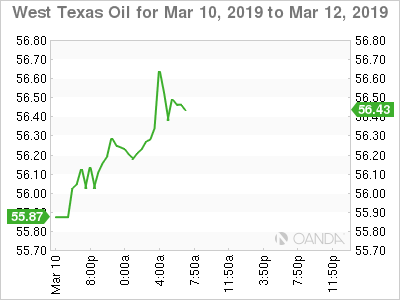
Oil prices start the week better bid, supported by comments from the Saudi oil minister Khalid al-Falih that an end to OPEC+ led supply cuts was unlikely before June. Also providing support is Friday’s U.S drilling activity report which showed a decline.
Brent crude futures are at +$65.02 per barrel, up +28c, or +0.4%, while U.S West Texas Intermediate (WTI) crude oil futures are at +$56.36 per barrel, up +30c, or +0.5% from Friday’s close.
Despite the gains, markets are being held back by revisions to global growth by OECD and G7 central banks.
Note: OPEC meets in Vienna on April 17-18, with another gathering scheduled for June 25-26, to discuss supply policy.
Crude prices are also being supported by Baker Hughes' latest weekly report showing the number of U.S rigs drilling for new oil production stateside fell by nine to 834.
This is the third consecutive week of declines as U.S oil producers trim their 2019 spending budgets. Nevertheless, because the overall U.S drilling level remains relatively high, the market still expects U.S crude output to rise above +13M bpd sooner than later.
Ahead of the U.S open, gold prices trade in a tight range, hovering near its one-week high print hit last week after a disappointing U.S NFP report increased concerns about a global economic slowdown. Spot gold has eased about -0.1% to +$1,296.62 per ounce. The 'yellow' metal rallied +1% on Friday, in its biggest one-day gain in a fortnight. U.S gold futures have slipped -0.2% to +$1,296.70 an ounce.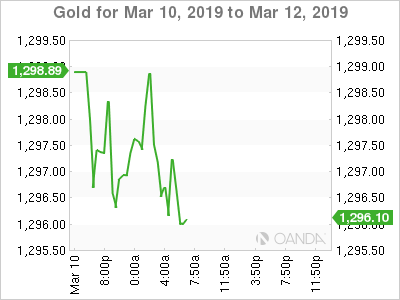
3. German Bund yields looking to go negative
Germany’s 10-year Bund yield, the eurozone’s most closely followed government bond, is close to trading in negative territory for the first time in three-years. This highlights the markets increasingly bleak outlook for the European economy.
Last week the ECB slashed its growth forecasts for 2019 to +1.1% from +1.7% and have basically ruled out hiking interest rates, currently negative, before the start of next decade at the earliest. The 10-year Bund yield trades at +0.06%.
Further pressure on eurozone bond yields has come from this morning’s disappointing German data – German industrial production fell in January (see below).
Elsewhere, the yield on 10-year Treasuries has backed up +1 bps to +2.64%, while in the U.K, the 10-year Gilt yield has eased -2 bps to +1.165%.
Note: Tomorrow’s Brexit votes will be a key driver for bonds.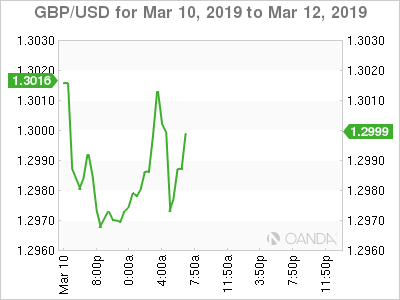
4. Dollar confined to tight ranges
GBP/USD (£1.2979) is lower by -0.3% as the Brexit situation enters an important week with the U.K parliament expected to vote this week on the plan to leave the EU. There is a lot of talk whether PM May would have the planned 'meaningful' vote tomorrow as scheduled or that she might change into a 'provisional' vote. There are concerns that if PM were to delay the 'no-deal,' Brexit or Article 50 extension votes then she could face resignations and possible removal as leader.
EUR/USD (€1.1240) is a tad higher as the market continues to focus on any divergence in central bank policies. The pair tested below the psychological €1.12 level after the ECB pushed back its view for the first potential hike until after 2019, but a soft U.S jobs report has given the 'single' unit some support.
USD/JPY (¥111.20) trades steady as the market focuses on the BoJ rate decision later this week.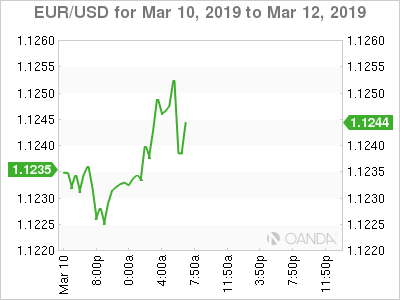
5. German Industrial output falls
Data this morning showed that German industrial production fell in January, missing expectations, and exports were flat. This suggests that Europe’s largest economy continues to flounder.
According to Destatis, the total industrial output declined -0.8% from the month before. The outcome missed the markets forecast of a +0.4% gain. But revised data for December now show a +0.8% M/M rise in industrial production, compared with a -0.4% drop previously reported.
Reflecting the trend, Destatis said that German exports were flat in December compared with November, whereas imports rose +1.5%. As a consequence, Germany’s adjusted trade surplus narrowed to +€18.5B from +€19.9B in December last year.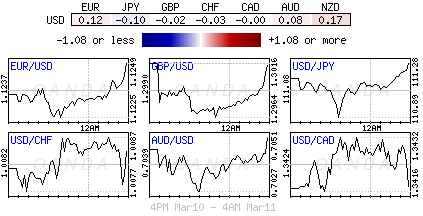
The Analytical Overview Of The Main Currency Pairs
The EUR/USD currency pair
Technical indicators of the currency pair:
Prev Open: 1.11933
Open: 1.12342
% chg. over the last day: +0.41
Day's range: 1.12231 – 1.12499
52 wk range: 1.1214 – 1.2557
EUR has recovered a major part of its losses after aggressive sales in Thursday, March 7. The Central Bank of Europe left the key interest rates at the previous level. The regulator worsened the forecast of the EU GDP in 2019-2020 and also notified the the long-term credit operation under the TLTRO program will be renewed to stimulate the economy. The EUR/USD quotes are consolidating around the key range of 1.1200-1.12500. The demand for the USD weakened after the ambiguous labour market reports in February. EUR/USD has further prospects for correction. You should open positions from the key levels.
At 14:30 (GMT+2:00) the US will publish the retail sales report.
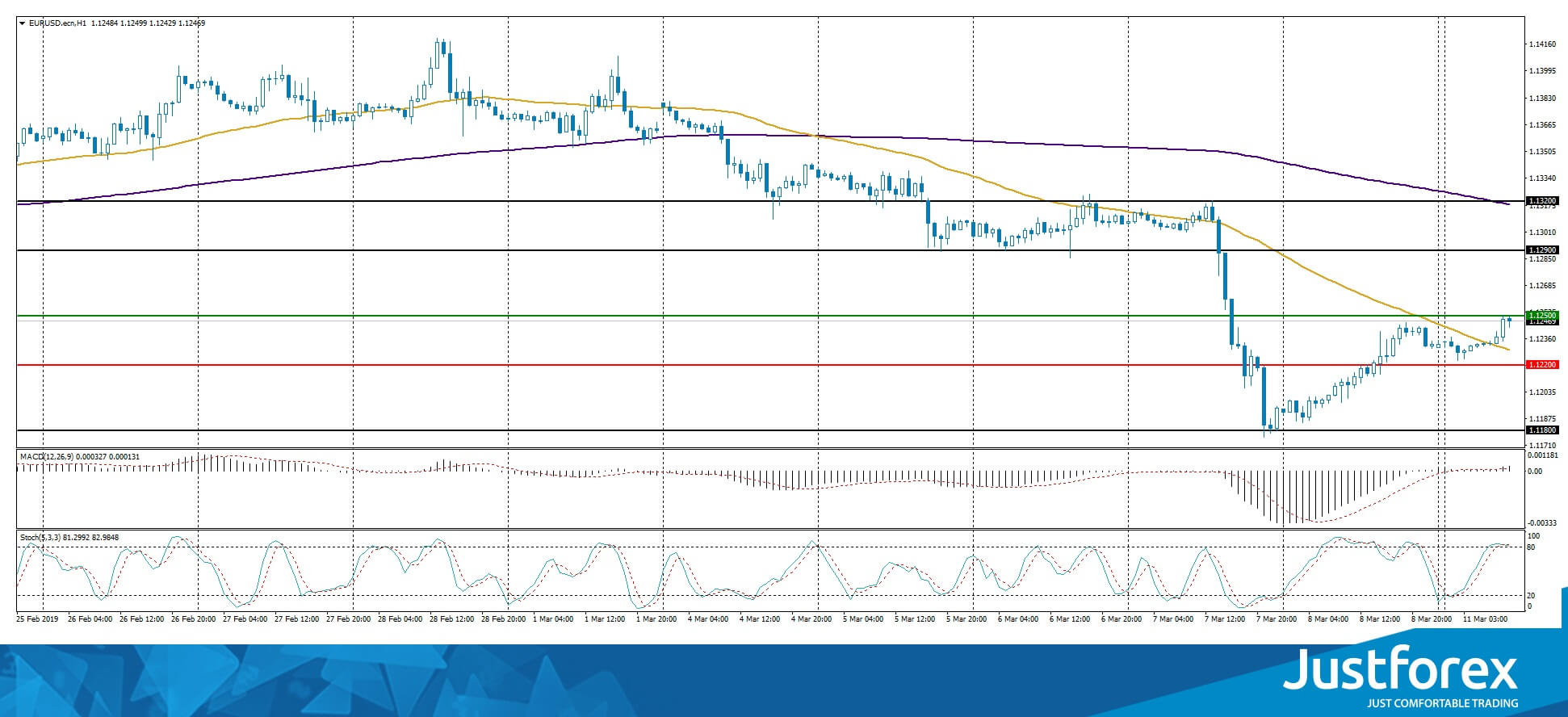
Indicators do not provide precise signals, the price has crossed 50 MA.
The MACD histogram is in the positive zone, which points toward the further recovery of EUR/USD quotes..
The Stochastic Oscillator is in the overbought zone, the %K line is crossing the %D line. There are no signals at the moment.
Trading recommendations
Support levels: 1.12200, 1.11800
Resistance levels: 1.12500, 1.12900, 1.13200
If the price fixes above the 1.12500, expect the quotes to correct toward 1.12900-1.13200.
Alternatively, EUR/USD can fall toward 1.11900-1.11700.
The GBP/USD currency pair
Technical indicators of the currency pair:
Prev Open: 1.30828
Open: 1.29668
% chg. over the last day: -0.52
Day's range: 1.29603 – 1.30180
52 wk range: 1.2438 – 1.4378
GBP/USD keeps the bearish mood due to the Brexit ambiguousness. Last week the GBP lost more than 250 points. Right now the quotes are consolidating around 1.29650 and 1.30150. The investors are waiting for the Parliament vote on Brexit tomorrow. You should open positions from the key levels.
The Economic News Feed for 11.03.2019 is calm.
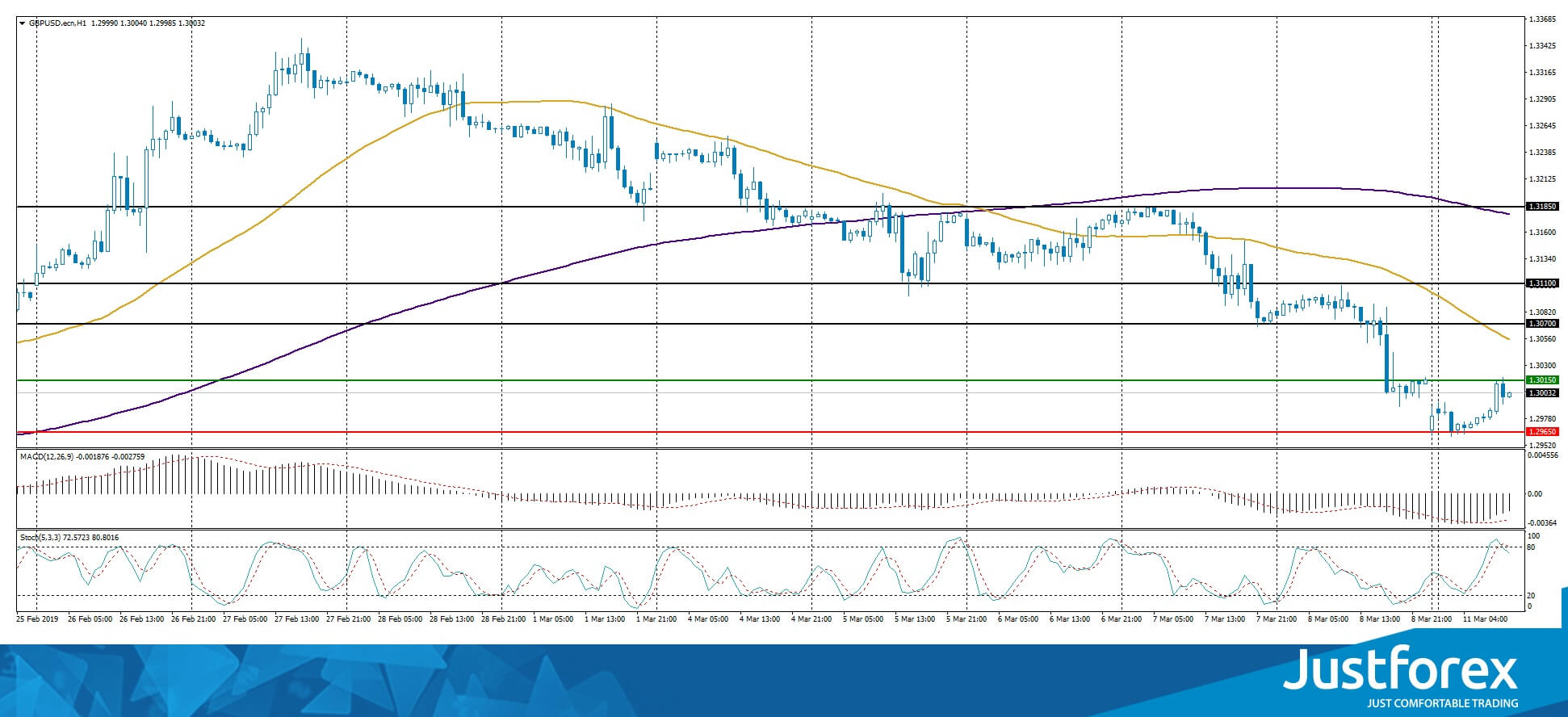
The price fixed below 50 MA and 200 MA which points to the power of the sellers
The MACD histogram is in the negative zone but above the signal line which gives a weak signal to sell GBP/USD.
The Stochastic Oscillator is near the overbought zone, the %K line is crossing the %D line. There are no signals at the moment.
Trading recommendations
Support levels: 1.29650, 1.29250, 1.29000
Resistance levels: 1.30150, 1.30700, 1.31100
If the price fixes below 1.29650, expect the quotes to fall toward 1.29300-1.29000.
Alternatively, the quotes can recover toward 1.30700-1.31000.
The USD/CAD currency pair
Technical indicators of the currency pair:
Prev Open: 1.34446
Open: 1.34148
% chg. over the last day: -0.30
Day's range: 1.34055 – 1.34343
52 wk range: 1.2248 – 1.3664
USD/CAD stabilized after a long rally since the beginning of the month. Right now the CAD is being traded in a flat. The key support and resistance levels are 1.34000 and 1.34400. A technical correction of USD/CAD is possible soon. The demand for USD is lowered due to ambiguous Labour Market reports for February. Keep an eye on the oil quotes dynamics and open positions from the key levels.
The Economic News Feed for 11.03.2019 is calm
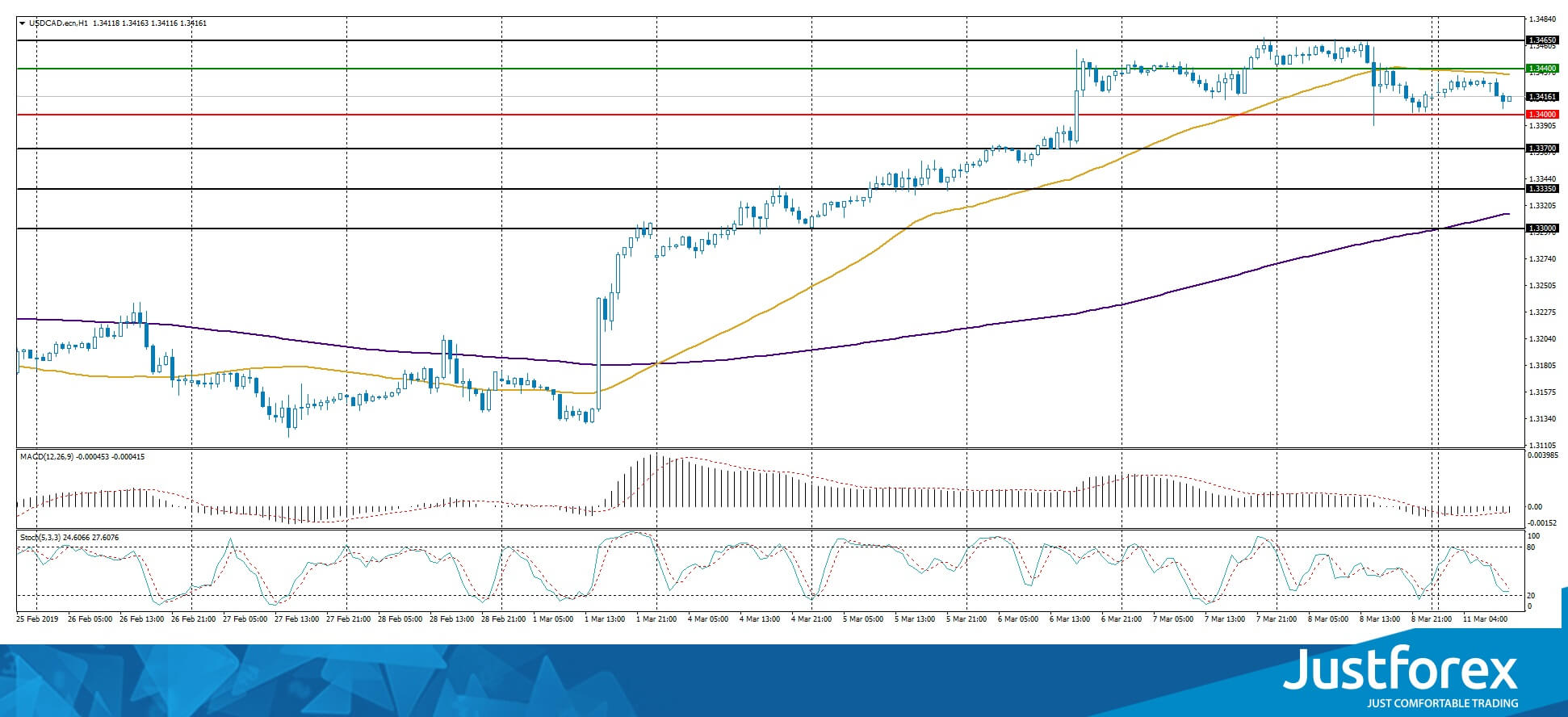
The price fixed between 50 MA and 200 MA which act as the strong dynamic support and resistance levels.
The MACD histogram is in the negative zone and below the signal line which points toward a correction of USD/CAD.
The Stochastic Oscillator is in the neutral zone, the %K line is crossing the %D line. There are no signals.
Trading recommendations
Support levels: 1.34000, 1.33700, 1.33350
Resistance levels: 1.34400, 1.34650, 1.35000
If the price fixes below the round 1.34000, expect the USD/CAD to correct toward 1.33600-1.33300.
Alternatively, the quotes can grow toward 1.34800-1.35000.
The USD/JPY currency pair
Technical indicators of the currency pair:
Prev Open: 111.533
Open: 111.003
% chg. over the last day: -0.38
Day's range: 110.877 – 111.307
52 wk range: 104.56 – 114.56
USD/JPY started to lower after the long consolidation. On Friday the quotes updated the key minimums. The demand for the safe haven currency is supported by the upcoming Brexit vote in Great Britain. The local support and resistance are 111.000 and 111.300. The trading instrument has further descent prospects. You should open positions from the key levels.
The Economic News Feed for 11.03.2019 is calm.
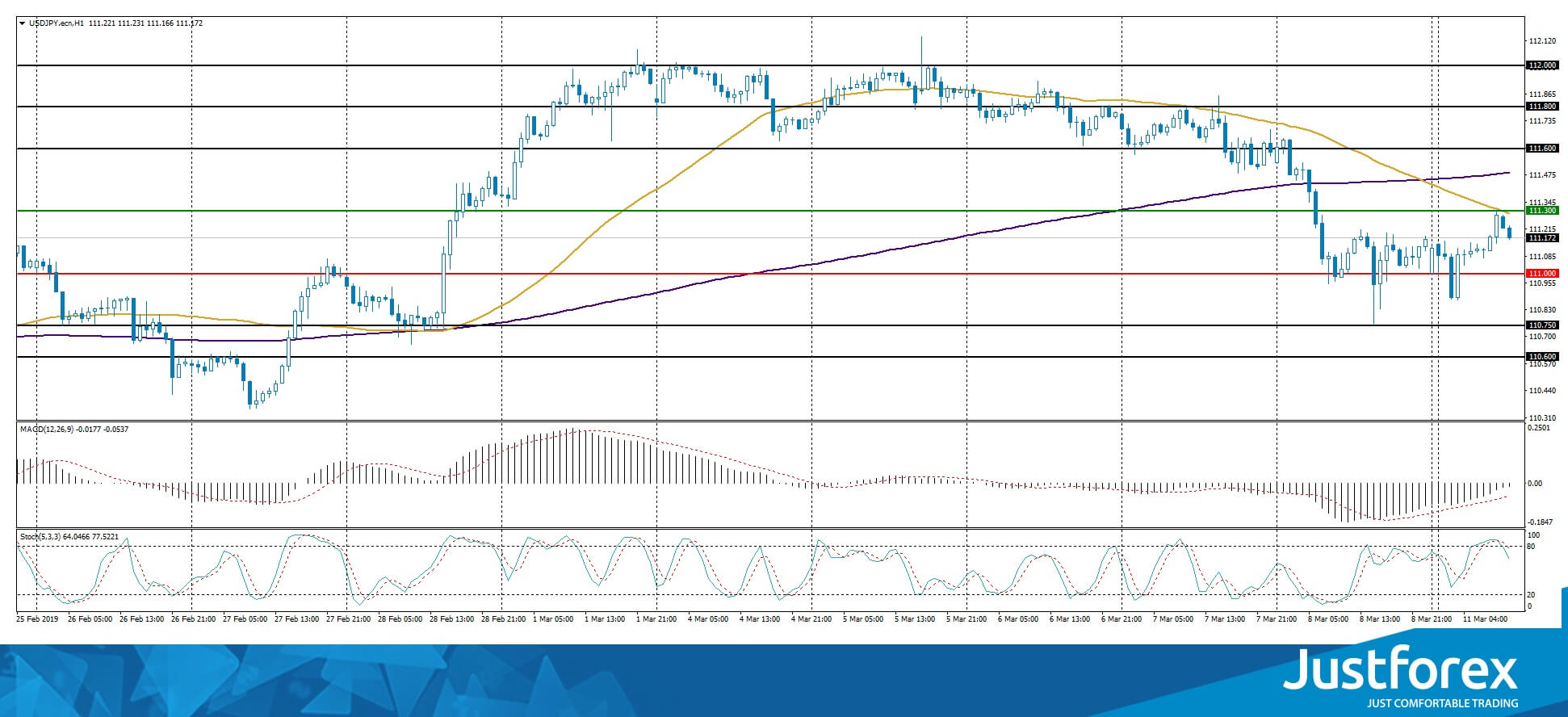
The indicators do not provide precise signals, the price is testing 50 MA.
The MACD histogram is close to 0.
The Stochastic Oscillator started to leave the overbought zone, the %K line is below the %D line which points toward the bearish mood.
Trading recommendations
Support levels: 111.000, 110.750, 110.600
Resistance levels: 111.300, 111.600, 111.800
If the price fixes below the round 111.000 the quotes can fall toward 110.750-110.600.
Alternatively, the quotes can grow toward 111.600-111.800.
The US Dollar Index Has Moved Away From Local Highs
Last week, the Reserve Bank of Australia, Bank of Canada and the ECB meetings were held. Regulators, as expected, kept key interest rates unchanged. The ECB lowered its forecast for the growth of the Eurozone economy in 2019-2020, and also announced the resumption of targeted longer-term refinancing operations (TLTRO). These events caused aggressive sales of the euro to lows since June 2017.
On Friday, the US dollar weakened against a basket of major currencies after the publication of ambiguous economic data. The number of building permits increased to 1.345M in January instead of 1.289M. Nonfarm employment change increased by only 20K in February, while experts expected 181K. This indicator shows a slowdown in economic growth in the country. At the same time, the unemployment rate fell to 3.8% in February instead of the forecasted 3.9%. Average hourly earnings increased by 0.4% compared with market expectations at 0.3%. The dollar index (#DX) closed the trading session in the negative zone (-0.37%).
Important economic reports are expected this week. Today, investors are focused on the US retail sales report. Also, US President, Donald Trump, should submit a draft budget for 2020, which was postponed due to the shutdown of the US government’s work. UK Parliament vote on Brexit deal will be held tomorrow. If the project is not accepted, then the Brexit delay will most likely be considered.
The "black gold" prices are rising after a decline the day before. At the moment, futures for the WTI crude oil have approached $56.70 per barrel.
Market Indicators
- On Friday, there was bearish sentiment in the US stock market: #SPY (-0.20%), #DIA (-0.04%), #QQQ (-0.15%).
- At the moment, the 10-year US government bonds yield is at the level of 2.65-2.66%.
The news feed on 11.03.2019:
- Retail sales in the US at 14:30 (GMT+2:00).
GBPUSD Downside Pressure Building
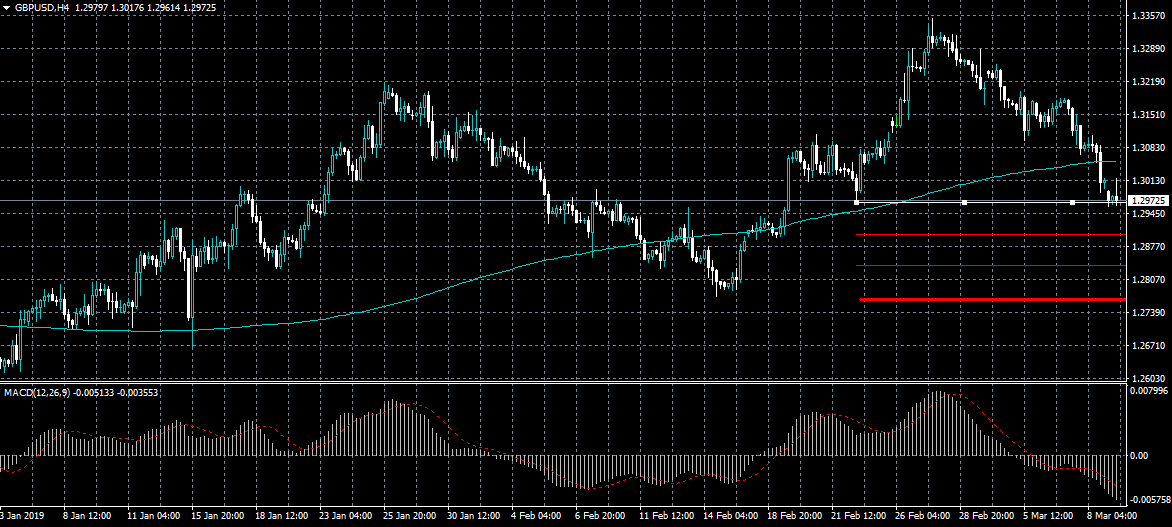
The British pound has come under further selling pressure against the US dollar during the European trading session, following recent reports that British PM Theresa May is set to cancel Tuesday’s Brexit vote. The GBPUSD pair looks increasingly weak and is starting to fall below the neckline of a bearish head and shoulders pattern. The 1.2900 level currently offers the strongest form of technical support below the 1.2975 level.
The GBPUSD pair is heavily bearish while trading below the 1.2975 level, key technical support remains at the 1.2900 and 1.2840 levels
If the GBPUSD pair trades back above the 1.2975 level, buyers may test towards the 1.3000 and 1.3015 resistance levels.
USDJPY Above Trendline Support
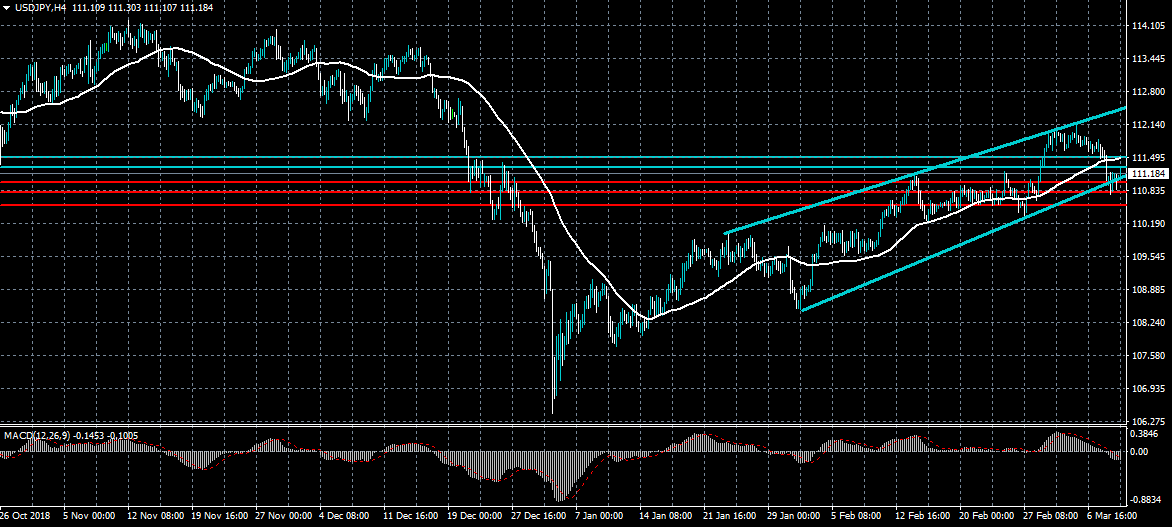
The US dollar is attempting to move higher against the Japanese yen currency in early Monday trading after sellers failed to hold price below key trendline support. The USDJPY pair could correct back towards the 112.00 level if buyers continue to force a recovery. The 111.60 level is the key intraday pivot point and the strongest form of technical resistance prior to the 112.00 level.
The USDJPY pair is only bearish while trading below the 111.10 level, key technical support is found at the 110.80 and 110.40 levels.
If the USDJPY pair trades above the 111.60 level, buyers may test towards the 112.00 and 112.50 resistance levels.