

Sample Category Title
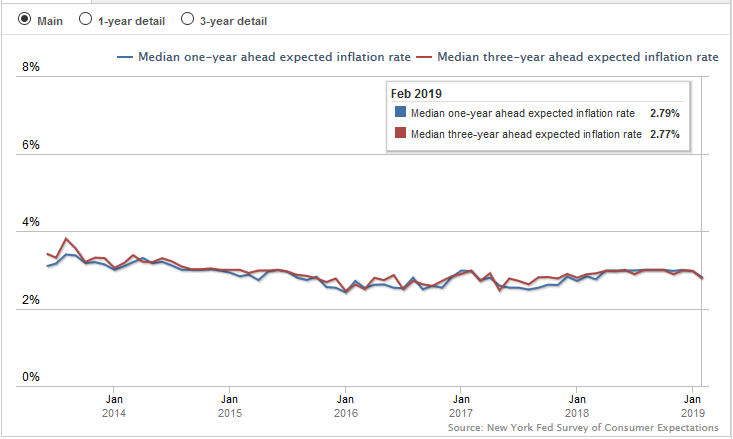
NY Fed: Inflation expectation dropped to 2.8%, wage growth expectation rose
According to New York Fed's February Survey of Consumer Expectations:
- 1-year median inflation expectations dropped -0.2% to 2.8%.
- 3-yer median inflation expectations dropped -0.2% to 2.8%.
- Uncertainty regarding future inflation outcomes dropped slightly.
- 1-year earnings growth expectation rose 0.1% to 2.5%.
- 1-year Unemployment expectation dropped from 40.6% to 37.2%
Saudis are Doing Whatever it Takes to Keep Oil Higher
- USD – Powell in no hurry to change policy
- Trump – 2020 budget to request $8.6B for wall
- Oil – Saudi keeps on over-delivering on supply cuts
- Stocks – Dow taken lower by Boeing
- Gold – ETF outflows continue for a fifth week
USD
Fed Chair Powell maintained his dovish pivot over the weekend, with the most interesting comment being he will likely not overreact if inflation is modestly above their target. Dovishness was confirmed at both a speech late on Friday in Stanford, California and during his interview on 60 Minutes. Powell noted the Fed will watching retail sales data to see confirmation that consumer spending will rebound. On Quantitative Tightening (QT), he expects to announce a new plan “reasonably soon”. Retail sales did rebound in January, but December was revised even lower.
We will next hear from Powell at the March 19-20th policy meeting. Softer growth is expected by Wall Street and downgrades to the economic forecasts are expected. The rate projections will likely deliver a downgrade in the forecast for this year, from two hikes to one hike or possibly no hikes.
Trump
President Trump’s fiscal 2020 budget will anger Democrats and is expected to be rejected by Congress. The President is expected to cut non-defense spending by 5%, while increasing military spending and raising $8.6 billion for his wall along the Mexican border. Trump’s skinny budget would mean we would not see a balanced budget for 15 years. It is also under the assumption the US would maintain stronger economic growth.
Trump’s budget is expected to be released at 11:30 a.m. EST on the Office of Management and Budget’s website. The US will need to see political leaders agree on funding by October 1st, which is around the same deadline for raising the debt limit. Trump is no stranger to government shutdowns and this budget battle will likely go down to the wire, which means the severe economic risks of a default may rattle the markets closer to the summer time.
Oil
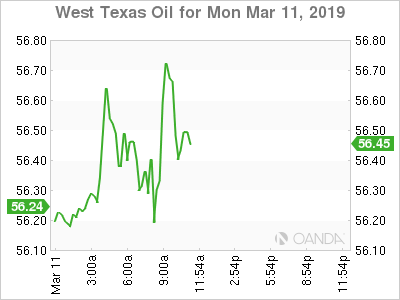
Saudis are determined to regain control of the oil market as they will pump well below 10 million barrels per day (bpd) in April, with exports seen below 7 million bpd. Saudi Arabia is delivering significantly less oil to their oil customers is providing a slight bid for oil.
Oil’s gains were capped as the EIA 2019 oil report reminded us that US will drive global oil supply growth over the next five years because of its shale industry. The EIA sees demand increasing at an annual pace of 1.2 million bpd to 2024.
Crude prices have been rangebound since mid-February with the recent headlines giving a slight edge to the argument that the OPEC-led production cuts are helping rebalancing the oversupplied market. The US will become a net exporter with oil by 2021 and the market might start to be more sensitive to rig count data from the US. When we start to see rig counts rise back to the levels we saw in 2014, we could see oil pullback sharply.
Stocks
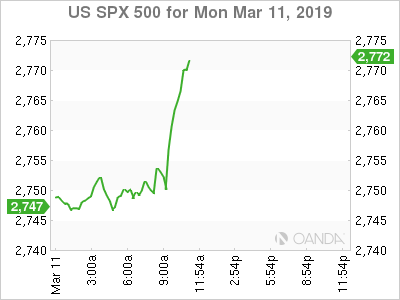
Dow is being dragged lower after a second deadly crash involving a Boeing 737 Max plane led China, Indonesia and Ethiopia to ground the aircraft. The 737 Max is key for Boeing and generates almost one-third of their profit. Many details still need to be discovered about the tragic crash, but initial assessments are that this could be a training issue. The Boeing 737 plane has its engines ahead of the wings to save 14% in fuel consumption. The Maneuvering Characteristics Augmentation System may have led the plane to overcompensate trying to level off the plane. Many analysts are comparing this Boeing crash in Indonesia.
Gold
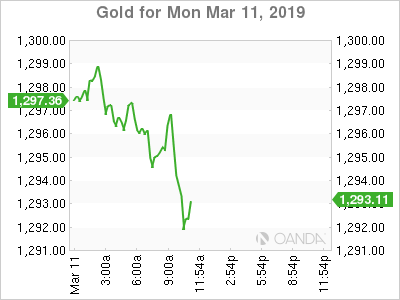
The precious metal kept a soft tone to start the week as investors abandoned gold ETF holdings for a fifth week. Gold last week rose sharply after a poor US jobs number but was unable to capture the $1,300 oz level. As trade optimism grows for a deal between the two largest economies, traders may need a fresh catalyst to see higher prices.
Sunset Market Commentary
Markets
Global core bonds are trading mixed to little changed today with US Treasuries underperforming German Bunds. Core bonds already ended close to unchanged last Friday and hovered sideways today as well. Disappointing German industrial production data for January had little impact on German Bunds before the EU opening bell. Risk sentiment in Asia was positive overnight. European equities opened cautiously in green, weighing slightly on core bonds. The German yield curve is mixed with changes in the range of -1.0 bp (5-yr) to +0.7 bps (30-yr). US Treasuries edged lower throughout the day. The mid-month refinancing operation will start later today with the sale of 3-yr Notes. January US retail sales printed mixed and had little impact on trading. The headline reading rose 0.2% M/M vs. a downwardly revised-1.6% in December. The control group reading, a proxy for US consumption growth, rose 1.1% (M/M) in January, well above consensus (0.6% M/M). However, the December reading was downwardly revised from -1.7% to -2.3% (M/M). The market reaction remained limited, even as US equity markets opened strong. The US yield curve is moving higher with changes up to 1.4 bps (30-yr). Peripheral spreads are close to unchanged with Italy (+5 bps) underperforming as the government coalition is bickering about a French-Italian rail line.
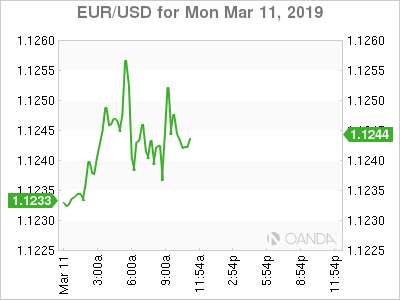
Global markets are trading in a rather constructive way (risk-on) given investor worries on growth in the wake of last week’s ECB policy guidance and considering Friday’s mediocre US payrolls. Asian equities rebounded. Sentiment in Europa is more cautious. German production data were mixed at best. Even so, EUR/USD regained slightly further ground. ECB’s Coeuré said last week’s guidance on interest rates shouldn’t be considered as a change in the ECB course. We doubt that this ‘clarification’ will be a big help for the euro short-term. The intraday EUR/USD rebound stalled in the mid 1.12 area. US retail sales were the next meaningful data reference for guidance on (US & global) growth. However, the report failed to give a clear signal on the momentum in US spending (January better than expected, but further downward revision of December). The reaction of US yields and the dollar was insignificant. EUR/USD hovers in the mid 1.12 area. USD/JPY struggles not to fall below the 111 handle even as sentiment on risk is quite positive. So, last week’s USD outperformance has been put on hold, at least for now.
The headlines from the latest episode in the UK-EU Brexit talks only confirmed that the deadlock persists just one day before UK PM May has to bring a (new?) Brexit deal to Parliament for another ‘meaningful vote’. The growing prospect/risk of political chaos in the UK weighed slightly on sterling this morning, but the UK currency soon found a better bid again. For now, we didn’t seen any clear indication that chances on an orderly Brexit are growing. In this respect, current relative sterling strength remains striking. EUR/GBP is again trading near the 0.86 pivot. Cable is changing hands in the 1.3075 area, compared to levels below 1.30 in early European dealings this morning.
News Headlines
Norwegian inflation rose 0.8% MoM (3.0% YoY) in February following a -0.5% MoM decline (3.1% YoY) in January. Core measures excluding tax changes and energy also jumped (1.2% MoM, 2.6% YoY), as did February’s PPI (0.4% MoM, 8.0% YoY). The krona advanced 0.5% as the data beat market estimates, trading close to EUR/NOK 9.77.
Czech CPI inflation accelerated more than expected in February even after January’s steep increase. Prices edged higher at 0.2% MoM (2.7% YoY) vs. 0.1% (2.6% YoY) anticipated but leaving the Czech koruna unimpressed. EUR/CZK even gained slightly, changing hands at 25.66.
The Turkish economy slipped into recession territory in 2018. The country posted negative growth of -2.4% QoQ (‑3.0% YoY) in 2018Q4, following a red Q3 (-1.6% QoQ). The lira showed some intraday volatility after the release but recovered losses soon as investors largely anticipated the weak outcome. EUR/TRY hovers around 6.12.
US: January Retail Sales Bounce, December Revised Even Lower
January retail sales showed that consumer spending bounced back a bit in January, but not enough to offset a December that was in some ways the worst on record. Q1 consumer spending growth will likely be below 2%.
It Was the Best of Times, It Was the Worst of Times
After 2018 ended with a thud, retailers cleaned up the holiday displays and pushed forward into the new year. We already knew going into today's report for January retail sales that the prior month's report was ugly. In revisions today, we learned that December 2018 was, at least in some respects, the worst on record. There was clearly a bounce in January, but not enough to completely alleviate concerns about the ability of the consumer to drive growth in a meaningful way in 2019.
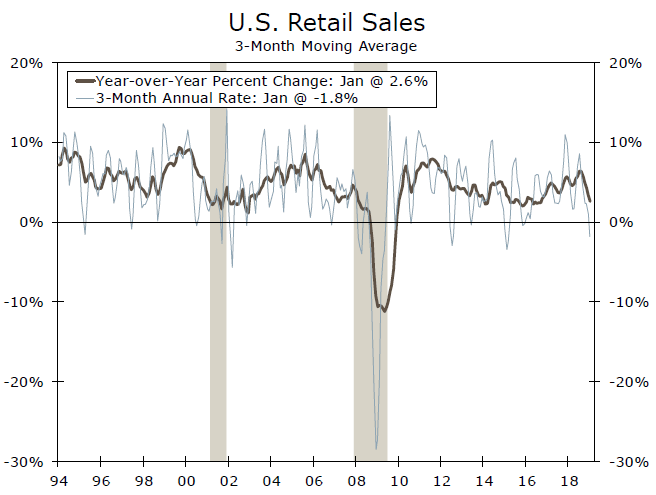
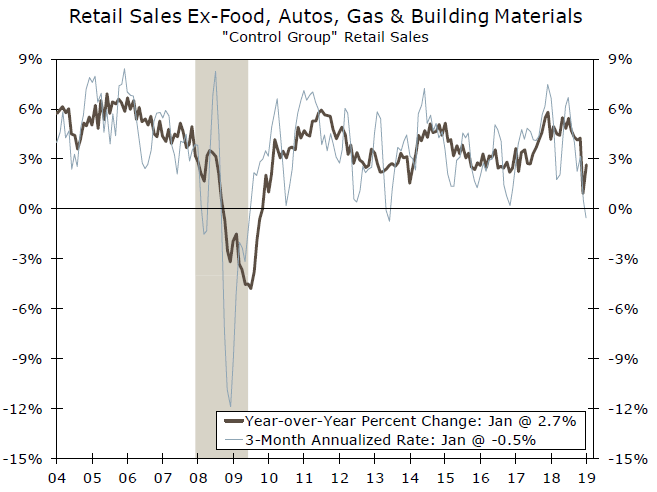
Headline retail sales edged up just 0.2% after a 1.6% decline in the prior month (revised down from the 1.2% decline as first reported). The December drop in retail sales was the worst since 2009, and other details were worse. Control group retail sales strips away food, autos, gas and building materials and serves as a good proxy for personal consumption in the GDP report. The 2.3% drop in December control group sales was the largest decline since 2000. That would be alarming were it not for the significant 1.1% rebound for this category in January, an increase that matched the largest increase since February 2014.
What the Heck Happened in December?
So why was December so awful for retail sales? There was no obvious culprit from a store category standpoint. There were broad declines in most categories up to and including online retailers, which have been known to swim against the stream and post a gain even in months where brick and mortar stores struggled. Non-store retailers, as they are called in the report, fell 5.0% in December—the worst month for online sales since January 2001 and the worst December on record.
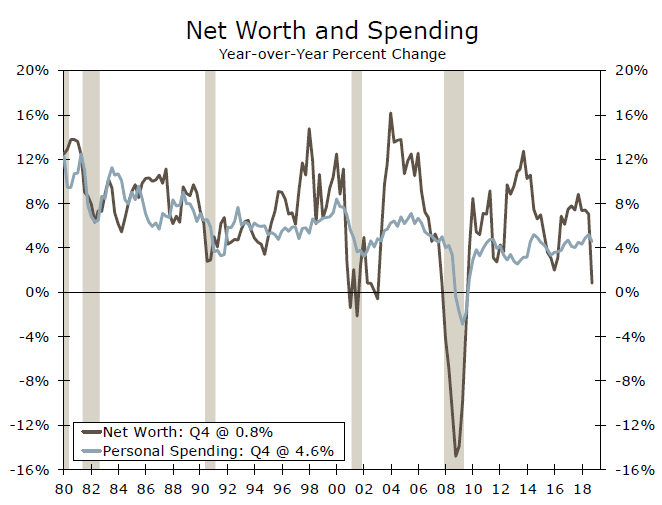
The stock market was exceptionally volatile in December and Christmas week in particular was characterized by steep sell-offs. While these declines have been largely retraced after a solid start to 2019 in financial markets, the impact on household psyche during a key period for shopping likely played a role. Official numbers on household wealth released last week put a spotlight on the hit to net worth and the relationship this measure has had over time with personal spending.
Triumph or Disaster?
In consecutive months control group retail sales posted both the biggest drop in 19 years and then tied the biggest increase of the expansion. Rudyard Kipling advised meeting with triumph and disaster and treating those two imposters just the same. That is the approach we take on these choppy readings from retail sales. The stock market swoon last year was a big hit to household wealth, but the rebound more recently assuages that somewhat. First quarter spending is dented. We are likely looking at a 1 %-handle on real PCE growth. But in our view this is not the beginning of a serious retrenchment in which consumers go into hiding.
BoE Haskel: Brexit is a process that might create more cliff-edges
Jonathan Haskel, External Member of BoE MPC, said in a speech that UK investment has been very weak in the last couple of years. Brexit uncertainty is weighing on business sentiment.
Also, he noted that "Brexit is a process not an event". And he warned that "that process has the possibility of creating more cliff-edges; the length of the transitional/implementation period, for example".
"Since the very nature of investment is that it needs payback over a period of time there is a risk that prolonged uncertainty around the Brexit process might continue to weigh down on investment."
USD/JPY Mid-Day Outlook
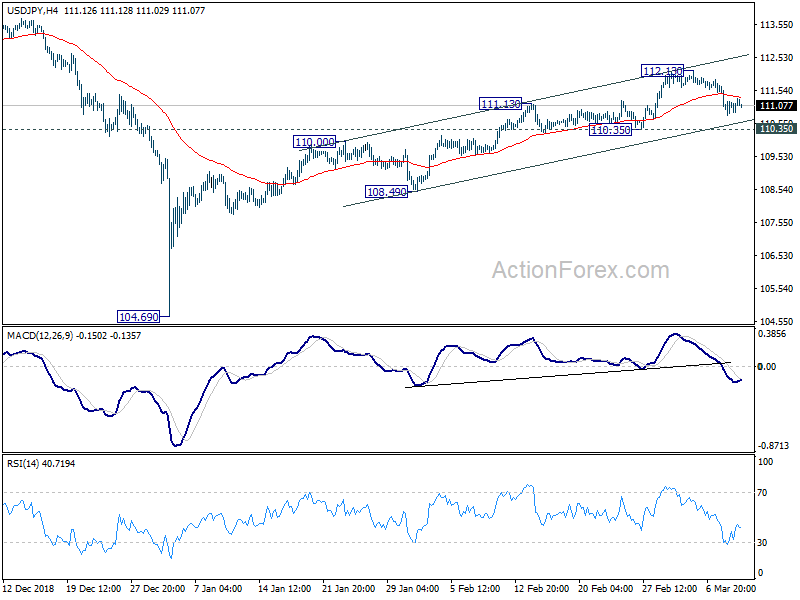
Daily Pivots: (S1) 110.76; (P) 111.20; (R1) 111.62; More...
USD/JPY is staying in consolidation from 112.13 and intraday bias remains neutral. As long as 110.35 support holds, near term outlook remains bullish and rise from 104.69 is still in favor to resume. On the upside, break of 112.13 will target 114.54 resistance next. However, firm break of 110.35 should confirm near term reversal and turn outlook bearish for 108.49 support and below.
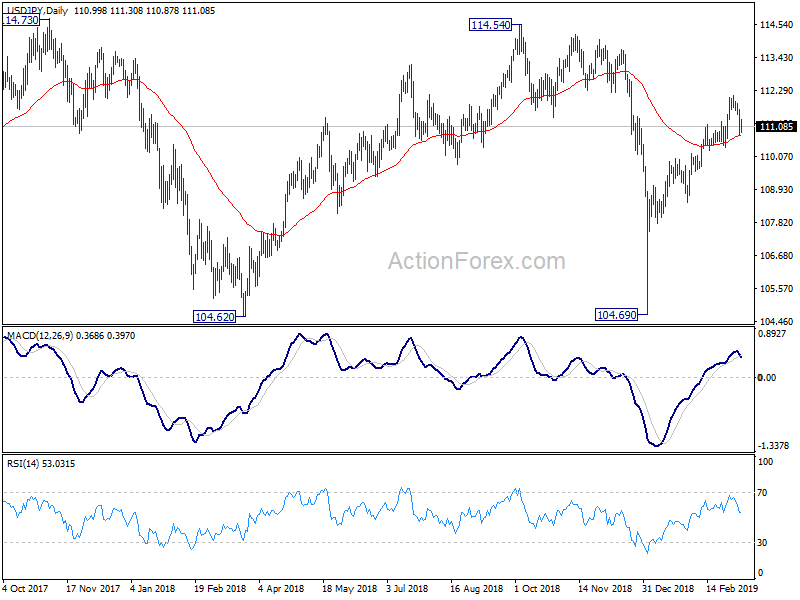
In the bigger picture, strong rebound from 104.69 argues that decline from 118.65 (2016 high) has completed with three waves down to 104.69, after failing 104.62. More importantly, the rise from 98.97 (2016 low) could be resuming. Decisive break of 114.54 resistance will add more credence to this bullish case and target 118.65. This will now be the favored case as long as 110.35 support holds. However, firm break of 110.35 will mix up the medium term outlook again and turn focus back to 104.69 low.
USD/CHF Mid-Day Outlook
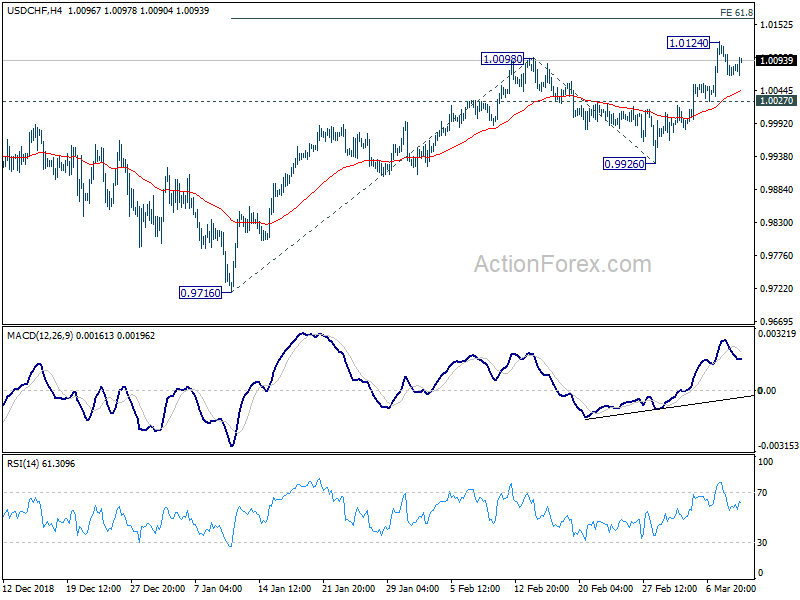
Daily Pivots: (S1) 1.0060; (P) 1.0089; (R1) 1.0110; More....
USD/CHF is staying in consolidation from 1.0124 temporary top and intraday bias remains neutral first. In case of deeper retreat, downside should be contained by 1.0027 minor support to bring another rally. On the upside, break of 1.0124 will target 61.8% projection of 0.9716 to 1.0098 from 0.9926 at 1.0162 and then 100% projection at 1.0308.
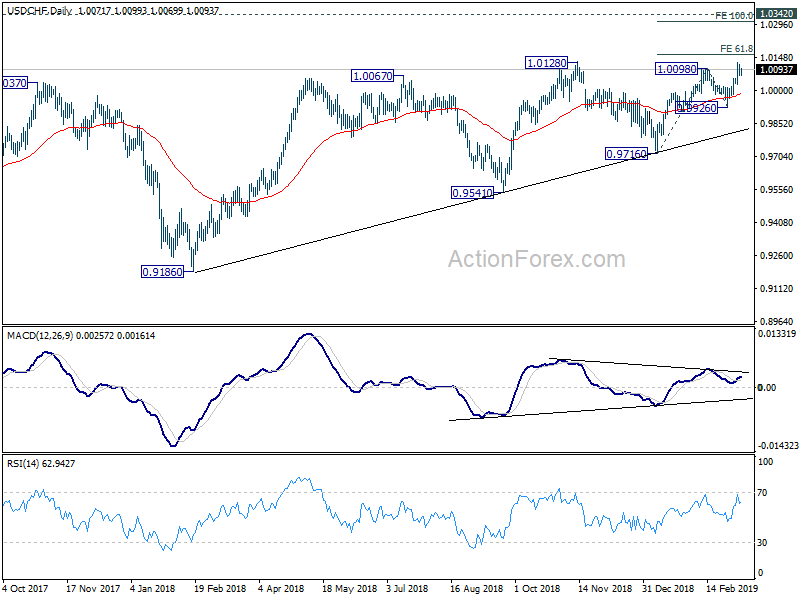
In the bigger picture, USD/CHF drew strong support from medium term trend line and rebounded. That suggests rise from 0.9186 is still in progress. Further break of 1.0128 will confirm up trend resumption and target 1.0342 key resistance. Nevertheless, break of 0.9926 support will be the first signal of medium term reversal and bring another test on the trend line.
EUR/USD Mid-Day Outlook
Daily Pivots: (S1) 1.1197; (P) 1.1221; (R1) 1.1258; More.....
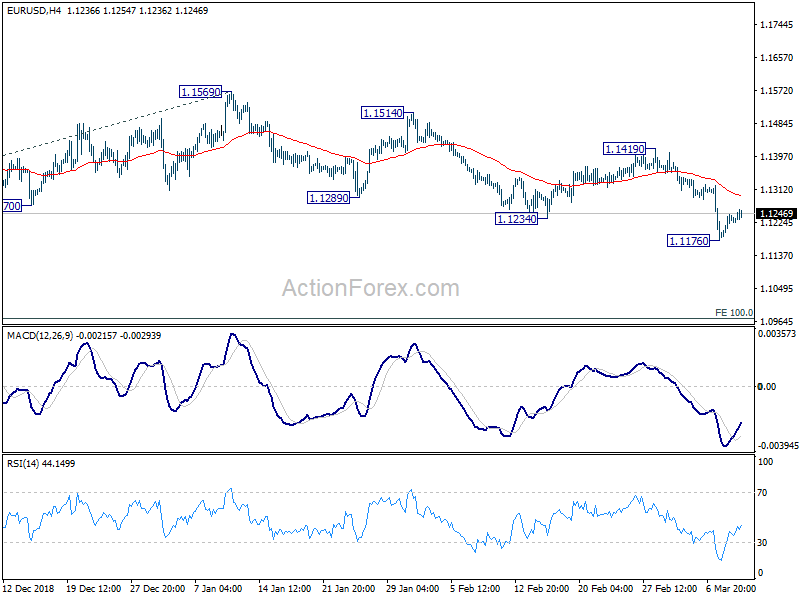
EUR/USD is staying in consolidation from 1.1176 temporary low and intraday bias remains neutral. Upside of recovery should be limited well below 1.1419 resistance to bring fall resumption. On the downside, break of 1.1176 will extend the down trend from 1.2555 and target 100% projection of 1.1814 to 1.1215 from 1.1569 at 1.0970 next.
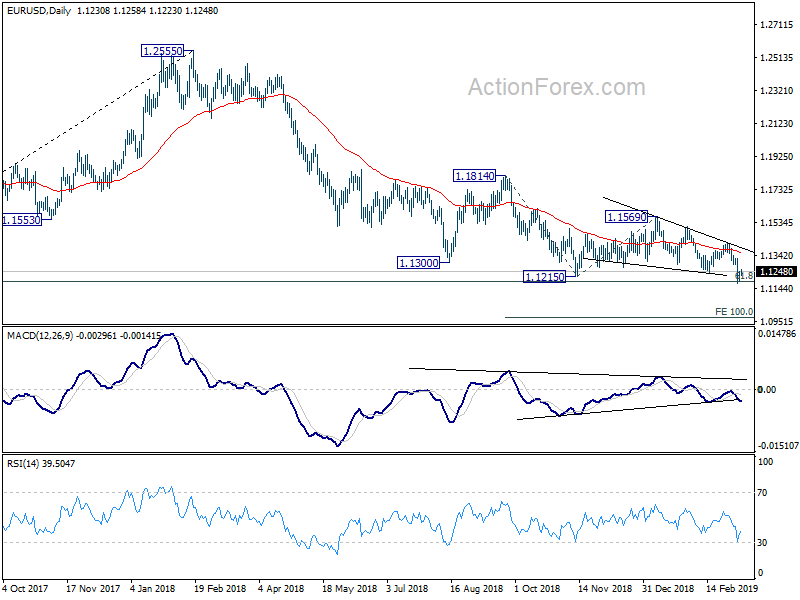
In the bigger picture, down trend from 1.2555 medium term top is still in progress. Bearishness is affirmed by sustained trading below falling 55 week EMA. 61.8% retracement of 1.0339 (2017 low) to 1.2555 at 1.1186 is met. Sustained break there will pave the way to retest 1.0339. On the upside, break of 1.1569 resistance will now indicate completion of such down trend and turn medium term outlook bullish.
US: Retail Sales Rebound in January
Retail sales rose 0.2% (m/m) in January, beating expectations that called for no change from December. The headline number was revised down for December to -1.6% (previously -1.2%). All told, retail sales haven't changed much since last September.
Eight of thirteen categories saw sales increases in January. Monthly gains at sporting goods (+4.8%), building materials (+3.3%), non-store retailers (+2.6%), and food and beverage stores (+1.1%) offset declines at gasoline stations (-2.0%, largely a reflection of falling fuel prices). Also of note was that sales of motor vehicles and parts declined 2.4% in January, ending a streak of four consecutive monthly advances.
Excluding the most volatile categories (gas, autos, building materials, and food services), the control group used in calculating GDP staged a decent comeback in January. It advanced 1.1% on the month, beating expectations for a 0.6% gain, and partially reversing the 2.3% decline in December.
Key Implications
January's retail sales report signals that U.S. consumers spent a little more than expected. This is a positive sign for first quarter consumer spending and GDP, which we expect to have slowed to about half of 18Q4's 2.8% pace due to weak momentum, and the impact of the 35-day government shutdown.
Looking ahead, we anticipate that tight labor market conditions will persist, supporting strong growth in personal disposable income. This should see consumer spending perk up in the second quarter, and maintain a steady trend in the second half of the year, once again leaving the consumer as the ultimate driver of growth for the U.S. economy for 2019. That said, a number of unresolved risks linger that can easily sideswipe confidence, and therefore spending. Elevated trade tensions and government fiscal uncertainty could continue to weigh on financial markets and confidence for some time yet.
Canadian Dollar Subdued as U.S. Retail Sales Jump
The Canadian dollar is showing little movement in the Monday session. Currently, the pair is trading at 1.3423, up 0.04% on the day. In the U.S., retail sales rebounded in February. Core retail sales sparkled with a 0.9% gain, up from -1.8% in January. Retail sales improved to 0.2%, compared to -1.2% in the previous release. Both indicators beat their estimates. There are no Canadian events until Thursday. On Tuesday, the U.S. releases CPI numbers.
Canada and the U.S. both ended the week with key employment numbers, albeit with very different results. Canada added 55.9 thousand, crushing the estimate of 0.6 thousand. In the U.S., nonfarm payrolls plunged to 20 thousand, much worse than the forecast of 180 thousand. Wage growth improved to 0.4%, above the estimate of 0.3%. The Canadian dollar responded with slight gains on Friday, after rolling off five six losing sessions.
There were no surprises from the Bank of Canada last week. The bank stayed on the sidelines and maintained the benchmark rate at 1.75%, where rates have been pegged since October. The rate statement was dovish, as policymakers dropped a reference to rates rising over time. Instead, the bank said that the economy will continue to require stimulus and said that there was “increased uncertainty” about future rate hikes. The pessimistic language is a result of the economic slowdown, which has been worse than the bank anticipated. The BoC’s dovish tone has reinforced market expectations that the bank will not raise rates in the near future, and could lower rates if the economy continues to weaken. Canada’s GDP contracted by 0.1% in November and December, and another decline could send the Canadian dollar even lower.