

Sample Category Title
USDCAD Faces More Bull Pressure Short Term
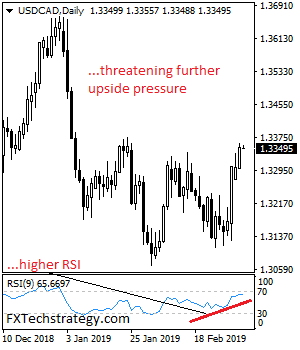
USDCAD faces more bull pressure short term as it looks to extend its strength. Support comes in at the 1.3250 level where a break will aim at the 1.3200 level. Further down, support comes in at the 1.3150 level where a turn lower may occur. But if further weakness is triggered support comes in at the 1.3100 level. Conversely, resistance lies at the 1.3350 level where a violation will target the 1.3400 level. Further up, resistance resides at the 1.3450 level and then the 1.3500 level. All in all, USDCAD looks to weaken further lower.
EUR/JPY Testing Crucial Support Near 126.30
Key Highlights
- The Euro climbed towards 127.50 before starting a downside correction against the Japanese Yen.
- A key bullish trend line is in place with support at 126.30 on the 4-hours chart of EUR/JPY.
- The Euro Area Retail Sales increased 1.3% (MoM) in Jan 2019, better than the +1.2% forecast.
- The US ADP Employment figure for Feb 2019 will be released today, which could change 189K.
EURJPY Technical Analysis
The Euro climbed higher steadily in the past four weeks and broke the 126.00 resistance against the Japanese Yen. The EUR/JPY pair tested the 127.50 level and later started a downside correction.
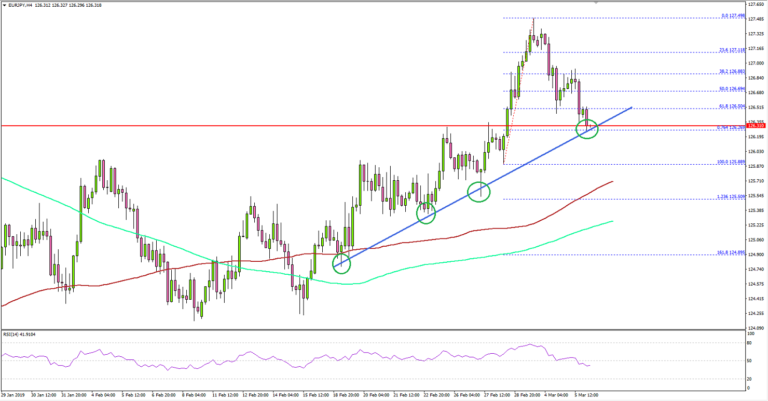
Looking at the 4-hours chart, the pair placed itself above the key 126.30 resistance and surged towards the 127.50 level. A high was formed at 127.49 and later the pair corrected below the 127.20 support.
There was a break below the 127.00 support and the 61.8% Fib retracement level of the last wave from the 125.88 low to 127.49 high. However, the 126.30 level acted as a strong support and prevented further declines.
There is also a key bullish trend line is in place with support at 126.30. Therefore, there is a crucial support in place near 126.30, below which the pair could turn bearish in the near term.
If the pair stays above 126.30 and climbs higher, it is likely to trade above the 127.20 resistance. The next key resistances are near 127.50 and 128.00.
Fundamentally, the Euro Area Retail Sales report for Jan 2019 was released recently. The market was looking for a 1.2% increase in sales in Jan 2019, compared with the previous month.
The result was better than the forecast as there was a 1.3% rise in sales, which was a lot better than the last decline of 1.4%. The yearly change was +2.2%, much better than the last +0.3%.
The report added that:
The volume of retail trade increased by 1.7% for non-food products, by 1.6% for automotive fuel and by 0.6% for food, drinks and tobacco in January2019, compared with December 2018.
The outcome helped the EUR/JPY pair in the short term, but it must gain momentum above the 127.20 resistance to start a fresh upward move.
Economic Releases to Watch Today
- US ADP Employment Change Feb 2019 – Forecast 189K, versus 213K previous.
- US Trade Balance Dec 2018 – Forecast $-57.0B, versus $-49.3B previous.
- BoC Interest Rate Decision – Forecast 1.75%, versus 1.75% previous.
Australia GDP slowed to 0.2% in Q4, RBA may need to revise down forecasts in May
Australia GDP grew only 0.2% qoq in Q4, slowed from prior quarter's 0.3% qoq and missed expectation of 0.5% qoq. Annual growth slowed to 2.3%, down from Q3's 2.7%. Looking at some details, terms of trade rose 3.2% qoq, 6.1% yoy. But consumer spending rose only 0.4% qoq, 2.0% yoy. Home building contracted -3.4% qoq, slowed to 2.5% yoy. Farm output dropped -4.0% qoq, -5.8% yoy. Full release here.
Australian Treasurer Josh Frydenberg tried to talk down the slowdown. He noted that "the moderation in part reflects the impact of the drought, lower mining investment and as we continue to move from the construction to the production phase, as well as a decline in residential construction activity from record levels".
However, the country "continues to grow faster than any G7 nation except for the United States". And, 0.2% growth was "within the range of market expectations" to him. Also, "over the past 12 months, more than 270,000 new jobs were created and more than 8 out of every 10 of these jobs were full-time."
Westpac noted that the data now posts a "challenge" for RBA to "credibly maintain its GDP growth forecasts at 3% in 2019 and 2.75% in 2020". Thus RBA is likely to revise down its growth forecasts in May SoMP. And the policy stance could then shift to steady with a clear easing bias. Westpac continued to expect RBA to cut twice this year in August and November.
Daily Markets Broadcast
Wall Street lacks inspiration from trade talks
No news is good news, so they say, but not when it comes to trade negotiations and Wall Street. Indices edged marginally lower yesterday though without conviction. Gold halted its recent slide on the lack of news.
US30USD Daily Chart
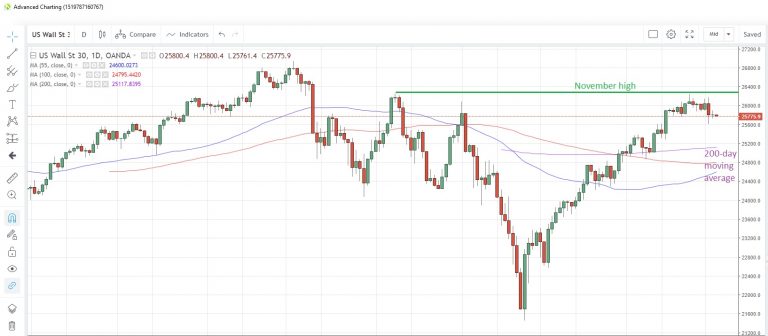
The US30 index fell for a second straight day and has carried the negative sentiment across to today’s start
Resistance at the November high of 26,249 remains intact. Support may be found at the 200-day moving average at 25,117
The run-up to Friday’s non-farm payroll report kicks off today with the release of the ADP employment change. Estimates suggest a lower 189k addition from January’s 213k.
DE30EUR Daily Chart
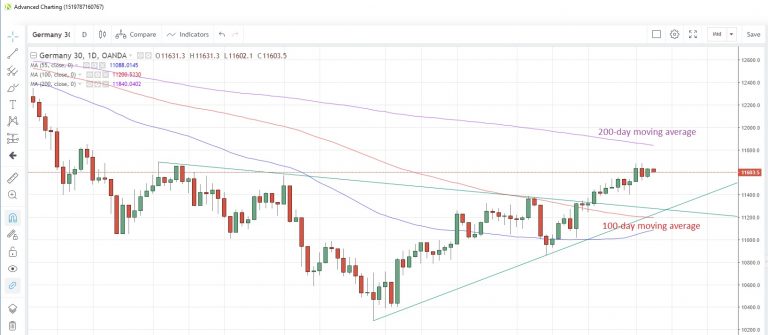
The Germany30 index rebounded yesterday after services PMIs across a number of Euro-zone countries showed improvement
The index is sandwiched between resistance at the 200-day moving average, which is at 11,840 today, and trendline support around the 11,277 level. The 100-day moving average lies at 11,200
Euro-zone service sector PMIs for Germany, Spain, France, Italy and the Euro-zone as a whole all beat forecasts in February. There are no major European data releases scheduled for today.
XAU/USD Daily Chart
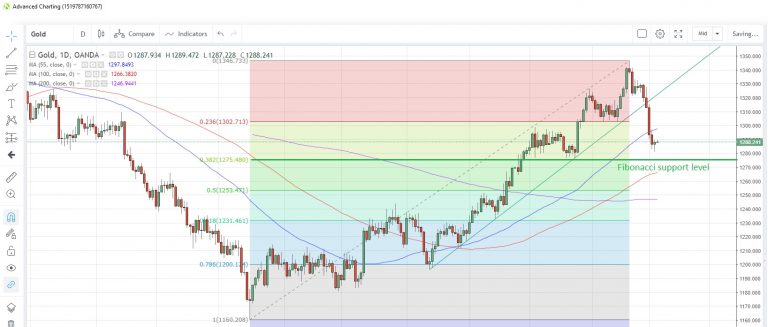
Gold snapped a four-day losing streak yesterday after touching the lowest in 5-1/2 weeks earlier in the session, as a lack news on the trade negotiations front rekindled demand for the precious metal as a safe-haven asset
The 38.2% Fibonacci retracement of the August to February rally lies at 1,275.48. Resistance could be found at the 55-day moving average at 1,297.85, which was broken to the downside for the first time since November 28 last Friday
Investment bank Goldman Sachs raised its 12-month gold price forecast to 1,450 from 1,425, according to a client note yesterday.
Markets Continue Hitting The Snooze Button
Markets continue hitting the snooze button
Wall Street searched for inspiration overnight but found very little in the pot, with lower Chinese growth balancing out better US ISM services sector data and a seven-month high in new home sales. Stocks limped into the close with the S&P finishing 0.1% down, the Dow Jones dropped 0.05% and the Nasdaq fell 0.2%. Individual stocks saw intra-day volatility with General Electric falling nearly 5%, but the net effect was that gainers and losers cancelled each other out.
The currency markets showed a smidge more life with the dollar rising overnight. The dollar index rose 0.16% to two-week highs as a directionless macroeconomic picture saw light haven flows head back into the greenback. The British Pound (GBP) continued its slow slide from above 1.3300 last week ahead of next week’s Parliamentary Brexit vote.
The data calendar starts gathering steam today with the regional highlight being Australian GDP, which was released at 0830 Singapore time. At 2.30%, the lower-than-expected print has provided at least some short-term volatility in the Aussie dollar (AUD). Tonight’s Bank of Canada rate decision will be closely watched to see if yet another previously hawkish central bank U-turns and lets doves fly.
FX
The greenback made moderate gains against G-10 and regional currencies overnight as traders moved to the sidelines awaiting more macroeconomic clarity. We expect the same tepid theme to continue into Asia today with a quiet day ahead. Things should get more exciting as we head into a data-heavy last two days of the week.
Equities
Asia will be closely watching for headlines on either US-China trade or from the People’s Congress in Beijing for direction. If neither provides the soundbites required, Asian equities are likely to follow Wall Street and endure a lukewarm trading day.
Oil
Despite some intra-day volatility, Brent crude and WTI finished the session unchanged from the previous day. Exxon and Chevron announced plans to massively expand shale output, but this was balanced by the ongoing efforts of OPEC+ and hopes of a US-China trade deal.
Gold
Gold edged slightly higher, rising USD1 to 1,287.85 an ounce, having tested 1,280.00 earlier in the session. The yellow metal benefited from safe-haven flows as moribund trading in other markets saw traders head to the sidelines. From a technical perspective, 1,280.00 and then 1,275.00 remain the crucial technical support in the near term.
First Impressions: Australian Q4 GDP
Q4 Real GDP: 0.2%qtr, 2.3%yr. Economy slowed sharply in the second half of 2018 around housing and the consumer.
Q4 GDP
- Output growth was 0.2%, meeting our expectations (market median 0.3% and Westpac 0.2%).
- This follows results for the past three quarters of: 1.1%; 0.8% and 0.3% for Q3.
- Annual growth slowed to 2.3% (vs Westpac forecast 2.4%), moderating from 2.7% in Q3 and down from 3.1% in mid-2018.
Key surprises
- The December national accounts provided no major surprises. Headline GDP and the detail around the consumer were broadly as anticipated, so too information on housing, investment and public demand.
Details
- Real GDP: 0.2%qtr, 2.3%yr
- Nominal GDP: 1.2%qtr, 5.5%yr
- Terms of trade: 3.2%qtr, 6.1%yr
- Hours worked: 0.4%qtr, 1.5%yr
- Domestic demand: 0.3%, 2.5%yr
- Inventories: +0.15ppts qtr
- Net exports: -0.14ppts qtr, ppts yr
- Consumer spending: 0.4%qtr, 2.0%yr
- Home building: -3.4%qtr, 2.5%yr
- Business investment: 0.7%qtr, -0.2%yr
- Public demand: 1.4%qtr, 6.2%yr
- Farm output: -4.0%qtr, -5.8%yr
- Wage incomes: 0.9%qtr, 4.3%yr
- Wages (average earnings non-farm sector): 0.5%qtr, 1.8%yr
- Household consumption deflator: 0.3%qtr, 1.7%yr
- Household saving ratio: 2.5%, up from 2.3% in Q3 but down from 4.2% a year earlier.
Comments
The economy lost considerable momentum in 2018, slowing from around a 4% annualised pace in the first half of the year to around a 1% pace in the second. This was centred on housing and the consumer against the backdrop of a further tightening of lending standards and persistent weak wages growth. A negative supply shock from the drought in NSW and surrounds is another negative.
Mid-2018 was the turning point for new home building, with strong gains now giving way to sizeable declines. The slump in dwelling approvals points to the downtrend continuing in 2019.
Consumer spending came in around expectations with a 0.4% gain in the quarter slowing annual growth to just 2.0%yr, marking the slowest pace since 2013.
Importantly, the second soft quarterly result in a row breaks the choppy quarterly pattern over recent years, confirming the underlying slowdown in demand.
Also notable, revisions were minor. The RBA has noted in recent commentary that spending estimates have been volatile and prone to revision, implying that some upward revision to recent soft estimates was possible.
The update on household incomes was a little better than the previous three quarters, which showed no net gain in real disposable income, but still on the soft side.
Nominal labour income posted a decent 0.9% rise with the September quarter gain marked up to +1.3% and annual growth at 4.2%yr.
Real disposable incomes rose by 0.5%qtr, but are only up 0.4%yr.
Notably, shifting savings behaviour added a slight headwind to demand in the December quarter, the savings rate rising from falling from a downwardly revised 2.3% in Q3 to 2.5% in Q4.
That would be consistent with a diminished ‘tailwind’ from wealth effects on spending. While at this stage the move is from a declining savings rates to stabilisation, the risk going forward is that rising savings rates create a further headwind to demand.
Business investment was mixed, with equipment spending up only 0.2% and commercial building work inching 0.1% higher.
Public demand remains a source of strength, with growth well above trend. Spending on health and on transport infrastructure projects are trending sharply higher. Tax revenues have been boosted by higher profits (centred on mining).
Exports fell by 0.7% over the second half of 2018 dented by the drought and supply disruptions in the resource sector. Net export subtracted 0.2ppts from Q4 activity.
Reserve Bank’s Response: Bill Evans, Chief Economist
This GDP print indicates that the Australian economy slowed in the second half of 2018 from around a 4% annualised pace in the first half to a 1% annualised pace in the second half.
Information around consumer spending was soft, with a rise of only 0.4% in Q4 following a 0.3% increase in Q3. Annual growth for consumer spending is now 2.0%, down from 2.9% in June.
The challenge for the Reserve Bank will be to credibly maintain its GDP growth forecasts at 3% in 2019 and 2.75% in 2020. Expecting a lift in the growth momentum from 1% to 3% could only really be justified if the economy was expecting to benefit from a significant stimulus. But global growth is slowing; the residential construction cycle has clearly turned; the AUD remains in a stable range; monetary policy is on hold and fiscal policy will continue to be constrained by the perceived need of both political parties to predict a surplus in 2019/2020.
Consequently the Reserve Bank is likely to see the need to further revise down its growth forecasts when it announces its revised forecasts with the May Statement on Monetary Policy.
Those are likely to have an upper bound of 2.75% in 2019 and 2.5% in 2020. That is a “trend” forecast for 2019 and slightly below trend in 2020.
Such forecasts are likely to still be assessed as consistent with steady policy with a clear “easing” bias.
With the residential construction cycle now turning down; business investment mixed; the savings rate now edging up; and house prices and new lending contracting, prospects for being able to maintain those forecasts in August look bleak. We expect by the August Statement on Monetary Policy the growth forecasts for both 2019 and 2020 will have both fallen below potential (2.75%); probably not to Westpac’s current forecasts of 2.2% in both years but sufficiently below trend to invalidate any forecast of a falling unemployment rate and solid wages growth.
In such circumstances, with 150 basis points of “flexibility” the Bank is expected to cut the cash rate by 25 basis points to 1.25% in August and follow that up with a second cut of 25 basis points in November recognising confirmation of persistent below trend growth.
Under such a benign growth outlook it will also be necessary to further push back on the expected timing of the return of underlying inflation into the 2-3% target band.
This expected scenario is consistent with Westpac’s forecast for two rate cuts in August and November.
Eco Data 3/6/19
[php_everywhere instance="1"]
Dollar extends rally after strong services and housing data
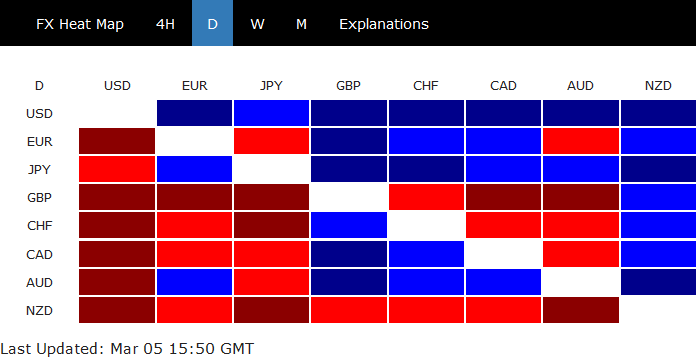
Dollar's rally seems to be finally picking up momentum after stronger than expected ISM services and new home sales. EUR/USD breaks 1.1316 minor support and should be heading back to 1.1215 low. USD/CHF also breaks 1.0024 and should be targeting 1.0098 resistance. USD/CAD also breaks 1.3340 resistance earlier today which indicates near term bullish reversal. Attention will be on 0.7054 support in AUD/USD to align dollar bullish outlook. At this point, Yen is the second strongest, followed by Aussie. New Zealand Dollar is weakest, followed by Sterling.
Fed Kashkari: Focus on wages as best indicator on labor market tightness
Minneapolis Fed President Neel Kashkari reiterated his view that the US is not full employment yet and there is room for growth. He said "here is still slack in the labor market, and until we see wages growth really pick up I'm going to believe that there are still more Americans out there".
Thus, "I'm very focused on wages as the best indicator overall of how tight is the labor force."
ECB Meeting: Acknowledging Weakness, Hinting at TLTROs?
The European Central Bank (ECB) will conclude its policy meeting on Thursday at 12:45 GMT, with a press conference by President Draghi to follow at 13:30 GMT. The Eurozone economy is struggling, and market attention will thus be on whether the ECB will take steps to cushion the slowdown, for example by hinting at another round of long-term loans for commercial banks. While such signals may hurt the euro a little, for euro/dollar to break below 1.1213, some greater catalyst may be needed.
The past few quarters have been a rough period for the euro area. Economic growth has slowed dramatically, and considering that forward-looking surveys such as the PMIs remain in the doldrums, any meaningful rebound seems unlikely in the near term. Meanwhile, underlying inflation remains subdued, with the recent acceleration in wages not having translated into higher prices, so far at least. There’s also an array of external risks, most notably the slowdown in China and elsewhere, as well as the hanging threat that the US could impose tariffs on European car exports soon.
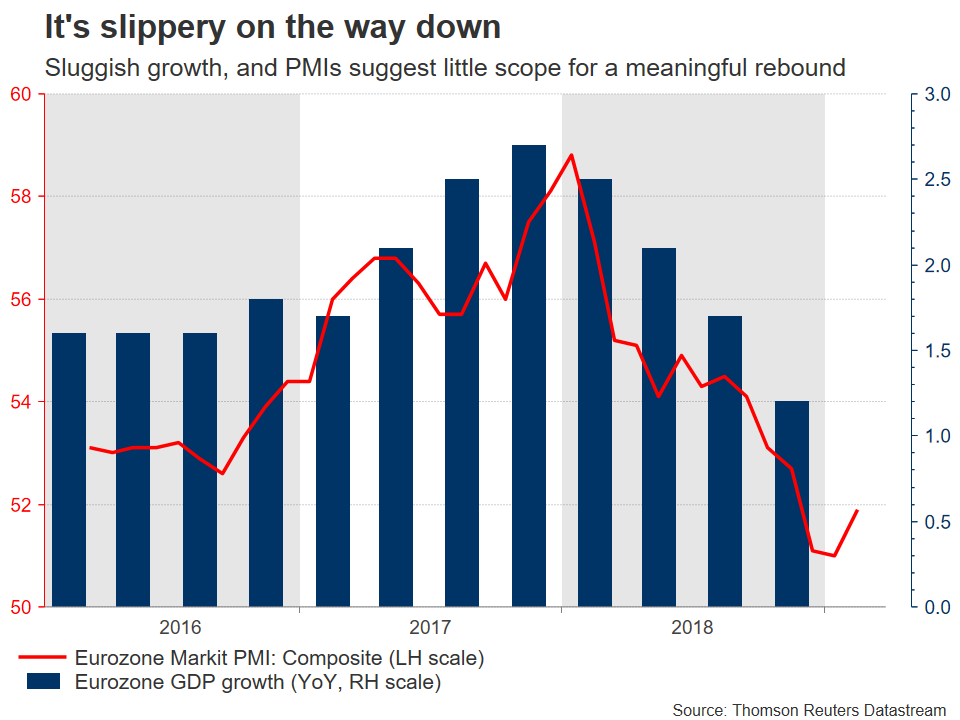
Admittedly, there are very few bright spots in the economy beyond the labor market, and the ECB finally started to admit as much at its latest meeting, when it downgraded its assessment of risks around growth. Alas, policymakers seemed reluctant to signal any potential measures to cushion the economy back then, preferring to postpone any decisions for a later gathering that would be accompanied by updated economic forecasts, which is now.
To make a long story short, this meeting will be about what steps the ECB is willing to take to support the bloc’s weakening economy, if any. Assuming that economic forecasts are revised down, which is highly likely, it would only make sense for the ECB to be proactive and signal it’s considering some action. A change in the rate guidance – for instance pushing back the expected timing of the first rate increase – seems quite unlikely for now, as the situation isn’t dire enough yet to warrant such a significant pivot. A more practical and conservative option would be launching another round of cheap long-term loans for commercial banks, the so-called TLTROs.
At the last meeting, Draghi said there would need to be a clear monetary policy reason to launch another liquidity operation, though in truth, if this slowdown isn’t enough of a reason then it’s unclear what is. While the ECB probably won’t go as far as actually announce new TLTROs on Thursday, it could send an explicit signal that it is seriously considering the option, for example by assigning the relevant committees to evaluate such a plan – effectively using this meeting as a stepping stone for a formal announcement later on. The alternative is to “stay the course” and simply do nothing for now, in order to buy some more time to examine incoming data.
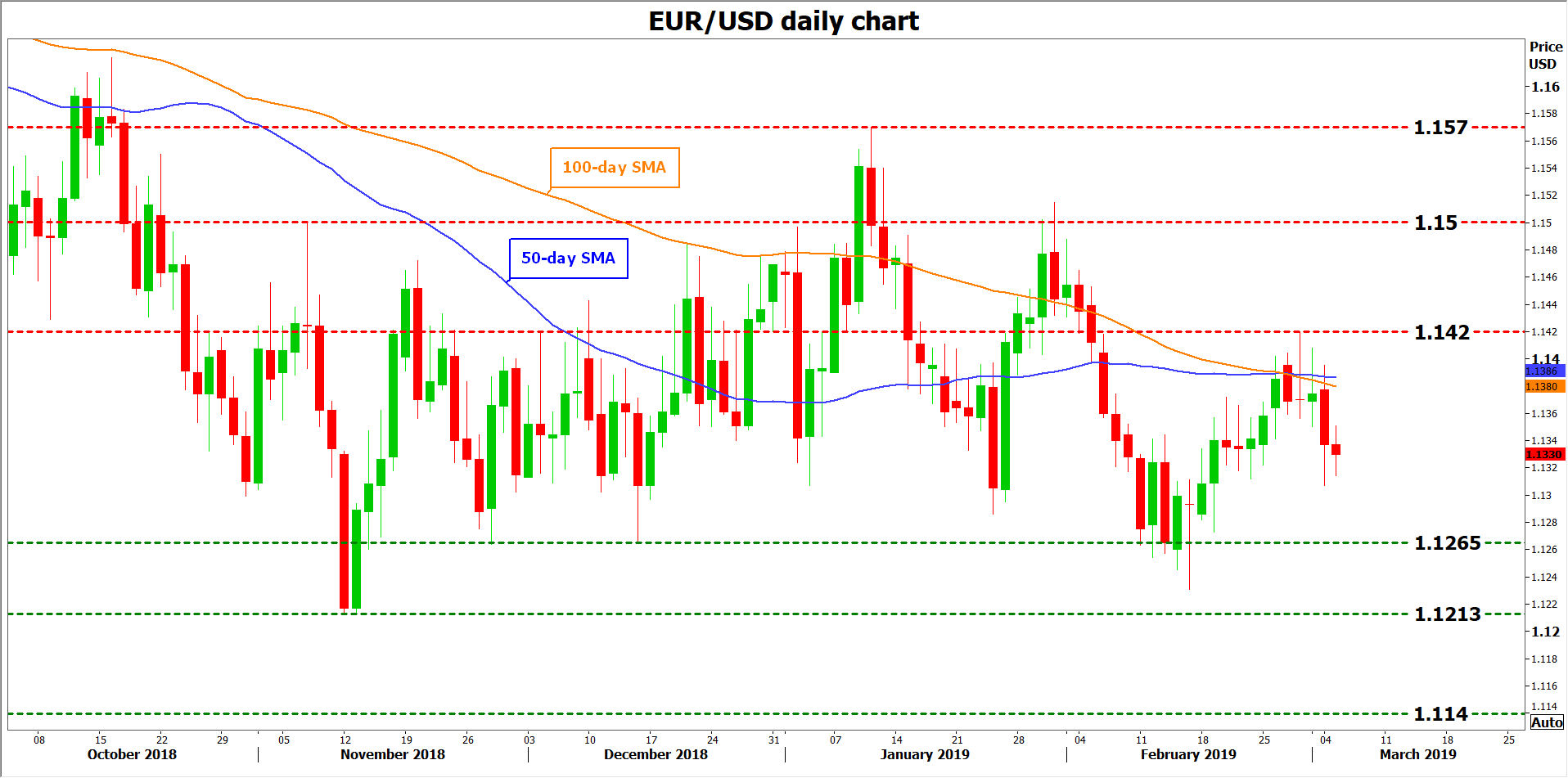
In the FX market, an explicit signal for TLTROs would likely be negative for the euro, at least on the news. A taste of this was provided recently by the ECB’s Coeure, whose mere suggestion that officials are ‘discussing’ this option was enough to push the single currency lower. In such a case, support to declines in euro/dollar may be found near 1.1265, which was a low back in December. Even lower, attention would shift to the crucial November low, at 1.1213.
On the flipside, if the ECB refrains from announcing anything at all, that would probably be taken as a hawkish sign and could therefore boost the euro, especially considering that some expectations for another TLTRO round are probably baked into the single currency already. In this scenario, initial resistance to advances in euro/dollar may be found near the 50- and 100-day simple moving averages (SMAs), both of which are around 1.1380. An upside break could open the way for a test of 1.1420.
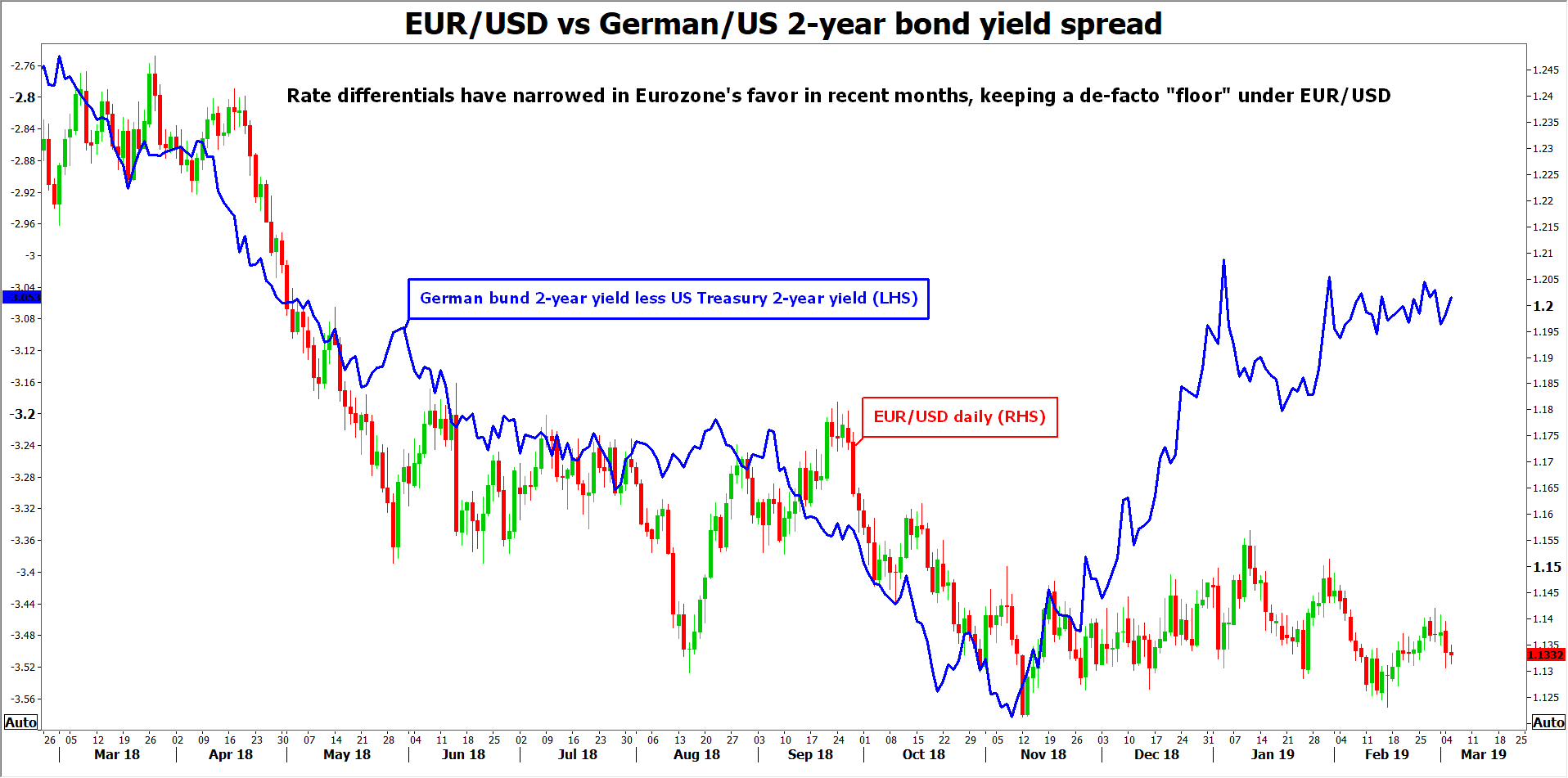
In the big picture, euro/dollar remains well supported from narrower interest rate differentials between the EU and the US. This implies that sellers may have a difficult time piercing below the November lows at 1.1213 and may require a strong catalyst for such a break – probably something bigger than a TLTRO announcement. That being said, until there is meaningful recovery in the Eurozone’s economic data pulse, any major rebound in the pair – for example above 1.1500 – seems equally unlikely.