Sample Category Title
EUR/USD – Euro Yawns Despite Strong German Services PMI
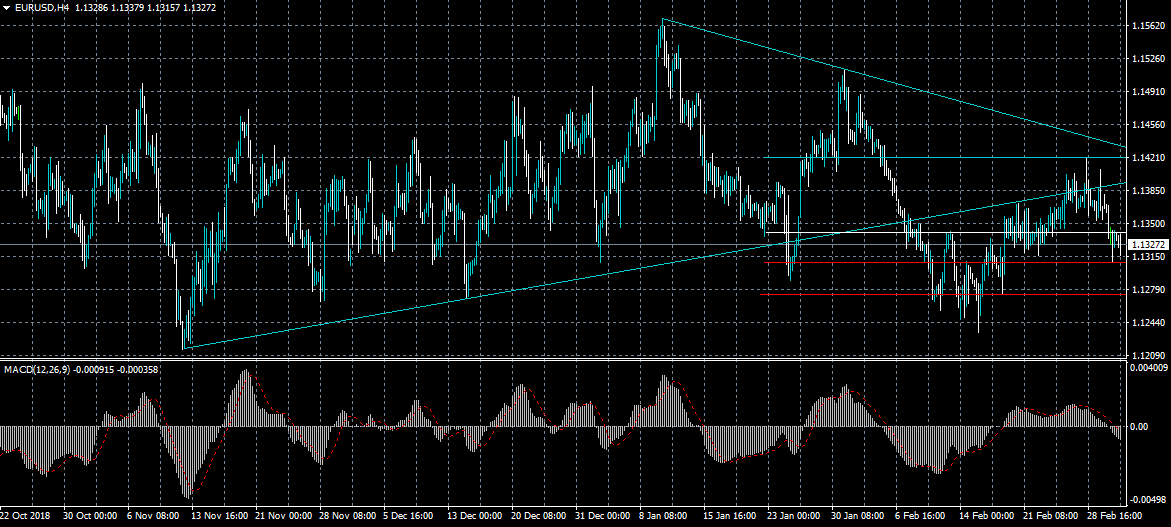
EUR/USD has ticked lower in the Monday session. Currently, the pair is trading at 1.1328, down 0.10% on the day. It’s a busy day in the eurozone, with the focus on services PMI reports. Germany and the eurozone services PMI both improved in February, with readings of 55.1 and 52.3, respectively. Eurozone retail sales rebounded with a strong gain of 1.3%. In the U.S., the key event is ISM Non-Manufacturing PMI, which is expected to climb to 57.4 points. In the U.S., employment numbers will be in the spotlight for the remainder of the week, starting with ADP nonfarm payrolls on Wednesday.
The eurozone services sector has looked stronger than manufacturing, which continues to struggle. German Final Services PMI climbed to 55.3 in February, marking a 5-month high. The eurozone release also improved, although the score of 52.3 points to weak expansion. France and Italy both pulled themselves out of contraction territory, but the scores were just above 50, pointing to stagnation. Meanwhile, consumer spending rebounded in January, after sustaining declines in December. German retail sales jumped 3.3%, while the eurozone release climbed 1.3%.
Germany is a bellwether for the rest of the eurozone, and Friday’s data pointed to a strong labor market but trouble in the manufacturing sector. On the employment front, German unemployment rolls fell by 21 thousand, crushing the estimate of -5 thousand. The eurozone unemployment rate dropped to 7.8% in January, down from 7.9% a month earlier. The manufacturing industry continues to struggle, as the global trade war has reduced the demand for European exports. German and eurozone manufacturing PMIs in February came in below the 50-mark, which separates contraction from expansion.
To sum up, although rising oil prices in this year may have been supporting the loonie, however, a dovish BoC could keep the currency’s gains limited.
Loonie Declines Ahead Of Rate Decision, BoC Expected To Be Dovish Again
The loonie has lost more than 1.0% of its value since last week, however, the currency is awaiting this week’s Bank of Canada (BoC) interest rate decision, which is scheduled to be announced on Wednesday at 1500 GMT. While interest rates are not expected to change, policymakers may adopt a more dovish tone amid heightened fears of a slowing global economy.
The BoC is predicted to pursue a 'wait-and-see' stance, as the markets believe that no rate hikes are taking place at this meeting. When they last met, policymakers left the way open for rate increases, however, economic data released since then has pointed to a loss in Canada’s growth momentum. Recent economic data suggested that a growth slowdown is in place. GDP growth eased to an annualized pace of 0.4% in fourth quarter of 2018, from about 2.0% previously. While household consumption contributed less to growth in the last quarter of 2018, government spending and business investment even contributed negative growth. These were partly offset by improvement in trade and inventories.
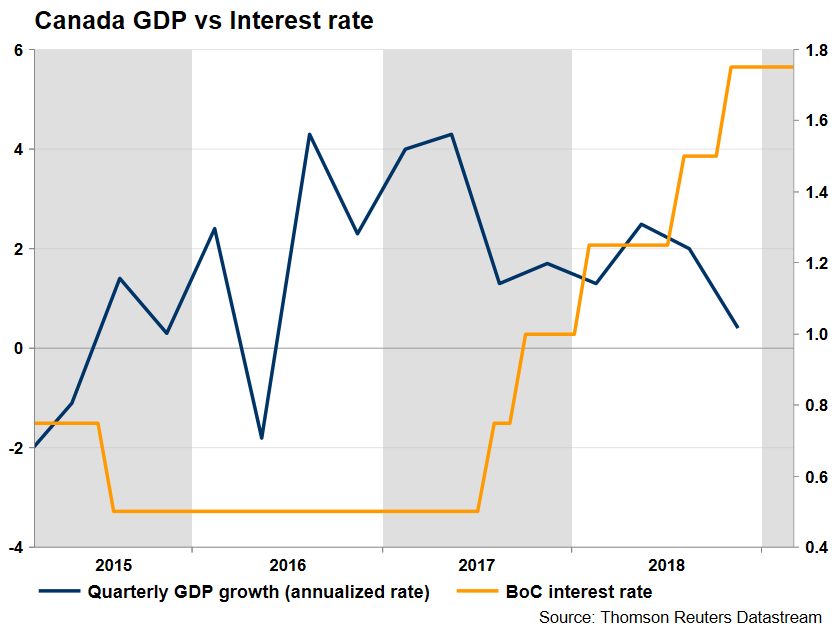
In a speech two weeks ago, Governor Poloz said that the timing of future rate increases is 'highly uncertain', which, combined with the aforementioned data may prompt policymakers to strike a more cautious stance compared to the previous time, even if they stick to their guns that further rate increases are needed in the foreseeable future.
Turning the attention to employment growth which is coming out on Friday, it was the biggest factor lifting the GDP figure. The job market in January remained resilient although the unemployment rate rebounded slightly to 5.8 %. The number of jobs increase was still remarkable, at +66.8K. It is worth mentioning that the headline CPI rate has been weakening, falling to 1.4% in January, the lowest level since October 2017, after peaking in mid-2018 at 3.0%.
Acknowledging such developments, the BoC revised lowest its forecasts at the January meeting and forecast inflation to 'edge further down and be below 2% through much of 2019 and depreciation in Canadian dollar would apply some upward pressure on inflation, causing it to return to around the 2% by late 2019'.
Should policymakers use a more dovish tone, signaling a potential delay in lifting rates, USDCAD may head even higher towards immediate resistance of 1.3370. Above that key resistance the focus will shift to the 19-month high of 1.3663.
On the other hand, if the bank reiterates that it would need to push up interest rates into the 2.5-3.5% neutral range to be consistent with its inflation goals, appearing less concerned about future economic developments, the pair may retest the 23.6% Fibonacci retracement level of the upleg from 1.2060 to 1.3663 near 1.3285. If that fails to hold, support could run towards 1.3110 – 1.3070 support area, where bears rested in February.
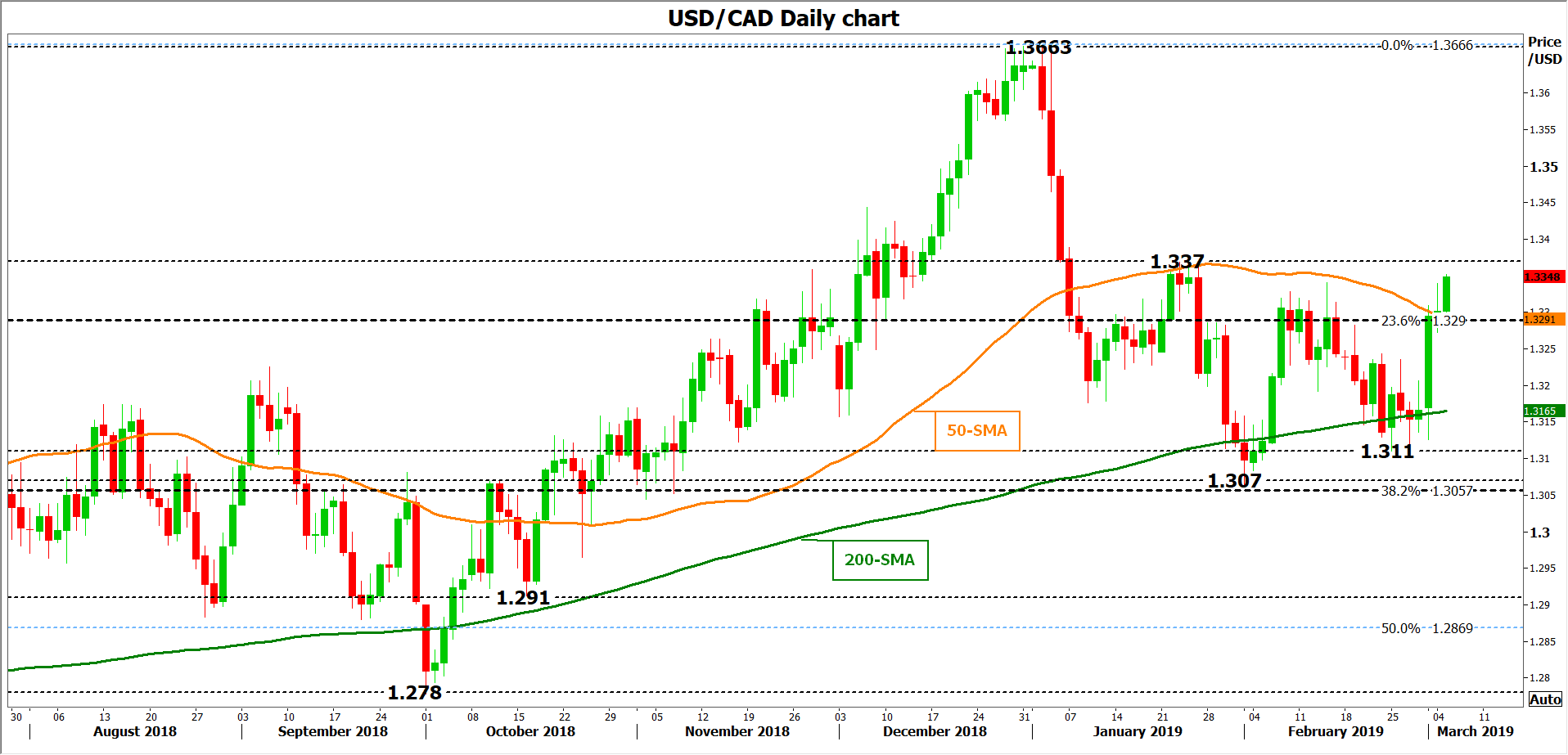
To sum up, although rising oil prices in this year may have been supporting the loonie, however, a dovish BoC could keep the currency’s gains limited.
USD/JPY Is Supported By 55-Hour SMA
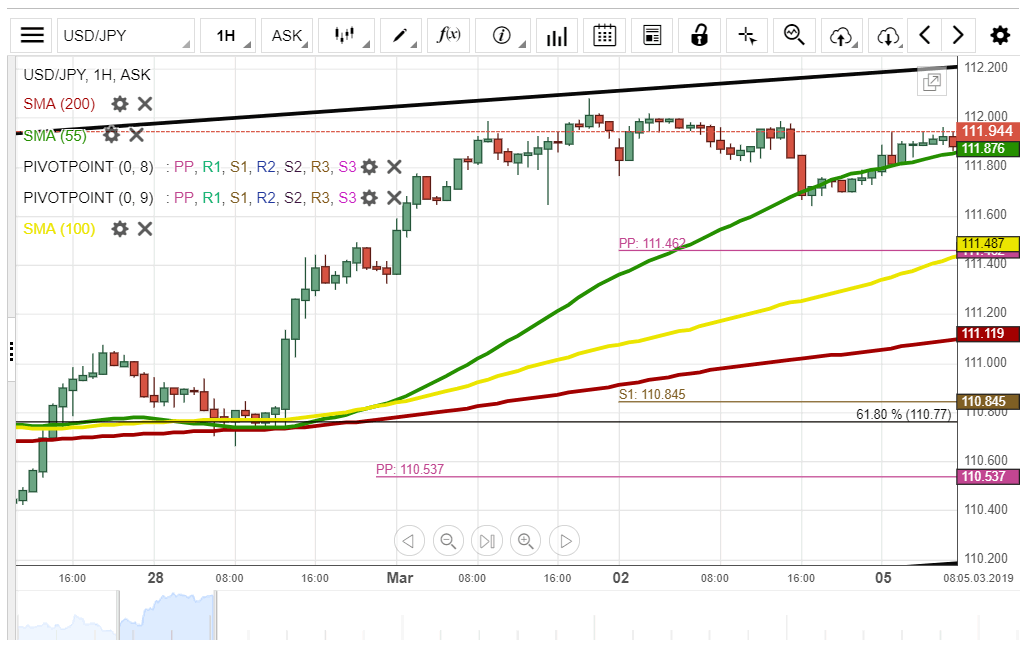
During Monday's trading session, the 55-hour simple moving average supported the rate to end the trading session at 111.80. On Tuesday morning, the currency exchange rate was located at the 111.93 mark.
In regards to the near-term future, most likely, the 55-hour simple moving average will continue to support the US Dollar to push the rate to trade sideways at the 112.00 level.
Note, due to the fact that the previously drawn pattern was broken, the chart was fully reviewed to draw a new pattern!
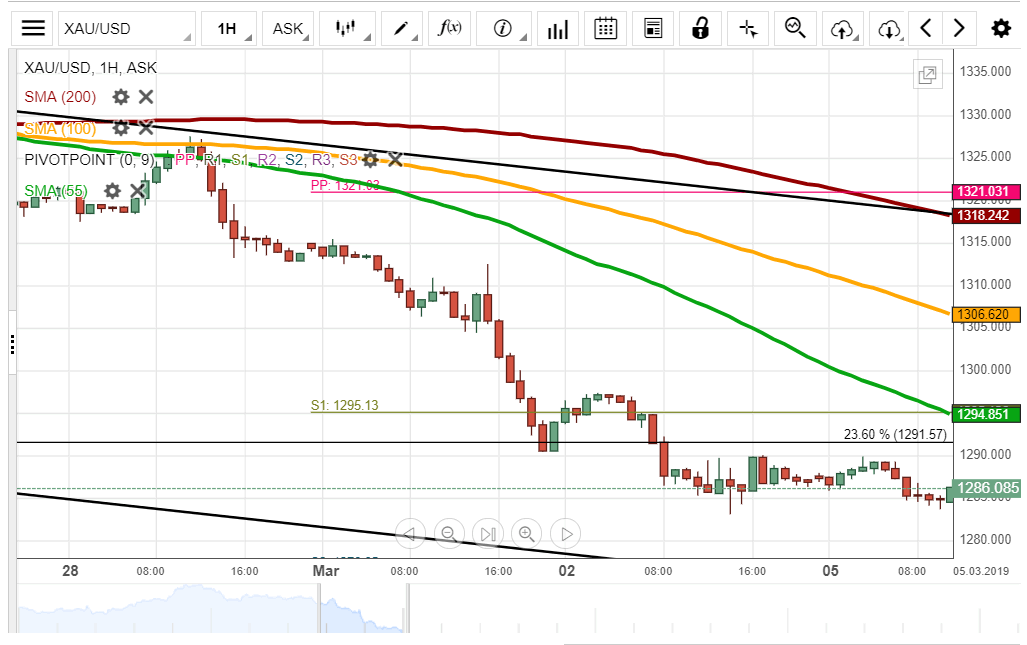
XAU/USD Might Fall To 1,275.00
During Monday's trading session, the yellow metal passed through the support level of the 23.60% Fibonacci retracement level to end the trading day at 1,280.00. On Tuesday morning, gold was located at the 1,284.88 mark.
In regards to the near-term future, most likely, the yellow metal will continue to depreciate against the US Dollar to end today's trading session near the weekly S2 at the 1,276.65 mark.
Note, due to the fact that the previously drawn pattern was broken, the chart was fully reviewed to draw a new pattern!
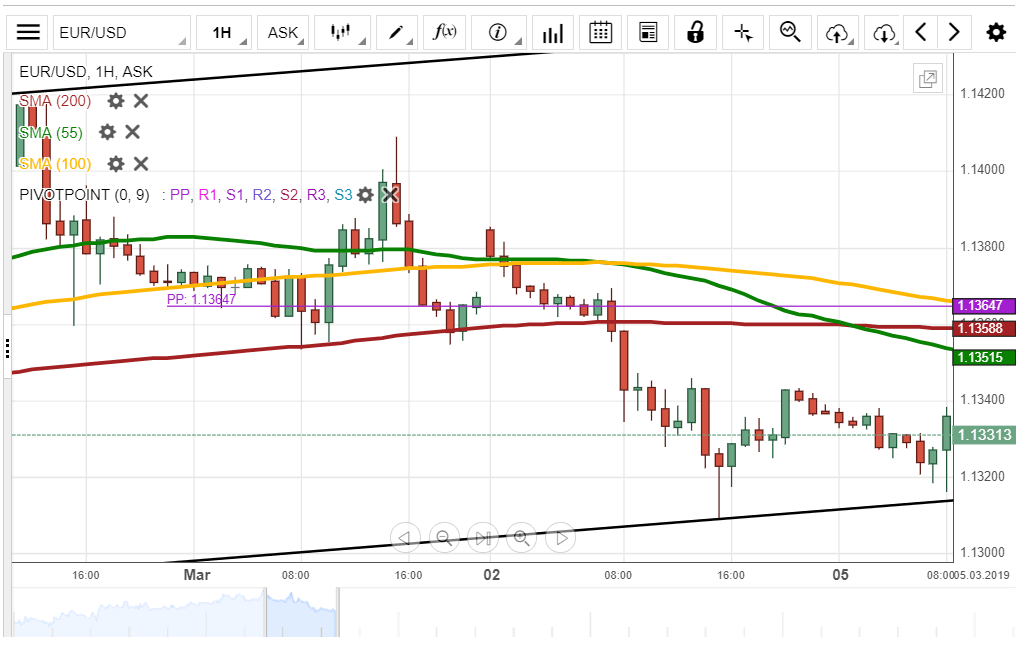
EUR/USD Could Break Freshly Drawn Pattern
During Monday's trading session, the European Single Currency dropped below the technical indicators to 1.1300. During Tuesday's morning, the currency exchange rate was trading sideways to be located at the 1.1326 mark. Note, the rate broke the previously drawn medium pattern!
In regards to the near-term future, it is expected that the rate will decline towards the 1.1300 mark to break freshly drawn pattern line.
However, the European Single Currency could bounce off the bottom boundary of the medium pattern line at 1.1320 to appreciate against the US Dollar to the 1.1340 level.
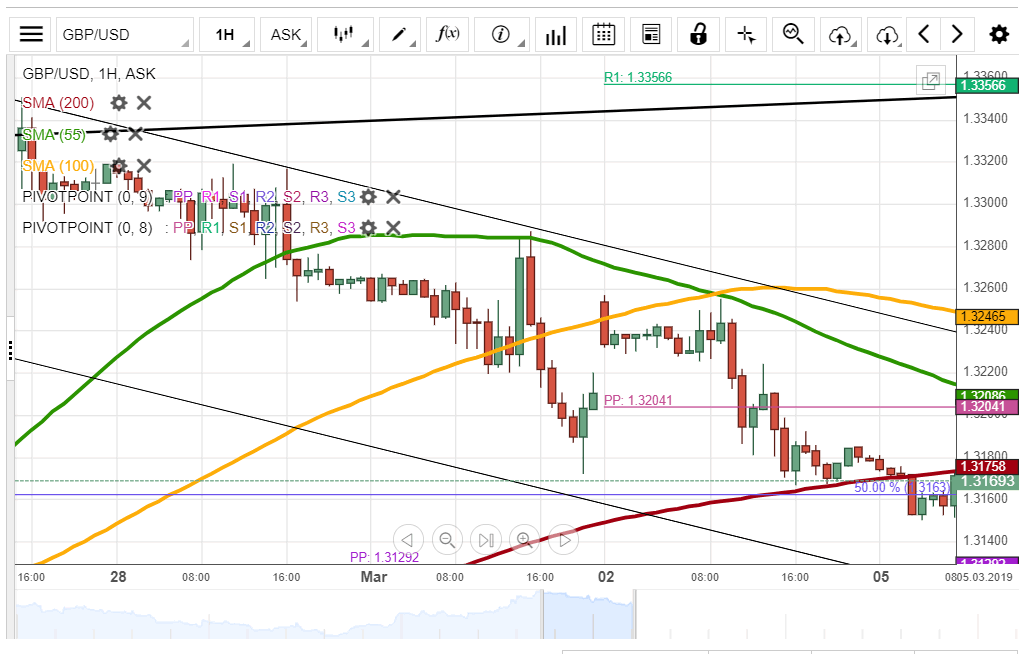
GBP/USD Could Stay At 1.3140
During Monday's trading session, the British Pound was supported by the 200-hour simple moving average to stay at 1.3180. On Tuesday morning, the currency exchange rate broke the support level of the 200-hour SMA to be located below the 50.00% Fibo at the 1.3155 mark.
It is expected that the rate will be trading sideways between the 50.00% Fibo and the monthly pivot point at 1.3129. More likely, the rate will end the trading session at the 1.3140 level!
On the other hand, the 50.00% Fibonacci retracement level could resist the British Pound to depreciate against the US Dollar to the bottom boundary of the pattern line at 1.3100.
Anxiety Around The US And China Growth Provoked A Wave Correction
The US and Chinese stock indices growth turned out to be unstable, which we warned about the day before.
USA side
The S&P 500 had lost more than 2% but later reduced the decline to 1%. The US market has undergone a serious sale after news that construction costs fell by 0.6% in December, which contrasts sharply with expectations of a 0.2% increase. This is not first-tier new, so such a strong reaction is explained, in our opinion, by the investors caution at important resistance levels after a long rally. Once again, the mark of 2,800 for the S&P 500 strengthened the demand for safe-heavens.
What do not go up it goes down, often says on markets. Therefore, it would not be surprising if the stock market's inability to confidently hit important resistance will result in a lengthy correction.
China side
Chinese markets also got their reason for the decline. The authorities have once again lowered economic growth forecasts from 6.5% to 6.0%, which seems to be the reason for the negative mood at the start of trading on Tuesday. As in the case of the United States, the news was the reason for the correction, although the main point is the previous 30% rally.
China's low growth rates often have a wide impact on the entire region and even on Europe. In addition to the technically overbought conditions for key indices, all this can turn into a launch of a stock markets sale and provoke a demand for defensive assets across the entire spectrum of trading instruments.
Conclusion
In particular, this may spur demand for the dollar, despite Trump's renewed pressure on the Fed to weaken the dollar. For the euro, this could turn into another test of the 1.1300 mark, while the pound can be sent back closer than 1.30 against the recent highs around 1.3350.
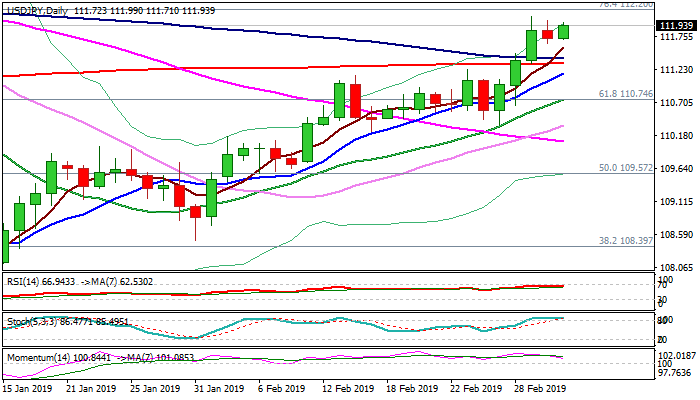
USD/JPY Outlook: Extended Consolidation Likely To Precede Final Push Through Key 112.20/31 Barriers
The pair maintains positive tone on Tuesday but shows hesitation at psychological 112.00 barrier and more significant 112.20/31 (Fibo 76.4% of 114.54/104.59 / 200WMA).
Optimism over US/China trade talks keeps the pair well supported, but traders look for more evidence, on further positive news that would inflate pair for eventual break through 112.20/31 pivots and trigger stops above.
Bulls would then look for 113.00+ extension, as sustained break higher would further accelerate strong four-week uptrend.
Scenario is supported by recent break above 200SMA (the first break after 26 Dec) which generated strong bullish signal.
Massive hourly cloud (spanned between 111.87 and 111.36) underpins, as cloud top holds today’s action.
Bullish bias is expected to remain as long as key supports, converged 100/200SMA’s (111.41/34) hold.
Res: 112.07, 112.20, 112.31, 112.60
Sup: 111.89, 111.41, 111.34, 111.17
USDJPY Buyers Challenging 112.00 Level
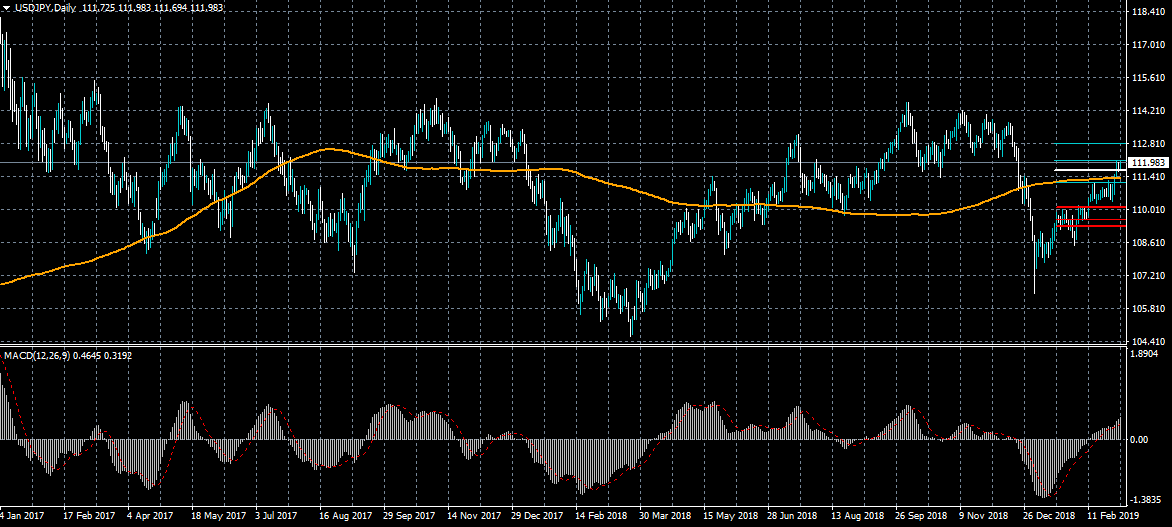
The US dollar is once again testing towards the 112.00 resistance level against the Japanese yen currency after the pair found strong buying interest from the 111.60 support level. If bulls can break above the 112.00 level, the 112.20 level offers the foremost technical resistance prior to the 112.80 level. Traders should note that overall risk-on trading sentiment remains weak due to weaker than expected Chinese economic data earlier today.
The USDJPY pair is intraday bullish while trading above the 111.60 level, key technical resistance is found at the 112.20 and 112.80 levels.
If the USDJPY pair trades below the 111.60 level, sellers may test towards the 111.40 and 111.12 support levels.
EURUSD 1.1337 Strong Resistance
The euro has continued to slip lower against the US dollar during the European trading session, with bulls repeatedly struggling to break the key 1.1337 resistance level. EURUSD sellers must now break before the current weekly trading low to sustain bearish intraday pressure. The MACD indicator on the four-hour time frame continues to signal further downside ahead.
The EURUSD pair is bearish while trading below the 1.1337 level, key support is found at the 1.1300 and 1.1275 levels.
If the EURUSD pair trades above the 1.1337 level, key technical resistance is found at the 1.1370 and 1.1390 levels.