

Sample Category Title
RBA Remains On Hold And The AUD Gets A Small Boost
The RBA remained on hold at +1.50% as was widely expected and the Aussie got a small boost during today's Asian session. There were no major changes in the accompanying statement and more or less the bank denied the markets a dovish turn. Main highlights of the accompanying statement, could include the comment about inflation being stable and expected to have a gradual progress, as well as employment market remaining strong. Also the central scenario of the bank includes the economy to grow around 3% in 2019. On the downside, the bank mentions that the economy has slowed down in the second half of 2018 and that trade tensions remain a source of uncertainty. Analysts point out that the bank refrained to take another dovish stance, however the focus remains on a potential easing, keeping the AUD on the defensive. Overall, we would like to add that despite data deteriorating the bank seems to remain in a rather comfortable position. Our main focus now, is on the release of Australia's GDP rate, as well as RBA governor Lowe's speech, both early in tomorrow's Asian session. AUD/USD got some support during today's Asian session, yet overall remained on the defensive testing the 0.7065 (S1) support line. Should the AUD remain on the defensive as mentioned, we could see the pair having some bearish tendencies today. Should the bears dictate the pair's direction, we could see it breaking the 0.7065 (S1) support line and aim for the 0.6985 (S2) support barrier. Should on the other hand the bulls take over, we could see the pair aiming if not breaking the 0.7150 (R1) resistance line.
GBP weakens on soft data and Brexit developments.
The pound weakened on Monday, as a soft Construction PMI was released and UK officials head towards Brussels. UK's Attorney General Geoffrey Cox is about to negotiate legally binding changes for the Irish backstop in Brussels, yet hopes remain low. On the other hand the EU doesn't seem convinced and seems to be pushing for a solution based on arbitration. In the inner UK political stage, media reports state that London may be softening its demands towards Brussels and if so, Theresa May could be running into trouble with her own party's hard Brexiteers. We expect the pound to remain under pressure, especially as the Services PMI release today could also bear a soft result. Cable dropped yesterday breaking the 1.3175 (R1) support line (now turned to resistance). We could see the pair maintaining the bearish momentum for the day, as financial releases today may weaken the pound and strengthen the USD. Should the pair remain under the selling interest of the market, we could see it aiming if not breaking the 1.3070 (S1) support line. Should on the other hand the market favor the pair's long positions, we could see it breaking the 1.3175 (R1) resistance line and aim for the 1.3270 (R2) resistance hurdle.
Today's other economic highlights
In today's European session we get Eurozone's final Composite PMI for February, along with a number of final PMI readings affecting the common currency. Also we get UK's Services PMI for February and Eurozone's retail sales growth rate for January. In the American session we get from the US the ISM non-manufacturing PMI for February and the API weekly crude oil inventories figure. As for speakers please note that BoE's governor Mark Carney will be participating in the House of Lords Economic Affairs Committee hearing and could create some Brexit volatility for the pound . Also from the US side, Boston Fed President Eric Rosengren, Minneapolis Fed President Neel Kashkari and Richmond Fed President Thomas Barkin speak.
GBP/USD
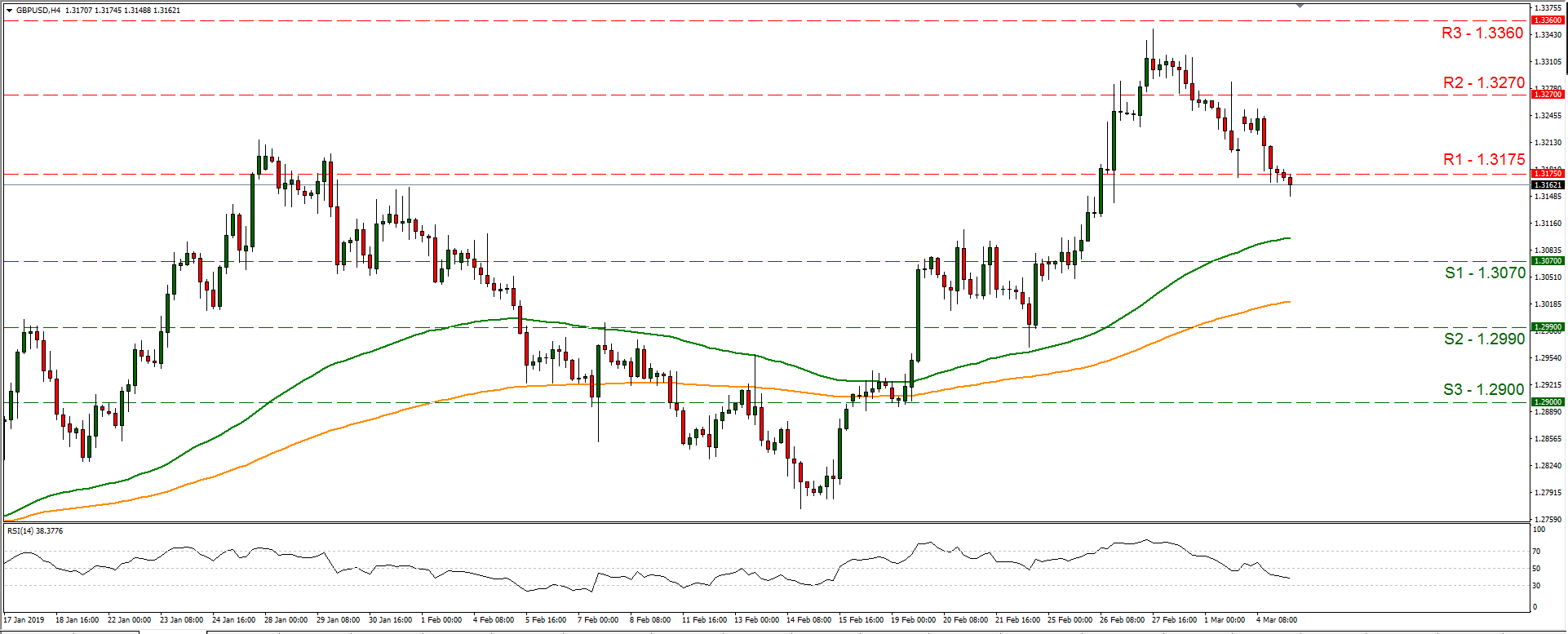
Support: 1.3070 (S1), 1.2990 (S2), 1.2900 (S3)
Resistance: 1.3175 (R1), 1.3270 (R2), 1.3360 (R3)
AUD/USD H4
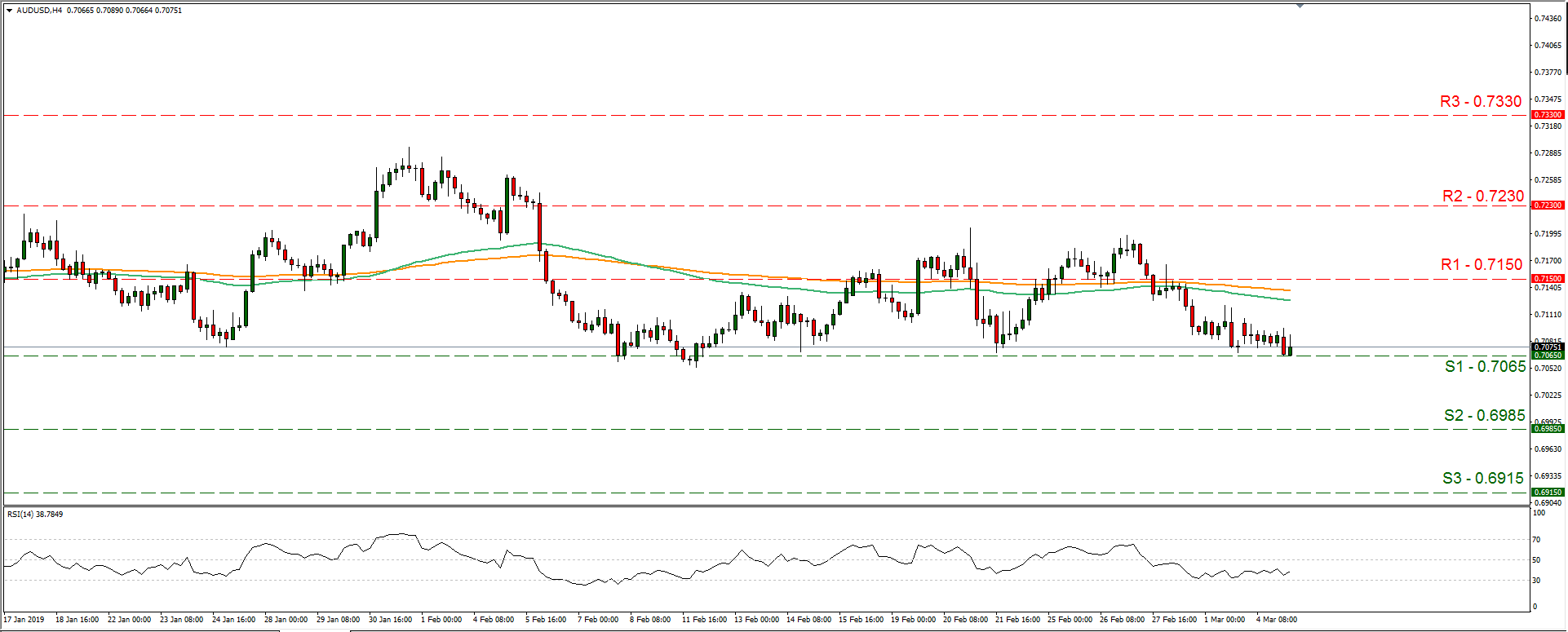
Support: 0.7065 (S1), 0.6985 (S2), 0.6915 (S3)
Resistance: 0.7150 (R1), 0.7230 (R2), 0.7330 (R3)
UK Hunt: EU gives positive signal on Irish backstop changes
UK Foreign Minister Jeremy Hunt said the EU gave "reasonably signals" on the changes regarding Irish backstop. He told BBC radio "compared to where we were a month ago the situation has been transformed in a positive direction". And, "signals we are getting are reasonably positive, I don't want to overstate them because I think there is still a lot of work to do.
He added, they are "beginning to realize that we can get a majority in parliament because they are seeing signals coming from the people who voted against the deal before who are saying, crucially, they are prepared to be reasonable about how we get to that position that we can't legally be trapped in the backstop."
Dollar Rally In Full Throttle, But Mind The Speed Bumps
- Dollar upswing continues unabated, but caution gradually warranted
- US stocks retreat after soft data, Chinese markets up on stimulus news
- RBA stays on hold, aussie yawns
- UK services and ISM non-manufacturing PMIs coming up today
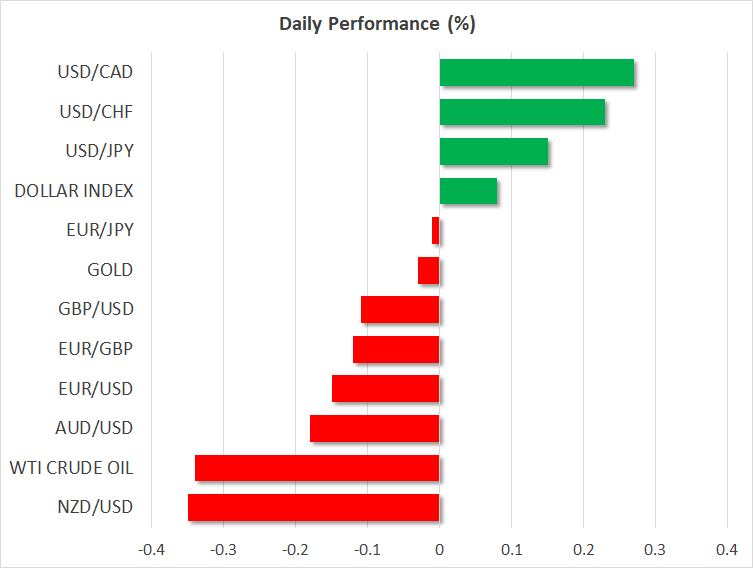
Dollar rally in full throttle, but speed bumps may lie ahead
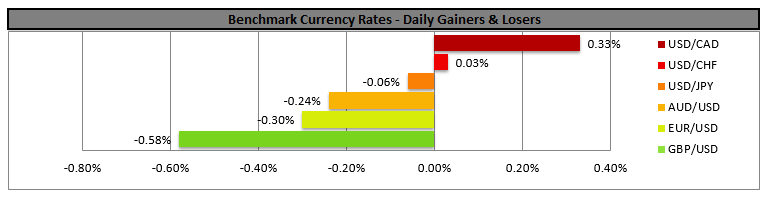
The US dollar registered another session of strong gains to kick off the week, gaining ground against all its major counterparts besides the defensive Japanese yen, which was the best performer as risk sentiment turned sour. The dollar seems to have attracted some defensive flows itself, considering that it advanced without any positive news and even as the yields on US Treasuries retreated – once again demonstrating its unparalleled ability to act both as a safe-haven and a carry currency.
The US fundamental picture remains bright for now, as even accounting for the latest slowdown, the American economy is still easily outgrowing its G10 peers. Alas, that doesn’t mean it’s all plain sailing higher from here for the dollar. Declines in euro/dollar in recent months have consistently run into an impenetrable wall of buy orders around 1.1250, which is owed to the slightly narrower spread between short-dated US and EU bond yields since November, de-facto keeping a floor under the pair. This implies that even if euro/dollar sellers manage to push the pair towards the November lows near 1.1213 – for instance on the upcoming ECB meeting – they will likely have a difficult time piercing below that level, and may require a greater catalyst to do so.
Stock markets pull back after testing key resistance areas
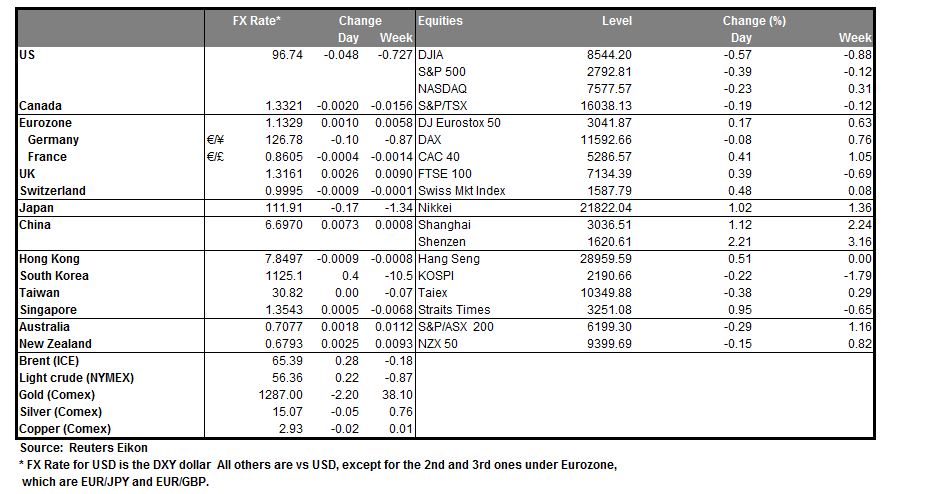
US equity markets closed in the red on Monday, with both the S&P 500 (-0.39%) and the Dow Jones (-0.79%) retreating after challenging some crucial resistance zones that capped the rally in these indices back in November. The trigger for this retreat seems to have been the US construction spending print for December, which fell unexpectedly, igniting speculation for a downward revision in the Q4 GDP. Some headlines that House Democrats are opening an investigation into whether the Trump administration engaged in obstruction of justice may have contributed too, via amplifying political uncertainty.
Across the Pacific Ocean, Asian markets are mixed on Tuesday. Whereas Japanese indices are lower, Chinese ones are notably higher, extending their spectacular year-to-date gains. The latest leg higher was seemingly fueled by hopes for more stimulus, following overnight announcements at the National Congress tax cuts across the board, for instance on VAT. Yet, stock gains were likely kept in check by signals that this will be a measured dose of stimulus aimed at avoiding a more severe slowdown, as opposed to a “deluge” of stimulus to re-accelerate growth.
No material news from RBA meeting, aussie snoozes
Overnight, the Reserve Bank of Australia (RBA) kept its policy unchanged once more, providing practically no new information. Although the accompanying statement did contain some more optimistic language, on the margin, there was nothing noteworthy enough to trigger any market reaction. Looking at market pricing, a 25bps rate cut by year-end is still priced in with an 85% probability. As for the aussie, the next market mover may be a speech by RBA Governor Lower today, at 22:10 GMT.
Coming up: UK services PMI and US ISM non-manufacturing index
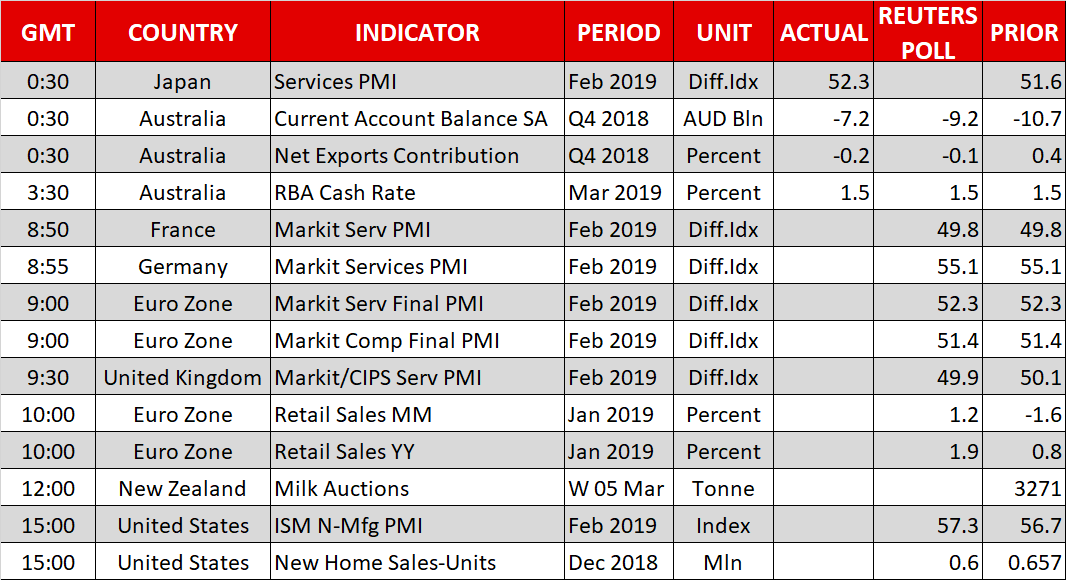
It will be another (relatively) light day in terms of economic releases, with the most noteworthy indicators coming out of the UK and the US.
In the UK, the services PMI for February is expected to have entered contractionary waters, below 50, highlighting that Brexit uncertainties are starting to bite. Some comments by BoE Governor Carney at 15:35 GMT could be important for the pound as well.
In the US, the ISM non-manufacturing PMI for February is due, with some remarks by regional Fed Presidents Rosengren (12:35 GMT) and Kashkari (14:30 GMT) also attracting attention.
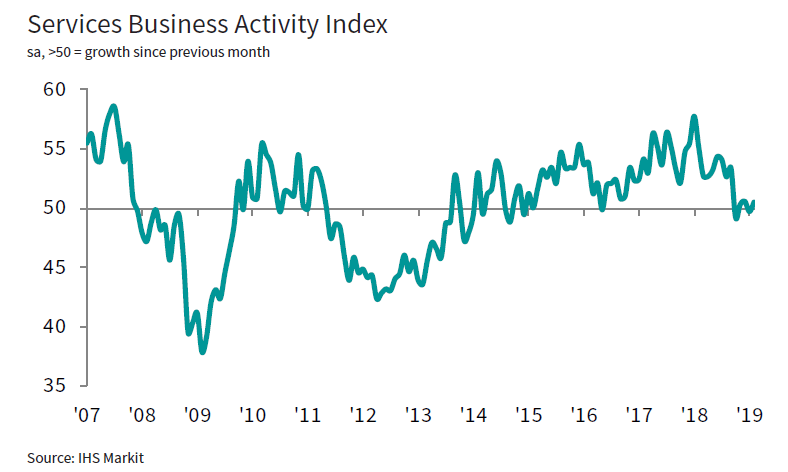
Italy PMI services rose to 50.4, but not much sign of relief
Italy PMI services rose to 50.4 in February, up from 49.7 and beat expectation of 49.5. Markit noted that "activity rises slightly in February", "new orders fall for first time since February 2015", and there was "third consecutive fall in selling prices".
Commenting on the PMI data, Amritpal Virdee, Economist at IHS Markit said:
"With the Italian economy currently in a recession (its third in the past ten years), February's Italian Services PMI data did not provide much sign of relief.
"Inflows of new business contracted for the first time in four years, amid the third month of falling output charges, signalling that attempts by service providers to stimulate customer demand are not always proving effective.
"Despite positive signs in the form of an increase in payroll numbers and an up-tick in optimism, the latest PMI data indicates that the private sector remains on course for a further contraction in the first quarter of 2019."
GBPUSD Weakens Below 7-Month Highs, Trend Remains On The Upside
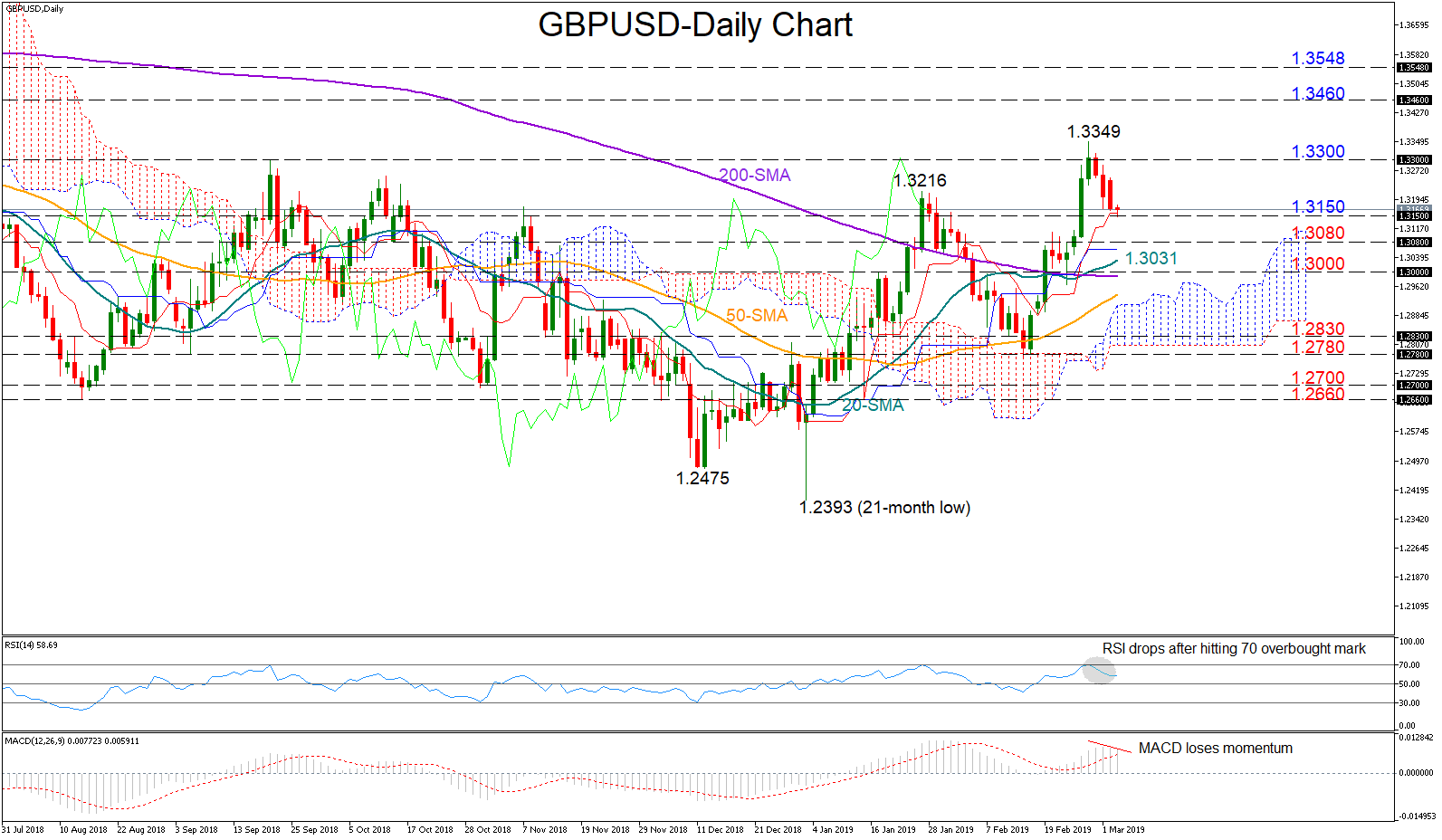
GBPUSD touched overbought levels at a seven-month high of 1.3349 according to the RSI which topped at 70 and reversed southwards to retest support around 1.3150. The RSI continues to weaken towards its 50 neutral threshold, while the MACD is also losing steam, both signalling that caution is likely to persist in the short term. Yet the upward-sloping 20-day moving average suggests that the recent uptrend is not near to its end.
The 1.3080-1.30 area could provide immediate support in case bearish action stretches below 1.3150. Under the 200-day MA (1.3000), the congested region between 1.2830-1.2780 could halt downside movements, while if this fails to hold too, traders could then look for support within the 1.27-1.2660 zone.
Otherwise, the pair could bounce up to challenge the 1.3300 level. If the market manages to rally above this point and more importantly clear the peak at 1.3349, resistance could be next found near 1.3460. Another successful upside break could bring 1.3548 into view, identified by the highs on November 2017.
In the medium-term picture, the rally towards seven-month highs has reactivated the uptrend started from the 1.2475 bottom, shifting the outlook from neutral to bullish. The 50-day MA has also improved significantly over the past two weeks and is now even closer to the 200-day MA, a sign that the market could turn more positive once the lines clearly cross each other.
Currencies: EUR/USD Correction Off 1.14 Resistance Continues
- Rates: First 10y Greek bond sale in almost a decade
Yesterday’s market correlations were very loose amid an empty eco/event calendar. The US non-manufacturing ISM spices trading today. We expect a strong, but in line with consensus outcome. This should nevertheless be sufficient to cause some underperformance of US Treasuries. Greece launches a new 10y bond via syndication for the first time since March 2010. - Currencies: EUR/USD correction off 1.14 resistance continues
EUR/USD drifted back lower in the 1.13 big figure yesterday as last week’s EMU reflation trade evaporated, at least temporarily. Euro traders are taking a cautious approach head of this week’s ECB meeting. Today, EMU and US data might cause some intraday volatility in the euro and the dollar. Sterling shifted to consolidation modus on ’Brexit pause’
The Sunrise Headlines
- US equity markets edged lower yesterday with losses varying between -0.23% and -0.79% (DJI). Asian equities are largely trading in red this morning with Japanese indices underperforming. China outperforms.
- The US removed Turkey/India from a list that grants low-income economies duty-free access for some exports, as India fails to assure the US reasonable market access while Turkey is now “sufficiently economically developed”.
- China lowered its GDP growth target for 2019 to a range of 6 to 6.5%, the lowest growth pace of economic growth in almost three decades. Premier Li announced tax cuts worth of $298bn for this year to offer some rebuttal.
- UK attorney General Cox and Brexit Secretary Barclay travel to Brussels today to seek concessions from the EU. UK PM May has only a week left to win over MP’s before the House of Commons decides on her divorce deal.
- China’s services PMI fell to 51.1 in February, down from 53.6 a month before and the lowest reading in 4 months. Weaker new orders at home and abroad underline the mounting concerns on a slump in global trade.
- The Reserve Bank of Australia kept its policy rate at 1.5%, unchanged since August 2016. Governor Lowe’s main focus remains the uncertainty of household consumption as wage growth remains soft and house prices are falling.
- Today’s US eco calendar contains the ISM Non-Manufacturing (Feb) in the US. Both the UK and EMU (final) Markit/CIPS PMI’s are released for February. BoE’s Carney testifies to UK Parliament, while Fed’s Barker and Rosengren speak.
Currencies: EUR/USD Correction Off 1.14 Resistance Continues
EUR/USD ease off 1.14 resistance.
Short term market trends of last week evaporated or even reversed yesterday. The cautious (EMU) reflation trade including higher equities, a rise in EMU yields and a gradual rise of the euro ran into resistance. US and European equities failed to profit from optimism on trade that dominated Asian trading. The faltering risk-rally put the dollar again in the drivers’ seat and weighed on the euro. EUR/USD declined off the 1.14+ resistance and closed at 1.1340 (from 1.1365). USD/JPY lost modest ground as risk sentiment deteriorated and closed at 111.74. Overnight, the focus in Asian is on the National People’s Congress in China. The Chinese growth forecast for this year was lowered to a range of 6.0% to 6.5%, but the government announced fiscal stimulus including a 3% VAT cut. The yuan gains marginal ground (USD/CNY 6.70 area). Global markets are still looking for concrete news from the US-China trade talks. Most Asian equity indices show modest losses with China outperforming. USD/JPY (111.95 area) rebounded on overall USD strength. EUR/USD struggles to prevent further losses. The RBA left its policy rate unchanged and kept a rather positive view on the economy. AUD/USD hovers in the upper half of the 0.70 big figure. The eco calendar contains EMU retail sales and the final PMI’s today. In the US, new home sales and the non-manufacturing ISM are scheduled for release. It is unlikely that (final) EMU PMI’s will restart last week’s ‘EMU-reflation’ trade. Decent data might help to put a floor for the euro. Still ECB meeting will be the key feature for EUR/USD trading this week. The US ISM is expected to rebound from 56.2 to 57.4. Even a slight miss shouldn’t hurt the dollar too much short-term. Of late, EUR/USD rebounded gradually as EMU data showed signs of bottoming. The ECB also kept the door open for policy normalisation. This narrative supported EUR/USD. Last week, the EUR/USD rebound stalled on (some) constructive US data. We started this week with a balanced bias on EUR/USD. The 1.14 area looks quite a solid resistance and more EUR/USD gains in the 1.12/15 range probably need more good EMU news or poor US data. For now, we see no trigger for such a break. So, some consolidation on recent EUR/USD gains might be on the cards.
Sterling mainly remained in consolidation modus yesterday. The UK May’s Brexit roadmap was set out last week. There are still several high profile meetings planned in Brussels today/this week, but we doubt they will change the overall picture on Brexit. Today, the UK services PMI is expected to ease close to contraction territory. If so, it might be a mildly negative for sterling
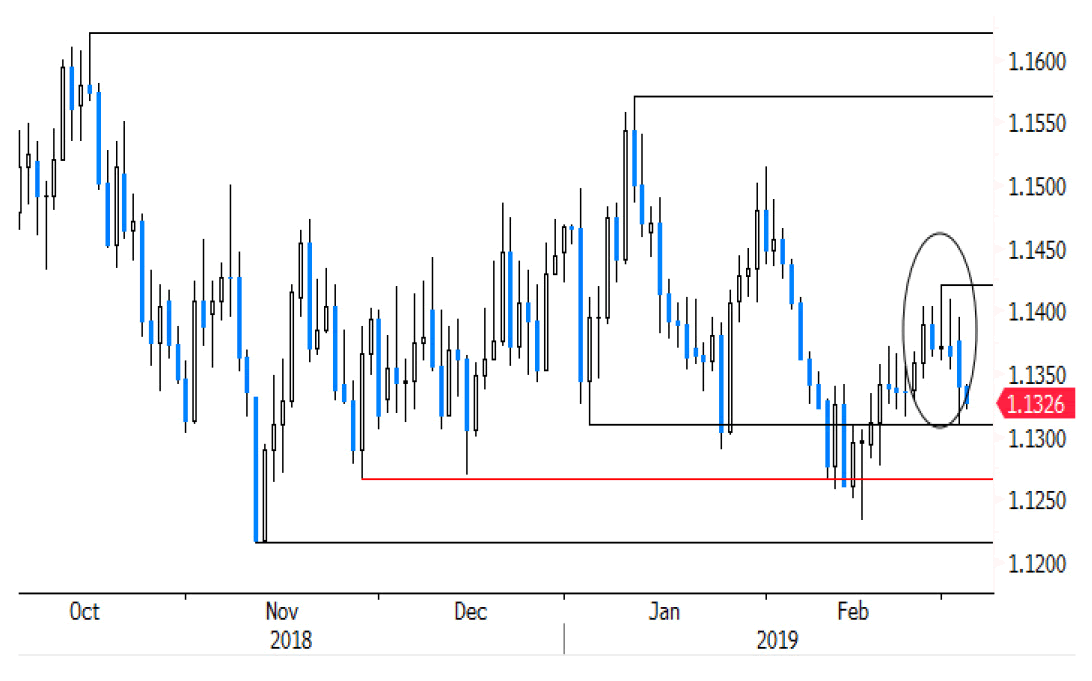
EUR/USD: correction off 1.14 resistance as markets await ECB decision
XAUUSD Intraday Analysis
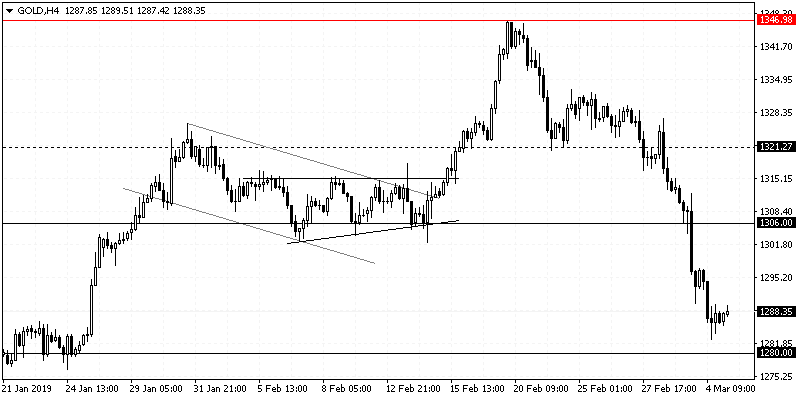
XAUUSD (1288.35): Gold prices extended declines for the fifth consecutive daily session. Price action closed near intraday lows of 1282.74 before slightly pulling back higher. We expect the bearish momentum to continue pushing gold prices lower toward the 1280 handle where support is most likely to be established. Following the test of support near the 1280 level, there is scope for gold to rebound in the short term. The breached support at 1305.72 remains a key level where resistance could be tested. However, if gold prices exceed the current level, further gains could push prices toward the 1321.60 level which would mark the breakout from the rising median line.
USDJPY Intraday Analysis
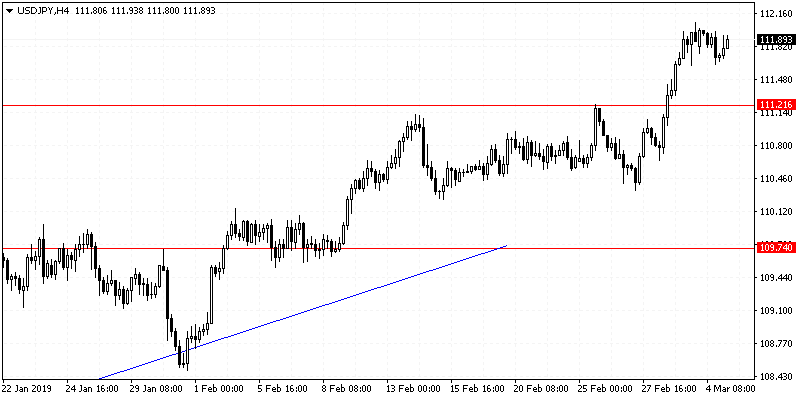
USDJPY (111.89): The USDJPY traded somewhat muted on Monday. Price action closed bearish, but the overall momentum remains to the upside. The bullish momentum remains in place with the USDJPY likely to target the resistance level at 112.50. A retest of this level to establish resistance will mark the completion to the upside. Alternately, with the recently breached resistance level at 111.21 exposed, the downside could bring the USDJPY to test this level of support.
EURUSD Intraday Analysis
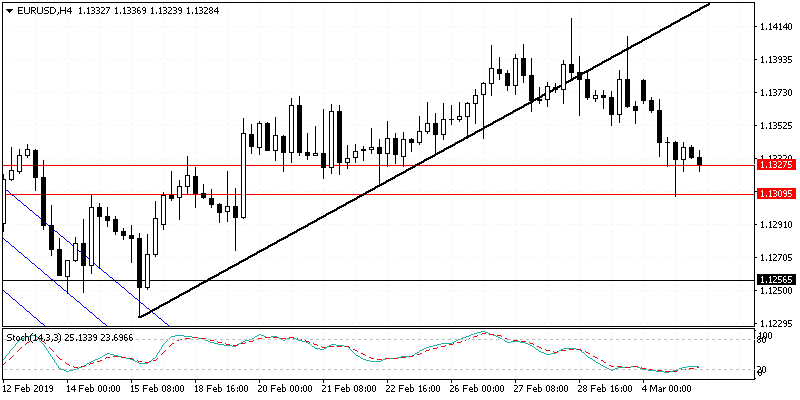
EURUSD (1.1328): The EURUSD currency closed on a bearish note yesterday following the previous two days of consolidation. Price is back near the support level of the 1.1327 region. With the support being tested once again, there is scope for further downside. A break down below 1.1327 – 1.1309 could signal further losses that could send the euro currency lower to the 1.1256 level of support. In the longer term, the EURUSD remains range bound.
RBA Holds Rates Steady At Today’s Meeting
The US dollar posted strong gains amid a risk on sentiment which saw the safe-haven assets losing ground. Meanwhile, commodities such as gold and silver extended strong declines on the day.
Economic data was relatively quiet on Monday. Eurozone Sentix investor confidence improved, with the index rising to -2.2, beating estimates of -3.1. In the UK, construction PMI fell to 49.5, marking a contraction in the sector.
The NY trading session saw the release of construction spending which posted a decline of 0.6%. This was worse than the forecast of 0.2% and dropped from 0.8% in the month before.
The Reserve Bank of Australia held its monetary policy meeting earlier today. As widely expected, the central bank left interest rates unchanged at 1.50%. The decision to leave rates unchanged comes ahead of key economic reports due later during the week.
The European trading session will kick off today with IHS Markit releasing the monthly services PMI reports. Expectations are for the eurozone services PMI to remain steady at 52.3, but we can expect the Italian and French services sectors to post a contraction.
As for the UK's services PMI, expectations are for a decline to the 50.0 level on the index. This marks a modest drop in activity from 50.1 in January. Forecasts indicate that retail sales for the eurozone may show an increase of 1.3% after they fell 1.6% in the month before.
The NY trading session will see the release of ISM's services PMI report. The non-manufacturing activity is expected to rise to 57.4 in February, up from 56.7 in January. Later in the day, the BoE governor, Mark Carney is scheduled to speak.