

Sample Category Title
BoE: UK financial system can withstand worst case disorderly Brexit
BoE noted in the Financial Policy Summary that the core of the financial system is prepared for wide range of risks it could face. And it could withstand even "a worst case disorderly Brexit". In such case, there will be a "sudden imposition of trade barriers with the EU; loss of existing trade agreements with other countries; severe customs disruption; a sharp increase in the risk premium on UK assets; and negative spillovers to wider UK financial markets."
But, major UK banks' capital ratios are more than three times higher than before the global financial crisis. Thus, these banks have "large buffers of capital" to absorb losses. The capital is even sufficient to withstand severe global stresses happening at the same time of worst case disorderly Brexit.
Forex Technical Analysis: EUR/USD, USD/JPY, GBP/USD
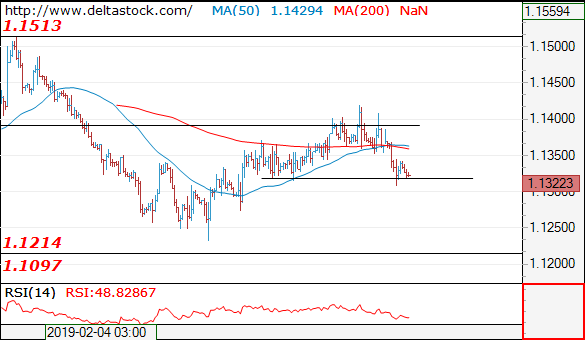
EUR/USD
Current level - 1.1322
My outlook is still bearish, for a break through 1.1320, towards 1.1214 lows. Initial resistance is projected at 1.1350.
| Resistance | Support | ||
| intraday | intraweek | intraday | intraweek |
| 1.1350 | 1.1630 | 1.1320 | 1.1214 |
| 1.1450 | 1.1820 | 1.1214 | 1.1100 |
USD/JPY
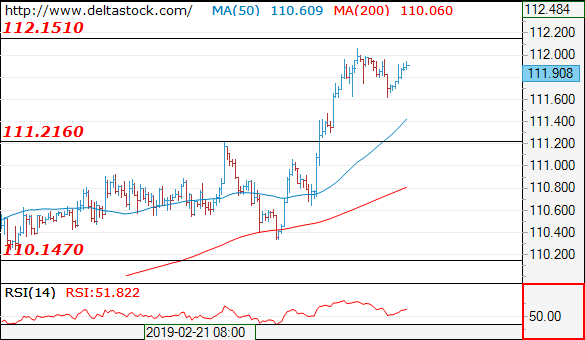
Current level - 111.90
The pair has pulled back after the 112.05 peak and the consolidation below 112.20 is likely to extend through 111.60, towards 111.20 static support.
| Resistance | Support | ||
| intraday | intraweek | intraday | intraweek |
| 112.15 | 113.00 | 111.20 | 110.20 |
| 113.00 | 114.50 | 110.20 | 108.50 |
GBP/USD
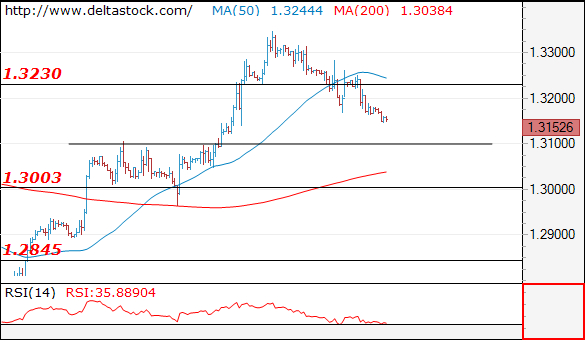
Current level - 1.3152
The bias remains bearish, for a test of 1.3100 area. Crucial on the upside is 1.3270.
| Resistance | Support | ||
| intraday | intraweek | intraday | intraweek |
| 1.3270 | 1.3290 | 1.3100 | 1.2800 |
| 1.3450 | 1.3450 | 1.3000 | 1.2610 |
GBP/USD Outlook: Three-Day Pullback Slows Ahead Of Key Supports, UK Services PMI Data Eyed For Fresh Signals
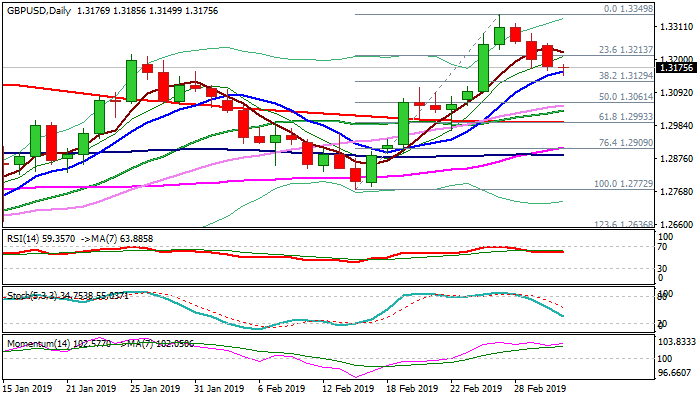
Cable is holding within narrow consolidation just above 10SMA support (1.3161), following three consecutive days in red.
Extension of pullback from 1.3349 high hit one-week low at 1.3150, but holding for now above pivotal supports at 1.3161/29 (10SMA / Fibo 38.2% of 1.2772/1.3349 upleg).
The pullback so far looks like positioning for fresh advance as sentiment improved after fears of no-deal Brexit have been sidelined, but needs to be contained above 1.3129 Fibo support to make scenario valid
Daily studies maintain bullish momentum, but south-heading stochastic shows room for further easing.
UK Services PMI data are in focus (Feb 49.9 f/c vs Jan 50.1), with weaker than expected figure to increase pressure and risk deeper dips through 1.3129 towards 1.3060/50 zone (Fibo 50% / rising 30SMA).
Conversely, upbeat release would boost pound and possibly signal an end of corrective phase on return above 5SMA (1.3225).
Res: 1.3186, 1.3225, 1.3286, 1.3319
Sup: 1.3149, 1.3129, 1.3061, 1.3050
EUR/USD Outlook: Bears Keep Key Fibo Support In Focus Despite Monday’s Strong Downside Rejection
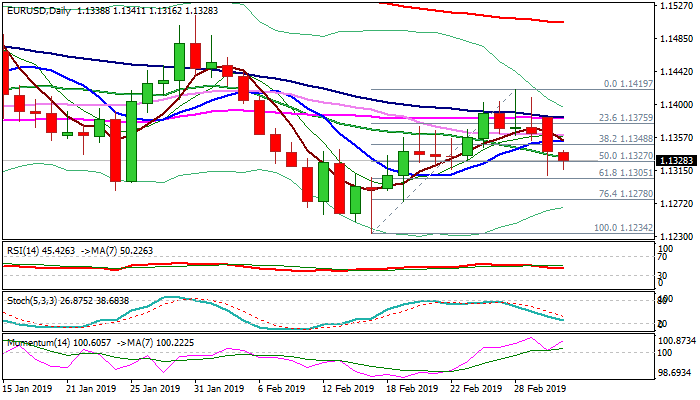
The Euro remains in red on Tuesday, but the downside looks protected for now after Monday's fall which faced strong downside rejection just above pivotal support at 1.1305 (Fibo 61.8% of 1.1234/1.1419).
Fresh weakness probes again below 20SMA (1.1331), keeping the downside under increased pressure, despite existing bullish momentum.
Stronger than expected releases of series of PMI data from EU countries may slow bears, but so far failed to provide more significant support.
Break and close below 1.1305 pivot would generate strong bearish signal and risk extension towards 1.1278 (Fibo 76.4%), while repeated daily close above 20SMA would ease existing bearish pressure, but bounce and close above 10SMA (1.1351) is needed to confirm.
Res: 1.1331, 1.1351, 1.1382, 1.1408
Sup: 1.1305, 1.1278, 1.1234, 1.1200
AUD/USD Outlook: Aussie Remains Nervous After RBA And Ahead Of GDP Data, Pressuring Key Support At 0.7070
The Aussie was slightly higher in late Asian trading after RBA kept interest rates unchanged at record lows but maintained upbeat view and expecting economic growth to pick up in 2019 after slowing in second half of 2018.
The central bank's policy meeting comes just day ahead of release of Australian GDP data.
According to forecasts, the economy growth is expected to slow to 2.5% in Q4, compared to previous quarter's 2.8%, which diverges from RBA's optimistic expectations for 3% growth.
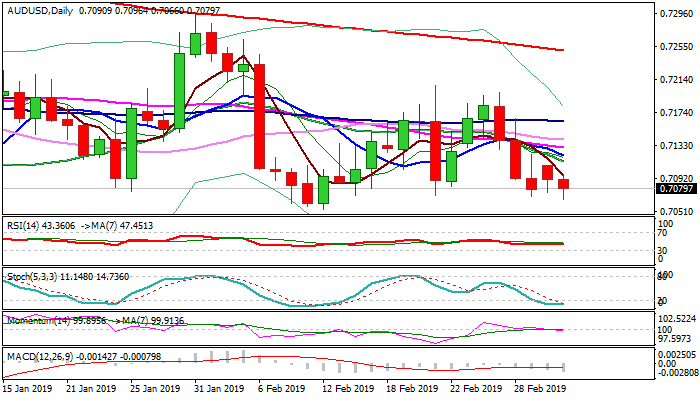
Pessimistic tones prevail in the market, keeping the pair at the back foot and pressuring pivotal support at 0.7070 (Fibo 38.2% of 0.6706/0.7295), already cracked on overnight's dip to 0.7066, with nervous choppy trading expected to remain until Wednesday's release. Overall bearish daily techs support the notion, as daily MA's in firm bearish setup turn lower and started to diverge, while momentum probes into negative territory. Falling thick hourly cloud ( 0.7092/0.7107) continues to pressure and marks initial resistance. Downbeat GDP results on Wednesday would further sour the sentiment and push the RBA closer to rate cut in coming months. Eventual break of key support zone at 0.7070/54 would risk bearish acceleration towards psychological 0.70 support and 0.6931 (Fibo 61.8%) in extension.
Res: 0.7092, 0.7107, 0.7118, 0.7130
Sup: 0.7070, 0.7054, 0.7000, 0.6931
China Growth Target Figures
The global economy was once again reminded of the risks that external headwinds can pose for domestic markets today, after the growth target for China in 2019 was estimated at a lower range when compared to 2017 and 2018.
China's Premier Li Keqiang announced that China is targeting an economic growth range between 6 - 6.5% this year, and there was a warning from externally-generated risks that the subsequent pressure this may have on the Chinese economy is increasing.
This warning around externally-generated risks and headwinds follows a narrative that has been echoed across the world in recent weeks and months, including major institutions like the IMF and a range of central banks across the major and developing economies.
The external headwinds are not limited to one individual factor by any means; they include a range of unconventional risks that are noted more regularly in politics, prolonged uncertainty around issues like Brexit and a list of other unknown events. While we have seen very regularly what impact risk aversion can have on financial markets, in terms of investor reluctance to take on “risk” in stock markets and emerging market currencies in recent months – we are yet to notice the full impact these external headwinds are having on the global economy. I expect that this trend will change over the coming weeks and months, meaning we will begin to gain a clearer indication on what impact external headwinds are having on economic data.
EUR/JPY Targeting The ATR Projection High
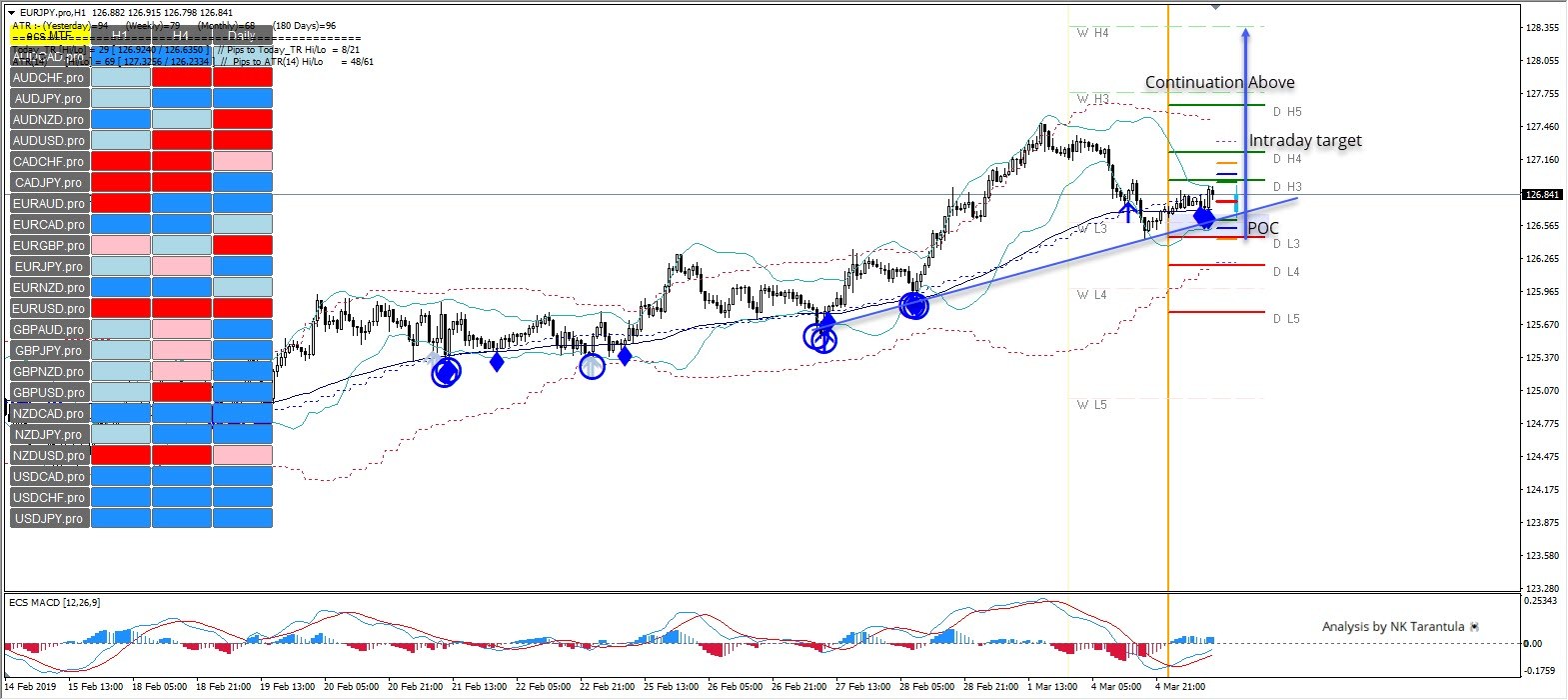
The EUR/JPY is making a bullish zig-zag which is supported by an ascending trend line. We should see a continuation of uptrend.
The JPY weakness might continue today and during this week. The POC zone 126.50-75 is supportive on a positive bullish momentum. We can spot a T-89 pattern along with a trend line rejection. As long as 126.25 holds, intraday bulls should be safe. The highest projected target is 127.32. Intra-week longs might target W H3 camarilla pivot 127.76. 4h close above W H3 will target W H4 128.36. Watch for POC rejection and/or continuation of the bullish trend.
ECB and BOE activate currency swap arrangements
ECB and BoE announced to activate currency swap arrangements ahead of Brexit. Under the arrangement, BoC will offer to lend Euro to UK banks on a weekly basis. BoE will also obtain Euro from ECB in exchange for Sterling. Also, Eurosystem would stand ready to lend Sterling to Eurozone banks if needed.
ECB said "the activation marks a prudent and precautionary step by the Bank of England to provide additional flexibility in its provision of liquidity insurance, supporting the functioning of markets that serve households and businesses."
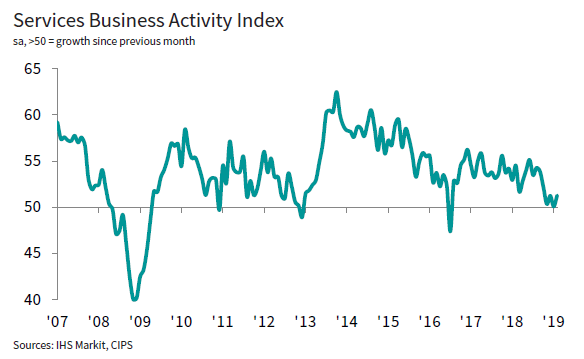
UK PMI services rose to 51.3, suggest just 0.1% GDP growth in Q1
UK PMI services rose to 51.3 in February, up from 50.1 and beat expectation of 50.0. Markit noted "modest upturn in service sector output". But there was "slight fall in new work" and "staffing levels drop to greatest extent for over seven years".
Chris Williamson, Chief Business Economist at IHS Markit, which compiles the survey:
"The latest PMI surveys indicate that the UK economy remained close to stagnation in February, despite a flurry of activity in many sectors ahead of the UK's scheduled departure from the EU. The data suggest the economy is on course to grow by just 0.1% in the first quarter.
"Worse may be to come when pre-Brexit preparatory activities move into reverse. Many Brexit-related headwinds and uncertainties also look set to linger in coming months even in the case of PM May's deal going through. Global economic growth meanwhile remains sluggish, adding an increasingly gloomy backdrop to the UK's current problems.
"Business optimism about the year ahead has consequently sunk to the lowest ever recorded by the survey with the exceptions of the height of the global financial crisis and July 2016. Brexit concerns dominate the list of reasons cited by companies for deteriorating business performance by a wide margin.
"Employment across services, manufacturing and construction is meanwhile now falling at a rate not exceeded for nine years as companies cut costs and await clarity on the outlook, highlighting the rising damage to the economy from intensifying uncertainty."
Eurozone PMI composite finalized at 51.9, easing of one-off dampening factors
Eurozone PMI services was revised up to 52.8 in February, from initial reading of 52.3. It's also an improvement from January's final reading of 51.2. PMI composite was finalized at 51.9, up from prior month's 51.0. Improvements were also seen across the countries. Italy PMI composite rose to 2-month high of 49.6. France reading rose to 3-month high of 50.4. Germany reading rose to 4-month high of 52.8.
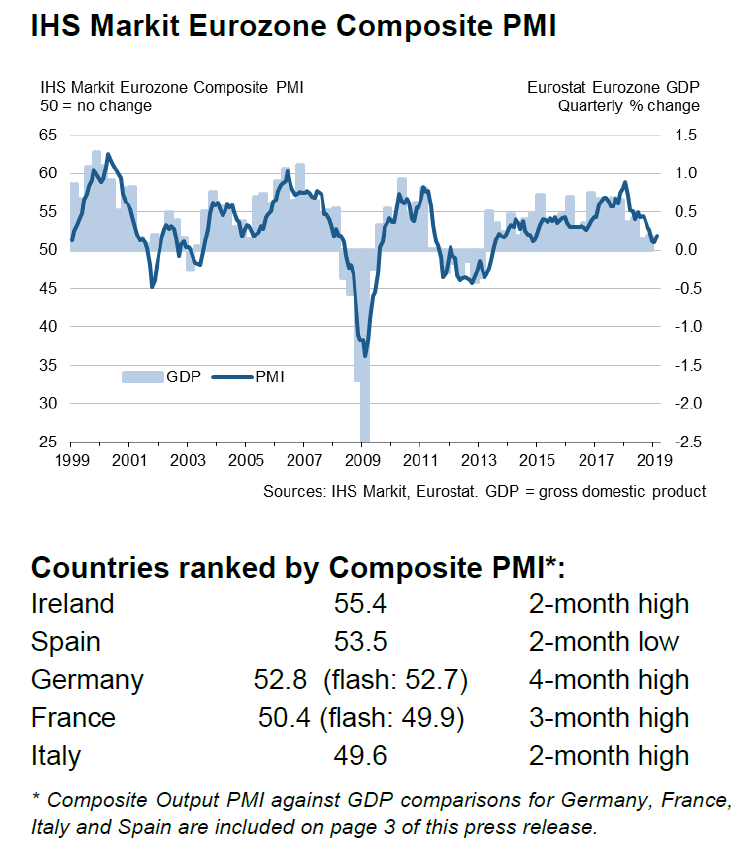
Chris Williamson, Chief Business Economist at IHS Markit said:
"The final PMI for February indicated a slightly improved performance compared to the flash estimate, lifted higher than January in part due to the further easing of one-off dampening factors such as the yellow vest protests in France and new auto sector emissions rules. However, the survey remained subdued as other headwinds continued to increasingly constrain business activity. These include slowing global economic growth, rising geopolitical concerns, trade wars, Brexit and tightening financial conditions.
"Measured overall, the survey shows the quarterly rate of GDP growth picking up to 0.2% in February from 0.1% in January, meaning the first quarter could see the eurozone economy struggle to beat the 0.2% expansion seen in the fourth quarter of last year.
"Manufacturing remains especially fragile, with an increased rate of decline of new orders and signs of excess capacity relative to sales boding ill for future production.
"While the service sector is showing greater resilience, inflows of new business remained worryingly weak, providing little hope for any noticeable improvement in performance in the coming months.
"Price pressures have meanwhile cooled to the lowest for a year-and-a-half amid a stagnation of demand, thereby adding to the suggestion that policymaking will turn increasingly dovish."