

Sample Category Title
USD/JPY Daily Outlook
Daily Pivots: (S1) 111.69; (P) 111.92; (R1) 112.11; More...
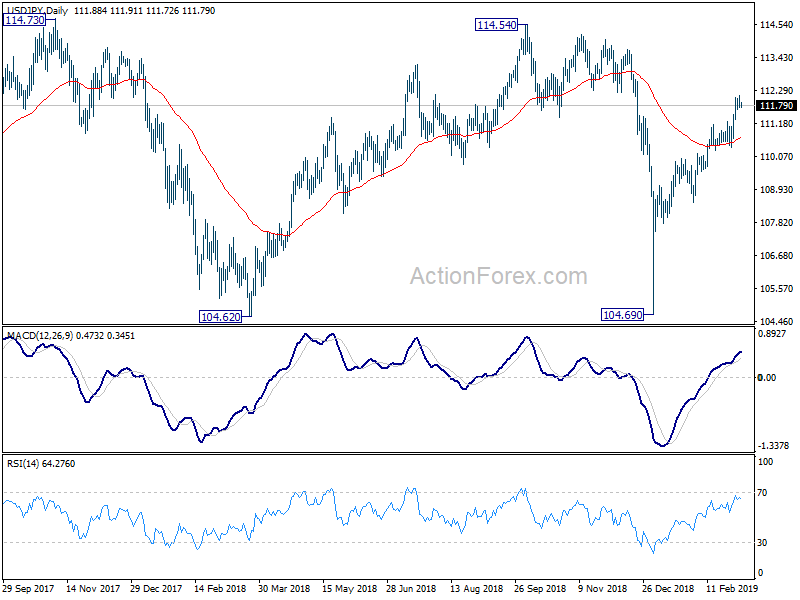
USD/JPY edged higher to 112.13 but retreated again and continues to loss momentum. Intraday bias remains neutral for more consolidative trading. In case of deeper pull back, downside should be contained above 110.35 support to bring another rally. On the upside, above 112.13 will resume rise from 104.69 for 114.54 resistance next.
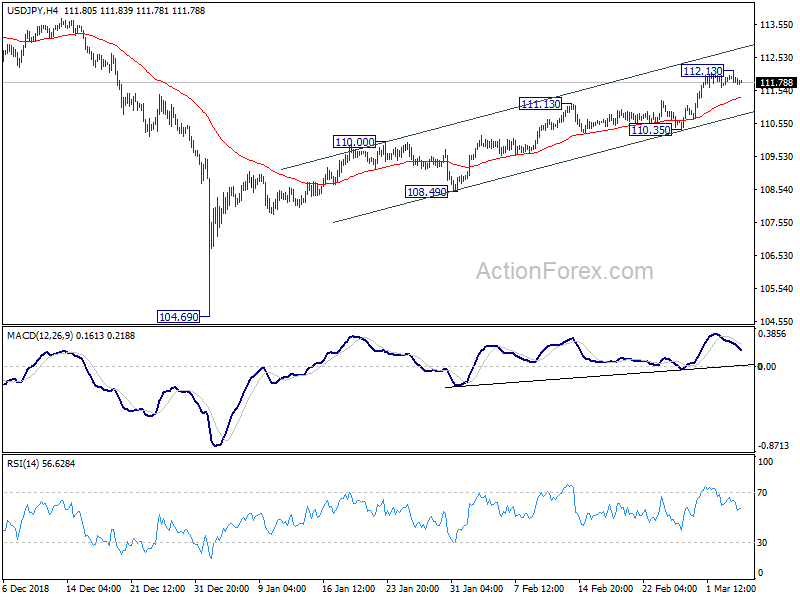
In the bigger picture, current strong rebound from 104.69 argues that decline from 118.65 (2016 high) has completed with three waves down to 104.69, after failing 104.62. More importantly, the rise from 98.97 (2016 low) could be resuming. Focus now turns back to 114.54 resistance, decisive break there will add more credence to this bullish case and target 118.65. This will now be the favored case as long as 110.35 support holds.
USD/CAD Daily Outlook
Daily Pivots: (S1) 1.3316; (P) 1.3338; (R1) 1.3376; More...
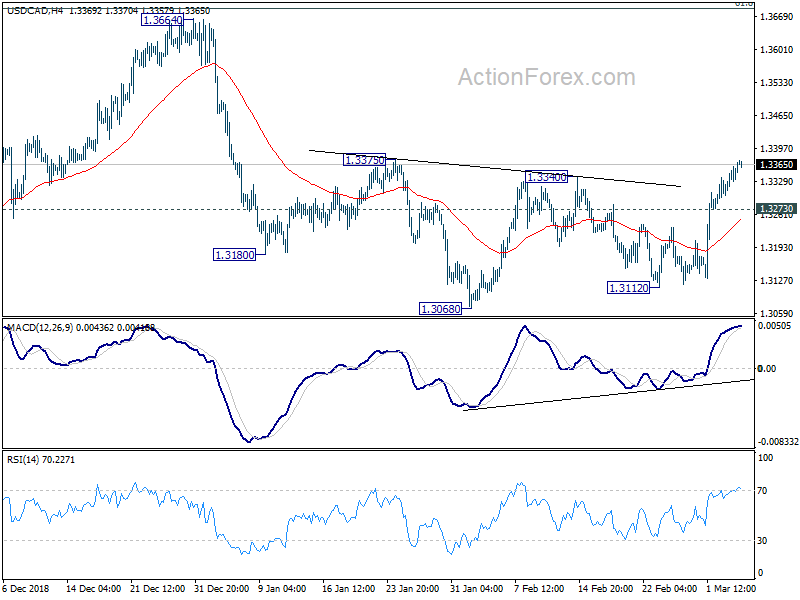
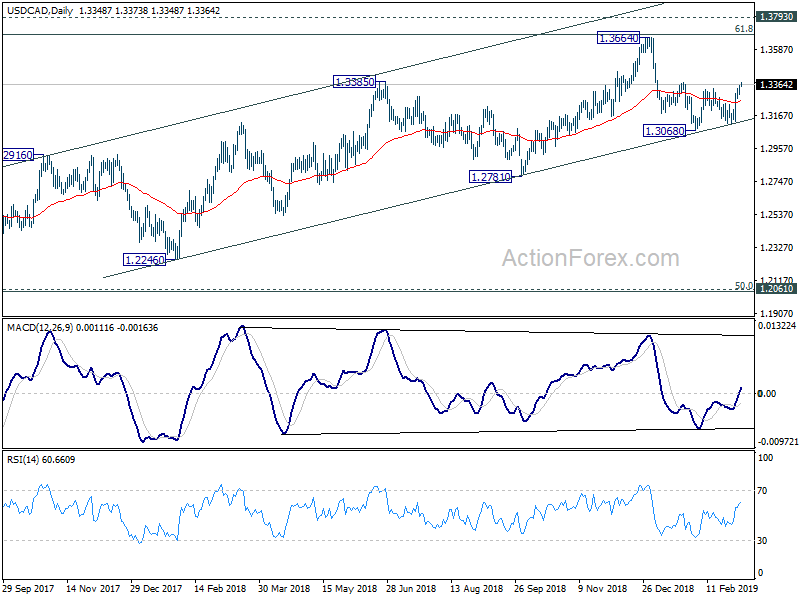
USD/CAD's break of 1.3340 resistance completes a head and shoulder bottom pattern (ls: 1.3180, h: 1.3068, rs: 1.3112). And the pull back from 1.3664 should have completed at 1.3068. Intraday bias stays on the upside for retesting 1.3664 and then 1.3685 fibonacci level. On the downside, break of 1.3273 minor support will dampen this view and turn bias back to the downside for 1.3112 support instead.
In the bigger picture, structure of the medium term rise from 1.2061 (2017 low) to 1.3664 is not clearly impulsive. Hence, we'd stay cautious on strong resistance from 61.8% retracement of 1.4689 (2016 high) to 1.2061 at 1.3685 and 1.3793 resistance to limit upside, and bring medium term topping. But in any case, medium term outlook will stay bullish as long as channel support (now at 1.3118) holds. Sustained break of 1.3793 will pave the way to retest 1.4689 (2015 high). Firm break of the channel support should confirm reversal target 1.2061 low again.
AUD/USD Daily Outlook
Daily Pivots: (S1) 0.7064; (P) 0.7080; (R1) 0.7102; More...
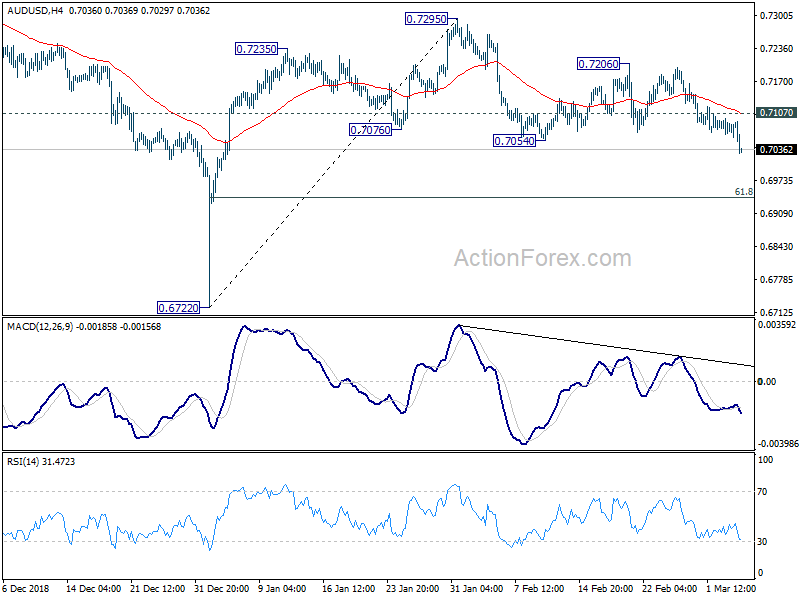
AUD/USD drops to as low as 0.7028 today as fall from 0.7295 extends. Break of 0.7054 support completes a head and shoulder top pattern (ls: 0.7235, h: 0.7295, rs: 0.7206) and confirms completion of rebound from 0.6722. Intraday bias is back on the downside for 61.8% retracement of 0.6722 to 0.7295 at 0.6941. Break will bring retest of 0.6722 low. On the upside, above 0.7107 minor resistance will dampen this bearish view and turn intraday bias neutral first.
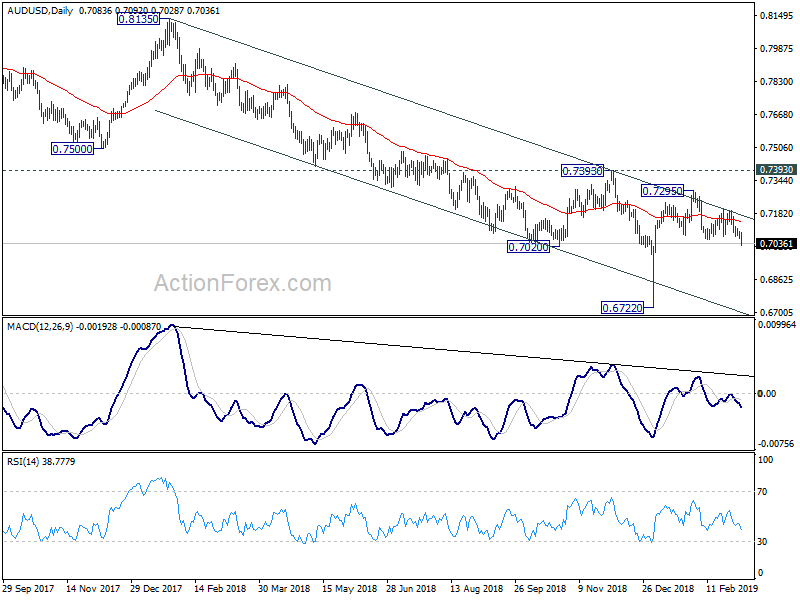
In the bigger picture, as long as 0.7393 resistance holds, we'd treat fall from 0.8135 as resuming long term down trend from 1.1079 (2011 high). Decisive break of 0.6826 (2016 low) will confirm this bearish view and resume the down trend to 0.6008 (2008 low). However, firm break of 0.7393 will argue that fall from 0.8135 has completed. And corrective pattern from 0.6826 has started the third leg, targeting 0.8135 again.
Australian Dollar Tumbles on Bet of RBA Rate Cuts after Dismal GDP
Australian Dollar tumbles broadly today as traders add to bet of RBA rate cuts after poor Q4 GDP. RBA Governor Philip Lowe basically maintained upbeat view on the outlook in a speech, but that was largely ignored. Sterling is also among the weakest as UK Attorney General Geoffrey Cox's trip to Brussels produced no breakthrough on Irish backstop. But it should be noted that the lack of result isn't really much of a bad news because expectation on a Brexit deal is still rather low. So far, the Pound is supported just by expectation that there will be no no-deal Brexit.
Staying in the currency markets, Dollar and Yen are the stronger ones for today so far. Both are mainly supported by weakness of others only. There is no clear sign of risk aversion. Japan 10-year JGB yield turns negative again today and could drag down Yen again if Germany and US yield resume recent rise. Canadian Dollar is mixed ahead of BoC rate decision.
Technically, Dollar is solidifying momentum for near term rally. EUR/USD broke 1.1316 support and should target 1.1215 low. USD/CHF broke 1.0024 and should target 1.0098 resistance. USD/CAD is staying firm above 1.3340 resistance, which indicates bullish near term reversal. AUD/USD also broke 0.7054 support which indicate bearish near term reversal. More upside remains in favor in Dollar.
In Asia, Nikkei closed down -0.60%. Hong Kong HSI is up 0.15%. China Shanghai SSE is up 0.53%. Singapore Strait Times is up 0.01%. Japan 10-year JGB yield is down -0.0134 at -0.005, turned negative again. Overnight, DOW dropped -0.05%. S&P 500 dropped -0.11%. NASDAQ dropped -0.02%. 10-year yield closed flat at 2.722.
Australia GDP slowed to 0.2% in Q4, RBA may need to revise down forecasts in May
Australia GDP grew only 0.2% qoq in Q4, slowed from prior quarter's 0.3% qoq and missed expectation of 0.5% qoq. Annual growth slowed to 2.3%, down from Q3's 2.7%. Looking at some details, terms of trade rose 3.2% qoq, 6.1% yoy. But consumer spending rose only 0.4% qoq, 2.0% yoy. Home building contracted -3.4% qoq, slowed to 2.5% yoy. Farm output dropped -4.0% qoq, -5.8% yoy.
Australian Treasurer Josh Frydenberg tried to talk down the slowdown. He noted that "the moderation in part reflects the impact of the drought, lower mining investment and as we continue to move from the construction to the production phase, as well as a decline in residential construction activity from record levels".
However, the country "continues to grow faster than any G7 nation except for the United States". And, 0.2% growth was "within the range of market expectations" to him. Also, "over the past 12 months, more than 270,000 new jobs were created and more than 8 out of every 10 of these jobs were full-time."
Westpac noted that the data now posts a "challenge" for RBA to "credibly maintain its GDP growth forecasts at 3% in 2019 and 2.75% in 2020". Thus RBA is likely to revise down its growth forecasts in May SoMP. And the policy stance could then shift to steady with a clear easing bias. Westpac continued to expect RBA to cut twice this year in August and November.
RBA Lowe: Income growth to provide counterweight to falling house price
RBA Governor Philip Lowe said in a speech that nationwide housing prices have fallen by 9% since peaking in 2017, bringing them back to level in mid-2016. He noted that "declines of this magnitude are unusual, but they are no unprecedented". Movement in house prices would influence consumer spending, building activity, access to finance by small businesses and profitability of financial institutions.
Though, labor market is expected to continue to tighten with gradual increase in wage growth and faster income growth. That should "provide a counterweight to the effect on spending of lower housing prices." And overall, Lowe said the adjustment in our housing market is manageable for the overall economy. It is unlikely to derail our economic expansion. It will also have some positive side-effects by making housing more affordable for many people."
On monetary policy, Lowe also noted that a "strong labour market is the central ingredient in the expected pick-up in inflation". Wag growth would "boost household income and spending and provide a counterweight to the fall in housing price". And, "a lot depends upon the labour market". RBA will "continue to assess the shifts in the global economy, trends in household spending and how the tension between the labour market and output indicators resolves itself. "
Lowe also reiterated that the probabilities for the next move to go up or down are "reasonably evenly balanced".
BoJ Harada: Should strengthen monetary easing without delay if economy deteriorates
BoJ board member Yutaka Harada warned that the economy is facing increasing risks, including slowdown in China, trade tensions and weak private consumptions. Also, subdued inflation could reinforce the public view of low inflation, which would delay the achievement of the 2% target. He urged that "if the economy deteriorates to the extent that achieving the inflation target in the long term becomes difficult, it's necessary to strengthen monetary easing without delay."
For now, Harada said BOJ should commit to loose monetary policy "unless prices show stronger movements than currently anticipated." And the conduct of monetary policy should be "data-dependent, not calendar-based". He also warned that "past episodes of premature monetary tightening worsened the economy, driven down prices and output, and led to declines in interest rates in the longer-term."
Fed Kaplan: US economy is more more interest rate sensitive than it has been historically
Dallas Fed President Robert Kaplan warned in a speech yesterday that in the event of an economic downturn, level, growth and credit quality of corporate debt could "contribute to a deterioration in financial conditions which could, in turn, amplify the severity of a growth slowdown in the U.S. economy." Thus, vigilance is warranted and Fed will continue to monitor corporate debt.
Meanwhile, he is "also sensitive to these corporate debt developments in light of the historically high level of U.S. government debt and the forward estimates for the path of government debt to GDP. An elevated level of corporate debt, along with the high level of U.S. government debt, is likely to mean that the U.S. economy is much more interest rate sensitive than it has been historically."
Separately, Minneapolis Fed President Neel Kashkari reiterated his view that the US is not full employment yet and there is room for growth. He said "here is still slack in the labor market, and until we see wages growth really pick up I'm going to believe that there are still more Americans out there". Thus, "I'm very focused on wages as the best indicator overall of how tight is the labor force."
BoC to maintain tightening bias despite growing downside risks
BOC is widely expected to leave the policy rate unchanged at 1.75% today . Since the last meeting, economic data released pointed to slowdown in Canada's growth momentum. Although Governor Stephen Poloz has recently affirmed at the central bank should still increase the policy rate to the neutral level at some point, the timing is data-dependent. It is important to monitor how the members react to the broad-based data disappointment of late.
Governor Poloz noted in a speech two weeks ago that the policy rate would need to move "up into a neutral range over time, to a point where it is not stimulating or constraining economic growth". He added, however, that "the path back to that neutral range is highly uncertain" and any move should be data dependent. More in BOC Preview – Risk on Growth is to the Downside.
More on Canada and BoC:
- BOC Preview: Will Poloz And Company Shift Into Neutral This Month…Or Next?
- Loonie Declines Ahead Of Rate Decision, BoC Expected To Be Dovish Again
- Canadian 'Solo' Recession Risk: Rhetoric vs Reality
Looking ahead
BoC rate decision is the main focus today. Also, Canada will release trade balance, labor productivity and Ivey PMI. US will release ADP employment and trade balance. Fed will also release Beige Book economic report.
AUD/USD Daily Outlook
Daily Pivots: (S1) 0.7064; (P) 0.7080; (R1) 0.7102; More...
AUD/USD drops to as low as 0.7028 today as fall from 0.7295 extends. Break of 0.7054 support completes a head and shoulder top pattern (ls: 0.7235, h: 0.7295, rs: 0.7206) and confirms completion of rebound from 0.6722. Intraday bias is back on the downside for 61.8% retracement of 0.6722 to 0.7295 at 0.6941. Break will bring retest of 0.6722 low. On the upside, above 0.7107 minor resistance will dampen this bearish view and turn intraday bias neutral first.
In the bigger picture, as long as 0.7393 resistance holds, we'd treat fall from 0.8135 as resuming long term down trend from 1.1079 (2011 high). Decisive break of 0.6826 (2016 low) will confirm this bearish view and resume the down trend to 0.6008 (2008 low). However, firm break of 0.7393 will argue that fall from 0.8135 has completed. And corrective pattern from 0.6826 has started the third leg, targeting 0.8135 again.
Economic Indicators Update
| GMT | Ccy | Events | Actual | Forecast | Previous | Revised |
|---|---|---|---|---|---|---|
| 00:30 | AUD | GDP Q/Q Q4 | 0.20% | 0.50% | 0.30% | |
| 13:15 | USD | ADP Employment Change Feb | 190K | 213K | ||
| 13:30 | CAD | International Merchandise Trade (CAD) Dec | -1.70B | -2.06B | ||
| 13:30 | CAD | Labor Productivity Q/Q Q4 | 0.20% | 0.30% | ||
| 13:30 | USD | Trade Balance (USD) Dec | -57.8B | -49.3B | ||
| 15:00 | CAD | BoC Rate Decision | 1.75% | 1.75% | ||
| 15:00 | CAD | Ivey PMI Feb | 54.7 | |||
| 15:30 | USD | Crude Oil Inventories | -8.6M | |||
| 19:00 | USD | Federal Reserve Beige Book |
Into European session: Aussie weakest after GDP miss. Dollar, Yen and Swiss firm
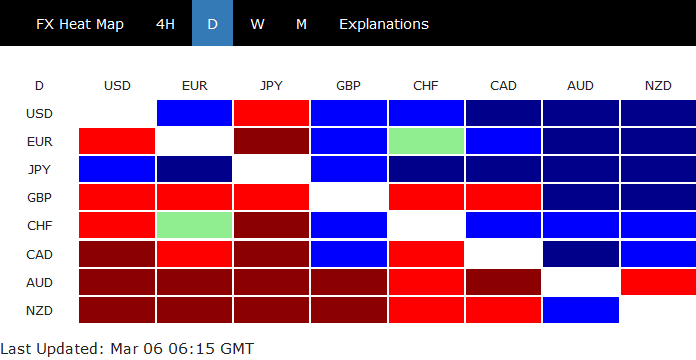
Entering into European session, Australian Dollar is the weakest one for today, followed by New Zealand Dollar. The Aussie is weighed down by much weaker than expected Q4 GDP growth, at 0.2% qoq. Australian Treasurer Josh Frydenberg attributed the slowdown to drought. RBA Governor Philip Lowe also maintained upbeat view on the outlook. But today's data further affirm market expectations that the next move is a cut, and could happen as soon as in August.
Sterling is the third weakest as there was no UK Attorney General Geoffrey Cox's trip to Brussels produced no breakthrough on Irish backstop. Yen, Dollar and Swiss are the strongest ones. Looking ahead, the European session is relatively empty today. BoE Cunliffe's speech may catch some attention. Focus will mainly be on BoC rate decision and US ADP employment.
In Asia:
- Nikkei closed down -0.60%.
- Hong Kong HSI is up 0.19%.
- China Shanghai SSE is up 0.33%.
- Singapore Strait Times is up 0.01%.
- Japan 10-year JGB yield is down -0.0134 at -0.005, turned negative again.
Overnight:
- DOW dropped -0.05%.
- S&P 500 dropped -0.11%.
- NASDAQ dropped -0.02%.
- 10-year yield closed flat at 2.722.
EUR/USD And USD/CHF: US Dollar Bulls In Control
EUR/USD failed to hold gains above the 1.1350 level and declined below 1.1320. USD/CHF surged higher and broke the key 1.0020 resistance level to move into an uptrend.
Important Takeaways for EUR/USD and USD/CHF
- The Euro topped above the 1.1400 pivot level and declined heavily against the US Dollar.
- Recently, there was a break below a contracting triangle with support at 1.1320 on the hourly chart of EUR/USD.
- USD/CHF broke the key 1.0015 and 1.0020 resistance levels to set the pace for more gains.
- There is a major bullish trend line formed with support at 1.0020 on the hourly chart.
EUR/USD Technical Analysis
After spiking above the 1.1400 resistance level, the Euro faced a strong selling interest against the US Dollar. The EUR/USD pair started a fresh decline and broke the 1.1380 and 1.1350 support levels.
The decline was strong as the pair even broke the 1.1320 support level and the 50 hourly simple moving average. Before the drop, there was a consolidation pattern formed above the 1.1320 support level. However, buyers failed to protect more losses and the price extended declines below 1.1300.
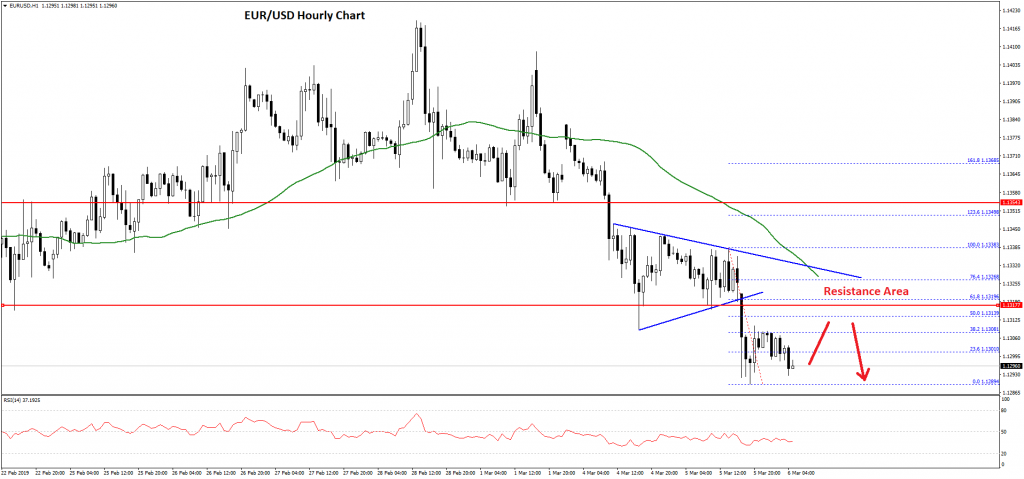
There was a break below a contracting triangle with support at 1.1320 on the hourly chart of EUR/USD. The pair gained pace below 1.1300 and traded as low as 1.1289 on FXOpen.
Later, there was a minor upside correction and the pair moved above the 1.1300 level and the 23.6% Fib retracement level of the last decline from the 1.1338 high to 1.1289 low. However, the pair struggled to break the 1.1308 level.
It seems like the 38.2% Fib retracement level of the last decline from the 1.1338 high to 1.1289 low acted as a resistance. On the upside, there is a strong resistance formed near the 1.1325 and the 50 hourly simple moving average.
Therefore, if the pair corrects higher, it is likely to face sellers near the 1.1310 and 1.1325 resistance levels. On the downside, a break below the 1.1289 low could push the pair towards the 1.1280 and 1.1260 support levels in the near term.
USD/CHF Technical Analysis
The US Dollar formed a solid support above the 0.9960 level and later climbed higher against the Swiss franc. The USD/CHF pair broke the 0.9980 and 0.9990 resistance levels to move into a positive zone.
The upward move was strong as there was a break above the key 1.0015 and 1.0020 resistance levels. There was even a close above the 1.0020 level and the 50 hourly simple moving average. The pair recently broke the 1.0040 level and traded as high as 1.0054 before correcting lower.
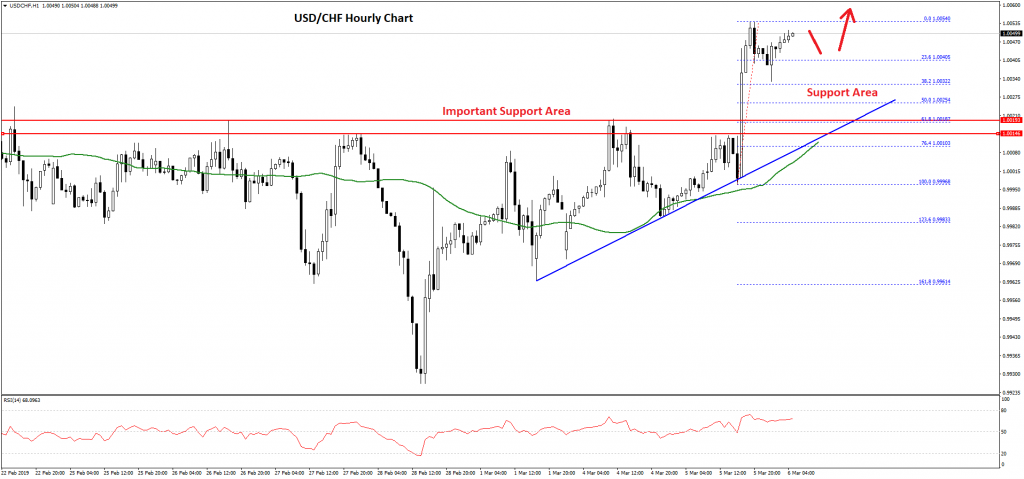
It traded below the 1.0040 level and the 23.6% Fib retracement level of the last wave from the 0.9996 low to 1.0054 high.
However, the decline was protected by the 1.0035 level and the 38.2% Fib retracement level of the last wave from the 0.9996 low to 1.0054 high. To the downside, there is a major bullish trend line formed with support at 1.0020 on the hourly chart.
The trend line is close to the previous resistance at 1.0020. Therefore, if there is a downside correction, the 1.0020 level is likely to act as a strong support.
On the upside, an initial resistance is near 1.0055, above which USD/CHF could accelerate towards the 1.0080 level in the coming sessions.
ECB Preview – Downgrades in Forecasts, Changes in Forward Guidance and Hints on New Lending
More dovish messages from ECB seem inevitable at the upcoming meeting. Clouded by Brexit uncertainty, trade conflicts with the US and global economic slowdown, economic developments since the January meeting turned out weaker than expected. We expect ECB to revise lower its GDP and inflation forecasts, extending the duration that policy rates would stay unchanged and provide stronger hints about the new lending facility (TLTROs).
Further Downgrades on Economic Forecasts
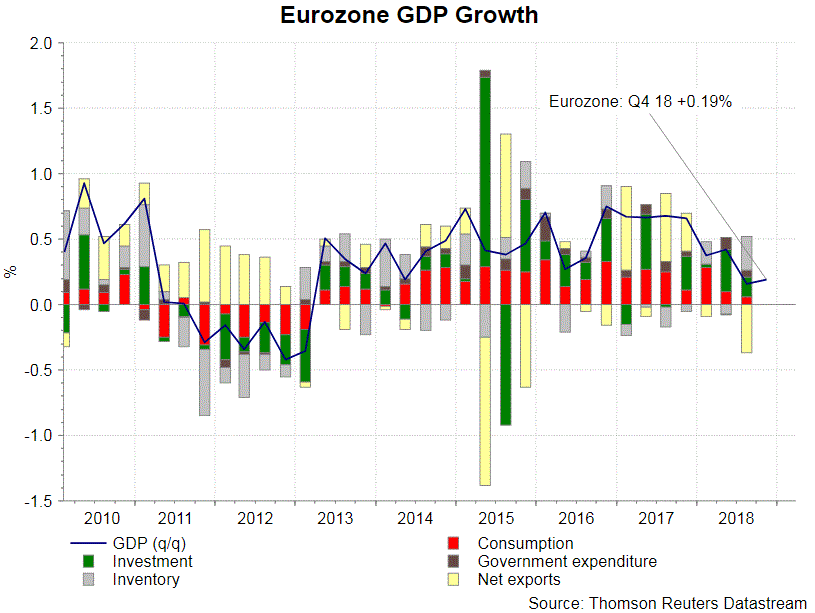
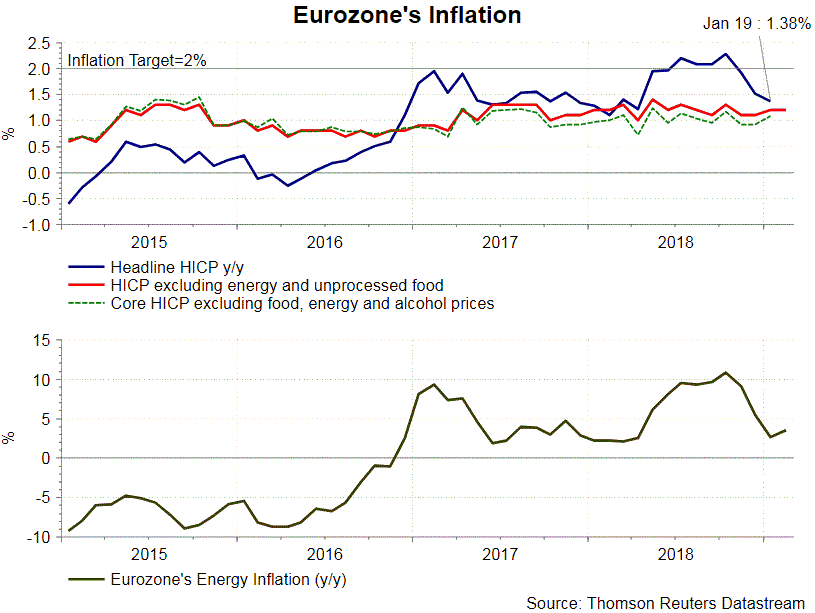
Since the January meeting, economic data in the Eurozone showed further slowdown. GDP growth was only +0.19% q/q in 4Q18. While net exports were the key drag, contributions from household consumption and investment on growth diminished significantly when compared with the prior quarter. Country-wise, Germany barely avoided entering technically recession with zero growth in 4Q18. Yet, Italy has already in recession. On inflation, the headline reading recovered to +1.5% y/y in February, after a sharp fall +1.38% y/y in January. While the headline reading can be volatile due to oil price, core CPI, supposedly a measure of the underlying price momentum of an economy, eased to +1% y/y, compared with consensus of +1.1%. Unemployment rate was unchanged at 7.8%, compared consensus. That’s the lowest level since October 2008. Yet, the employment situation is diverged in different member states. For instance, Greece and Spain are still embracing double-digit unemployment rates.
Last month, the European Commission trimmed its forecasts for the bloc’s GDP growth +1.3% for 2019 (from +1.9%) and +1.6% (from +1.7%) for 2020. We expect ECB would deliver a more dovish tone in the economic outlook. Besides reiterating that the risk of growth is to the downside, it would also revise lower its projections for both GDP growth and inflation.
Forward Guidance
In January, ECB simply repeated December’s statement, noting that there would no rate hike “at least through the summer 2019”. Given the rapid economic slowdown, it would be prudent for ECB to extend the duration to at least “end of 2019”. On the reinvestment process, the central bank would affirm to “continue reinvesting, in full, the principal payments from maturing securities purchased under the asset purchase programme for an extended period of time past the date when we start raising the key ECB interest rates, and in any case for as long as necessary”. While giving no definite timing for the end of reinvestment, i.e., the beginning of balance sheet reduction, we anticipate it would continue at least through end-2020.
TLTROs
While announcement of the new lending facility has been long-awaited, it is not certain whether ECB would talk about the details at the upcoming meeting. Speeches from ECB officials appear to signal that it is still in discussion and analysis stage. It is possible that President Mario Draghi could hint about the operation without giving more details.
Market Morning Briefing: Dollar Yen Has Resistance At 112.5
STOCKS
Global equities look mixed while the Indian indices have staged a strong rally yesterday thereby leaving the near-term outlook positive for it. Dow looks vulnerable for a further fall. Nikkei is nearing a key support and has the possibility to bounce back. DAX and Shanghai can consolidate in the near term within their overall uptrend.
Dow Jones (25,806.63, -13.02, -0.05%) seems to lack strength after having bounced from the 21-day moving average support level of 25,635. A near-term consolidation between 25,600 and 26,000 cannot be ruled out. But the overall bias remains negative and while below 26,000, Dow is in a danger to break and fall below 25,605 targeting 25,100-25,000 in the short term.
DAX (11,620.74, +28.08, +0.24%) can consolidate between 11,500 and 11,700 for some time before resuming its uptrend towards 11,800.
Nikkei (21,603.10, -123.18, -0.57%) has fallen further and is heading towards 21,500 as expected. The 100-week moving average is near 21,500 and the 100-day moving average support at 21,427 can limit the downside. A bounce from these supports can take the index higher to 21,950 and 22,000 in the coming days.
Shanghai (3,070.89, +16.64, +0.54%) is consolidating between 3000 and 3100. A breakout on either side of 3000 or 3100 will decide the next move.
Sensex (36,442.54, +378.73, +1.05%) and the Nifty 50 (10,987.45, 123.95, 1.14%) has risen sharply yesterday. Immediate resistances are at 36,480-36,500 for the Sensex and 11,000 for the Nifty 50. A strong break above these resistances will pave way for a test of 36,850-37,000 on the Sensex and 11,100-11,150 on the Nifty.
COMMODITIES
Gold and Silver trades subdued and remains pressured for further dip. Copper has bounced from a key support and can consolidate sideways for some time within its overall uptrend. Oil looks mixed for the near term within is sideways move.
Gold (1287) has bounced slightly after testing its support at 1280. While this support holds, an intermediate bounce to 1300 cannot be ruled out. However, broadly gold is likely to remain under pressure and a test of 1275-1270 cannot be ruled out as long as it trades below 1300.
Silver (15.12) has bounced from the psychological support level of 15. Resistance is at 15.20 which has to be broken for a relief rally to 15.40. But while below 15.2, silver looks vulnerable to break 15 and fall to 14.85.
Copper (2.94) has bounced from the 2.90-2.89 support region and can move up to 2.97-2.98 on a break above 2.95. A sideways consolidation between 2.89 and 2.98 can be seen for some time before the overall uptrend resumes targeting 3.0 and higher levels.
WTI (56) retains its 55-58 sideways range. It seems to be lacking strength to breach 57 decisively. A test of 55 is possible in the near term. A break below the immediate support at 55.75 can trigger this downmove.
Brent (65.35) is stuck between 65 and 66.35 since the beginning of this week. The broader 64-68 sideways range remains intact. Within this range, while below 66, a dip to 64.5 and 64.2 is possible in the coming sessions.
FOREX
Euro looks a little weak while Dollar-Yen may test 112.50 before falling from there. Pound and Aussie have important supports below current levels which may hold for the near term. Indian Rupee looks strong just now. Need to see if Dollar Index holds below 97 or rises higher to test 97.50 in the next few sessions.
Dollar-Index (96.90) has moved up as expected but could face rejection from 97.00-97.50 which could again push back Dollar Index towards 96-95.75 levels.
Euro (1.1297) is also trading lower in line with our expectation and has enough room on the downside towards 1.1250 and then lower towards 1.12. Unless the dollar Index comes off from 97 itself, Euro has scope of falling further in the near term.
Euro-Yen (126.31) has also come off from immediate daily resistance near 127.6 and while that holds, Euro-Yen could dip to test lower levels of 126.00-125.20 soon.
Dollar Yen (111.80) has resistance at 112.5 and even if the pair does not face a sharp rejection from here, it could remain stable and see some range trade in the 112.5-111 region. A fall from current levels is preferred targeting 110-109 in the longer run.
Pound (1.3141) has interim support at 1.31 which if breaks could open up chances of falling towards 1.2950 in the coming sessions. Watch price action near 1.31 which if produces a decent bounce could take Pound back towards 1.32-1.33 levels.
Aussie (0.7038) is heading towards support at 0.70 which could hold and produce a bounce for the near term. Only if 0.70 breaks, we may look at a possible test of 0.69. Note that Aussie is trading near important long term support levels indicating that further downside is limited to 0.69-0.70 with a possible rise to be witnessed soon targeting 0.7150-0.72 and higher again.
USDCNY (6.7149) is seeing narrow trade for the last 3-sessions and could possibly spend some time below 6.72 in a small range. 6.68-6.72 is the trade region for the near term.
Dollar Rupee (70.4950) came off below 70.60 contrary to our expectation of some range trade within 70.60-71.00 boosted by a stronger Nifty. While below 70.60, there is scope of testing support near 70.10/30 which may hold in the first testing pushing the pair back towards 70.50/60.
INTEREST RATES
The US yields are almost stable. The 2Yr (2.554%), 5Yr (2.53%), 10Yr (2.72%) and 30Yr (3.08%) are trading near levels seen yesterday and look bearish for the every near term. As mentioned yesterday, the 10Yr could fall towards 2.69% and 30Yr towards 3.06%. The 5Yr could head towards 2.49%.
The German-Japan 10Yr (0.17%) is coming off from resistance and while it falls further towards 0.16/0.15% Euro-Yen could come off further from current levels. (Refer FOREX section above)
UK 20Yr (1.71%) is coming off from resistance and while that holds the yield could fall to 1.60% again in the coming sessions.
The 10Yr GOI (7.5563%) has been stable. As mentioned yesterday there is support at 7.50/52% levels and while that holds the 10Yr could probably rise towards 7.60% in the near term. Only on a break below 7.50%, we may negate an immediate rise towards 7.60%.
BoJ Harada: Should strengthen monetary easing without delay if economy deteriorates
BoJ board member Yutaka Harada warned that the economy is facing increasing risks, including slowdown in China, trade tensions and weak private consumptions. Also, subdued inflation could reinforce the public view of low inflation, which would delay the achievement of the 2% target. He urged that "if the economy deteriorates to the extent that achieving the inflation target in the long term becomes difficult, it's necessary to strengthen monetary easing without delay."
For now, Harada said BOJ should commit to loose monetary policy "unless prices show stronger movements than currently anticipated." And the conduct of monetary policy should be "data-dependent, not calendar-based". He also warned that "past episodes of premature monetary tightening worsened the economy, driven down prices and output, and led to declines in interest rates in the longer-term."
RBA Lowe: Income growth to provide counterweight to falling house price
RBA Governor Philip Lowe said in a speech that nationwide housing prices have fallen by 9% since peaking in 2017, bringing them back to level in mid-2016. He noted that "declines of this magnitude are unusual, but they are no unprecedented". Movement in house prices would influence consumer spending, building activity, access to finance by small businesses and profitability of financial institutions.
Though, labor market is expected to continue to tighten with gradual increase in wage growth and faster income growth. That should "provide a counterweight to the effect on spending of lower housing prices." And overall, Lowe said the adjustment in our housing market is manageable for the overall economy. It is unlikely to derail our economic expansion. It will also have some positive side-effects by making housing more affordable for many people."
On monetary policy, Lowe also noted that a "strong labour market is the central ingredient in the expected pick-up in inflation". Wag growth would "boost household income and spending and provide a counterweight to the fall in housing price". And, "a lot depends upon the labour market". RBA will "continue to assess the shifts in the global economy, trends in household spending and how the tension between the labour market and output indicators resolves itself. "
Lowe also reiterated that the probabilities for the next move to go up or down are "reasonably evenly balanced".
Lowe speech "The Housing Market and the Economy".