

Sample Category Title
German GfK: Economic expectations continued steep downward spiral
Germany GfK consumer confidence for February was unchanged at 10.8. GfK noted that "mood of consumers paints a mixed picture. Income expectations remain stable. But propensity to buy lost ground again. Economic expectations continued their "steep downward spiral". Economic expectation dropped -6.5 pts to 4.2. That's the fifth decline in a row and the lowest reading since March 2016. Gfk said "Consumers feel that the risk of the German economy slipping into recession again has tangibly increased in recent weeks". A technical recession was only "narrowly avoided" last year, with 0% growth in Q4.
And, "external factors are primarily responsible for the lack of momentum in the German economy.". Gfk cited trade dispute between Europe, China and US is "causing growing uncertainty among consumers". And, they " worry that Germany, as a strongly export-oriented economy, would suffer negative consequences if this dispute led to trade barriers such as rising customs tariffs." How and when Brexit will take place is far from certain and "This makes planning more difficult for companies on all sides.
Crude Oil: Oil Extends Its Losses, Ahead Of API’s Weekly Crude Oil Inventories Data
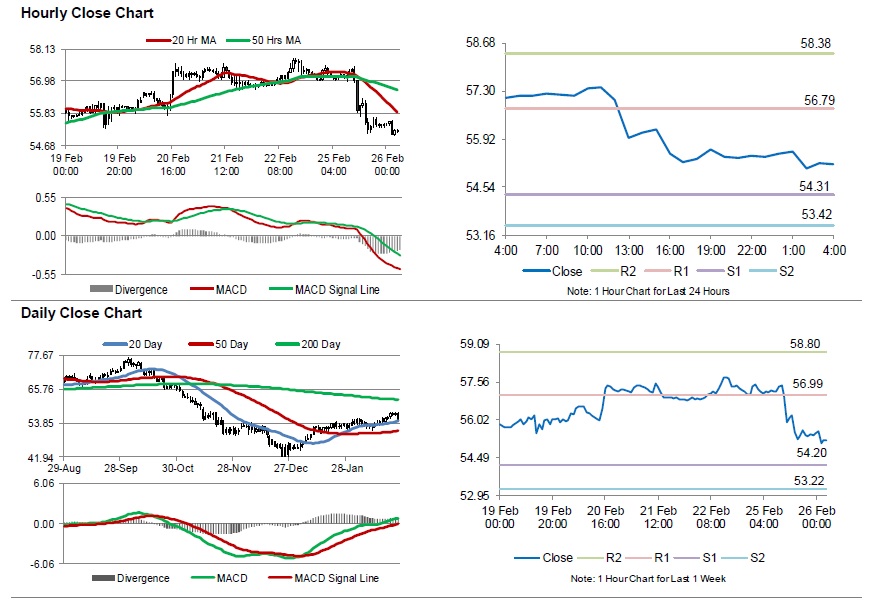
For the 24 hours to 23:00 GMT, Crude Oil declined 3.11% against the USD and closed at USD55.41 per barrel, after the US President Donald Trump criticised the OPEC for escalating oil prices and stated that the organisation should implement measures to stop the rise in oil prices.
In the Asian session, at GMT0400, the pair is trading at 55.19, with oil trading 0.40% lower against the USD from yesterday's close.
The pair is expected to find support at 54.31, and a fall through could take it to the next support level of 53.42. The pair is expected to find its first resistance at 56.79, and a rise through could take it to the next resistance level of 58.38.
Crude oil is trading below its 20 Hr and 50 Hr moving averages.
USD/CAD Daily Outlook
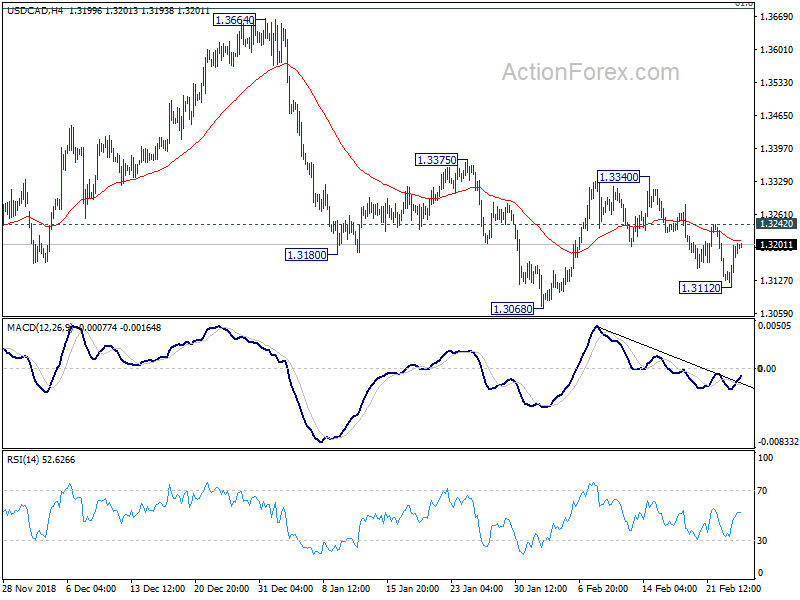
Daily Pivots: (S1) 1.3135; (P) 1.3166; (R1) 1.3219; More...
USD/CAD recovered strongly after hitting 1.3112 and intraday bias is turned neutral again. On the upside, break of 1.3242 support will turn bias back to the upside for 1.3340 resistance first. Break will complete head and should bottom pattern (ls: 1.3180, h: 1.3068, rs: 1.3112). In that case, further rise should be seen back to 1.3664 resistance. On the downside, decisive break of 1.3068 low will firstly resume whole fall from 1.3664. Secondly, it will be a strong sign of medium term bearish reversal.
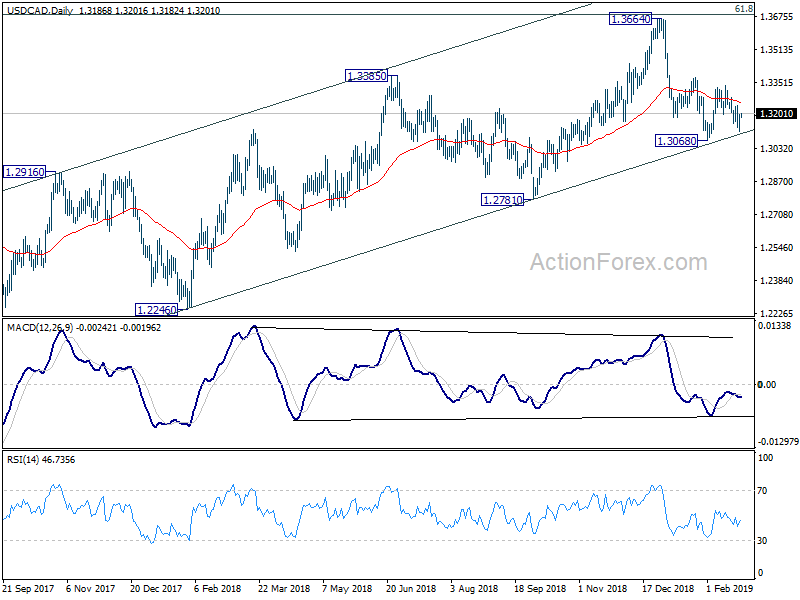
In the bigger picture, structure of the medium term rise from 1.2061 (2017 low) to 1.3664 is not clearly impulsive. Hence, we'd stay cautious on strong resistance from 61.8% retracement of 1.4689 (2016 high) to 1.2061 at 1.3685 and 1.3793 resistance to limit upside, and bring medium term topping. But in any case, medium term outlook will stay bullish as long as channel support (now at 1.3099) holds. Sustained break of 1.3793 will pave the way to retest 1.4689 (2015 high). Firm break of the channel support should confirm reversal target 1.2061 low again.
AUD/USD Daily Outlook
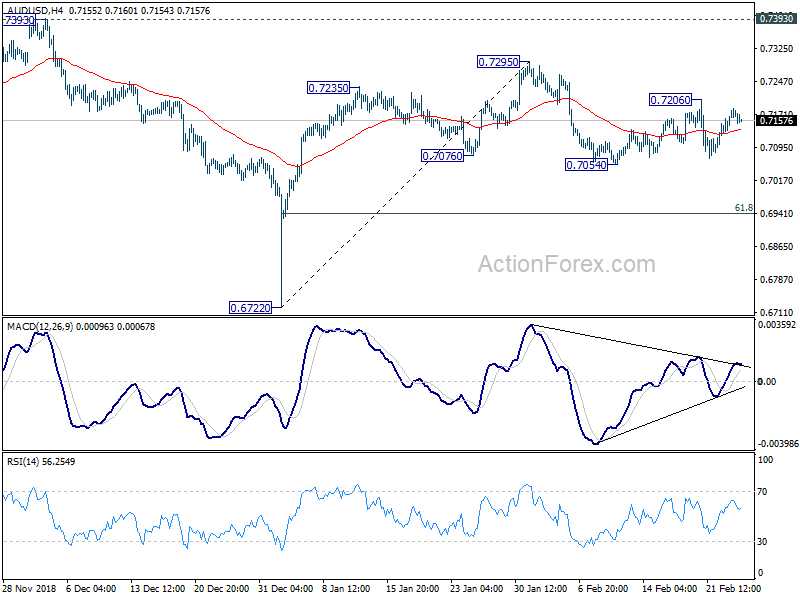
Daily Pivots: (S1) 0.7140; (P) 0.7163; (R1) 0.7191; More...
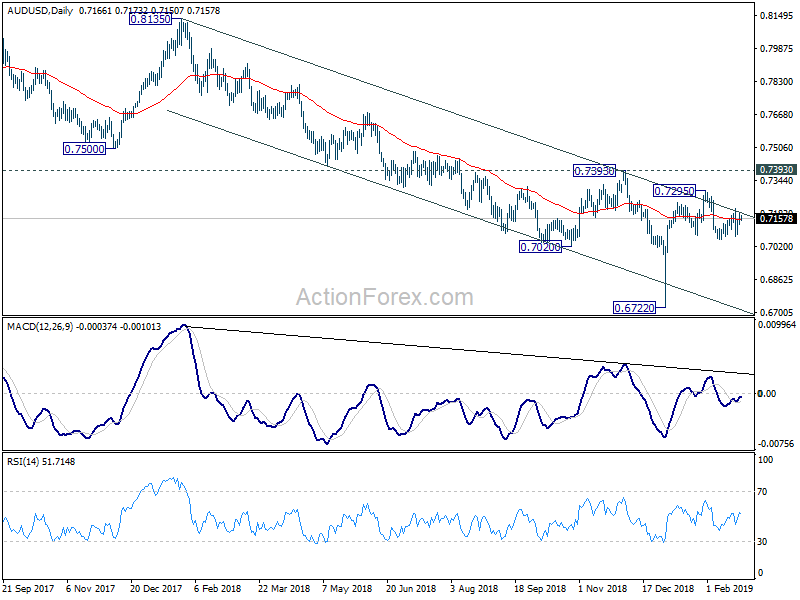
AUD/USD is staying in range of 0.7054/7206 and intraday bias remains neutral first. On the downside, decisive break of 0.7054 will complete a head and shoulder reversal pattern (ls: 0.7235, h: 0.7295, rs: 0.7206). That should confirm completion of rebound from 0.6722. Further decline should then be seen to 61.8% retracement of 0.6722 to 0.7295 at 0.6941 next. On the upside, though, break of 0.7206 will turn focus back to 0.7295 resistance instead.
In the bigger picture, as long as 0.7393 resistance holds, we'd treat fall from 0.8135 as resuming long term down trend from 1.1079 (2011 high). Decisive break of 0.6826 (2016 low) will confirm this bearish view and resume the down trend to 0.6008 (2008 low). However, firm break of 0.7393 will argue that fall from 0.8135 has completed. And corrective pattern from 0.6826 has started the third leg, targeting 0.8135 again.
USD/JPY Daily Outlook
Daily Pivots: (S1) 110.68; (P) 110.96; (R1) 111.33; More...
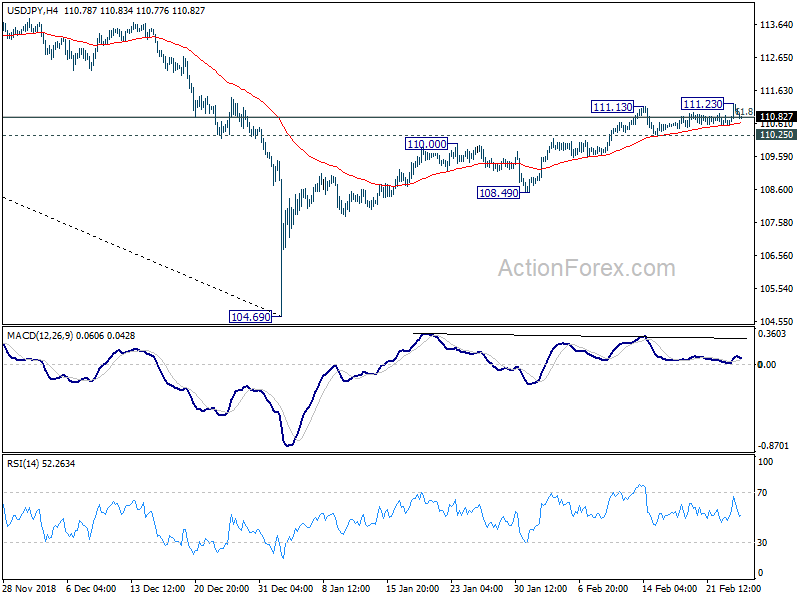
USDJPY spiked higher to 111.23 but couldn't sustain above 111.13 resistance and retreated. Intraday bias remains neutral at this point. On the downside, break of 110.25 minor support will suggest rejection by 61.8% retracement of 114.54 to 104.69 at 110.77 and the rebound from 104.69 has likely completed. Intraday bias will be turned back to the downside for 108.49 support for confirmation. Nevertheless, firm break of 111.23 should confirm resumption of rise from 104.69 for 114.54 resistance.
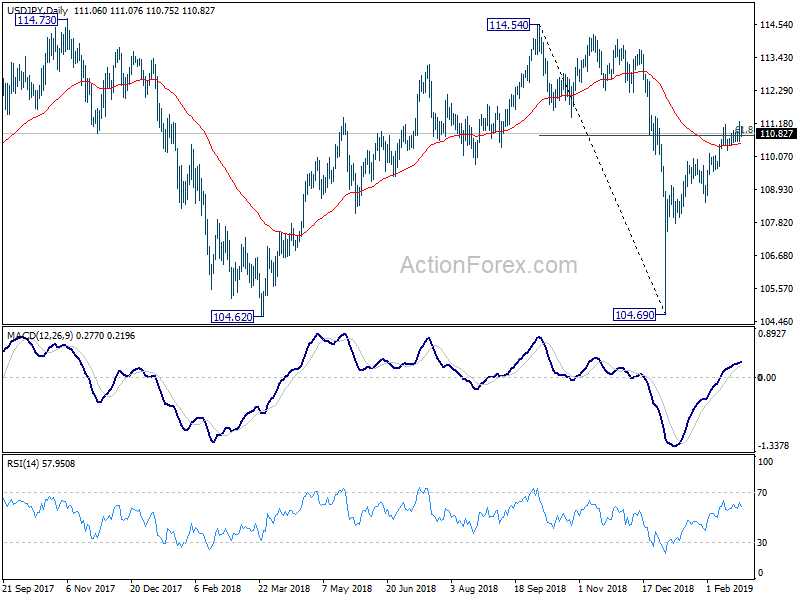
In the bigger picture, while the rebound from 104.69 was stronger than expected, it's struggle to get rid of 55 day EMA completely. Outlook is turned mixed first. On the downside, break of 108.49 support will revive that case that such rebound was a correction. And, larger down trend is still in progress for another low below 104.62. But sustained trading above 55 day EMA will turn focus to 114.54. Decisive break there will confirmation completion of the decline from 118.65 (2016 high).
USD/CHF Daily Outlook
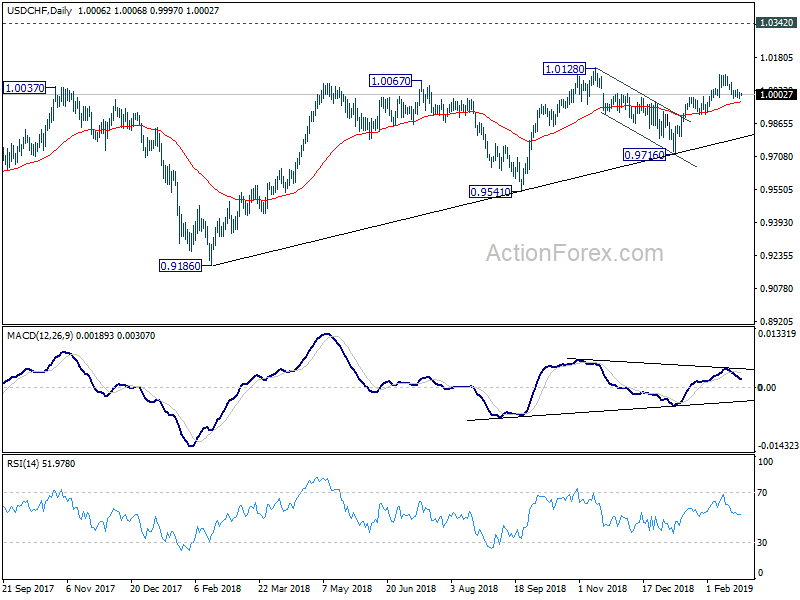
Daily Pivots: (S1) 0.9988; (P) 1.0000; (R1) 1.0018; More....
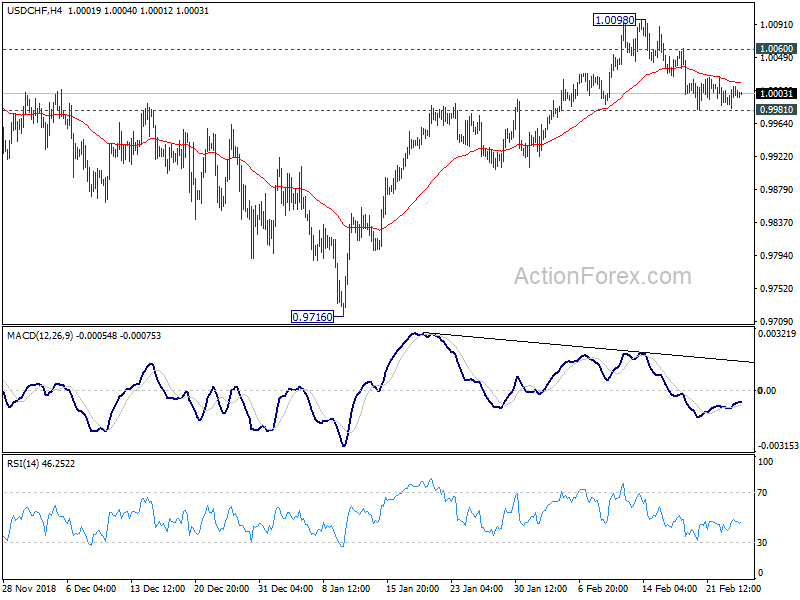
USD/CHF is staying in tight range above 0.9981 and intraday bias remains neutral. On the downside, break of 0.9981 will resume the decline from 1.0098. Sustained trading below 55 day EMA (now at 0.9966) should confirm completion of rise form 0.9716, after rejection by 1.0128 resistance. In that case, deeper fall would be seen back towards 0.9716 support. On the upside, break of 1.0098 will extend the rise from 0.9716 to 1.0128 high next.
In the bigger picture, USD/CHF drew strong support from medium term trend line and rebounded. That suggests rise from 0.9186 is still in progress. Further break of 1.0128 will confirm up trend resumption and target 1.0342 key resistance. Nevertheless, break of 0.9716 will dampen this bullish view and at least bring deeper fall to 0.9541 key support.
EUR/USD Daily Outlook
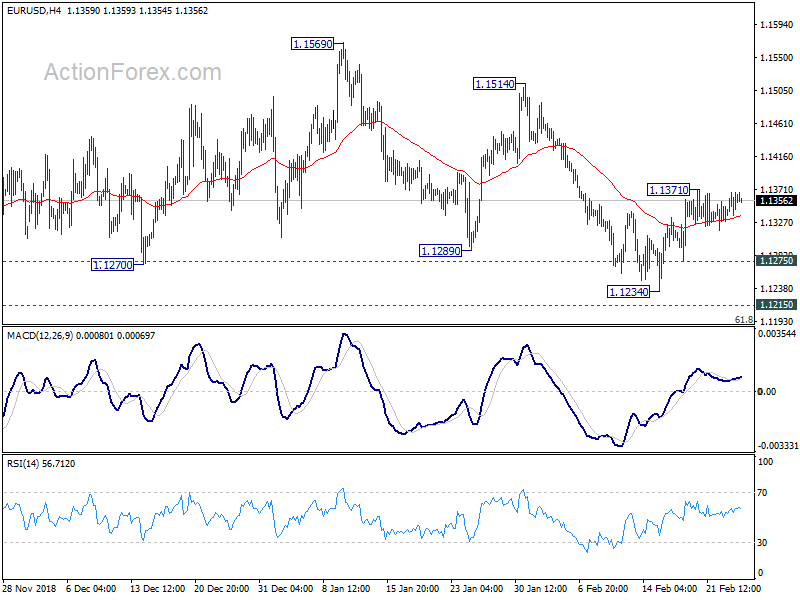
Daily Pivots: (S1) 1.1334; (P) 1.1351; (R1) 1.1375; More.....
EUR/USD is still bounded in tight range below 1.1371 and intraday bias stays neutral. On the upside, break of 1.1371 would extend the rebound from 1.1234. In that case, rise from 1.1234 is seen as another leg in the consolidation pattern from 1.1215 and should target 1.1514 resistance. On the downside, break of 1.1275 minor support will turn bias back to the downside for 1.1215 low instead. Decisive break there will confirm completion of consolidation from 1.1215, and resumption of down trend from 1.2555.
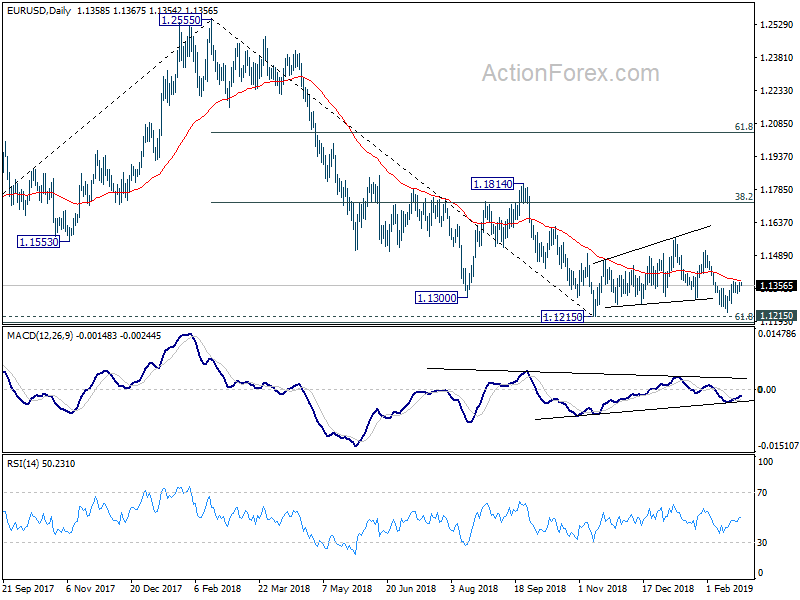
In the bigger picture, as long as 1.1814 resistance holds, down trend down trend from 1.2555 medium term top is still in progress and should target 61.8% retracement of 1.0339 (2017 low) to 1.2555 at 1.1186 next. Sustained break there will pave the way to retest 1.0339. However, break of 1.1814 will confirm completion of such down trend and turn medium term outlook bullish.
GBP/USD Daily Outlook
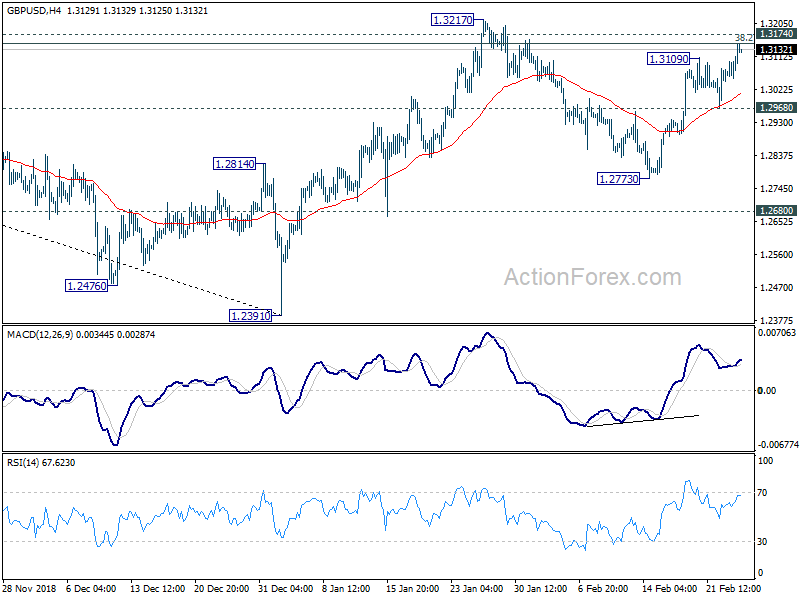
Daily Pivots: (S1) 1.3055; (P) 1.3085; (R1) 1.3128; More....
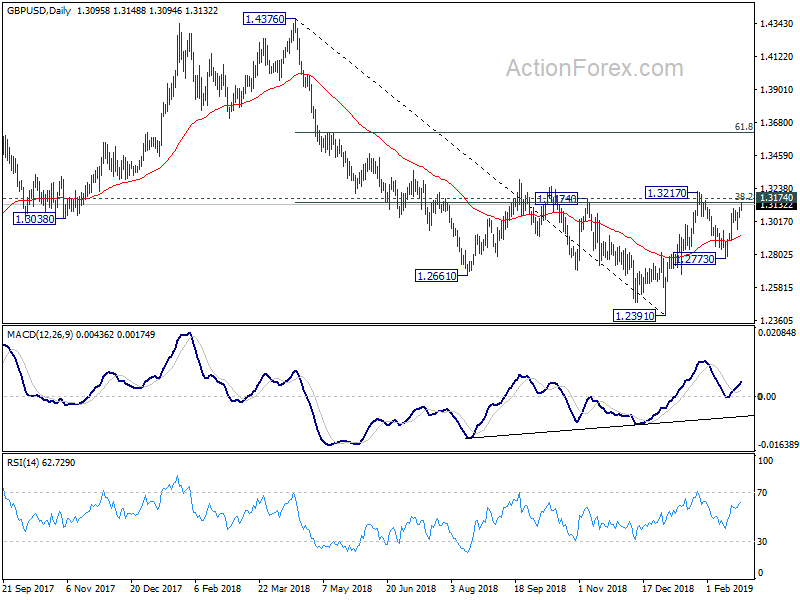
GBP/USD's rise from 1.2773 resumed by taking out 1.3109 and reaches as high as 1.3148 so far. Intraday bias is back on the upside with focus on 1.3174/3217 resistance zone. Decisive break there will complete a head and shoulder bottom pattern (ls: 1.2661, h: 1.2391, rs: 1.2773). That would indicate bullish reversal for 61.8% retracement of 1.4376 to 1.2391 at 1.3618 next. On the downside, break of 1.2968 minor support will turn bias back to the downside for 1.2773 instead.
In the bigger picture, focus is back on 1.3174 resistance with current rebound. Sustained break will indicate completion of decline from 1.4376. Rise from 1.2391 would then be seen as the third leg of the corrective pattern from 1.1946 (2016 low). In that case, further rise could be seen through 1.4376 resistance. Nevertheless, rejection by 1.3174 again will extend the decline from 1.4376 through 1.2391 to 1.1946 low.
Sterling Surges as BoE Hearing and May’s Cabinet Meeting Watched
Sterling rises broadly today on news that opposition labor is going to back second Brexit referendum. Meanwhile, the UK government is also considering delaying Brexit. The Pound stays firm entering in to European session and eyes will be on Prime Minister Theresa May's post Cabinet meeting update. Meanwhile, Sterling will also look into BoE's Inflation Report hearings.
Yen is following as the second strongest as Asian stocks pull back from yesterday's rally. Only Chinese stocks are extending slight gain. Swiss Franc is the third strongest for now. Australian Dollar is back under pressure as the weakest one. Canadian Dollar follows as oil price dived yesterday follow Trump's tweet urging OPEC to relax. Euro and Dollar are mixed. Some volatility in the greenback could be triggered by Fed Chair Jerome Powell's semi-annual testimony to Congress later in the day.
Technically, GBP/USD is set to take on key resistance zone at 1.3174/3217. Decisive break will complete a head and shoulder bottom and confirm bullish reversal. EUR/GBP is also heading back to 0.8617/20 key support zone. USD/JPY and EUR/JPY are both worth mentioning. Both spiked higher late yesterday but quickly reversed. The break of 111.13 and 125.95 resistance could be bull traps.
In Asian, Nikkei closed down -0.40%. Hong Kong HSI is down -0.69%. China Shanghai SSE is up 0.36%. Singapore Strait Times is down -0.30%. Japan 10-year JGB yield is up 0.0053 at -0.03%, still negative. Overnight, DOW rose 0.23%, S&P 500 rose 0.12%, NASDAQ rose 0.36%. 10year yield rose 0.018 to 2.673.
Sterling jumps as Corbyn supports second referendum, May mulls Brexit delay
Sterling jumps broadly as UK opposition Labour said they're ready to back second referendum. Also, Prime Minister Theresa May is said to be considering delaying Brexit. Labour leader Jeremy Corbyn has been against another public vote on Brexit but finally bowed down to pressure inside his party. He formally said on Monday evening that "one way or another, we will do everything in our power to prevent no-deal and oppose a damaging Tory Brexit based on Theresa May's overwhelmingly rejected deal,". And, "that's why, in line with our conference policy, we are committed to also putting forward or supporting an amendment in favor of a public vote to prevent a damaging Tory Brexit being forced on the country."
Separately, Bloomberg reported that May will finally allow Cabinet discussion on extending Article 50 beyond March 29 on Tuesday. The Sun went further and said May would propose formally ruling out a "no-deal" Brexit scenario. May will chair a Cabinet discussion today in London morning, and that update the Parliament on discussions after noon. The government will propose motions on Brexit state-of-play by Tuesday night. The motion will be debated and voted on Wednesday.
Trump: China trade deal in advanced stages, very close to signing summit
Trump indicated overnight that the US is "very, very close" to completing a trade agreement with China. And there will be a "signing summit" with Chinese President Xi Jinping soon. Trump said that "we're going to have another summit, we're going to have a signing summit" and "so hopefully, we can get that completed. But we're getting very, very close."
He later also tweeted that "China Trade Deal (and more) in advanced stages. Relationship between our two Countries is very strong. I have therefore agreed to delay U.S. tariff hikes. Let's see what happens?" "If a deal is made with China, our great American Farmers will be treated better than they have ever been treated before!"
Trump decided to delay new tariffs on USD 200B of Chinese imports beyond March 1. For now, there is no information on how long that would that be postponed. A spokeswoman for the U.S. Trade Representative's Office said the agency had no announcements at this time beyond the president's remarks.
Separately, Trump has left for a summit with North Korean leader Kim Jong-un in Vietnam. An initial one-on-one meeting is scheduled for Wednesday, followed by dinner with advisers.
Fed Clarida: US economy in a good place right now
Fed Vice Chair Richard Clarida attended a Dallas Fed event on Global Perspectives, with Dallas Fed President Robert Kaplan. There Clarida said that "the U.S. economy is in a good place right now....It's a good situation to be in, and we really want to do whatever we can to help support and maintain the economy."
Clarida also noted that slowdown in Asia and Europe are "definitely a relevant factor" to Fed policy. Since other central banks are still having interest rates stuck in crisis-fighting mode, "that obviously, on balance, makes the global economy more fragile." He also tried to talk down the implication of yield curve inversion. He said "you can't be handcuffed" to financial market signals . There are factors like global demand for US treasuries that pushes yields down at the long end.
Kaplan indicated that "you want to run maybe a little hotter, but you don't want to go too far." And, since "inflation is not running away from us", Fed "might have the luxury of trying to do more to get more people into this workforce on a sustainable basis ..."
BoJ Kuroda: Chinese economy to remain in doldrums in first half
BoJ Governor Haruhiko Kuroda told the parliament that China's economy "slowed quite significantly in the latter half of last year". And he predicts that it may "remain in the doldrums in the first half of this year." Nevertheless, Kuroda expects Chinese even economy to "pick up thereafter, as authorities have taken fiscal and monetary stimulative action."
Domestically, Kuroda expected that the net burden on households from this year's scheduled sales tax hike to be smaller than previous hike in 2014. And he added that BOJ will be watching the impact of the sales tax hike on the economy. The impact could change depending on consumer sentiment, job and income conditions at that time.
Looking ahead
BoE inflation report hearings in the parliament will be the main focus in European session. Fed Chair Jerome Powell's Congressional Testimony will be the next main event in US session. On the data front, UK will release BBA mortgage approvals. US will release housing starts and building permits, house price indices and consumer confidence.
GBP/USD Daily Outlook
Daily Pivots: (S1) 1.3055; (P) 1.3085; (R1) 1.3128; More....
GBP/USD's rise from 1.2773 resumed by taking out 1.3109 and reaches as high as 1.3148 so far. Intraday bias is back on the upside with focus on 1.3174/3217 resistance zone. Decisive break there will complete a head and shoulder bottom pattern (ls: 1.2661, h: 1.2391, rs: 1.2773). That would indicate bullish reversal for 61.8% retracement of 1.4376 to 1.2391 at 1.3618 next. On the downside, break of 1.2968 minor support will turn bias back to the downside for 1.2773 instead.
In the bigger picture, focus is back on 1.3174 resistance with current rebound. Sustained break will indicate completion of decline from 1.4376. Rise from 1.2391 would then be seen as the third leg of the corrective pattern from 1.1946 (2016 low). In that case, further rise could be seen through 1.4376 resistance. Nevertheless, rejection by 1.3174 again will extend the decline from 1.4376 through 1.2391 to 1.1946 low.
Economic Indicators Update
| GMT | Ccy | Events | Actual | Forecast | Previous | Revised |
|---|---|---|---|---|---|---|
| 07:00 | EUR | German GfK Consumer Confidence Mar | 10.8 | 10.8 | ||
| 09:30 | GBP | BBA Loans for House Purchase Jan | 39.2K | 38.8K | ||
| 10:00 | GBP | BoE Inflation Report Hearings | ||||
| 13:30 | USD | Housing Starts Dec | 1.25M | 1.26M | ||
| 13:30 | USD | Building Permits Dec | 1.29M | 1.32M | ||
| 14:00 | USD | House Price Index M/M Dec | 0.40% | 0.40% | ||
| 14:00 | USD | S&P/Case-Shiller Composite-20 Y/Y Dec | 4.90% | 4.70% | ||
| 15:00 | USD | Consumer Confidence Feb | 124.1 | 120.2 | ||
| 15:00 | USD | Fed Powell testifies Before Senate Banking Panel |
China’s Monetary Easing to Continue after End of Trade War
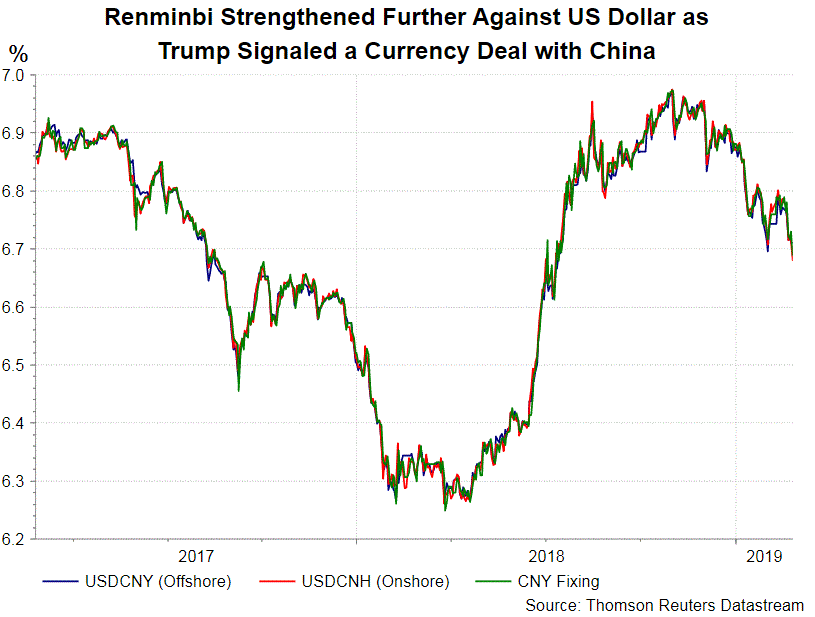
Market sentiment improves further as Trump sent more hints on trade truce extension and “substantial progress” on striking a trade deal with China. Indeed, his indication that a deal on “currency manipulation” has send renminbi (Chinese yuan) to the 7-month high against the US dollar. Meanwhile, China January money/ credit report has shown signs of transmission of its monetary easing to the market, also lifting confidence about the country’s economic outlook. Yet, these events should not alter the government’s monetary policy. That is, it would continue with the more accommodative monetary policy, with focus on lowering reserve requirement ratio and injecting liquidity via open market operation (e.g. reverse repos). Rate cut, while not unlikely, would still be the last resort.
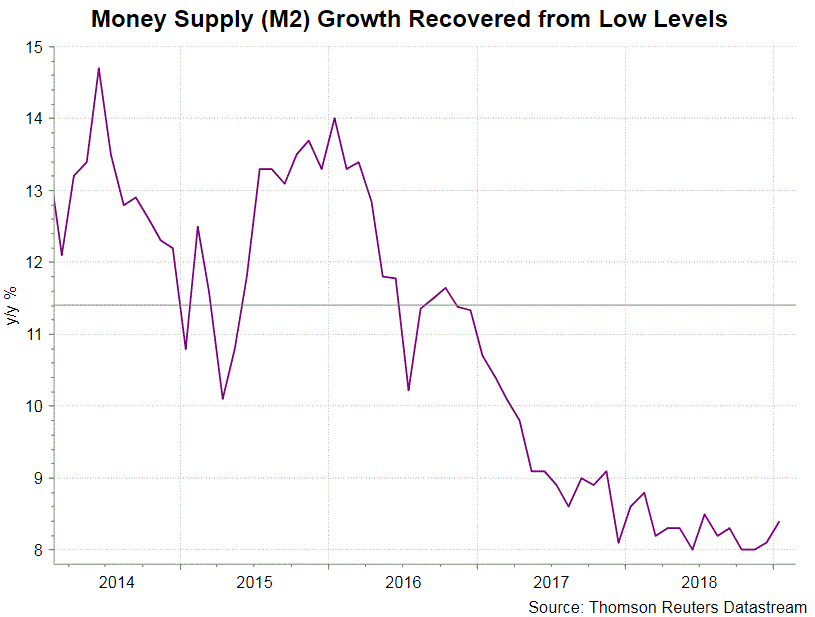
 China’s credit data surprised to the upside in January. Much was driven by seasonal factor, front-loaded borrowing ahead of Lunar New Year holiday in February. Total social financing (TSF) increased to RMB 4.6 trillion, while RMB lending rose to RMB 3.2 trillion. Both readings exceeded market expectations. Broad money supply (M2) grew +8.4%, beating +8.1% in December 2018 and consensus of +8.2%. The improvements in money supply growth and lending are signals that PBOC’s RRR cut and reverse repo operations are taking effect.
PBOC has only resumed reverse repos last week, the first time after Lunar New Year holiday. The pause during the period had caused speculations that the central bank would adopt a less easy monetary policy. Moreover, the fact that the 7 -day reverse repo rate has stayed unchanged at 2.55% since March 2018 has also made some to expect a less accommodative policy stance. We do not see any change in PBOC’s monetary stance. At the 4Q18 monetary report released on February 21. PBOC mentioned that it would “maintain a prudent monetary policy stance”. Note that the term “neutral”, which appeared in the third quarter report, was removed. This suggested that the policy stance is more biased, to the accommodative side in our opinion.
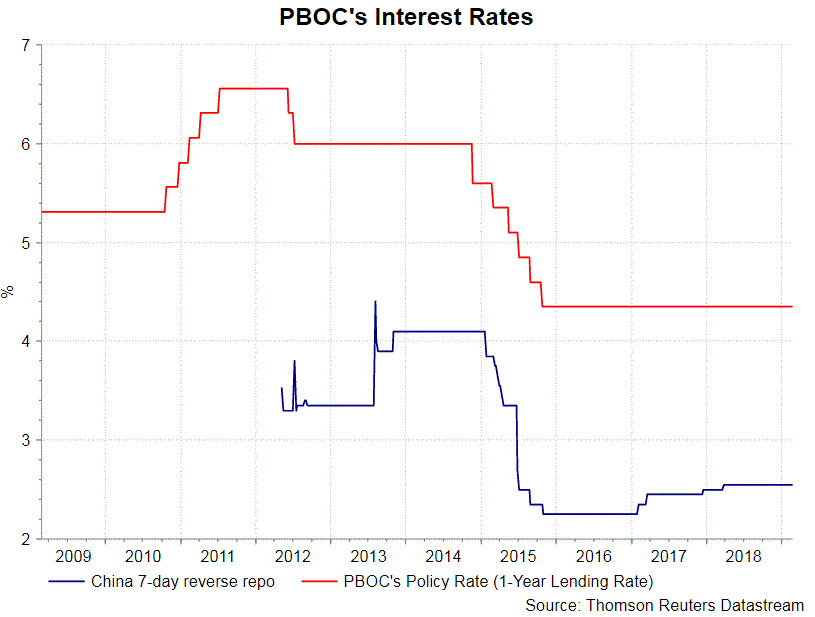 Indeed, PBOC’s monetary policy is never neutral over in recent years, according to international standard. It reduced RRR four times in 2018 and once so far this year. Meanwhile, in January, it relaxed criteria for banks’ eligibility for RRR cuts, so that more banks can lower their RRR and lend more money to the market. CICC estimates that such adjustment could free up as much as RMB 400B. Last week, the central bank adopted the so-called Central Bank Bill Swap (CBS) for the first time so as to encourage lending to the private sector. While the central bank denied that it’s a form of QE, such denial has nonetheless evidenced the easing effect of such instrument.
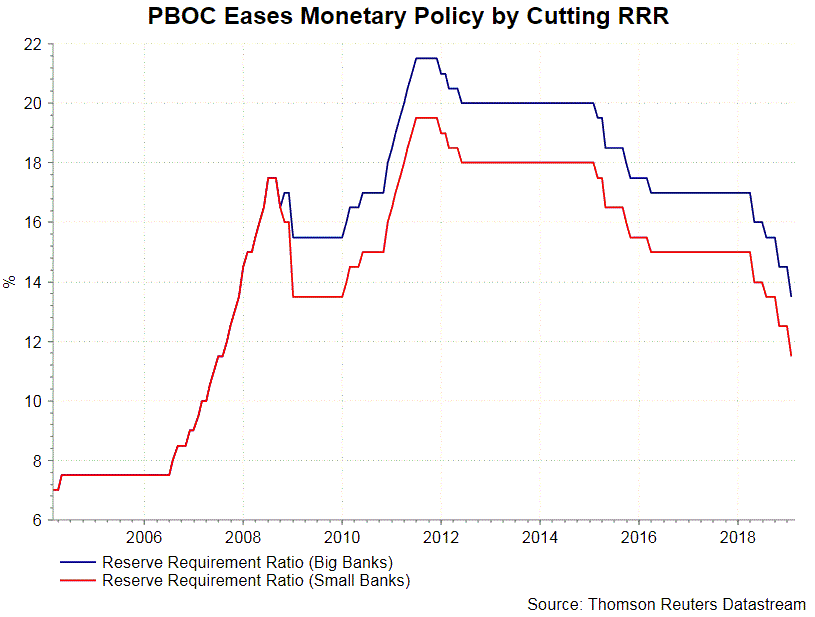 All these moves have proved that China has been adopting monetary easing. Economic growth slowdown in China has accelerated since US- China trade war began in mid-2018. Stimulus using both monetary and fiscal measures has been implemented. Signs that the trade war is coming to an end should not end these stimulus. While no detail of the trade agreement has been disclosed, China might be obliged to let the renminbi appreciate more significantly to accommodate Trump’s demand. This could hurt China’s exports sector, and hence, the overall growth outlook. On the other hand, a forced appreciation in renminbi might allow PBOC more flexibility to cut interest rates. It is believed that the central bank has been reluctant to lower interest rates as it fears that would trigger a sharp fall in renminbi and capital outflow. All in all, the events evolving still support PBOC to continue a easing monetary policy.