Sample Category Title
Canadian Dollar Subdued on Light Data
USD/CAD has ticked higher in the Tuesday session. Currently, the pair is trading at 1.3255, up 0.12% on the day. There are no Canadian events, and the sole U.S. indicator is a minor housing report. On Wednesday, the FOMC releases the minutes of its January policy meeting.
Traders should treat the Federal Reserve minutes as a market-mover. All eyes will be on the Federal Reserve on Wednesday, with the release of the minutes of its most recent meeting. The Fed acted aggressively in 2018, boosting rates four times in order to keep the red-hot U.S. economy from overheating. Since raising rates in December, however, the Fed has changed direction and become much more dovish. In late 2018, there was talk of up to four rate hikes in 2019, but the Fed has revised its forecast to two hikes. The markets have gone further, projecting no rate increases this year, and there has even been talk of a rate cut in late 2019. In the January rate statement, the Fed discarded previous pledges of “further gradual increases” in interest rates, and said it would be “patient” before any further hikes.
Is the U.S. economy slowing down? There are concerns about the strength of the economy, after soft consumer data in January. Retail sales and core retail sales showed sharp contraction, and these numbers came on the heels of soft inflation indicators. Inflation remains low, despite a strong labor market. CPI showed no change in January and has failed to post a gain since November. Core CPI has recorded weak gains of 0.2% for four successive months. On an annualized basis, CPI gained 1.6% in January, the weakest year-over-year gain since mid-2017. The soft inflation numbers were a result of low energy prices, which fell 3.1% in January as oil prices remain under pressure.
EU Juncker and UK May to take stock of Brexit play tomorrow
European Commission Spokesman Margaritis Schinas, said President Jean-Claude Juncker will meet UK Prime Minister Theresa May in Brussels tomorrow to "take stock of the latest state of play on Brexit".
He reiterated EU's position that "The EU 27 will not reopen the withdrawal agreement. We cannot accept a time limit to the backstop or unilateral exit clause."
ECB de Guindos: Analyzing causes of European slowdown, but confident on inflation outlook
ECB Vice President Luis de Guindos said policy makers are "currently analyzing the causes of the economic slowdown in Europe, some of which are temporary". But he emphasized that "we will not take a decision until we have conducted a thorough analysis."
And, regarding inflation, he said "even if energy prices were to fall a little in the coming months, we are confident that inflation will, over the medium term, converge towards our aim of below, but close to, 2 percent."
On no-deal Brexit, de Guindos said "a disorderly Brexit... would represent a significant macroeconomic shock at a time when the European economy is already weakened."
Dollar In No Mans Land
Tuesday February 19: Five things the markets are talking about
Global equities are trading mixed as Sino-U.S trade talks continue and investors await commentary from the Fed this week – the minutes from the latest meeting are out tomorrow (02:00 pm ET). The big dollar trades a tad higher while U.S Treasuries are steady.
According to the White House the China trade talks are aimed at “achieving needed structural changes in China that affect trade between the United States and China. The two sides will also discuss China’s pledge to purchase a substantial amount of goods and services from the United States.” Trump’s team seem determined to reach a deal that avoids a step up in tariffs on March 1.
Elsewhere, the chances of a disorderly Brexit seem to be rising every day. Seven members quit the U.K’s Labour Party over the weekend over issues including Brexit and antisemitism, while PM Theresa May still hopes that parliament will accept her Brexit withdrawal deal (Feb 27) before the March 29 deadline.
Central Banks and governors are to the fore this week – Aside from the Fed publishing its latest minutes tomorrow, the European Central Bank (ECB) following suit on Thursday (07:30 am ET), while Bank of Canada (BoC) Governor Stephen Poloz will also speak on Thursday (12:35 pm ET) and ECB President Mario Draghi speaks on Friday (10:30 am ET), a day after Reserve Bank of Australia (RBA) Governor Philip Lowe gives his parliamentary testimony (05:30 pm ET).
1. Stocks trade mixed
In Japan, stocks ticked up to new two-month highs overnight on hopes of a breakthrough in Sino-U.S trade talks, though the gains were led by defensive shares as investors remained cautious on the global economic outlook. The Nikkei share average edged up +0.10%, its highest close since mid-December, while the broader Topix added +0.28%.
Down-under, Aussie shares closed modestly higher overnight as losses in the mining and healthcare sectors were offset by significant gains in financial stocks. The S&P/ASX 200 index rose +0.3% at the close of trade. The benchmark had gained +0.4% yesterday. In S. Korea, stocks sagged on weaker export prices. The Kospi stock index closed out down -0.17%.
In China and Hong Kong, stocks ended lower overnight, snapping a two-month and six-week rally respectively, as investors booked profits partly fuelled by optimism that China and the U.S would hammer out a deal to resolve their trade dispute. The CSI300 closed -0.2% lower, while the Hang Seng index ended -0.4% lower and the China Enterprises Index closed -0.3% weaker.
In Europe, regional bourses trade a tad lower across the board, pressured by worse than expected earnings from a number of financials stocks.
U.S stocks are set to open in the ‘red’ (-0.2%).
Indices: Stoxx600 -0.5% at 368.1, FTSE -0.6% at 7178, DAX -0.2% at 11280, CAC-40 -0.4% at 5146, IBEX-35 -0.4% at 9118, FTSE MIB -0.8% at 20159, SMI -0.1% at 9258, S&P 500 Futures -0.2%
2. Oil trades atop 2019 highs on OPEC cuts, gold unchanged
Oil trades atop of this year’s high print, supported by OPEC+ led supply cuts, although investor concerns about slowing economic growth is currently capping gains.
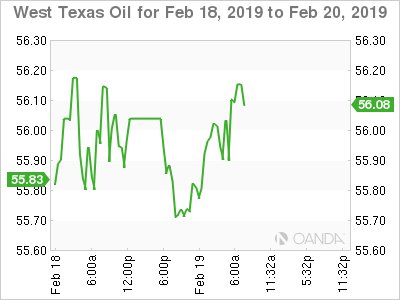
Brent crude has eased -28c to +$66.22 a barrel, not far from the 2019 high of $66.83 reached yesterday, while U.S crude is up +54c at +$56.13.
The supply curbs led by OPEC have helped crude prices rally more than +20% in 2019. Also helping prices are U.S sanctions against Iran and Venezuela.
Nevertheless, demand-side worries remain the main drag on prices. Investors are concerned that an economic slowdown in China and Britain would “throw up further hurdles this year.”
Both investors and traders remain cautious on taking on large new positions before the outcome of Sino-U.S trade talks this week.
Note: OPEC last week lowered its forecast for growth in world oil demand this year to +1.24M bpd – however, there are some analysts who believe that number “could be weaker still.”
Ahead of the U.S open, Gold prices hover atop of their 10-month highs as optimism around U.S-China trade discussions reduced the ‘big’ dollar’s appeal. Spot gold is little changed at +$1,326.48 per ounce – the ‘yellow’ metal touched +$1,327.64 an ounce in Monday’s session, its highest since late April. U.S gold futures have rallied +0.5% to +$1,329 an ounce.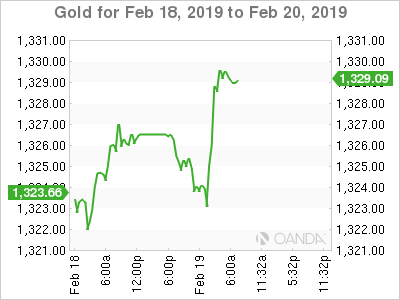
3. Italian yields jump after industrial orders disappoint
Italian government bond yields have backed up +5 to +6 bps across the curve this morning after data showed industrial orders in the euro zone’s third-largest economy dropped -5.3% in December over the same month in 2017.
The disappointing data has put an end to an earlier rally in prices that was sparked by expectations for a new round of cheap multi-year loans for Italian banks by the ECB.
Italy’s 10-year BTP yield was last up +6 bps on the day at +1.74%, pushing the gap over German 10-year Bund yields to +273 bps – 10 bps wider on the day.
Elsewhere, the yield on 10-year Treasuries has decreased -1 bps to +2.66%. In Germany, the 10-year Bund yield has dipped -2 bps to +0.09%, the lowest in more than a week, while in the U.K, the 10-year Gilt yield has dipped -1 bps to +1.151%.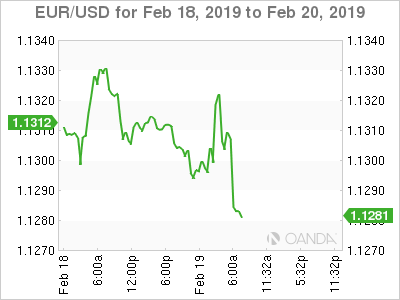
4. Dollar slips, looks for support
EUR/USD (€1.1281) is a tad weaker and holding just below the psychological €1.13 level despite mixed German ZEW data for Feb. – German Feb ZEW survey was mixed, but a slight improvement in ‘expectations survey’ suggests that negative factors (Brexit deal and weak growth from China) had already been expected.
GBP/USD (£1.2910) holding atop of the £1.29 handle as UK-EU officials continue to meet to find a fix to the Irish backstop issue. Expect the market to become rather volatile and nervous if next week’s vote delivered another defeat for PM May’s Brexit strategy.
The SEK has plunged, taking EUR/SEK to a five-month high of €10.5801 earlier this morning after Swedish inflation data for January came in below market expectations, up +1.9% y/y – this compares to a +2% increase in the previous month, which is the Riksbank’s target and was well below the consensus for +2.3%.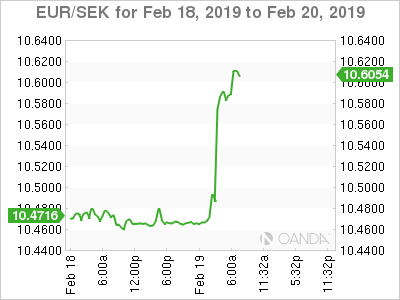
5. German economic expectations brighten
German data this morning from the ZEW economic research institute showed that economic expectations improved slightly in February, albeit from an extremely low level previously, but also despite a much “gloomier assessment of the current economic situation.”
The institute’s measure of economic expectations increased to -13.4 points from -15.0 points in January.
Note: The latest reading is below the historical average of 22.4 points, but narrowly beats economists’ forecasts of -14.0 points.
“There are currently no signs that Germany’s flagging economy will stage a swift recovery,” ZEW President Achim Wambach said.
Note: Europe’s largest economy narrowly avoided recession toward the end of 2018 and many have cut their growth outlooks. The consensus now forecast Germany’s economic growth at just +0.5% this year. If so, it would be the weakest expansion rate since 2013.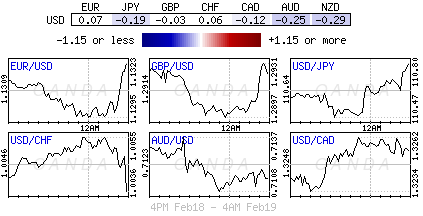
DAX Dips As Investors Eye US-China Trade Talks
The DAX index continues to have a quiet week. In the Tuesday session, the DAX is at 11,260, down 0.35% on the day. In economic news, German ZEW economic sentiment improved slightly to -13.4, beating of the estimate of -14.1 points. The all-eurozone release followed the same trend, improving to -16.6, which was above the forecast of -18.2 points. On Wednesday, the FOMC releases the minutes of its January policy meeting.
After posting strong gains on Friday, the DAX has given up some ground. Bank and automotive shares are in the red on Tuesday. Deutsche Bank has plunged 2.85%, while Daimler and Volkswagen have declined over 1.0%. Investors are keeping a close look at U.S-China trade talks, which continue this week in Washington. This will be the fourth round of talks, as the sides look to ease trade tensions after months of tit-for tat tariffs which have hurt global growth and rocked the stock markets. Treasury Secretary Steven Mnuchin joined the talks last week and called the negotiations “productive”. If there are tangible signs of progress, risk appetite could jump and send the equity markets higher.
The ZEW economic sentiment surveys remains mired in deep freeze, as investors and analysts are pessimistic about the economic outlook in Germany and the eurozone. There is a silver lining in the German release, as the readings have improved steadily over the past four months – back in October, the score was -24.7 points. In the first quarter of 2018, the readings were in positive territory, as the German economy was performing well. However, optimism then dissipated, as the global trade war intensified and the German economy slowed. It has been a similar story with the eurozone, as ZEW economic sentiment scores have been in negative territory since the second half of 2018.
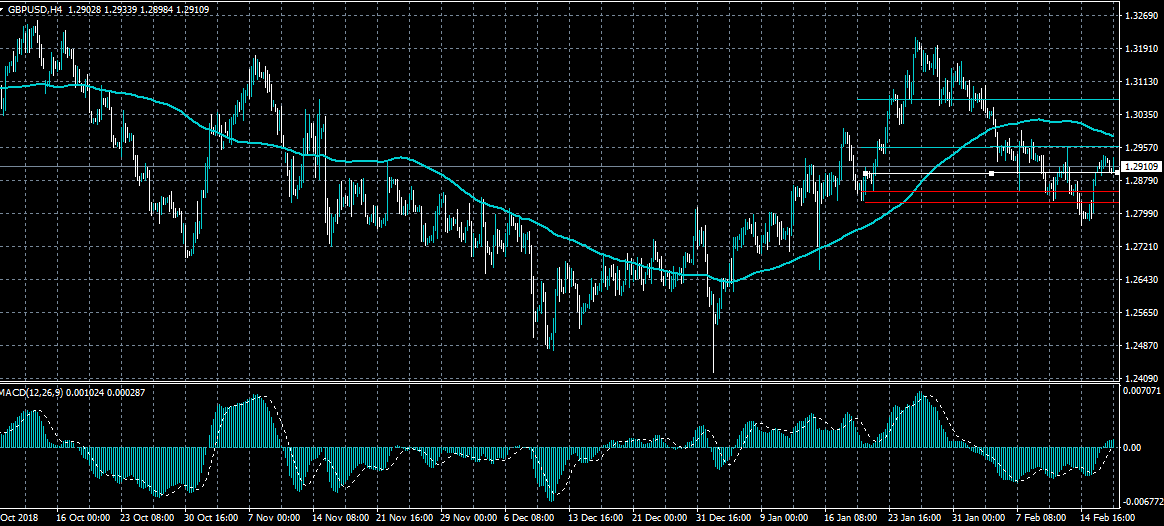
GBPUSD 1.2900 Remains Key
The British pound is coming under moderate selling pressure against the US dollar after wage and employment data from the United Kingdom economy came in slightly worse than expected. The GBPUSD pair continues to retain an intraday bullish trading bias, with price holding above the important 1.2900 support level. If bulls can break the 1.2960 level, further upside towards the 1.3000 resistance level should be expected in the near-term.
The GBPUSD pair is bullish while trading above the 1.2900 level, key technical resistance remains at the 1.2960 and 1.3000 levels
If the GBPUSD pair trades below the 1.2900 level, sellers may test towards the 1.2850 and 1.2830 levels.
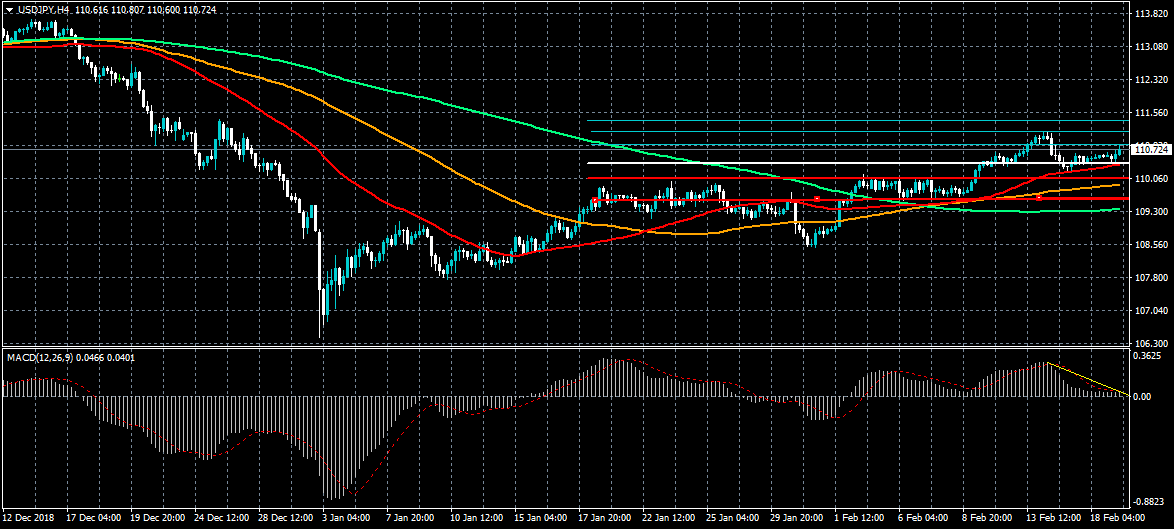
USDJPY Intraday Bullish Above 110.80
The US dollar is starting trade higher against the Japanese yen currency, following earlier dovish comments from Bank of Japan Governor Kuroda. If the USDJPY break above the 110.80 resistance level, the intraday sentiment towards the pair will turn bullish. The four-hour time frame is currently showing bearish MACD price divergence, with price rising while the MACD histogram declines.
The USDJPY pair is bullish while trading above the 110.80 level, key technical resistance is found at the 111.10 and 111.40 levels.
If the USDJPY pair trades below the 110.40 level, sellers may test towards the 110.24 and 110.00 support levels.
Euro Flat As German Economic Sentiment Remains Soft
EUR/USD is almost unchanged in the Monday session, after showing little movement on Tuesday. Currently, the pair is trading at 1.1308, down 0.02% on the day. In economic news, German ZEW economic sentiment improved slightly to -13.4, beating of the estimate of -14.1 points. The all-eurozone release followed the same trend, improving to -16.6, which was above the forecast of -18.2 points. There are no major events out of the United States. On Wednesday, the FOMC releases the minutes of its January policy meeting.
The ZEW economic sentiment surveys remains mired in deep freeze, as investors and analysts are pessimistic about the economic outlook in Germany and the eurozone. There is a silver lining in the German release, as the readings have improved steadily over the past four months – back in October, the score was -24.7 points. In the first quarter of 2018, the readings were in positive territory, as the German economy was performing well. However, optimism then dissipated, as the global trade war intensified and the German economy slowed. It has been a similar story with the eurozone, as ZEW economic sentiment scores have been in negative territory since the second half of 2018.
Traders should treat the Federal Reserve minutes as a market-mover. Since raising rates in December, the Fed has changed direction and become much more dovish. In late 2018, there was talk of up to four rate hikes in 2019, but the Fed has revised its forecast to two hikes. The markets have gone further, projecting no rate increases this year, and there has even been talk of a rate cut in late 2019. In the January rate statement, the Fed discarded previous pledges of “further gradual increases” in interest rates, and said it would be “patient” before any further hikes.
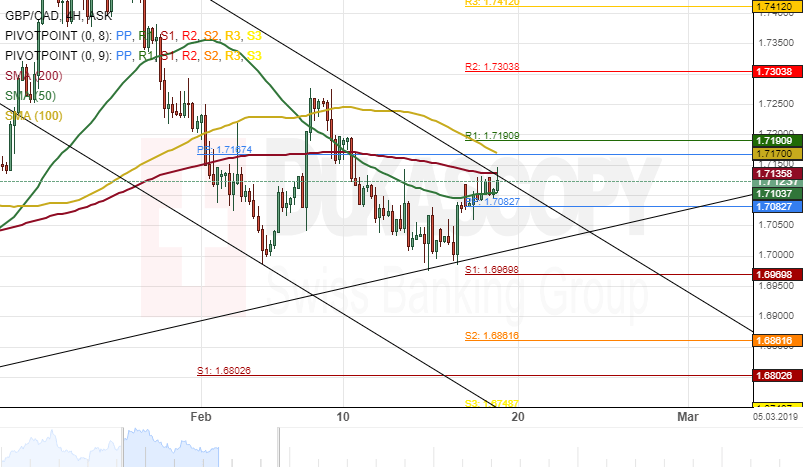
GBP/CAD 4H Chart: Stranded Between SMAs
The Pound Sterling versus the Canadian Dollar has revealed a new junior descending channel pattern. This channel pattern has guided the currency pair towards a one-month low at 1.6969.
The exchange rate was stranded between SMAs during the morning hours of today's trading session. The 200-hour simple moving average was providing resistance for the pair at 1.7135, while the 50-hour SMA and the weekly PP at 1.7082 were supporting the rate.
A breakout through the upper boundary of the junior descending channel is likely to occur within this session. If the breakout occurs, a surge towards 1.7350 could be expected.
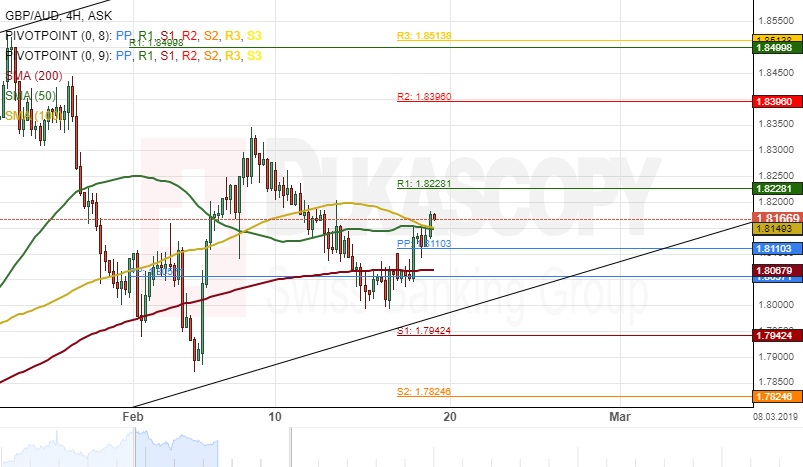
GBP/AUD 4H Chart: Tests Resistance Cluster At 1.8153
During the past week, the British Pound has lost about 1.31% of its values against the Australian Dollar. The currency pair moved closer to the bottom border of an ascending channel pattern at 1.8000.
The exchange rate is currently testing a resistance cluster formed by the 50– and 100-hour SMAs at the 1.8153 area.
If the cluster holds, a potential breakout through the lower boundary of the channel pattern could be expected in a short while.
However, if the currency exchange rate passes the moving averages, Bulls could push the pair towards a swing high of 1.8336 during the following trading sessions.