Sample Category Title
Switzerland’s Trade Activity Bounced Back In January
After a disappointing end to 2018, Swiss external trade started the year on a solid footing with exports rising 1.1% m/m (nominal, seasonally adjusted) to CHF 18.9 billion, thanks to a bounce back in demand from Asian countries (+9.3% m/m). Imports increased 3.4% to CHF 17.5 billion. The trade surplus printed at CHF 1.4 billion. In real terms, exports climbed 0.8% m/m, while imports were up 4.8%, the largest increase since July 2016 (+8.6% m/m). Exports to the European Union contracted 1.3% m/m, while those to North America (US and Canada) decreased 3.2%.
Overall, Swiss trade activity has continued to improve despite a strong Swiss franc. Exports kept expanding throughout 2018. Nevertheless, the trade surplus has continued to narrow due to the faster increase in imports.
Switzerland's trade activity has become more volatile over the last six months as trade tensions took centre stage. In addition, Switzerland is exporting more and more to China (10% of total exports compared to less than 3% a decade ago) and to the US (12% compared to 8% a decade ago). By comparison, the share of exports that goes to countries from the European Union has never recovered from the Swiss franc appreciation following the GFC. Indeed, before the crisis more than 55% of total exports went to the EU, today it is less than 40%. Switzerland will have no choice but to develop good trade relationships with more and more countries, especially as the economy of its main trade partner is slowing down.
Sino-American talks repeat
Since trade talks have resumed at the end of January 2019, it seems that nothing much has advanced. Yet the new round of talks in Washington starting today should provide a clear breakthrough as the March 1 deadline nears, while investors remain highly optimistic on the matter.
Similarly to last week, both sides are expecting to address the softer structural issues relating to China's agreement to purchase a significant amount of US goods while higher-level talks will be taking place on Thursday - Friday with China's Vice Premier Liu He, US Trade Representative Robert Lighthizer, Treasury Secretary Steven Mnuchin and other senior officials. Still, a memorandum of understanding remains the key objective that both countries are aiming for and which could trigger a 60-day postponement of US tariffs of 25% on USD 200 billion of US imports from China which would provide sufficient time to develop a detailed roadmap including key deadlines for resolving remaining issues (i.e. technology transfer and industrial subsidies).
When looking at recent data releases, it appears that China's economy remains solid, with a rebound of current account balance of USD 54.6 billion (prior: USD 23.3 billion), higher than the 3-year average while the slowdown in inflation figures for January (+1.70%) confirms that a downside risk for the Chinese economy remains. Looking on the brighter side, the impressive rise in credit extension for the period of January suggests the stimulus engine has been turned on.
Currently trading at 6.7655, USD/CNY will be trading sideways as traders closely monitor the outcome of this week's talks.
Does Trading Psychology Really Affects Your Performance
For effective trading on the international currency market, it is important to have a good theoretical background, ability to use strategies, as well as follow political and economic news, and understand what impact they have on currency rate trends. However, these skills do not guarantee successful activity in the market unless the trader develops knowledge of Forex trading psychology.
Not only statistical indicators, but also the emotional state of the trader influence the total trading results. Everyone who seeks to master Forex trading as the main source of their income should understand that learning the trading psychology and further self-control together with self-discipline will form a competent trader.
Psychological characteristics and emotions that are companions of trade in the market:
- Greed is a toxic emotion, which affects both novices and experienced professionals, who are instantly influenced by the desire for quick profits;
- Excitement is another emotion that suppresses common sense in favour of making a high-risk deal that has a chance for a quick profit;
- Fear is not such a common, but harmful emotion, in the event of which it is recommended to stop working and take a break;
- The hope of profit is another feeling that hinders the use of statistical analysis, replacing it with “lottery” trading methods.
In order to deal with these and other emotional factors affecting the work of a trader, it is recommended to study the psychology of trading in the foreign exchange market. Now let's have a look at what trading mistakes these emotions can lead.
Psychological mistakes
- Lack of analysis at the time of making important trading decisions - an inexperienced player may mistakenly accept a trend correction as the main move. As a result, followed by greed, the trader chooses the entry point to the market incorrectly and then incurs losses. It’s highly important to read the financial news on a regular basis, for instance, the market overview.
- Fear and emotional stress before trend reversals are typical for beginners. Experiencing impatience and fear of losing a part of the deposit, they prematurely close the deal, losing money.
- Unjustified impulsive movements - the trader impulsively opens an order while sharp jumps in prices. Sometimes it is profitable, but more often it brings a loss since the decision was made spontaneously, cause there was no detailed analysis of the market situation.
- Excessive trust in trading advisors - often such scripts are not controlled. Incorrectly configured advisors lead to irreversible consequences. After all, computer technology responds to the movement of the market belatedly.
Correct Actions
A trained trader should be guided by the generally accepted rules:
- The process of capital management is necessary, taking into account the current price zones and compliance with the rules of money management. This will help minimize risks.
- It is necessary to adhere to the trading plan - cold calculation, painted in details, should prevail over emotions. You can not deviate from the planned procedure.
- Sometimes it is better to stay idle - the market is not constant. You can make a dozen profitable trades in one trading day. But sometimes it is recommended to wait, watching the events taking place on Forex, accumulating information and comparing facts. The competent trader always knows when to act and when not.
- It is necessary to constantly strive for new knowledge - sometimes even half a year is not enough to understand a certain view of the market and the corresponding trading strategies. Therefore, theoretical knowledge is supported only by practice.
So now you can see that psychology is a significant issue in Forex trading. Trading on the foreign exchange market is not a game in a casino, but serious everyday work. That rational approach is the most effective one. Besides, anytime you can try online forex trading for free on practice Demo account.
Profit Taking Continues In Subdued Trade
Slow start to the week
US investors return from the long bank holiday weekend having not missed very much, with Monday proving to be rather uneventful in the absence of North America.
The same macro themes continue to be the driving forces in the markets at the moment, whether that be the more global impacting events like the Sino-US trade talks or domestically focused issues like Brexit. Equity markets are trading slightly in the red though in subdued trade, although this is likely nothing more than a little profit taking following another strong week on the back of no major news flow.
Sterling unmoved by Labour resignations and jobs report
The only notable news stories at the start of the week have come from the UK, where seven opposition lawmakers resigned from the party in a blow to the leadership and party as a whole. It doesn’t really change the landscape on Brexit though which is why the pound was almost entirely unmoved by the revelation. There was probably more of a reaction to the jobs data this morning but even this generated quite a muted response, with the figures being more-or-less in line with expectations.
Dollar pares gains but remains supported
The dollar has struggled over the last few sessions though, pulling back from its highs on a mixture of profit taking and positive developments in trade talks between the US and China. Those talks are expected to resume in Washington this week as teams from both countries work to avoid further tariffs being imposed at the start of March, now less than two weeks away. An extension for the truce now looks the most likely outcome, which is a positive development for the markets but isn’t weighing on the dollar too much, despite the greenback having performed very well throughout the escalation of the conflict.
Gold buoyed by USD profit taking
Gold has certainly benefited from the pullback in the dollar in recent days, driving above $1,320 having previously held above $1,300 as the drag of a stronger greenback weighed. It has run into some resistance around $1,330, although the next notable level is $1,340 having been so at times in early 2018 and even prior to that.
WTI struggling to gather momentum after testing resistance
Oil is looking very interesting at these levels, with Brent having broken through notable technical resistance while WTI drags its feet a little. WTI broke above $55 but struggled to pick up much momentum and has since stalled. If we can break through today’s high, just above $56, then it could be the catalyst for further gains but the dollar could hold it back.
WTI Oil Outlook: Bulls Are Taking A Breather Under 100SMA
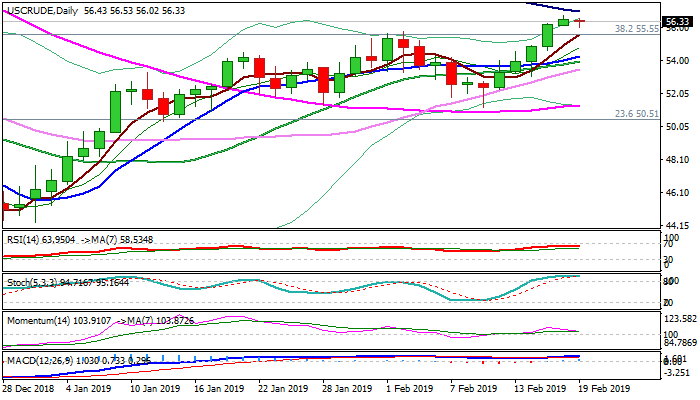
WTI oil price holds within tight range under new 2019 high posted after strong 5-day advance, showing hesitation on approach to strong barrier at $56.92 (falling 100SMA).
Bulls are running out of steam as daily slow stochastic is turning south in deep overbought territory and momentum moved lower and is creating bear-cross.
Strong rally from $51.23 trough is likely taking a breather and would be positioning for fresh advance through 100SMA pivot.
The sentiment remains positive on OPEC production cut and sanctions on Iran and Venezuela, but traders look for more news on US/China trade talks, as fresh optimism on comments about possible deal, boosted oil price but needs more evidence.
Focus turns towards US crude inventories reports, API report on Wednesday and EIA report due on Thursday ( delayed one day due to US holiday) for fresh signals.
Former high at $55.73 (4 Feb) and broken Fibo barrier at $55.55, reinforced by rising 5SMA, mark solid support zone which should ideally contain dips, however, deeper pullback towards pivots at $54.25/$53.95 (converged rising 10&20SMA’s) cannot be ruled out before fresh attempts higher.
Only close below these supports would sideline bulls for stronger correction.
Res: 56.71, 56.92, 57.43, 58.14
Sup: 56.02, 55.55, 54.48, 54.25
Forex Technical Analysis: EUR/USD, USD/JPY, GBP/USD
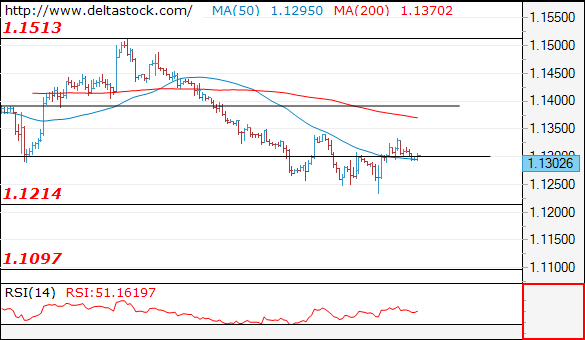
EUR/USD
Current level - 1.1303
The intraday bias is slightly positive, for a rise towards 1.1400 area. Initial support lies at 1.1270.
| Resistance | Support | ||
| intraday | intraweek | intraday | intraweek |
| 1.1350 | 1.1630 | 1.1214 | 1.1214 |
| 1.1400 | 1.1820 | 1.1214 | 1.1100 |
USD/JPY
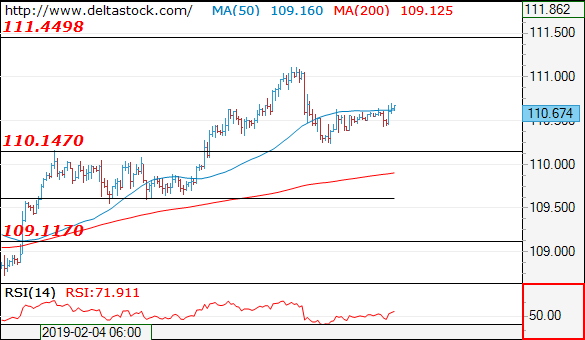
Current level - 110.67
My outlook is counter-trend, for a reversal and another attempt at 110.20 support.
| Resistance | Support | ||
| intraday | intraweek | intraday | intraweek |
| 110.80 | 111.45 | 110.20 | 106.70 |
| 111.45 | 114.50 | 109.10 | 104.60 |
GBP/USD
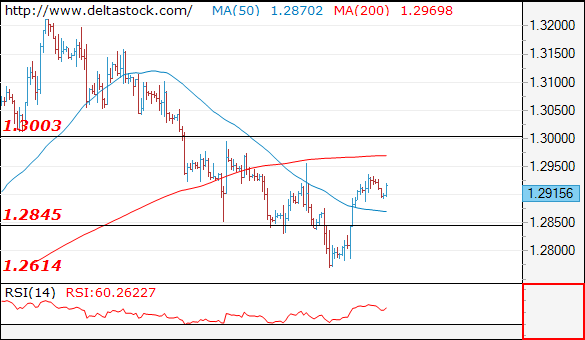
Current level - 1.2915
The outlook is positive above 1.2845, for a rise towards 1.3000 hurdle.
| Resistance | Support | ||
| intraday | intraweek | intraday | intraweek |
| 1.2930 | 1.3000 | 1.2845 | 1.2800 |
| 1.3000 | 1.3290 | 1.2700 | 1.2610 |
Trade Issues Remain In Focus, German Feb ZEW Survey Mixed
Notes/Observations
- Trade concerns remain on the front burner
- China-US delegation continues talks in Washington on (lower level officials on Tuesday). Focus on top level officials from Thursday/Friday with China Vice Premier Lui He attending meetings with Lighthizer and Mnuchin
- Awaiting results of the S232 report (if made public) on the investigation of the national security risk posed by imported cars.
- Sweden CPI data below expectations and dents expectations of the next potential Riksbank rate hike
- German Feb ZEW survey was mixed but slight improvement in expectations survey suggests that negative factors like the rejection of the Brexit deal by the UK Parliament and weak growth from China had already been anticipated
Asia:
- BOJ Gov Kuroda stated that might consider easing if JPY currency (Yen) movement impacted the economy and prices. Crucial to guide monetary policy with eye on economy and market moves including FX. Currency manipulation was not a target for BOJ as central banks did not link policy to FX moves
- Japan PM Abe and US President Trump to hold phone conversation on Wed, Feb 20thahead of the North Korea summit (Reminder:2nd US/North Korea summit expected to be held in Vietnam between Feb 27-28th)
- Japan Economy Min Motegi reiterated that was seeing some risks in outlook due to China slowdown but noted that capex overall was on an expansion trend
Europe:
- ECB's Praet (Belgium, Chief Economist): ECB could adapt rate guidance if economy slows sharply. General Council to reassess the outlook for bank lending in March, expected ECB Staff forecasts to be cut again in March (particularly for the near-term)
- UK Brexit Sec Barclay: Had positive meeting with EU's Barnier on Monday. Discussed the proposed Malthouse Compromise. Believed that UK could reach its goals on Brexit backstop without reopening withdrawal agreement. To meet again mid-week
- EU's Juncker: Brexit delay beyond EU election is possible. Any decision to ask for more time lies with the UK. If such a request were to be made, no one in Europe would oppose it
- EU official: Greece is at risk of not getting some €750M in April from debt relief agreement because it had not completed agreed reforms
- Italy said to have started discussions with the EU over the renewal of a state guarantee scheme designed to help banks and shed bad loans (NPLs)
Americas:
- White House Press Sec Sanders: US trade meetings with China in Washington D.C to start on Tuesday, Feb 19th, US side to be led by USTR Lighthizer in the higher level talks (Note: China Vice Premier Liu He to visit the US for trade talks between Feb 21-22 (Thursday-Friday))
Macro
- (EU) Eurozone: The current account surplus narrowed in FY18 to 3% of GDP from 3.2% of GDP in 2017. The narrowing won't be enough to assuage critics of the Eurozone's surplus and will do little to lessen the risk of US tariffs on auto imports from the EU. The ECB also reported that purchases of euro area portfolio investment by non-residents fell to just €38B from €374B.
- (DE) Germany: President Trump has received the findings of a probe that examined whether imported vehicles pose a national security threat, which has sparked fresh fears that European automakers will face tariffs. Chancellor Merkel stressed over the weekend that BMW's biggest plant is actually in South Carolina, rather than Bavaria, saying that "these cars are built in the United States of America, which are no less a threat than those built in Bavaria are suddenly a national security threat to the U.S., then that is a shock to us". Estimates suggest that if the US imposed permanent tariffs of 25%, German car exports to the US could fall by almost 50% or about €17B.
- (JP) Japan: BoJ Governor Kuroda said that if the yen were to strengthen and was "having an impact on the economy and prices," and if it was considered necessary to achieve the price target, "we'll consider easing policy." He said that this could be by cutting short- and long-term interest rates, and/or expanding asset buying.
SPEAKERS/FIXED INCOME/FX/COMMODITIES/ERRATUM
Equities
- Indices [Stoxx600 -0.5% at 368.1, FTSE -0.6% at 7178, DAX -0.2% at 11280, CAC-40 -0.4% at 5146, IBEX-35 -0.4% at 9118, FTSE MIB -0.8% at 20159, SMI -0.1% at 9258, S&P 500 Futures -0.2%]
- Market Focal Points/Key Themes: Equities European Indices trade slightly lower across the board following a mixed session in Asia and slightly weaker US futures after US markets were shut for President'day on Monday. Worse then expected earnings from banking giant HSBC has set the negative tone as bank stocks trade under pressure. HSBC trades around 4% lower as profits missed estimates, elsewhere Swiss traded Danone trades lower after a slight profit miss. HeidelbergCement, Greggs, Future, dotDigital, Straumann Holding trades higher on earnings while Bakkafrost, BW Offshore, William Demant and Basilea are some of the names trading lower on earnings. In other news TomTailor trades over 10% higher after Fosun International makes €2.26/shr bid to acquire the company; Bourbon trades higher on reports creditors could make offer for the company. Looking ahead notable earners include Walmart, Cooper Tire, Medtronic and Ecolabs among others.
- Consumer discretionary: Greggs PLC [GRG.UK] +7% (trading update), Tom Tailor [TTI.DE] +15% (to be acquired), Cobham PLC [COB.UK] +1.5% (agreement) , Air France-KLM [AF.FR} +2.5% (analyst action)
- Consumer staples: Danone Group [BN.FR] -0.5% (earnings) , Bakkafrost [BAKKO.NO] -11% (earnings)
- Materials: HeidelbergCement AG [HEI.DE] +5% (earnings), DSM [DSM.NL] -2% (analyst action)
- Financials: HSBC [HSBA.UK] -3.5% (earnings), BHP Billiton [BLT.UK] -1% (earnings)
- Healthcare: MDxHealth [MDXH.DE] +9% (appoints CEO)
- Technology: Blancco Technology Group [BLTG.UK] +17% (earnings), Future PLC [FUTR.UK] +18% (trading update)
Speakers
- Germany Econ Min Altmaier: US trade policy was slowing the global economic environment; EU and US should aim for 'zero' tariffs on cars
Currencies/Fixed Income
- EUR/USD was slightly firmer and holding above the 1.13 level despite mixed German ZEW data for Feb. German Feb ZEW survey was mixed but slight improvement in expectations survey suggests that negative factors like the rejection of the Brexit deal by the UK Parliament and weak growth from China had already been anticipated
- GBP/USD holding around the 1.29 level as UK-EU officials continued to meet to find a fix to the Irish backstop issue. Dealers noted that markets could get nervous" if next week's vote delivered another defeat for PM May''s Brexit strategy
- Weaker Swedish CPI data for Jan put some headwinds into further Riksbank rate hikes. EUR/SEK surged higher by 1% to test above 10.57 level for 8-month highs in the cross after headline CPI moved below the central bank target for the 1st time since last May.
- Italian government bond prices initially traded firmer, propelled by growing expectations of new targeted long-term refinancing operations by the ECB. Howver, the price action did a U-turn with no specific catalyst cited. The 10-year Italian BTP yield higher by 5bps at 2.82%
Economic Data
- (CH) Swiss Jan Trade Balance (CHF): 3.0B v 2.0B prior; Real Exports M/M: +0.6 v -4.3% prior; Real Imports M/M: +4.8% v +3.9% prior; Watch Exports Y/Y: +0.2% v -2.8% prior
- (FI) Finland Jan CPI M/M: -0.4% v -0.1% prior; Y/Y: 1.1% v 1.2% prior
- (SE) Sweden Jan CPI M/M: -1.0% v -0.7%e; Y/Y: 1.9% v 2.2%e (1st time since May 2018 annual inflation below target level)
- (SE) Sweden Jan CPIF M/M: -1.0% v -0.7%e; Y/Y: 2.0% v 2.3%e; CPI Level: 328.56 v 329.70e
- (EU) Euro Zone Dec Current Account (Seasonally Adj): €16.2B v €22.6B prior
- (IT) Italy Dec Industrial Sales M/M: -3.5% v -0.1% prior; Y/Y: -7.3% v +0.5% prior
- (IT) Italy Dec Industrial Orders M/M: -1.8% v -0.4% prior; Y/Y: -5.3% v -2.2% prior
- (PL) Poland Jan Employment M/M: 2.2% v 1.0%e; Y/Y: 2.9% v 1.8%e
- (PL) Poland Jan Average Gross Wages M/M: -6.5% v -7.0%e; Y/Y: 7.5% v 6.9%e
- (IT) Italy Dec Current Account Balance: €4.2B v €4.6B prior
- (GR) Greece Dec Current Account Balance: -€1.5B v -€1.4B prior
- (UK) Jan Jobless Claims Change: +14.2K v +20.2K prior; Claimant Count Rate: 2.8% v 2.8% prior
- (UK) Dec Average Weekly Earnings 3M/Y: 3.4% v 3.5%e; Weekly Earnings (ex Bonus) 3M/Y: 3.4% v 3.4%e
- (UK) Dec ILO Unemployment Rate: 4.0% v 4.0% prior; Employment Change 3M/3M: +167K v +141K prior
- (DE) Germany Feb ZEW Survey Current Situation: 15.0 v 20.0e; Expectations Survey: -13.4 v -13.6e
- (EU) Euro Zone Feb ZEW Expectations Survey: -16.6 v -20.9 prior
- (EU) Euro Zone Dec Construction Output M/M: -0.4% v +0.3% prior; Y/Y: 0.7% v 1.1% prior
Fixed Income Issuance
- (CY) Cyprus opened its book to sell EUR-denominated 15-year bonds; guidance seen +200bps to mid-swaps
- (FR) France Debt Agency (AFT) opened book to sell EUR-denominated May 2050 Oat via syndicate; guidance seen +10bps to May 2048 Oat with order book over €11B
- (ID) Indonesia sold total IDR8.12T vs. IDR8.0T target in 6-month Islamic Bills, 2-year, 4-year, 7-year and 15-year Project-based Sukuk (PBS)
- (ZA) South Africa sold total ZAR vs. ZAR2.85B indicated in 2026, 2032 and 2048 bonds
- (ES) Spain Debt Agency (Tesoro) sold total €1.33B vs. €0.5-1.5B indicated range in 3-month and 9-month Bills
- (CH) Switzerland sold CHF532.0M in 3-month Bills; Avg Yield: -0.774% v -0.770% prior
Looking Ahead
- (IT) Italy Debt Agency (Tesoro) announcement on upcoming CTZ and BTPei issuance for Friday, Feb 22nd
- (IL) Israel Feb 12-month CPI Forecast: No est v 1.2% prior
- (PE) Peru Q4 GDP Y/Y: No est v 2.3% prior
- (CO) Colombia Jan Consumer Confidence Index: -3.6e v -8.3 prior
- 05:30 (UK) Weekly John Lewis LFL Sales data
- 05:30 (EU) ECB allotment in 7-Day Main Refinancing Tender (MRO)
- 05:30 (HU) Hungary Debt Agency (AKK) to sell in 3-month Bills
- 06:00 (BR) Brazil Feb IGP-M Inflation (2nd Preview): 0.5%e v 0.0% prior
- 06:00 (PT) Portugal Jan PPI M/M: No est v -1.0% prior; Y/Y: No est v 2.7% prior
- 06:00 (TR) Turkey to sell Bonds (2 tranches)
- 06:30 (SE) Sweden Central Bank (Riksbank) Gov Ingves
- 06:30 (EU) ESM sells €B vs. €2.0B indicated in 6-month bills; Avg Yield: % v -0.519% prior; Bid-to-cover: x v 2.7x prior (Jan 22nd 2019)
- 06:45 (US) Daily Libor Fixing
- 08:00 (RU) Russia Jan Unemployment Rate: 4.9%e v 4.8% prior; Real Wages Y/Y: 1.0%e v 2.5% prior; Real Disposable Income: -0.9%e v +0.1% prior
- 08:00 (RU) Russia Jan Real Retail Sales Y/Y: 1.0%e v 2.3% prior
- 08:00 (UK) Baltic Dry Bulk Index
- 08:00 (RU) Russia announces upcoming OFZ Bond issuance
- 08:50 (US) Fed's Mester (hawk, non-voter)
- 09:00 (EU) Weekly ECB Forex Reserves
- 09:30 (NZ) Fonterra Global Dairy Trade Auction: Dairy Trade price index: No est v +6.7% prior
- 09:30 (PT) ECB's Costa (Portugal) at event
- 10:00 (US) Feb NAHB Housing Market Index: 59e v 58 prior
- 10:00 (MX) Mexico weekly International Reserves
- 10:00 (BE) ECB's Praet (Belgium, chief economist) in Frankfurt
- 11:30 (US) Treasury to sell 3-Month and 6-Month Bills
- 11:15 (EU) ECB's Enria (SSM chief)
CADJPY Advances Above SMAs With Soft Momentum
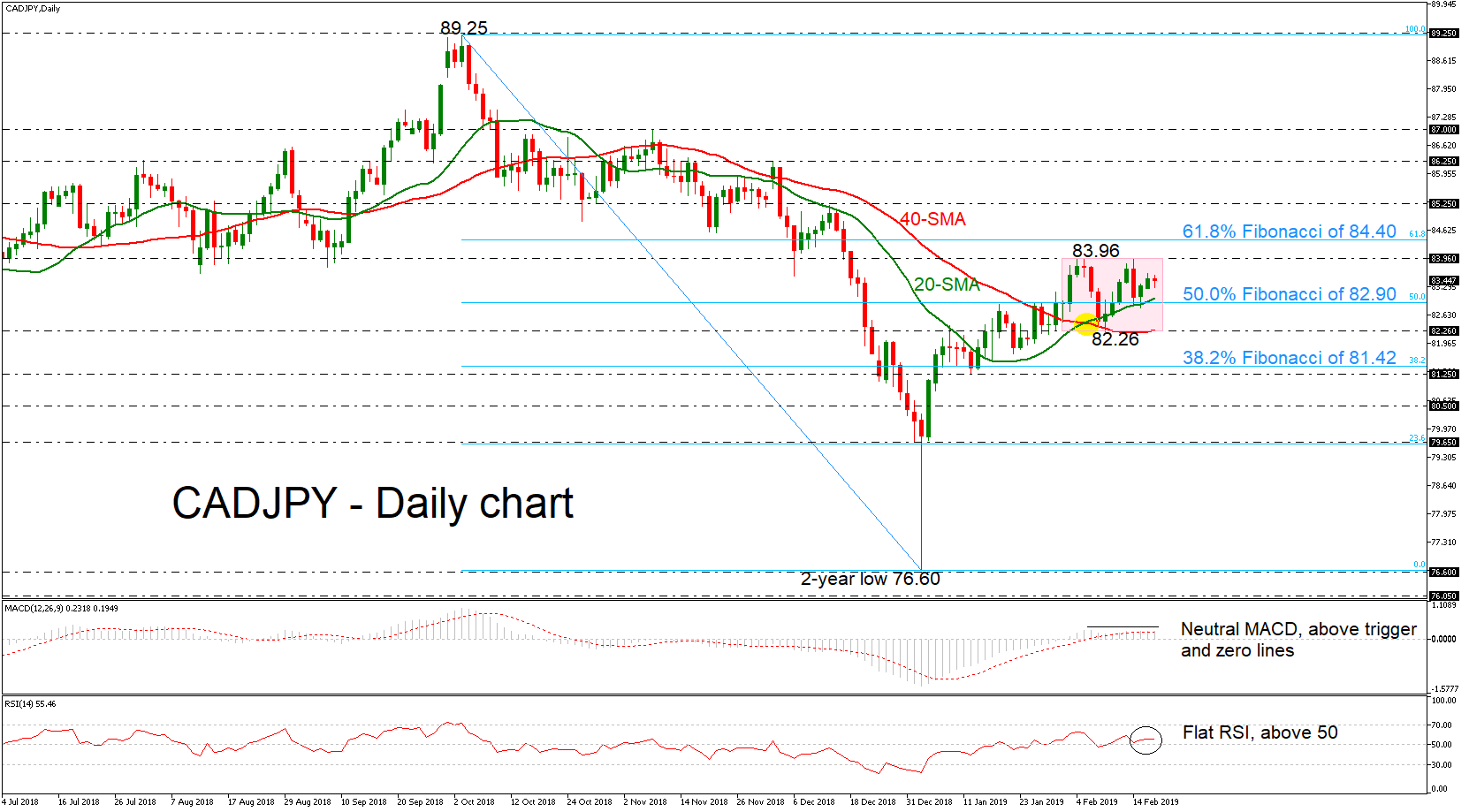
CADJPY has been struggling within a narrow range in the near term with upper boundary the 83.96 resistance and lower boundary the 82.26 support barrier. The pair climbed above the bullish crossover of the 20- and 40-simple moving averages (SMAs) as well as above the 50.0% Fibonacci retracement level of the downleg from 89.25 to 76.60, near 82.90. The MACD oscillator is flattening above the trigger and zero lines, while the RSI holds in the positive zone.
Should the price extend its advances, the 83.96 barrier and then the 61.8% Fibonacci around 84.40 could be immediate resistances for investors to look for. A climb above these significant levels could turn the bias to a more bullish one and the market could head towards the 85.25 resistance, taken from the peak on December 13. If the latter permits for further upside rally the next stop could be around 86.25, registered on December 3.
On the other hand, a downside retracement could retest the 50.0% Fibonacci of 82.90, which stands near the 20-day SMA, before heading towards the 82.26, which overlaps with the 40-day SMA. Moving lower, the 38.2% Fibonacci of 81.42 and the 81.25 support could attract attention.
To sum up, CADJPY holds a slightly bullish profile in the short-term, following the pullback on the two-year low of 76.60
XAU/USD Breaks Dominant Pattern
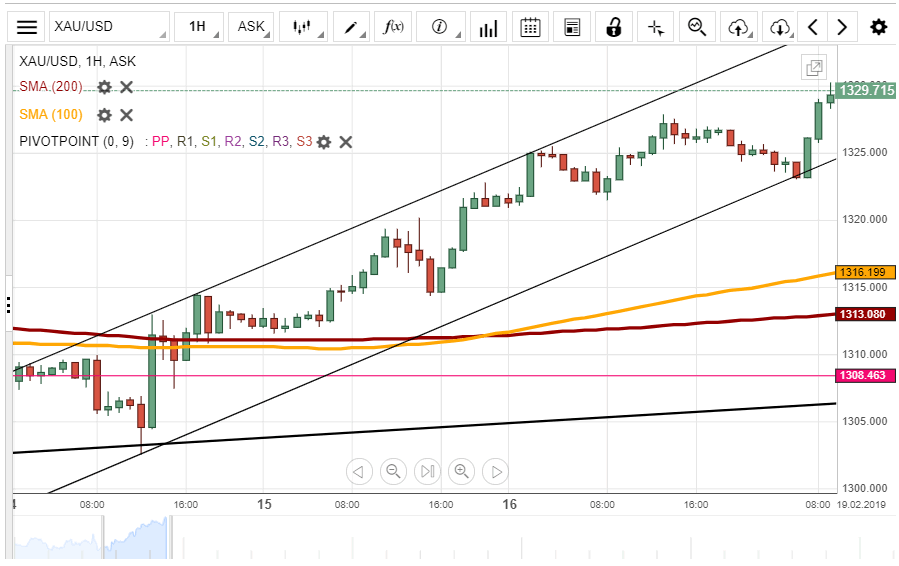
During Monday's trading session, the yellow metal broke the previously drawn dominant pattern line at 1,325.06. On Tuesday morning, the rate was located at the 1,329.53 mark.
In regards to the near-term future, it is expected that the yellow metal will continue its surge against the US Dollar to the 1,330.00 level.
Note, the chart was fully reviewed, and some corrections were applied to
USD/JPY Passes 61.80% Fibo
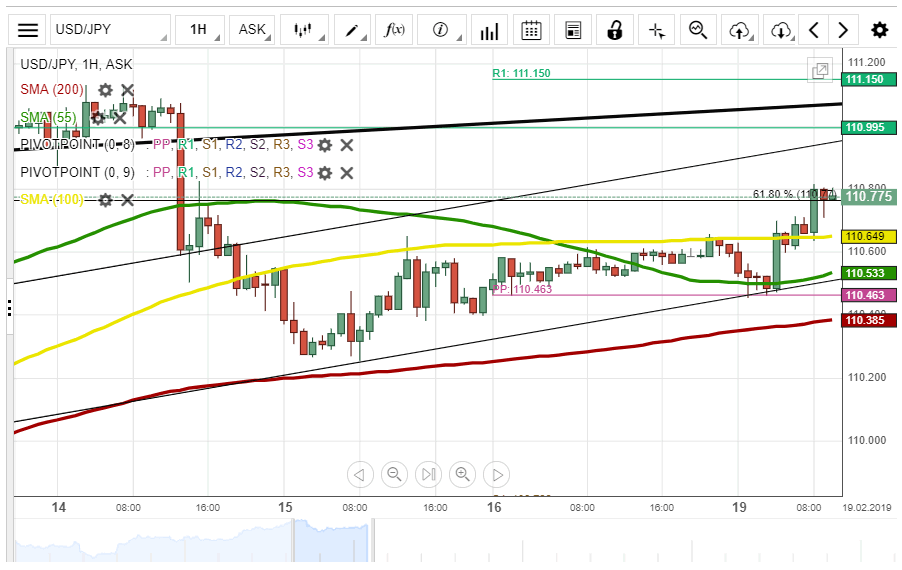
During Monday's trading session, the 55-hour simple moving average supported the currency exchange rate to trade above the weekly PP at 110.40. On Tuesday morning, the rate tested the 61.80% Fibonacci retracement level to be located at the 110.77 mark.
In regards to the near-term future, it is expected that the currency exchange rate will break the resistance of the 61.80% Fibo at 110.77 to trade at the 110.80 level during the day.
However, the resistance level of the 61.80% Fibo could resist the rate to push it towards the bottom boundary of the freshly drawn pattern line at the 110.60 mark.
EUR/USD Trades Sideways
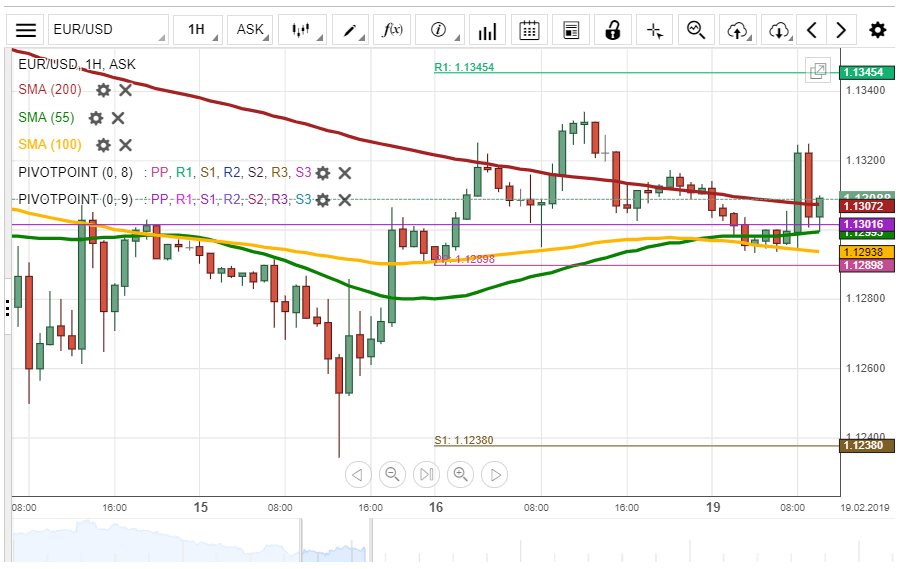
During Monday's trading session, the currency exchange rate was trading sideways to stay at 1.1300. On Tuesday morning, the European Single Currency was trading above the monthly S1 at the 1.1307 mark.
In regards to the near-term future, most likely, the rate will be trading sideways to stay between the weekly R1 at 1.1345 and the weekly PP at 1.1289.
However, the resistance of the 200-hour simple moving average could push the rate to pass through most of the technical indicators to trade at the 1.1260 level.