

Sample Category Title
Gold Price Climbs To New 10-Month High
Key Highlights
- Gold price rallied recently and traded to a new 10-month high above $1,340 against the US Dollar.
- There was a break above a bullish flag with resistance at $1,311 on the 4-hours chart of XAU/USD.
- The UK Claimant Change Changed 14.2K in Jan 2019, more than the 12.3K forecast.
- The FOMC Meeting Minutes will be released, which could impact gold movements in the short term.
Gold Price Technical Analysis
After correcting from the $1,326 swing high, gold price found support near the $1,302 level against the US Dollar. The price started a fresh upward move and broke many resistances near $1,315 and $1,320.
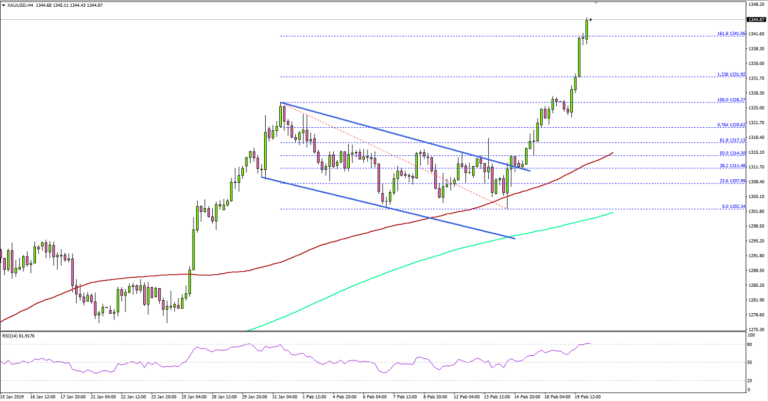
The 4-hour chart of XAU/USD indicates that the price gained pace once it broke the $1,320 resistance and settled above the 100 simple moving average (red, 4-hours). During the rise, it broke the 61.8% Fib retracement level of the last drop from the $1,326 high to $1,302 low.
More importantly, there was a break above a bullish flag with resistance at $1,311, opening the doors for a fresh high above the $1,326 level. Buyers gained control and pushed the price to a new 10-month high above $1,340.
The price even spiked above the 1.618 Fib extension level of the last drop from the $1,326 high to $1,302 low at $1,341. In the short term, there could be a downside correction, but dips remain supported above $1,330.
On the upside, the next key target for buyers could be $1,350 or the 2.618 Fib extension level of the last drop from the $1,326 high to $1,302 low.
Overall, gold price is placed nicely in a strong uptrend and it may continue to rise towards the $1,350 and $1,355 resistance levels. On the other hand, EUR/USD recovered recently, but it failed to break the key 1.1340-1.1350 resonance area. Today’s FOMC Meeting Minutes report holds the key and it could impact gold price and major pairs such as EUR/USD, GBP/USD, AUD/USD and USD/JPY in the near term.
Economic Releases to Watch Today
- Euro Zone Consumer Confidence Feb 2019 (Preliminary) – Forecast -7.8, versus -7.9 previous.
- Swiss Industrial Production for Q4 2018 (YoY) – Forecast +1.2%, versus +1.4% previous.
- FOMC Meeting Minutes.
Daily Markets Broadcast
Wall Street firmer on trade talk leeway
Most US indices extended recent gains following positive comments of trade war developments. US President Trump said talks were going well and the March 1 deadline in not a “magical date”. PM May meets with EU’s Juncker today in what has been deemed a ‘significant” meeting.
US30USD Daily Chart
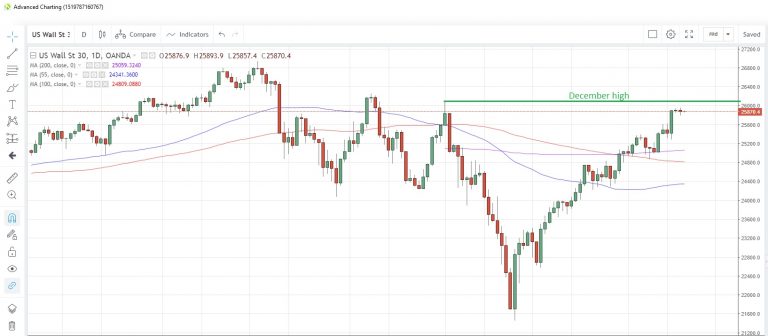
The US30 index touched a 2-1/2 month high yesterday before retreating to close lower on the day. Walmart led other indices higher after posting the best holiday quarter earnings in a decade
The index touched the highest since December 3, though struggled to cross above the psychological 26,000 mark. The December high was 26,082
Minutes of the January FOMC meeting will be released later today, with investors hoping for more details on the Fed’s recent turnaround on rate hikes.
DE30EUR Daily Chart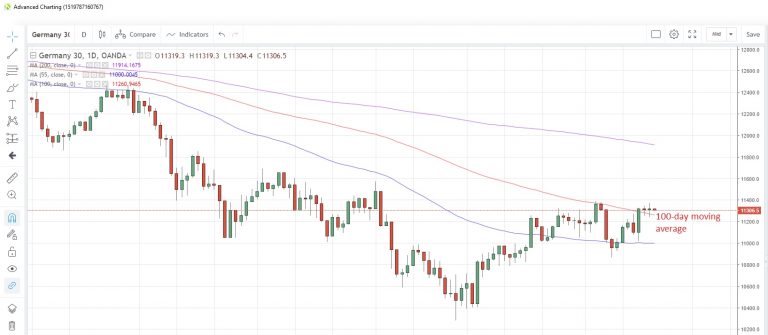
The Germany30 index closed barely changed for a second day as the threat of US tariffs on imports of German automobiles hurt sentiment. The US Commerce Dept has presented President Trump with their report. EU’s Juncker doesn’t think he will impose tariffs while the trade talks are ongoing
The index remains above the 100-day moving average at 11,261, The next resistance level could be the high from earlier this month at 11,392
The ZEW expectations index came in higher than expected at -13.4 from -15.0 in January, but failed to give stocks a lift.
UK100GBP Daily Chart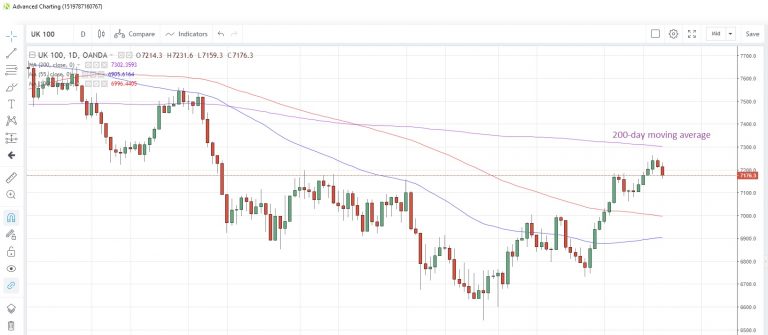
The UK100 index fell for a second straight day yesterday as Brexit issues remain unresolved. The index failed to benefit from EU’s Juncker’s comments that a Brexit delay beyond the EU election is possible. It’s up to the UK to request
Prices are shying away from the 200-day moving average resistance at 7,302
CBI industrial trends survey for February is expected to show the orders index slumping to -3 from -1 in January. PM May meets with EU’s Juncker at 1730GMT today. Markets could get volatile in the aftermath.
A Golden Day For Sterling
A golden day for sterling
Given that Tuesday was a supposedly news and data light post-US holiday trading day, quite a lot happened overnight. The action going on in currency and commodities markets contrasted a quiet equities session on Wall Street, with the major indices finishing ever so slightly higher, dragged up by an excellent Walmart result. The S&P and Dow Jones both rose 0.20% for the day.
The currency markets saw plenty of excitement though. The Swedish krona fell 0.46% against the euro to 10.5600 following an abysmal CPI number, throwing the Riksbank’s plan to hike rates through 2019 into doubt. We’ll add that to the list of central banks facing the same problem recently.
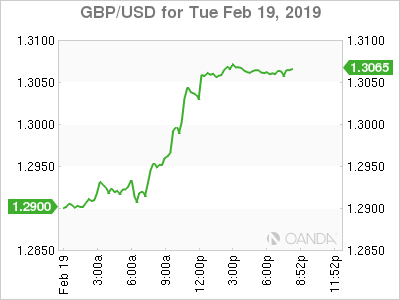
The contrast couldn’t be stronger in the UK with the British pound smashing through 1.3000, rising 1.10% to 1.3060. The rise was driven by strong UK data with wage growth touching multi-year highs of 3.40% and unemployment at a mere 4.0%. Maybe some of the hand-wringing naysayers summoning the riders of the apocalypse on a hard Brexit should calm down a little because Her Majesty’s Kingdom seems to be doing just fine right now. That said, going long GBP anywhere near 1.3200 could prove to be a perilous trade until a deal is secured.
The euro shrugged of poor data (yet again) from the German ZEW and Eurozone construction, rising to 1.1350 against the dollar. This was likely more to do with the dollar being generally weaker overnight than the single currency turning a corner, and data from Europe clearly shows the Eurozone slowing in contrast to the UK. Against this backdrop, Brussels might want to crack open a decent red instead of the cooking wine for UK PM Theresa May’s next visit.
The offshore Chinese yuan rallied sharply against the dollar with USD/CNH tumbling 0.45% to 6.7455. This is rumoured to be down to US demands that China doesn’t devalue its currency as part of the overall trade deal. I suspect this will leave China’s negotiators spluttering their green tea, but the move overnight should ensure a strong start for regional currencies today.
Gold exploded higher overnight, rising USD15 to 1,340.00. A softer US dollar only partially explains the move. Falling developed market bond yields will be playing a part as Sweden looks likely to be the latest country to leave the rate normalisation party central bankers have been throwing. Most importantly though is what gold is telling us about the economy in 2019. As a safe-haven asset, gold typically does very well in times of recession and central banks turn on the easing spigots. Golds price action this year suggests the 2019 equity rally thus far may be the last dance before the bar closes.
FX
We would expect the regional currencies to open stronger following the CNH rally overnight. The US dollar seems to have slowed down for now after an excellent run that may set markets for a period of profit taking and stronger G-10 currencies. This could be temporary however as the US economy continues to fire on all cylinders for now, and with partly normalised yields – in contrast to many of its global peers – it’s hard to bet against the big dollar longer-term in 2019. The Federal Reserve may be nervous, but the US is nowhere near a recession.
Equities
Regional markets should follow Wall Street’s lead and trade in the green this morning. Bullish sentiment will be tempered however by progress (or lack thereof) in the US-China trade talks and ahead of the release of the FOMC Minutes tomorrow morning.
Oil
WTI and Brent diverged overnight. News that Iran’s exports had risen tempered Brent’s gains and it finished down 0.10% at USD66.45 a barrel. WTI continued its advance, rising 0.90% to USD56.45 supported by Venezuelan matters. Both contracts will also be awaiting more clarity from the trade talks in today’s session.
Gold
Gold bugs will be rejoicing after the overnight session and this sentiment should flow into Asia’s markets, even if we see a little profit-taking initially from North American traders. As I’ve been saying for some time, gold’s price action has been constructive, pointing to higher prices. And after the overnight move, gold is now within shouting distance of a multi-year high resistance zone between 1,370.00-1,390.00 dollars an ounce, capping gold since 2013. The technical picture implies any dips will be well supported going forward.
A break of the long-term resistance would likely only be triggered by the failure of the trade talks in the near term. However, the markets should be concerned about the story gold is telling in terms of the global economy if these multi-year highs are broken.
Markets Higher Awaiting Fed Minutes For Signs Of More Dovish Rhetoric
The US dollar is lower against most major pairs on Tuesday as North American traders rejoined the action following Monday’s holiday. The greenback is being sold across the board as the US-China talks move to Washington. US President Trump said earlier that the talks are going well, but warned that the March 1 was not a magical date. There have been reports about a possible extension to avoid increasing tariffs if both sides are close to an agreement.
GBP – Brexit Extension Boosting Pound
The pound was the biggest mover against the dollar, with sterling rising 1.13 percent on Tuesday as Prime Minister May is headed to Brussels. Her cabinet is firm that the new proposals will be enough to secure a deal, but the EU has remained inflexible on the terms of the agreement ahead of the meeting this week.
Opposition leader Jeremy Corbyn will visit Brussels on Thursday to present his plan with a main objective to remove a no-deal Brexit as a possibility.
The EU is showing some possible concessions about the timing of the exit, as Jean-Claude Juncker has said a delay beyond the European parliamentary elections in May would not be opposed, but the Uk has to request it, which they have not done.
GOLD – Gold Higher as a Natural Dollar Hedge as US Politics Heat Up
Gold touched a 10 month high with a softer dollar ahead of the Fed publishing the FOMC minutes giving the green light for the metal to advance. Gold is having a moment despite investors looking for riskier assets in search of yield. The safe haven appeal as political uncertainty in the US and abroad is keeping the yellow metal bid.
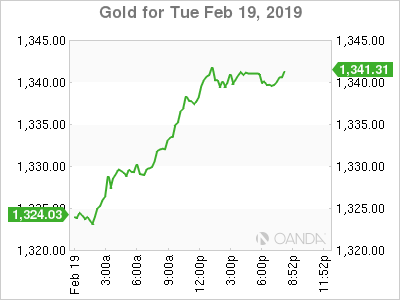
The US-China trade deal is near a breakthrough and with it the edge of the dollar as a safe haven is evaporating giving way to other alternatives that could hedge against US political risk events.
OIL – Soft Dollar and Saudi Over Compliance Keep Energy Higher Ahead of US Inventories
West Texas rose 0.84 percent while Brent was almost flat on Tuesday. Trade optimism has pushed prices higher with the combined factors of a softer dollar and higher global growth expectations.
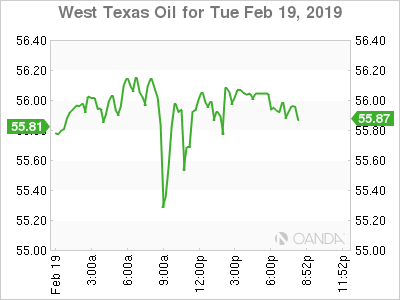
Saudi Arabia has been the main driver of stability as the OPEC plus other major producers are cutting their output, with the kingdom making up for the shortfalls of compliance.
Trade war concerns put a ton of downward pressure on energy prices, and as the anxiety eases as the two nations get closer to a deal crude has been one of the main beneficiaries.
STOCKS – Trade Optimism and Walmart put US Stocks Higher
Global stocks were higher for the most part as Brexit headlines showed the possibility of concessions and comments from the US on trade were encouraging that a deal could be in the works in the short term.
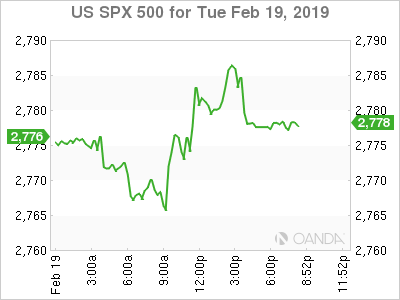
US stocks were boosted by Walmart’s earnings with investors bracing themselves for the release of the Fed’s minutes on Wednesday. The central bank took a dovish turn and the notes form the January FOMC meeting will shed some light on what policy makers were discussing when they reached a decision to pause quantitive tightening.
After the Fed pumped the brakes on its interest rate hike path, other major central banks have turned from neutral to dovish as economic data has disappointed, with the trade war between China and the US a major factor in global growth downgrades.
Eco Data 2/20/19
[php_everywhere instance="1"]
Japanese Yen Unchanged as Investors Search for Cues
USD/JPY continues to show little movement this week. In Tuesday’s North American session, the pair is trading at 110.63, up 0.03% on the day. On the release front, there are no major events out of the United States. Japan is expected to post a trade surplus after recording six successive deficits. On Wednesday, the FOMC releases the minutes of its January policy meeting.
China is Japan’s biggest trading partner, so it’s no surprise that the slowdown in China is having a negative impact on the Japanese economy. The manufacturing and export sectors are particularly vulnerable, with Japan exporting car parts and electronics to China. This has resulted in a string of monthly trade deficits, as the global trade war has dampened the appetite for Japanese exports. There was positive news last week, as Japan’s economy grew 0.3% in the fourth quarter, after a decline of 0.6% in the third quarter. Business and consumer spending improved, helping the economy expand. Exports rose 0.9% in Q4, the strongest growth in a year. However, if the global trade war continues, Japanese growth could dramatically fall.
Traders should treat the Federal Reserve minutes as a market-mover. Since raising rates in December, the Fed has changed direction and become much more dovish. In late 2018, there was talk of up to four rate hikes in 2019, but the Fed has revised its forecast to two hikes. The markets have gone further, projecting no rate increases this year, and there has even been talk of a rate cut in late 2019. In the January rate statement, the Fed discarded previous pledges of “further gradual increases” in interest rates, and said it would be “patient” before any further hikes.
Aussie Retains Bearish View; Employment Report Key to the Australian Outlook
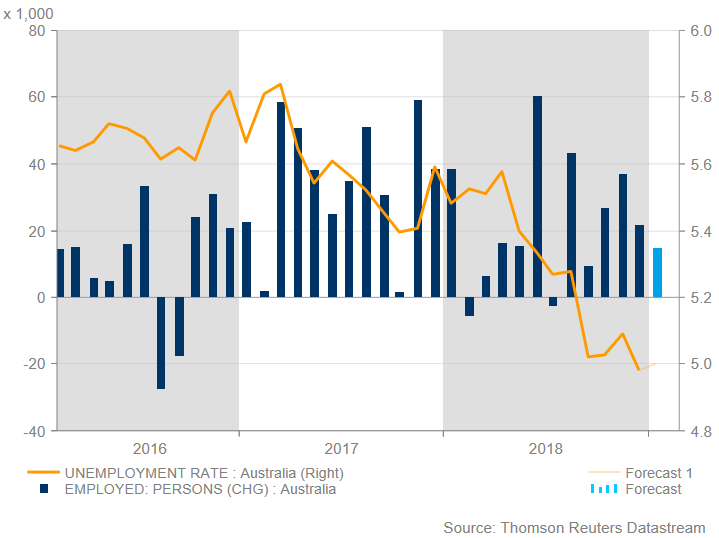
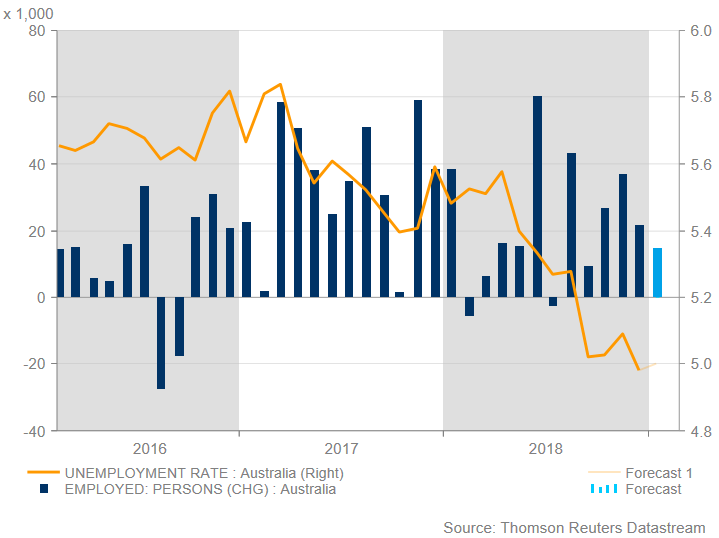
January’s employment report for Australia is likely to attract investor’s attention on Thursday at 0030 GMT as the Australian dollar has been losing some ground over the past week. Stronger figures in employment may provide some relief to the currency.
The unemployment rate is predicted to have stayed at 5.0% in January, while the net change in employment is expected to show that the economy added 15,200 jobs, less than December’s 21,600. However, the participation rate is expected to remain steady at 65.6%, while there could be some gains ahead for the aussie if wage growth and employment numbers show further tightening in the labour market.
Early on Tuesday, the Reserve Bank of Australia released the minutes of its latest policy meeting, that kept interest rates unchanged and the statement had a somewhat dovish flavor compared to the preceding one. Policymakers noted that the growth in real GDP of 0.3% in the third quarter and 2.8% over the year had been below expectations as it was expected to be above 3%, reinforced by accommodative monetary policy. Slowing growth in China and ongoing trade tensions had led to lower growth in global trade and forced the RBA to lower its GDP growth forecast for 2019 to 2.75% from 3.25% in its latest Monetary Policy Statement.
Board members were more upbeat, though, about the labour market, citing employment that continues to grow faster than the working-age population in the December quarter, as the unemployment declined to 5%, which was the lowest rate since 2011 and lower than had been expected a year earlier. Moreover, inflation had remained low with the headline rate falling to 1.8% y/y and the underlying rate being 0.5% m/m in the latest quarter. Headline inflation had been lower than forecast because of cheaper fuel prices as a result of falling oil prices. Underlying inflation was expected to increase to 2% until the end of 2019 and to reach 2.25% by the end of 2020.
However, despite the recent downside rally in the Australian dollar, having a look at the outlook for the US economy, the US Federal Reserve had emphasized that it would be patient in making any future adjustments to the funds rate, and that the next monetary policy decisions would be guided by the incoming data because interest rates were closer to estimates of neutral.
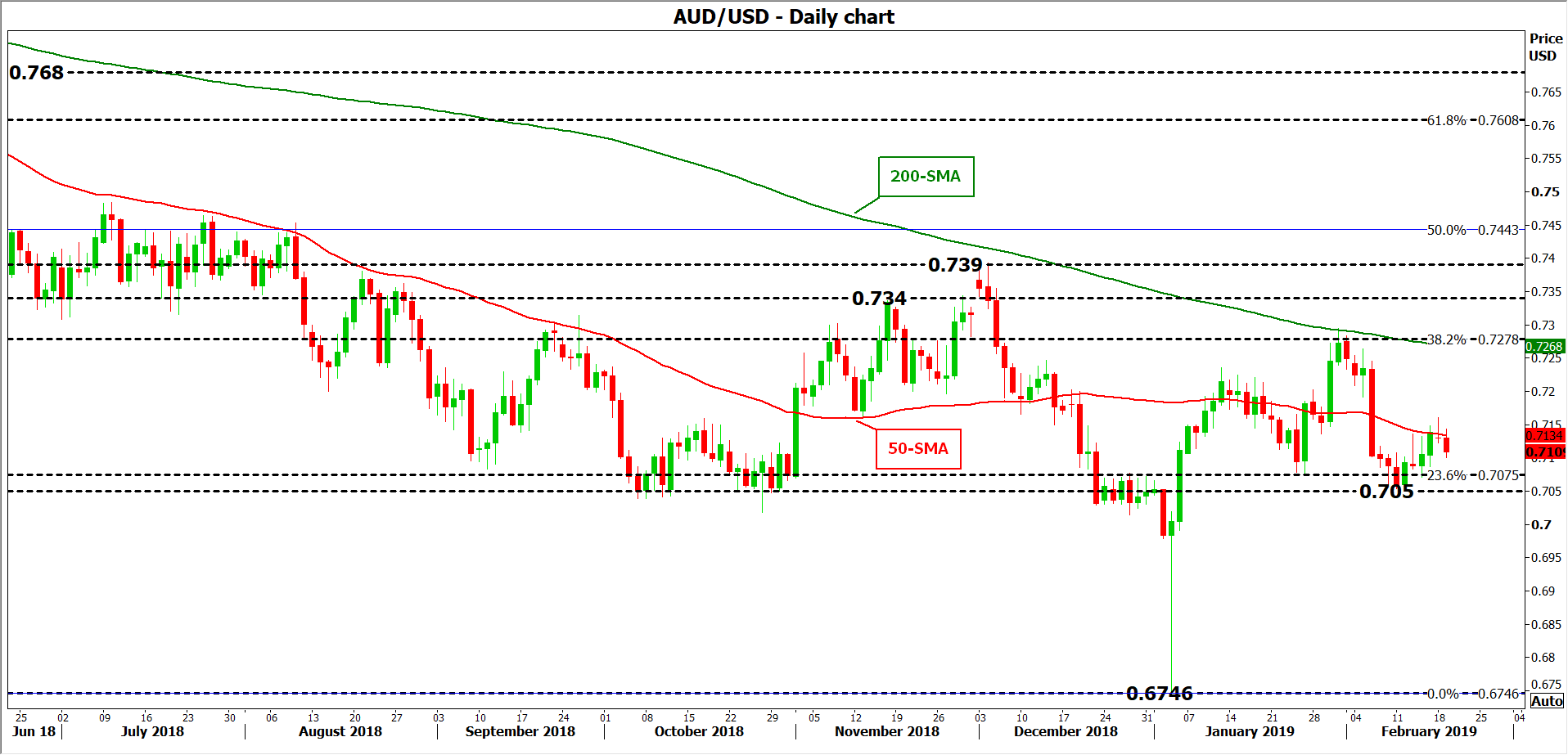
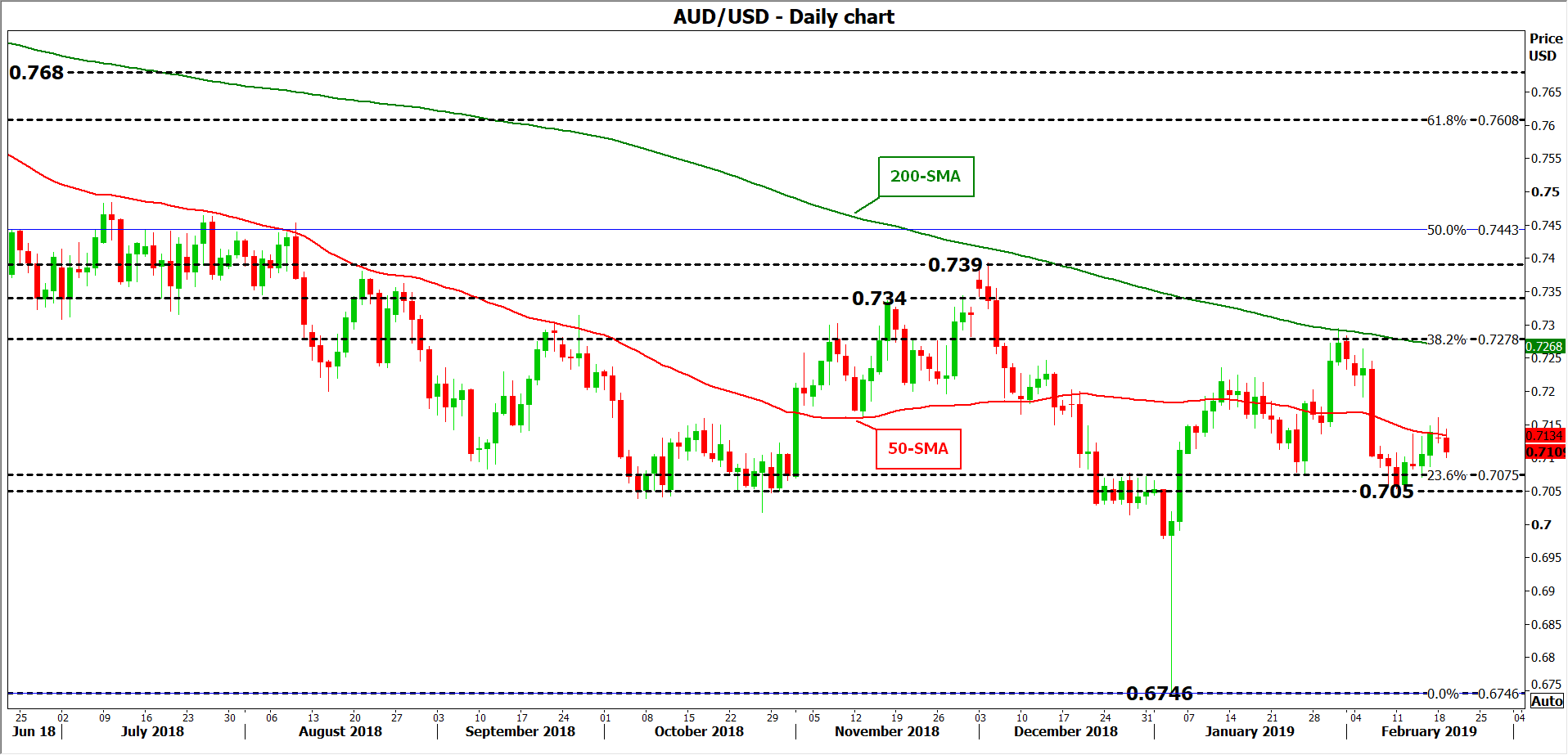
So, from the technical point of view, aussie/dollar moved slightly lower, dropping below the 50- and 200-simple moving averages (SMAs) in the daily timeframe, indicating selling interest. Upbeat numbers on employment are likely to propel the price higher towards the 38.2% Fibonacci retracement level of the downleg from the 31-month high of 0.8135 to the decade low of 0.6746, near 0.7278. More bullish pressure would drive the pair towards the 0.7340 – 0.7390 resistance zone.
However, the price could be at risk of a bearish retracement if the employment report disappoints. Price action is likely to challenge again the 23.6% Fibonacci region of 0.7075 and slightly below the 0.7050 support level. A significant leg below these levels could send prices until the 10-year low of 0.6746.
Overall, aussie/dollar is losing momentum in the near term and continues to endorse the long-term bearish structure.
FOMC Minutes to Reinforce ‘Patient’ Mode; May Offer Clues on Balance Sheet Reduction
The minutes of the Federal Reserve’s January policy meeting are due to be published on Wednesday at 19:00 GMT and will be inspected for confirmation that the world’s most important central bank is on hold for the foreseeable future. However, since January, policymakers, including Chairman Jerome Powell, have been pretty consistent in signaling that the Fed is in wait-and-see mode, hence, the focus of the minutes will be on possible changes to the balance sheet reduction plan. Although the Fed’s dovish pivot has already been priced into the US dollar, clearer hints of an early end to shrinking the balance sheet could lift stock markets, while weighing on Treasury yields and the greenback.
Powell took markets by surprise on January 4 when he first indicated that the Fed “will be patient as we watch to see how the economy evolves”. After all, only three months earlier, Powell had said the Fed was a “long way” from neutral interest rates. While political pressure from the White House may have contributed to the dramatic shift, the main reason for the Fed’s change of tune was the significant tightening of financial conditions, led by hefty declines in US and global equities towards the end of 2018.
At the policy meeting on January 29-30, the Fed surprised again by seemingly appearing to rule out further rate hikes in 2019. But the Fed’s U-turn didn’t stop there and signaled its readiness to adjust its balance sheet normalisation plan “if future economic conditions were to warrant a more accommodative monetary policy”. That balance sheet reduction plan, dubbed as quantitative tightening, will likely be the focal point of Wednesday’s minutes as investors will want to see just how far the discussions of such a move have advanced.
Many analysts see the Fed’s balance sheet roll-off, which has been on auto-pilot since October 2017, as adding to the market stress by raising long-term borrowing costs. Although the Fed has refused to take the blame for the recent market turmoil, speculation has been growing that the central bank will soon announce an early exit from its plan to shrink the balance sheet. Fed Board Governor Lael Brainard gave the strongest indication yet of this last Thursday by saying that the “balance sheet normalization process should probably come to an end later this year”.
Any signs from the minutes that a decision could arrive as early as the next meeting on March 19-20 would likely fuel the rebound in equities markets, while pressuring the US currency. The March meeting is also when Federal Open Market Committee (FOMC) members will be updating their quarterly economic projections, including the dot plot chart, making a major announcement then more probable.
If there’s evidence in the minutes that FOMC members are planning on maintaining a larger post-QE balance sheet than previously envisioned, dollar/yen could initially seek support at the 50-day moving average (MA) just above the 110 handle. A slip below this level could accelerate the decline towards the 50% Fibonacci retracement of the upleg from 104.55 to 114.54 at 109.55.
However, if the Fed signals that changes to its balance sheet unwinding plan are still some time away, dollar/yen could clear the immediate hurdle around the 38.2% Fibonacci at 110.73 and aim for the 200-day MA at 111.30. However, chances of stronger gains from the minutes alone and a move towards the 23.6% Fibonacci at 112.18 are remote as the Fed is unlikely to stray from its recent dovish stance.
Moving beyond the January minutes, the March gathering is already looking like it’s going to be another crucial policy meeting as markets will get the first real glimpse of policymakers’ outlook on GDP growth, inflation and the projected path of the fed funds rate following the dovish shift. With some market participants holding the view that the Fed has leaned too far towards the dovish end of the spectrum, there will be a lot of attention on whether FOMC members will retain at least one rate hike in their forecasts or abandon further tightening altogether for 2019. If the Fed does not keep its options open, there is a risk Powell may need to perform another U-turn later in the year if the US economy does not slow as much as currently being feared and the trade war-related risks dissipate.
Fed Mester: Interest rate may need to rise a bit if most likely case realizes
Cleveland Fed President Loretta Mester said in a speech that the most likely case this year is that "the economy will transition toward a more sustainable pace of growth, with continued strength in labor markets and inflation near 2 percent." And if this case realizes, " fed funds rate may need to move a bit higher than current levels.
Though, she also emphasized that Fed must "remain attentive to several risks to the outlook, including the slowdown in global growth, uncertainty over trade policy, tighter financial conditions, and the changes in business and consumer sentiment". If some of the risks manifest themselves, and, economy turns out to be weaker than expected, she will need to adjust her outlook and policy views.
For now, federal funds rate are now at the lower end of the longer-run neutral level. Monetary policy is "neither ahead of nor behind the curve". She said "we can take the time to make that assessment. "
Sunset Market Commentary
Markets
Global core bonds gain ground today with US Treasuries outperforming German Bunds. Sentiment proved fragile today as political event risks have put investors in wait-and-see modus. Core bonds opened neutral with a modest upward tendency. Italian production data fell harder than expected in December. Italian bonds fell on the news while German Bunds moved higher. ECB vice-president Luis de Guindos confirmed the dovish turn of the ECB recently but said the bank is in no rush to change course. The German/EMU ZEW expectations gauge printed mixed, but market reaction was muted. The German yield curve is little changed with changes varying between -0.3 bps (2-yr) and +0.1 bp (5-yr). US Treasuries tread water today but jumped higher when US investors joined trading. With only housing sentiment to be released, sentiment will steer trading today. US equities opened lower but with an upward tendency, reversing the upward move of US Treasuries. The US yield curve moves lower with changes in the range of 1.5 bps (30-yr) to -2.4 bps (5-yr). Peripheral spreads over the German 10-yr yield are steady with only Italy underperforming (+6 bps).
Headlines were tentatively euro negative, but the reaction of the single currency was only of intraday significance. Italian production and orders missed consensus again by a wide margin. The report blocked a wary intraday attempt of EUR/USD to move away from the 1.13-area. ZEW German investors sentiment printed below consensus but the expectations component improved for the 4th month in a row. The release had little impact on the euro. Around noon, the EUR/USD pair dropped (temporarily) below the 1.13 handle on ‘soft’ comments from ECB’s de Guindos. However, the move had no strong legs. The simple confirmation that the euro zone is in a soft spot and the ECB is pondering the consequences for its policy, at least today, wasn’t enough for euro ‘shorts’ to add to their positions. With few important eco data in the US, EUR/USD is currently trading in the 1.1310 area. The yen initially declined as BoJ’s Kuroda warned that the BOJ can still take measures to prevent unwarranted yen strength. However, the USD/PY reversed gains from Asia and Europe as the dollar lost ground early in US dealings (currently 110.60 area).
Sterling traded with a positive bias today. EUR/GBP hovered in the 0.87 area going into the publication of the monthly labour data. The labour market report was solid (cf infra). The reaction of sterling immediately after the release was limited, but the UK currency gained traction later. UK policy makers continued to stress the significance of upcoming meetings with EU officials. At the same time, there are few indications that the EU is prepared to make substantial concession on the issue of the ‘Irish backstop’. Still the UK currency extended gains. EUR/GBP is trading in the 0.8725 area. Cable is making good progress in the 1.29 big figure.
News Headlines
The Swedish Riksbank’s preferred inflation gauge, which is calculated using fixed mortgage interest rates, unexpectedly slowed to 2% Y/Y in January (-1% M/M). Markets expected CPIF to clock at 2.3% Y/Y while the central bank even expected 2.4% Y/Y. The Swedish crown lost ground after the release as investors put in doubt the Riksbank’s H2 2019 rate hike intentions. EUR/SEK rose to 10.6, the highest level since last August.
The UK labour market remains hot. The unemployment rate stabilized at 4% in Q4 2018, the lowest level since 1975. Average hourly earnings rose by 3.4% in the same period, matching the fastest pace in 9 years and strengthening UK households’ disposable income. The economy added 167k jobs, pushing the employment rate to a record 75.8%. Productivity declined though, with output per hour worked down 0.2% in Q4 2018.
Polish employment rose by 2.2% M/M and 2.9% Y/Y in January, beating consensus and providing evidence of a strong labour market. Average gross wages declined by 6.5% on a monthly basis (end of year effect), but rose 7.5% on a yearly level. These strong data probably won’t cause a change of heart at the dovish central bank who sticks with her view of unchanged policy in 2019 and 2020. The Polish zloty couldn’t profit.