Sample Category Title
Into European Session: Aussie strongest, lifted by stock rebound and improving business confidence
Entering into European session, Australian Dollar is so far the best former for today. It's partly helped by another day of rebound in Chinese stock markets. Japanese Nikkei also came back from holiday with a rebound. Additionally, better than expected NAB business condition and confidence also give Aussie a pop. But upside momentum is rather weak as the current recovery should be corrective in nature.
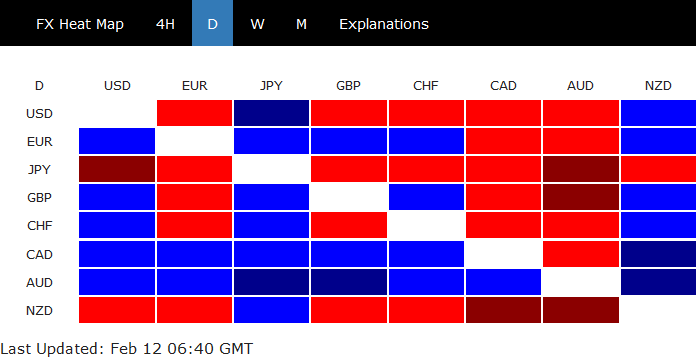
For now, Canadian Dollar follows as the second strongest one. WTI crude oil drew support from 51.37 support and is recovering, back at 52.8. Euro is the third strongest, paring some of yesterday's losses. On the other hand, Yen, New Zealand Dollar and Dollar are the weakest ones so far.
The economic calendar is rather light ahead today. Main focus will be on UK Prime Minister Theresa May's Brexit statement in the Commons. The US Congress has reached a tentative deal to avert another partial government shutdown. So, focus will turn back to any news regarding US-China trade negotiation.
In Asia:
- Nikkei closed up 2.61%.
- Hong Kong HSI is up 0.09%.
- China Shanghai SSE is up 0.53%.
- Singapore Strait Times is down -0.01%.
- Japan 10-year JGB yield is up 0.0113 at -0.017, staying negative.
Overnight:
- DOW closed down -0.21%.
- S&P 500 rose 0.07%.
- NASDAQ rose 0.13%.
- 10-year yield rose 0.029 to 2.661.
- 30-year yield rose 0.023 to 2.999, just failed to reclaim 3% handle.
Australia Housing Finance: Broad-Based Fall Late 2018
Owner-occupiers (no.) –6.1%mth, –11.6%yr (f/c –2%). Investors (value): –4.8%mth, –21.8%yr. Total ex refi (value): –5.9%mth, –19.8%yr.
Housing finance approvals posted a very weak finish to 2018 with sizeable declines across all components.
The headline number of owner occupier loans fell 6.1%, much weaker than the consensus forecast of a 2% decline. Ex-refi, the number of approvals were down a hefty 8.2% in the final month of 2018, to be off 14.4% for the year. Notably, what was initially an investor-led cycle is now seeing clear weakness in owner occupier activity – both the value and number of loans.
The value of investor loans also declined, a 4.8% fall taking this segment down 21.8% for the year. Note that survey changes mean this measure now excludes investor loans for ‘construction of dwellings for rent or resale’ and for ‘purchase of dwellings by others for rent or resale’ – components that previously accounted for around 15% of the value of investor approvals. Helpfully, the ABS also now provides an ‘ex refi’ measure for the value of investor loans, which dropped 4.6% in the month but is down more substantially by 27.8% over the year.
The combined total value of housing finance approvals including investors but excluding refi declined 5.9%mth to be down 19.8%yr.
Construction finance approvals fared a little better, recording a 2.4% decline but still down over 10% for the full year. Approvals for the purchase of newly built dwellings, including 'off the plan apartment sales' were down more sharply, –5.5%mth, –20.2%yr.
All major states recorded declines in the December month, the number of owner occupier approvals excl refi down 6.1% in NSW, 10.4% in Vic, 6% in Qld, 7% in WA and 3.4% in SA. The value of dwelling approvals including investor loans and excluding refi (estimates of which are now provided on a more timely basis) confirm the wide spread as well with large declines in NSW, Vic, Qld and WA, all down around 20%yr.
There were some notable details in the mix. First home buyer activity, a segment that has been supported by state government incentives, are also starting to show signs of slowing. However, the detail around average loan sizes suggests the biggest decline is coming in the 'upgrader' segment, suggesting changes to borrower assessments and perhaps the impact of lower prices on existing home equity may be impacting.
All up, the December finance approvals data shows a very weak finish to 2018 with weakness coming across the board, confirming the message from other market measures.
RBNZ survey: Inflation, house price and GDP expectations dropped
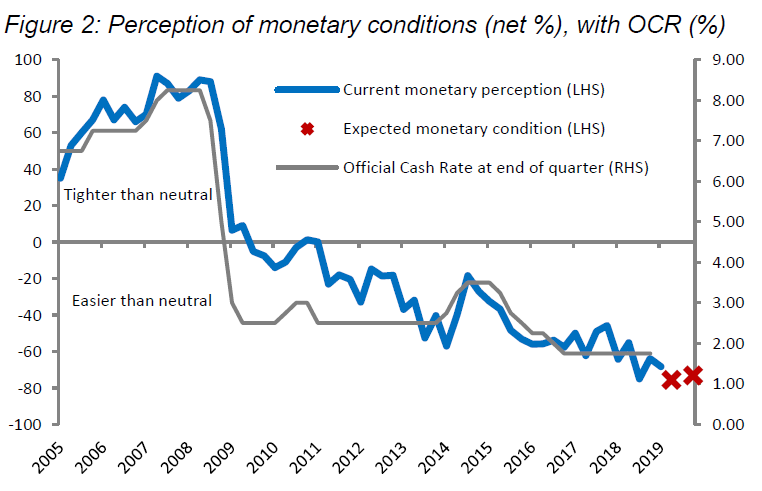
RBNZ quarterly survey showed inflation expectation for a year ahead dropped from 2.09% to 1.82%. One-year house price expectations dropped sharply from 2.86% to 1.91%. One-year rolling annual GDP expectation dropped slightly from 2.44% to 2.38%. Regarding RBNZ monetary policy, a net 75.6% of respondents believe monetary conditions in one year's time will be easier than neutral.
NAB on RBA: Next rate move could be down rather than up
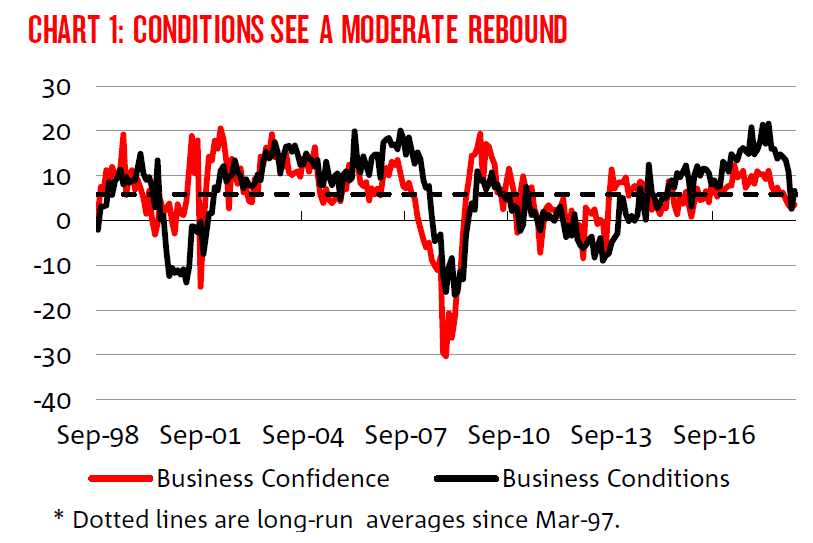
Australia NAB Business Condition staged a moderate rebound in January up from 2 to 7 and beat expectation of 4. That came after the sharp decline from 11 to 3 in December. Business Confidence also rose slightly from 3 to 4. NAB noted that even after the recovery, "conditions and forward orders continue to trend lower and still show a sizeable decline over the past 6 months."
Alan Oster, NAB Group Chief Economist noted that "Based on the confirmation that conditions have deteriorated further and our current set of forecasts we now see the RBA staying in neutral for the foreseeable future, though think the next move could be down rather than up based on the current trajectory of growth and growing downside risks".
China MOFCOM: Consumption faces more challenges in 2019 after slowdown last year
Chinese Commerce Department's Deputy Director of the Market Operation Wang Bin admitted that consumption growth in 2018 has slowed down. In particular, growth in products related to automobiles and housing have been weak. Additionally, there will be more challenges for consumption growth in 2019 than expected.
Wang added that there will be measures to boost consumption in five aspects. Those include polices on urban consumptions, rural consumptions, service consumptions, product circulations and consumption environments.
EU Barnier and UK Barclay held constructive meeting on next step for Brexit
EU chief Brexit negotiator Michel Barnier had a meeting with UK Brexit Minister Stephen Barclay in Brussels on Monday evening. A UK government spokesman said the two had a "constructive" meeting.
And they met to "discuss the next steps in the UK's withdrawal from the EU and explore whether a way through can be found that would be acceptable to the UK Parliament and to the European Union".
UK Prime Minister Theresa May is scheduled to make a statement on Brexit today. Without any progress, there will not be another meaningful vote on her withdrawal agreement. Instead, debate will resume on Thursday in the Commons, with some lawmakers pushing for shift control of the negotiation from the government to the parliament.
Euro Trading A Tad Higher In The Asian Session
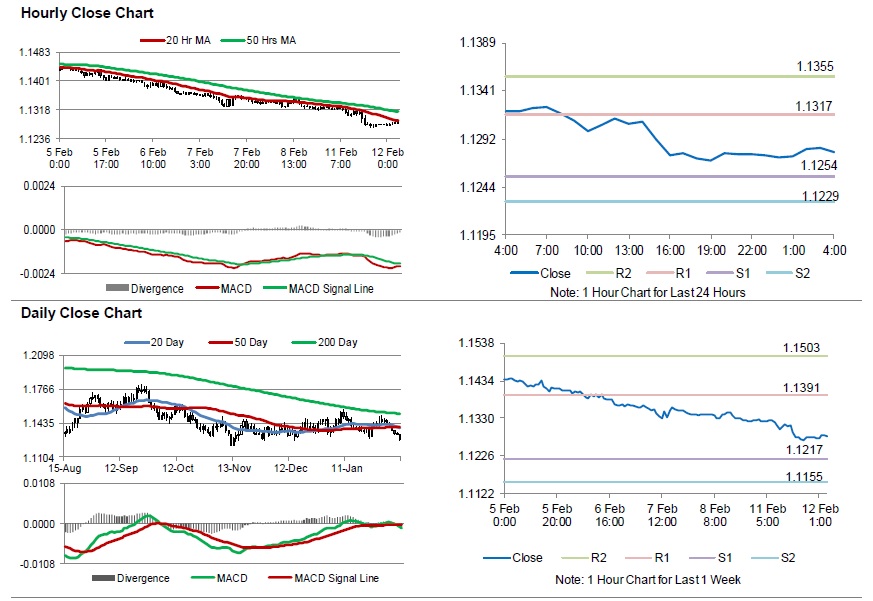
For the 24 hours to 23:00 GMT, the EUR declined 0.41% against the USD and closed at 1.1279.
In the Asian session, at GMT0400, the pair is trading at 1.1279, with the EUR trading slightly higher against the USD from yesterday’s close.
The pair is expected to find support at 1.1254, and a fall through could take it to the next support level of 1.1229. The pair is expected to find its first resistance at 1.1317, and a rise through could take it to the next resistance level of 1.1355.
Amid no major macroeconomic releases in the Euro-zone today, investors would focus on the US NFIB small business optimism index for January and the JOLTS job openings for December, set to release later in the day.
The currency pair is showing convergence with its 20 Hr moving average and trading below its 50 Hr moving average.
UK’s Economic Growth Slowed To A Six-Year Low Level In 4Q 2018
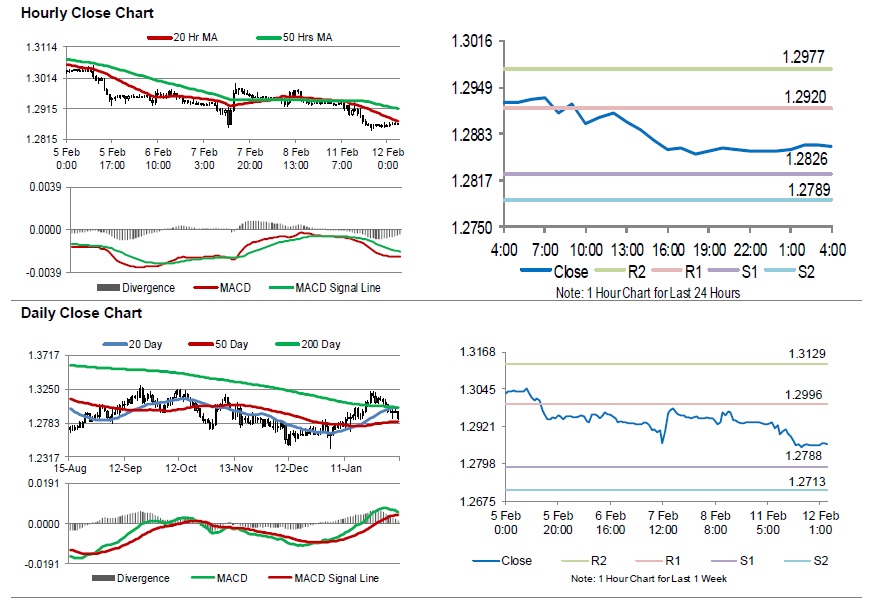
For the 24 hours to 23:00 GMT, the GBP declined 0.57% against the USD and closed at 1.2858 amid a slew of disappointing economic data.
On the macro front, UK's preliminary gross domestic product (GDP) growth slowed to a six-year low level of 0.2% on a quarterly basis in 4Q 2018, compared to market expectations for a rise of 0.3%. GDP had recorded a climb of 0.6% in the previous quarter. Moreover, the nation's manufacturing production eased 2.1% on an annual basis in December, compared to a revised fall of 1.2% in the preceding month. Markets had anticipated manufacturing production to record a fall of 1.1%. Additionally, industrial production declined 0.9% on a yearly basis in December, more than market expectations for a drop of 0.5% and following a revised fall of 1.3% in the prior month. Also, UK's construction output unexpectedly dropped 2.4% on an annual basis in December, defying market expectations for a rise of 1.5%. Construction output had registered a revised rise of 1.8% in the previous month. Further, visible trade deficit narrowed to £12.10 billion in December, compared to a revised visible trade deficit of £12.40 billion in the prior month.
In the Asian session, at GMT0400, the pair is trading at 1.2864, with the GBP trading 0.05% higher against the USD from yesterday's close.
The pair is expected to find support at 1.2826, and a fall through could take it to the next support level of 1.2789. The pair is expected to find its first resistance at 1.2920, and a rise through could take it to the next resistance level of 1.2977.
With no macroeconomic releases in UK today, investors would look forward to global macroeconomic releases for further directions.
The currency pair is trading below its 20 Hr and 50 Hr moving averages.
Tentative deal reached to avert another US government shutdown, with border fencing
A tentative deal was agreed yesterday between the Republicans and Democrats to avert another partial government shutdown this Saturday. But the agreement does not include the USD 5.7B funding for the border wall that Trump demanded.
No detail is provided for the deal yet. But based on unnamed source, there would be USD 1.375B in funding for new fencing along the southern border of the US. That is around the same amount the Congress allocated last year.
Also, it's reported that only currently deployed design could be used for 90km of additional barriers, which might include steel bollard fencing.
Japanese Yen Extends Its Losses In The Morning Session
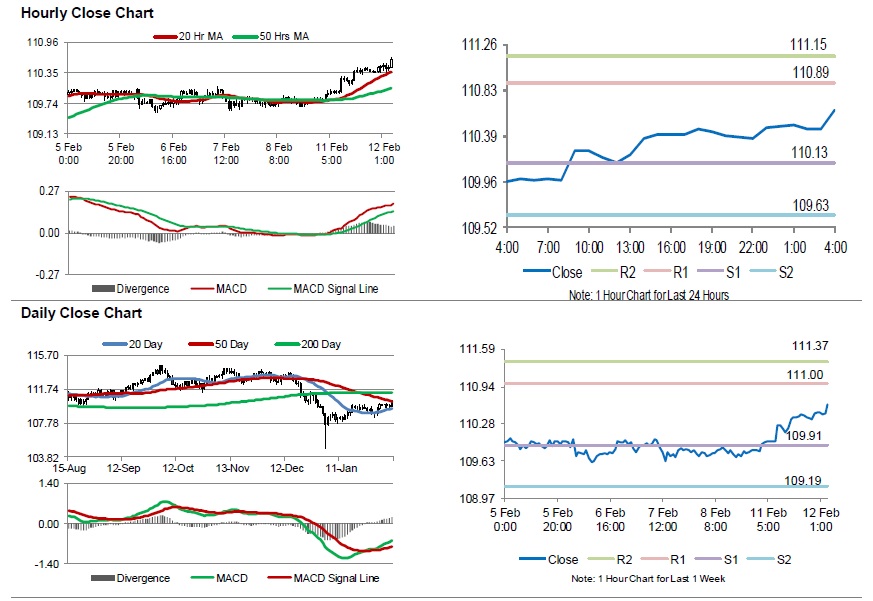
For the 24 hours to 23:00 GMT, the USD rose 0.50% against the JPY and closed at 110.47.
In the Asian session, at GMT0400, the pair is trading at 110.63, with the USD trading 0.14% higher against the JPY from yesterday’s close.
The pair is expected to find support at 110.13, and a fall through could take it to the next support level of 109.63. The pair is expected to find its first resistance at 110.89, and a rise through could take it to the next resistance level of 111.15.
Trading trend in the Japanese Yen today is expected to be determined by Japan’s machine tool orders for January, scheduled to release in a while.
The currency pair is trading above its 20 Hr and 50 Hr moving averages.