Sample Category Title
Daily Markets Broadcast
Wall Street mixed as investors eye trade talks
It was a mixed, lacklustre trading session on Wall Street yesterday, with investors waiting for clues on trade talks and the potential second US government shutdown.
US30USD Daily Chart
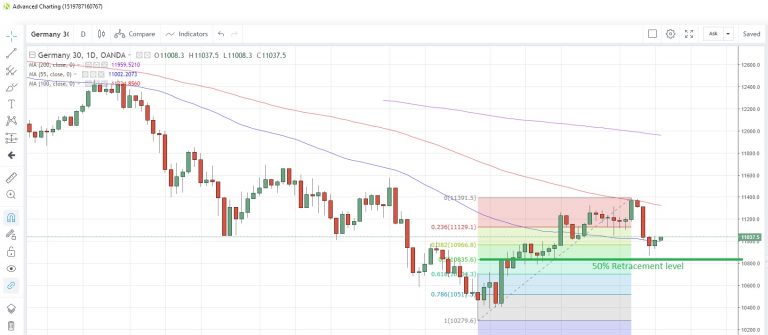
The US30 index fell for a fourth consecutive day yesterday, but lacked any true direction as ranges were tight and volumes low
The index has held above the 100-day moving average at 24,854
Data releases today are only second-tier ones again, though we have speeches from Fed’s Powell, George and Mester on tap.
DE30EUR Daily Chart
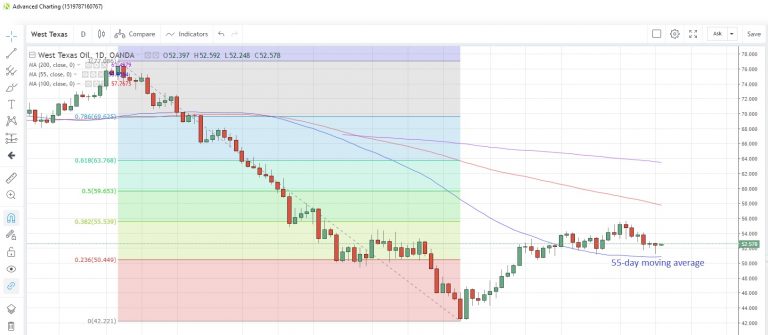
The Germany30 index snapped a three-day losing streak yesterday on stronger corporate results
The index held above the 50% retracement level of the run-up which lasted from December 27 to February 5, which is at 10,835
ECB’s Guindos said he sees core inflation accelerating in the medium term, implying there is no further downward shift in the ECB’s policy stance. He reiterated that the ECB will be prudent in setting monetary policy.
WTICOUSD Daily Chart
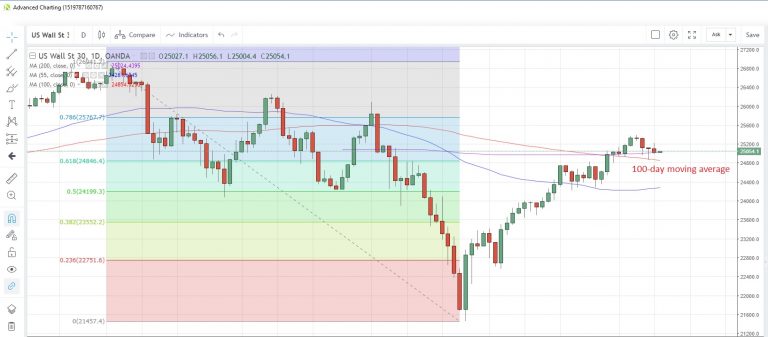
WTI fell more than 1% yesterday, but recovered into the close, as OPEC output curbs overcame doubts about the looming trade talks
WTI is holding above the 55-day moving average at $50.856, as it has since January 17 on a closing basis
Later today API releases weekly crude oil inventory data. The data has shown an increase in oil stockpiles for three consecutive weeks.
Markets Not Keen On A Deadlock Holiday
Markets not keen on a deadlock holiday
The markets were relatively quiet overnight as traders nervously awaited progress on many political fronts. Officials on both sides of the US-China trade talks expressed satisfaction with the progress thus far. The Republicans and Democrats made no progress though, appearing to be as far apart as ever ahead of Friday’s impending government shutdown. Brexit followers (who isn’t?) enjoyed a respite from the rhetoric overnight although the British pound sunk to monthly lows of 1.2860 following abysmal manufacturing data.
With political news broadly cancelling itself out, the US stock markets closed flat with the dollar remaining strong across the board. Gold fell on profit-taking along with oil as the energy markets fretted about slowing growth and over-supply concerns.
The global data calendar is very light today with China new loans this morning the highlight. A weak number could spark some short-term volatility as traders remain sensitive to headlines. Overall the street appears to be in wait-and-see mode.
FX
The US dollar continued to gently strengthen with GBP and EUR both suffering as poor data weighs on both. The EUR fell 50 points to 1.12785, just ahead of crucial daily support at 1.1265. The GBP fell another 100 points overnight to 1.2860 with significant support at 1.2825. The technical picture suggests more pain lies ahead for the GBP as the UK’s deadlock holiday seemingly drags on forever.
Other regional currencies will likely follow the Aussie and New Zealand dollars, which moved lower overnight due to their high beta to China. The Thai baht will remain under pressure and sits at 31.45 this morning. This follows the election commission, which came on the back of the King’s advice and barring his sister from running for Prime Minister at the April elections.
Stocks
US stocks had a sideways night with industrials standing out as the best performing sector. The optimism of the trade talks was offset by worries over the government shutdown. Asia will likely have a quiet session as the street awaits news from Beijing.
Gold
Gold fell seven dollars to USD1307.00 per ounce overnight in the face of a stronger US dollar. In the bigger picture, however, this appears to be a short-term move in the absence of other drivers. Gold continues to constructively consolidate its gains in a broader 1,300.00/1,320.00 range as it awaits a clearer political picture.
Oil
WTI and Brent had a volatile US session with both down nearly two percent at one stage before rallying to close almost unchanged. Oil was buffeted initially by a stronger dollar and oversupply fears before profit-taking set in.
WTI closed unchanged at $51.45 with significant support at $51.00 a barrel. Brent closed the worse of the two, down 50 cents at $61.60, reflecting its potential vulnerability to anti-OPEC legislation in the US.
Dollar Rises As Trade War Talks Get Under Way
FX – Dollar Rides Safe Haven Wave
The US dollar was higher across the board versus major pairs. US and Chinese officials kicked off a new round of talks to avoid increasing tariffs on March 1. Despite hopeful comments from both sides there has been little of substance that markets can digest as trade representative Robert Lightizer and Treasury Secretary Mnuchin will visit Beijing this week. Even if there is no grand agreement, a reduced tariff percentage could be a temporary solution as the two nations remain far apart in key issues.
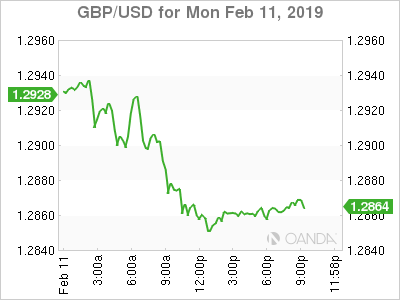
Sterling fell 0.58 percent as monthly GDP came in lower than expected with a loss of 0.4 percent and manufacturing production shrank 0.7 percent. Brexit remains a major factor as Prime Minister May still has to convince the EU to accept the amendments that were so contested in the UK. The EU said that there would be no changes to the agreement she already had, but as the March 29 deadline approaches some concessions will have to be made from both sides to avoid a hard Brexit.
OIL- Disruptions Balance Out Trade War Concerns
Oil prices pared losses from earlier in the session, but crude remain under pressure as the US-China talks get underway with some tension on the South China seas stealing some of the thunder. Last week US President Donald Trump said that he won’t meet his Chinese counterpart ahead of the March 1 deadline. Washington will remain a source of uncertainty as later this week the government shutdown will have to be addressed.
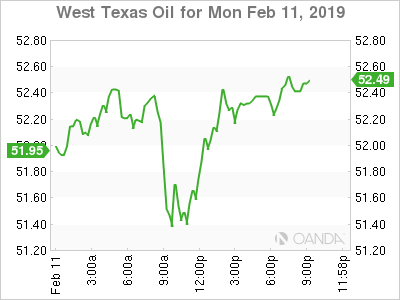
The trade war between the two largest economies has impacted global growth expectations. Until there is a positive breakthrough energy prices will keep dropping.
There have been positive comments from both sides, but until there are details ahead of the deadline to avoid increasing tariffs energy demand forecasts have more room to the downside.
Venezuela remains a factor as US sanctions have made heavier grades more expensive as US refiners look to purchase alternatives in the short term.
GOLD – Dollar Hogs Safe Haven Flows
Gold was flat on Monday as the US dollar got its mojo back and advanced on trade uncertainty as US negotiators travelled to Beijing. The greenback has shaken off some of the dovish pressure from the Fed and has now gained for 8 straight days.
Optimism for a US-China deal was offset by rising concerns that the Democrats and Republicans won’t find a compromise ahead of Friday’s deadline to avoid another government shutdown.
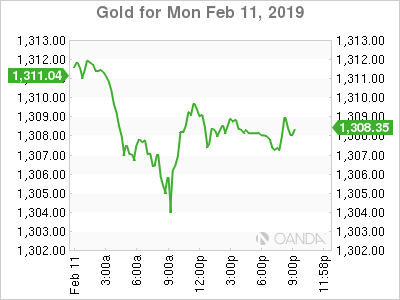
The dollar was also higher as European data revealed further signs of an economic slowdown. Brexit headlines combined with a disappointing British GDP and manufacturing as sterling dropped 0.58 percent.
STOCKS – US-China Talks Do Little to Dispel Uncertainty
Global stocks were mixed as investors returned from Lunar Year celebrations putting Chinese stocks higher. The US-China trade talks made it difficult for equities to end in positive territory and companies that had strong earnings were balanced out with tech firms who are struggling. Activision fell in anticipation of layoff reports as the company is said to focus on more mobile games.
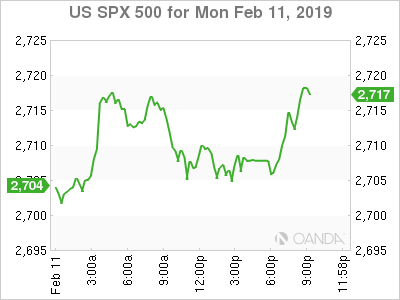
Recession fears have been pushed to the background after the Fed announced it would pause its tightening of monetary policy, but investors remain anxious after the drop in December. Uncertainty in Washington as the trade talks reassume and a middle ground remains elusive on border security with Democrats could have a negative impact on indices with the dollar the de facto safe haven.
GBPUSD Looks To Decline Further Lower Nearer Term
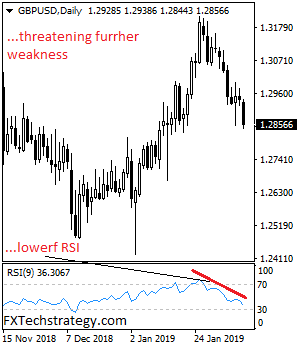
GBPUSD looks to decline further nearer term on bear pressure. Support is seen at 1.2800 level. Further down, support comes in at the 1.2750 level where a break will turn focus to the 1.2700 level. Further down, support lies at the 1.2650 level. Below here will set the stage for more weakness towards the 1.2600 level. On the upside, resistance stands at the 1.2900 with a turn above here allowing for additional strength to build up towards the 1.2950 level. Further out, resistance stands at the 1.3000 level followed by the 1.3050 level. On the whole, GBPUSD faces further downside pressure on more weakness.
Eco Data 2/12/19
[php_everywhere instance="1"]
US update: Dollar marches on, US stocks indecisive despite global rally
US stocks opened higher today but quickly turn mixed. Despite positive words from White House senior counselor Kellyanne Conway, investors see the result of US-China trade talk as highly uncertain. Also, sentiments could be weighed down by a report that Apple's iphone shipment to China dived -20% in Q4.
At the time of writing:
- DOW is down -0.13%
- S&P 500 is up 0.07%.
- NASDAQ is up 0.20%
- US 10-year yield is up 0.22 at 2.654.
In Europe:
- FTSE rose 0.87%.
- DAX rose 1.03%.
- CAC rose 1.09%.
- German 10-year yield is up 0.032 at 0.121.
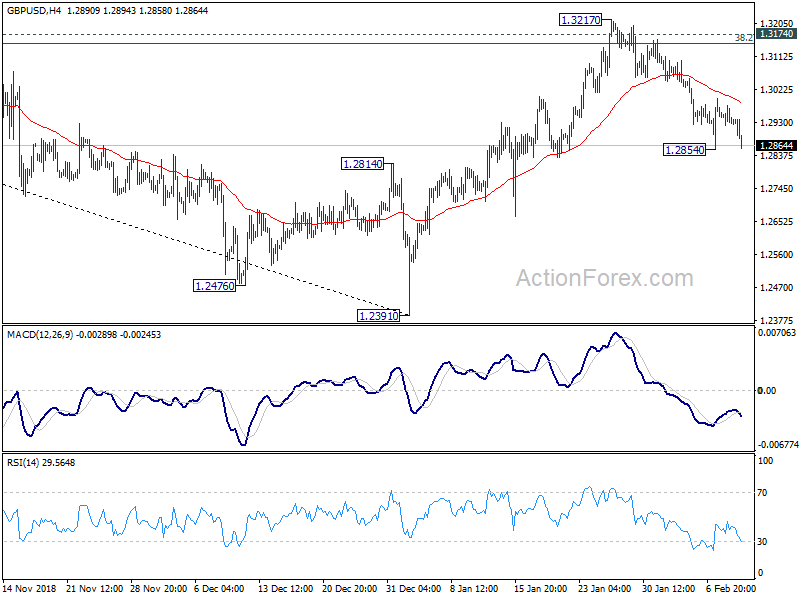
In the forex markets, Dollar is the strongest one for today and the strength is rather convincing. USD/CHF and USD/JPY resumed recent rise by taking out 1.0028 and 110.16 resistances earlier today. EUR/USD's break of 1.1289 support also argues that recent consolidation from 1.1215 low has completed. Focus will be on whether 1.2854 support in GBP/USD, 0.7060 support in AUD/USD and 1.3329 resistance in USD/CAD would be taken out before the end of the US session.
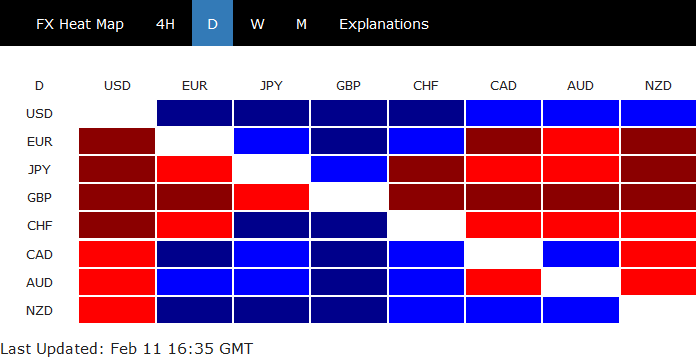
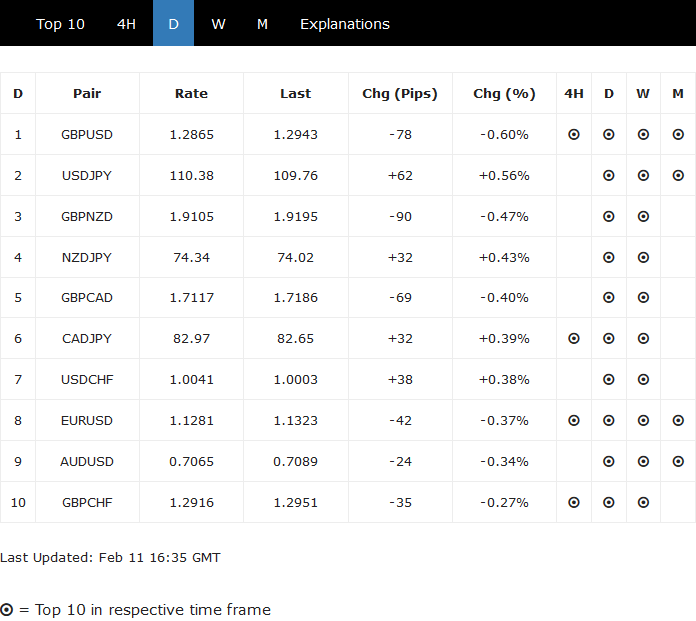
Meanwhile, Sterling is the weakest one after poor data today. UK GDP grew only 0.2% qoq in Q4, below expectation of 0.3% qoq. In December, GDP contracted -0.4% mom , much worse than expectation of 0.0% mom. Industrial and manufacturing production also missed expectations. Yen and Swiss Franc are next weakest, mainly because of rebound in Asian and European stock markets.
GBP/USD is the top mover for today so far, but USD/JPY is not that far away. We're holding on to the view that rebound from 1.2391 has completed at 1.3217 already. Break of 1.2854 will affirm this bearish case and pave the way to retest 1.2391 low.
Aussie and Kiwi Outlook: Storm Clouds Gathering?
Both the Australian and New Zealand dollars have seen the wind leave their sails lately, amid mounting speculation that their respective central banks will cut rates soon, and as investors started having second thoughts about a US-China trade deal. Examining the landscape for each economy, the case for looser policy in New Zealand seems much clearer than in Australia, though market pricing currently implies roughly equal odds for a rate cut in both. This suggests that the risks surrounding aussie/kiwi may be skewed to the upside.
RBA to bide its time, rate-cut speculation may be premature
The aussie posted decent gains to start the year, supported by encouraging signals in the US-China trade talks. Australia is an open economy that relies on commodity exports, so its currency is quite sensitive to the global trade outlook. Not to mention that China is Australia’s largest export and import partner. The close ties between the two imply that developments in China tend to be reflected in Australia over time, so the aussie is considered a “liquid proxy” for China plays.
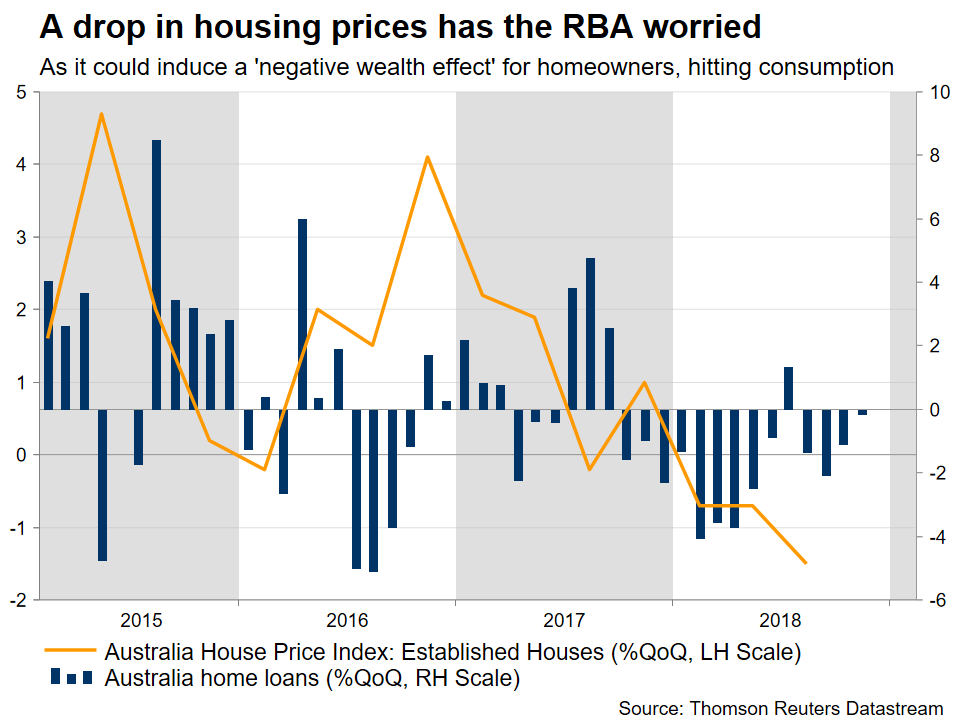
However, this optimism around the aussie came to a screeching halt last week, after Reserve Bank of Australia (RBA) Governor Philip Lowe walked back on some of his previous rhetoric that the next move in interest rates would probably be higher, indicating instead that he now sees even chances for either a rate hike or a rate cut. He provided several reasons for this shift. Trade tensions are still casting a shadow, growth in China is slowing, and Australia’s housing market is cooling, which may spill over into weaker consumption via a negative wealth effect for homeowners.
Markets took these as a signal the RBA may be ‘laying the groundwork’ for a rate cut, with the implied probability for such an action this year surging to 85%, sending the aussie into a tailspin. Nonetheless, this looks as somewhat of an overreaction, with the information available today at least. Firstly, the cooling in the housing market was necessary and engineered by the RBA itself, as prices were previously soaring, threatening financial stability.
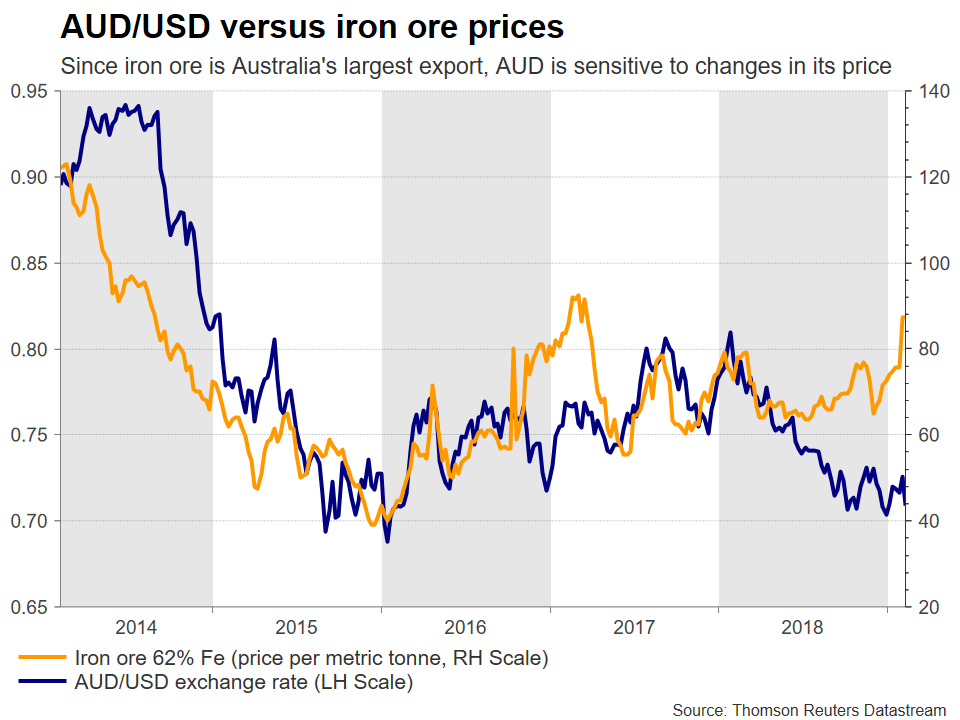
Secondly, the economy is still in a good shape, with the RBA’s latest forecasts projecting above-trend growth this year and Australia’s biggest export in iron ore seeing its price soar lately. Third, it’s an open question how much further China will slow. Authorities there have opened the stimulus taps – both monetary and fiscal – to counter the slowdown, so that could keep a ‘floor’ under growth. Finally, both the US and China still seem eager to reach a trade deal, though that may not happen until well into the middle of the year.
 To be clear, all the above don’t necessarily imply that the RBA won’t cut rates. It well might, but for that to happen it would probably take a further deterioration in economic conditions. This suggests that the elevated probability for a rate cut may be premature (for now), and that the Bank may instead opt to remain on hold throughout the year – unless the economy takes a sharp turn lower.
Therefore, in the scenario that the Bank indeed takes no action this year, the aussie may manage to recover towards the latter half of the year. That said, the near-term direction will depend on how the trade saga plays out and how quickly China stabilizes, so some more pain may well lie in store before the currency can recover. Particularly in light of Australian federal elections coming up in May, which could add another headwind for the aussie by raising uncertainty. In other words, short-term pain but perhaps long-term gain, for the Australian currency.
Yet, the RBNZ does seem poised to ease eventually
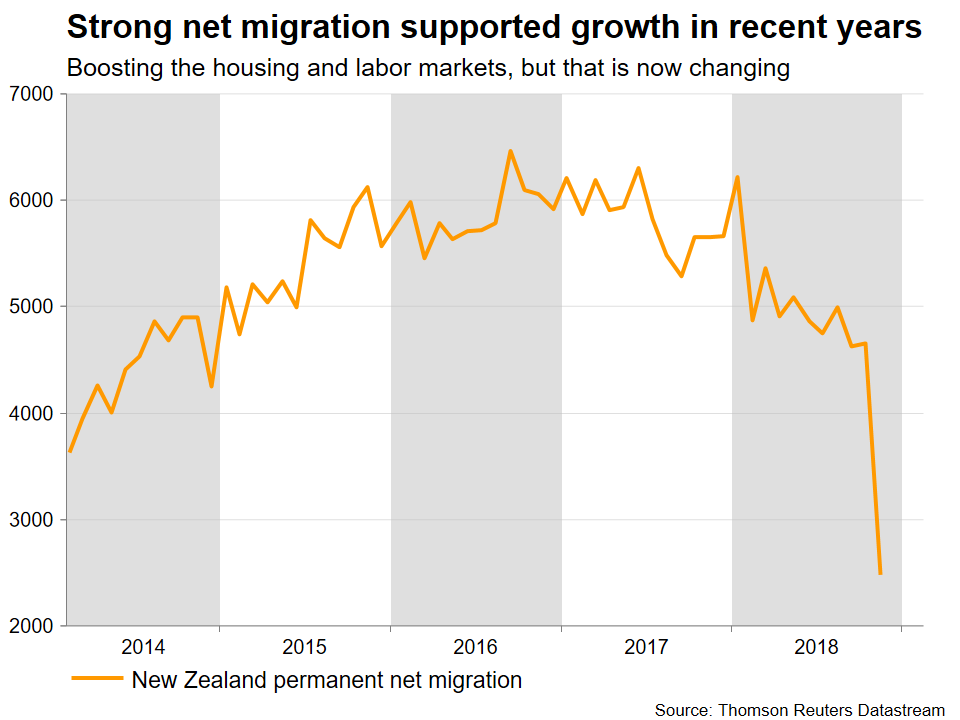
Across the Tasman sea, New Zealand’s economy has been losing momentum. Growth was weaker than expected in Q3 2018 as tanking business confidence held back investment, and the available data for Q4 suggest the softness hasn’t abated. Another factor has been a major slowdown in net migration, which will likely continue to limit construction spending and consumption, and by extent, broader growth. Of course, there’s an array of external risks too, with trade tensions and the global economic slowdown topping the list.
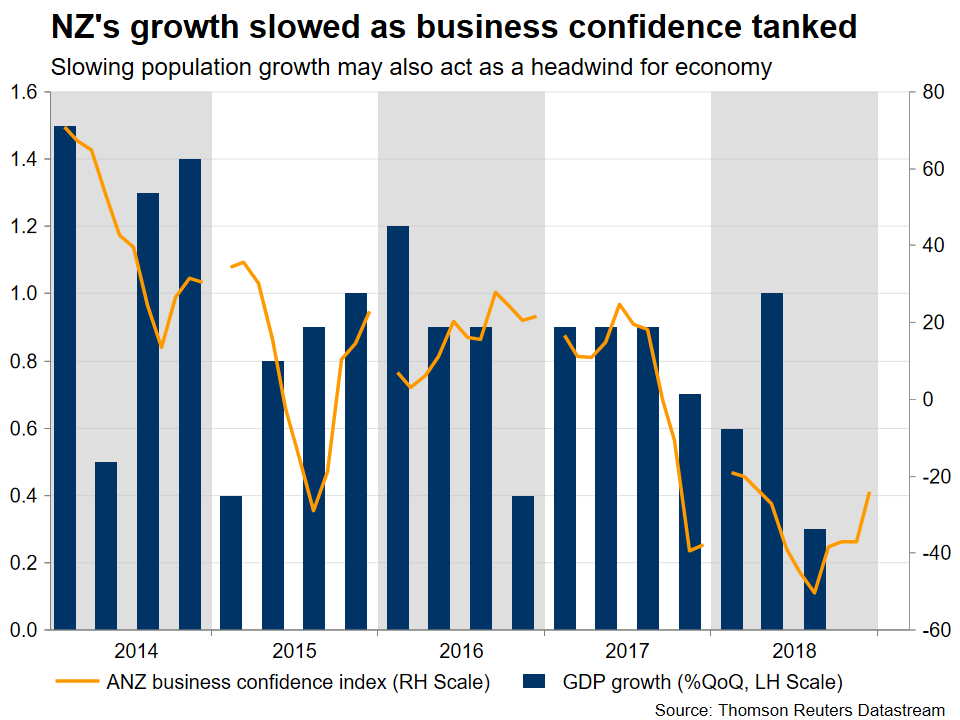
Yet, the kiwi held up rather well in the midst of all this, supported by hopes that the US-China talks could bear fruit and rising prices for dairy products, which constitute New Zealand’s largest export category. As for the Reserve Bank of New Zealand (RBNZ), it has been in a neutral ‘the next rate move could be either up or down’ mode for almost a year now, in the context of waning growth. Markets seem confident that the next move will be down though, assigning an 86% probability for such an action this year, which seems to accurately encompass the outlook.
Besides plenty of signs that growth may remain sluggish, ranging from still-subdued business confidence to slowing population growth to signs of cooling in the labor and housing markets, there’s another factor arguing for a rate cut down the road. The RBNZ recently announced plans to raise the capital requirement ratios for commercial banks. This will be a slow process, but it suggests financial conditions will ultimately tighten and that banks may start charging borrowers slightly more. By extent, that could limit lending and dampen economic activity, implying the central bank could try to offset these negative effects by lowering its own interest rate. At the least, this would be yet another factor arguing in favor of a cut.
Blending it all together, the RBNZ seems to be facing a variety of domestic risks, though just like with Australia, much will also hinge on the trade picture and China’s growth. Having said that, the case for looser monetary policy in New Zealand seems much stronger than in Australia currently. Attesting to this, the RBNZ has been saying that rates can move in both directions for a year now, while the RBA only said as much last week.
So, not only does it seem more likely that the RBNZ could cut rates overall, but if the external environment deteriorates enough to cause both central banks to ease, any cut may also come sooner in New Zealand. Other things equal, this implies that the risks surrounding the aussie/kiwi pair may be tilted to the upside going forward.

Technically, initial resistance to advances in aussie/kiwi may be found near 1.0535, with an upside break opening the way for a test of the January 9 highs at 1.0635. On the flipside, preliminary support to declines may be met around 1.0450, an area which capped several declines in recent months. Even lower, the February 6 lows at 1.0395 may attract attention.
MARKET WRAP: European Markets Closed Higher on Trade Optimism
There was a complete shift in the market sentiment today because of the growing optimism about a possible solution on trade war between the US and China.
Stocks
- The S&P 500 Index jumped 0.3 percent on the back of the trade hopes as of 15:31 London time.
- The Nasdaq 100 soared 0.5 percent and the Dow Jones Industrial Average also added to its yearly gains by 0.4 percent.
- The Stoxx Europe 600 Index moved higher by 0.8 percent.
- Germany’s DAX Index jumped 0.9 percent.
- The MSCI Emerging Market Index followed other market and moved up by 0.1 percent.
Currencies
- The Dollar Spot Index still moving higher despite dovish stance by the Fed and jumped 0.4 percent, hitting its peak in almost six weeks.
- The Euro dropped again and added more lossed today. It fell by 0.1 percent to $1.1309.
- The British pound was hammered on the back of the feeble economic data and plunged by 0.4 percent to $1.2898, the lowest level in three weeks.
- The Japanese yen lost more ground today and dropped by 0.6 percent to 110.36 per dollar.
Bonds
- The yield on 10-year Treasuries jumped two basis points to 2.66 percent, breaking its consecutive days of losses in a week.
- Germany’s 10-year yield still very volatile and moved higher by three basis points to 0.11 percent.
- Britain’s 10-year yield is highly sensitive to to Brexit news and moved up by three basis points to 1.18 percent.
Commodities
- West Texas Intermediate crude still out of luck because of lack of demand and dropped 0.7 percent to $52.34 a barrel, the weakest point in two weeks.
- Gold cant find its shine and dropped further again today by 0.7 percent to $1,305.09 an ounce, the lowest level in two weeks.
Japanese Yen Slips as Services Report Contracts
USD/JPY has started the trading week with considerable losses. In Monday’s North American session, the pair is trading at 110.42, up 0.60% on the day. On the release front, it’s quiet start to the week. Japanese Tertiary Industry Activity dropped 0.1%, its third decline in fourth months. On Tuesday, Japan releases Preliminary Machine Tool Orders and PPI. The U.S. releases JOLTS Jobs Openings and Federal Reserve Chair Powell speaks at an event in Washington.
Japan is heavily reliant on trade with the U.S. and China, so the U.S-China trade war remains a significant concern for policymakers. Although the sides are talking, markets slipped after President Trump that he would not hold a meeting with President Xi prior to the March 2 deadline, when the U.S. is set to impose further tariffs if the sides fail to reach a deal. A third round of negotiations starts this week, with Treasury Secretary Mnuchin joining the talks later in the week. Still, with no signs of progress, there is growing alarm that the sides will not be able to reach a deal by March 2.
Japanese Prime Minister Shinzo Abe and the Bank of Japan have come under fire over inflation levels, which have stubbornly remained well below the target of 2.0%, despite the BoJ’s ultra-loose monetary policy. Spoiler alert – the bank won’t be making changes in monetary policy anytime soon. Last week, Abe defended the policy, saying it had helped create jobs and had benefited the economy. For its part, the BoJ has said that the inflation target remains elusive due to weak oil prices and the public’s deflationary mindset. Abe said that he “accepts” the BoJ’s explanation. In January, the BoJ maintained its monetary policy, but lower its inflation forecast, warning that protectionism and softer global demand posed significant risks to the Japanese economy.
GBP/USD Outlook: Cable Breaks Below 1.29 Pivots; Weak UK Data Added to Negative Sentiment
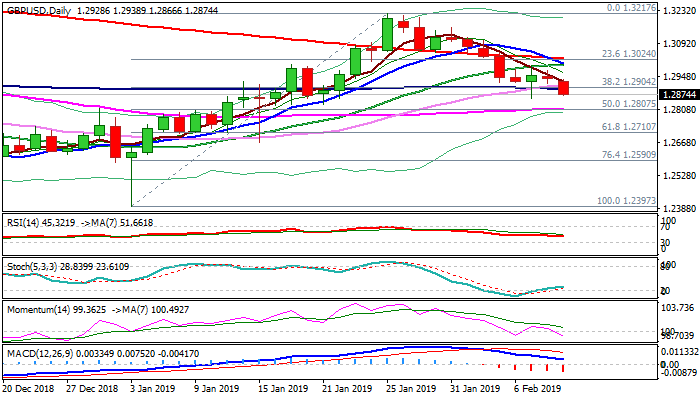
Cable remains at the back foot in early American trading on Monday and probes below pivotal 1.29 support zone, after weak UK data further soured the sentiment.
Sterling entered the third week deeply in red, pressured by Brexit concerns and stronger dollar, with downbeat UK GDP data today, adding to bearish sentiment.
Data showed that Britain's economy slowed significantly in the last quarter of 2018, mainly due to Brexit fears.
Q4 GDP showed that quarterly rate of growth slowed to 0.2% vs Q# growth of 0.6% and also undershooting 0.3% forecast.
Other data released today, also showed negative figures (IP Dec -0.5% vs 0.1% f/c and Manufacturing Production Dec -0.7% vs 0.2% f/c).
The data showed strong concerns about disorderly Brexit after UK PM May's divorce plan agree with EU was voted down in parliament, less than two months before the UK's final exit.
Further weakness could be anticipated on firm break below 1.29 handle that would offer fresh negative signal and accelerate bears for test of Fibo 50%/55SMA supports at 1.2809/07 and daily cloud top at 1.2786.
Res: 1.2893; 1.2904; 1.2938; 1.2998
Sup: 1.2854; 1.2830; 1.2807; 1.2786