Sample Category Title
GBPUSD Under Downside Pressure
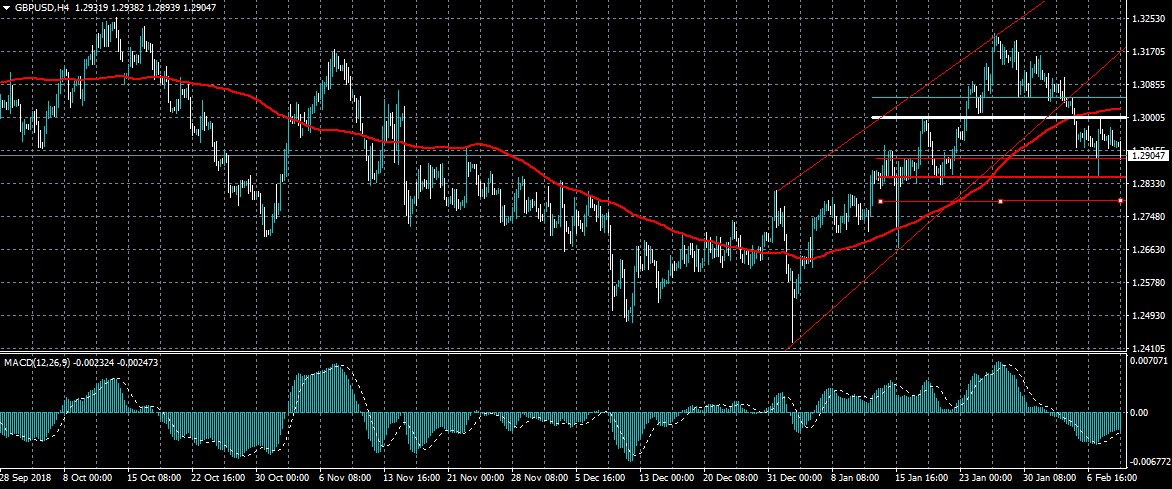
The British pound is under downside pressure against the US dollar after the United Kingdom economy released much weaker than expected GDP number this morning. If sellers can break the 1.2890 support level, a further decline towards the 1.2780 level appears possible. If buyers can defend the 1.2890 support region, the GBPUSD pair could bounce back towards the 1.2950 technical region.
The GBPUSD pair is heavily bearish while trading below the 1.2890 level, key technical support is found at the 1.2850 and 1.2780 levels
If the GBPUSD pair holds above the 1.2890 level, buyers may test towards the 1.2930 and 1.2950 levels.
Gold Reverses Down But Remains Above 1300
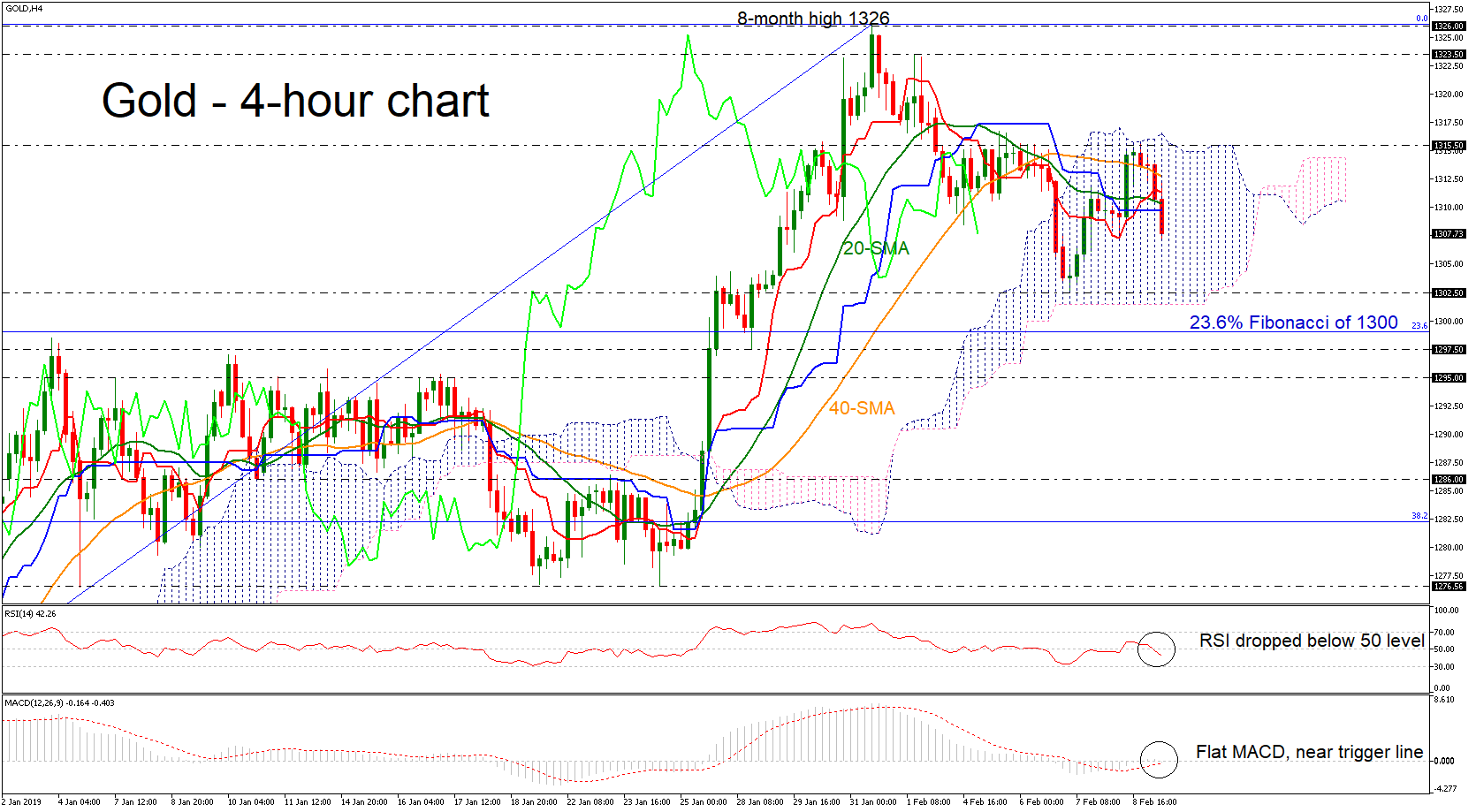
Gold has come under renewed selling pressure over the last couple of 4-hour sessions, dropping below the 20- and 40-simple moving averages (SMAs) with strong momentum. Also, the price slipped below the Kijun sen and Tekan sen lines, supporting the bearish view, while the RSI indicator plunged into the negative zone. On the other hand, the MACD oscillator is flattening near the zero line.
In case of further declines the price could challenge the 1302.50 support, taken from the low on February 7 before retesting the 23.6% Fibonacci retracement level of the upleg from 1211 to 1326, around 1300. Marginally below this strong line, the 1297.50 support could act as significant obstacle for the bears.
To the upside, if the price climbs above the Ichimoku cloud and the SMAs, it could hit the 1315.50 resistance. A bullish action even higher could drive yellow metal towards the 1323.50 resistance, identified by the peak on February 1.
Overall, gold prices reversed back to the downside following the bounce off the eight-month high of 1326 at the end of January, maintaining a bearish correction mode.
King Dollar
Monday February 11: Five things the markets are talking about
Equities are small better bid in the euro session following a mixed session in Asia that sees a holiday shorten trading week in Japan.
The ‘big’ dollar remains dominate for an eight consecutive session where again Sino-U.S trade talks and Brexit discussions top investors agendas. Chinese Vice Premier Liu He will join U.S Treasury Secretary Mnuchin and trade representative Lighthizer in Beijing for high-level trade talks this week.
In the U.K, PM Theresa May is seeking more time to renegotiate Brexit talks, while stateside, another U.S government shutdown over funding remains very much on the agenda.
Crude oil and gold are a tad softer on a stronger greenback whilst sovereign yields are little changed.
On tap: Mid-week, eurozone data this week (Feb 13 & 14) will be watched for any recessionary clues. On Tuesday (Feb 12) RBNZ will hold its first meeting of the year and ‘dovish’ talk will be sought, while Sweden’s Riksbank is expected to keep interest rates on hold Wednesday (Feb 13). Elsewhere, GBP inflation, CAD trade balance, USD GDP, inflation & retail sales, USD PPI (Feb 14), GBP & USD retail sales (Feb 15).
1. Stocks mixed results
Note: Japan was closed for a national holiday.
Down-under, Aussie stocks retreated overnight, as a rally in resource stocks was offset by declines in financials and healthcare equities. The S&P/ASX 200 index closed down -0.2%, while in S. Korea, the Kospi index closed +0.17% higher.
In China, regional bourses played catch-up after a week-long Lunar New Year holiday break. Gains came as the commerce ministry indicated that retail earnings during holiday season would increase by +8.5% y/y, and this despite domestic growth being under pressure. At the close, China’s blue-chip index rallied +1.6% while Shanghai’s composite climbed +1.2%.
In Hong Kong, at the close of trade, the Hang Seng index was up +0.7%, while the Hang Seng China Enterprises index gained +0.6%.
In Europe, regional bourses trade higher across the board after a flat close stateside on Friday and a mixed session in Asia.
U.S stocks are set to open in the ‘black’ (+0.36%).
Indices: Stoxx600 +0.94% at 361.52, FTSE +0.94% at 7,140.25, DAX +0.97% at 11,012.55, CAC-40 +1.06% at 5,014.06, IBEX-35 +1.07% at 8,952.00, FTSE MIB +1.47% at 19,635.50, SMI +0.86% at 9,078.00, S&P 500 Futures +0.36%
2. Oil prices lower on higher U.S rig count, gold unchanged
Oil prices are starting the week under pressure as data Friday showed that drilling activity in the U.S picked up and a refinery fire stateside (in Illinois on Sunday) has resulted in the shutdown of a large crude distillation unit. Also, global growth worries are also helping to curb fuel demand.
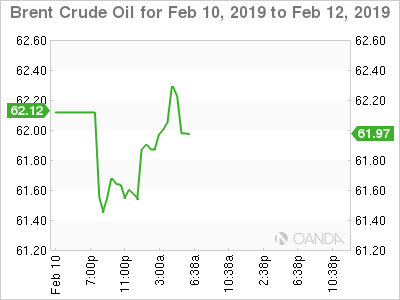
Brent crude oil futures are down -27c, or -0.4%, at +$61.83 a barrel, while West Texas Intermediate (WTI) crude futures are at +$52.17 per barrel, down -55c, or -1% from Friday’s close.
In the U.S, Baker Hughes data Friday showed that energy firms last week increased the number of oil rigs operating for the second time in three weeks. Companies added seven oil rigs in the week to Feb. 8, bringing the total count to 854 – this would suggest an increased rise in U.S crude production.
And another factor weighing on oil prices this month has been a stronger U.S dollar.
Ahead of the U.S open, gold prices are little changed, supported mostly by uncertainties around the Sino-U.S trade war and concerns of slowing global economic growth, while a strong U.S dollar weighs on the ‘yellow’ metal. Spot gold is steady at +$1,308 per ounce, while U.S gold futures are also firm at +$1,312 per ounce.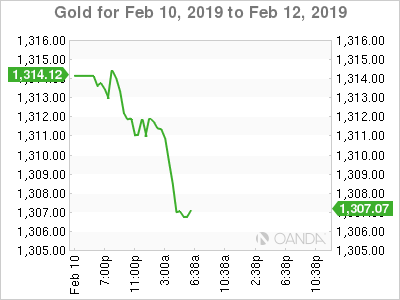
3. Sovereign yields remain low
Safe-haven government bonds have benefited the most on growing investor anxiety over the global outlook, with German and Japanese debt yields falling to their lowest in over two-years.
Germany’s 10-year Bund yield is just +8 bps away from “zero” percent. Analysts note that its “now in territory that reflects dire concern about economic conditions.” The yield fell as low as +0.77% on Friday, its lowest since October 2016, reflecting dire concern in bond markets about economic conditions.
Despite weaker eurozone growth data and inflation the prospect of another U.S government shutdown and continuing Brexit discussions are also weighing on investors risk appetite.
Elsewhere, the yield on U.S 10-year Treasuries has backed up +1 bps to +2.64%, the first advance in a week, while in Italy the 10-year BTP yield has gained +2 bps to +2.983%, hitting the highest in two-months with its fifth consecutive advance.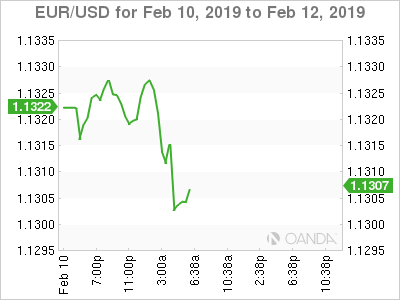
4. King dollar
The EUR (-0.17% at €1.1300) starts the week a tad softer and is currently testing the lower end of its €1.1300-€1.1500 trading range. With increasing talk of a slowdown in Europe the markets focus will be on German data on Feb 14 – just how bad are things in the eurozone’s biggest economy?
GBP/USD is softer by -0.3% at £1.2897 with the continued Brexit issues remaining ‘front and center.’ The market expects PM Theresa May to request more time before she puts her deal to a fresh vote in Parliament while she has more talks with the E.U. The pound has also come under pressure from this morning’s weaker U.K data – Q3 preliminary GDP, Dec. production data and Dec. trade balances all missing expectations.
Note: If there was no fresh meaningful vote by February 27th then PM would allow Parliament to vote on alternatives.
USD/JPY trades above the psychological ¥110 level at ¥110.20 as the market begins the week with a more optimistic outlook of the upcoming US-China trade talks.
Note: CHF recreated a “mini-flash” crash at the start of Asian session overnight, supported mostly by the Japan holiday causing an illiquid trading session.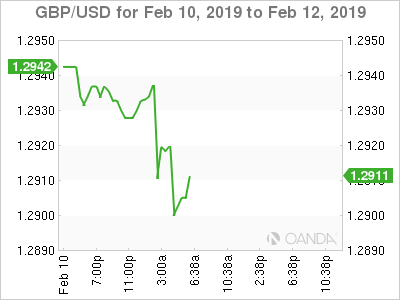
5. U.K economy slowed in 2018
Data this morning showed that the U.K economy slowed in 2018 as businesses slashed investment because of the growing uncertainty about the U.K’s exit from the E.U.
Note: The BoE has warned that the economy could fall into recession due to a disorderly exit.
The ONS said the U.K.’s GDP was +1.4% higher in 2018 than in 2017, the weakest expansion in seven-years. They noted that the economy slowed more sharply in Q4, with GDP rising at an annualized pace of +0.7%, down from +2.5% in Q3. In December alone, GDP fell by -0.4% from November.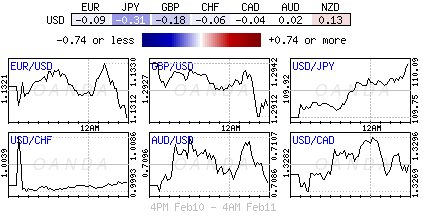
Swiss Negative Rates Will Remain
The Swiss economy remains robust and Swiss companies are optimistic, with order backlogs, stable employment and high capacity utilization. Inflation was quiet in January, with headline consumer prices +0.60% and -0.30% in yearly and monthly terms. Overall prices advanced 0.50% annually (prior: 0.30%), the highest jump since August 2018. Currently trading at 1.0027, USD/CHF is expected to head along 1.0030 short-term. We don’t see the Swiss National Bank putting an end to its negative interest rate policy for a while.
Indeed, the Swiss economy remains resilient while its main client, the EU, is facing severe downgrades in growth outlook. Italy’s central bank, for instance, recently slashed its GDP forecast for 2019 from 1% to 0.60%. The announcement caused the revolt of Italy’s coalition government, including leaders from Lega and Five Star Matteo Salvini and Luigi Di Maio, who condemned the statement and threatened to remove the bank’s independence.
Futures Higher As Trade Talks Resume
It's shaping up to be another big week for the US, with the government on the verge of another shutdown and trade talks continuing with China.
This week the US team will travel to Beijing for what is increasingly looking like deal-saving negotiations. An acknowledgement from Trump that no meeting is planned with Xi later this month has been widely taken as a signal that a deal is unlikely to be achieved, with best hopes now being that enough progress is made to warrant an extension to the deadline and avoid further tariffs. An agreement was always going to be very difficult within the 90 day period so if an extension is agreed on the back of promising progress then it's still encouraging.
It's the negotiations at home where Trump appears to be making the least progress, as Democrats refuse to back down on funding for the border wall. With the blame for the previous shutdown having been levied at the President, the Democrats will likely feel comfortable seeing this through. Trump has been very good at the PR side of politics previously but this may be a challenge too far.
The pound finds itself back in negative territory this morning following a raft of poor economic data, which comes as the country prepares to exit the European Union. The uncertainty caused by the exit – more specifically, the lack of a deal – has quite clearly taken its toll. Unlike the last couple of years, the rest of the world around the UK is also going through a challenging period and so there’s nothing to paper over the cracks.
Growth in the final quarter was very soft, bringing the annual rate of GDP to only 1.3%. This includes a dreadful December, when the economy contracted by 0.4% from a month earlier. Despite this, the UK is not yet facing recession like Italy or the possibility of one like Germany. The first quarter could be weak again though and business investment – which contracted by 3.7% year on year in Q4 – is likely going to be a big contributor to this.
It’s another big week for the UK, with another Brexit vote in Parliament later in the week – albeit not on Theresa May’s deal which is still being negotiated in Brussels. This will likely leave us with a series of indicative votes on various amendments, including further attempts to delay exit day, among other things. There’s also a lot more data to come this week as well as another appearance from BoE Governor Mark Carney on Tuesday.
The pound is off around 0.4% against the dollar but this is partly being driven by the greenback itself which continues to be well supported in the face of struggling negotiations with China. Gold’s rally is continuing to stall on the back of the dollar’s resurgence although we are seeing some strong resilience, with the yellow metal holding above $1,300 having not really properly tested it yet.
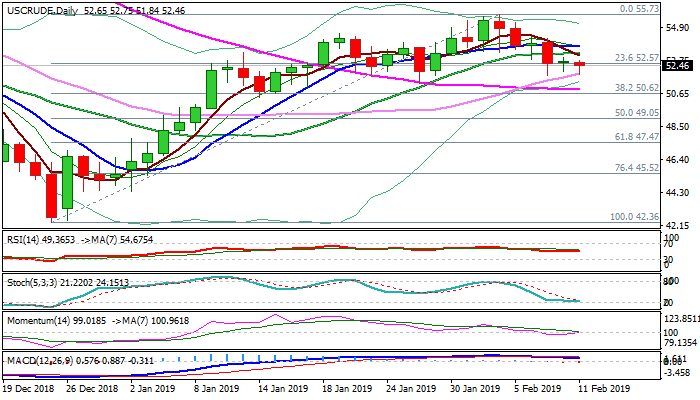
WTI Oil Outlook: Bears Face Headwinds But Weekly Bearish Engulfing Weighs
WTI oil started week in negative mode after Friday’s report showed increase of numbers of US oil rigs which adds to existing concerns over global growth slowdown and oversupply.
However, the downside attempts were so far limited by rising 30SMA (currently at $51.94), with downside rejections seen last Thu/Fri and today’s bounce from 30SMA) generating initial signal that bears might be running out of steam.
Rising daily momentum supports scenario and may keep the downside protected for some time, but more work at the upside is needed to neutralize existing downside risk.
Break above 20/10 SMA’s ($53.30 and $53.69 respectively) is needed to activate reversal scenario and shift near-term focus higher.
On the other side, last week’s close in red and formation of weekly bearish engulfing weighs, however, fresh bears need clear break below 200WMA ($52.33) to generate stronger bearish signal and expose supports at $50.90 (55SMA) and $50.62 (Fibo 38.2% of $42.36/$55.73 ascend), loss of which would spark stronger weakness.
Res: 52.98, 53.30, 53.69, 54.28
Sup: 51.94, 51.32, 50.90, 50.62
AUD/USD Outlook: Slight Optimism On US/China Talks Keeps The Pair Above 0.7070 Pivot, But The Downside Remains Vulnerable
The Aussie holds within tight range and directionless mode, just above pivotal support at 0.7070 (Fibo 38.2% of 0.6706/0.7295 rally) which was cracked on Friday.
Slight bid tone in early Monday is marked by rising momentum and stochastic turning north in oversold zone, as well as on comments of Trump / Xi meeting next month, which maintains slight optimism.
With no signs of recovery, the downside remains vulnerable and risks firm break below 0.7070 pivot that would open daily cloud top at 0.7050 and psychological 0.70 support (also 50% retracement and near daily cloud base) in extension.
Falling 5SMA marks initial resistance at 0.7120, however, lift above a cluster of daily MA’s (0.7150/74) is needed to signal reversal.
Res: 0.7120, 0.7150, 0.7174, 0.7245
Sup: 0.7070, 0.7050, 0.7000, 0.6931

Bank of France: GDP to growth 0.4% in Q1
Bank of France said today that according to the monthly index of business activity (MIBA), the country's GDP is expected to grow 0.4% qoq in Q1 this year.
The business sentiment indicator in manufacturing dropped to 99 in January, down from 102. in December. Services indicator dropped to 100, down from 101. Construction indicator was unchanged at 105.
Also, BoF said for February, Business leaders expect industrial production to pick up, service sector activity to accelerate and construction sector activity to continue to grow.
ECB de Guindos: Wage growth increasingly broad-based, inflation to rise over medium term
ECB Vice President Luis de Guindos sounded confidence in his comemnts on inflation today. He sid that "wage growth has become increasingly broad-based in recent years."
And, "this, together with our monetary policy measures and the ongoing economic expansion, is expected to translate into higher underlying inflation over the medium term."
NZD/USD Potential Breakout
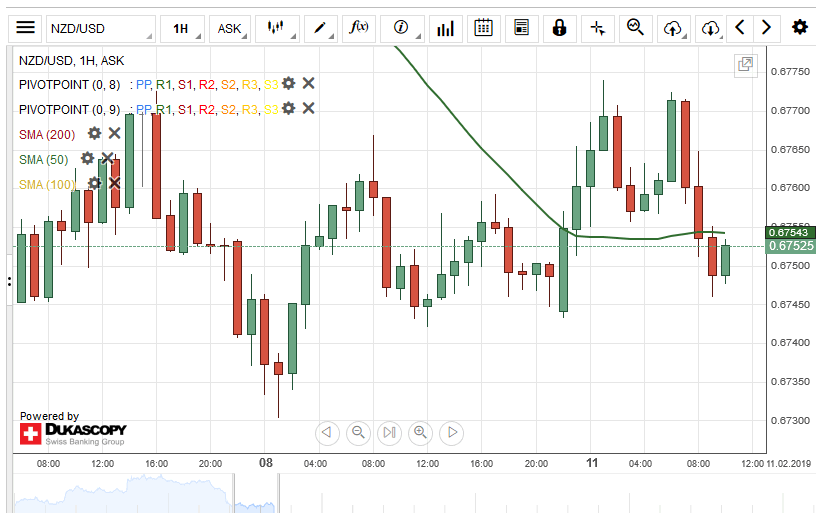
The New Zealand Dollar has been moving in a horizontal channel pattern against the US Dollar. The currency pair tested the lower boundary of the channel pattern at 0.6733 on Friday.
Technical indicators demonstrate that the currency exchange rate is likely to edge lower within this session. If this technical sentiment is correct, a breakout through the lower boundary of the horizontal channel pattern could be expected within this session.
Although, the NZD/USD exchange rate could reverse from the current price level and aim for a resistance cluster at 0.6795.