

Sample Category Title
Switzerland’s Consumer Price Inflation Slowed In January
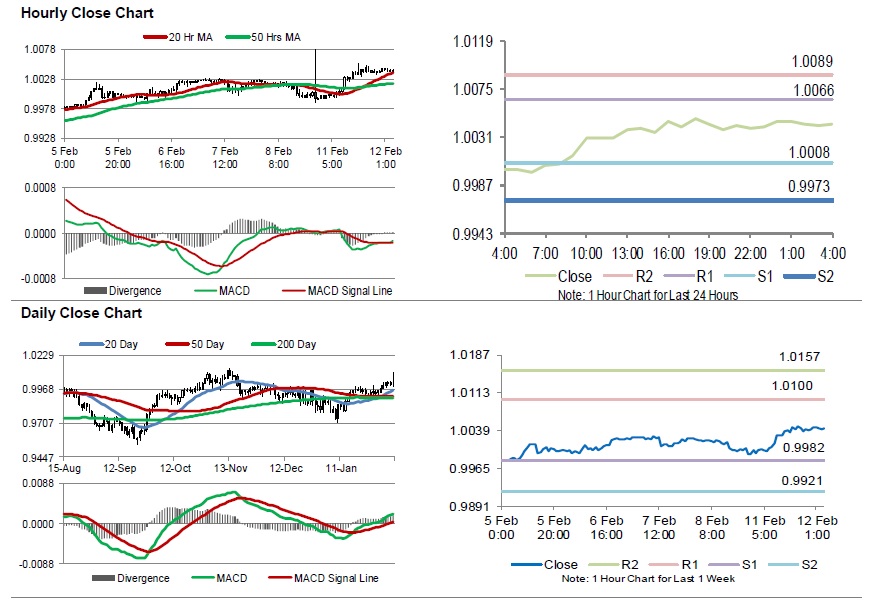
For the 24 hours to 23:00 GMT, the USD rose 0.41% against the CHF and closed at 1.0041.
In economic news, Switzerland's consumer price inflation (CPI) slowed for a third consecutive month to 0.6% on an annual basis in January, meeting market expectations. The CPI had recorded a rise of 0.7% in the previous month. Moreover, the nation's total sight deposits slightly rose to a level of CHF576.24 billion in the week ended 08 February, from CHF576.20 billion in the previous week.
In the Asian session, at GMT0400, the pair is trading at 1.0043, with the USD trading marginally higher against the CHF from yesterday's close.
The pair is expected to find support at 1.0008, and a fall through could take it to the next support level of 0.9973. The pair is expected to find its first resistance at 1.0066, and a rise through could take it to the next resistance level of 1.0089.
The currency pair is showing convergence with its 20 Hr moving average and trading above its 50 Hr moving average.
Loonie Reverses Its Losses In The Asian Session
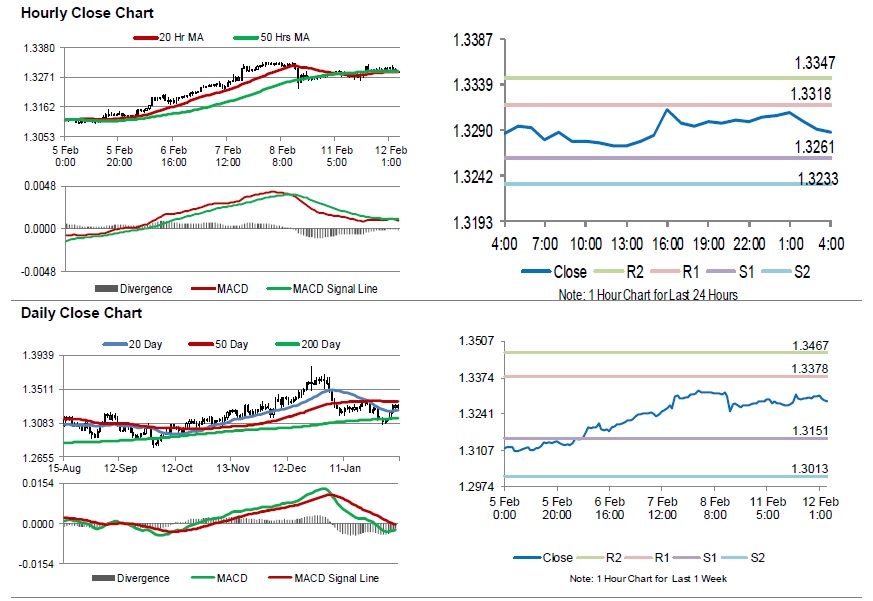
For the 24 hours to 23:00 GMT, the USD rose 0.13% against the CAD and closed at 1.3304.
In the Asian session, at GMT0400, the pair is trading at 1.3289, with the USD trading 0.11% lower against the CAD from yesterday’s close.
The pair is expected to find support at 1.3261, and a fall through could take it to the next support level of 1.3233. The pair is expected to find its first resistance at 1.3318, and a rise through could take it to the next resistance level of 1.3347.
In absence of key economic releases in Canada today, investor sentiment would be determined by global macroeconomic events.
The currency pair is showing convergence with its 20 Hr and 50 Hr moving averages.
Australia’s NAB Business Confidence Index Advanced In January
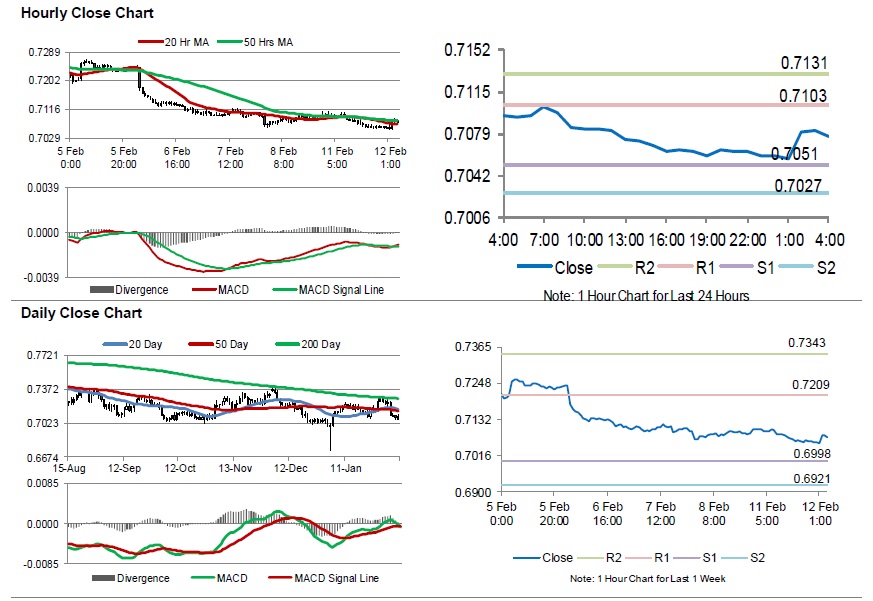
For the 24 hours to 23:00 GMT, the AUD declined 0.55% against the USD and closed at 0.7060.
LME Copper prices declined 1.0% or $59.0/MT to $6148.0/MT. Aluminium prices declined 0.9% or $17.0/MT to $1848.0/MT.
In the Asian session, at GMT0400, the pair is trading at 0.7076, with the AUD trading 0.23% higher against the USD from yesterday's close.
Overnight data indicated that Australia's NAB business conditions rose to a level of 7.0 in January, following a level of 2.0 in the previous month. Furthermore, the nation's NAB business confidence index advanced to a level of 4.0 in January, compared to a reading of 3.0 in the preceding month. On the other hand, home loan approvals recorded a more-than-expected drop of 6.1% on a monthly basis in December. In the previous month, home loan approvals had registered a drop of 0.9%.
The pair is expected to find support at 0.7051, and a fall through could take it to the next support level of 0.7027. The pair is expected to find its first resistance at 0.7103, and a rise through could take it to the next resistance level of 0.7131.
Looking forward, traders would await Australia's Westpac consumer confidence index for February, slated to release overnight.
The currency pair is trading above its 20 Hr moving average and showing convergence with its 50 Hr moving average.
White House Conway: Trump wants to meet Xi very soon
Mid-level trade negotiations between US and China continue in Beijing today. That's supposed to lead up to high level meeting between USTR Robert Lighthizer, Treasury Secretary Steven Mnuchin and Chinese Vice Premier Liu He on Thursday and Friday. So far, little news is reported regarding the actual talks. It's believed that the teams are only in the stage of drafting a common document that addresses the issues. But they're still struggling to find concrete ways on the main issue, enforcement of the agreement.
White House adviser Kellyanne Conway said yesterday that Trump "wants to meet with President Xi very soon." She added that This president wants a deal. He wants it to be fair to Americans and American workers and American interests." Also, Trump has "forged a mutually respectful relationship with President Xi," and "they will meet again soon." However, Conway also noted that no deal will be final until the Trump-Xi meeting happens.
As the March 1 trade truce deadline is approaching, time is running out for the talks. It's reported that an option for the US is to extend the period. However, to maintain pressure on China and urgency on the negotiations, any extensions won't be open-ended. And based on unnamed sources, the US side intend not to let the Trump-Xi meeting slip much past end of March.
Yellow Metal Trading Slightly Lower In The Morning Session
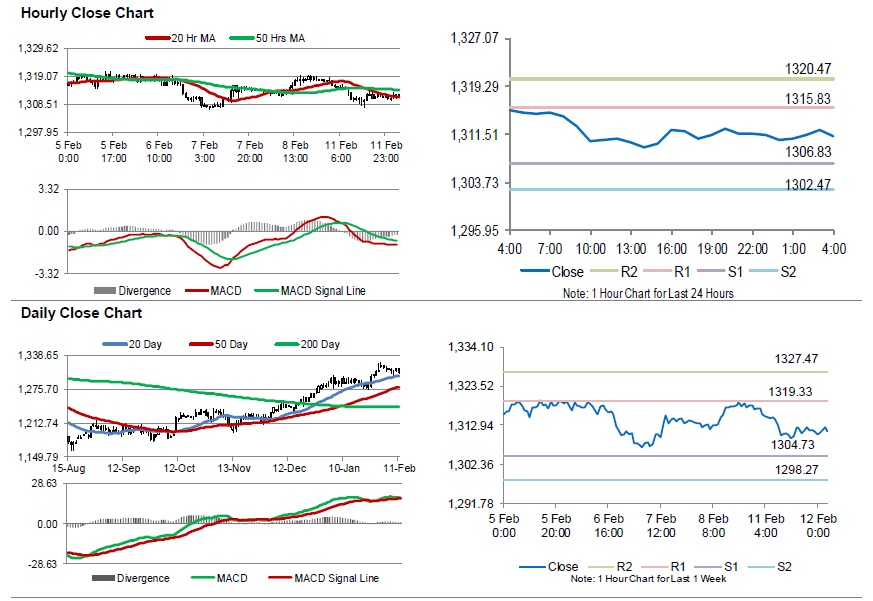
For the 24 hours to 23:00 GMT, Gold declined 0.32% against the USD and closed at USD1311.60 per ounce, amid broad strength in US dollar.
In the Asian session, at GMT0400, the pair is trading at 1311.20, with gold trading marginally lower against the USD from yesterday’s close.
The pair is expected to find support at 1306.83, and a fall through could take it to the next support level of 1302.47. The pair is expected to find its first resistance at 1315.83, and a rise through could take it to the next resistance level of 1320.47.
The yellow metal is showing convergence with its 20 Hr moving average and trading below its 50 Hr moving average.
Silver: White Metal Trading On A Stronger Footing This Morning
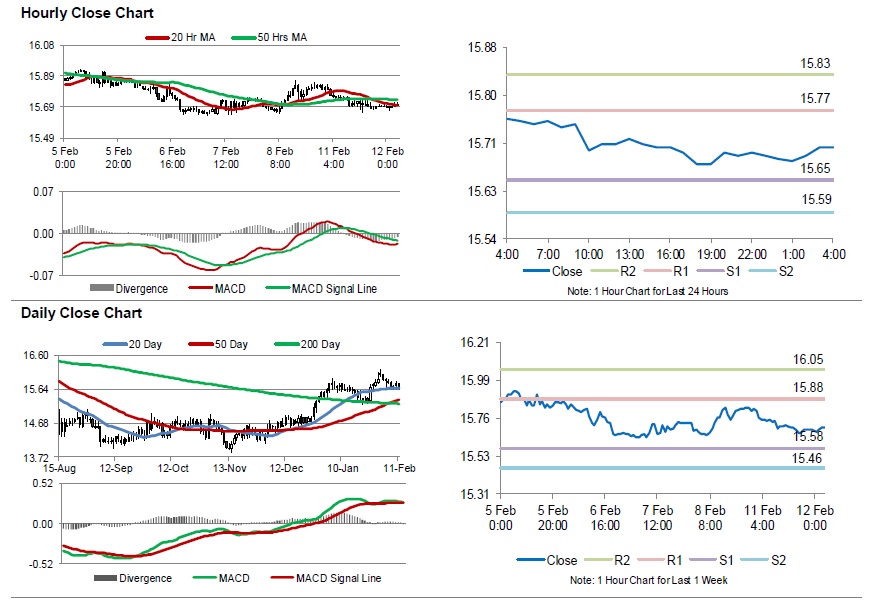
For the 24 hours to 23:00 GMT, Silver declined 0.48% against the USD and closed at USD15.69 per ounce, tracking losses in gold prices.
In the Asian session, at GMT0400, the pair is trading at 15.71, with silver trading 0.10% higher against the USD from yesterday’s close.
The pair is expected to find support at 15.65, and a fall through could take it to the next support level of 15.59. The pair is expected to find its first resistance at 15.77, and a rise through could take it to the next resistance level of 15.83.
The white metal is showing convergence with its 20 Hr moving average and trading below its 50 Hr moving average.
Crude Oil: Oil Trading Higher, Ahead Of API’s Weekly Crude Oil Stockpiles Data
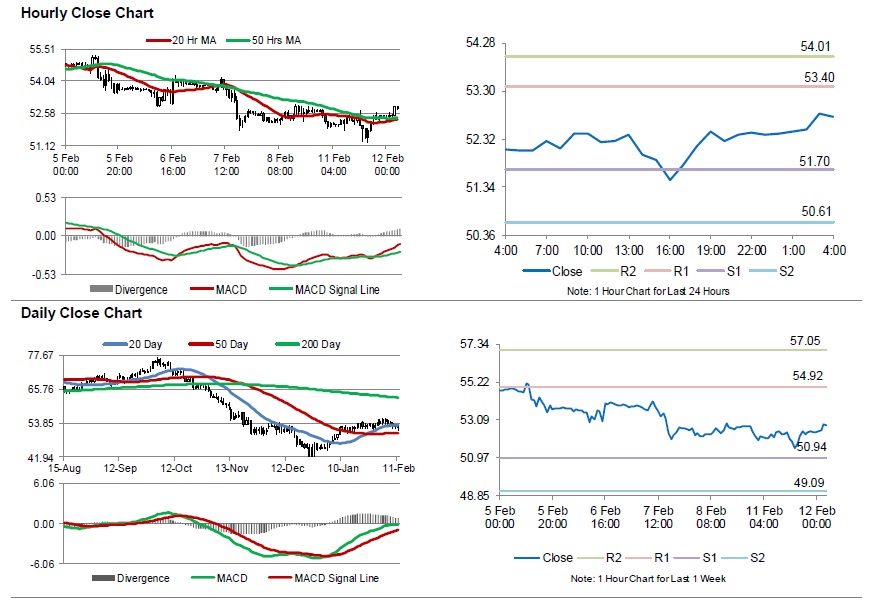
For the 24 hours to 23:00 GMT, Crude Oil rose 0.50% against the USD and closed at USD52.41 per barrel.
In the Asian session, at GMT0400, the pair is trading at 52.78, with oil trading 0.71% higher against the USD from yesterday's close, amid OPEC-led supply cuts and US sanctions against Iran and Venezuela..
The pair is expected to find support at 51.69, and a fall through could take it to the next support level of 50.61. The pair is expected to find its first resistance at 53.39, and a rise through could take it to the next resistance level of 54.01.
Crude oil is trading above its 20 Hr and 50 Hr moving averages.
Australian Business Conditions & Confidence, January 2019
Conditions rebound, but down trend continues. Conditions: up 4pts to +7. Confidence: up 1pt to +4.
The NAB business survey confirmed that the down trend in business conditions has extended in to 2019 - notwithstanding a modest partial rebound in January.
The business conditions index rose by 4pts following an 8pts plunge in December (note that the December read was revised up to +3 from +2). Some of the December decline was evidently due to statistical volatility - which is greater around the holiday period.
Business confidence was little changed, edging up 1pt to a still below average +4.
The survey was conducted from January 24 to 31. This follows on the heels of the December survey which was conducted from January 8 to 14 (the December survey is delayed each year due to the end of year holidays).
The current reading for business conditions, of +7, is broadly in line with average levels (for the monthly series dating back to March 1997).
Notably is the loss of economic momentum since the first half of 2018, when the conditions index averaged +18. The deterioration in business conditions on a 6 month basis is particularly stark - not as sharp as during the GFC and the introduction of the GST, but otherwise the weakest period in the past 20 years (see chart opposite).
Business conditions staged a ‘v-shaped’ recovery during the GFC and GST episodes - but only after an aggressive easing of policy.
The slowing of the Australian economy is centred on housing and the consumer. Retail sales all but stalled over the second half of 2018, as weak wages growth, high debt levels and falling house prices impacted. Dwelling approvals collapsed late in 2018 as the housing downturn gathered pace after lending conditions were tightened further. The global economy also lost momentum during 2018 with trade slowing and uncertainty increasing. However, a plus is that some key commodity prices (eg iron ore) remain elevated.
Business conditions details for January are: trading conditions up 3pts to +10; profitability up 4pts to 5; while employment rebounded by only 1pt to +5.
Businesses willingness to hire and invest is another important consideration for the outlook this year.
The survey suggests that employment conditions currently are consistent with near-term job gains of +19k per month - which is only a little below the 2018 average of +21k and would likely hold the unemployment rate steady. We would note that employment conditions are now almost back to the levels prevailing at the end of 2016 (see chart).
Capacity utilisation levels moderated in January to now be only just above average levels - with reportedly most industries now at below average levels. This may have implications for both future employment and capex plans.
By industry, retail conditions remained very weak (at -14); finance, business & property softened further (to +7) but construction rebounded partially (to +10), so too transport (to +2).
By state, conditions failed to rebound in NSW (at +6) and in Victoria (at +5), while Qld managed a weak rebound (to +5).
Market Morning Briefing: Dollar Yen Could Continue To Rise While Dollar Index Rises Towards 98
STOCKS
Most of the indices broadly remain bearish although there is room for an intermediate bounce in them. Shanghai is making a strong come-back after its long holiday and is outperforming other indicies.
Dow Jones (25,053.11, -53.22, -0.21%) is hovering above its key support level of 25,000. Near-term resistance is at 25,100. While it holds, the Dow can break below 25,000 and test 24,900 in the coming sessions.
DAX (11,014.59, +107.81, +0.99%) bounced-back but has resistance near 11,100 which can restrict the upisde. While below 11,100, the outlook will remain negative for the DAX to test 10,800 and 10,700.
Shanghai (2,654.03, +0.14, +0.01%) has risen breaking the resistance at 2,635. The upmove can extend to test 2,675 and 2,700 in the coming days.
Sensex (36,395.03, -151.45, -0.41%), and the Nifty 50 (10,888.80, -54.80, -0.50%) extended the fall as expected to test their respective support levels of 36,280 and 10,850 respectively. While these supports hold, a near-term intermediate bounce to 36,850 on the Sensex and 10,985 on the Nifty cannot be ruled out. However, the indices will come under pressure if they break below these supports. Sensex can fall to 36,000-35,985 on a break below 36,280. Nifty 50 on the other hand can test 10,815-10,800 on a break below 10,850
COMMODITIES
Strong dollar keeps gold, silver and copper under pressure. While gold and silver can remains range bound with an overall bullish bias, copper has room for further corrective dip before we see a bounce. Oil remains mixed and can remain in a broad sideways range for some time before a clear trend emerges.
Gold (1,308) has come-off sharply yesterday, but is managing to hold above 1,300. A range bound move between 1,300 and 1,325 is possible before we see a fresh rally towards 1,350-1,360.
Silver (15.70) is hovering above the key 15.60-15.55 support region. While this support holds, a bounce to 16 and 16.2 cannot be ruled out in the coming days. But, a break below 15.55 can drag silver lower to 15.1 and 15.
Copper (2.79) fell as expected yesterday to test 2.78. While below 2.82, the corrective fall can extend towards 2.76 and 2.75 before the overall uptrend resumes.
WTI (52.40) has bounced after testing a low of 51.25. While it remains above 52, a bounce to 53.5 is possible in the coming sessions.
Brent (61.65) is stuck in a narrow range between 61 and 63 over the last one week. The near-term view is negative for it to break below 61 and test 60. Broadly, WTI is likely to remain sideways between 60 and 64.
FOREX
Fresh strength in dollar Index above 97 could lead to weakness in the major currencies for the near term. Currency pairs are trading near important resistance and support levels but could remain weak against the Dollar for the next few sessions.
Dollar Index (97.04) has broken above the immediate resistance at 97 and while the index trades higher and manages to sustain above 97, we may look for a rise towards upper resistance at 98 as seen on the 3-day and weekly charts.
Euro (1.1281) has also clearly broken below 1.13. Unless the break is temporary and the Euro bounces back above 1.13 today itself, we look for bearishness and the fall to continue towards 1.11. Below 1.13, there is scope for a fall to 1.11 in the near term.
Euro-Yen (124.64) bounced slightly yesterday and while the near term support at 124.40/20 holds, we could see a rise towards 126 in the near term. Break below 124.40/20 could take it down to 123.70/60 but we are not looking at a sharp fall below 123.60 in the medium term. Rather a rise towards 126 is preferred for now.
Dollar Yen (110.48) could continue to rise while Dollar Index rises towards 98. Although 110.50 is an immediate resistance on the daily candles, a break on the upside could take it higher towards 111.50 from where a corrective fall could be seen. Near term looks bullish.
Pound (1.2868) could get some support near 1.2850 leading to a rise towards 1.29/30 again. But a failure to bounce from 1.2850 could take Pound to 1.26 in the near term.
Aussie (0.7082) has seen a slight bounce but could trade sideways in the 0.70-0.71 region for sometime before rising towards 0.72 again.
USDCNY (6.7843) has 21-day Ma near 6.8040 which could act as a decent resistance just now and push the pair back towards 6.70. A break above 6.8040 could take it higher towards 6.81 from where a short corrective dip is possible. Overall the current rise could be limited to 6.8040-6.8100 in the near term before a dip is seen.
Dollar Rupee (71.1750) could test 71.00 on the downside while below 71.40/30. Although some of the EM currencies look weak against the Dollar just now, Rupee could also see some weakness but may be limited to 71.40. Overall trade within 71.00-71.40 is likely just now.
INTEREST RATES
The US yields have risen slightly. The 2Yr (2.50%), 5Yr (2.49%), 10Yr (2.67%) and 30Yr (3.01%) have risen from 2.48%, 2.46%, 2.65% and 2.99% respectively. Some more rise is possible in the near term before falling off in the medium term. While the US Dollar strengthens a bit, US yields could see a rise for the next few sessions.
The German-US 2Yr differential (-3.07%) tested immediate resistance and has fallen from there. While the yield differential could come down towards -3.10%, near term looks bearish.
GBP/USD Rebound Could Face Hurdles
Key Highlights
- The British Pound declined heavily and broke the 1.3040 support area against the US Dollar.
- Two bearish trend lines formed with resistance at 1.2970 and 1.3025 on the 4-hours chart of GBP/USD.
- The UK Manufacturing Production in Dec 2018 declined 0.7% (MoM), compared with the +0.1% forecast.
- Today in the US, the NFIB Business Optimism Index for Jan 2019 will be released, which could decline from 104.4 to 103.2.
GBPUSD Technical Analysis
After a solid upward move, the British Pound faced sellers near 1.3200 area against the US Dollar. The GBP/USD pair started a major decline and broke the 1.3100 and 1.3040 supports to move into a bearish zone.
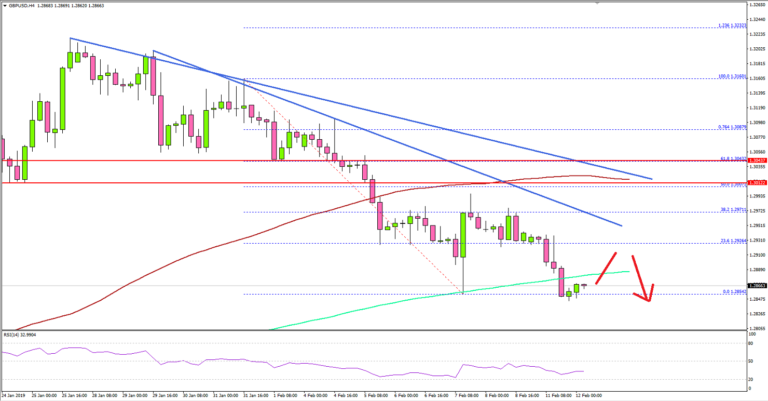
Looking at the 4-hours chart, the pair settled below the 1.3000 support and the 100 (red) simple moving average (4-hours), opening the doors for more losses in the near term. The pair tested the 1.2850 support area, where buyers emerged.
Later, there was an upside correction above the 1.2925 level and the 23.6% Fib retracement level of the recent decline from the 1.3160 high to 1.2854 low.
However, the pair faced a strong resistance near the 1.3000 level and the 38.2% Fib retracement level of the recent decline from the 1.3160 high to 1.2854 low. Moreover, there are two bearish trend lines formed with resistance at 1.2970 and 1.3025 on the same chart.
A successful close above the 1.3000 and 1.3025 resistance is needed for the pair to move back in the positive zone. If not, there is a risk of a downside move towards the 1.2850 and 1.2800 supports.
Fundamentally, the UK Manufacturing Production report for Dec 2018 was released recently by the National Statistics. The market was looking for a minor rise in the production by 0.1% in Dec 2018, compared with the previous month.
However, the result was disappointing as there was a 0.7% decline the UK Manufacturing Production. Looking at the Industrial Production, there was a 0.5% decline, which was more than the last -0.3%.
Overall, the price action is still bearish, suggesting more losses in GBP/USD. If there is an upside correction, the pair may perhaps struggle near the 1.3000 handle in the near term.
Economic Releases to Watch Today
- BOE’s Governor Mark Carney Speech.
- US NFIB Business Optimism Index Jan 2019 – Forecast 103.2, versus 104.4 previous.