

Sample Category Title
Traders Cautious On US China Trade Reports
Markets flat after trade talks reports
We’re continuing to see caution in the markets on Wednesday, with reports a day earlier regarding trade talks between the US and China only aiding that.
European markets are currently trading slightly in the red while US futures are marginally higher, following a flat session in Asia. Reports on Tuesday that preparatory talks between the US and China ahead of a meeting at the end of the month had been cancelled put a slight dampener on the mood in the markets at a time when we’re already seeing some profit taking, following an impressive four week rally.
This was denied by Larry Kudlow but that appears to have done little to convince, with the stories being reported by what is considered to be reputable media outlets. There’s no smoke without fire seems to be the view in the markets which puts even more focus on the visit of Chinese Vice Premier Liu He at the end of the month.
Promising trade talks has been a key driver of the rebound in markets over the last four weeks and if these talks are stalling and meetings are, in fact, being cancelled, investors may quickly lose confidence. Of course, other factors have also contributed to the improvement in risk appetite, including a more dovish and patient Fed, so I wouldn’t expect a dramatic drop off but the momentum could well be lost.
Gold could drop a little further as USD strengthens on trade reports
The dollar did rise in the aftermath of the reports and while these gains were slightly pared, they weren’t entirely reversed which also suggests traders aren’t entirely convinced by Kudlow’s denial. The dollar has benefited during periods of escalation in the trade war and vice versa, with it peaking around the time of the G20 at the start of December. While this isn’t necessarily an escalation, it is a potential stumbling block which could support the greenback for now.
This is obviously bad news for gold, which has rallied towards $1,300 on the back of a weaker dollar and risk averse trading at the back end of last year. It has temporarily pulled back and while $1,280 has held so far, could drop a little further to $1,260. That said, beyond the near-term price action, I think there are a number of supportive factors for gold which could see $1,300 come under significant pressure again.
In a week where speculation in driving market sentiment in the absence of any solid news, the economic data and earnings reports could grab a lot of attention. Especially given the more gloomy outlooks people now have for 2019. We’ll get fourth quarter earnings figures from 23 S&P 500 companies today, as well as manufacturing data from the US, consumer sentiment figures from the euro area and retail sales numbers from Canada.
DAX Ticks Lower, Risk Appetite Under Pressure After IMF Forecasts
The DAX index has posted small losses in the Wednesday session. Currently, the index is at 11,078, down 0.10% on the day. In economic news, the eurozone will release consumer confidence, which is expected to post a second straight decline of -6 points. On Thursday, Germany and the eurozone release PMI reports and the ECB will set interest rates and ECB President Mario Draghi will follow with a press conference.
With the global trade war continuing to take a bite out of the eurozone economy, it is no surprise that growth forecasts for 2019 have been revised downwards. On Tuesday, the International Monetary Fund lowered its global and eurozone growth forecasts. In October, the IMF projected global growth of 3.7% percent, but this has been revised to 3.5 percent. IMF head Christine Lagarde said that the world’s economy continues to expand, but “it is facing significantly higher risks”. The forecast for Germany was lowered to 1.3%, down from 1.9% in December. The IMF said that German growth had been dampened by weak consumer demand and lower factory production, notably in the car industry. The grim forecast follows a soft Chinese GDP, which dropped to 6.6% in 2018, its weakest level since 1990.
With dark economic clouds on the horizon, the ECB will is unlikely to make any moves at today’s policy meeting. Growth forecasts have been revised lower for the three largest economies in the bloc (Germany, France and Italy). The U.S-China trade war, which shows not signs of being resolved anytime soon, has taken a bite out of the eurozone export and manufacturing sectors have slowed. If the trade war worsens or the U.S. economy slows down in 2019, the eurozone could lapse into a recession. Given these weak economic conditions, the ECB, which finally terminated its massive stimulus program last month, is unlikely to raise interest rates before the fourth quarter of 2019. Just a few months ago, analysts were predicting a rate hike in the third quarter. Lower rates should be bullish for the equity markets, which will be more attractive to investors than the bond markets.
EUR/USD Will Be Retraced To 1.1340 Level
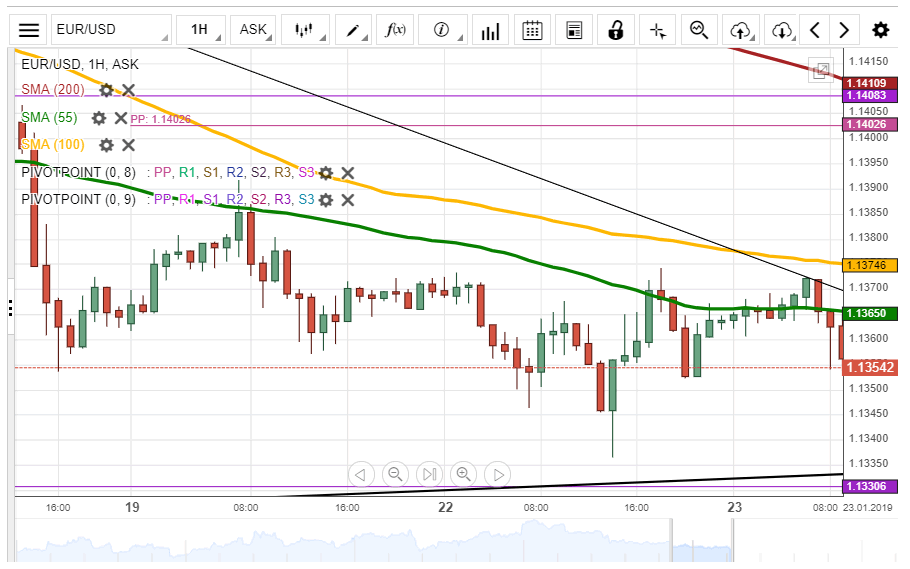
During Tuesday's trading session, the 55-hour simple moving average retraced the rate to the 1.1360 level. On Wednesday morning, the European Single Currency was located at the 1.1352 mark.
Most likely, the currency exchange rate will be trading downwards to the monthly S1 at 1.1330. Moreover, it is expected that the monthly S1 and the bottom boundary of the medium pattern line will retrace the rate to the 1.1340 level.
On the other hand, the European Single Currency could pass the support of the monthly S1 and the medium pattern line to trade near the weekly S1 at 1.1315.
GBP/USD Trades Towards Monthly R1
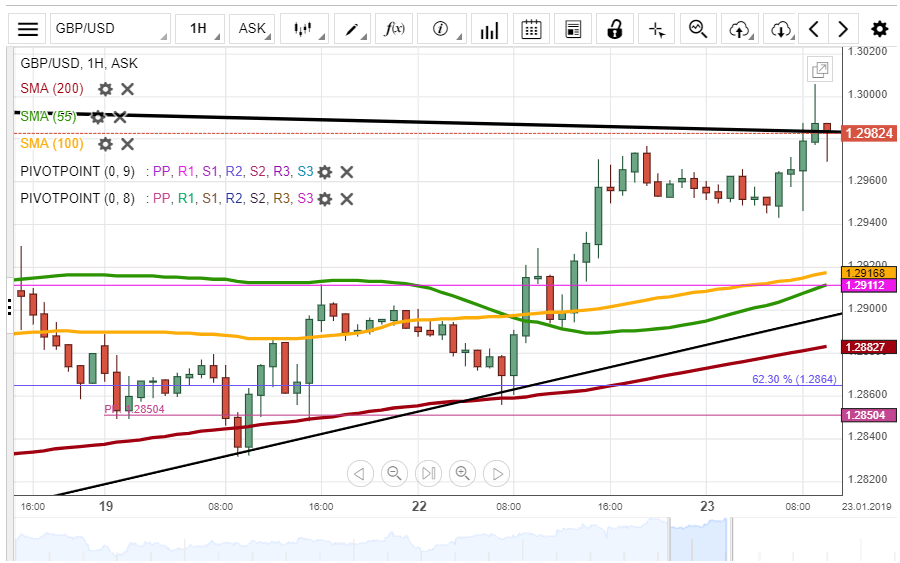
During Wednesday's morning hours, the currency exchange rate met the upper boundary of the descending pattern line to trade at the 1.2981 mark.
In regards to the near-term future, most likely, the British Pound will depreciate against the US Dollar towards the monthly R1 at 1.2911.
However, the British Pound could be supported by the 55-hour and the 100-hour simple moving averages at 1.2920 to push the rate to end the trading day at the 1.2940 level.
USD/JPY Will Drop To 109.45 Level
During the previous trading session, the currency exchange rate broke the previously drawn pattern. Due to the fact, the chart was corrected!
In regards to the near-term future, most likely the currency exchange rate will depreciate towards the 109.45 level. Besides, the 50.00% Fibonacci retracement level will retrace the rate to pass through the 55-hour simple moving average.
On the other side, the US Dollar could be supported by the 100-hour simple moving average to stay at the 109.40 level during the trading session.

XAU/USD Trades At 1,284.00 Level
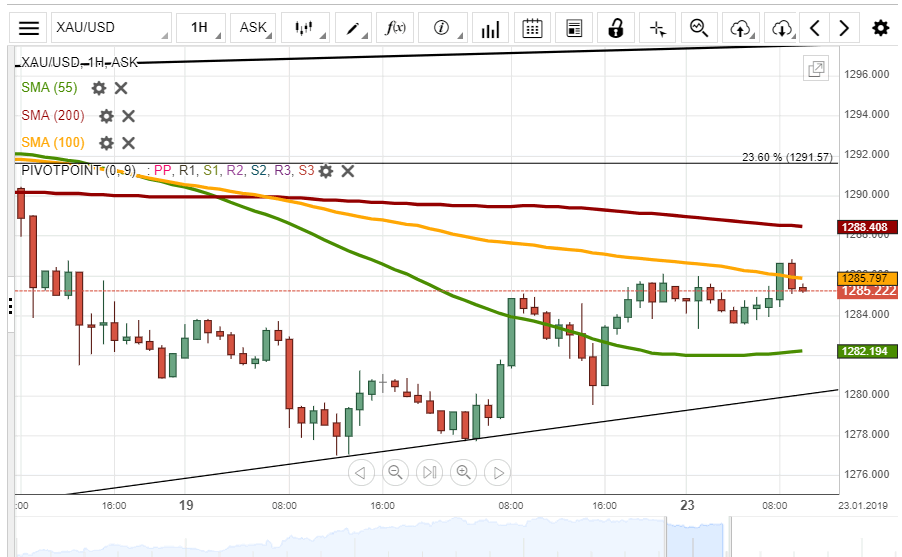
On Wednesday morning, the yellow metal was trading between the 55-hour and the 200-hour simple moving averages at the 1,285.38 mark.
Most likely, the gold will be trading downside towards the bottom boundary of the pattern line at the 1,280.50 mark. Moreover, it is expected that the 200-hour simple moving average will retrace the gold to give an additional push to depreciate against the US Dollar.
On the other hand, the 100-hour simple moving average could support the yellow metal to break the resistance of the 200-hour simple moving average to trade near the 23.60% Fibonacci retracement level at 1,291.57.
GBP/JPY Clear Uptrend Showed By Camarilla MTF
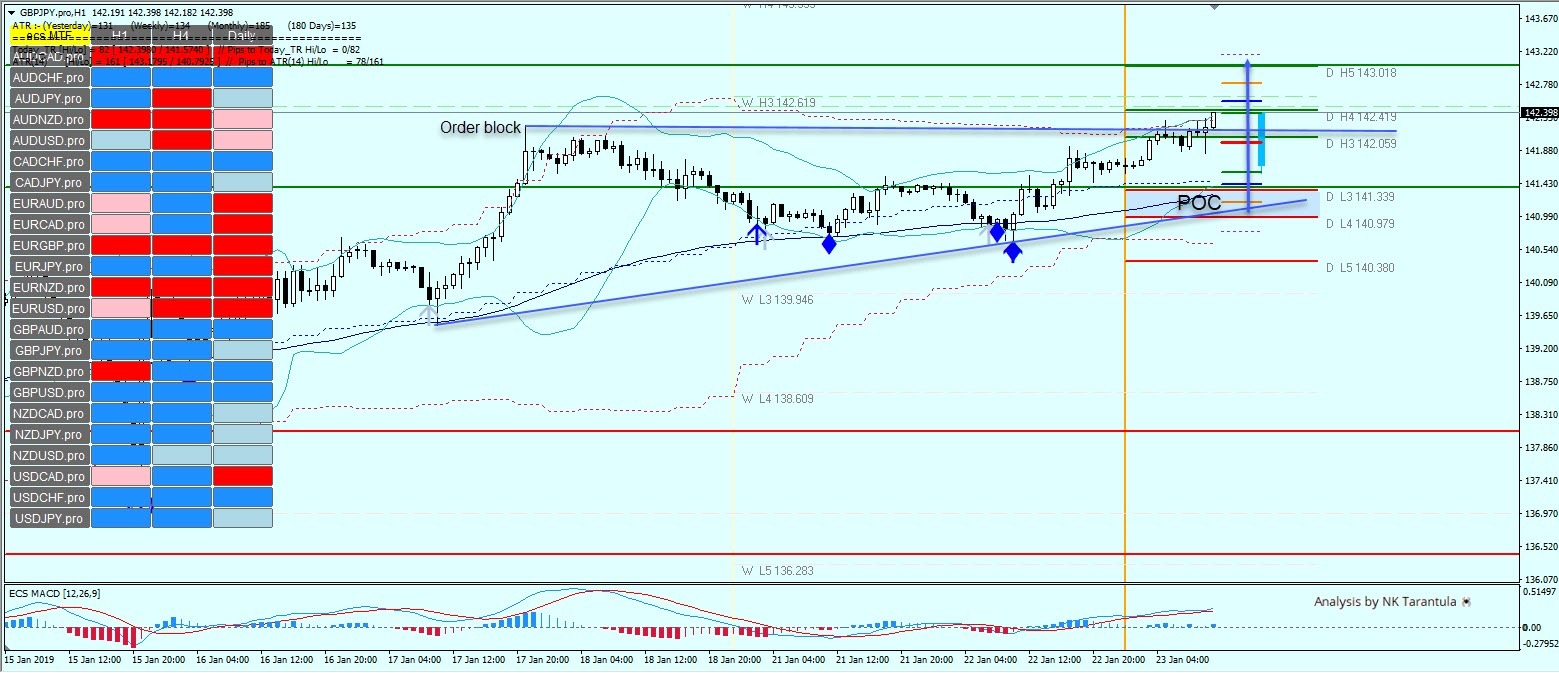
The GBP/JPY shows a clear uptrend with multiple bouncing spots signaled by Camarilla MTF. Both arrows and diamonds show confluence spots and successful rejections (automated)
Next bouncing spot could be a retest of the POC zone 141.00-141.30. However, if we don’t see a deeper retracement we can also watch for 142.20 bounce as a form of order block retest. Targets are 142.60 and 143.17. Momentum is still very positive so expect a continuation trade.
Only a drop below the projected ATR low 140.79 will initiate a neutral move in the pair, where a test of 140.38 is a big possibility in that case.
The US Dollar Index Closed In The Red
The US dollar weakened slightly against a basket of major currencies. Yesterday, a weak report on existing home sales was published in the US, according to which sales fell to 4.99M instead of 5.25M. The US dollar index (#DX) closed in the negative zone (-0.04). The US currency is still under pressure due to the US government shutdown, which has not already worked for 33 days.
The British pound strengthened against the US dollar despite unresolved issues concerning Brexit. Yesterday, ambiguous data on the UK labor market were published. Thus, the average earnings, including bonuses, increased by 3.4% in November, while experts expected growth of 3.3%. However, the number of jobless claims rose to 20.8K in December instead of 20.0K. Optimistic data were also published in the Eurozone: German ZEW economic sentiment index counted to -15.0 in January and turned out to be better than the forecasted value of -18.4. The New Zealand dollar strengthened against the US dollar after the publication of the consumer price index, which increased by 0.1% in Q4 instead of 0.0%.
Today, during the Asian trading session, the Japanese yen has been decreased against the US dollar. The Bank of Japan, as expected, left the interest rate unchanged at -0.10%. Also, weak economic data from Japan were published. Trade balance counted to -55B in December, while experts forecasted -30B. Exports decreased by 3.8% instead of 1.9%. The demand for safe assets has weakened.
The "black gold" prices are recovering after a strong decline the day before. At the moment, futures for the WTI crude oil are testing the mark of $53.20 per barrel. At 23:30 (GMT+2:00), the API weekly crude oil stock will be published.
Market Indicators
Yesterday, aggressive sales were observed in the US stock market: #SPY (-1.35%), #DIA (-1.23%), #QQQ (-2.00%).
The 10-year US government bonds yield is at the level of 2.73-2.74%.
The Economic Calendar for 23.01.2019:
Core retail sales in Canada at 15:30 (GMT+2:00).
BOJ Remains On Hold And JPY Weakens Somewhat
JPY weakened somewhat as BoJ's interest rate decision was to remain on hold as was widely expected. The decision was accompanied by cuts in the forecasts for the core CPI rate in 2019/20 and a small boost in the forecast for the GDP growth rate. In the accompanying statement, the bank left the forward guidance on rates unchanged as it stated that it will keep current extremely low rates for an extended period of time. The bank also noted that the core CPI rate maintains a weak trend if compared to economic expansion and the current tight labour market. Analysts pointed out that the bank seems to be in no hurry to reach its +2.00% yoy inflation target, yet we maintain our concerns about the course of the Japanese economy and the negative effect it may have on the JPY. Also a weakening of the JPY could occur as a safe haven, should there be further positive developments for the US-Sino trade relationships. The bearish sentiment for the JPY could strengthen and volatility could extent throughout Governor Kuroda's press conference later on. USD/JPY maintained a range bound motion yesterday, rising slightly albeit remaining between the 109.20 (S1) support line and the 110.15 (R1) resistance line. We could see the pair maintaining a sideways motion today as no important financial releases affecting the pair are due out. Some sensitivity could be displayed should there be any headlines about the US-Sino trade relationships. Should the pair's long positions be favored by the market, we could see the pair, breaking the 110.15 (R1) resistance line and hover above it. Should on the other hand, the pair come under the selling interest of the market, we could see it breaking the 109.20 (S1) support line and aim for lower grounds.
GBP jumped on strong employment report
The pound strengthened against the USD yesterday, after a strong labour report for November, which showed a tight UK labour market. The unemployment rate ticked down (4.0%) while the average earnings ticked up (+3.4% yoy) and the employment change figure rose reaching an impressive 141 k (vs. expected 88k). The strengthening was also encouraged by articles suggesting that the UK parliament moves closer to preventing a no deal Brexit. Labour party seems to be increasingly likely to back an extension in the March 29th deadline and articles imply that the main opposition party may also be backing a second referendum. Analysts point out that the overall probability of a market friendly Brexit outcome is currently helping the pound. We also maintain a positive attitude for the pound as Brexit political developments seem to be moving towards a softer Brexit currently, however we would also like to note that uncertainty is still in the cards as the opposition may need a number of Tory MP's to back their plans. We could see further volatility for the pound as Brexit headlines could continue to reel in. GBP/USD rose yesterday, breaking the 1.2880 (S1) resistance line (now turned to support) and tested the 1.2960 (R1) resistance line. We could see the pair rising if there are more positive headlines about Brexit over the next couple of days. Should the pair find fresh buying orders along its path, we could see it breaking the 1.2960 (R1) resistance line and aim for the 1.3070 (R2) resistance level. Should the bears take over, we could see the pair aiming if not breaking the 1.2880 (S1) support line targeting lower grounds.
Today's other economic highlights
In today's European session, we get from Turkey the minutes of CBRT's last meeting, while in the American session we get Canada's retail sales growth rates for November, Eurozone's preliminary consumer confidence indicator for January and form the US the API weekly crude oil inventories figure.
USD/JPY H4
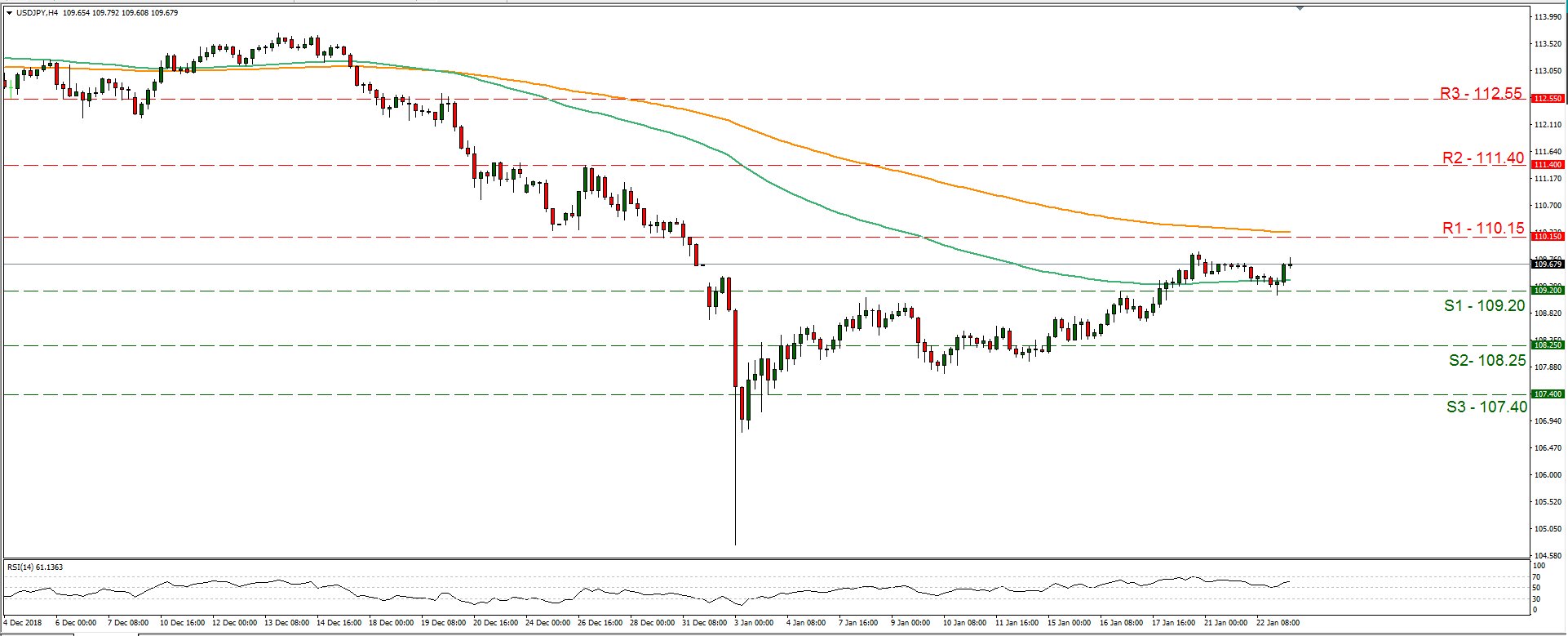
Support: 109.20 (S1), 108.25 (S2), 107.40 (S3)
Resistance: 110.15 (R1), 111.40 (R2), 112.55 (R3)
GBP/USD H4
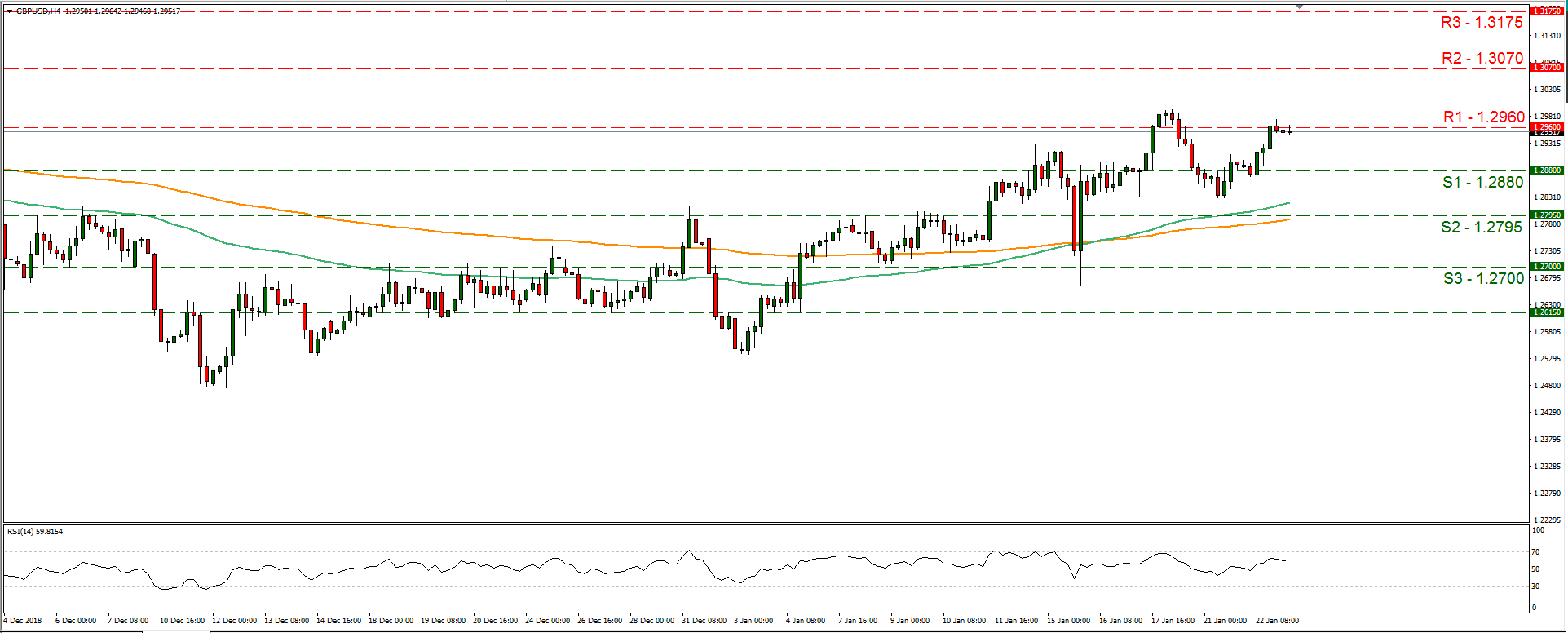
Support: 1.2880 (S1), 1.2795 (S2), 1.2700 (S3)
Resistance: 1.2960 (R1), 1.3070 (R2), 1.3175 (R3)
EUR/USD Drifting But ECB Could Shake Up Euro
EUR/USD continues to have a quiet week. Currently, the pair is trading at 1.1360, down 0.01% on the day. On the release front, there are no major events out of the U.S. or the eurozone, so traders can expect a quiet day for the pair. The eurozone will release consumer confidence, which is expected to post a second straight decline of -6 points. On Thursday, Germany and the eurozone release PMI reports and the ECB will set interest rates and we’ll hear from Mario Draghi at a press conference. The U.S. will release unemployment claims.
With the global trade war showing no signs of easing, it is no surprise that growth forecasts for 2019 are heading south. On Tuesday, the International Monetary Fund lowered its global and eurozone growth forecasts. In October, the IMF projected global growth of 3.7% percent, but this has been revised to 3.5 percent. IMF head Christine Lagarde said that the world’s economy continues to expand, but “it is facing significantly higher risks”. The forecast for Germany was lowered to 1.3%, down from 1.9% in December. The IMF said that German growth had been dampened by weak consumer demand and lower factory production, notably in the car industry. The grim forecast follows a soft Chinese GDP, which dropped to 6.6% in 2018, its weakest level since 1990.
The ECB has been below the radar over the past few weeks, overshadowed by the Federal Reserve. Policymakers at the Fed have shown a significantly more dovish stance since the December policy meeting, which has weighed on the U.S. dollar while sending the stock markets higher. The ECB terminated its massive stimulus package in December, and a natural follow-up move would be a modest hike in interest rates – if the eurozone economy was performing well. That hasn’t been the case, as the economy slowed in the third quarter of 2018 and all signs are Q4 will also be soft. Analysts had predicted a rate hike in the third quarter, but sluggish economic activity has pushed off that forecast until the fourth quarter. The markets are keeping a close eye on the ECB policy meeting on Thursday, looking for clues with regard to future rate policy.