Sample Category Title
Brexit and Forex Markets: The Good, the Bad and the Ugly
As the Euro celebrates its 20th birthday, there are many signs of a cooldown in the Eurozone economy, following a turbulent 2018.
Looking ahead to 2019, the road is expected to be a bumpy one for European financial markets, thanks in part to the Brexit fallout, Italy's budget woes as well as the prolonged trade tensions between US and China which are significantly impacting the financial markets globally.
But what does all this mean for Forex traders? Lukman Otunuga, Research Analyst at FXTM, predicts the highs and lows of Forex markets as the UK prepares to leave the EU.
Uncertainty, a currency trader's worst enemy
As we head towards Brexit day on 29 March, it seems we're no closer to understanding what Brexit really means for the UK and the EU economies.
The Forex market functions on the level of trust traders have in global currencies. As such, uncertainty over the current and future strength of an economy introduces greater risk when it comes trading said currencies.
Blurred by Brexit limbo, the British Pound is being subject to more volatility than usual and the same Brexit uncertainty has the knock-on effect of impacting inflows of foreign capital into the UK and potentially weakening Sterling even further. These discouraging macroeconomic conditions could threaten Britain's position as an investment hotpot while also encouraging the Bank of England to cut interest rates in an effort to stimulate economic growth,
Keeping a finger on the pulse
Any Forex trader should keep their eyes peeled for signs as to the direction of the final exit agreement as it plays out.
With Theresa May unveiling her Brexit 'Plan B' to Parliament and debates on the deal expected to take place near the end of January, the Pound is poised to turn volatile and highly reactive to Brexit headlines. The outcome of the Parliamentary vote on May's 'Plan B' could play a role in how the UK exits the European Union.
A soft Brexit outcome where the UK continues to trade openly with the European Union will be warmly welcomed by the British Pound, whereas if the UK crashes out of the European Union with no deal in place, Sterling can expect severe losses.
Looking at the bigger picture
Despite being a fairly localised geopolitical event, Brexit has the potential to cause ripple effects wider than just the Eurozone economy.
Emerging market currencies – such as the Turkish Lira, South African Rand and Russian Ruble – could find themselves in the firing line if Brexit sparks widespread risk aversion.
However, safe-haven currencies such as the Japanese Yen and the Dollar could be key benefactors from Brexit as traders park their cash in times of market flux. If the trade tensions between US and China continues or indeed escalates, the Yen will remain the undisputed king of FX markets in 2019.
The extent of the unknowns around the path of Brexit makes it very difficult to provide any direction, or market expectations on future Pound movements. Growing concerns revolving around a nightmare no-deal outcome have drained investor confidence thoroughly throughout the past couple of months, while chaos within the Commons has added further fuel to the raging Brexit flames.
By Lukman Otunuga, Research Analyst, FXTM
May Moves Closer To No-Deal Brexit | S&P500 Suffered 2nd Worst Day In 2019
May doesn't care if the UK faces a disorderly Brexit, for her the most important part is the red lines defined by her and she is not willing to move from that. Hence, Parliament has moved one step closer to save the UK from a no-deal Brexit deal. The plan is to delay the Brexit so that the economic shock to the economy is minimum. The opposition Labour party has started to support the proposal, the deadline must be extended if May cannot negotiate a divorce agreement. The upheaval of a disastrous no-Brexit deal could bring the country to its knees.
The time is ticking and only nine weeks are left before the deadline approaches and sterling traders are paying attention this. For now, the trend remains to the upside against the dollar and the average earning index number supported the currency yesterday but the claimant count number missed the forecast. The actual number was 20.8K while the forecast was 20.1K. This kind of number makes matter more arduous for the Bank of England because, on one hand, they have a data which confirm that the labour market is tightening and they should think about normalising the interest rate but then, on the other hand, they have Brexit chaos.
Nonetheless, technically speaking, we are looking at the 1.30 mark for sterling to break against the dollar and stay above this. Only this will send a bullish signal for the markets otherwise, I think the currency can actually fall.
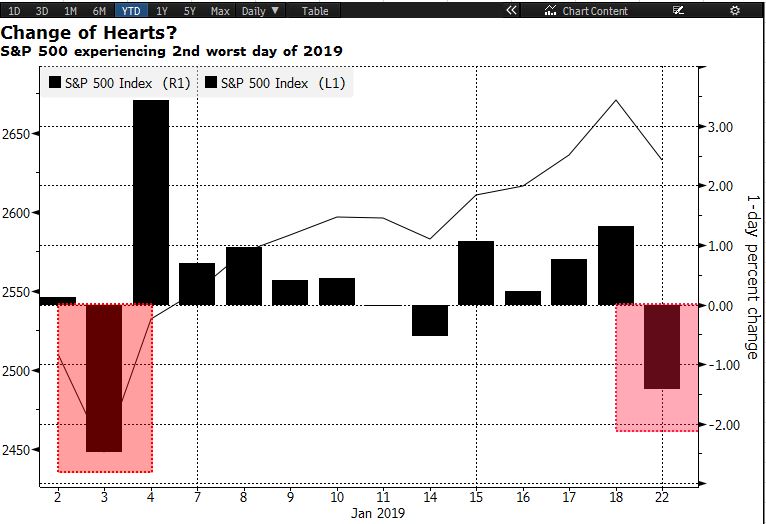
The global equity markets have decided to change their direction and failed to deliver on their promise- to continue to move higher. Looking at the Years to date performance of the major indices such as the S&P500 (5.03%), Nasdaq (5.80%) and the Dow Jones (4.62%) makes you think that the markets cannot continue like this so the retracement is a must. However, if you look at the 1-day percentage move for the S&P 500 which took place yesterday, it does ring some alarm bells because the index suffered from its second worst day yesterday.
The reality is that headline coming out for the past two days aren't soothing at all, the IMF global growth downgrade has sent a nerve-wracking wave and investors have adopted a very cautious tone after this. However, if we look at the elite gathered over in Davos, listening to them makes it clear that they are concerned about the weak economic situation but certainly, no one is ready to jump off the ship. The message is that we are growing but we would like to higher growth.
Yen Losing Its Momentum
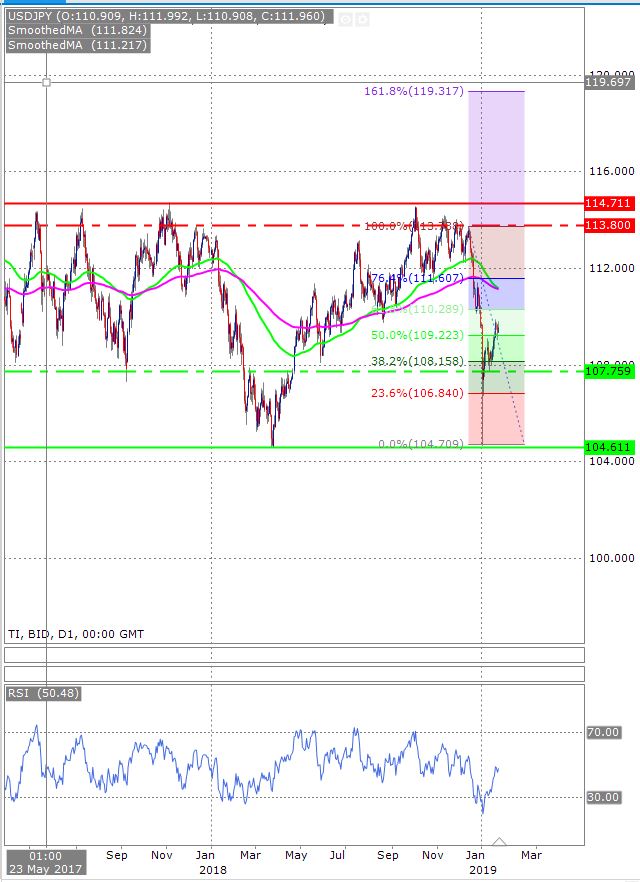
The dollar-yen pair has recovered more than half of its losses from its peak of 113.80 formed on the 17th December 2018. The trend is still to the downside and the simple reason for this is because the price has not been able to break above the 50 and 100-day moving averages shown in green and pink respectively. Moreover, it looks like that the 50-day moving average is about to break below the 100-day moving average and this suggests to me that the bulls still do not own the momentum.
However, the RSI does confirm the fact that the price has bounced off from its oversold part and it is moving towards the upside which confirms that the current upward move does have potential, but the confirmation of downtrend no longer in play. It will only come when the price breaks above the important moving averages mentioned above.
The primary support is shown the horizontal solid green line and the minor support by the dotted line.
The primary resistance is shown the horizontal solid red line and the minor support by the dotted line.
Forex Technical Analysis: EUR/USD, USD/JPY, GBP/USD
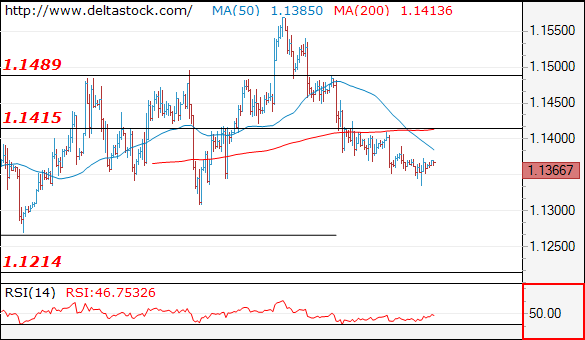
EUR/USD
Current level - 1.1366
The pair is struggling above the dynamic support at 1.1330 and I favor a break through the mentioned area to target 1.1214 low. Crucial resistance lies at 1.1415.
| Resistance | Support | ||
| intraday | intraweek | intraday | intraweek |
| 1.1415 | 1.1630 | 1.1330 | 1.1214 |
| 1.1540 | 1.1820 | 1.1214 | 1.1100 |
USD/JPY
Current level - 109.63
The dip to 109.10 has set the stage for the next upswing, towards 110.20 resistance area. Initial intraday support lies at 109.50.
| Resistance | Support | ||
| intraday | intraweek | intraday | intraweek |
| 109.90 | 111.45 | 109.50 | 106.70 |
| 110.20 | 112.20 | 109.10 | 104.60 |

GBP/USD
Current level - 1.2965
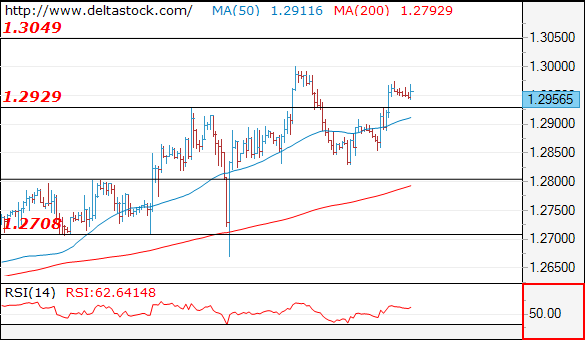
The violation of 1.2930 has neutralized the bearish bias and although there is still a chance for another downswing while below 1.3000, the overall outlook is positive, for 1.3050.
| Resistance | Support | ||
| intraday | intraweek | intraday | intraweek |
| 1.3000 | 1.3050 | 1.2930 | 1.2420 |
| 1.3050 | 1.3250 | 1.2800 | 1.2340 |
EURJPY Struggles In Tight Bollinger Band, Neutral In Near Term
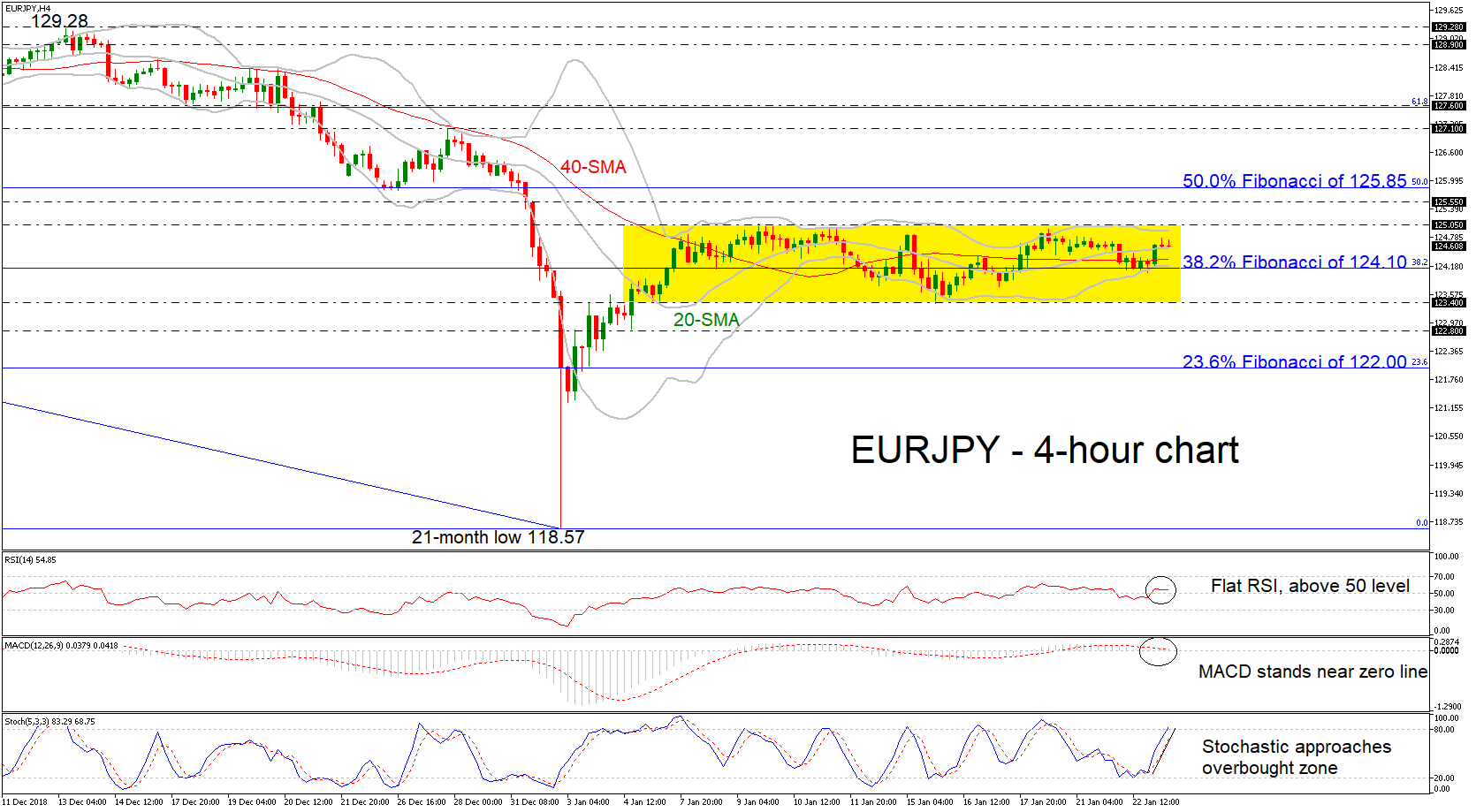
EURJPY has been moving sideways over the last three weeks with upper boundary the 125.05 resistance and lower boundary the 123.40 support. Currently, the mid-level of the range is the 38.2% Fibonacci retracement level of the downleg from 133.10 to 118.57, around 124.10, where the price has been trading above it since January 17.
According to the technical indicators, in the 4-hour chart, the RSI and the MACD are flattening above the neutral threshold of 50 and the zero line respectively, however, the stochastic oscillator is strengthening its momentum higher in the overbought zone. It is worth mentioning, that the Bollinger bands are squeezing the price action, suggesting a possible strong break outside of the range in either direction.
If the market pushes the pair higher above the upper boundary, prices could challenge the 125.55 resistance level, taken from the low on August 17. More advances would likely open the way for the immediate resistance of the 50.0% Fibonacci of 125.85 before traders’ attention turns on the 127.10 hurdle, identified by the peak on December 27.
On the flipside, if the market manages to turn to the downside again and slips back below the 38.2% Fibonacci and the 123.40 support, this could send prices until the 122.80 support level before touching the 23.6% Fibonacci of 122.00, shifting the bias back to a more bearish one.
Concluding, EURJPY has been trading in a narrow range in the very short term, however, in the longer timeframe the price remains in a strong bearish structure following the pullback on 133.10.
Market Sentiment Stays Fragile, But Kiwi Shines
- Risk appetite remains weak as trade and growth concerns resurface
- BoJ stays on hold, provides no new signals – yen yawns
- Kiwi outperforms as New Zealand’s inflation prints beat estimates
Growth and trade woes keep investors on the defensive
Market sentiment remained fragile on Tuesday, with investors cutting their exposure to riskier assets and diverting those funds into safer plays, amid resurgent worries around global growth and trade uncertainties. News that the US will proceed with the extradition of the Huawei executive arrested in Canada turned sentiment sour early on, and subsequent reports that the US rejected holding preparatory talks ahead of next week’s high-level trade negotiations amplified worries further. The data flow wasn’t any better, as both Germany’s ZEW survey and US existing home sales fell short of expectations, feeding the narrative of a global slowdown.
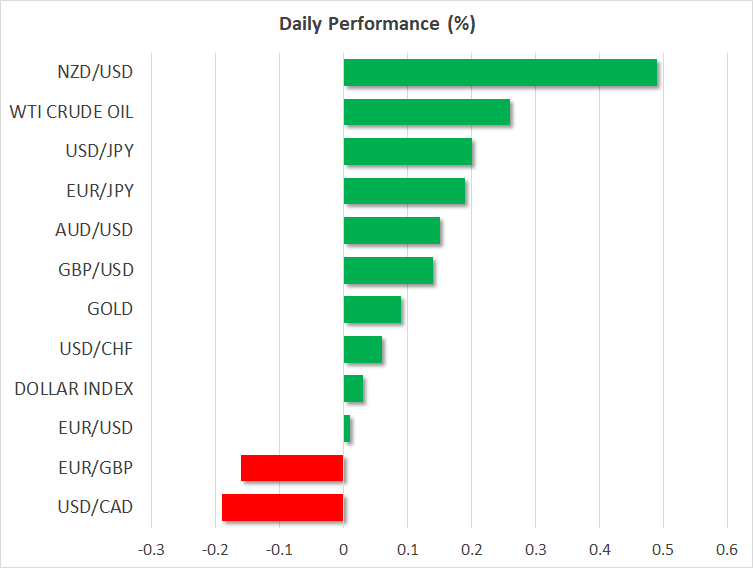
Accordingly, US stock markets felt the burn, with the S&P 500 and the Dow Jones falling by 1.42% and 1.22% respectively on their first day back from a public holiday. Crucially though, both of these indices found support near their 50-day moving averages and rebounded, which keeps the short-term technical picture neutral for now. In the FX space, the defensive Japanese yen outperformed most of its major peers, while commodity currencies such as the aussie and the loonie surrendered ground, in tandem with oil prices.
Looking ahead, the meeting next week between US Secretary Mnuchin, Trade Representative Lighthizer, and China’s Vice Premier Liu He will be critical for risk sentiment. Recent reports suggest the US is dissatisfied with the lack of progress on key issues such as forced technology transfer. To the extent that is accurate, it will be interesting to see whether the Trump administration is “in it for the long haul”, in the sense of being willing to hold out for major concessions on the key subjects, or whether it will settle for a short-term solution that merely boosts markets.
BoJ: Don’t stay up waiting for normalization
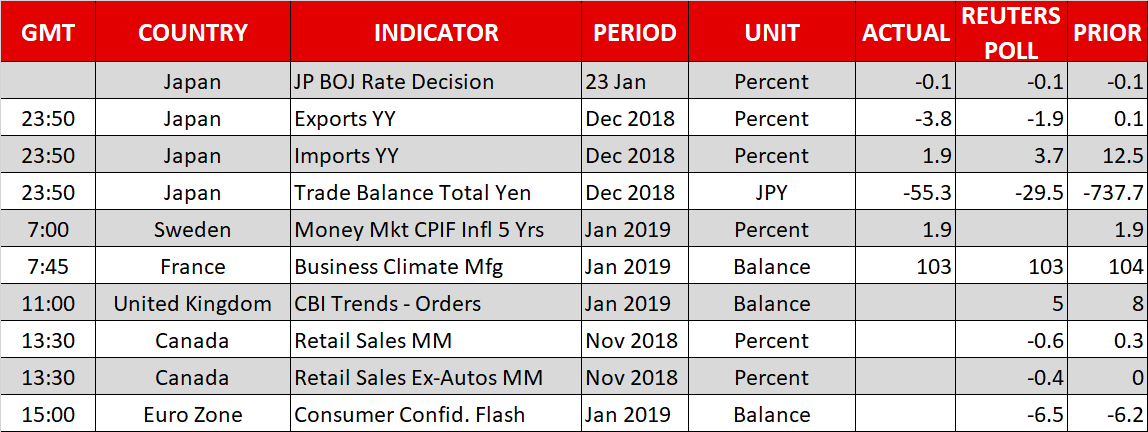
Overnight, the Bank of Japan (BoJ) kept both its massive stimulus program and forward guidance unchanged, as was widely expected. The Bank did revise down its inflation forecasts, but that was hardly surprising either considering that price pressures remain muted. Overall, there was no sign that policymakers are contemplating removing any stimulus in the foreseeable future, considering the recent streak of soft data and external trade risks. Given the absence of any new signals, there was no major reaction in the yen on the news, though the currency is broadly on the back foot today. Other things equal, the BoJ’s ultra-loose stance argues for a weaker yen over time from a yield-differential perspective, though admittedly, the currency’s actual direction will depend primarily on how risk sentiment evolves, given its safe-haven status.
Kiwi cheers as inflation beats forecasts
The kiwi is the best performer among major currencies today, gaining roughly 0.5% against the dollar thanks to stronger-than-expected quarterly CPI figures out of New Zealand overnight. The headline CPI for the fourth quarter clocked in at 1.9% in yearly terms, staying unchanged from previously and beating the forecast for a downtick to 1.8%. Consequently, the news may have reassured investors that the economy is still strong enough to keep inflationary pressures up, thereby reducing the chances for a potential rate cut by the Reserve Bank of New Zealand later this year. That said, given the growth slowdown in the third quarter and the mounting downside risks from the US-Sino trade war, the RBNZ is unlikely to abandon its neutral-to-cautious policy stance anytime soon either.
Elliott Wave Analysis: USD/CAD At Interesting Resistance Zone, A Bearish Continuation In View
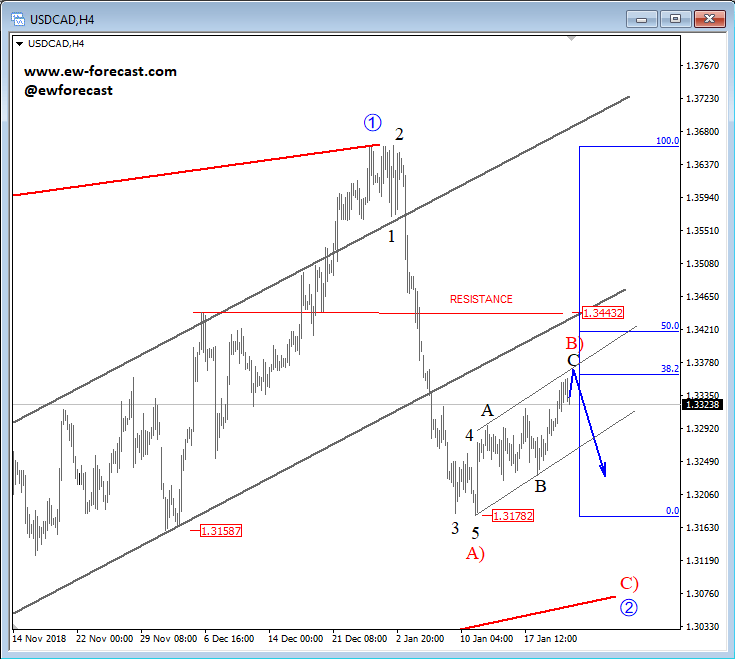
USDCAD made a sharp bearish reversal down from 1.366 level, an impulsive wave A) to be specific which looks to have found a base at the 1.318 level. A recovery that followed from the lows can be part of a temporary three-wave pullback labelled as wave B), which can retrace towards the 1.344 level(level of a former swing high) and there find resistance and make a reversal lower. Also, Fibonacci ratios of 38.2 and 50.0 can react as possible turning point zones for the pair.
USDCAD, 4h
GBP/USD Outlook: Pound Remains At The Front Foot, Underpinned By Strong Jobs Data And Steer In Brexit Saga
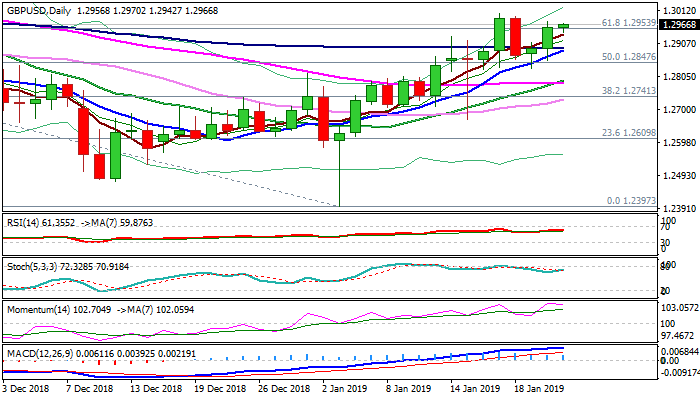
Cable remains firm and consolidating within tight range in early Wednesday's trading, following Tuesday's advance on better than expected earnings data that revived hopes of possible BoE rate hike. Technical studies on daily chart remain bullish, with positive signal being generated on Tuesday's close above 1.2953 (Fibo 61.8% of1.3297/1.2397 descend). Pound enjoys support from hopes for smooth exit, delayed exit or possibly no exit at all, as UK labor party backs amendment that could stop scenario for no-Brexit deal. Sterling could rise further in such environment and could attack again psychological 1.30 barrier, violation of which would open way towards falling 200SMA (1.3082). Bullish bias is expected to remain in play while the price holds above 100SMA (1.2893), reinforced by rising 10SMA (1.2885) which attempts to form bull-cross and further strengthen near-term structure.
Res: 1.3000, 1.3029, 1.3082, 1.3149
Sup: 1.2942, 1.2893, 1.2885, 1.2830
USD/JPY Outlook: Bullish Bias Exists Above 109.15/05 Support Zone
The pair edged higher in Asia on Wednesday, driven by risk sentiment and weaker than expected Japan's export data which showed the biggest fall in over two years.
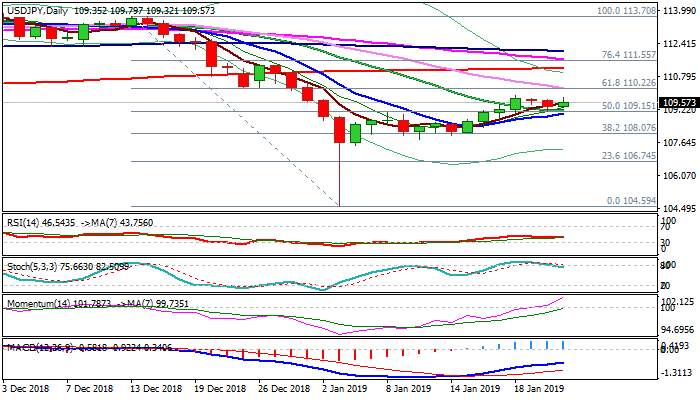
Near-term action holds within 109.15/90 consolidation for the third straight day, after recovery stalled on approach to psychological 110 barrier.
Daily studies maintain strong bullish momentum which supports the action for renewed attempts towards 110 barrier.
The price needs to hold above strong support at 109.15 (broken 50% of 113.70/104.59/20SMA) supported by rising 10SMA (currently at 109.05) to keep bullish bias.
Break of key barriers at 110.00/22 (psychological resistance/Fibo 61.8% reinforced by falling 30SMA) is needed to generate bullish signal for extension of recovery leg from 109.59 (3 Jan spike low).
Conversely, near-term structure would weaken on sustained break below 109.15/05 pivots and would risk dip towards 108 support zone.
Res: 109.79, 110.00, 110.22, 110.47
Sup: 109.32, 109.15, 109.05, 108.68
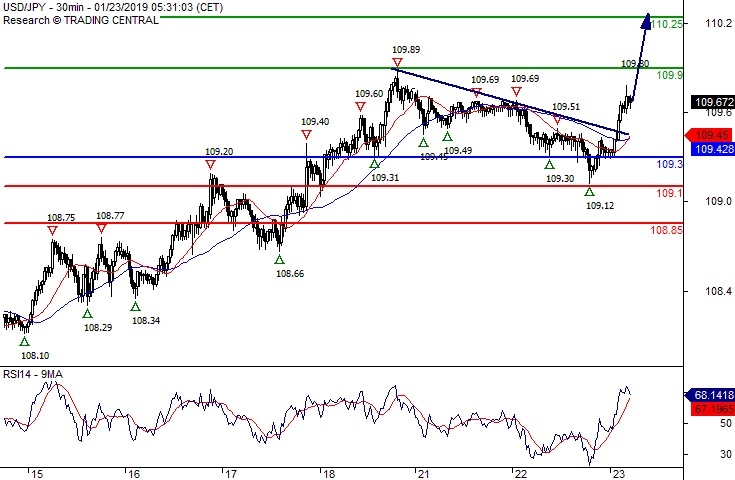
USD/JPY Further Advance
Pivot (invalidation): 109.30
Our preference Long positions above 109.30 with targets at 109.90 & 110.25 in extension.
Alternative scenario Below 109.30 look for further downside with 109.10 & 108.85 as targets.
Comment The RSI is bullish and calls for further advance.