Sample Category Title
Dollar Mixed As Market Awaits Brexit Vote
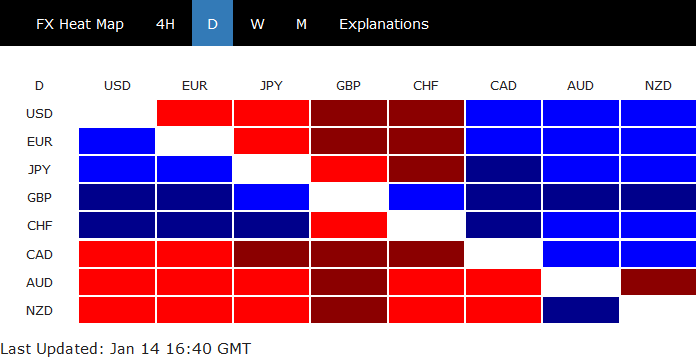
The US dollar is mixed against major pairs on Monday. The greenback is down against the Japanese yen, the Swiss franc and the British pound, but is appreciating against the euro, Canadian, New Zealand and Australian dollars. Data released out China shows a slowdown in trade which has impacted global growth expectations to the downside. Despite the positive headlines out of Beijing and Washington about progress in their trade talks, there has been little got show. The tariff spat was fast and furious as both sides retaliated, but reaching an agreement has not been as speedy. Brexit will be the main focus on Tuesday as the UK parliament is set to vote, with success almost ruled out, but as an event that will be measured on how close Prime Minister May can get to a deal to see if there is hope for more attempts and something to use as leverage with the European Union to seek a time extension.
Pound Higher on Hope more than Reality
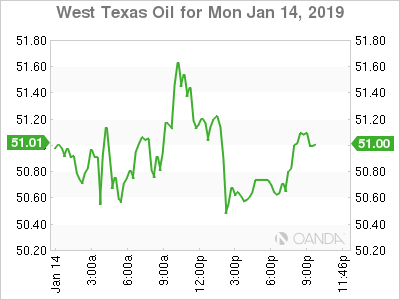
The GBP/USD dropped 0.25 percent on Monday. The currency pair is trading at 1.2867 awaiting the parliament vote on Brexit due on Tuesday. Prime Minister May has launched a strong campaign to pass the current deal on the table, but it is highly unlikely given how British politicians have already declared they will vote against it. May is now shifting gears and is trying to woo Leave supporters that a vote against her deal could embolden a no Brexit scenario if there is a referendum.
The divorce between the United Kingdom and the European Union has give the market plenty of uncertainty. The real impact of the Brexit vote has not been felt, but ever since article 50 was invoked it has put a timeline on big matters that need to get sorted before the March 29 final exit. A backstop has not been fully agreed to as both sides are far apart in their definition of a border. The EU is not conceding, but is said to be preparing a letter of support ahead of the vote in parliament on Tuesday.
Brexit could ironically end the actual Conservative government, even if that same government promised the original referendum. A no deal Brexit has steadily climbed in the probabilities as the UK government is deeply divided and whatever is agreed to internally would not be acceptable for the members of the EU.
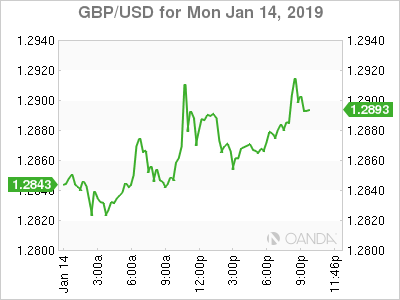
Energy prices fell more than 2 percent on Monday. Brent fell 2.35 percent and WTI 1.98 percent as disappointing data out of China hit energy demand forecasts. The Organization of the Petroleum Exporting Countries (OPEC) and other major producers have agreed to reduce production to stabilize prices, but the other side of the equation is driving prices lower. China-US uncertainty is lower after talks have been ongoing this year, but with little show after an acrimonious tariffs announcement in 2018, investors are not convinced.
March 2 is the deadline for the US and China to reach a trade deal, but given the damage of the trade restrictions had on global growth expectations it will take a significant deal to quickly undo all the pain. Chinese exports fell 4.4 percent in December and imports had their largest decline since 2016.
Saudi Arabia’s Energy Minister is not concerned about the Chinese data, but today’s price action might make him reconsider.
Natural Gas Rises 16 Percent on Colder Weather
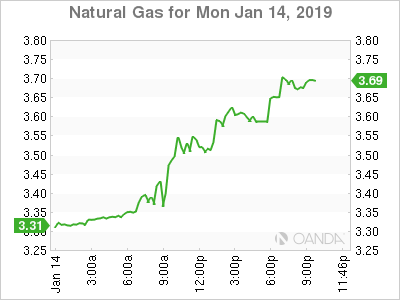
Supply and demand showed their influence in the markets as natural gas surged 16.2 percent on Monday as colder weather is expected to remain for longer in the United States. The persistence of cold weather prompted traders to build on their long natural gas positions.
The summer was surprisingly long prompting lower prices as a shorter Winter term was expected. The new weather forecasts call for a longer and colder winter and prompting a rise in natural gas prices.
Gold Rises Slightly as China Data Prompts Safe Haven Buying
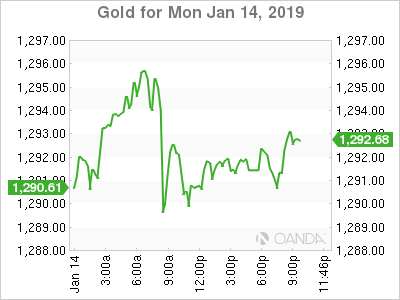
Gold rose 0.18 on Monday. The yellow metal was on its way to break the $1,300 price level after news out of China sent investors looking for cover. The softer than expected trade data out of China took gold to 1,295 only for the North American session to bring it back in line as Brexit headlines and a more stable stock market was negative for the metal.
Political uncertainty in the United States and the eventual fate of the Brexit vote will keep gold bid as investors look for a safe haven.
Eco Data 1/15/19
[php_everywhere instance="1"]
Sterling surges broadly as UK PM May delivers uninspiring statement in Commons on Brexit
Sterling overtakes Yen as the strongest major currency for today for now. Renewed buying emerges as UK Prime Minster Theresa May delivers her uninspiring statement in the Commons.
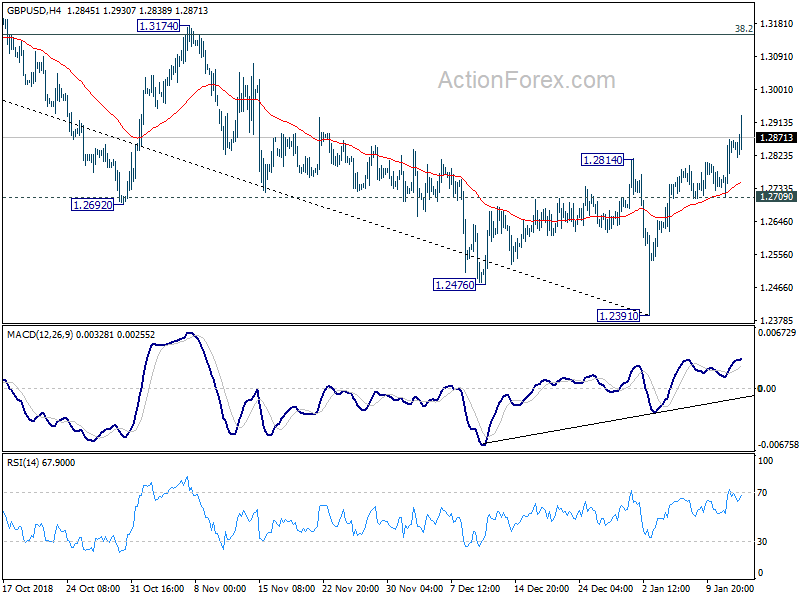
Technically, GBP/USD hits as high as 1.2930 so far. Rebound from 1.2391 is on track to 1.3174 resistance, which is close to 38.2% retracement of 1.4376 to 1.2391 at 1.3149.
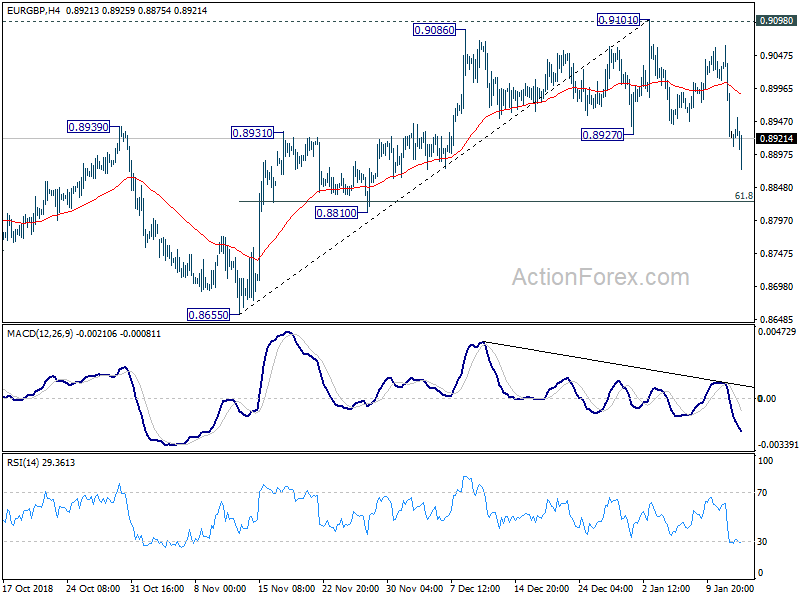
EUR/GBP dives to as low as 0.8875. We now consider 0.8927 support firmly broken. And EUR/GBP is on track to 61.8% retracement of 0.8655 to 0.9101 at 0.8825 and below.
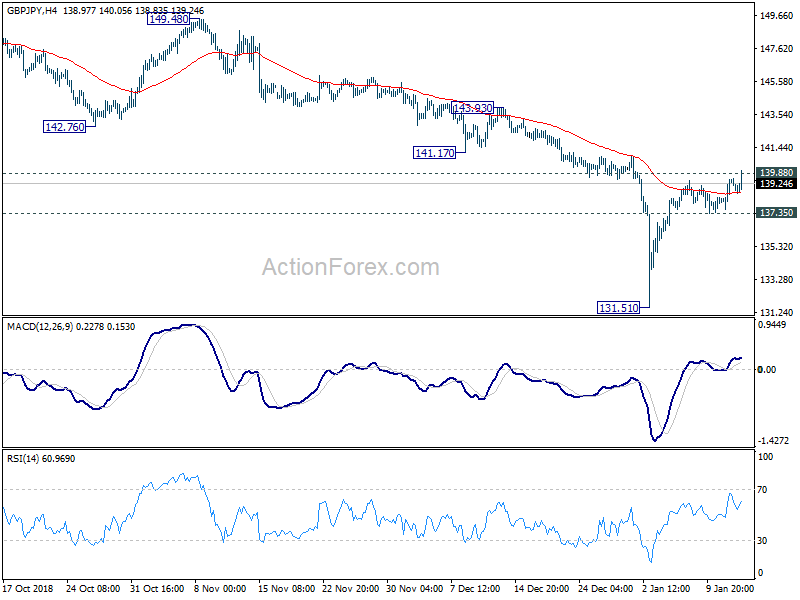
GBP/JPY, however, despite breaching 139.88 resistance to 140.05, it couldn't sustain above this resistance yet. We'll holding on to the expectation that upside of the rebound from 131.51 should be limited by 139.88 and bring reversal. Break of 137.35 minor support will turn bias to the downside for 131.51.
UK PM May gives statement in parliament on Brexit, live stream
https://www.youtube.com/watch?v=F8Jwvgdefxc
Japanese Yen Edges Higher, US Inflation Data Ahead
USD/JPY has started the week with slight gains. In Monday’s North American session, the pair is trading at 108.31, down 0.19% on the day. It’s a very light day on the release front. The sole Japanese event is M2 Money Supply, which edged up to 2.4%. There are no U.S. indicators, so the yen is likely to remain subdued during the day. On Tuesday, the U.S. releases PPI reports.
Risk appetite has improved of late, and the yen rally paused last week, as investors sought out risk assets rather than the safe-haven yen. On Monday, China released unexpectedly weak data, with exports down 4.4 percent from a year earlier and imports plunging 7.6 percent. The slowdown in China has taken a toll on corporate profits, with Apple and Jaguar Land Rover posting revenue warnings. Investors will be keeping a close eye on Chinese numbers, and further signs of a slowdown from the world’s sec
EUR/GBP – Pound May Rise Further on Brexit Plan Rejection
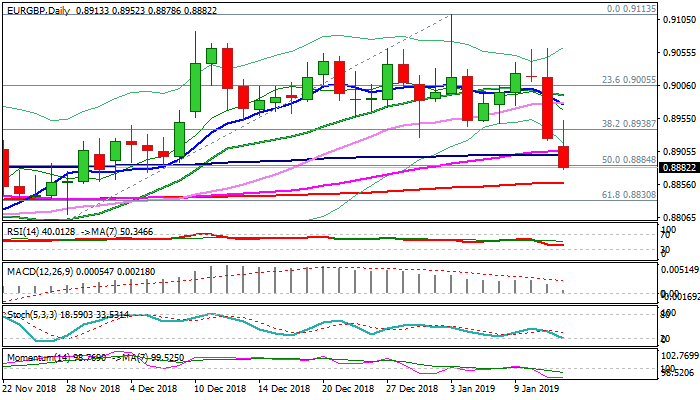
The cross stands at the back foot on Monday following Friday’s sharp fall (the pair was down1% for the day) as pound maintains positive sentiment on wide expectations that UK PM’s Brexit plan will be rejected that may force the UK to stay in the union.
Friday’s long bearish daily candle weighs, along with daily close below 0.8938 Fibo support (38.2% of 0.8686/0.9113).
Bears pressure 55/100 SMA’s (at 0.8900 zone) loss of which would expose 200SMA (0.8858) and Fibo 61.8% (0.8830).
The pound may accelerate further on Brexit vote rejection, but unlikely to violate 0.8656 (13 Nov low, the floor of wider 0.8658/0.9113 range) which would provide good entry points after traders take profits from their shorts.
Res: 0.8932; 0.8952; 0.9000; 0.9061
Sup: 0.8900; 0.8884; 0.8853; 0.8828
Trump doing well with China, rejects Republican Graham’s deal to reopen government
Trump sounded upbeat on trade negotiation with China today. He told reporters at the White House that "we're doing very well with China". And, "I think that we are going to be able to do a deal with China... China wants to negotiate".
On the other hand, Trump rejected fellow Republican' Lindsey Graham's proposal to sign a stopgap spending bill to buy more time for talks on the border wall. Trump said, "I did reject it... I'm not interested. I want to get it solved. I don't want to just delay it. I want to get it solved".
US government shutdown is now in the record fourth week as Trumps insists on demanding the funding for border wall.
Commodities Outlook 2019: Will Precious Metals Shine?
The commodities complex had a particularly volatile run in 2018, with flaring trade tensions, mounting concerns around slowing global growth, and a stronger US dollar being behind the abysmal performance of most commodities. In 2019, the outlook will hinge mainly on how the trade dispute plays out, with precious metals likely to perform well in case global risks remain pronounced, and the dollar soft.
Plethora of market risks could keep gold in fashion
Admittedly, gold had a rocky year in 2018, mostly suffering at the hands of a resurgent US dollar. Since gold is denominated in dollars, an appreciating US currency renders the metal less attractive for investors using foreign currencies, hence diminishing its demand. Yet, the yellow metal managed to recover substantially, to close the year only 1.5% lower.
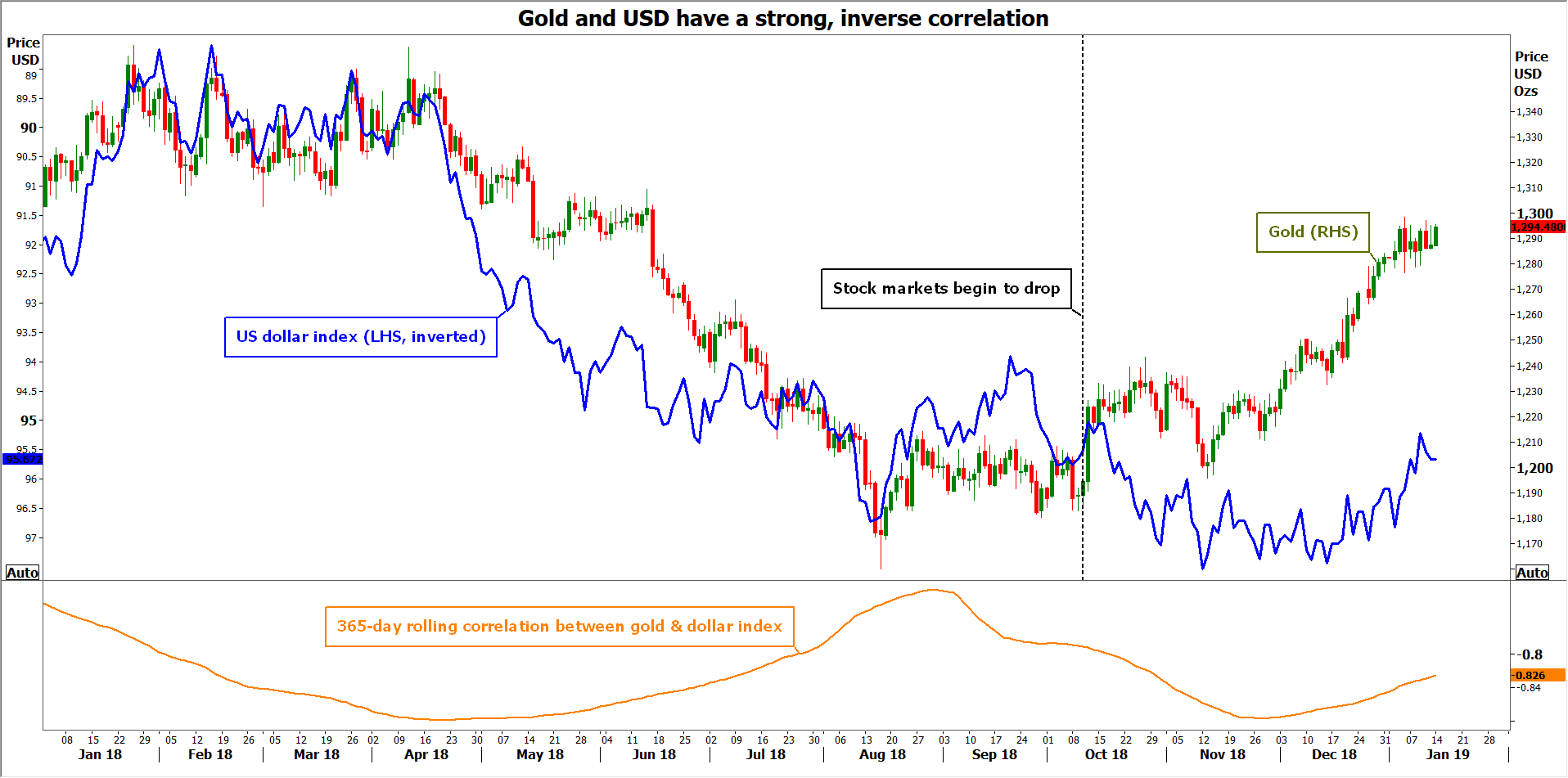
The latest pullback in the greenback aided gold’s recovery, as did the repricing of Fed rate-hike expectations, with the US central bank no longer expected to raise rates at all in 2019. Rising rates are typically negative for gold, which not only pays zero interest to hold but also carries storage costs. The final factor behind gold’s latest bounce, was of course safe-haven demand by investors seeking protection amid stock market wobbles.
Now as for what 2019 holds for the yellow metal, the risks currently seem to be skewed to the upside. The prospect of further equity market weakness, the dollar losing its shine, a slowing global economy, uncertainty stemming from protectionism, as well as EM and geopolitical risks, all present compelling arguments for gold to perform well.
In terms of downside risks, bullion’s greatest threat may be the scenario in which expectations for a US economic slowdown prove incorrect, leading the Fed to resume its gradual hiking approach. The resulting combination of higher interest rates, a stronger dollar, and reinvigorated risk appetite would be a dangerous elixir for gold.
Silver underperforms gold as mining production rebounds
While gold closed 2018 marginally lower, silver was not as fortunate, ending the year down 8.8% as a rebound in mining production boosted the white metal’s supply. Note that the annual quantity of silver mined is multiple times that of gold, so mining activity is a much more important variable for silver. Meanwhile, silver is used much more for industrial purposes, so its fortunes tend to also rely on the outlook for global growth, expectations around which have turned pessimistic.
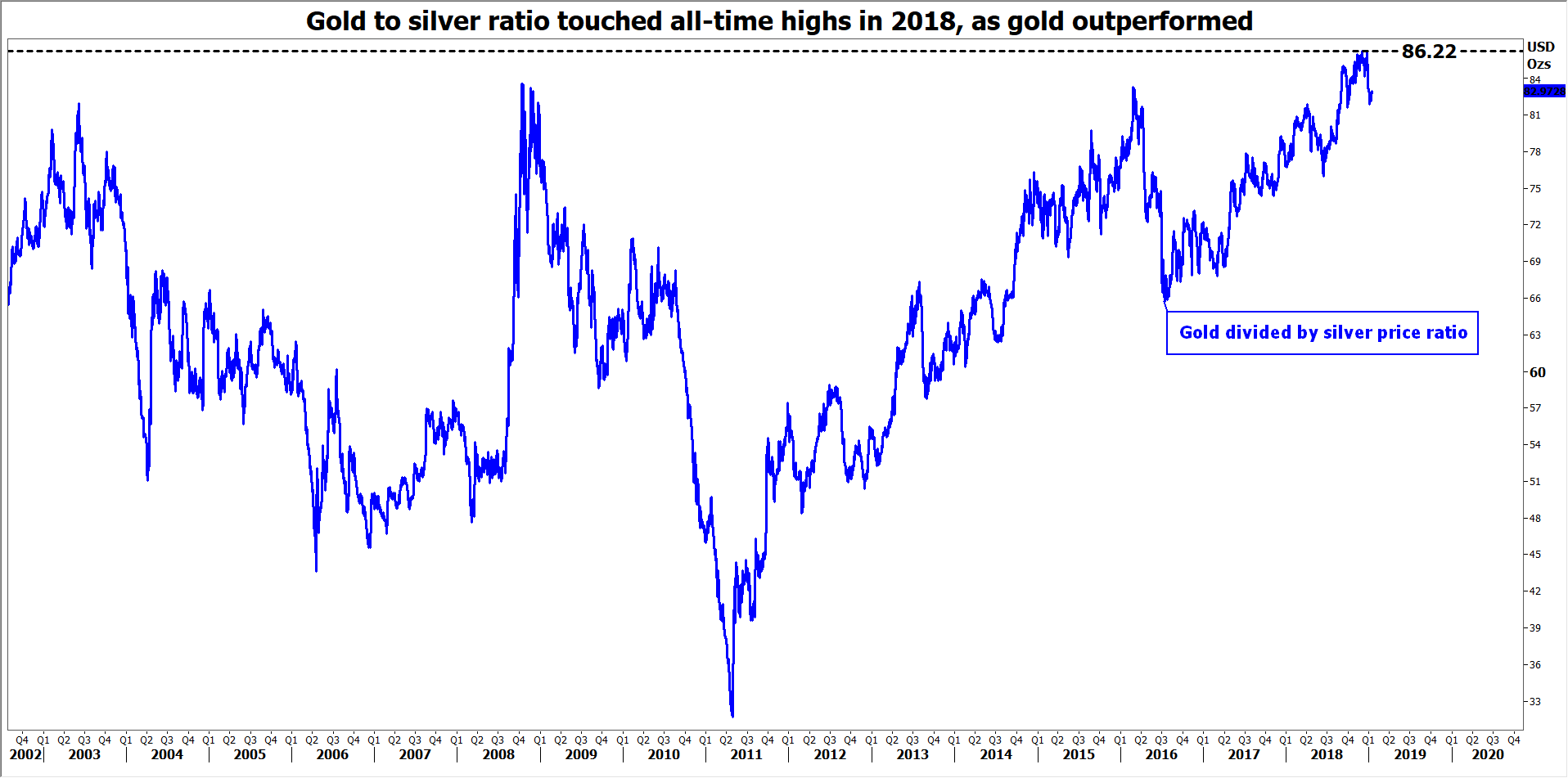
Does 2019 promise to be any brighter? If one holds a broadly constructive view on gold prices in light of the above-mentioned risks, then silver could also perform relatively well amid a potential re-allocation into safe havens. Albeit, perhaps worse than gold, keeping in mind that silver supply is expected to remain ample, and the global economy looks set to lose momentum.
Crude oil at a crossroads
Oil prices started 2018 on a strong note, amid worries that US sanctions on Iran would curtail global supply. However, crude staged a spectacular downtrend in the final quarter to close the year almost 25% lower, after the US announced it will grant six-month waivers to Tehran’s largest customers, and amidst soaring global production.
Although OPEC and allied producers recently agreed to cut production by 1.2million barrels per day in the first half of 2019, the scope and magnitude of these cuts were seen as insufficient. It also remains doubtful whether members will maintain full compliance. On the other side of the equation, the outlook for demand has been clouded by trade tensions and slowing global growth.
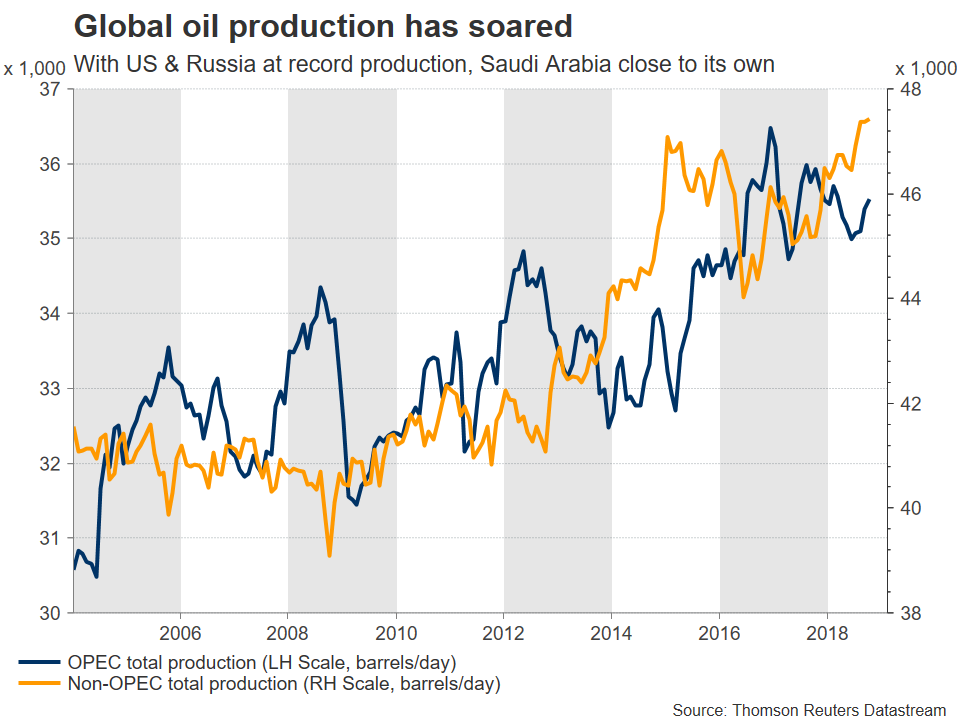
Looking at 2019 though, crude’s prospects appear cautiously bullish. Sanctions on Iran may indeed be implemented fully by April, while in the US, record production driven by shale will likely taper off following the latest price crash. Separately, it seems more likely than not a US-China trade deal will ultimately be reached, calming nerves around demand. Then there’s OPEC. Any major drop in prices from current levels would probably lead the cartel to extend, and perhaps even expand its latest cuts.
Key risks for oil include a re-escalation in trade frictions, a more severe global slowdown than anticipated, or troubled producers like Libya, Iraq, Venezuela, and Nigeria managing to raise their currently-low output in a sustained manner.
Copper’s fate hangs on trade war
Like most industrial metals, copper had a horrendous year, falling by 17.5%. China is by far the world’s largest copper consumer and hence, the trade dispute threatens demand for the metal, which is used in power and construction. In fact, China’s factory activity has already started to weaken, with both the official and Caixin manufacturing PMIs dropping into contractionary territory; an ominous sign for the next 12 months.
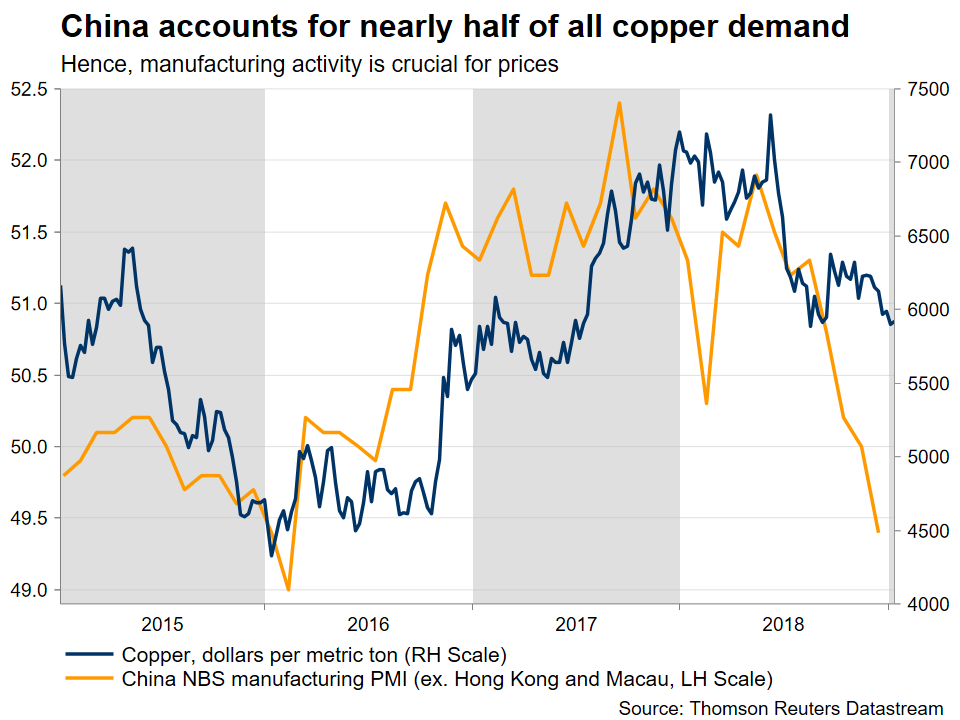
On the bright side, China is opening up the spending taps to support its economy, and most of that stimulus is expected to go into infrastructure, construction, and power projects, propping up demand for industrial metals such as copper. The biggest danger by far is that of the trade war, whose impact could spread beyond China if a deal with the US isn’t agreed, though the risk that China’s stimulus may finally prove less supportive of copper prices than hoped shouldn’t be discounted either.
Sunset Market Commentary
Markets
Global core bonds are erasing intraday gains as US investors enter dealings. German Bunds outperform US Treasuries. Risk sentiment soured this morning as the US government shutdown set a record while Chinese trade data disappointed. There’s no solution in sight with regards to the shutdown which probably starts having repercussions for the growth. The EMU trading session left no traces with November EMU production data disappointing (-1.7% M/M) as expected. The ECB warned Italian Monte dei Paschi di Siena in a letter containing draft conclusions after an annual supervisory review about the funding risks it faces. Italian stock and bond markets underperformed, partly explaining the Bund’s outperformance against the US Note future as well. On top, European investors probably prefer to err on the cautious side ahead of tomorrow’s brexit vote. German yields decline by 1.1 bp (2-yr) to 2.1 bps (10-yr) at the time of writing. Changes on US yield curve vary between +0.2 bps (30-yr) and -1.5 bps (5-yr). 10-yr yield spread changes vs Germany are close to unchanged with Italy marginally outperforming (+2 bps). The Italian debt agency announced to launch a new 15y syndicated benchmark in the near term. The bond sale will be closely watched and an important proxy for sentiment towards Italy/Italian politics.
Trading in the major dollar cross rates was confined to very tight ranges. Risk sentiment deteriorated further as poor Chinese December foreign trade data spurred investor uncertainty on the Chinese (& global) economy. Political event risk (Brexit vote and the US government shutdown) are also an ongoing source of investor uncertainty. However, it didn’t help the USD dollar. EMU November production data were very poor, as expected, but ignored by FX traders. EUR/USD held an extremely tight sideways range close to, mostly slightly above, the 1.1450 handle. Interest rate differentials were no big issue for EUR/USD trading as both German and US yields declined due to the risk-off environment. USD/JPY declined In Asia this morning, but found a new ST equilibrium in the low 108 area.
UK PM May staged a final attempt to convince lawmakers to approve her Brexit deal ahead of tomorrow’s vote in Parliament. In a speech in central England, she repeated that rejecting her deal risks to end up in no Brexit at all. The UK PM also exchanged letters with the EU to get assurance that the EU will try to avoid an implementation of the Irish border backstop, if possible. However, the EU assurance most probably won’t change tomorrow’s voting in any profound way. Sterling is still trading with a tentative positive bias though, as was the case on Friday. Some investors are apparently adapting positions for a scenario of Brexit being delayed beyond March 29. EUR/GBP is trading in the 0.8920 area. Cable gained a few ticks towards the 1.2850 area.
News Headlines
The Eurozone industrial production fell more than anticipated in November, posting a -1.7% monthly (-3.3% YoY) decline vs. -1.5% (-2.1%) expected. The sharpest fall since February 2016 shouldn’t come as a total surprise though, given the dismal data published earlier this month by Germany, France and Italy.
Hopes for a political breakthrough in Sweden are fading just days after Löfven’s Social Democrats forged a (minority) government deal with Green party, Center Party and Liberals on Friday. The Left Party said it can’t accept having “zero influence” and announced it would not back the agreement nor Löfven as PM this Wednesday.
Citigroup kicked off the 2018 Q4 earnings season on a downbeat note. The bank missed EPS estimates as high market volatility kept clients on the sidelines. Revenue from fixed-income trading slipped 21% last quarter to the lowest in 7 years. Going forward, Citi still believes it can achieve profitability gains, aiming for a 12% ROE in 2019 up from 10.9% last year.
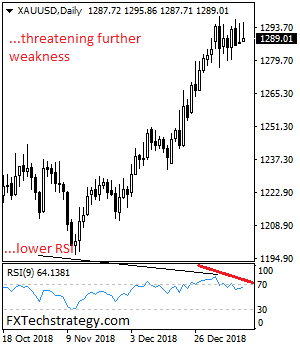
GOLD: Remains Vulnerable Below Key Resistance At 1,2987.55 Level
GOLD remains vulnerable below key resistance at 1,298.55 level as it looks for more weakness. commodity looks to pullback as it rejected higher prices the past week. On the downside, support comes in at the 1,280.00 level where a break will turn attention to the 1,270.00 level. Further down, a cut through here will open the door for a move lower towards the 1,260.00 level. Below here if seen could trigger further downside pressure targeting the 1,250.00 level. Conversely, resistance resides at the 1,290.00 level where a break will aim at the 1,300.00 level. A turn above there will expose the 1,310.00 level. Further out, resistance stands at the 1,320.00 level. All in all, GOLD looks to move further lower on correction.