Sample Category Title
Citigroup Kicks Off Earning Season With a Whimper
Normally we see JP Morgan kickoff earning season, but this time Citigroup gets to kick things off. Citigroup reported a beat on fourth quarter EPS at $1.61, higher than the $1.55 analysts’ consensus. Revenue missed with a $17.1 billion print, much lower than the eyed $17.6 billion consensus.
Citigroup shares are lower by 1.4% in the premarket trade as Wall Street focused on the steep 21% decline in fixed income markets. They noted it reflected a challenging trading environment characterized by volatile market conditions and widening credit spreads, particularly in December.
CEO Michael Corbat noted, “A volatile fourth quarter impacted some of our market sensitive businesses, particularly Fixed Income. However, our ICG accrual businesses – Treasury and Trade Solutions, Securities Services, Private Bank and Corporate Lending – continued their strong performance. And in Global Consumer Banking, we had good underlying growth in U.S. Branded Cards and solid performance from our franchise in Mexico where we have been investing. For 2019, we remain committed to delivering a 12% RoTCE and continuing to improve our operating efficiency during the year.”
US Stocks are poised to open much lower with the Dow set to open lower by 200 points.
Into US session: Yen and Swiss Franc Strongest, Aussie Weakest on China worries
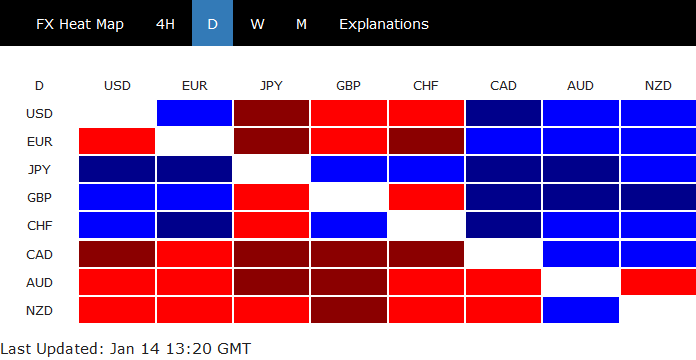
Entering into US session, Yen is the strongest one for today followed by Swiss Franc. On the other hand, Australian Dollar leads other commodity currencies lower on risk aversion. The main theme for today is further evidence of slowdown in China. Trade balance data showed both imports and expects contracted in the fastest pace since 2016 in December.
On the other hand, Brexit is another major theme. Ahead of tomorrow's vote in the parliament, UK Prime Minister Theresa May stepped her rhetorics. She warned that there are some MPs who wish to delay or even stop Brexit. And she urged MPs to vote to deliver what people decided in the referendum back in 2016. EU sent a "reassurance" letter to May today, pledging to work on a post-Brexti agreement by end of 2020 deadline to avoid triggering the backstop "in the most solemn manner". But it's unsure how such assurances could change the mind of those who already got a position. That is, those who believed no-deal Brexit is closest to what people want, and those who want no Brexit at all.
In European markets, currently:
- FTSE is down -0.86%
- DAX is down -0.59%
- CAC is down -0.72%
- German 10 year yield is down -0.0252 at 0.215
Earlier in Asia:
- Hong Kong HSI dropped -1.38%
- China Shanghai SSE dropped -0.71%
- Singapore Strait Times dropped -0.79%
- Japan was on holiday
USDCNH Erases Downward Rally; Rebounds on 6-Month Low
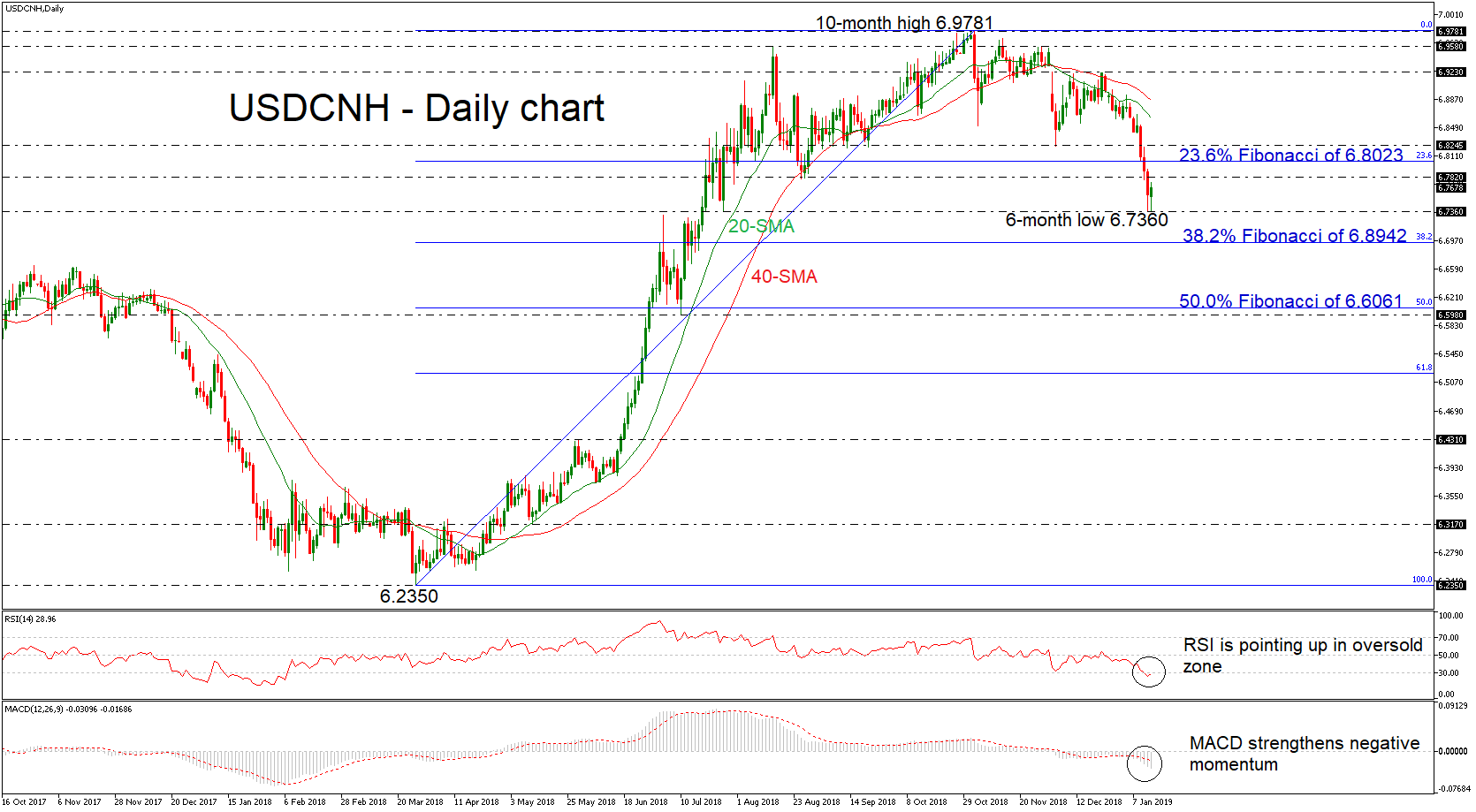
USDCNH plunged to a new six-month low of 6.7360 in Friday’s session, creating three straight negative days. The price dropped beneath the 23.6% Fibonacci retracement level of the upleg from 6.2350 to 6.9781, however, currently, it is paring some of the lost ground.
The RSI is pointing up near oversold levels, slightly below 30, indicating that the market could strengthen a little bit in the short-term until the index falls back below that threshold, while the MACD supports a bearish picture as well, since the index continues to increase negative momentum below its red-signal line.
If the market manages to pick up speed, the 6.7820 could offer nearby resistance ahead of the 23.6% Fibonacci, which stands at 6.8023. A significant close above the latter would break the 6.8545, raising chances for further increases. In this case, prices could climb towards the 20-day simple moving average (SMA) at 6.8618.
However, should prices decline, immediate support could be found around the six-month low, an area which has provided strong support level in the past as well. Then a leg below that level, the pair could meet the 38.2% Fibonacci of 6.8942 before the focus shifts to 50.0% Fibonacci region of 6.6061.
In the short-term, the outlook remains negative since prices hold below all the moving average lines and the bearish cross between the 20- and the 40-day SMAs stays in place.
Euro Subdued at Start of Week
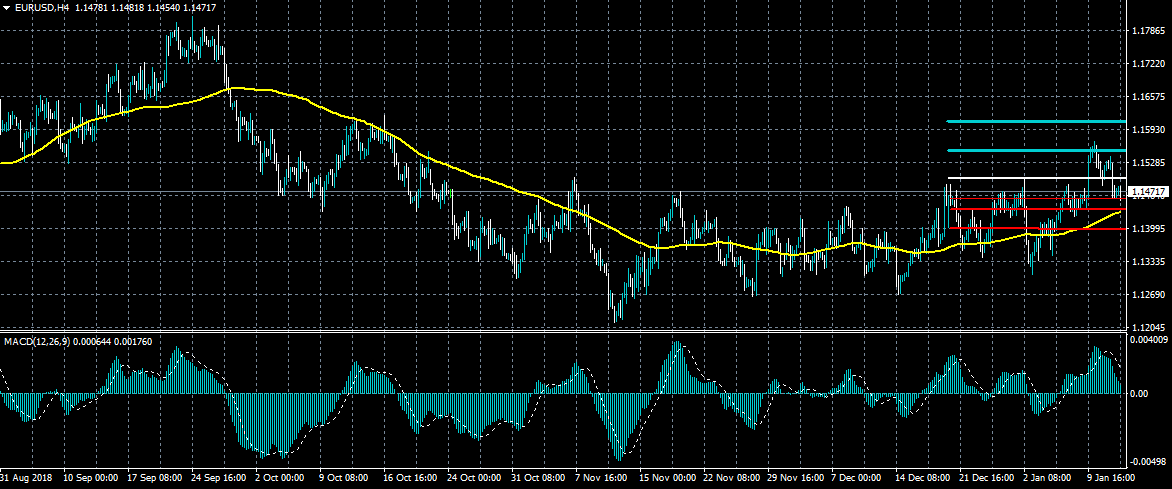
EUR/USD has ticked higher in the Monday session. Currently, the pair is trading at 1.1468, up 0.08% on the day. On the release front, it’s a quiet day. German WPI shocked with a decline of 1.2%, its weakest reading since December 2008. Eurozone industrial production fell 1.6%, much worse than the forecast of a 0.3% gain. There are no U.S events on the schedule. On Tuesday, the U.S. releases PPI reports and ECB President Draghi will testify about the ECB Annual Report.
The ongoing global trade war continues to hamper manufacturing sectors across the eurozone. Last week, industrial production in Italy fell by 1.6% in November and in France the drop was 1.3%. The alarming trend continued on Monday, as eurozone industrial production declined 1.6%. Germany, the locomotive of the bloc, is also in trouble, in which industrial production has slipped for three straight months. With the three largest economies in the eurozone showing signs of weakness, conditions may not warrant any rate increases in the foreseeable future. The ECB winded up its stimulus program last month, and had expressed plans to raise rates later this year, but this will require stronger economic conditions in the eurozone.
The euro gained ground late in the week, as the Fed’s dovish turn has reduced enthusiasm for the U.S dollar. The minutes from the Fed’s December meeting, released Wednesday, noted that low inflation levels meant that the Fed could “afford to be patient about further policy firming”. Even more striking, the minutes revealed that at the December meeting, some policymakers opposed a rate hike, arguing that inflation was too low to warrant higher rates. On Thursday, Fed Chair Jerome Powell said he was “very worried” about the massive U.S. debt and reiterated that the Fed would remain patient on monetary policy. Given that further interest rate hikes would hurt the debt burden of corporate borrowers, Powell’s remarks on the debt could be a sign that the Fed will take a pause on rate hikes in the near future, and perhaps even entertain a rate cut this year. The sharp U-turn on monetary policy by the Fed could continue to weigh on the U.S dollar for the near future.
Juncker and Tusk: EU commits in solemn manner to avoid triggering Irish backstop
European Commission President Jean-Claude Juncker and European Council President Donald Tusk sent a joint letter to UK Prime Minister Theresa May. That's for hoping to provide the "assurances" to help May get the agreed Brexit deal through the UK Parliament tomorrow.
In short, Juncker and Tusk pledged to try to reach the agreement regarding post-Brexit EU-UK relationship by the end of next year so as to avoid using the Irish backstop. They also emphasized that a commitment to speedy trade deal made by EU leaders had "legal value" which committed the Union "in the most solemn manner".
If the target date couldn't be met, UK will have an option to extend a status-quo transition period, also for avoiding to trigger the backstop. They also pledged that "If the backstop were nevertheless to be triggered, it would only apply temporarily, unless and until it is superseded by a subsequent agreement that ensures that a hard border is avoided."
Below is the full letter:
Dear Prime Minister,
Thank you for your letter of 14 January 2019.
As you are well aware, we regret but respect the decision of the United Kingdom to leave the European Union. We also consider that Brexit is a source of uncertainty and disruption. In these challenging times, we therefore share with you the determination to create as much certainty and clarity as possible for citizens and companies in a situation where a Member State leaves the European Union after more than four decades of closest economic and political integration. That is why the Withdrawal Agreement that you and the Leaders of the 27 EU Member States agreed after long negotiations is so important. It represents a fair compromise and aims to ensure an orderly withdrawal of the United Kingdom from the European Union, thereby limiting the negative consequences of Brexit. That is also why we wish to establish as close as possible a relationship with the United Kingdom in the future, building on the Political Declaration, which the Leaders of the 27 EU Member States agreed with you. It is also why we want negotiations to this effect to start as soon as possible after the withdrawal of the United Kingdom from the European Union.
As you know, we are not in a position to agree to anything that changes or is inconsistent with the Withdrawal Agreement, but against this background, and in order to facilitate the next steps of the process, we are happy to confirm, on behalf of the two EU Institutions we represent, our understanding of the following points within our respective fields of responsibility.
A. As regards the President of the European Council:
On the 13 December, the European Council (Article 50) decided on a number of additional assurances, in particular as regards its firm commitment to work speedily on a subsequent agreement that establishes by 31 December 2020 alternative arrangements, so that the backstop will not need to be triggered.
The European Council also said that, if the backstop were nevertheless to be triggered, it would only apply temporarily, unless and until it is superseded by a subsequent agreement that ensures that a hard border is avoided, and that the European Union, in such a case, would use its best endeavors to negotiate and conclude expeditiously a subsequent agreement that would replace the backstop, and would expect the same of the United Kingdom, so that the backstop would only be in place for as long as strictly necessary.
In this context, it can be stated that European Council conclusions have a legal value in the Union commensurate to the authority of the European Council under the Treaties to define directions and priorities for the European Union at the highest level and, in the specific context of withdrawal, to establish, in the form of guidelines, its framework. They may commit the European Union in the most solemn manner. European Council conclusions therefore constitute part of the context in which an international agreement, such as the Withdrawal Agreement, will be interpreted.
As for the link between the Withdrawal Agreement and the Political Declaration, to which you make reference in your letter, it can be made clear that these two documents, while being of a different nature, are part of the same negotiated package. In order to underline the close relationship between the two texts, they can be published side by side in the Official Journal in a manner reflecting the link between the two as provided for in Article 50 of the Treaty on European Union (TEU).
B. As regards the President of the European Commission:
The Political Declaration agreed at the November Special European Council (Article 50) describes a future relationship of unprecedented depth and breadth, reflecting the continuing strength of our shared values and interests. The Withdrawal Agreement and the Political Declaration represent a fair balance of European Union and United Kingdom interests. They will ensure a smooth withdrawal and a strong future relationship in the interests of all our citizens.
As the European Council has already stated, it will embark on preparations for a future partnership with the United Kingdom immediately after signature of the Withdrawal Agreement. As regards the European Commission, we will set up the negotiating structure for these negotiations directly after signature to ensure that formal negotiations can start as soon as possible after the withdrawal of the United Kingdom, having in mind the shared ambition of the European Union and the United Kingdom to have the future relationship in place by the end of the transition. Should national ratifications be pending at that moment, the Commission is ready to propose provisional application of relevant parts of the future relationship, in line with the legal frameworks that apply and existing practice. The Commission is also ready to engage with you on a work program as soon as the United Kingdom Parliament has signaled its agreement in principle to the Withdrawal Agreement and the European Parliament has approved it.
There is an important link between the Withdrawal Agreement and the Political Declaration, reflecting Article 50 of the Treaty on European Union. As stated in Article 184 of the Withdrawal Agreement and reflected also in Paragraph 138 of the Political Declaration, the European Union and the United Kingdom have committed to use best endeavors, in good faith and in full respect of their respective legal orders, to take necessary steps to negotiate expeditiously the agreements governing their future relationship referred to in the Political Declaration.
In light of your letter, the European Commission would like to make the following clarifications with regard to the backstop:
The Withdrawal Agreement including the Protocol on Ireland/Northern Ireland embodies the shared commitment by the European Union and the United Kingdom to address the unique circumstances on the island of Ireland as part of ensuring the orderly withdrawal of the United Kingdom from the European Union. The Commission can confirm that, just like the United Kingdom, the European Union does not wish to see the backstop enter into force. Were it to do so, it would represent a suboptimal trading arrangement for both sides. The Commission can also confirm the European Union's determination to replace the backstop solution on Northern Ireland by a subsequent agreement that would ensure the absence of a hard border on the island of Ireland on a permanent footing.
The European Commission can also confirm our shared understanding that the Withdrawal Agreement and the Protocol on Ireland/Northern Ireland:
- Do not affect or supersede the provisions of the Good Friday or Belfast Agreement of 10 April 1998 in any way whatsoever; they do not alter in any way the arrangements under Strand II of the 1998 Agreement in particular, whereby areas of North-South cooperation in areas within their respective competences are matters for the Northern Ireland Executive and Government of Ireland to determine;
- Do not extend regulatory alignment with European Union law in Northern Ireland beyond what is strictly necessary to avoid a hard border on the island of Ireland and protect the 1998 Agreement; the Withdrawal Agreement is also clear that any new act that the European Union proposes should be added to the Protocol will require the agreement of the United Kingdom in the Joint Committee;
- Do not prevent the United Kingdom from facilitating, as part of its delegation, the participation of Northern Ireland Executive representatives in the Joint Committee, the Committee on issues related to the implementation of the Protocol on Ireland/Northern Ireland, or the joint consultative working group, in matters pertaining directly to Northern Ireland.
The European Commission also shares your intentions for the future relationship to be in place as quickly as possible. Given our joint commitment to using best endeavors to conclude before the end of 2020 a subsequent agreement, which supersedes the Protocol in whole or in part, the Commission is determined to give priority in our work program to the discussion of proposals that might replace the backstop with alternative arrangements. In this context, facilitative arrangements and technologies will be considered. Any arrangements which supersede the Protocol are not required to replicate its provisions in any respect, provided that the underlying objectives continue to be met.
Should the parties need more time to negotiate the subsequent agreement, they could decide to extend the transition period, as foreseen in the Withdrawal Agreement. In that case, the Commission is committed to redouble its efforts and expects the same redoubled efforts from your negotiators, with the aim of concluding a subsequent agreement very rapidly. Were the backstop to enter into force in whole or in part, it is intended to apply only temporarily, unless and until it is superseded by a subsequent agreement. The Commission is committed to providing the necessary political impetus and resources to help achieving the objective of making this period as short as possible. To this end, following the withdrawal of the United Kingdom, and until a subsequent agreement is concluded, the Commission will support making best use of the high level conference foreseen in the Political Declaration to meet at least every six months to take stock of progress and agree the appropriate actions to move forward.
Finally, in response to your concern about the timetable, we would like to make it clear that both of us will be prepared to sign the Withdrawal Agreement as soon as the meaningful vote has passed in the United Kingdom Parliament. This will allow preparations for the future partnership with the United Kingdom immediately thereafter to ensure that negotiations can start as soon as possible after the withdrawal of the United Kingdom from the European Union.
Yours sincerely,
Donald Tusk, Jean-Claude Juncker
Elliott Wave Analysis: German DAX And EURUSD Intra-day Developments
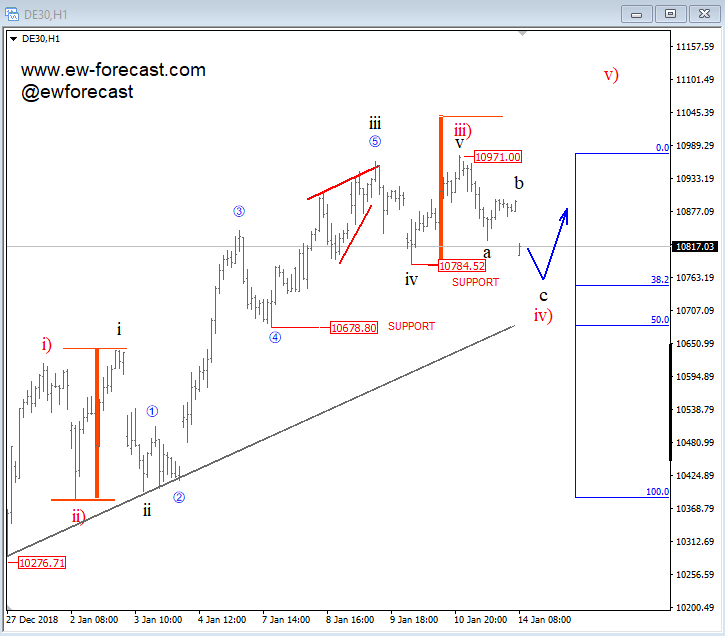
DAX is still unfolding a five-wave rally from the lows which can be an indication of a bottom at 10276. So, currently we are tracking a wave iv) correction that can be either a flat or a triangle pattern, so sooner or later DAX can be headed back to the highs for wave v), while it stays above 10600 area. Technically speaking, after today's gap down, ideal support for wave iv) would be here around 10780 and 10670 levels.
 German DAX, 1h
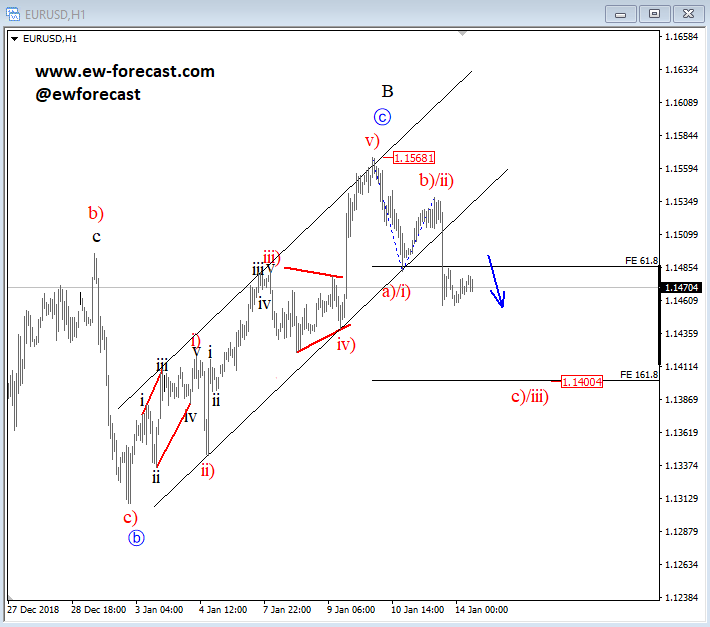
EURUSD made a pretty big decline from 1.1568 highs followed by a break below channel support line which can be the first evidence of a bearish reversal. That being said, at the moment, we only see three waves from the highs, so only if we see an extension and acceleration towards 1.14 area, only then we may start considering a bearish five-wave cycle.
EURUSD, 1h
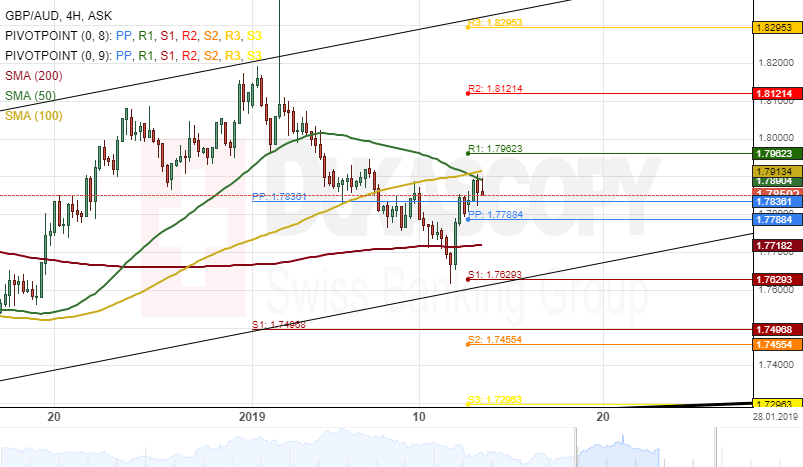
GBP/AUD 4H Chart: Testing 50–And 100-Hour SMAs
The Pound Sterling has depreciated about 1.74% against the Australian Dollar since January 7. However, a support level formed by the weekly S1 at 1.7629 hindered the currency pair from further depreciation.
Currently, the exchange rate is testing a resistance cluster formed by the combination of the 50– and 100-hour SMAs at 1.7908.
If this cluster holds, the currency exchange rate will aim for the lower boundary of an ascending channel pattern at 1.7600 today.
However, if the pair passes the SMAs, the next target for bullish traders during the following trading sessions will be at the upper boundary of the channel pattern at 1.8295.
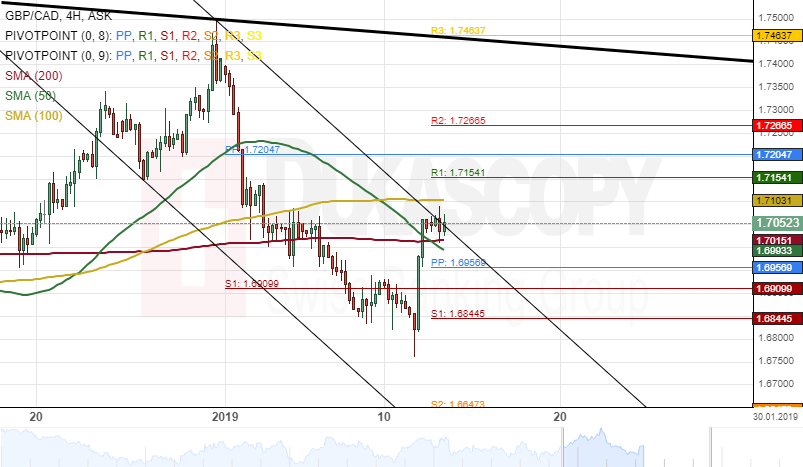
GBP/CAD 4H Chart: Breaches Channel Pattern
The GBP/CAD currency pair has been appreciating in a descending channel pattern. This surge began after the Pound Sterling breached a support level formed by the weekly S1 at 1.6844.
The exchange rate tested the upper boundary of the descending channel pattern at 1.7079 during the Asian session on Monday.
Given that the currency exchange rate has breached the channel pattern, it is likely that the pair could aim for the monthly PP at 1.7204 today.
However, a resistance level formed by the 100-hour SMA at 1.7103 could restrict the British Pound from gaining further strength against the Canadian Dollar during the following trading sessions.
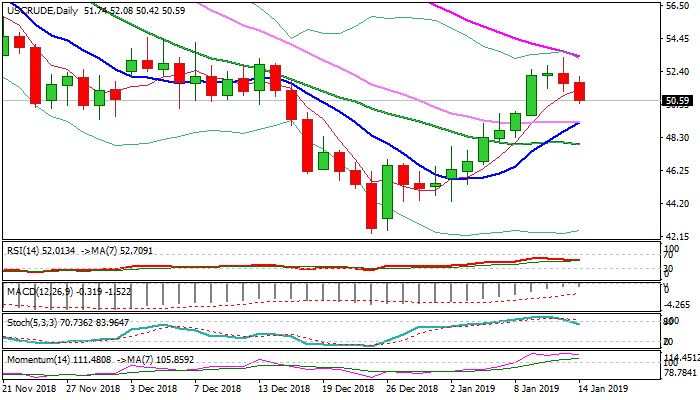
WTI OIL Outlook: Recovery May Be Paused For Deeper Pullback
WTI oil holds in red for the second straight day, with fresh weakness on Monday being boosted by weaker than expected China's export/import data.
Friday's bearish outside day was initial signal of reversal after strong recovery rally from new multi-month low at $42.36 showed signs of stall on approach to falling thick daily cloud (action was capped by falling 55SMA).
Slow stochastic reversed from overbought territory, while momentum and slow stochastic are turning south and adding to negative near-term outlook.
Correction comes after strong recovery in past two weeks when oil price advanced around 14% but failed to close above cracked 200WMA ($52.28).
Current action could be seen as positioning for fresh recovery and eventual attack at daily cloud base ($55.08), as improved sentiment in oil market sets scope for further advance. Psychological $50 level marks solid support, with extended dips to find support at $49.25 (converged 10/30SMA's) to keep bullish bias. Conversely, break here would weaken the structure, with extension below $47.88 (20SMA / 50% of $42.36/$53.29 recovery leg) needed to confirm reversal.
Res: 51.30; 52.28; 53.21; 54.54
Sup: 50.00; 49.25; 49.11; 48.28
EURUSD Awaiting Technical Breakout
The euro is trading in an increasingly narrow range against the US dollar, as the pair struggles to find an intraday directional bias. A clear break from the 1.1460 to 1.1490 price range is currently needed, although short-term momentum is currently with sellers. The EURUSD pair may also be trading cautiously, ahead of European Central Bank President Mario Draghi’s keynote speech on Tuesday.
The EURUSD pair is intraday bearish while trading below the 1.1460 level, key technical support remains at the 1.1430 and 1.1400 levels.
If the EURUSD pair breaks above the 1.1490 level, buyers may test towards the 1.1530 and 1.1550 resistance levels.