

Sample Category Title
EURUSD Challenges Descending Trend Line, Bulls May Take Control
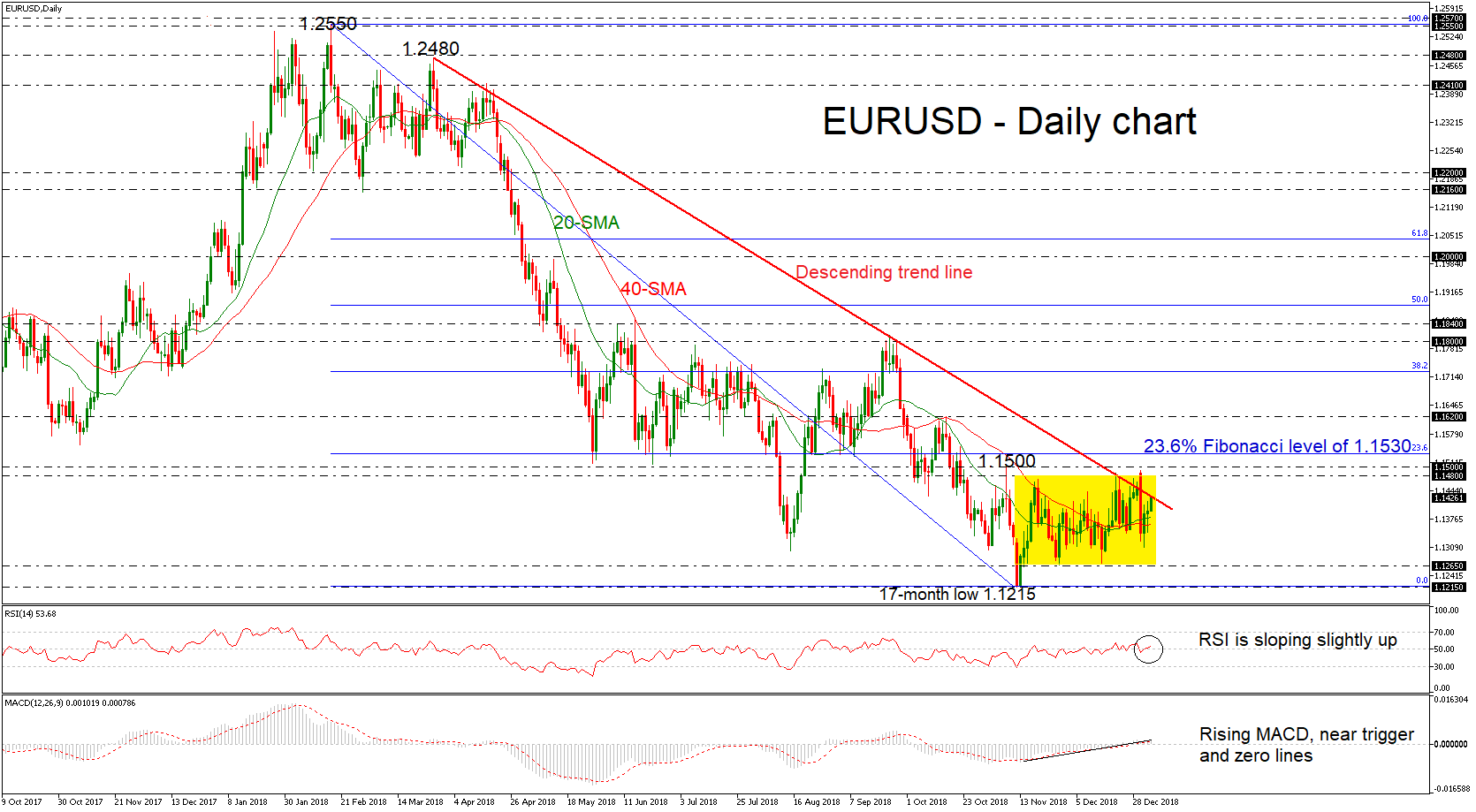
EURUSD is challenging the long-term descending trend line, creating positive movement in the narrow range. The price has been developing within a consolidation area over the last three months with the 1.1480 resistance level as the upper boundary and the 1.1265 support barrier as the lower boundary. If the price jumps above the diagonal line, it would change the outlook to a more neutral one.
Momentum indicators in the short-term though are currently supporting that neutral momentum. Specifically, the RSI indicator is pointing somewhat upwards near 50, while the MACD oscillator continues to stand marginally above the trigger and zero lines, moving positively and signaling a slightly bullish mode.
In case of a climb above the falling trend line, the pair could find a stop around the 1.1480 – 1.1500 resistance area, before hitting the 23.6% Fibonacci retracement level of the downleg from 1.2550 to 1.1215 around 1.1530. More advances could send prices towards the 1.1620 resistance, taken from the high on October 16.
On the flipside, should the pair experience negative pressure, it could challenge the 20- and 40-day simple moving averages (SMAs) around the 1.1370 barrier, before the price heads sharply lower towards the 1.1265 support level. In case of steeper declines, the pair could breach this trough, diving to the 17-month low of 1.1215, which was reached on November 13.
To sum up, bulls seem to be ready to break above the descending trendline, however, there are significant obstacles remaining before posting a sharp bullish rally in the short term.
EUR/USD: Euro Buyers Guilty Of Over-Reliance On A USD Sell-Off
It was only six months ago that the consensus was building that 2019 would be the year of the Euro. Although the reality as we enter the early stages of the new trading year is that instead of 2019 becoming the year where the Euro bounces back, is that the currency of Europe faces high risks of becoming an unfortunate casualty of global market turmoil.
The Euro, British Pound and Australian Dollar stand as the prime contenders to suffer the most out of the G-10 currencies from a prolonged risk-off environment in financial markets, where investors are unwilling to add risk into their portfolios due to ongoing concerns over slowing global growth.
What still hasn’t been priced into the Euro with the focus in Europe for a number of months directed on the Italian budget deficit is how exposed the Eurozone economy is to headwinds from the expected global economic slowdown. The prolonged trade tensions between the United States and China is also a major risk to the European economy. Europe relies heavily on demand from both nations for its goods, therefore if each of the economies in question slowdown this year this will have a resulting consequence on European data.
Thelikelihood of weakening economic momentum in the EU will also wipe away optimism that the ECB will aim to raise interest rates before the end of 2019.This would represent more bad news to Euro investors, and I see the probability of market expectations for a potential rate hike from the ECB to be pushed back sooner rather than later.
This means that when looking for opportunities for the Euro to extend higher in 2019, we are limited to bounces higher on USD weakness. This is where investors should spot another potential concern for the Euro because market participants are entering 2019 guilty of becoming too bearish on the Greenback. Yes, the United States economy is expected to slow down this year and this would be negative for the USD.However, an economic slowdown in the United States will not change the fact that the U.S. economy is still outperforming many of its developed peers and even emerging markets. If the expected global economic downturn does arise early in 2019, I would expect this to be positive for the USD because US assets are still favored byinvestors due to their yield on offer.
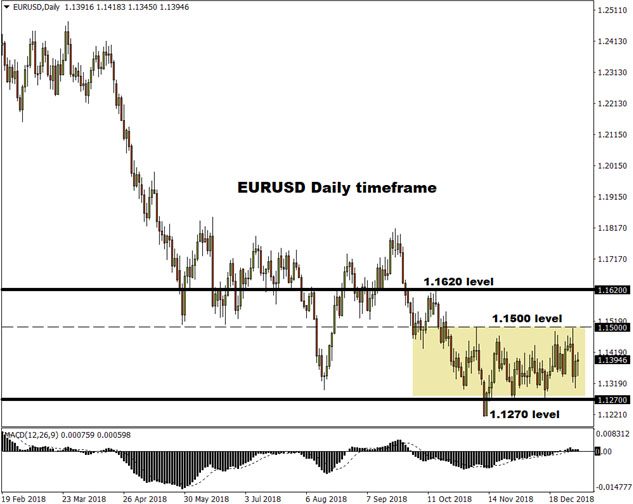
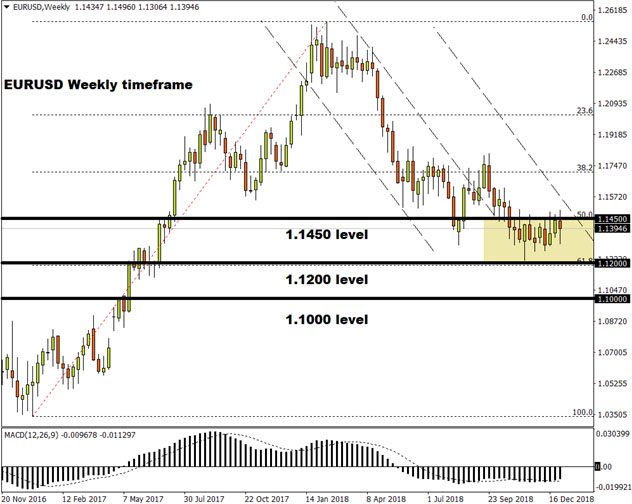
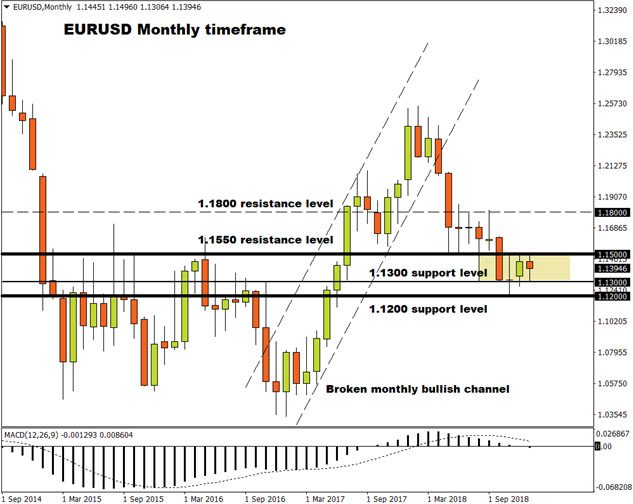
In regards to the technical outlook, we can see that the EURUSD has found stubborn short-term support close to 1.13, but travelled withina very narrow range between 1.145 and 1.12 for most of the final quarter of 2018. Even if the Euro manages to rally higher, the EURUSD faces tough resistance at 1.15 which will probably be used by investors as an opportunity to attack the Euro on rallies.
On the flip side, a breakdown on the monthly chart below 1.12 will be seen as inspiration for investors to send the EURUSD to levels that can potentially extend below 1.10.
GBP/USD: Outlook Blurred By Brexit Limbo
The chronic uncertainty surrounding Brexit negotiations has offered nothing but pain and punishment for the British Pound. The extent of the unknowns around the path of Brexit makes it very difficult to provide any direction, or market expectations on future Pound movements until the pending vote for the Brexit deal scheduled week commencing 14 January is out of the way.
Most views on the British Pound are understandably negative, but it does appear that a high level of bad news has already been priced into the Pound. This means that the market will require guidance that the United Kingdom is falling into an unfortunate disorderly Brexit trap to send the Pound to the low 1.20’s.
Growing concerns revolving around a nightmare no-deal outcome have drained investor confidence thoroughly throughout the past couple of months, while chaos within the Commons has added further fuel to the raging Brexit flames. With the UK political and economic landscape negatively influenced by the Brexit limbo, investors are expected to remain hesitant to hold Sterling.
The mounting pessimism and negativity over parliament approving any deal Theresa May brought forwardbasically means that fireworks are expected for the Pound in anticipation of the previously postponed crucial vote from MPs on the Brexit deal early January. The Irish border backstop clause very much remains as a spanner in the works preventing further progress in Brexit talks, and with this clearly treated as a very sensitive issue for UK MPs what impact this could have on the pending vote in Parliament scheduled for week commencing14January remains open to interpretation.
Adisorderly no-deal outcome remains unlikely, but this scenario must not be overlooked as it could have catastrophic consequences on both the UK and EU economy. If it becomes apparent that the UK is on a collision course to crashing out of the European Union with no deal in place, Sterling will most likely suffer severe losses.
Regardless of the macroeconomic conditions in the UK, the Pound’s trajectory will be heavily dictated by Brexit developments this quarter. With the Bank of England expected to remain status quo on interest rates amid the endless uncertainty, the fundamental outlook for Sterling swings in favour of bears.
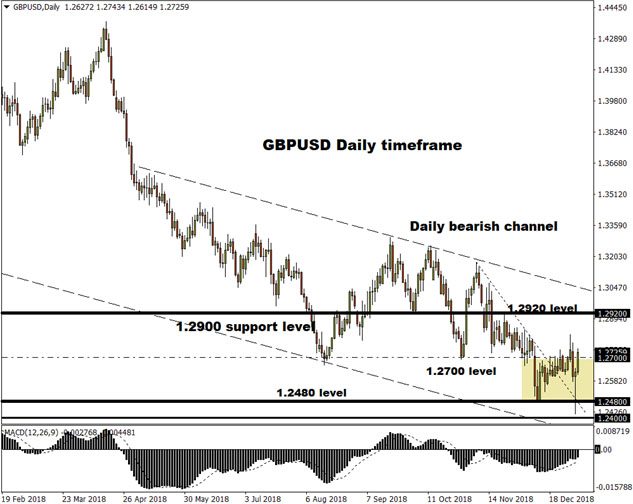
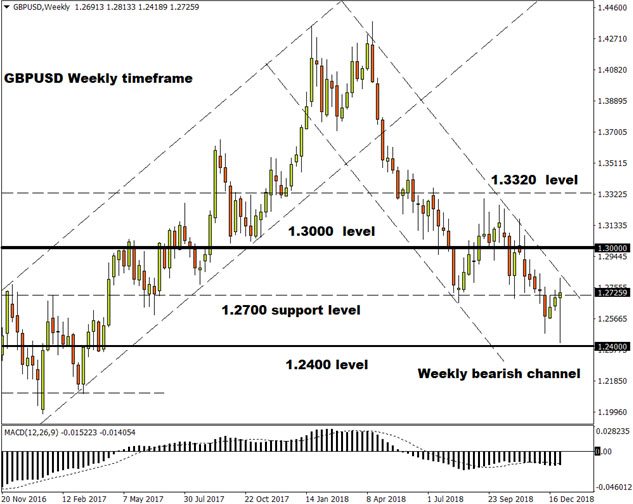
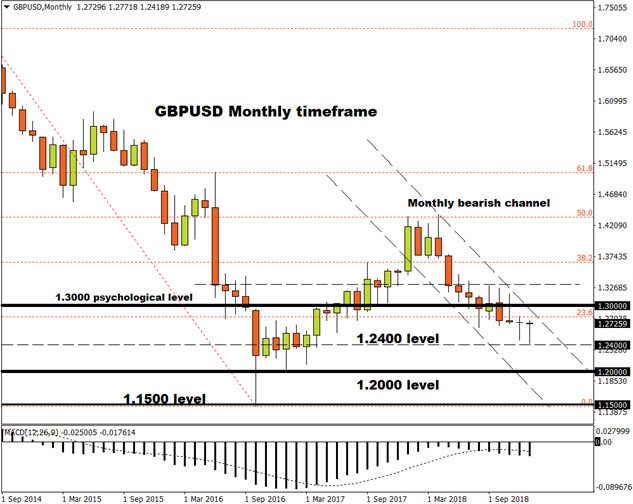
The technical outlook for the GBPUSD points to further downside on the monthly timeframe with prices trading within a bearish channel. Price action suggests that the 1.3000 resistance level will continue to act as a psychological barrier preventing upside gains. Sustained weakness below the 1.2700 level is seen opening a path back towards 1.2480 and1.2400, respectively. With the Pound extremely sensitive to Brexit developments, Sterling still has the ability to rebound on any market-friendly outcomes.
AUD/USD: Aussie Dollar – The Losing Dark Horse Contender For 2019
2019 is not expected to be a kind year for the Australian Dollar. The currency is at risk to entering the new trading year under unexpected negative momentumamid investor fears over a synchronized global economic slowdown in 2019.
What needs to be considered for Australia heading into 2019 is that the expected economic downturn will also be evident throughout Asia and a number of different emerging markets within geographic proximity. This will be a different circumstance for the region as a whole to contend with when you factor in that these economies actually emerged stronger on the back of the world financial crisis a decade ago. This time the Asian region will be one of the first to report weaker growth.
Investors should also not forget that the Australian Dollar stands as one of the most historically overvalued currencies in the developed markets. The negative implications of prolonged trade tensions between the United States and China are going to impact Australia more than the market has as ofyet priced in. China still remains as Australia’s largest trading partner, and it was the economic boom in China that had a positive knock-on effect for Australia.
I also feel that what will surprise market participants over the upcoming quarter is how sensitive the Australian currency can be during periods of market uncertainty. The Aussie relies on strong levels of risk appetite.With the previous mindset of investors “buying the dips” during stock market sell-offs aging as a trend, “selling the rallies” is going to limit buying interest in the Australian Dollar.
For investors who want to remain loyalto the Aussie Dollar in Q1,they needmarket euphoria from an actual resolution to the trade tensions between the United States and China. This is something completely out of the hands of Australia and I wouldn’t hold my breath that a resolution will be agreed anytime soon either, when considering that this is something financial markets have been hoping for since the second half of 2018.
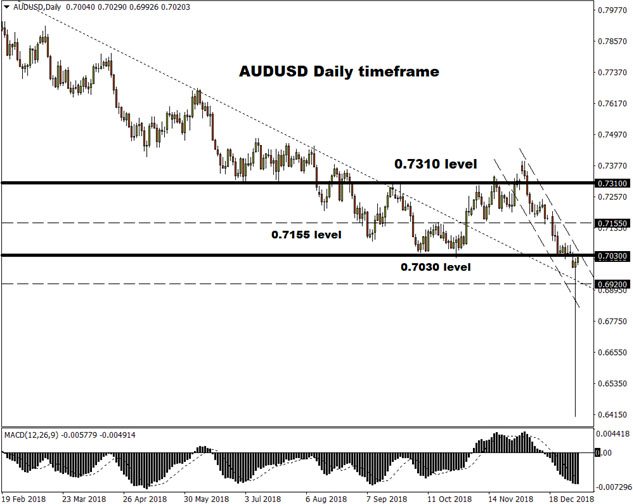
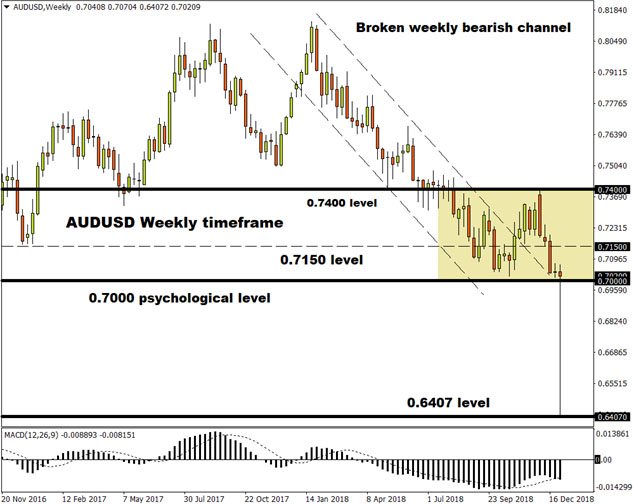
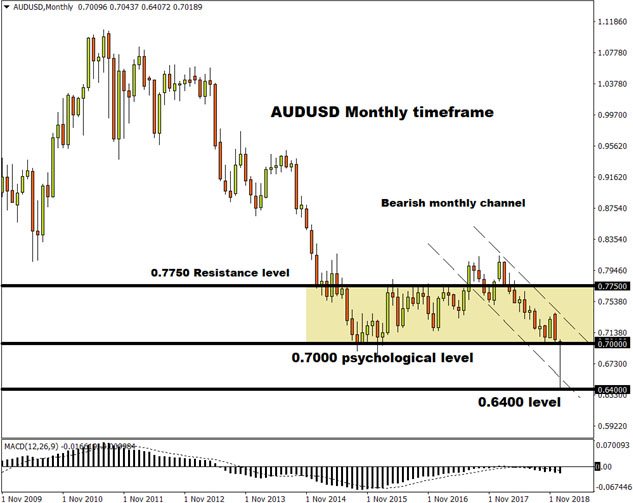
Taking a look at the technical picture, the AUDUSD monthly close narrowly above 0.70 in December 2018 suggests that the market will be encouraged to sell the Aussie early 2019.
A solid monthly and weekly close below the psychological 0.70 level holds the potential to attract investors swarming to attacked the AUDUSD lower.
0.70 will be viewed as a critical level for the AUDUSD and if this level becomes stubborn support, the alternative view is that the pair can rebound towards 0.7150 and even 0.7310 if risk appetite returns.
WTI Oil: Conflicting Fundamental Drivers To Overshadow OPEC Headlines
Persistent concerns over excessive supply coupled with worrying signs of falling demand exposed Oil markets to severe losses during the final trading quarter of 2018. The pessimistic view that the global economy is going to enter a slowdown in 2019 is why the outlook for Oil remains negative into the new year.
Ongoing geopolitical risks in the form of U.S.-China trade disputes represent a significant concern to demand prospects for Oil at a similar time to where many economies are reporting weaker economic data, which favours the short-term outlook that bears are still to be in control of Oil fluctuations. Concerns over a slowdown in the global economy are also seen overshadowing OPEC-related headlines, because market participants are going to focus attention instead on global slowdown worries which are seen promoting market uncertainty and therefore, encouragement to sell riskier assets like Oil.
As we head into 2019, Oil prices are poised to be pulled and tugged by conflicting fundamental drivers with various uncertain market conditions clouding the medium to longer term outlook. While OPEC and Russia productions cuts have the ability to shave excess supply, it is likely to promote more U.S.Oil production – ultimately exposing Oil markets to more oversupply concerns. Escalating U.S.-China trade tensions, the health of the global economy and most importantly Chinese Oil demand will heavily influence the demand side of the equation. Any further signs of an economic slowdown in China amid trade tensions will be very bad news for energy markets, especially when considering how Asia is a major Oil consumer.
Other forces seen influencing Oil prices during Q1 will include the Dollar’s performance and sporadic Tweets from U.S. president Donald Trump. A weaker Dollar amid speculation of the Fed taking a pause on rate hikes will be a welcome development for Oil prices because the commodity is denominated in Dollars. With President Trump already celebrating low Oil prices on Twitter and predicting further declines this year, investors should fasten their seat belts for another volatile trading quarter.
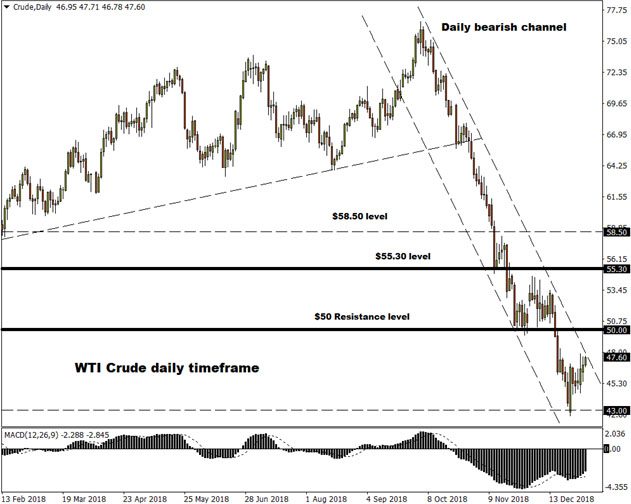
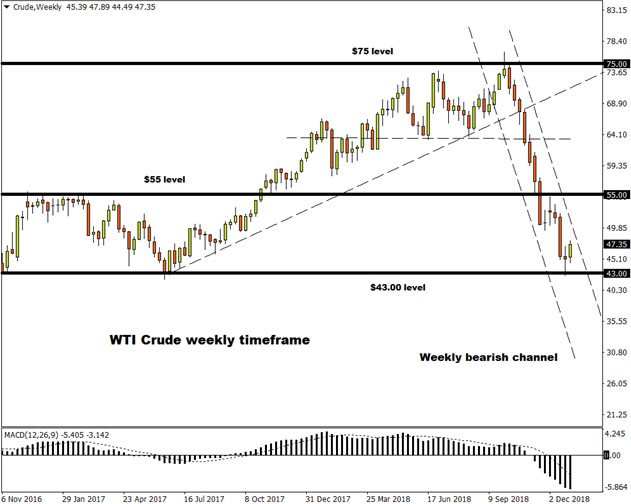
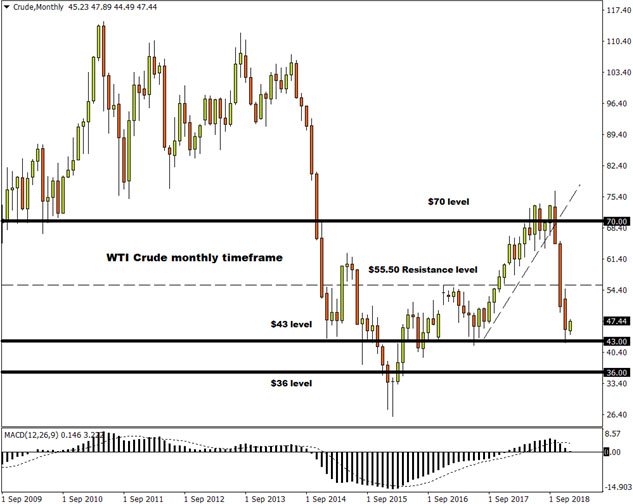
Taking a look at the technical picture, WTI Crude is unquestionably bearish on the weekly and monthly timeframes. The solid yearly close below $50 in 2018 signals that bears remain in firm control with the next key levels of interest back at $45, $43 and $36. Weekly traders will be concerned with how prices react to the $43 level and will use this range to judge if a technical rebound could be on the cards.
Focusing on the daily timeframe, WTI still remains in a bearish trend. Previous support around $50 could transform into dynamic resistance that encourage a move back towards $43. Alternatively, a breakout above $50represents the key to opening a path higher towards $55.30.
With the supply and demand dynamics clearly not in favour of oil markets, bears have a firm grip on WTI.
Fasten Your Seatbelts, 2019 Will Be A Wild Ride
The final quarter of 2018 will be remembered as a dramatic one for financial markets. Don’t expect this trend to change in the early period of 2019.
Financialmarkets have been severely hit by accelerating signs of an economic slowdown, trade concerns, geopolitical risks, and the tightening of U.S. monetary policy. Volatility has returned with steep moves to the downside. Selling the rallies is now seen as a preferred strategy from investors as opposed to buying the dips which has been closely followed by traders over the last several years.
Global synchronized economic growth was the key theme in 2017. Year 2018 saw the divergence between the U.S. and the rest of the world. In 2019 we are likely to converge again, but this time in a synchronized global slowdown. Many indicators have indicated a peak in the U.S. economic cycle, including most recent economic surveys, financial conditions, housing data, and the inversion of the U.S. Treasury yield curve. Adding this together with trade tensions, political risk, fading fiscal stimulus, and a tighter U.S. monetary policy; the economic outlook is expected to look much more vulnerable in 2019.
It is becoming evident that the U.S. economy has reached an inflection point. This doesn’t necessarily mean we are immediately entering a recession but expect much slower growth than the 4.2% seen in the second quarter of 2018. In such an environment, investors need to be prepared for a more volatile year as markets adjust toa new reality of slower economic growth.
In Foreign Exchange markets, the U.S. Dollar was the second-best performing major currency in 2018 after the Yen. It rose more than 4% against its major peers and appreciated significantly against commodity and emerging markets currencies. However, there is a high probability for the Dollar rally to come to an end in 2019.
There were numerous factors that supported the Dollar in 2018. Robust economic expansions, fiscal stimulus, a hawkish Federal Reserve, and fund repatriation by U.S. firms were key to the Dollar’s strength. Looking into 2019, none of these factors will remain in play.
Brexit is fast approaching and will likely make most of the headlines in the first couple of weeks in 2019. Although Prime Minister Theresa May has finalized the UK Withdrawal Agreement in November 2018, it’s not a done deal yet. Sterling will face a tricky situation in the months ahead. While an orderly exit from the EU will be welcomed by markets and provide a boost to the Pound, a no deal scenario has multiple outcomes with a varying degree of impact on U.K. assets. Are we going to see a disorderly exit from the EU, an extension to the deadline, a general election, or no Brexit at all? With all these possible scenarios, expect to see large swings in Sterling until the Brexit clouds clear.
Gold: Expected To Shine Through Market Chaos
Gold glittered intenselyduring the final quarter of 2018 as persistent trade tensions, explosively volatile equity markets and fears of plateauing global growth sent investors sprinting to safety. With none of these themes showing signs of letting up, there are plenty of reasons to expect Gold to continue its revival into 2019.
Themes that can support Gold this year include heightened political uncertainty in France, Italy’s budget drama and the ongoing Brexit turmoil of uncertainty. All of these circumstances provide just a few reasons to remain supportive on the yellow metal’s appeal as a safe-haven. When you then factor into the equation anxiety over the ongoing market turmoil and also fears the global economy is expected to enter a downturn, signals are clear that bulls are ready in the vicinity to purchase the precious metal.
As we enter Q1 of 2019, the outlook for Gold will be heavily influenced by geopolitics, U.S. rate hike speculation and equally as important, the Dollar’s trajectory. Rising geopolitical tensions across the globe are likely to fuel risk aversion and accelerate the flight to safety – ultimately elevating Gold prices higher. Persistent U.S.-China trade tensions coupled with severely depressed stock markets remain major factors that will positively impact Gold’s outlook.
Macroeconomic conditions in emerging market markets will be another important factor when determining Gold’s direction. Emerging markets have been treated without mercy by the unfavorable market conditions with geopolitical risks draining investor confidence. Physical demand for the yellow metal could take a hit if growth in emerging markets decelerates sharply this year. On the bright side, possible Dollar weakness will be a welcome development for EM currencies as it boosts consumer purchasing power for Gold.
While Gold’s near-term outlook hangs on the Dollar’s performance, the longer-term direction will be determined by the U.S.-China trade tensions, Federal Reserve, health of the global economy and developments across emerging markets. If global market conditions fail to improve and risk aversion reigns, Gold is in line to be one of the very few instruments that shines through in 2019.
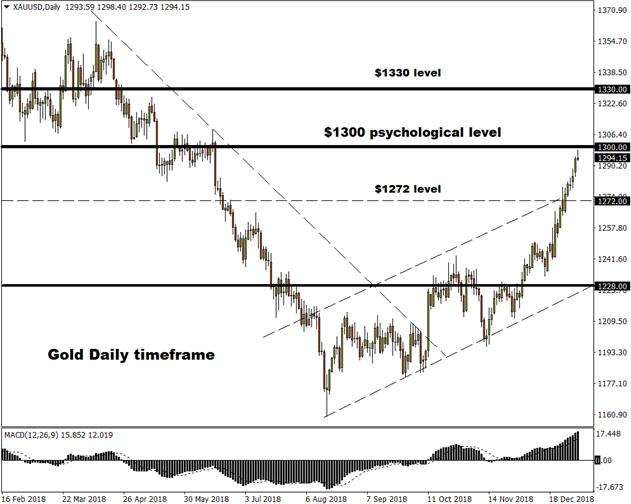
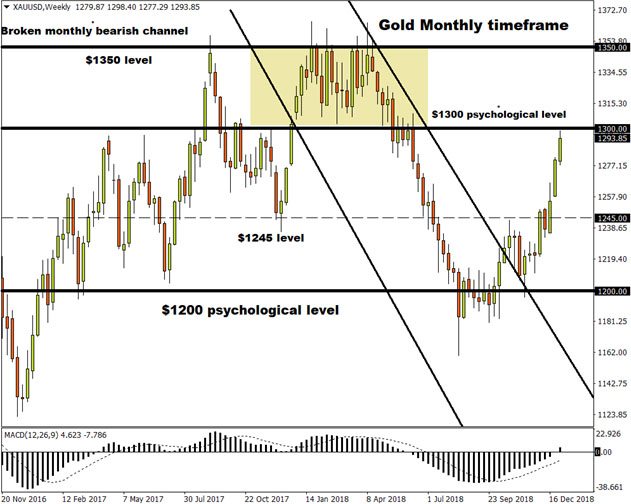
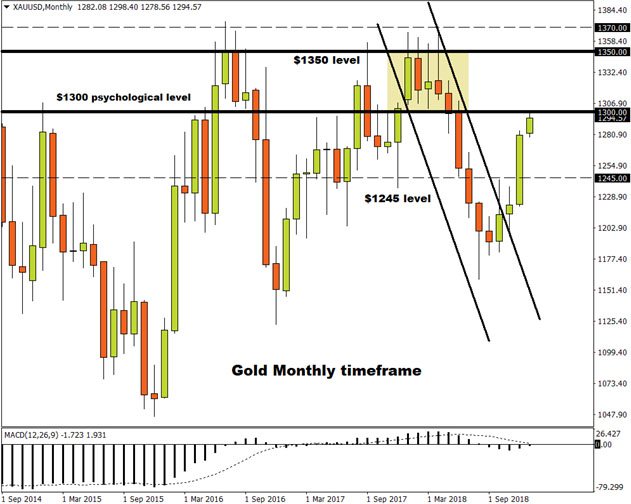
Focusing the technical outlook, Gold is firmly bullish on the monthly timeframe with prices trading infinitely closer to the psychological $1300 resistance level. There have been consistently higher highs and higher lows created on the monthly, weekly and daily charts. With the metal commencing 2019 on an extremely positive note and poised to challenge $1300, bulls remain in firm control. A solid breakout above $1300 is likely to open the gates towards $1350 and $1370.
The weekly chart depicts a similar bullish picture with $1300 seen as a very significant point of interest. In regards to the daily charts, with prices clearly in an uptrend bulls remain protected above $1272.
Alternatively, Gold still runs the risk of sinking back towards $1245 if $1300 proves to be a very stubborn resistance and global risk sentiment improves on easing trade tensions.
Positive Momentum From Friday Carries Into New Week
Jobs and Powell the ideal tonic for investors
An extraordinary equity market rally on Friday is carrying some positive momentum into the open on Monday, with Europe eyeing a higher open as investor anxiety eases, for now.
The combination of a very strong – and completely unexpected – jobs report and rather dovish comments from Jerome Powell proved the ideal tonic for investors at a time of such angst. The labour market figures far exceeded market expectations, the only downside being the increase in the unemployment rate, but even this came as a result of the rise in participation which is ultimately a good thing.
Powell following this by stressing that the Fed will be patient and will shift if necessary was the icing on the cake. With markets at such depressed levels compared to the start of the fourth quarter, there was plenty of motivation for investors to pile back in. Whether they’ll stay in is another question because this is only one risk factor – albeit an important one - and am openness to shift is not a change in itself.
Gold eyeing $1,300 and USD softens on Powell comments
The reaction in the dollar was interesting on Friday, with the currency rallying strongly in response to the jobs report before reversing course following Powell’s comments. Given that markets had completely priced out a hike this year prior to the release, this isn’t necessarily a surprise but it could keep the pressure on the greenback in the near future.
This initially saw gold come under some pressure as the dollar rallied but once it started to come off, the yellow metal was heading back towards $1,300 which remains a key resistance level to the upside. The risk environment may have temporarily returned, taking some of the shine off gold, but I don’t think this will stop it if the dollar continues to weaken, as currently looks likely.
Oil bounces as risk appetite improves
Oil has also become closely linked to the risk environment lately, with a global slowdown being an obvious downside risk for prices. The rally on Friday, with another looking on the cards today, is proving supportive for Brent and WTI although the EIA report last week did take some of the edge off the recovery.
Inventories were relatively flat last week, which was above expectations of a drawdown, weighing a little on prices. This could be a reflection of slower demand, hence the drop in price, or suggest that Saudi Arabia’s attempts to manipulate the data and lift prices aren’t working as hoped.
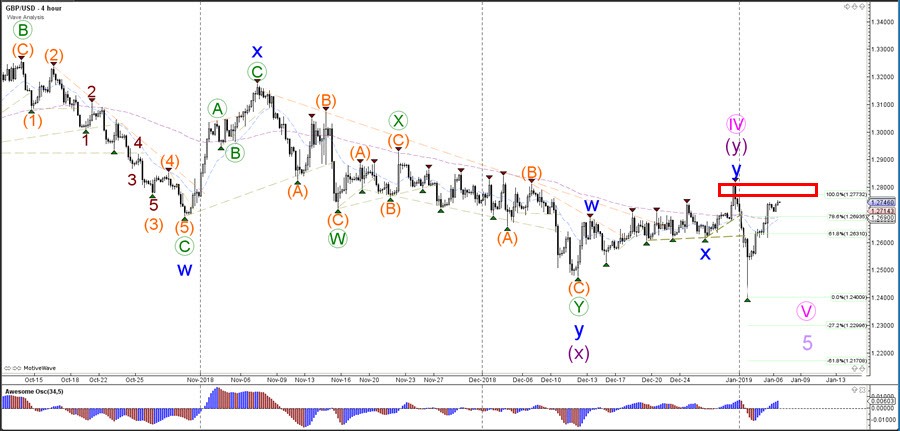
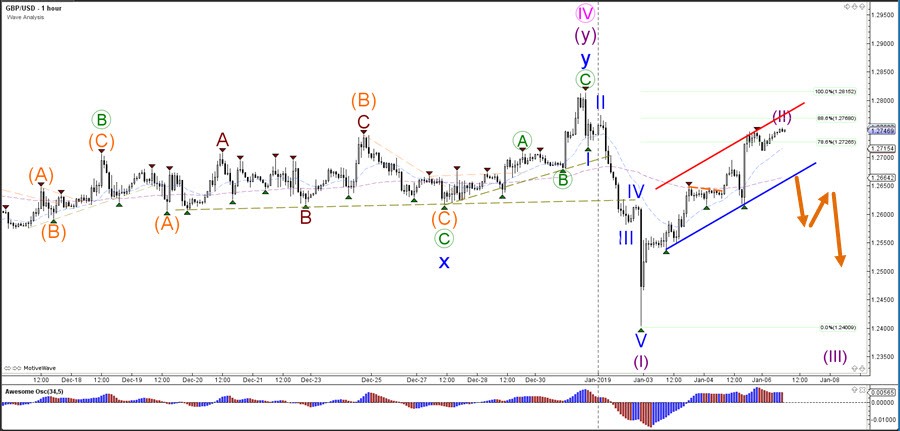
GBP/USD: Testing Deep 88.6% Fibonacci Retracement Level
The GBP/USD downtrend continuation could be part of wave 5 (pink) of wave5 (purple). A break above the resistance zone (red) however indicates a larger bullish correction.
 The GBP/USD could be building a bullish retracement within wave 2 (purple) as long as price stays below the previous top and 100% Fibonaccilevel. A break below the support (blue) trend line confirms the potential bearish breakout.
Risk Markets Rebound On Fed Comments And China Easing
Market movers today
With a relatively light data calendar, a key focus point today will be the start of US and Chinese officials' mid-level trade talks in Beijing. These talks will probably pave the way for more high-level negotiations later in January, where President Trump could meet with Chinese Vice President Wang Qishan at the World Economic Forum in Davos. This week, we should also look out for an announcement on tax cuts for consumers and companies, which have been well signalled by Chinese leaders.
In the US, given the recession fears in financial markets, focus will be on today's ISM non-manufacturing index. The index remains at a very high level, indicating the economy is doing fine, but any substantial decline will be taken as a further indication of a slowing US economy.
In the UK, this week will see the start of the Brexit debate ahead of the vote in the House of Commons - the vote is scheduled for the following week beginning on Monday 14 January (the vote will probably take place on Tuesday or Wednesday).
Selected market news
US equity markets surged on Friday and Asian markets are trading higher this morning, supported by a very strong US jobs report, monetary policy easing in China and Fed Chairman Jerome Powell indicating that the FOMC would be prepared to change the monetary policy course if the outlook shifts.
The US jobs report released on Friday was very strong, with non-farm payrolls gaining 312,000 in December compared to consensus of an increase of 184,000. Wages also gained substantially with an increase of 0.4% m/m and 3.2% y/y in December, suggesting solid momentum in the labour market towards the end of the year.
On Friday, Federal Chairman Powell said that the FOMC's policy is flexible and that officials are 'listening carefully' to financial markets. Powell also said that the Fed will be patient as it observes how the economy evolves and referred to 2016 as an example where the FOMC indicated four hikes but only raised the target range once in December. Powell's comments came after FOMC members Kaplan (on Thursday) and Mester (earlier on Friday) said something similar and overall, the Fed is clearly indicating flexibility in its policy both in terms of the interest rate and quantitative tightening. The market expects the Fed to stay on hold in March.
In China, the People's Bank of China (PBOC) responded to the slowdown and announced a reduction in the RRR for banks of one percentage point, freeing up another USD116bn. See China Weekly Letter: China hits the gas as the economy slows further, 4 January.
The big question for now is whether easing from China and the Fed on hold will be enough to stabilise markets. According to Thomas Harr, Global Head of FI&C Research, it is probably premature to call the bottom, as we may need to see a stabilisation in growth expectations before equities stabilise and head higher. See Harr's View: Market turmoil to continue until growth stabilises , 6 January 2019.