Sample Category Title
Market Morning Briefing: Dollar Yen Has Trend Support At 108
STOCKS
On Friday morning, we said, "...the Eastern hemisphere could be nearing Supports, readying for a bounce." It looks like the Western hemisphere also got a whiff of the potential bullishness and rallied on Friday. We now need to see how sustainable the rally is likely to be. For now, the markets look bullish for the next few days at least.
Instead of falling towards 22000, the Dow Jones(23433.16, +746.94, +3.29%) saw a big rally. It brings back the possibility of a rise towards the immediate resistance at 24000, with 22600 being the immediate Support now.
The mentioned Support at 10300 held strong on the DAX (10767.69, +351.03, +3.37%), triggering a good rally, which increases the chances of testing the resistance at 10900.
As hoped for, the Nikkei(20113, +2.82%) found Support near 19400 on Friday and has posted a strong gain today. Look for a rally towards 20500 in medium-term.
Shanghai(2532, +0.71%) also saw a strong bounce from the long-term support at 2450 on Friday and may test Resistance at 2550-75 this week.
The Sensex (35695.10, +181.39) and Nifty (10727.40, +55.10) both respected the Supports at 35250 and 10600 respectively mentioned on Friday and can rise towards 36500 & 10900 respectively in the near term.
COMMODITIES
Brent (57.72) and Nymex WTI (48.61) are trading higher and look bullish for the near term. 58 and 50 respectively could act as decent resistance from where a slight dip is possible before a rise towards 60 and 54 is seen.
Brent-WTI spread (9.08) is rising towards resistance at 9.45 and could come off in the near term back towards 7.75-7.50 in the near term.
Gold (1290.60) came off after testing 1300 last week. As mentioned in our earlier editions, 1300-1320 is the immediate resistance zone that is likely to hold and push prices back to 1270. Only on a break above 1320, we would consider higher resistance at 1350.
Silver (15.83) is heading towards immediate horizontal resistance near 16.0-16.1 and while that holds, a sharp decline towards 15.25 may occur. But with some chances of weakness in the US Dollar, precious metals could see some gain in the near term.
Copper (2.6380) has risen a bit but while below 2.68, there is scope of falling towards 2.55 again in the near term. Weekly line chart shows support at 2.55 to be strong enough to hold in the longer run. Some more sessions of sideways range trade above 2.55 is possible for this week and the next.
FOREX
Dollar Index (96.01) is trading near 96 and is looking bearish for now. The index could fall in the near term towards 95.50. Thereafter a break below 95.50 would take it lower towards 94.80 else a bounce may push it higher towards 98 again.
Euro (1.1421) has bounced back to trade above 1.14 as Dollar sees fresh weakness. While the dollar Index looks bearish for the near term, Euro could re-test 1.15. Repeated testing of 1.15 could give way for further upmove in the medium to longer term, hence we watch price action closely near 1.15.
Dollar Yen (108.25) has trend support at 108 on the 3-day line charts and while that holds, a bounce from 108 back towards 110 looks possible. Failure to sustain above 108 could make the pair vulnerable to a fall towards 105 in the medium term. Watch price action near immediate support at 108.
124-123 levels seem to be an immediate support for Euro-Yen (123.63) on the 3-day line charts. A bounce from there could take it higher towards 128; else a fall in the medium term towards 120 will have to be considered. Preference is for a bounce from 123-124 levels.
Pound (1.2743) has come up to test immediate resistance near 1.2750 which if holds, could push the currency towards 1.24 again in the near term. Trade within 1.28-1.24 is preferred for the near to medium term. A break above 1.28 if seen and sustains could indicate a reversal in the current downtrend, forcing us to re-visit our target levels on the upside.
Aussie (0.7126) has 21-day MA as immediate resistance near 0.7150. If Aussie manages to break on the upside, it could rise towards 0.73 in the near term.
USD-CNY (6.8446) is trading lower and looks bearish just now. A fall towards 6.8310 just now and 6.79 later is a possibility. Near term looks bearish.
Dollar Rupee (69.73) is trading at 69.52 on the NDF. This could indicate some strength in Rupee today’s session towards 69.40.
INTEREST RATES
Fed Chairman Powell made dovis statements on Friday, saying that the Fed was listening to the markets carefully. The market is now reported to be even pricing in a rate cut in 2019, instead of one hike which was the accepted likelihood a few weeks ago.
While the market expectations will see flip-flops over time, it might be prudent on our part to budget for one hike after June.
For now, the US 2Yr (2.50%) can fall some more over the coming weeks, to test Support near 2.10%. The US 5Yr (2.50%), which had dipped below 2.40% briefly last week again trades above important Support at 2.45%. It is to be seen whether the 5-2 Spread (0.0%) manages to rise towards +0.04%, or whether it falls back towards -0.05%.
The German-US 2Yr Spread (-3.09%) continues to creep up towards Resistance near -3.00%. Maybe it will come down from there.
The 10Yr GOI (7.448%) may have Resistance in the 7.45-50% region and is expected to come down towards 7.10% while that holds.
UK PM May repeated her warnings over no-deal Brexit
UK Prime Minister Theresa May repeated her warning that voting down her Brexit agreement in the parliament will put the UK into "uncharted territory". And she added, "I don't think anybody can say exactly what will happen in terms of the reaction that we'll see in Parliament."
She also reiterated that the Irish backstop "is not intended to be used in the first place, and if it is, it's only temporary". And, "ensuring that we actually get the future relationship in place to replace the backstop if it's used is actually a crucial element of this."
May also reiterated her opposition to a second referendum as that would "divide our country" and require a delay to Brexit.
Separately, a cross party group of Conservative and Labour MPs are seeking to amend the government's Finance Bill to ensure the "no deal" provisions in it can only be implemented if Parliament votes to allow it.
Debate on the Brexit agreement will resume this Wednesday, with the vote due in the week beginning January 14.
Trump threatens radical move over border wall, but offers concession too
The partial US government shutdown is now in its third week without any resolution in sight. Trump repeated his threat of a radical move to get funding for his border wall, but at the same time offered concession over the weekend. He warned on Sunday "I may declare a national emergency dependent on what's going to happen over the next few days." He also added, "The barrier, or the wall, can be of steel instead of concrete, if that helps people. It may be better."
Later Trump also tweeted that Vice President Mike Pence had a "productive meeting with the Schumer/Pelosi representatives". And, ."We are now planning a Steel Barrier rather than concrete. It is both stronger & less obtrusive."
But so far, the Democrats showed little interest in the "concession."
Daily Markets Broadcast
Wall Street boosted by strong US jobs report
The highest number of US jobs added to the economy in 10 months gave the green light to risk appetite on Friday, and it looks to extend into today’s activity. China had earlier trimmed banks’ reserve ratio requirements on Friday, which had set risk on an upward trajectory. US and China restart trade negotiations today.
US30USD Daily Chart
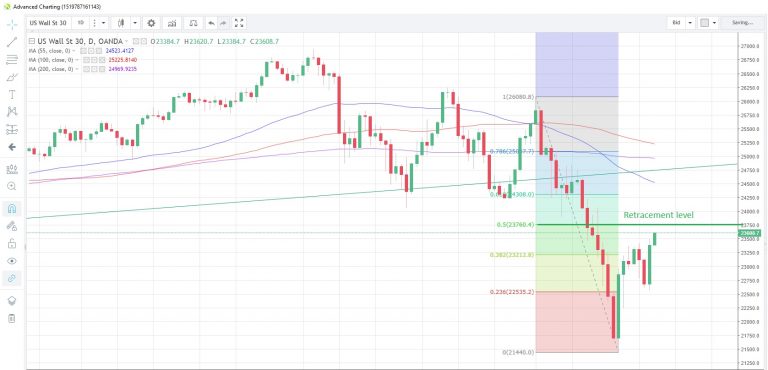
The US30 index posted the biggest one-day gain in six days after the US economy added 312,000 jobs in December, well above estimates for a 177,000 gain.
The index is nearing the 50% retracement of the December drop at 23,760
Today sees the release of the ISM non-manufacturing PMI for December, which is expected to slide to 59.7 from 60.7.
DE30EUR Daily Chart
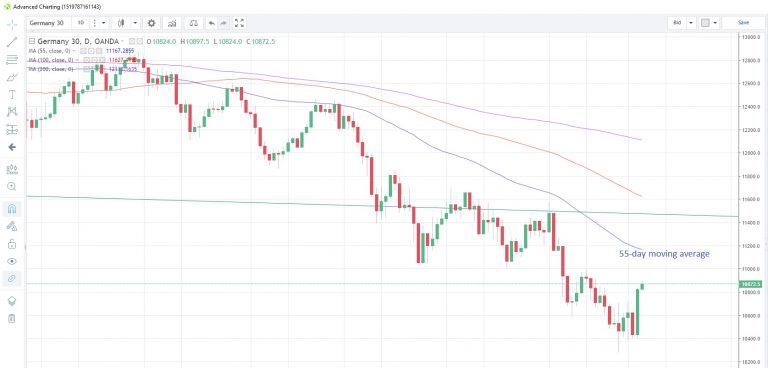
The Germany30 index jumped to a seven-day high after the US jobs data. Euro-zone Dec. advance CPI moved back below the ECB target for first time in 7 months, with oil being a contributing factor
The 55-day moving average is at 11,167. This average has capped prices on a closing basis since August 29
Germany’s factory orders are expected to fall 0.5% m/m in November, the first monthly contraction in four months, following a 0.3% increase in October.
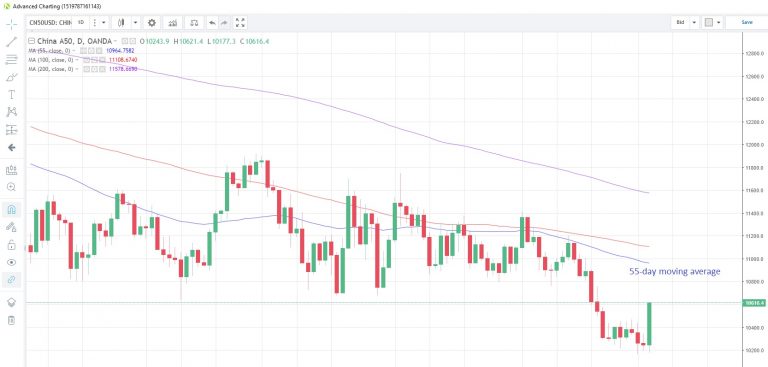
The China50 index surged the most since Oct. 22, reaching a two-week high, after the PBOC trimmed banks’ reserve requirements by a full percentage point on Friday
The 55-day moving average is at 10,965 and has capped prices on a closing basis since Dec. 3
The mid-level trade talks are not expected to produce any major breakthrough this time, with the 90-day tariff truce ending in March. Issues under discussion are likely to include: intellectual property; Huawei Technologies and 5G; Beijing’s “Made in China 2025” plan; energy; agricultural imports; auto tariffs and market access for banks.
The Feds Monetary Policy Reaction Function Is Yawing Dovish
Markets
The Fed debate will rage on after a colossus NFP headline followed by Chair Powell speech which then went well beyond the market expectations by yawing dovish the Feds monetary policy reaction function.
Fed Chair Powell’s dovish confirmation was music to equity investors ears while EM and high beta currencies celebrated in the afterglow in a flip-flop Friday for the greenback. The USD initially gained after the behemoth NFP print only to shed those gains post- Fed Chair Powell who signalled the ” all green” for risk while suggesting he ” wouldn’t hesitate ” to tweak balance sheet reductions if it was tightening financial conditions beyond need. After all, what investor doesn’t like a strong economy and a dovish lean from the Fed all the while the NFP report should put to rest fears sky is not falling on the US economy and could reinforce the notion that recent turmoil, particularly on the S&P 500, as a ‘market correction’ instead of an economic problem.
However, the key in Chair Powell’s latest messaging is that he addressed concerns that the global equity market turmoil is a clear and present threat to US economic growth
Equity markets usually struggle as cash becomes tighter during a Fed rate hike cycle triggering investors to reduce risk. But the emotional market meltdown in Q4 which tightened financial conditions so much so that the Fed will likely pause until at least mid-2019 to let the dust settle. However what’s critical is the comparison Powell drew between 2016 and 2019. In both periods markets were hyper-volatile, and speculation was rife about the possibility of a US growth slowdown. Powell suggested that if 2019 were to unfold like 2016, the current FOMC would likely take a similar course of action as after hiking in December 2015, the committee back then paused and did not increase rates again until December 2016. So Indeed, it appears Chair Powell is becoming far more patient with regards to the pace of rate hikes in 2019
However, this upcoming week will probably bring more questions than answers as investors will have ample opportunity to test the markets new found bullish resolve. Traders will be laying the groundwork for the string of top-tier USD events such as Fedspeak, including from San Fran President Daly and VP Clarida; ISM Services; FOMC December minutes; US CPI and the omnipresent trade uncertainly to watch over as US-China trade talks are expected to resume. But with the latest fed skew in place, could we return to the Goldilocks economy or end up with yet another fractured market fairy tale?
Thankfully risk sentiment is on more stable footing than we opened 2019 as a confluence of factors including the PBOC RRR cut, China and the US will hold vice-ministerial-level trade talks this week and of course Chair Powell comments which elevated the chances the Fed will pause interest rate increases until at least mid 2019 are all market-friendly developments. However, some investors remain sceptical that Friday’s price action was little more than a vicious short covering frenzy after their portfolios were beaten to a pulp during the past 90 days. And while the markets have been mired in disappointing global economic data, the softer Fed and robust US payrolls data could go a long way to stabilising investor sentiment.
Oil Markets
The US economy added more jobs than expected in December, prompting a sharp recovery in the S&P 500 that provided a robust framework for supporting oil prices that were already rebounding after early estimates showed OPEC crude oil production falling roughly 0.5 mmbpd during December as Saudi Arabia has chopped production.
And while the EIA weekly inventory report dampened sentiment and reminding traders about the bearish inventory story. At at a minimum, however, the robust NFP, a softer Fed mandate, more Pboc easing likely, a further thaw in US-China trade tensions and a drop in OPEC production suggests a more positive outlook despite the EIA reporting both gasoline and distillate inventories showing significant builds indicating the US supply glut remains a bearish concern.
However, those inventory gluts could be reversed out as Saudi Arabia makes good on its pledge to slash exports to the US by a reported 60 % between November and December and the impact should start to show up in the closely watched US inventory reports
Gold Markets
Gold markets recent gains have been staggering, but with equity markets showing signs of stabilising investors are left wondering if this current gold rally is the real deal or not. Stock markets were making investors very nervous throughout the holiday period, and by the looks of late December Gold price action, it was clear that many investors missed the boat and were not long nearly enough gold hedge vs the equity markets meltdown. But this too suggests there is a lot of freshly minted longs at or near the top of the recent gold run which makes prices extremely susceptible to favourable equity market flows, as we saw on Friday.
In early November equity markets were signalling significant pullbacks as even usually reliable tech stocks, including Netflix, Facebook and Amazon were tanking, but the move to $1300 has been extraordinarily swift. And while demand pales in comparison the to glory days of 2011, it’s gradually broadening, and as we approach typical seasonality demand in January ahead of China Lunar New Year, gold could also be in for a retail revival.
But with impressive rallies on a cross currency basis with XAUAUD trading at an all-time high, one would expect some gold producing countries to view current levels as attractive to hedge future production. The big question is now where current investor demand will outstrip hedging supply at the current level to keep the current market momentum going.
Given the uncertain financial market climate, gold should continue to flourish, and for those that have missed the boat, pullbacks could be an excellent opportunity to engage. But in the unlikely case that stock markets start to draw more affection from investors, gold could struggle over the near term to regain momentum and prices could slip aggressively
Currency Markets
Continue to expect currency markets to be driven by equity market sentiment, but with traders already leaning bearish USD into 2019, Chair Powell’s dovish pivot when taken at face value could see US interest rates remain on hold through 2019, suggesting the US dollar could weaken. Of course, this is very much a data dependent storyline, however, without calendar-based US rate hikes to tether itself, for at least the first part of 2019, the US dollar remains incredibly susceptible to weaker US economic data even more so with US economic surprise index starting the year in negative territory. Mind you this could be more of a factor of the softer December US data and the recent market tumult, but even within this context, a more data dependent Fed, given the current cards on the table does suggest further USD weakness in the weeks ahead.
The Malaysian Ringgit
In the wake of Fed Chair Powell dovish comments on Friday green lighting risk, EM Fx has outperformed globally. A weaker US dollar a lower glide path for US interest rates is always a welcome relief for Aisa currencies. But adding to the MYR appeal is a further thaw in US-China trade tensions, and when coupled with a robust crude oil rally, which looks likely to extend, the Ringgit is trading favourably as global risk sentiment stabilises
The Yuan
Last week’s PBOC liquidity injection via RRR has triggered a positive tone across the region but its early days. However, given the fact this cut will have a negligible impact on the economy and it’s only a means to provide liquidity in January ahead of Lunar New Year( LNY), it won’t have much legs. But what the market is reading into Pboc policy is if the data continues to run south in China ahead of LNY, the central bank could trigger more easing through a TFL or TMF. The central bank policy support should be good enough to stabilize mainland equity markets over the short term and would be Yuan supportive. The low valuations and higher risk premiums in China are a function of expectations for a further drop in economic growth and the constant downdraft from US-China trade negotiations.
The Pboc stimulus could right the economic ship while the thawing in SU -China trade tensions could trigger significant bargain basement buying on the Shanghai Composite.
USDCHF Remains Vulnerable With Pullback Threats Expected
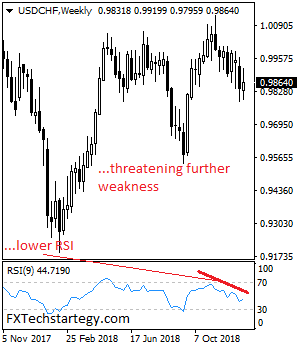
USDCHF remains vulnerable with pullback threats expected in the new week. This development leaves resistance residing at the 0.9900 level as the next upside target. A break of here will clear the way for more gain towards the 0.9950 level. Above here, resistance comes in at the 1.0000 level and then the 1.0050 level. On the downside, support is seen at the 0.9800 level. A turn below there will set the stage for more decline towards the 0.9750 level. And then the 0.9700 level. Its weekly RSI is bearish and pointing lower suggesting further weakness. All in all, USDCHF faces further downside threats on correction.
EURUSD Eyes Recovery Threats Towards 1.1496 Zone
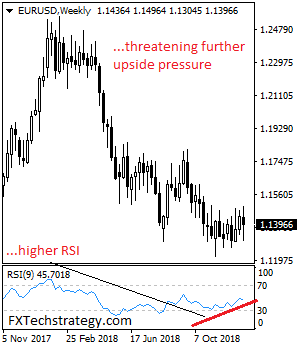
EURUSD eyes recovery threats towards 1.1496 zone. Support comes in at the 1.1350 where a violation will aim at the 1.1300 level. A break below here will target the 1.1250 level. Further down, support lies at the 1.1200. On the upside, resistance comes at 1.1400 level with a break through there opening the door for further upside towards the 1.1450 level. Further up, resistance comes in at the 1.1500 level where a violation will expose the 1.1550 level. All in all, EURUSD continues to threaten further upside pressure.
Eco Data 1/7/19
[php_everywhere instance="1"]
Forex Forecast and Cryptocurrencies Forecast
For starter, a few words about the events of the past week, the first working day of which gave unpleasant surprises, which for some were quite pleasant.
Not having recovered after the New Year celebration, in the morning of January 2, the pair EUR/USD made a sharp dash to the south, losing almost 200 points in a day. Then, however, everything returned to normal, and the pair quickly returned to Pivot Point 1.1400, around which it has been revolving since October 2018. On Friday, January 5, using positive data from the US labor market, the dollar tried to regain the lost ground, but the attempt failed, and the pair ended the week at 1.1394.
An even sharper jump from 2018 to 2019 was expecting the GBP/USD, which lost on January 2, due to increased demand for the dollar, more than 400 points. Then, just as in the case of the European currency, the excitement subsided, and the pair returned to the main support/resistance line of the last two months in the 1.2720 area;
The forecast for the pair USD/JPY suggested the strengthening of the yen as a safe haven currency. But the fact that within only one hour on January 2 it would be able to win back 400 points from the dollar, that is, almost everything it had lost during the whole 2018, was almost impossible to foresee. The cause of the incident was a "festive" lack of liquidity in Japan, which was then eliminated. But the dollar could not fully recover, and the pair ended the trading week at 108.50;
Cryptocurrencies. Against the background of the major currency pairs Bitcoin demonstrated a remarkable stability last week, keeping on to lateral movement in a narrow corridor of $3,775-4,100 and returned where it has repeatedly been in the last six weeks by Friday evening, to the level of $3,955. Following the example of the reference cryptocurrency, the Olympic calmness was shown by Litecoin (LTC/USD). But Ethereum and Ripple behaved somewhat more actively. Thus, the ETH/USD pair has grown by 12%, rising above the $160 mark, and the XRP/USD pair, on the contrary, lost 7%, although it could not break through the support of $0.3560.
As for the forecast for the coming week, summarizing the opinions of a number of analysts, as well as forecasts made on the basis of a variety of methods of technical and graphical analysis, we can say the following:
EUR/USD. Both trend indicators and oscillators on H4 and D1 have taken a neutral position. The opinions of the experts are divided as follows: 20% have voted for the growth of the pair, 40% are for the sideways trend and 40% are for the strengthening of the dollar and the fall of the pair.
It should be noted that in the transition from the weekly to monthly forecast, the number of supporters of strengthening the US currency rises to 65%. Graphical analysis on D1 also indicates a possible decrease of the pair to December lows in the 1.1215 zone. The nearest strong support area is 1.1305.
As for the “bullish” scenario, according to its supporters, the dollar will continue to be pressured by political uncertainty in the United States. The nearest strong resistance zone is 1.1485-1.1500, in case of its breakthrough, the next target for the bulls will be consolidation in the zone 1.1550-1.1625.
Among the economic events that could affect the formation of dollar pairs, one should pay attention to the US FOMC protocol, which will be published on Wednesday evening, January 9, the ECB meeting on Thursday, January 10, as well as data on inflation in the United States, which will be released at the very end of the week, on Friday, January 11;
GBP/USD. Here, of particular interest are the speech of the head of the Bank of England, Mark Kearney on January 9, as well as data on UK GDP, published on January 11. However, in both cases, one should not expect any special surprises, and the uncertainty associated with the British exit from the EU will continue to be decisive for the British pound exchange rate.
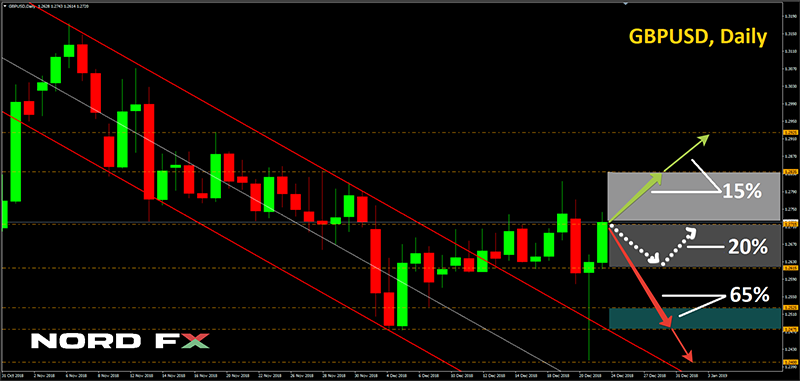
That is why 65% of experts predict a further fall of the pound. According to them, with the support of graphical analysis on D1, the pair will first test support 1.2615 once again and, if successful, will move to the zone 1.2475-1.2525. It is unlikely to achieve the low of the first week of January in the 1.2400 zone in the upcoming week.
20% of analysts are in favor of the GBP/USD sideways trend, and only 15% have sided with the bulls, suggesting movement of the pair in the corridor 1.2715-1.2835. The next resistance is 1.2925.
At the time of writing the forecast, about 90% of indicators sided with the bulls. However, most likely, this is only a consequence of the upward movement of the pair on January 3-5. Moreover, 10% of the oscillators have already signaled that it is overbought, which indicates a possible reversal of the pair to the south.
USD/JPY. About half of the indicators are red and half are green. As for the opinions of analysts, 70% of them predict a decline of the pair to the level of 107.00, and then another 100 points lower. So far, only 30% of experts have voted for the growth of the pair, but in the medium term, the number of supporters of strengthening the dollar doubles. The main goal for the bulls is to return to the zone 112.25-113.80. The nearest resistance levels are 109.45, 110.25 and 111.15;
Cryptocurrencies. The behavior of BTC/USD does not give reasons for optimism or pessimism. Therefore, the experts' opinions are divided almost equally: 30% are for the growth of Bitcoin, 30% are for its fall and 40% are for the continuation of the sideways trend. At the same time, the total capitalization of the crypto market is at the level of the end of December last year, around $130 billion, which also does not allow for making any predictions. Although some experts, based on the cyclical nature of the growth and the fall of quotations, argue that the first quarter of 2019 will be on the side of buyers, and expect the pair to rise to $4,800-5,200. The alternative scenario: the end of the correction and the fall of BTC/USD to the strong zone, recorded as early as July-August 2018: $2,500-2,700. Moreover, such a fall may take from one to two months. The nearest support is in the $2,940-3.050 zone.
FX 2019 – JPY to Shine In Risk-Off Environment
We are not convinced that the "flash crash" of USDJPY last Thursday was driven by Apple.Inc's lowering of guidance, especially on China. The rally in Japanese yen during the time did not just appear in USDJPY, but also other JPY-crosses, such as AUD and TRY. There are factors underlying JPY that caused such rally. Indeed, strength in JPY would likely persist in 2019. Besides valuation, safe-haven demand amidst risk-averse market environment, liquidation of foreign investment positions by Japanese investors and slower rate hike path by the Fed are factors supporting the yen this year.
Valuation
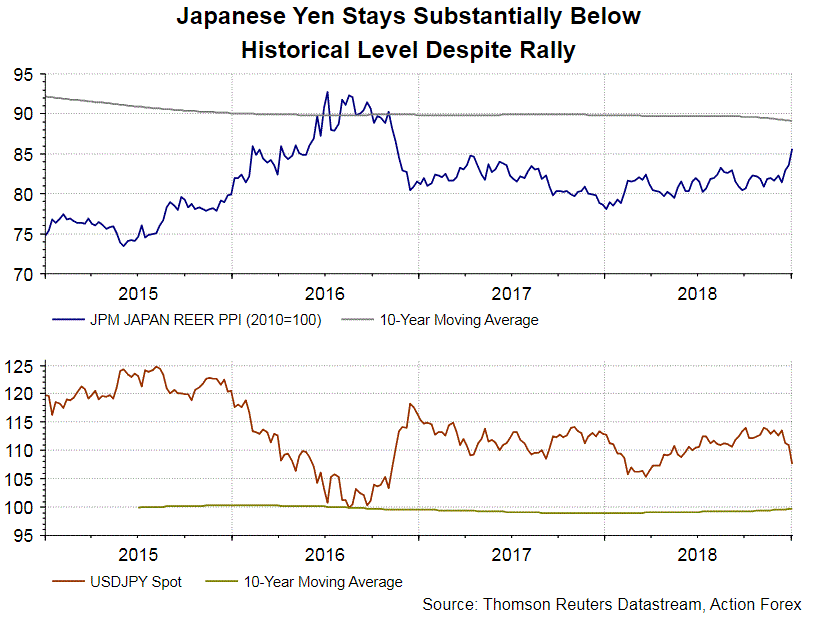
USDJPY declined for a third consecutive year in 2018. Yet, this has not made Japanese yen overvalued. The chart below shows that USDJPY has been trading above its 10-year moving average since mid-2016 (lower pane), while the real effective JPY index has been consistently moving below the 10-year average since late 2016. Traders adopting mean reversion strategy would continue to bet for higher yen.
Safe haven Demand
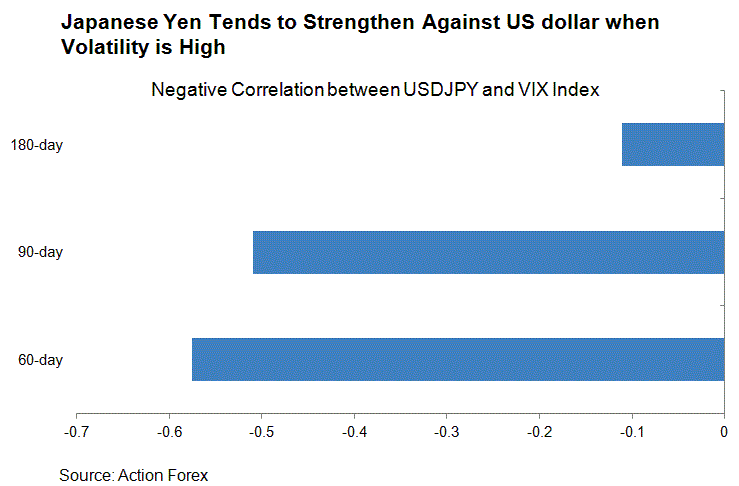
US-China trade war, Brexit uncertainty, political turmoil in the Eurozone and unrests in some emerging economies have restrained risk appetite, leading many to seek safe investments. Japanese yen is a typical safe-haven asset. Due to the low yields, JPY has been a darling in carry trades (a strategy in which investor borrow money at a low interest rate and invest in an asset (risky asset) that is likely to provide a higher return). JPY, hence, strengthens during periods of risk aversion as traders square their carry trade positions and repay their borrowed money. Japanese yen performs well during huge market volatility. Our data shows that USDJPY and VIX index (fear index) are negatively correlated. That is JPY appreciates against USD when risk aversion intensifies.
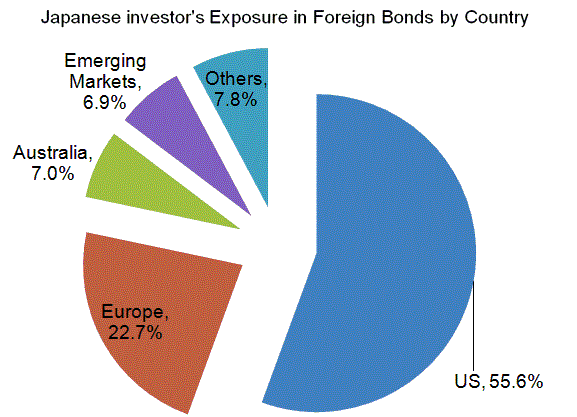
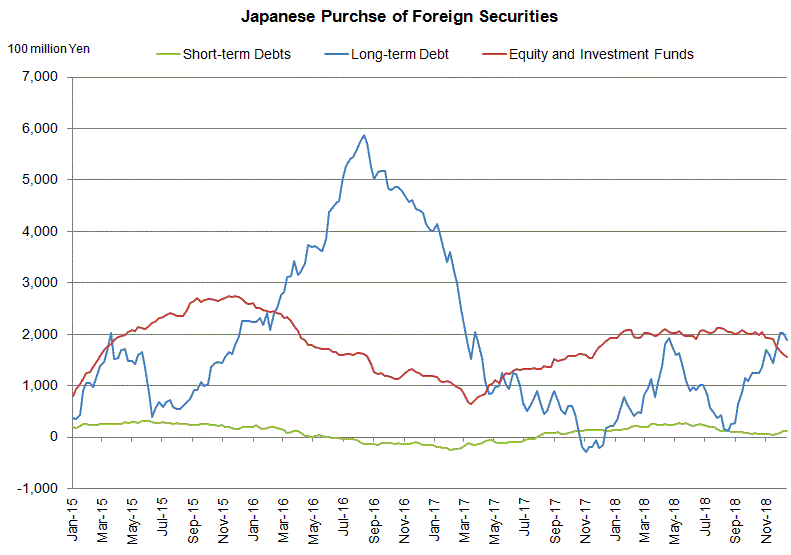
The chart below shows that Japanese bond investors’ exposure is mainly in the US. Unwinding of these investments can be rapid is risk appetite diminishes and US financial markets decline further. Such scenario would send JPY higher. Indeed, the recent rally in JPY has been driven by the US-led decline in global financial markets.
 BOJ’s Monetary Policy
BOJ’s existing monetary policy tools include keeping policy rate at -0.1%, purchasing JGBs at a pace of 80 trillion yen/ year and yield curve control (YCC) -keeping 10-year JGB yield at 0%, with trading band at +0.2% and – 0.2%. Concerning bond purchases, the actual increase in BOJ's holdings has been falling consistently since 4Q16. The annual increase fell to 58 trillion yen and below 40 trillion yen in December 2017 and November 2018, respectively. As speculations intensified regarding BOJ tapering, Governor Haruhiko Kuroda clarified in October that the 80 trillion yen purchase is only a symbolic measure and stressed the major policy tool is YCC.
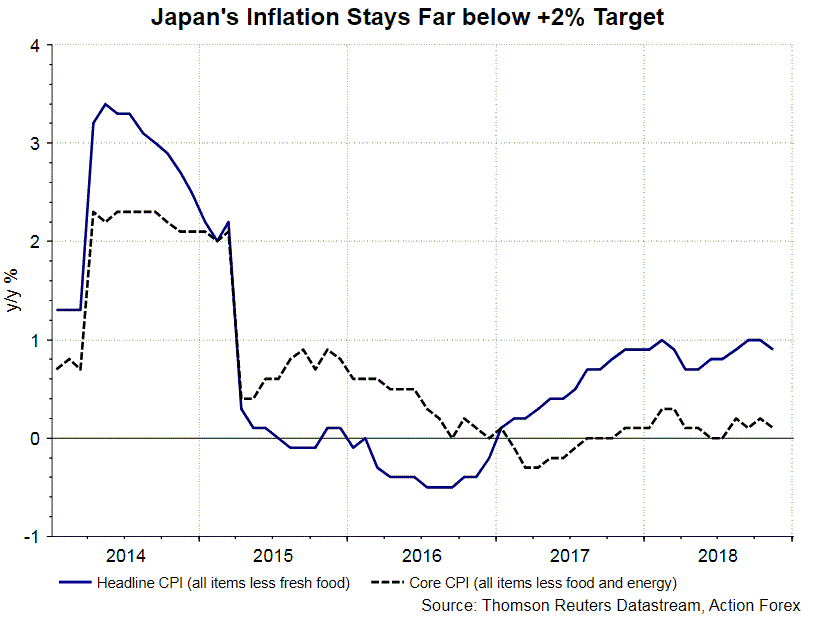
Japanese economy is recovering. Yet, the pace is still slow. Both headline and core inflation have stayed far below BOJ’s target of +2%. For the coming year, ongoing US-China trade war suggests that risk to Japanese growth is skewed to the downside. Meanwhile, trade negotiations with the US have raised the uncertainty. Speculations are rising that BOJ could revised lower its inflation target in early 2019.
Kuroda noted in mid-December that “there are more downside risks to Japan’s economy, particularly via overseas economic developments”, adding that “if we think doing so would be necessary to sustain the momentum for achieving our price target, we will ease monetary policy further as appropriate”. We doubt if there are more things that BOJ can do to stimulate the economy although the central bank stressed that it could lower interest rates further and accelerate the pace of asset buying.
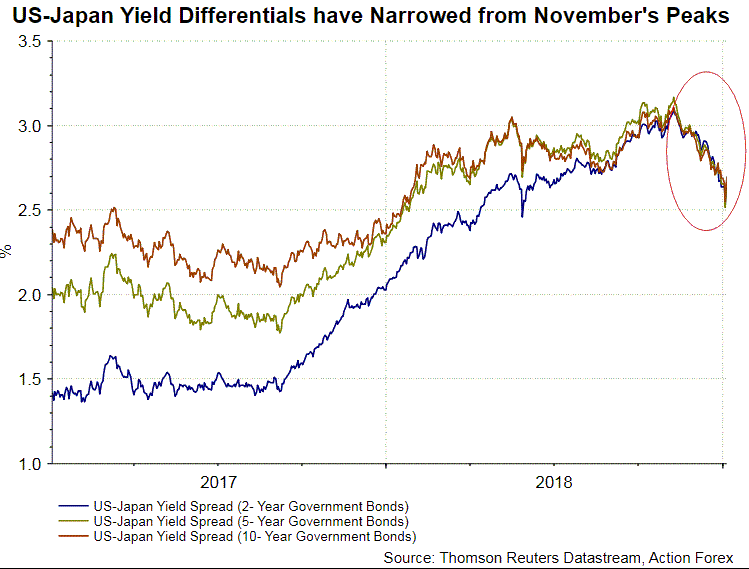
Further monetary easing by BOJ should be negative for JPY. However, the impact might be watered down by Fed’s moderation in the pace of rate hikes. In the last two months, US 5-year and 10-year Treasury yields have erased most of the gains made last year. Meanwhile, US-Japan yield spreads have also narrowed across the board since early November. As such, we do not expect Japanese yen to be markedly lower if BOJ maintains the accommodative stance.