

Sample Category Title
EUR/CHF Weekly Outlook
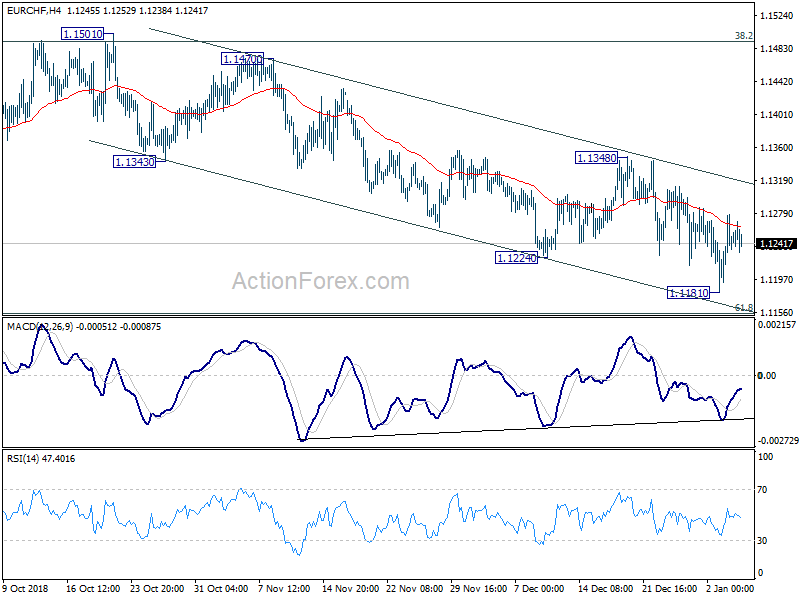
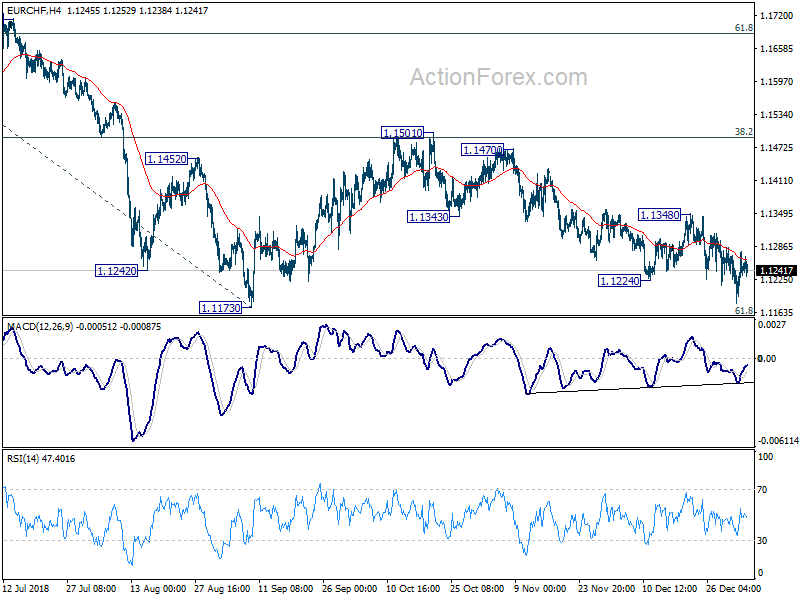
EUR/CHF's choppy decline continued last week an hit 1.1181 but quickly recovered. Initial bias is neutral this wee first. Outlook is unchanged that we expect strong support from 1.1154/98 support zone to contain downside to bring reversal. On the upside, above 1.1348 resistance will turn bias to the upside for retesting 1.1501 resistance first. However, Sustained break of 1.1154/98 will carry larger bearish implications and extend the whole decline from 1.2004 high.
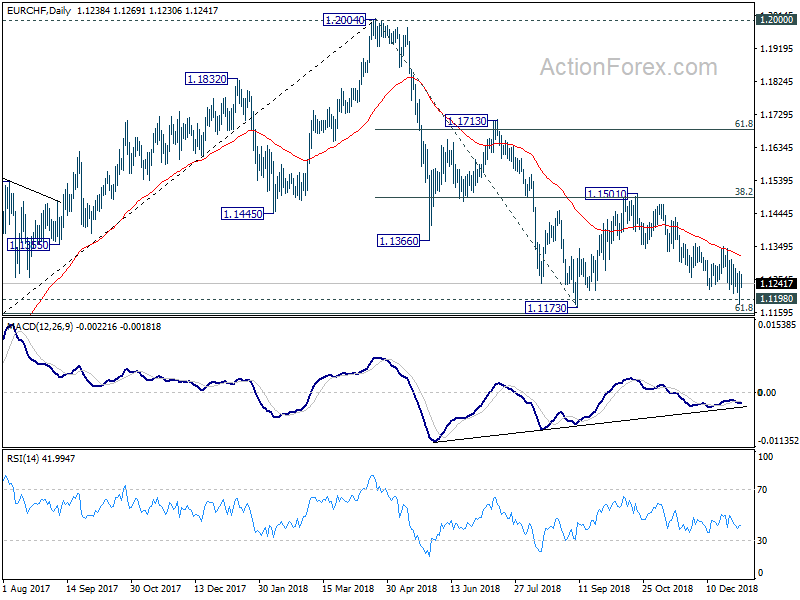
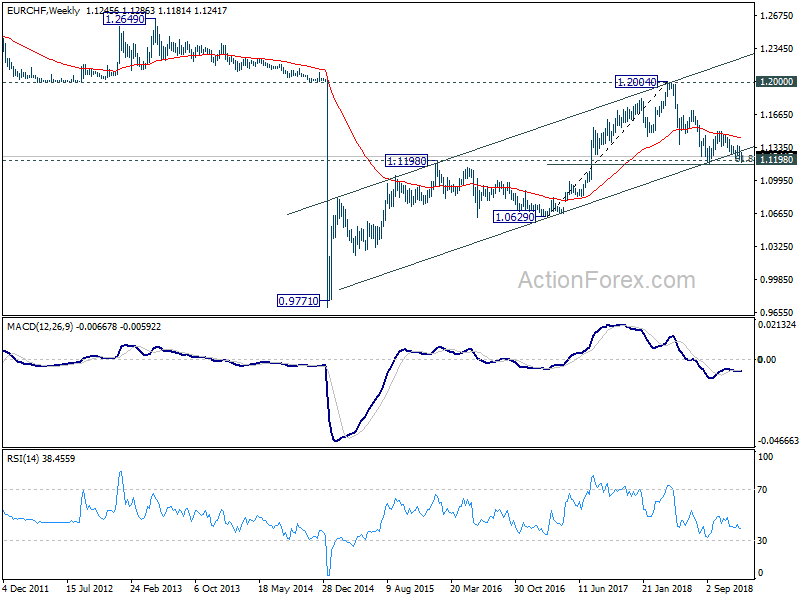
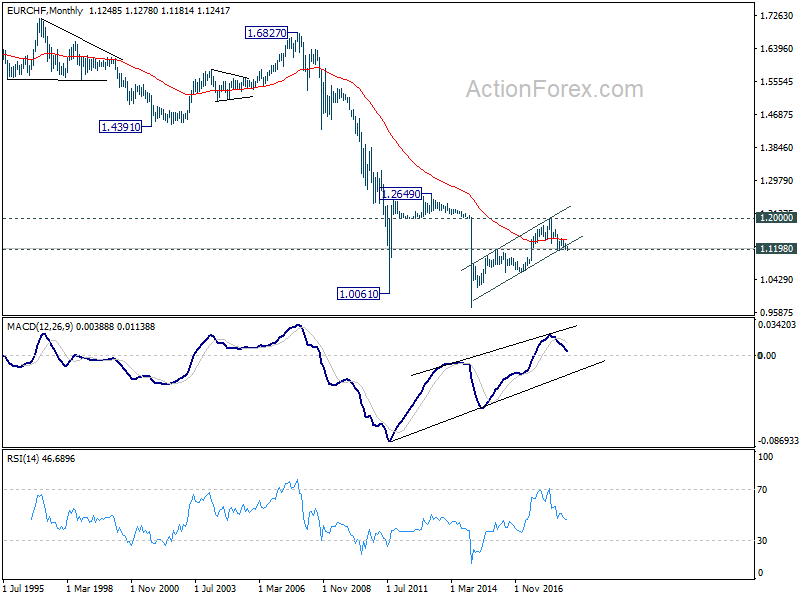
In the bigger picture, price actions from 1.2004 medium term top is seen as a correction only. Downside should be contained by support zone of 1.1198 (2016 high) and 61.8% retracement of 1.0629 to 1.2004 at 1.1154 to complete it and bring rebound. A break of 1.2 key resistance is still expected in the medium term long term. However, sustained break of the mentioned support zone will mark reversal of the long term trend. In that case, 1.0629 key support will be back into focus.
Sentiments Saved as Fed Powell Turned Cautious, China Stepped Up Supporting Measures
There were big roller coaster rides in the financial markets last week. Apple's sales outlook downgrade heightened the concerns over serious slowdown in the Chinese economy. There was the "Currency Flash Crash" which sent through all key technical resistance levels while Australian Dollar tumbled to multi-year low. The partial US government shut down is entering its third week, without any breakthrough.
But looking through all the volatility and one-off events, there are a few developments to note. Firstly, China stepped up the pledge to support the economy with easing measures immediately announced. More are expected to come this year which might cushion any deterioration in sentiments. Secondly, Fed chair Jerome Powell turned rather cautious in his comments which prompted some re-think of the rate path ahead. Thirdly, stakes are getting high on US-China trade talks, which are to resume at vice ministerial level this week.
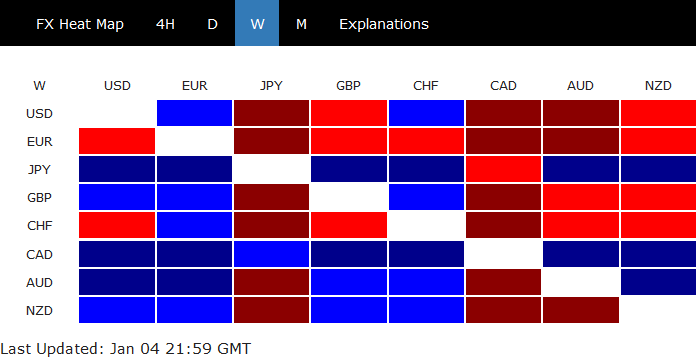
In the currency markets, after all the volatile moves, Yen was only the second strongest one for the week. Canadian Dollar occupied the top spot, thanks to rebound in oil prices and as markets prepare for BoC rate decision. Australian Dollar was the third strongest after recovery from the torture of the flash crash. Euro was the worst performing one, followed by Swiss Franc and then Dollar.
Investors expect Fed to stand pat in first half, may cut rate by December
Fed Chair Jerome Powell's comments on Friday were at least more cautious than before, if not dovish. In short, he pledged that Fed was "listening" to the markets after December's volatility. And, "particularly with the muted inflation readings that we've seen coming in, we will be patient as we watch to see how the economy evolves." He also added that "we are always prepared to shift the stance of policy and to shift it significantly" if needed.
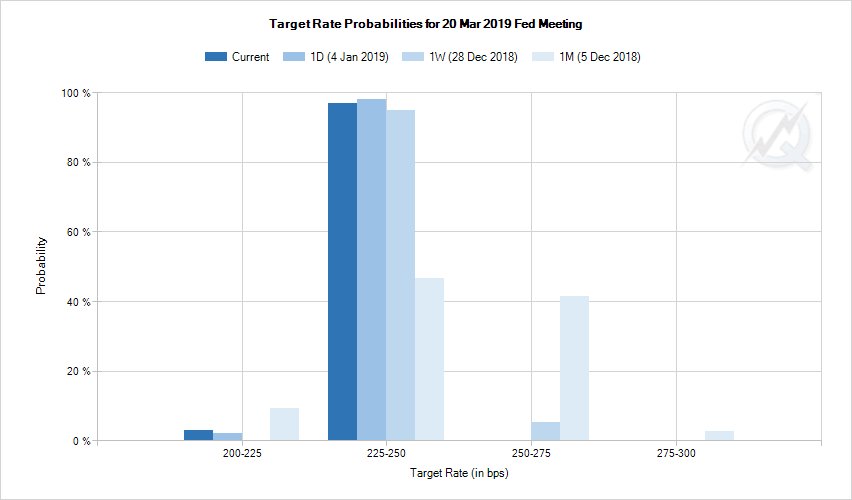
After last week's development, Fed funds futures are now pricing in near 0% chance of a rate hike to 2.50-2.75% in March. It was at 43% a month ago.
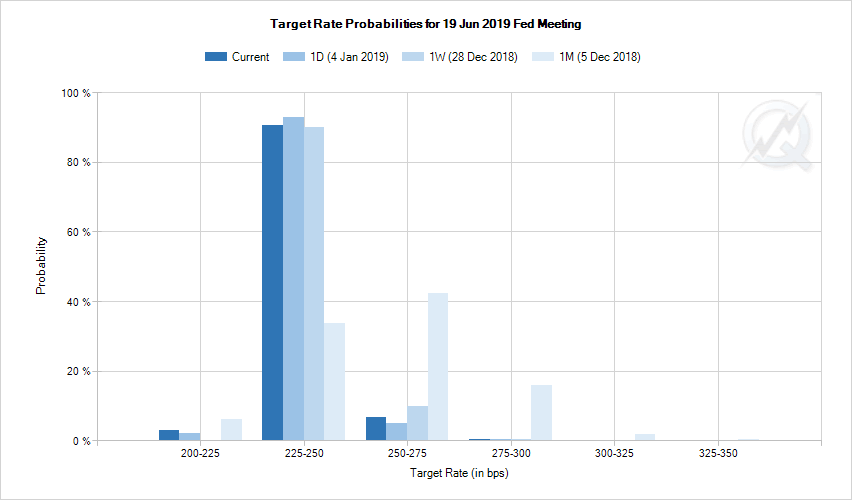
For June meeting, chance of a hike to 2.50-2.75% stands at only around 6.6%. Last month, it was at around 60%.
And, chance of a hike to 2.50-2.75% by end of December meeting is at around 5% only.
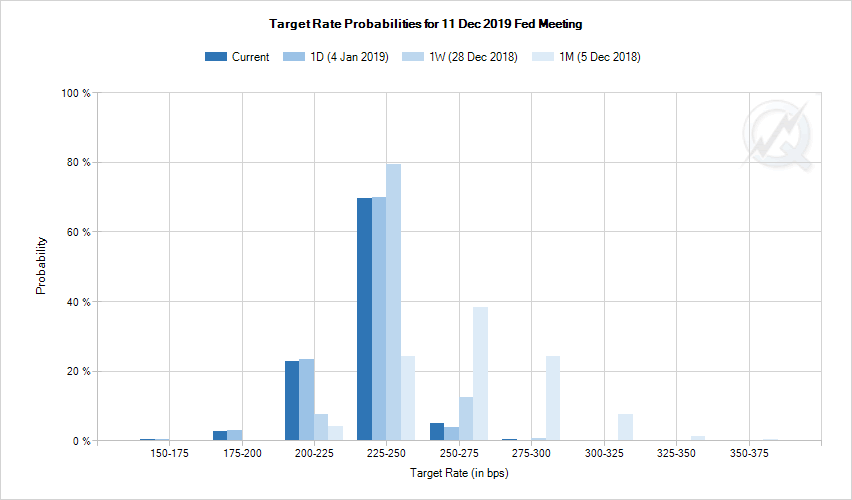
So, basically, traders are not expecting any rate hike by Fed in 2019 at all. What's more important is that, CME futures are pricing in 3% chance of a cut in March and June, but over 25% chance of a cut to 2.00-2.25% in December. That is, for now, the consensus is Fed will do nothing in the first half. And chance of rate cut towards the end of the year increases, depending the developments. To us, such pricing is a bit too pessimistic on the economy, in particular after the strong NFP report.
DOW's rebound is still viewed as a correction that may not last long
While US stocks tumbled broadly after Apple's sales outlook downgrade, sentiments staged a massive turnaround on Friday, with help from Powell. However, we'd like to point out that the post-Christmas rebound is still viewed as a corrective move, and all three major indices are held below key near term fibonacci levels. Such rebound might not sustain for long.
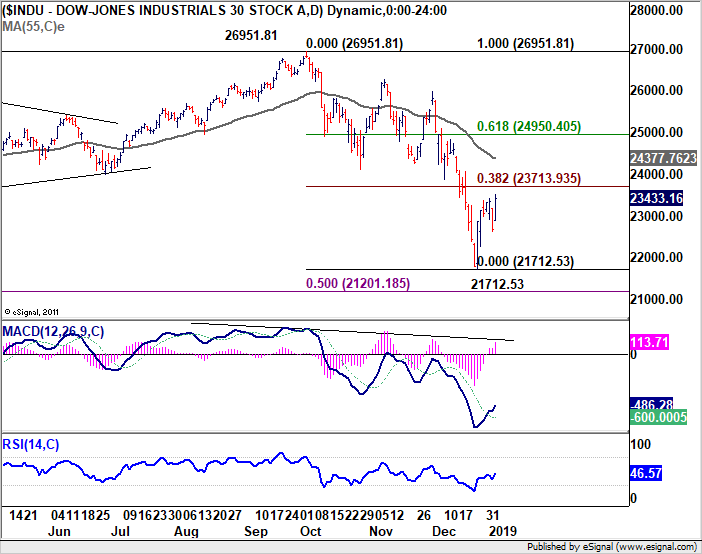
DOW is staying below 38.2% retracement of 26951.81 to 21712.53 at 23713.93. There is no bottom reversal pattern yet. And there is no bullish convergence condition in daily MACD. The rebound is viewed as being technically resulted from oversold condition, as seen in daily RSI. Even if DOW might extend through 23713.93, strong resistance will likely be seen from 55 day EMA (now at 24377.76) to limit upside.
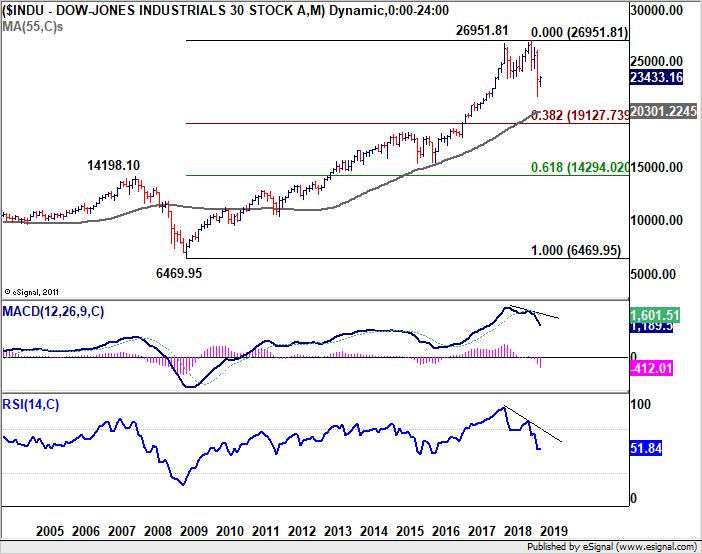
Overall, we maintain the view that price actions from 26951.81 are correcting decade long up trend from 6469.95 (2009 low). And such correction should at least have take on 38.2% retracement at 19127.73 before completion.
2- to 5-year yields in federal funds rate target range
Yield curve inversion, a indication of recession ahead, is clearly something that's troubling investors. The situation was rather serious when 10 year yield dived to as low as around 2.54 and 1-year yield reached 2.50. It looked like 1- and 10-year yields were going to invert. But the situation eased much after Friday's rebound.
Yield curve remained inverted from 1-year (2.592) to 2-year (2.492), 3-year (2.478) and 5-year yield at 2.496 is not too far away. Also yields are now within federal funds rate range of 2.25-2.50% from 2- to 5-year.
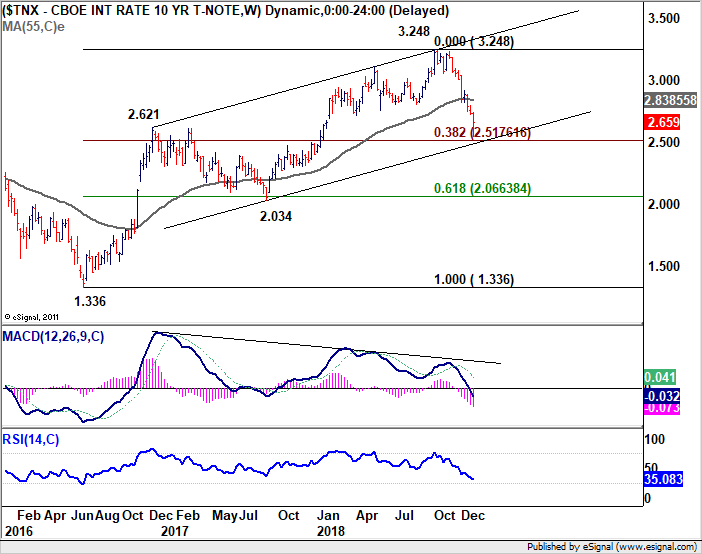
The better news is that 10-year yield is now within touching distance from a key support zone. Those include channel support at around 2.485 and 38.2% retracement of 1.336 to 3.248 at 2.517. There is prospect of stronger rebound, but last week's high at 2.745 is needed to be taken out first.
Dollar index near term neutral for now
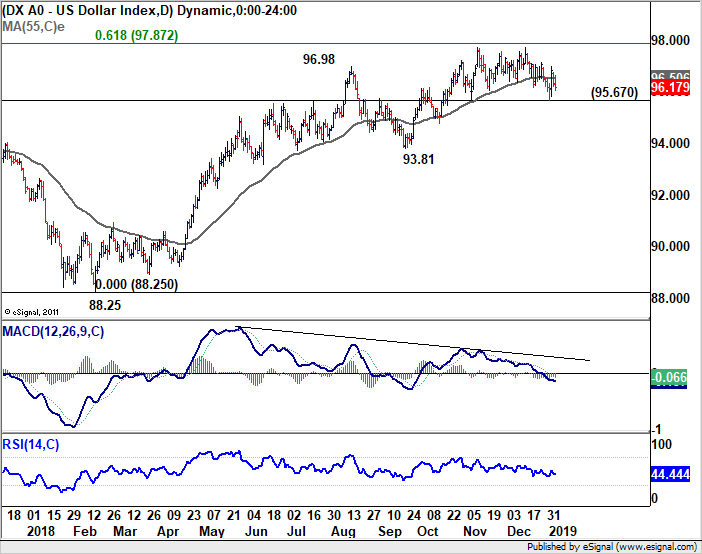
The Dollar index very much reflected EUR/USD's movements. That is, it's staying in familiar range. DXY drew support from 95.67 and recovered after last week's decline attempt. But there was no momentum for an upside breakout. The development is starting to turn bearish with 55 day EMA taken out briefly. But still, break of 95.67 support is needed to confirm near term reversal. On the upside, 61.8% retracement of 103.82 (2017 high) to 88.25 (2018 low) at 97.87 remains a difficult hurdle to overcome. Near term outlook is overall neutral for now.
Chinese stocks lifted by RRR cut and pledge on countercyclical measures
Overall market sentiments have started to turn around on Friday on news that China was ready for measures to support the economy. The State Council noted in a brief statement in its website that Premier Li Keqiang pledged to step up "countercyclical adjustments" of macro policies. Measures will include tax cuts, targeted lowering of reserve requirements to help small and private companies.
And a few hours later, the People's Bank of China announced to lower the reserve requirement ratios (RRR) by 100 basis points to "support the development of the real economy, optimize the liquidity structure, and reduce financing costs". The RRR will be lowered by 0.5% on January 15 and another 0.5% on January 25. Currently, the RRR stands at 1.4% for large banks and 12.5% for smaller banks.
In addition, China's Ministry of Commerce confirmed that there will be US-China vice ministerial level trade talks in Beijing on Jan 7-8. There will be "positive and constructive discussions" in following up to the agreement of Xi and Trump in Argentina. Deputy U.S. Trade Representative Jeffrey Gerrish will lead the team on the US side. This was seen by many as positive developments on US-China trade talk and gave another lift to sentiments.
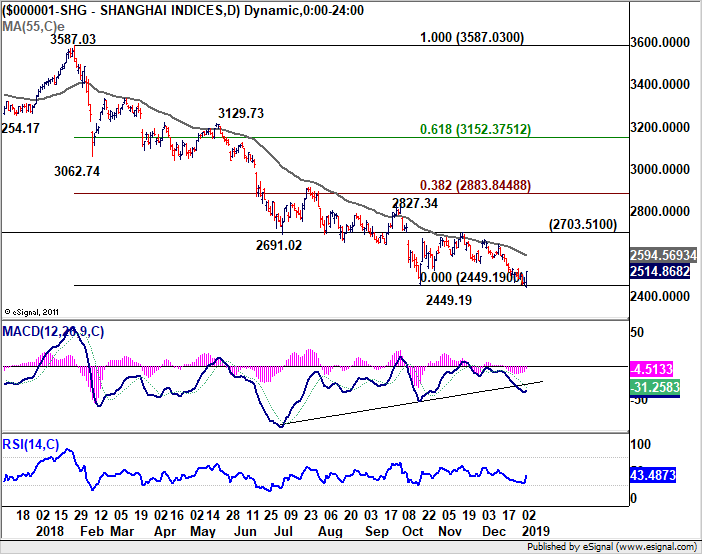
The news gave Chinese stocks a lift while helped other markets globally. After breaching 2449.19 low to 2440.90, the Shanghai SSE composite quietly rebound to close higher at 2514.86 on Friday. Last week's high at 2532.00 is the first hurdle to confirm short term bottoming. We'd expect this to be done rather quickly this week. And there is prospect of rising further to 55 day EMA (now at 2594.56). The real hurdle is double bottom neck line at 2703.51. For now, we'd expect strong resistance from there to limit upside to bring down trend resumption. We don't expect investors to be convinced that the Chinese government could save the slowdown that easily.
Canadian dollar lifted by oil's corrective rebound, BoC eyed
Canadian Dollar ended the week as the strongest one partly thanks to the rebound in oil prices. Also, traders lighten up their short positions ahead of BoC rate decision this week. For now, its seems most analysts lean towards the case of holding rate unchanged at 1.75%. But this is not a total consensus. BoC turned cautious last week as it warned that "the persistence of the oil price shock, the evolution of business investment, and the Bank's assessment of the economy's capacity will also factor importantly into our decisions about the future stance of monetary policy". But overall it still maintained that the policy rate would "need to rise into a neutral range to achieve the inflation target".
Talking about oil prices, WTI extended the rebound from 42.05 short term bottom to as high as 49.33/ Considering bullish convergence condition in daily MACD, 42.05 will likely provide a solid base for the short term at least. The question is how far the rebound could go. For now, we're not seeing any strong momentum to warrant a trend reversal yet. Thus, upside should be limited by 54.61 resistance, which is close to 38.2% retracement of 77.06 to 42.05 at 55.42). That should have set the range for a medium term sideway pattern.
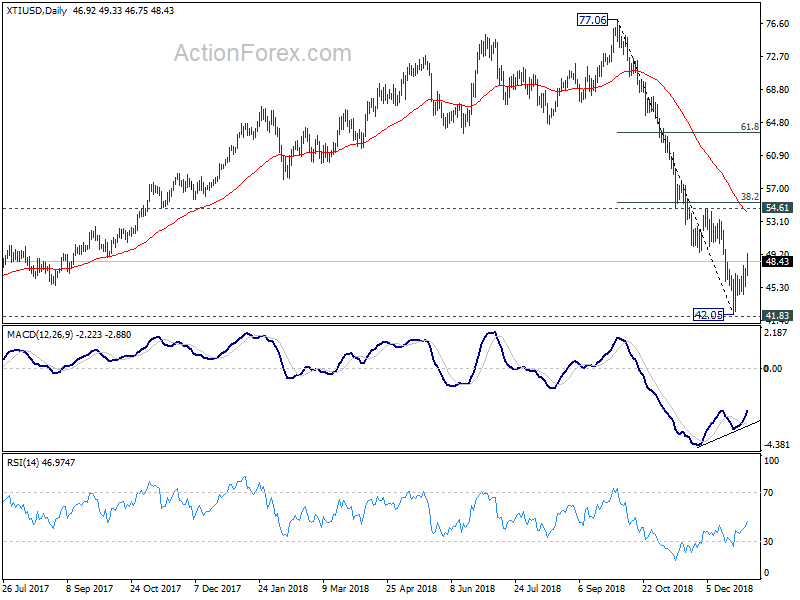
The outcome of BoC's meeting could very much depend on how they view the rebound in oil prices. If they do see it as a correction, there is certainly room to stand pat and be cautious. That's another story if they see 42 as the bottom already. The overall BoC meeting will be a rather live one, together with new economic projections too.
Position trading
We've closed our EUR/JPY short as last updated in this update. So we're not going to repeat here.
In considering the strategy for this week, we'd firstly avoid Sterling. Brexit debate is going to resume in the UK parliament this week, with a vote tentatively scheduled for next week. So far, we haven't seen any real progress yet but there could be a turnaround any time. It's just too hard to predict what's next.
Secondly, we'd avoid Aussie and Yen for now after last week's flash crash. Both look exhausted recent moves. AUD/USD has bottomed in near term after breaching 2016 low of 0.6826. But current rebound doesn't warrant bullish reversal yet. Similarly, EUR/AUD topped out in near term after breaching 2015 high at 1.6587. But the deep pull back doesn't suggest medium term bearish reversal yet too. Yen crosses are still bearish in general after last week's rebound. But USD/JPY, EUR/JPY and GBP/JPY's recovery could extend higher.
Thirdly, we'd also like to avoid Canadian Dollar for now. Current rebound in oil price is seen as corrective. And, if the sharp falls in USD/CAD and EUR/CAD are considered corrective, they're both run away already. BoC meeting is a little of a wild card that we don't prefer to bet on.
That leaves us with only Dollar, Euro and Swiss Franc. Dollar is in favor if 10-year yield rebound further away from the above mentioned key support zone. Positive development from US-China trade talk might also help. Additionally, there is prospect that investor might realize they're being too pessimistic in pricing Fed's rate path. After all, Friday's NFP was a rather strong one.
EUR/CHF is close to key support level at 1.1173 with diminishing downside momentum as seen in 4 hour MACD. And there is prospect of a strong sustainable rebound. Thus, Swiss Franc is preferred to Euro for selling.
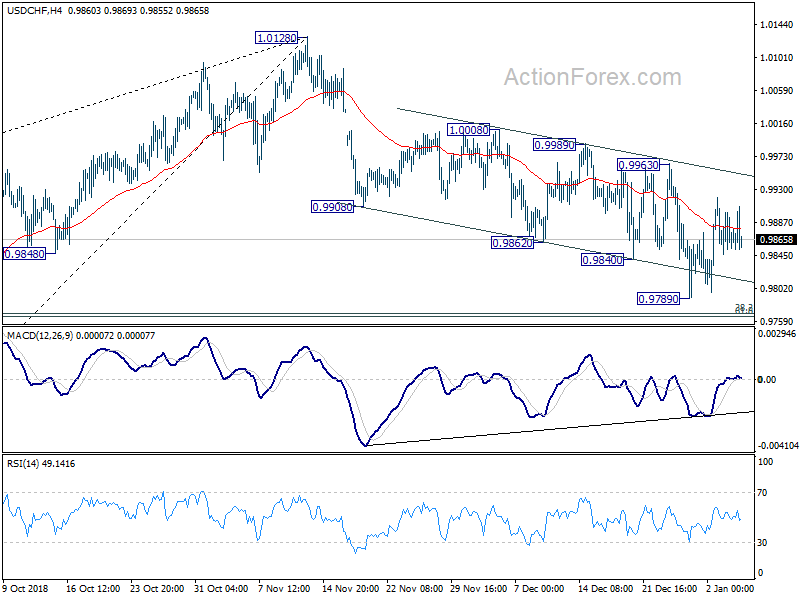
USD/CHF's price actions from 1.0128 are corrective looking. And it's already close to key cluster support level at 0.9765/8 (61.8% retracement of 0.9541 to 1.0128 at 0.9765, 38.2% retracement of 0.9186 to 1.0128 at 0.9768). There is prospect of completing the correction from 1.0128 any time to resume larger rally from 0.9541 and 0.9186.
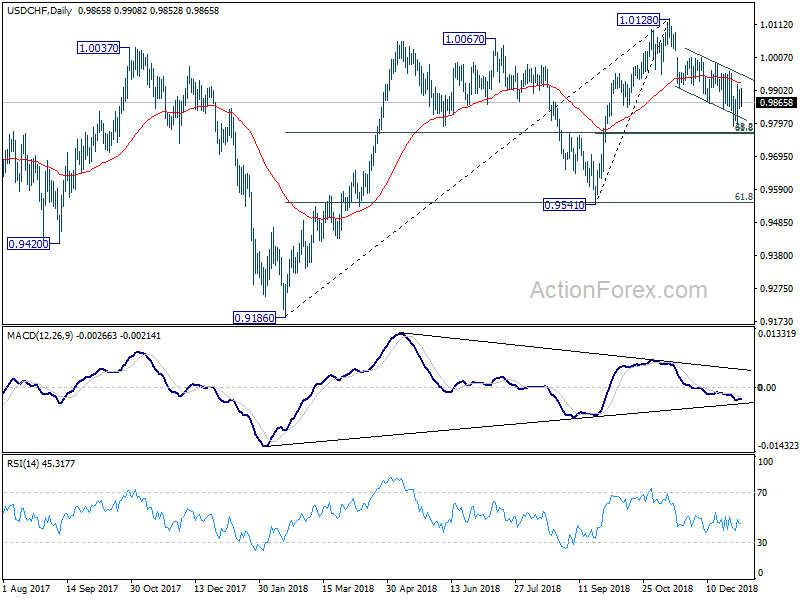
So, we'll try to buy USD/CHF on break of 0.9965 (slightly above 0.9963 resistance). Stop will be placed at 0.9875, slightly below 4 hour 55 EMA at 0.9879. We'll see if USD/CHF could get through 1.0128 high to resume the mentioned up trend. And our target is 1.0300, slightly below 1.0342 high. The strategy has risk/reward ratio at around 1: 3.7.
USD/CAD Weekly Outlook
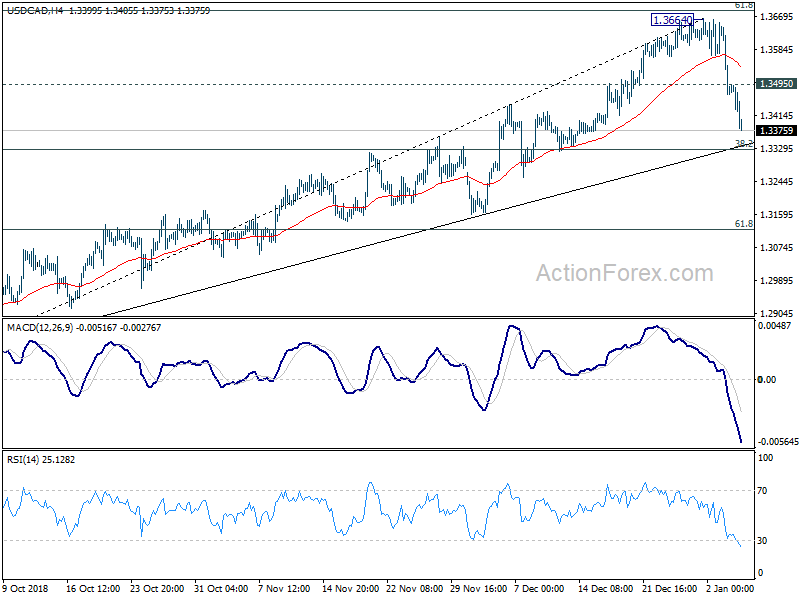
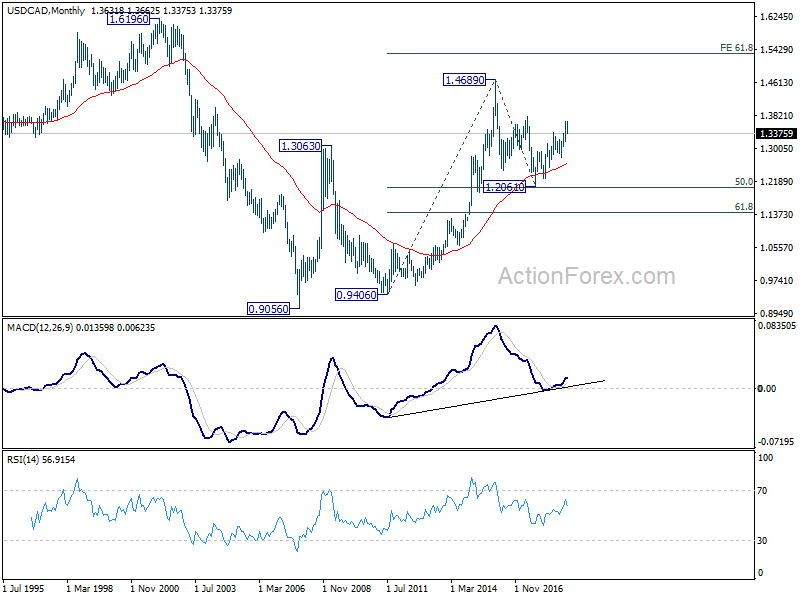
USD/CAD formed a short term top at 1.3664 last week, just ahead of 1.3685 long term fibonacci level, and dropped sharply from there. Initial bias remains on the downside this week for 38.2% retracement of 1.2781 to 1.3664 at 1.3327, which is close to 55 day EMA (now at 1.3324). As such decline is viewed as a corrective move for now, we'd expect strong support from 1.3327 to contain downside to bring rebound. On the upside, above 1.3495 minor resistance will turn bias back to the upside for retesting 1.3664 high. However, sustained break of 1.3327 will bring deeper fall to 61.8% retracement at 1.3118 instead.
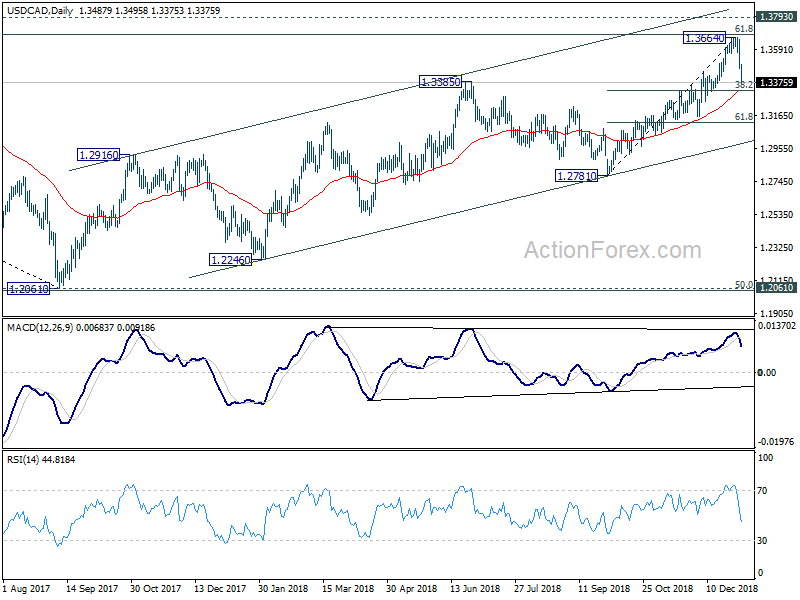
In the bigger picture, the medium term rise from 1.2061 (2017 low) might continue further. But the structure of such rise is not clearly impulsive so far. Hence, we'd stay cautious on strong resistance from 61.8% retracement of 1.4689 (2016 high) to 1.2061 at 1.3685 and 1.3793 resistance to limit upside, and bring medium term topping. But in any case, medium term outlook will stay bullish as long as channel support (now at 1.2993) holds. Sustained break of 1.3793 will pave the way to retest 1.4689 (2015 high).
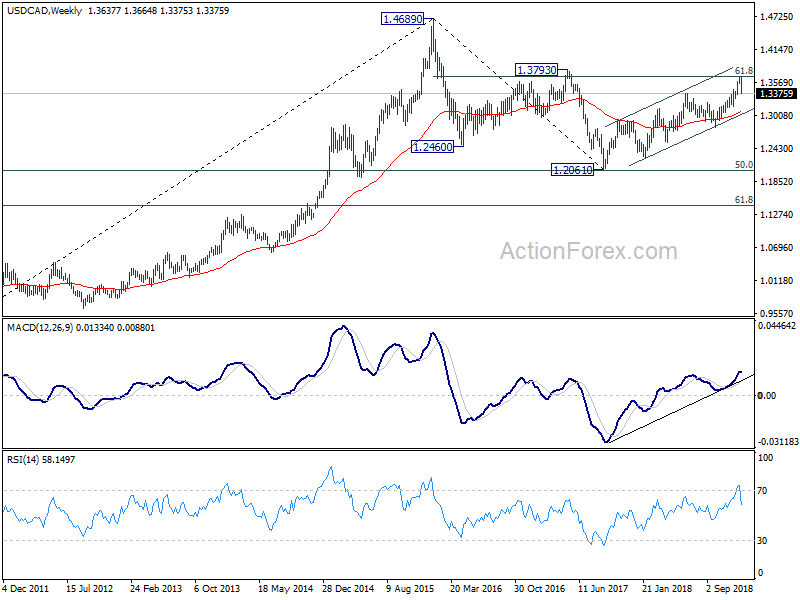
In the longer term picture, corrective fall from 1.4689 (2015 high) should have completed with three waves down to 1.2061, just ahead of 50% retracement of 0.9406 (2011 low) to 1.4689 (2015 high) at 1.2048. The development keeps long term up trend from 0.9406 and that from 0.9056 (2007 low) intact. For now, there is prospect of extending the long term up trend to 61.8% projection of 0.9406 to 1.4689 from 1.2061 at 1.5326 in medium to long term.
Stocks surged as Fed Powell pledged to listen, with patience
US stocks surged overnight as lifted by Fed Chair Jerome Powell's comments, strong job report and Chinese easing. DOW, S&P 500 and NASDAQ all extended post-Christmas rebound and made new weekly high before closing strong. DOW rose 3.29%, S&P 500 rose 3.43% and NASDAQ rose 4.26%. Treasury yield also staged a strong come back with 10 year yield added 0.105 to 2.659.
In short, Powell pledged that Fed was "listening" to the markets after December's volatility. And, "particularly with the muted inflation readings that we've seen coming in, we will be patient as we watch to see how the economy evolves." He also added that "we are always prepared to shift the stance of policy and to shift it significantly" if needed.
Separately, Cleveland Fed President Loretta Mester said in a Reuters interview that federal funds rate is close to neutral. She added, "we really need to be looking at the data and having the economy tell us, do we need to move more? Do we need to move more, faster? Can we wait?" She emphasized "We should take our time and assess ... We may be where we need to be."
Summary 1/7 – 1/11
Monday, Jan 7, 2019
[php_everywhere instance="1"]
Tuesday, Jan 8, 2019
[php_everywhere instance="2"]
Wednesday, Jan 9 2019
[php_everywhere instance="3"]
Thursday, Jan 10, 2019
[php_everywhere instance="4"]
Friday, Jan 11, 2019
[php_everywhere instance="5"]
US Crude Oil Inventory Gained Marginally, In Contrast with Hopes of Decline
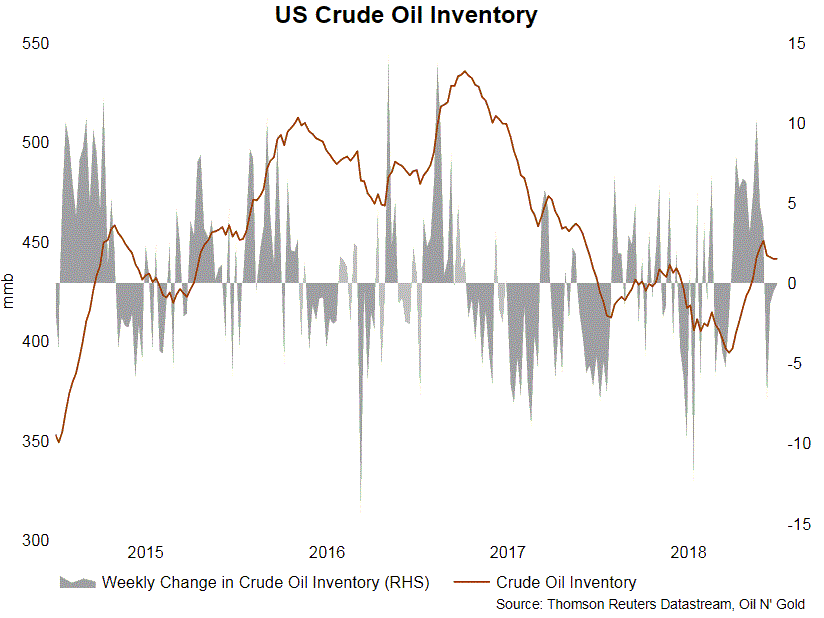
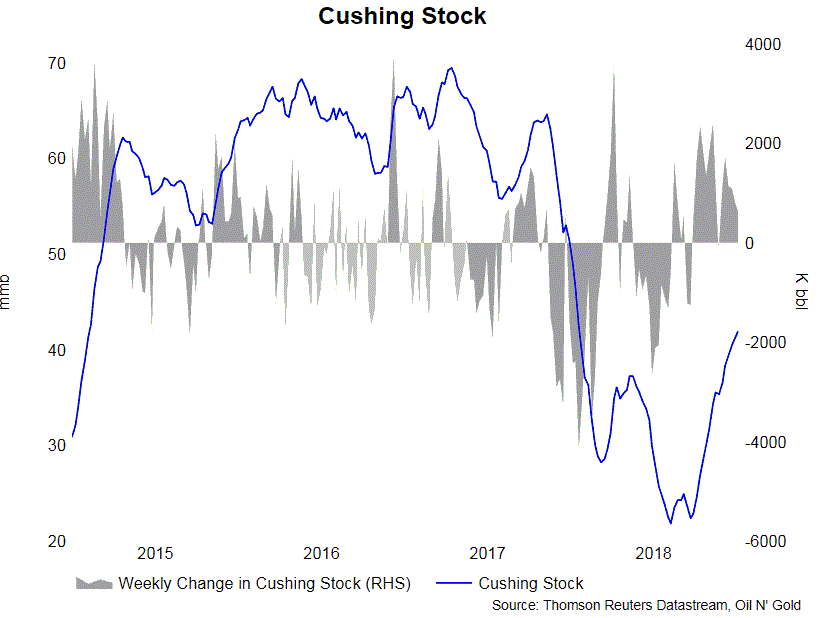
The report from the US Energy Information Administration (EIA) shows that total crude oil and petroleum products stocks gained +14.62 mmb to 1242.16 mmb in the week ended December 28. Crude oil inventory rose +0.01 mmb to 441.42 mmb (consensus: -3.09 mmb). Inventories increased in 3 out of 5 PADDs. Meanwhile, Cushing stock added +0.64 mmb to 41.29 mmb. Utilization rate soared +2.1% to 97.2% and crude production steadied at 11.7M bpd for the week.
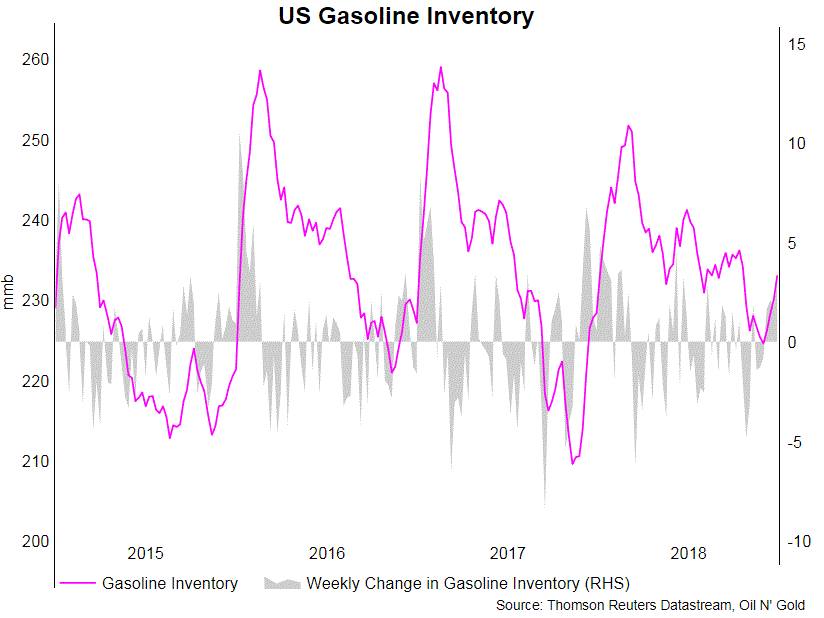
 Concerning refined oil product inventories, gasoline inventory jumped +6.89 mmb to 240 mmb as demand fell -7.8% to 8.62M bpd. The market had anticipated a +1.97 mmb increase in stockpile. Production dropped -6.02% to 9.53 bpd while imports slumped -38.31% to 0.31M bpd during the week. Distillate inventory soared +9.53 mmb to 129.43 mmb. Demand declined -24.5% to 3.2M bpd. The market had anticipated a +1.63 mmb gain in inventory. Production climbed +35.7% higher 5.59M bpd while imports slipped -4.41% to 0.2M bpd during the week.
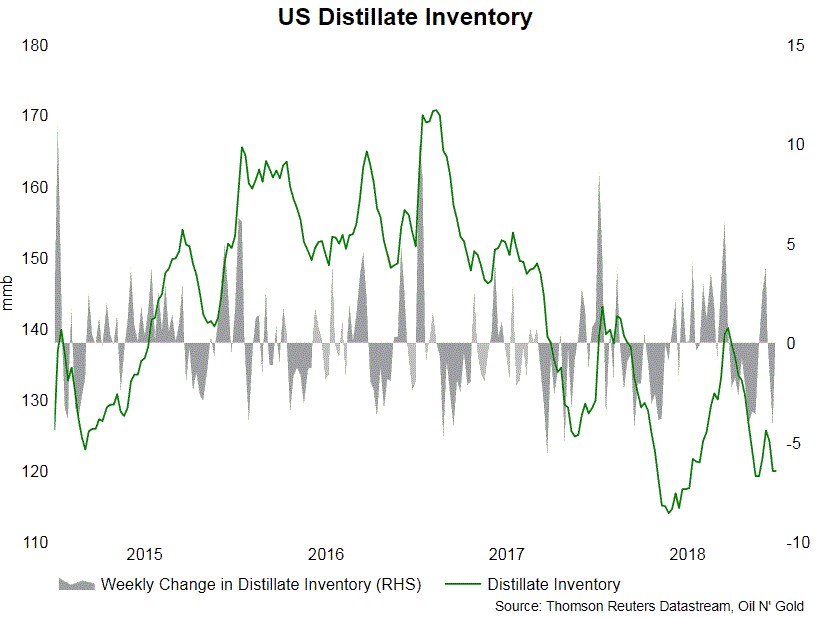
Released after market close on Wednesday, the industry- sponsored API estimated that crude oil inventory declined -4.55 mmb during the week. For refined oil products, gasoline stockpile gained +8mb while distillate was up 4 mmb.
Markets Rise After Strong US Jobs Growth with Fed Talking Down Rate Hikes
The US dollar had a tough first week of 2019. The greenback is lower against most major pairs as market optimism of two rate hikes from the U.S. Federal Reserve have virtually evaporated. Mixed economic indicators and a neutral to dovish Fed Chair Powell put downward pressure on the USD. Inflation data will be released on Friday, January 11 with investors also keeping an eye on trade negotiations improving between China and the US. The Bank of Canada (BoC) will publish its rate statement on Wednesday, January 9. The central bank is expected to keep rates unchanged amid global growth uncertainty, but is still expected to hike once in the first quarter of 2019 if Canadian inflationary pressures keep up.
- Bank of Canada (BoC) to hold rates at 1.75%
- Fed Minutes to be released on Wednesday, January 9
- US inflation data expected flat on Friday, January 11
Loonie Reaches 3 Week High on Falling USD
The USD/CAD lost 1.79 percent in the last five trading days. The pair is trading at 1.3393 after the release of the U.S. non farm payrolls (NFP) showed a solid 312,000 jobs gain and a better than expected 0.4 percent growth in wages. Traders awaited for Fed Chair Jerome Powell's speech in Atlanta which stopped the momentum of the US dollar. In December market estimates had 2 to 3 rate hikes in 2019, but after a stock market sell off that continued into early January the expectations changed radically where even a rate cut would not be out of the question. Powell's words on Friday once again stuck to the central bank's data dependency, but the non committal language was received as a strong signal that the Fed is ready to pause its monetary policy tightening for the time being.
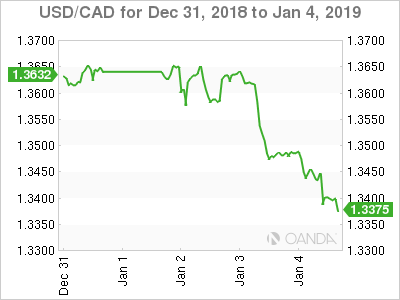 Canadian jobs data continues to impress with a 9,300 new positions added in December. Following a massive 94,100 gain in November the estimates were lower as some headwinds were beginning to affect the economy. The BoC is expected to hold rates at 1.75 percent as the trade dispute between the US and China continues. Governor Poloz has said that he doesn't expect a recession in 2019, but lower wage growth and global geopolitics could have the BoC emulate the Fed and pause its tightening of monetary policy.
Stock markets were encouraged by US indicators pointing to a positive growth US picture, and the way Powell delivered his remarks kept the US dollar from rising. Emerging markets and other riskier assets benefited with Wall Street breathing a sigh of relief after a tough start to the year.
Oil Rises Boosted by US Jobs and Energy Production Slowdown
Oil prices rose 2.60 percent on Friday after concerns around global growth diminished after a strong US jobs report and news out of China regarding US-China negotiations combined with the first signs Saudi Arabia is reducing its crude production. Higher energy demand expectations rose as US negotiators will meet with their Chinese counterparts as the Saudis begin cutting their production as per the agreement with major suppliers in an effort to stabilize crude prices.
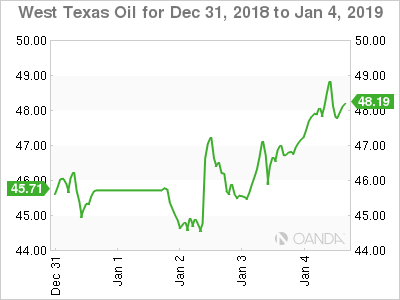 The Organization of the Petroleum Exporting Countries (OPEC) and other major producers agreed to cut supply by 1.2 million last year with Saudi Arabia taking the lead with early cuts, with others expected to join in January. If the US and China can find a middle ground to stop tariff escalation this week as OPEC compliance starts rolling in the outlook for oil prices will improve after a difficult 2018 and the fate of the organization itself will be on more solid ground after the fall in energy prices threatened to break the group apart.
Gold Slows Down as Risk Factors Subside
Gold lost 0.66 percent on Friday but given the volatility of the trading week will end up in the black for the first week of 2019. With US representatives on their way to China to restart trade talks and US jobs once again boosting global growth expectations the yellow metal was sold as investors looked for riskier assets.
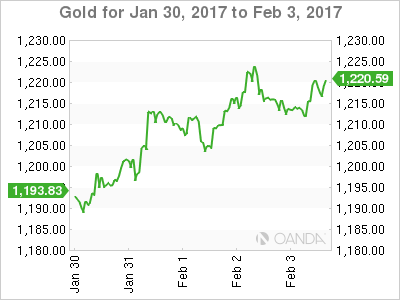 Fed Chair Powells words reassured markets as he will not step down despite pressure from the Trump administration. The neutral comments on monetary policy, but the optimism on the economy boosted markets. The release of the minutes form the Fed's December meeting where the central bank hiked interest rates by 25 basis points could reignite the forecasts of 2 rate hikes this year, despite the turbulence felt in the last four weeks.
Monday, January 7
- 10:00am USD ISM Non-Manufacturing PMI
Tuesday, January 8
- 8:30am CAD Trade Balance
Wednesday, January 9
- 10:00am CAD BOC Monetary Policy Report
- 10:00am CAD BOC Rate Statement
- 10:15am CAD BOC Press Conference
- 10:30am GBP BOE Gov Carney Speaks
- 2:00pm USD FOMC Meeting Minutes
Thursday, January 10
- 12:00pm USD Fed Chair Powell Speaks
- 7:30pm AUD Retail Sales m/m
Friday, January 11
- 4:30am GBP GDP m/m
- 4:30am GBP Manufacturing Production m/m
- 8:30am USD CPI m/m
China Weekly Letter: China Hits the Gas as the Economy Slows Further
- PMI survey points to very weak start to 2019 - more stimulus coming
- Apple another casualty in the trade war - both US and China need a trade deal
- Xi stresses self-reliance - and that Taiwan belongs to China
China eases policy further on weak economic data
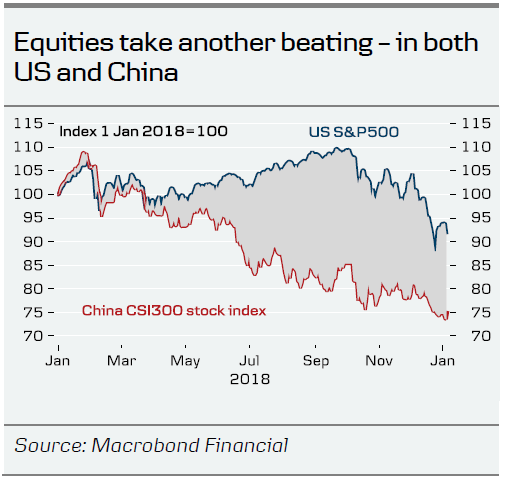
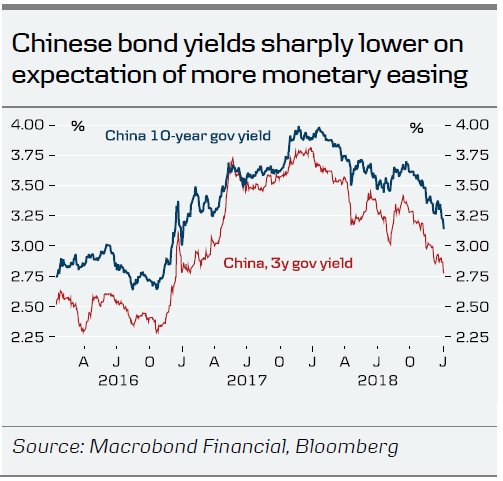
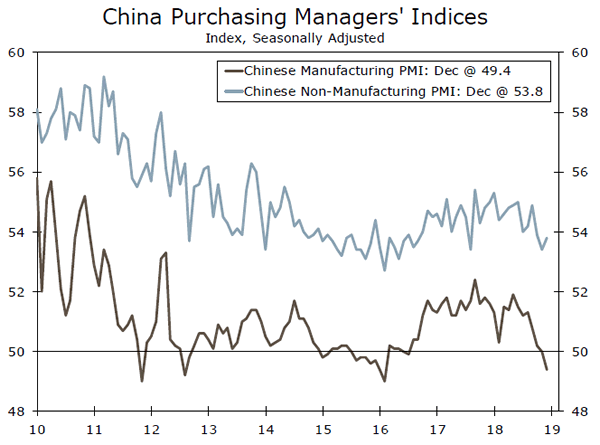
The past week provided more evidence that the Chinese economy is heading for a rough start to 2019 . Both the official and the private version of PMI manufacturing dropped below 50 in December on the back of very weak export orders (see top chart). The news pushed Chinese stock markets and bond yields even lower (see charts on next page).
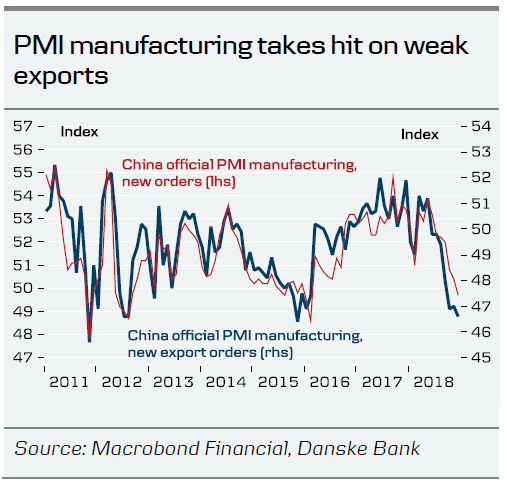
Responding to the slowdown, the People's Bank of China (PBOC) took two steps this week to ease policy further. On Thursday the PBOC increased the scope of a targeted cut in the Reserve Requirement Ratio (RRR), that was initiated last year, see SCMP 3 January. It is estimated to free up around USD100bn of liquidity. On Friday the PBOC followed up with a reduction in the RRR for banks of one percentage point freeing up another USD116bn, see Reuters 4 January 2019.
Comment. It was widely expected that China would ease monetary policy further and more easing could very well come during H1. We are still waiting for the announcement on major tax cuts for businesses and consumers, which we expect to come soon, see also China Weekly Letter: Major tax cuts coming - trade talks on track , 20 December 2018. This week we published China Leading Indicators - Darkest before dawn , 3 January 2019. Our main message is still that we expect the economy to get worse before it gets better from Q2 on economic stimulus and a resolution of the trade war.
Apple another casualty in the trade war - deal needed soon
On Wednesday Apple made its first warning in 15 years of weaker revenues and pointed to disappointing sales in Greater China as the main culprit, see CNBC 3 January. The stock price took a further beating on the news and is now down more than 35% since early October (see bottom chart). Trump's economic adviser Kevin Hasset said in an interview with CNN that the trade war is 'having an impact on earnings and it's not going to be just Apple'. He added that 'a heck of a lot of US companies' are likely to downgrade their earnings until we have a trade deal, see Reuters 3 January.
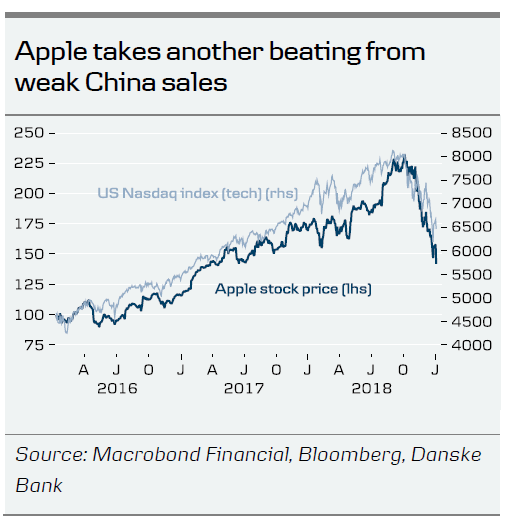
In another sign that the trade war is starting to hurt US companies, the ISM manufacturing index for December nose-dived and many companies highlighted the trade war in the comments in the report .
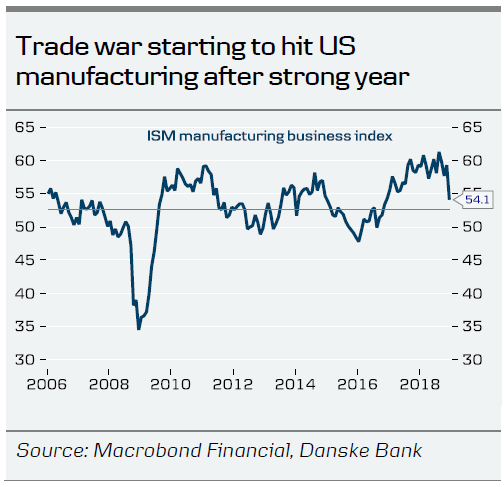
Comment. It is now very clear that the trade war is hurting big US corporates as well. On top of slower Chinese growth, there may be a consumer boycott effect. Apple is probably also a casualty of the arrest in Canada of the Huawei CFO, which has caused great anger in China. Some companies urge employees to boycott Apple - and sanction those that do not comply, see Appleinsider , 24 December.
US and China need a trade deal soon. Both sides also continue to send positive signals in this regard and will meet on vice-ministerial level in Beijing on 7.-8. January, see Reuters 4 January. We continue to look for a trade deal by the end of Q1 or in Q2. We look for a deal to ease some of the pressure on equity markets as well as both the US and Chinese economy.
Xi stresses self-reliance – and that Taiwan belongs to China
In Xi Jinping's New Year speech he stressed that 'China's reforms will never stop, and its doors will open ever wider', see Xinhua 1 January. He also pointed to self-reliance several times in the speech saying 'Through the years, the Chinese people have been self-reliant and worked diligently to create Chinese miracles…And now, looking forward, despite the complexities and difficulties we may face on the road ahead, we shall always closely rely on the people and stick to self-reliance and hard work'.
In another speech on 2 January on Taiwan, Xi Jinping made clear that China's clear aim is reunification with Taiwan, see Xinhua 2 January. He said China must be and will be reunited and pledged 'utmost sincerity and greatest efforts' for a peaceful reunification. However, he also made no promise to abandon the use of force if necessary. He said that the long-standing political differences could not be dragged on generation after generation and promised that that Taiwan's social system and way of life would be fully respected arguing for a 'one country, two systems' solution. Finally he stressed that the Taiwan question is China's internal affair and allows of no external interference.
Comment. The theme of self-reliance was increasingly brought up in 2018 as the trade war and tech war with the US gained steam. 2018 made it clear that China is vulnerable within certain technology sectors and that China needs to become less reliant on the US. On Taiwan, China has raised its voice on the plan for reunification following the increased relations between Taiwan's independence-leaning government and the Trump administration.
Other China news
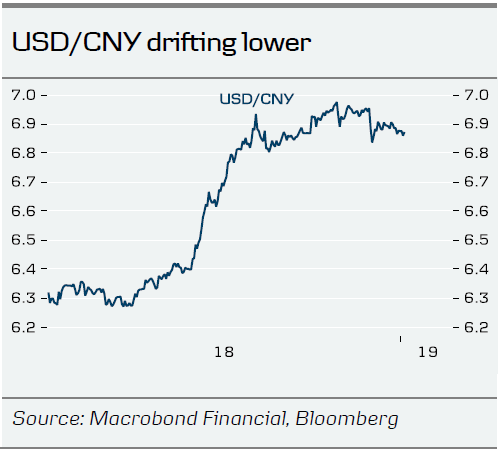
USD/CNY continues to range trade. The overall USD weakening lately has helped to put a cap on USD/CNY. Our forecast is for USD/CNY to trade slightly lower towards 6.80 in 12M.
China on dark side of the moon, see BBC 3 January. On Thursday China said it successfully landed a robotic spacecraft on the far side of the moon. It is the first ever such attempt and landing and is seen as a major milestone in China's space programme. It can also be seen as a show of force in the technology area.
Beijing turns to facial recognition to combat public housing abuses, SCMP 28 December. Another illustration of how China uses facial recognition and AI against illegal activities.
US issues travel warning on China amid tensions over arrest over Huawei's CFO, SCMP 4 January.
China's next generation of weapons and military equipment nears readiness, SCMP 23 December 2018.
Weekly Economic and Financial Commentary: It’s Not Just The Financial Markets Losing Steam
U.S. Review
Conflicting Signals On Employment and Output
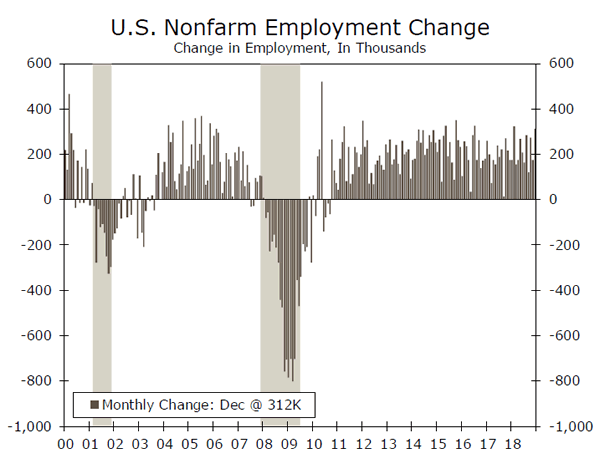
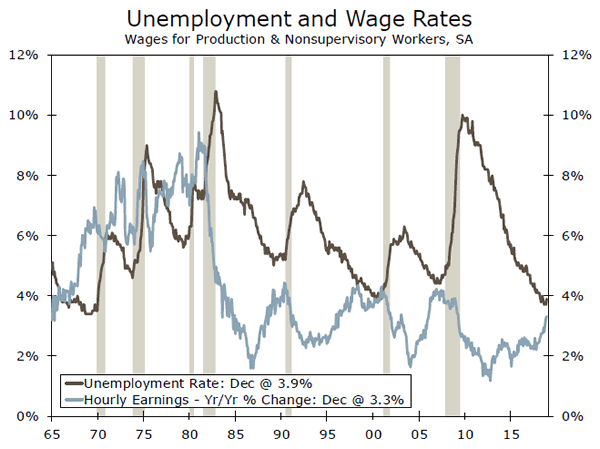
- Nonfarm employment jumped by 312,000 in December, the largest gain since February. Data for the prior months were also revised higher. Gains were broad-based, and there was also a huge increase in the labor force, which explains why the unemployment rate rose 0.2 percentage points to 3.9%.
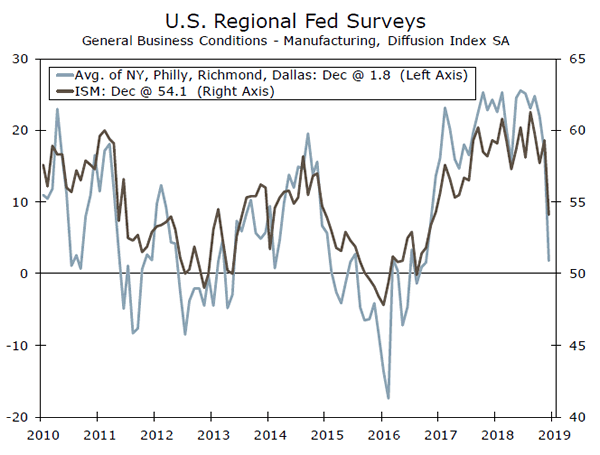
- The stronger job report is a sharp contrast to December's weaker ISM manufacturing survey, which tumbled 5.2 points. That marks the largest one-month drop in more than a decade. Moreover, the forward-looking new orders index plunged 11 points, signaling the factory sector is likely to slow further in coming months.
It's Not Just The Financial Markets Losing Steam
The sell-off in the stock market that began in early October appears to be more of a harbinger of tougher economic times than a simple overdue correction. The production side of the economy has slowed considerably, pulling down commodity prices and business confidence. December's ISM Manufacturing survey tumbled 5.2 points to 54.1, the largest one-month drop in more than a decade. The drop in the headline index was driven primarily by an 11-point plunge in the new orders component, which tumbled to just 51.1. Order backlogs also declined. The decline in these two leading components suggests that output and manufacturing employment are both likely to slow further in coming months.
While manufacturing accounts for just 12% of the economy, it still accounts for the bulk of the quarterly swings in real GDP and its performance is closely watched by policymakers. The latest slide is particularly disconcerting in that it is not linked to any single industry or region, as we saw in the middle of the decade, but is rather sharp and broad-based like we have typically seen prior to the onset of a recession. The top chart shows a comparison of the ISM manufacturing survey and the average of the regional manufacturing surveys from the New York, Philadelphia, Richmond and Dallas Federal Reserve Banks.
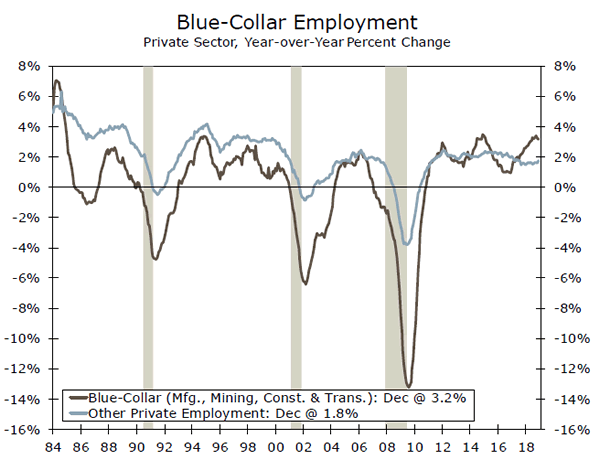
The apparent slide in the factory sector was not evident in the employment data. Nonfarm employment surged by 312,000 in December and data for the prior two months were revised up by 58,000 jobs. Strength was broad-based, which lends credence to the headline number. Moreover, manufacturing payrolls added 32,000 jobs in December and gains were broad-based.
We suspect the December data contained some catch-up elements. This past fall's hurricanes hit during the September and October survey weeks, and the California wildfires and unusually wet weather along much of the East Coast depressed job growth the following month. After not changing in November, construction employment rose by 32,000 in December, with most of the increase coming in heavy and civil engineering construction, likely reflecting highway work. All of that gain, however, was due to a smaller than usual non-seasonally adjusted drop in jobs. But even after taking this into account, the stronger jobs figures and the 0.4% rise in average hourly earnings should alleviate any concerns about a more troublesome slowdown.
Consumer spending also appears to be holding up well. Early reports on the holiday shopping season suggest consumers splurged a bit. Motor vehicle sales also came in strong, with the Ward's measure showing sales at a 17.5 million vehicle pace in December. Lower gas prices helped boost spending in both areas.
Reconciling the weak ISM report and strong employment report puts policymakers in a bit of a quandary. The ISM report is more of a leading indicator, while the jobs figures tend to be more backward looking. The Fed puts a great deal of stock into the ISM data and a further weakening below 50 in the next few months would provide ample support for folks inside and outside the Fed that are calling for a pause in the Fed's rate hikes.
U.S. Outlook
ISM Non-Manufacturing • Monday
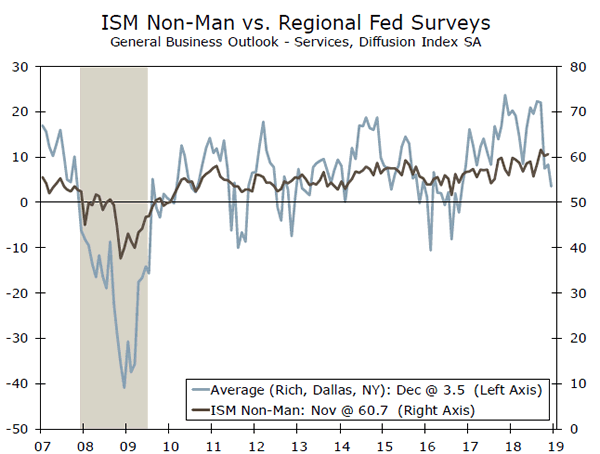
Economic activity has been exceptionally strong according to the ISM non-manufacturing index, which has come in above 60 for three consecutive months. We expect to see the index end the year on a softer note, however. Lower oil prices are likely to hit respondents in the mining industry, while comments from recent reports indicated some concerns over tariffs. In contrast to the ISM non-manufacturing index, regional PMIs for the service sector as well as the Markit services index have rolled over the past few months.
A sharp miss to the downside would generate more cause for concern about a slowdown in the economy given that the non-manufacturing index represents nearly 90% of U.S. output. Another elevated print, however, would suggests that the economy's momentum remained solid heading into the new year.
Previous: 60.7 Wells Fargo: 58.4 Consensus: 59.5
NFIB Small Business Optimism • Tuesday
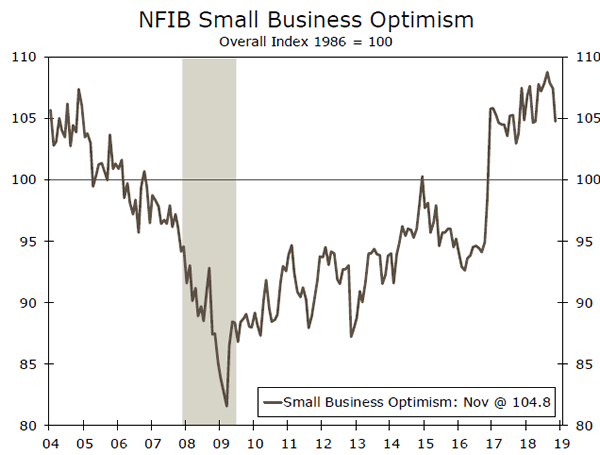
Like the ISM indices, the NFIB's Small Business Optimism Index was fairly buoyant in 2018. The index has lost some ground the past couple months, however, as expectations for the economy and sales have moderated. With the stock market having tumbled over December, a further pullback in sentiment is expected.
While expectations for sales and profits have come down a bit, the NFIB survey continues to suggest a tight labor market. The most commonly cited challenge of small firms has been finding qualified labor, while the share of firms reporting they have at least one job hard to fill is already reported to have risen in December to a recordhigh of 39. At the same time, the share of firms raising compensation hovers near all-time highs, signaling to the FOMC further upward pressure on wages and, potentially, inflation.
Previous: 104.8 Consensus: 103.5
Consumer Price Index • Friday
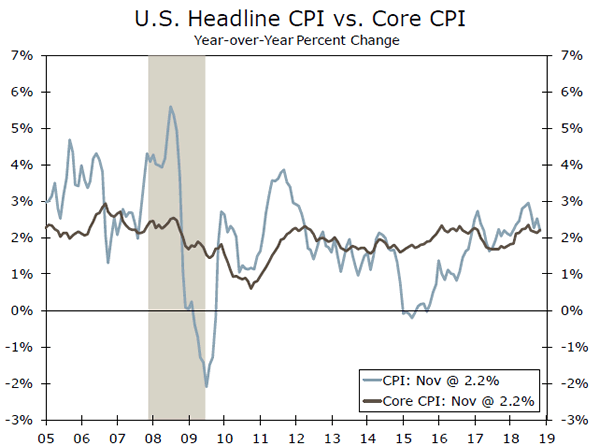
Falling gasoline prices in November left the consumer price index unchanged. With gasoline prices declining further last month, we expect the CPI slipped 0.1% in December. We also anticipate a softer reading for core inflation (+0.1%) to account for some payback after a rare back-to-back increase in core goods prices and an above-trend gain in shelter costs. That said, the overall trend in core inflation is expected to remain firm.
Given that the FOMC focuses on core inflation in its near-term policy deliberations, a downside miss on the headline is unlikely to ring alarm bells if driven by drops in energy and/or food. An increase in core CPI of 0.1-0.2% would be consistent with the recent trend. A noticeably weaker print for the core index would suggest that inflation is not a pressing threat, while an upside surprise would support the FOMC's recent plans to raise rates.
Previous: 0.0% Wells Fargo: -0.1% Consensus: -0.1% (Month-over-Month)
Global Review
Fears of Global Economic Slowdown Linger
- Weak Chinese PMI data earlier in the week weighed on global sentiment, and saw Chinese authorities announce a further cut in the reserve requirement ratio for banks, effectively increasing liquidity in the banking system.
- Other economic data from international economies were somewhat mixed, including a subdued Canadian jobs report, soft Eurozone inflation figures and a rebound in U.K. PMIs. Politics remain in focus as well, as the Italy-E.U. budget spat was largely resolved but uncertainty remains over the next steps for the Brexit process and the ongoing U.S.-China trade war.
Fears of Global Economic Slowdown Linger
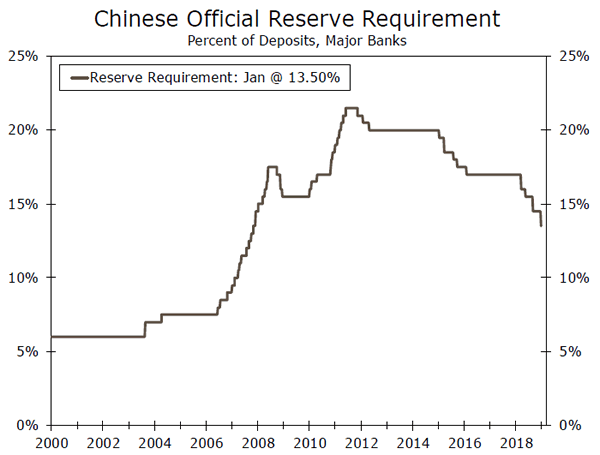
Economic news on the global front was somewhat mixed in the first week of the new year, with concerns lingering over prospects for global economic growth. China garnered attention as the official and Caixin manufacturing PMIs fell into contraction territory (i.e., below 50), reigniting concerns around a sharper slowdown in the world's largest developing economy. Later in the week, China announced that it would reduce the reserve requirement ratio (RRR) for major banks 100 basis points to 13.50%, effectively increasing the amount of liquidity in the banking system. That announcement is likely at least partly a response to weak economic data, and comes after 250 basis points worth of RRR cuts in 2018. On a more positive note, the official and Caixin services PMIs climbed higher in December and remain well above the 50-line demarcating expansion and contraction. Meanwhile, there appears to be a great deal of anticipation around upcoming U.S.-China trade talks scheduled to take place on January 7-8. As a reminder, if the two sides do not reach a formal trade deal by March 1, President Trump has threatened to raise the current 10% tariff on $200 billion worth of Chinese goods to 25%.
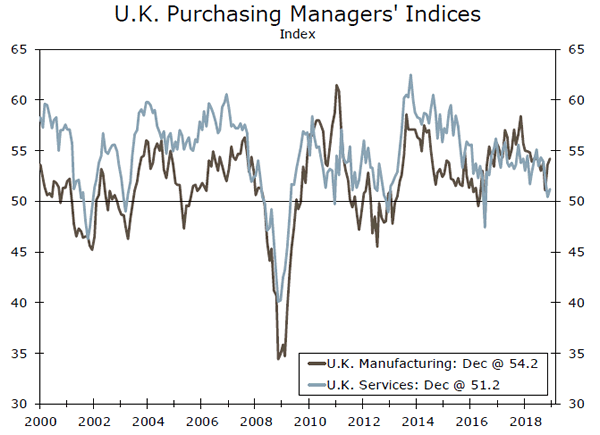
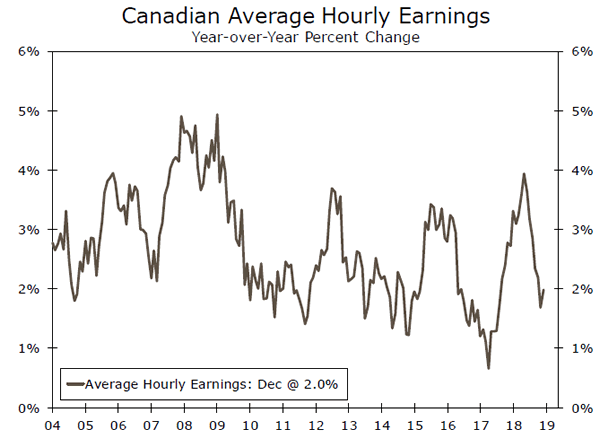
Economic data from the United Kingdom were a bit less downbeat, as the December manufacturing and services PMIs recovered to 54.2 and 51.2, respectively. Still, it is hard to get particularly optimistic regarding U.K. economic prospects as a resolution to the current Brexit uncertainty remains elusive. Little progress was made in lessening that Brexit uncertainty in recent weeks as parliaments in the United Kingdom and European Union were on holiday recess, while U.K. Prime Minister Theresa May is still targeting a vote on the current Brexit withdrawal deal for the week of January 14. Elsewhere, Canada's December jobs report was generally soft in tone—9,300 jobs were added over the month, but mostly in part-time industries, while the unemployment rate stayed at 5.6% and wage growth remained low at 1.5% year-overyear. The Bank of Canada already shifted toward a more dovish stance at its meeting in mid-December, and is likely to remain on hold at its upcoming policy announcement next week.
On a more positive note, Italian parliament approved a final budget proposal for 2019, settling on a deficit target of 2.04% of GDP for this year after a series of revisions recommended by the European Commission. The key question now for the Italian government will be how to allocate the limited stimulus to its various campaign promises, and moreover whether the government will actually be able to achieve its narrower deficit target. European data were limited this week—a slowing in December Eurozone CPI inflation to 1.6% year-over-year garnered some attention, but largely confirmed the narrative that ECB rate hikes are a long way off. Finally, Brazilian President Jair Bolsonaro took office on January 1, and is expected to detail his reform agenda in the coming days and weeks. Arguably at the top of the list, at least from an economic perspective, is reforming Brazil's pension system, a key issue that has hindered consolidation in Brazil's budget deficit and which is likely to pose an increasingly significant threat to the country's finances unless addressed.
Global Outlook
Eurozone Retail Sales • Monday
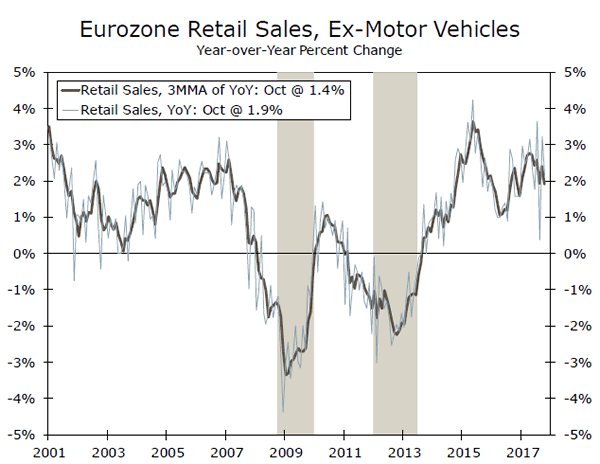
2018 was a challenging year for the Eurozone economy, marked by slowing growth and worsening sentiment. The retail sector was no exception, as total sales growth slowed to roughly 1.5% year-over-year toward the end of 2018 from a run rate of above 2% for most of 2017. While a change in auto emissions rules led to some volatility in the overall series, sales excluding motor vehicles have also softened in recent months.
The weakening in consumer confidence over the course of last year does not bode particularly well for retail sales in 2019, while the services sector PMI has also fallen markedly over the past year. However, firming wage growth in the Eurozone gives us confidence that retail sales should hold up reasonably well this year, while steady employment growth should also bode well for overall consumer spending in the region.
Previous: 0.3% Consensus: 0.2% (Month-over-Month)
Bank of Canada • Wednesday
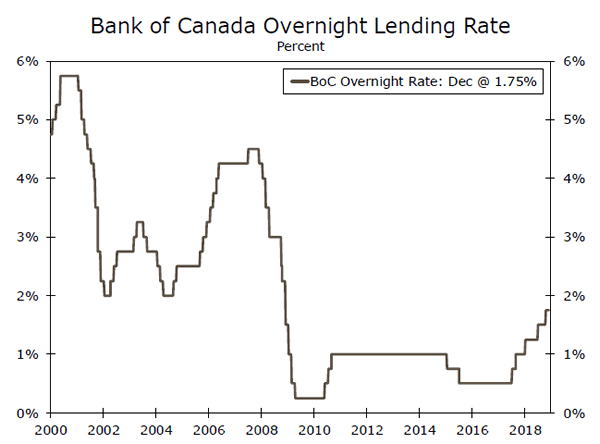
The Bank of Canada (BoC) is likely to hold its overnight rate steady at 1.75% when it announces monetary policy next week. At its latest meeting in early December, the central bank sounded more cautious with regards to the domestic economic outlook, in part due to the ongoing weakness in oil prices. Moreover, it said there was "more room for non-inflationary growth," a sign it likely felt less urgency to normalize interest rates. Amid that more dovish signaling, market pricing for future BoC rate hikes has fallen substantially in recent weeks.
Despite more dovish BoC language, we still think the central bank will hike rates further in 2019. Headline inflation has eased, but core inflation has held relatively steady near the BoC's 2% target, while Canadian economic growth generally remains above potential. Next week's policy decision could provide clues for when that next hike could be delivered.
Previous: 1.75% Wells Fargo: 1.75% Consensus: 1.75%
Mexico CPI • Wednesday
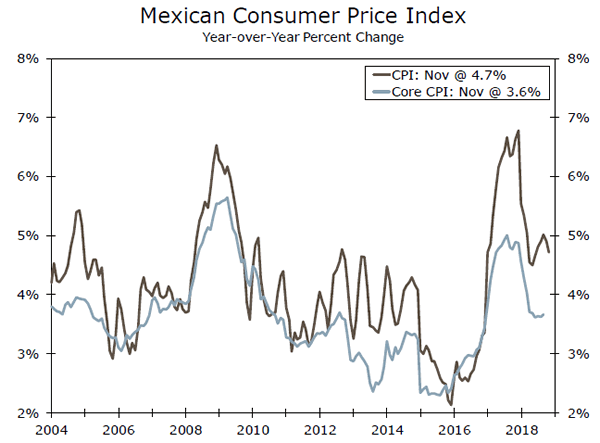
The Bank of Mexico raised its overnight rate 25 bps to 8.25% in late December, its fourth 25 bps rate hike of 2018. Those rate hikes coincided with another volatile year for the Mexican peso, which swung from gains to losses as markets considered Mexico's economic and fiscal prospects under the leadership of new president Andres Manuel Lopez Obrador (AMLO). Amid all the volatility in the peso, Mexican CPI inflation was reasonably steady for most of last year, particularly when looking at the core figure. Accordingly, rate hikes from Mexico's central bank appeared to be more defensive in nature, aimed at keeping inflation expectations anchored and limiting the pass-through from a weaker peso to higher inflation. Subsequent CPI readings will be key to watch for clues on whether the central bank will continue to raise interest rates, while any further signs of disruptive economic policies under AMLO's leadership could also prompt a hawkish response from central bank policymakers.
Previous: 4.7% Consensus: 4.8% (Year-over-Year)
Point of View
Interest Rate Watch
Is the Fed Done Hiking Rates?
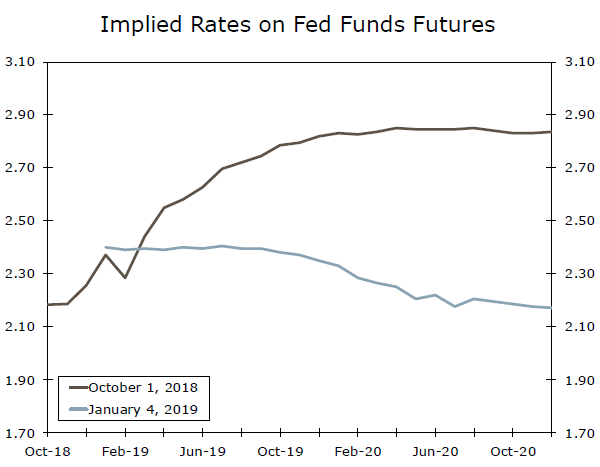
In early October, the U.S. economy was cruising along with strong growth momentum and with stock market indices sitting at or near all-time highs. Prices of fed funds futures contracts at that time indicated that investors expected the Federal Open Market Committee (FOMC) would raise rates 75 bps by the end of 2019 (top chart). Three months later, the economy has decelerated somewhat and financial markets have encountered a bout of volatility. Investors now expect that the FOMC will refrain from raising rates further, and that it will cut rates by 25 bps in 2020.
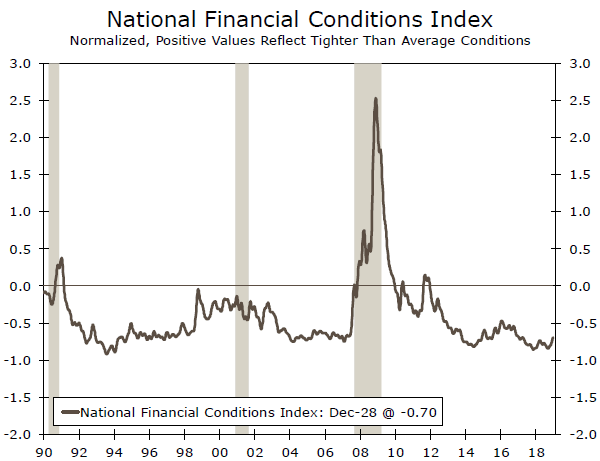
Has the high-water mark for the fed funds rate for this cycle been reached already? The sequential rate of real GDP growth has slowed from 4.2% in Q2-2018 to 3.4% in Q3 to our estimate of 2.2% in Q4. And the recent widening in credit spreads and the swoon in the stock market represent a tightening in financial conditions that we discussed in more detail in a recent report. Although financial conditions, as measured by the Chicago Fed's National Financial Conditions Index, have tightened in recent weeks, they do not appear to be overly restrictive at present, at least not in a historic context (middle chart).
At its last policy meeting on December 19, the FOMC voted unanimously to raise rates 25 bps. Moreover, the FOMC's "dot plot" indicates that most FOMC members thought that 50 bps of further rate hikes would be appropriate in 2019. But the events of the past few weeks cast some doubt on those expectations. Dallas Fed President Kaplan said this week that he believes the FOMC should pause until some of the uncertainties are resolved.
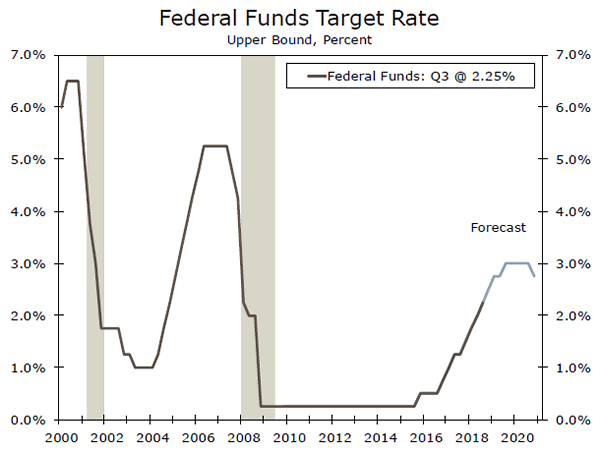
Our most recent forecast, which was compiled in early December, looks for two 25 bps rate hikes in 2019, first in March and again in September (bottom chart). But we readily acknowledge that the risks are skewed to a longer pause in the first half of the year than we thought just a month ago. We will be watching incoming data and making changes to our Fed call, as appropriate.
Credit Market Insights
Tighter Credit Conditions Ahead?
The end of 2018 saw a ramp up in financial market volatility, with the S&P 500 index falling over 10% in Q4. As discussed in our Interest Rate Watch section, we have examined the recent tightening in financial conditions and possible implications for monetary policy.
With these trends in mind, what does the recent tightening in financial conditions mean for broader credit availability? For starters, until recently, financial conditions have actually eased even as the FOMC has normalized monetary policy. This relationship is indicative of the performance of the broader economy. GDP growth remained solid in Q3, while consumers continue to enjoy rising wages and inflation that is largely anchored.
At the same time, loan growth remains positive, with consumer loans rising nearly 4.6% year-over-year in November. The most recent data from the Senior Loan Officer Opinion Survey echo the hard data and point to banks' willingness to make consumer loans continuing to rise in Q3. The survey also noted that "banks reported little change in their credit standards and most terms across categories of consumer loans on balance."
On net, although financial conditions have tightened as the cost of credit has steadily increased while the Fed has raised rates, overall credit availability still looks relatively robust for most consumers, while interest rates are also still low by historical norms.
Topic of the Week
D.C. Deadline Drama in 2019? Probably.
Congress and the President were unable to reach an agreement on all 2019 appropriation bills at the end of December, leading to a partial government shutdown that began on December 22 and has persisted into the new year. While government shutdown drama has mostly been avoided in recent years, the return of divided government means these topics could come back into focus in 2019. In a special report published this week, we analyze the economic impact of the shutdown and key issues to watch in Washington over the coming year.
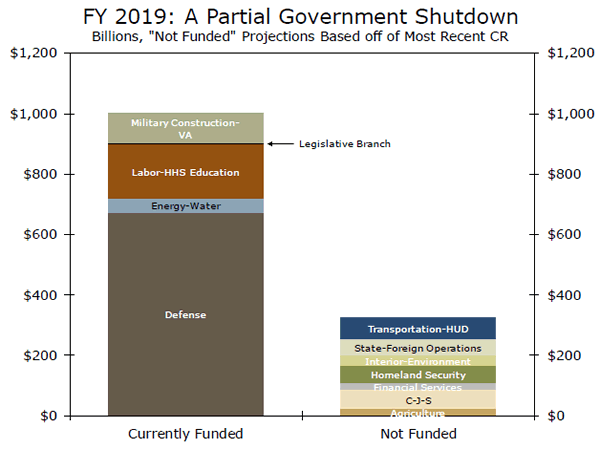
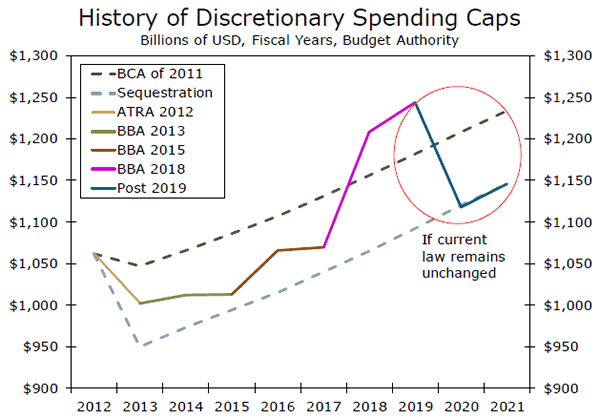
Given that 75% of discretionary spending has already been appropriated and passed into law (top chart), we see the current shutdown having only a minimal negative impact on quarterly GDP growth of 0.1-0.2 percentage points at most, assuming the current impasse is resolved in the near future. But the shutdown is unlikely to be the only budget issue this year. The two-year budget deal passed in February 2018 that set top-line spending levels for FY 2018 and FY 2019 will no longer be in effect when FY 2020 begins on October 1 (bottom chart). This means that Congress will need to determine both the total amount of funds available for 2020 appropriations, as well as complete the actual appropriations process.
Adding to already-complex budget process, the debt ceiling will also be reinstated on March 2, meaning that the U.S. Treasury will be unable to issue additional debt to meet government spending needs beyond what is met by tax revenue. It would then need to use "extraordinary measures" to meet the daily cash flow needs of the federal government until Congress can agree on a new debt limit. Based on our analysis, we expect the "X date," or the date by which the debt ceiling must be raised before the Treasury is unable to meet all of its obligations, to occur in mid-to-late summer, creating the potential for another budget showdown later this year.
In sum, with concerns swirling about global growth, monetary policy mistakes and other recession risks, a fiscal fumble from policymakers in Washington is another risk to the economic outlook as 2019 progresses.
The Weekly Bottom Line: The Shutdown Slowdown
The Weekly Bottom Line
U.S. Highlights
- The New Year came with baggage from the old for thousands of federal employees caught in the middle of a budget tug-of-war between Congress and the White House that has led to a partial government shutdown.
- The volatility in stock markets continued early in the week as a slew of weaker-than-expected economic data and signs of a slowing China roused investor concerns that global growth may be slowing faster than expected.
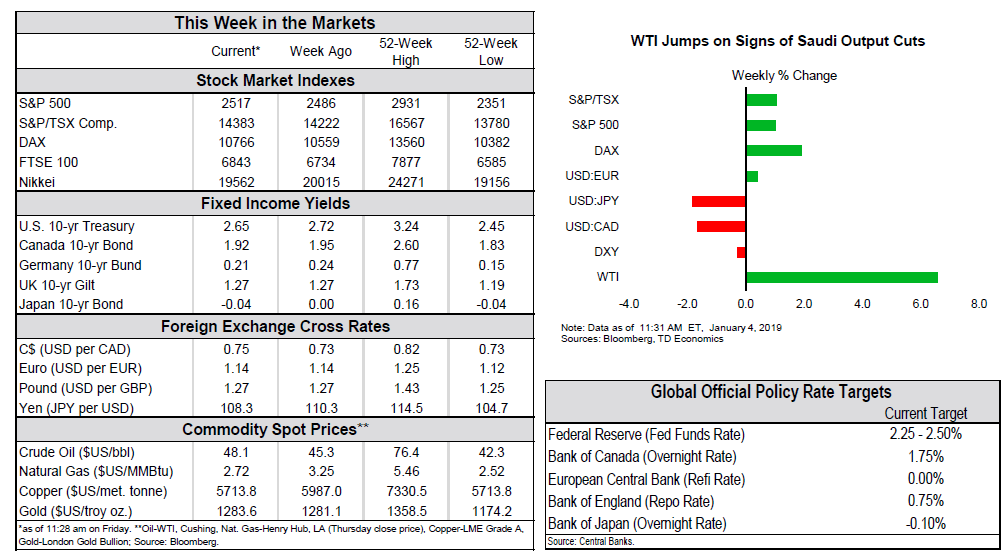
- Fortunately, a strong payrolls tally lifted investors' spirits by week's end. Employment rose 312k and the unemployment rate edged up to 3.9% as more people joined the workforce. Hourly earnings growth also topped 3% (year-on-year) for a third consecutive month.
Canadian Highlights
- A soft jobs report that left the unemployment rate at a historically-low 5.6% highlighted a light week for Canadian data.
- The S&P/TSX composite index is up modestly on the week, but global risk-off sentiment and a decline in energy prices have weighed heavily on the index in recent weeks.
- Oil prices enjoyed a strong run this week, with Brent rising around 9% and WTI up 6% as markets weigh recent data suggesting large Saudi production cuts against global growth concerns.
U.S. - The Shutdown Slowdown
Happy New… whatever. 2019 kicked off with a fizzle as a partial U.S. government shutdown that began in the old year limped into the new. President Trump and Congress are at a stalemate over discretionary funding for 25% of the Federal government, and a border wall with Mexico. The standoff meant a not-so-happy start to the New Year for over 800,000 federal employees who have been furloughed, or if considered "essential", had to work without pay.
Set to enter its third week, the shutdown is expected to negatively impact consumer spending and business activity. Assuming it ends soon, it is projected to lower first quarter GDP growth by 0.1 percentage points. Once resolved, federal employees will receive back pay, (though workers on contract will not), and this should boost economic activity in the second quarter. The question that remains is how long it will last. The longest government shutdown was for 21 days in 1995 (Chart 1), but workers and businesses who depend on their spending, are hopeful that such a scenario will not be repeated.
The stock market also rang in the New Year noticeably lower. Sentiment had been dragged down by a confluence of factors ranging from slowing global growth and uncertainty over the Fed's policy path to simmering trade tensions between the U.S. and China. A weaker-than-expected reading for December's ISM manufacturing index on top of an outright contraction in China's manufacturing activity, further fueled fears through the middle of the week. Though still technically in growth territory, the U.S. ISM index posted the slowest pace of expansion since November 2016, reflecting concerns of less robust demand and trade worries. The Trump administration has negotiated truces with multiple trading partners, however, many of these are set to expire in short order. Unless a long-term agreement can be reached, businesses may face renewed trade uncertainty as the year unfolds.
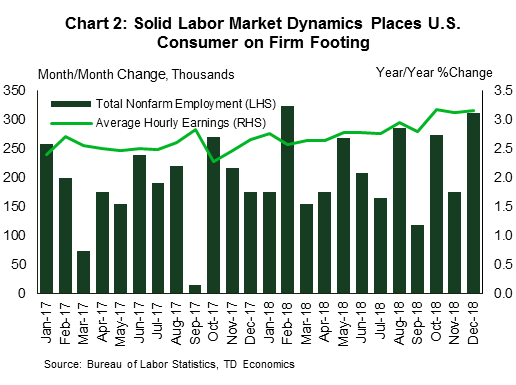
By the end of the week, a nod to "patience" by Fed Chair Powell and a strong December jobs report helped pull equity markets back into positive territory. Non-farm payrolls exceeded expectations, adding 312K jobs in December. This resulted in 99 straight months of expanding payrolls – the longest stretch on record. Even the uptick in the unemployment rate to 3.9% resulted from a labor force rising participation rate. Such dynamics suggest that even amid the tightest labor market in decades, the U.S. economy is still able to pull workers off the sideline and into the job mix. Wages also surprised to the upside, growing by 3.2% year-on-year (Chart 2) – the best full-year gain since 2008.
The employment data should serve to calm concerns that the American economy is quickly running out of steam. While growth in 2019 is projected to be lower, we still expect it to remain above the economy's trend pace. All in all, government showdowns aside, consumers remain on firm footing, supported by the most favorable labor market in decades.

Canada - An Uneventful Start to 2019
The last two weeks were relatively quiet on the Canadian economic data front. Today's labour force survey report was the highlight this week, but proved largely immaterial from a policymaker's standpoint. Financial and commodity price movements, however, remained the centre of attention again given the ongoing global risk-off sentiment amidst fears of a global economic slowdown.
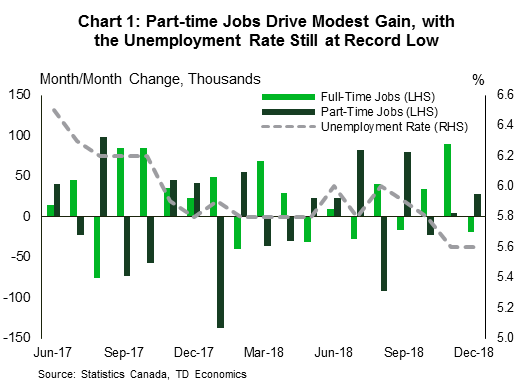
Following November's blockbuster jobs report, December's less stellar report does not change the Canadian labour market narrative. Employment gains were modest at 9.3k, largely in line with consensus expectations. This was accompanied by an almost equal change in labour force growth (+9.6k) that together acted to hold the unemployment rate at a historically-low 5.6% (Chart 1).
The details of the report were less encouraging. Part-time jobs (+28.3k) drove the headline gain, with full-time employment falling on the month (-18.9k). Furthermore, job gains were concentrated in the self-employment category (+46.4k), the most volatile class of worker in the labour force survey. Still, these compositional changes are likely more noise than signal.
Meanwhile, the subdued trend in wage growth continues to be one of the more puzzling aspects of Canada's labour market. Coming in at 1.5% year-on year (y/y), the pace implies that Canada's labour market may not be as tight as one would expect given its record-low unemployment rate.
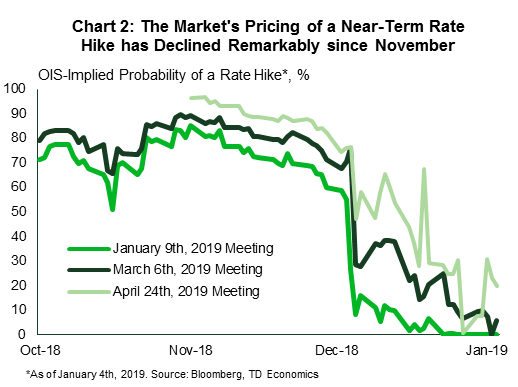
Combined with a moderation in other indicators and a struggling energy sector, the economic picture suggests that higher interest rates are not urgently needed. Indeed, odds of an upcoming rate hike for the next three Bank of Canada meetings as implied by the OIS curve have steadily declined since October. In fact, expectations of a rate hike by January have fallen to zero from roughly 80% in October, although ongoing global risk-off sentiment has likely contributed in part to this sudden re-pricing (Chart 2).
Following a December which saw markets mostly in the red, performance was slightly more positive this week, with the energy-heavy S&P/TSX composite posting a modest gain relative to last week at the time of writing. Just as encouraging was the strong run up in oil prices this week after dipping to lows not seen in more than a year. The WTI benchmark is up roughly 6%, and Brent crude is up an even more impressive 9%. Data suggesting Saudi output declines ahead of the OPEC+ cut implementation schedule contributed to the recent oil price rally. That said, prices are likely to remain volatile as markets weigh output cuts against evidence of slowing global growth.
In the meantime, higher world oil prices are a welcome development for Canada's ailing oil patch. Since early December, Alberta's output curtailment plan has sent heavy oil prices surging, narrowing the WCS benchmark's spread to WTI to below US$15.
U.S.: Upcoming Key Economic Releases
U.S. CPI - December
- Release Date: January 11, 2019
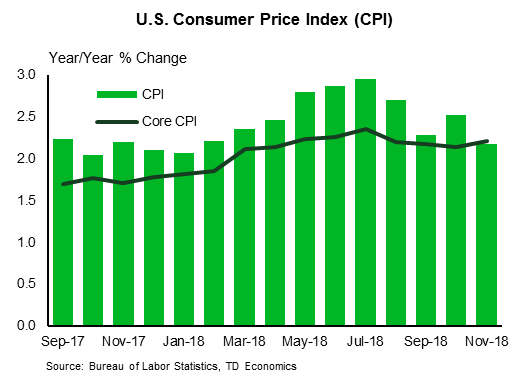
- Previous: 0.0% m/m, 2.2% y/y
- TD Forecast: -0.1% m/m, 1.9% y/y
- Consensus: -0.1% m/m, 1.9% y/y
We expect another sharp retreat in oil prices to be reflected on a significant 8.4% m/m decline in the CPI's fuels category, more than offsetting an expected increase in food prices at 0.2% m/m. The notable decline in energy prices should have dragged down headline CPI inflation to a negative 0.1% m/m print for December, which should also be reflected on a softer 1.9% annual increase. On the back of another steady rise in its core services segment, we anticipate core CPI prices to have registered their third consecutive 0.2% m/m increase, maintaining annual core CPI inflation stable at 2.2%. Looking ahead, we expect headline CPI inflation to gradually rebound to above-2% levels as oil prices stabilize and core CPI inflation maintains its recent steady pace.
Canada: Upcoming Key Economic Releases
Canadian International Trade - November
- Release Date: January 8, 2019
- Previous: -$1.2bn
- TD Forecast: -$2.8bn
- Consensus: -$1.93bn
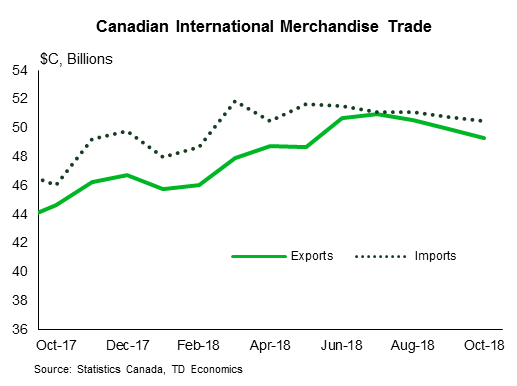
TD looks for the international trade deficit to widen to $2.8bn in November on another outsized decline in energy exports, as a sharp pullback in crude oil prices is compounded by voluntary shut-ins throughout the oil sands. Motor vehicle exports unwind part of the 6% gain in October, contributing to a wider deficit, while nominal imports should see little change after posting four declines in the last five months. Aircraft imports have scope to recover on higher deliveries to Canadian airlines while imports of machinery & equipment will be closely watched as a barometer for a rebound for Q4 investment. The real trade balance is expected to post a more modest deterioration on lower commodity prices, allowing real exports to outperform the nominal decline, although the external sector should still be a drag on growth.
Canadian Housing Starts
- Release Date: January 9, 2019
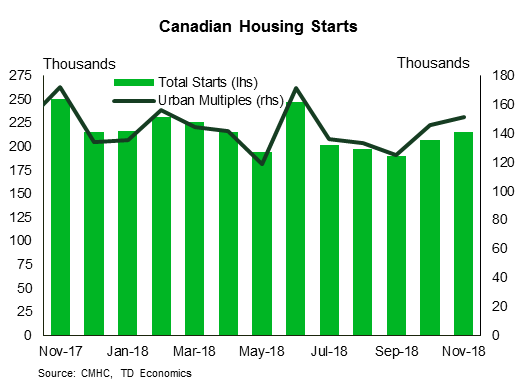
- Previous: 216k
- TD Forecast: 205k
- Consensus: 210k
Housing starts are forecast to slow to an annualized 205k in December. Weaker multi-unit construction in Toronto and Vancouver should provide the main catalyst following outsized gains the prior month, while single family construction should see little change. This will leave housing starts to tally roughly 213k for the year as a whole, only slightly below the 220k units created in 2017. However, our forecast is consistent with only 55k single-unit starts in urban areas, which is only slightly above the worst year on record from 1982.
Bank of Canada Rate Decision
- Release Date: January 9, 2019
- Previous: 1.75%
- TD Forecast: 1.75%
- Consensus: 1.75%
We expect the Bank of Canada to hold the overnight rate steady at 1.75% next week, which is already fully priced into markets. The Bank will have to acknowledge recent developments in the energy sector and financial markets, but will try to strike a somewhat balanced tone as the longer term forecast is largely intact; we expect modest downward revisions to growth for 2019 (approximately 0.2 p.p.), but the 2020 growth estimate should be stable. Risks around international trade tensions and/or global growth may take a more prominent position in the hierarchy of risks, but we nonetheless look for Poloz to reiterate that the policy rate will need to move back to the neutral range while maintaining the BoC's data dependence.

Week Ahead – Factory Data to Remain in Focus; BoC to Start off 2019 Central Bank Meetings
Industrial production out of Germany, the UK and France will dominate the economic calendar next week, keeping investors’ attention firmly on the growth outlook for 2019. The Bank of Canada will be the first of the major central banks to hold a policy meeting this year, while the highlight in the US will be the ISM non-manufacturing PMI and speeches from Fed policymakers. However, with market moves being mostly driven by jitters about the growth outlook at the moment, economic indicators may struggle to generate much reaction in currency markets. Instead, the market tone could be set by the planned trade talks between the US and China early in the week.
After flash crash, aussie to seek reprieve from data
The Australian calendar will get busier next week after a quiet start to the new year. But with Australia’s economy showing some signs of weakness and futures markets pricing about a 30% probability that the RBA will cut interest rates before the end of the year, the Australian dollar is unlikely to get a significant lift from any positive indicators, while disappointing numbers could push the currency back below the $0.70 handle.
Opening the week on Monday will be the AIG manufacturing index for December and will be followed by the November trade balance on Tuesday. Building approvals for November will be looked at on Wednesday and rounding up the week on Friday will be retail sales figures, also for November.
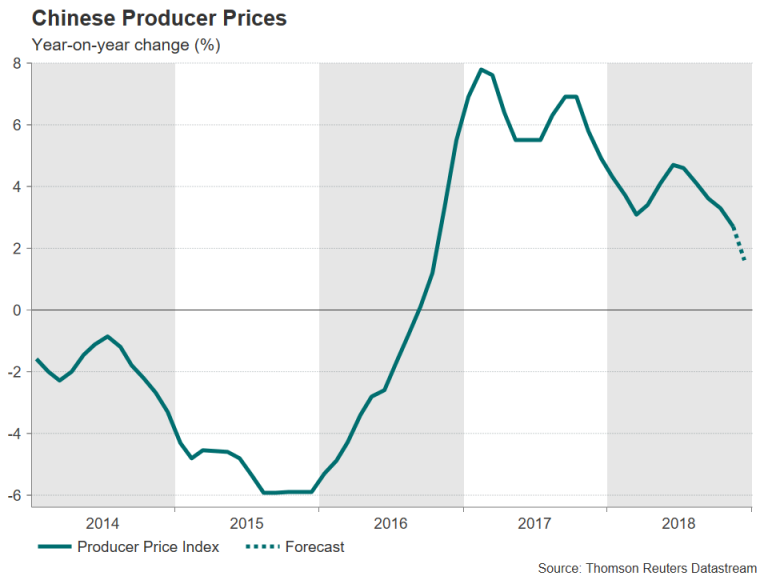
In addition to domestic data, aussie traders will also be keeping a watch on Chinese producer and consumer inflation numbers due on Thursday. China’s producer price index (PPI) is expected to have moderated further in December to an annual rate of 1.6%, highlighting the weakening factory demand for raw materials.
Japanese data could take some shine off safe-haven yen
The yen has had a strong start to 2019 as traders have sought safety in less risky assets amid the darkening outlook for world growth. As Japan’s economy feels the strain of the global slowdown, incoming data is more likely to disappoint than impress, though yen strength should persist as long as markets remain in risk-off mode.
The main releases that will be watched over the coming week are wage figures on Wednesday and householding spending on Friday, both for November. Total cash earnings picked up to 1.5% year-on-year in October, though they remain below the peak of 3.3% scaled back in June. Another quickening in wage growth in November, along with higher household spending, could provide some cushion to the economy as exporters face challenging times.
Eurozone slowdown fears to prevail
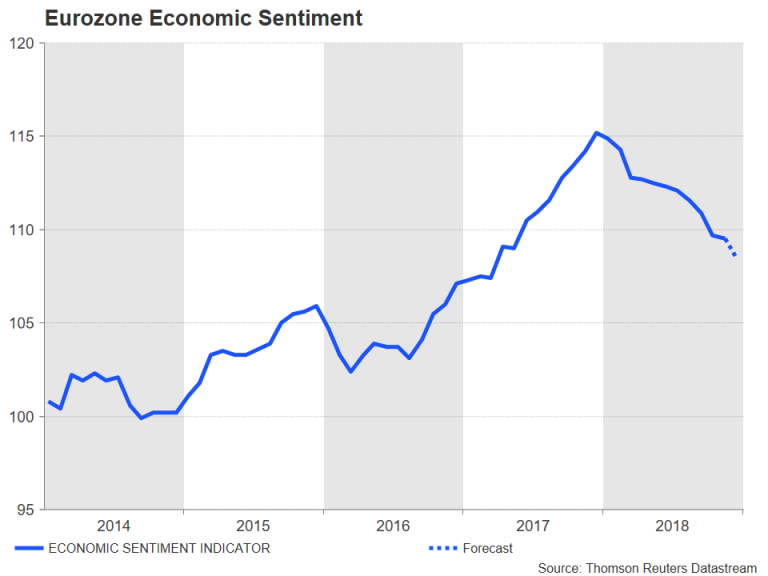
It’s going to be a relatively quieter few days for the euro area with only a handful of major releases. Business surveys will kick off the week, with the Eurozone sentix index due on Monday and the economic sentiment gauge on Tuesday. The economic sentiment indicator slumped to a 1½-year low in November and is expected to fall further to 108.5 in December.
Also attracting attention next week will be industrial output numbers out of Germany and France. Although the figures will be for November and manufacturing PMI prints for December have already been published, they could nevertheless add to the negative sentiment weighing on the euro if they confirm the deteriorating economic backdrop across the single currency bloc. The German industrial output data are out on Tuesday and will be preceded by industrial orders on Monday, while the French figures are due on Thursday. Moreover, November trade numbers are scheduled for release in both France and Germany on Tuesday and Wednesday, respectively.
UK monthly GDP eyed as Brexit stalemate continues
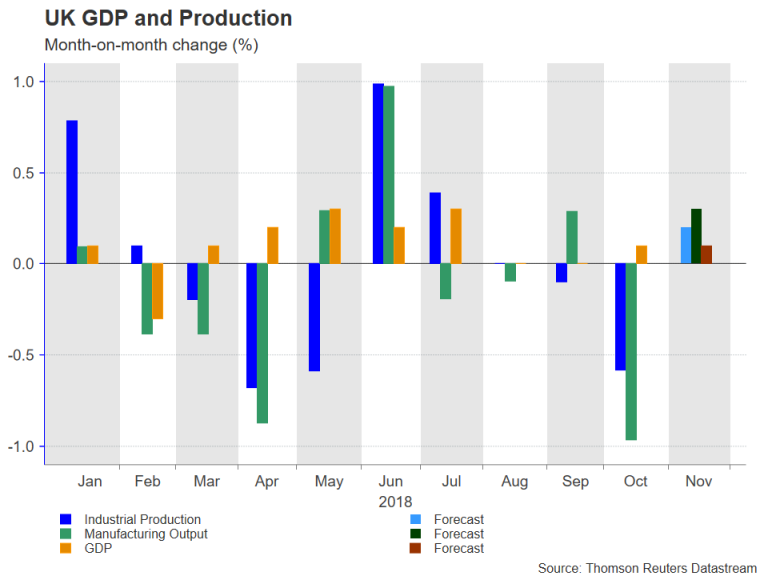
The UK will also publish industrial output and trade stats next week, along with monthly GDP data. Despite the Brexit gloom and the gridlock in Parliament on the withdrawal deal, the UK economy does not appear to have slowed down any more than its European counterparts and probably managed growth of 0.1% month-on-month in November, GDP estimates on Friday are anticipated to show. Friday’s numbers will also include services, industrial and manufacturing output, along with the trade balance.
Industrial production is forecast to have posted its first increase in four months in November, rising by 0.2% m/m. The manufacturing sector, meanwhile, is expected to have expanded by 0.3% m/m, rebounding somewhat from a 0.9% drop in the prior month.
The pound may find some support from potentially better-than-expected figures, but any upside is more likely to come from dollar weakness or positive Brexit headlines.
Bank of Canada meets as rate hike odds evaporate
While the US Federal Reserve has been garnering all the attention on the shifting expectations of interest rate hikes in 2019, the odds of rate increases by the Bank of Canada have also dwindled dramatically since the last meeting. That, along with the slump in oil prices, explains why the Canadian dollar hit a 19-month low of 1.3664 to the US dollar this week. The loonie could face further downside pressure on Wednesday if the Bank of Canada adopts a more dovish view.
The BoC is widely anticipated to hold its overnight rate unchanged at 1.75%. However, should the Bank keep its options open for possible rate hikes in the next few months, the loonie could correct higher.
US-China trade talks on the radar
Moving south of the border, the Fed will also be in the headlines on Wednesday as the minutes of the December 18-19 FOMC meeting are published. But with several Fed speakers on the agenda, including Chairman Jerome Powell on Thursday, the minutes are unlikely to have a big impact on the greenback.
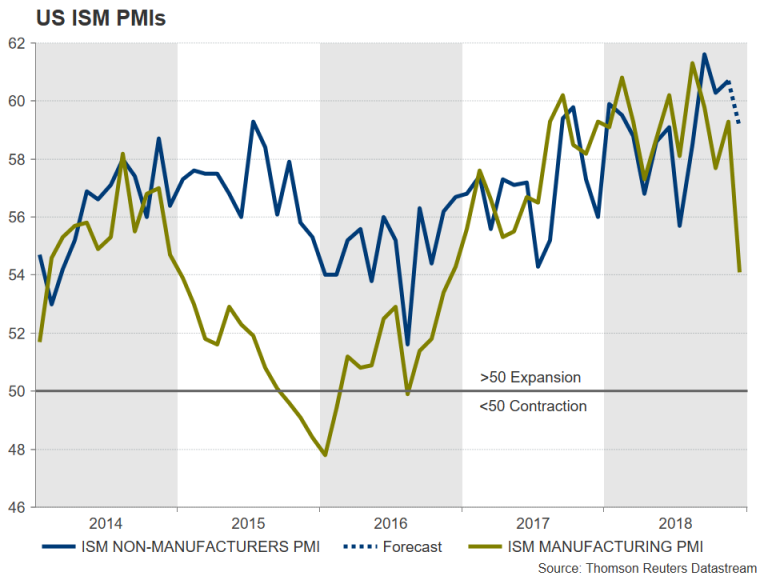
In terms of data, November factory orders will start the week on Monday together with the ISM non-manufacturing PMI for December. The closely-tracked non-manufacturing PMI is forecast to decline to 59.1 in December. After the unexpected big drop in the ISM manufacturing PMI, a similarly weak reading for the non-manufacturing composite could fuel concerns that the US economy may be slowing down sharply and drag the dollar to fresh multi-month lows versus the yen.
Trade figures for November will follow on Tuesday, where the trade balance is forecast to have narrowed slightly. That could be good news for the Trump administration while senior officials from the US and China meet on January 7-8 to discuss how to implement the points agreed between President Trump and President Xi at the G20 summit. Should the meeting prove fruitless, market sentiment could take another turn for the worse, however, if the two sides make substantial progress, risk appetite could receive a massive boost.
Also due on Tuesday is the JOLTS job openings for November and ending the week on Friday is the CPI report for December. Headline inflation based on the consumer price index has eased significantly from the summer high of 2.9% y/y and is projected to moderate further in December, slipping below the 2% mark to 1.9% y/y. The core rate of inflation is forecast to stay unchanged though, at 2.2%. A bigger-than-expected fall in the CPI rate would add to the pressure on the Fed to pause or end its rate hike cycle.