

Sample Category Title
Weekly Focus: 2019 Starts off on the Wrong Foot
Market movers ahead
- Recession fears continue to loom in the US, and we expect that to weigh on business confidence indicators released next week.
- The FOMC minutes and a number of speeches will attract a lot of attention next week, along with further developments in the ongoing government shutdown.
- In the upcoming ECB minutes we will look in particular for discussion on the growth and inflation outlook - not least the comments on the strong wage growth numbers.
- In the UK, the focus remains on Brexit as the debate ahead of the vote in the House of Commons begins next week - the vote is scheduled for the following week.
- The main event of the week in Scandies is the Riksbank Minutes. The focus will be on clues as to how determined the Board is about the need for further hikes.
Weekly wrap-up
- In the US market pricing is now pointing to cuts rather than hikes. We find the move overdone and with the strong US labour market and economy, we expect the Fed to continue on its hiking path.
- We do not expect a recession in 2019 and hence expect investors to make a reality check at some point, which should lead to higher equity prices.
- On a positive note, we have received promising indications on the US-China trade war, with a new round of talks kicking off next week.
- Our new forecast for the Nordics, Nordic Outlook , 4 January, has been released. We expect a more pronounced slowdown in Sweden, but continued moderate growth in the rest of the region.
U.S. Payroll Employment Surged Higher in December
Highlights:
- December payroll employment jumped a stronger-than-expected 312k — above survey estimates for a ~180k increase
- The unemployment rate ticked up to 3.9% from 3.7% but that is still historically low
- Wage growth strengthened to 3.2% from 3.1% in November
Our Take:
The headline 312k gain in payroll employment, plus 58k worth of upward revisions to the prior two months should calm some concerns about the near-term economic backdrop. The unemployment rate still rose to 3.9% from 3.7%, but that is still historically very low and down from 4.1% a year ago. Evidence continued to mount that tight labour markets are giving workers more bargaining power. Wage growth unexpectedly ticked up to 3.2% on a year-over-year basis—a new cycle high and up from 2.8% in Q3. Combining rising hours worked and wages leaves a pretty solid household income backdrop still in place.
Other economic data has not been quite as good, but also not as bad as might be ordinarily implied by recent financial market volatility. The economy still looks to have ended 2018 growing at an above-potential rate — just not quite as strong as the unsustainable 4% pace over Q2 and Q3. Of course, part of the concern in financial markets is related to uncertainty about the external rather than domestic growth backdrop and possible escalation of international trade disruptions. And the U.S. government shutdown hasn’t helped instill confidence, particularly with a potentially more disruptive debt ceiling debate still to come later this year. Nonetheless, while comments from the Federal Reserve in December suggested policymakers have been somewhat unnerved by recent developments, the U.S. economy still looks to be running above long-run capacity limits while interest rates are still at historically low levels. To be sure, the list of things that can go wrong at this (mature) point in the economic cycle is probably longer than the list of things that can go right, but current conditions still argue that there is room for official interest rates to ultimately grind gradually higher.
Canada’s Jobs Market Ends 2018 on a Positive Note
Highlights:
- Employment rose 9k in December, not giving back any of the outsized 94k gain recorded in November.
- Ontario created 18k new jobs but that was offset by a similar decline in Alberta. The latter’s pullback follows a 24k increase in November. On an industry basis, growth was led by manufacturing while services employment recorded a modest decline in December.
- The unemployment rate held steady at 5.6%, a 44-year low. That is down from 5.8% a year ago.
- Wage growth for permanent employees remained slow at 1.5% in December. For the year as a whole, hourly pay growth picked up to 2.7% from 1.6% in 2017.
Our Take:
We expected a modest pullback in employment growth in December following a whopping 94k gain in November, so today’s reported 9k increase was a pleasant surprise. And the unemployment rate, which had fallen by 0.4 percentage points in the prior three months, managed to hold steady at a 44-year low. 2018 certainly wasn’t as impressive as 2017 in terms of job gains, but it still represented another year of solid improvement in Canada’s labour market. Employment growth averaged 14k per month in 2018, all of it full-time, and 3/4 of industries recorded gains for the year. Q4 proved to be the best month for job growth and also saw the largest decline in the unemployment rate. We think that will contrast with a soft quarter for GDP growth—our current tracking is for annualized growth of slightly more than 1% to close out the year.
The latest jobs reports, along with the Q4 Business Outlook Survey, give the BoC some positive data points to consider at next week’s policy meeting. Nonetheless, we think recent tightening in financial conditions, growing global growth concerns, and lower oil prices will lend the MPR a dovish tone overall. Well-behaved inflation and muted wage growth (as reported today) give the BoC time to be patient and evaluate how those factors are impacting Canada’s economy in early-2019. We continue to think interest rates will move higher this year—low unemployment points to an economy at its capacity limits—but don’t expect a move until Q2.
Sunset Market Commentary
Markets
Core bond markets fell prey to profit taking today with US Treasuries underperforming German Bunds. Core bonds erased yesterday’s eye-popping gains which came on the back of an Apple revenue warning (stock markets up to 3% lower) and a disappointing manufacturing ISM. Risk sentiment improved overnight following news that China and the US will hold face-to-face trade negotiations early next week. The headlines lifted hopes on a more permanent trade truce between the two economic heavyweights. Monetary easing by the PBOC lifted intraday optimism further. Brent crude simultaneously extended this year’s early comeback, piercing through $57.5/barrel and triggering more core bond profit taking. EMU core inflation stabilized at 1% Y/Y while the headline number fell back to 1.6% Y/Y. Markets didn’t budge. A stellar US payrolls report amplified the split between the current state of the US economy and fears for a growth slowdown going forward. US Treasuries spiked to fresh intraday lows, but investors clearly don’t know how to handle the news. Payrolls at least suggest that current positioning is probably more than soft enough. US equity futures, for what they’re worth, managed to cling on to intraday gains. Fed speakers are a wildcard for the remainder of today’s trading session with Fed Chair Powell, Atlanta Fed Bostic (dove) and Richmond Fed Harkin (hawk) still featuring. US yields add 5.3 bps (30-yr) to 9.9 bps (5-yr). The German yield curve bear steepens with yields currently 0.8 bps (2-yr) to 4.1 bps (30-yr) higher. Peripheral yield spread changes vs Germany are virtually unchanged with Greece and Italy (-4 bps) outperforming.
There were plenty of eco data in Europe and the US today. EMU data were mostly soft. The December composite PMI was downwardly revised (to 51.1) conforming recent evidence of an economic slowdown. EMU inflation also dropped more than expected from 2.0% to 1.6%, drifting from the ECB target. However, this news hardly affected the single currency. A constructive risk sentiment kept EUR/USD close to the 1.14 mark during the morning session. The focus of FX markets was on the US payrolls and, even more, on an joined interview of Fed Powell with its predecessors Bernanke and Yellen. The payrolls report was exceptionally strong. The report was a bit of an ambiguous sign for equities. US yields jumped about 4 bp but USD gains remained modest. EUR/USD dropped to the mid 1.13 area. USD/JPY also succeeded some cautious gains and tries to clear the 108.50 level.
Sterling still traded with a cautious positive intraday bias today. EUR/GBP fully reversed yesterday’s intraday spike in Asia. UK eco data were mixed. The services PMI printed stronger than expected at 51.2 (from 50.4). However, the report still suggests mediocre Q4 growth as Brexit uncertainty continues to weigh on the economy. On the other hand, Nationwide House prices came out lower than expected as were November lending data. EUR/GBP dropped (temporarily?) below the 0.90 mark after the PMI release, but rebounded. Investors are looking out for the next steps in the brexit sage when UK politicians return from the New Year holidays next week. The post-payrolls EUR/USD decline finally pushed EUR/GBP again back to the 0.90 area.
News Headlines
A stellar December payrolls report surprised friend and foe. The US labour market added 312k jobs (vs 184k expected and the previous two month’s numbers received a cumulative 58k upward revision. Wage increases (0.4% M/M & 3.2% Y/Y) outpaced forecasts with the length of the average work week rising from 34.4 to 34.5 hours. The unemployment rate ticked up from 3.7% to 3.9%, but went hand in hand with an increase of the participation rate, from 62.9% to 63.1%, matching the 2014 and 2017 peaks.
The People’s Bank of China will cut the reserve requirement ratio by 0.5 ppt each on Jan 15 and on Jan 25 to offset liquidity fluctuations ahead of Chinese Lunar New Year. Chinese markets are closed from Feb 4 until Fed 10. The central bank estimates that the move will releases a net 800bn yuan ($117bn) of liquidity.
USD/JPY Mid-Day Outlook
Daily Pivots: (S1) 105.57; (P) 107.25; (R1) 109.31; More..
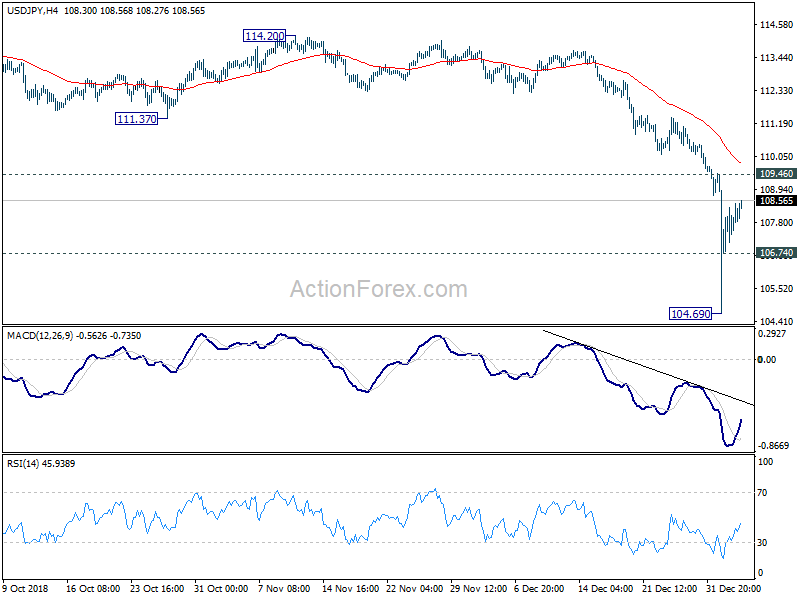
Intraday bias in USD/JPY stays neutral for now and more consolidation would be seen. But upside should be limited by 109.36 minor resistance to bring fall resumption. On the downside, below 106.74 minor support will turn bias to the downside for 104.62 low. Decisive break of 104.62 low will extend larger down trend and target 100% projection of 118.65 to 104.62 from 114.54 at 100.51, which is close to 100 psychological level.
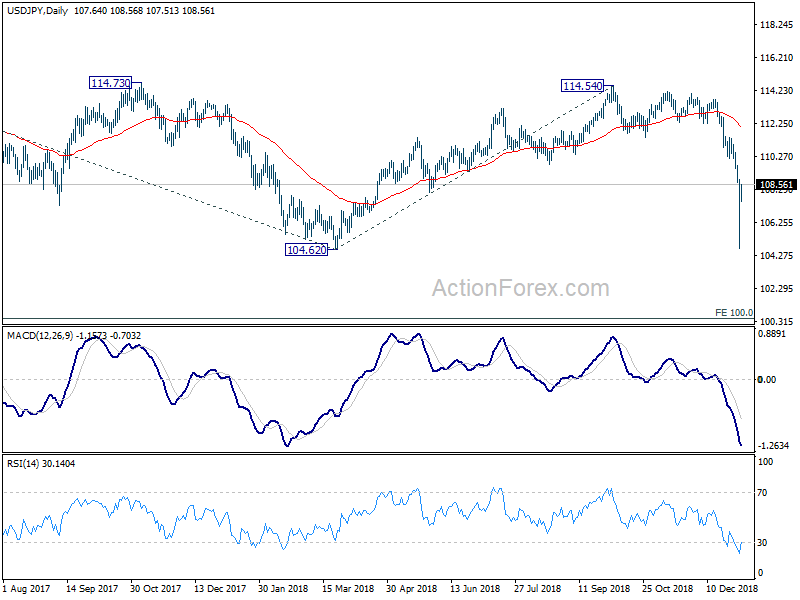
In the bigger picture, price actions from 125.85 (2015 high) are seen as a long term corrective pattern, no change in this view. Apparently, such corrective pattern is not completed yet. Fall from 114.54 is seen as another medium term down leg, targeting 98.97/104.62 support zone. For now, we'd expect strong support from there to contain downside to bring rebound.
USD/CHF Mid-Day Outlook
Daily Pivots: (S1) 0.9833; (P) 0.9880; (R1) 0.9914; More...
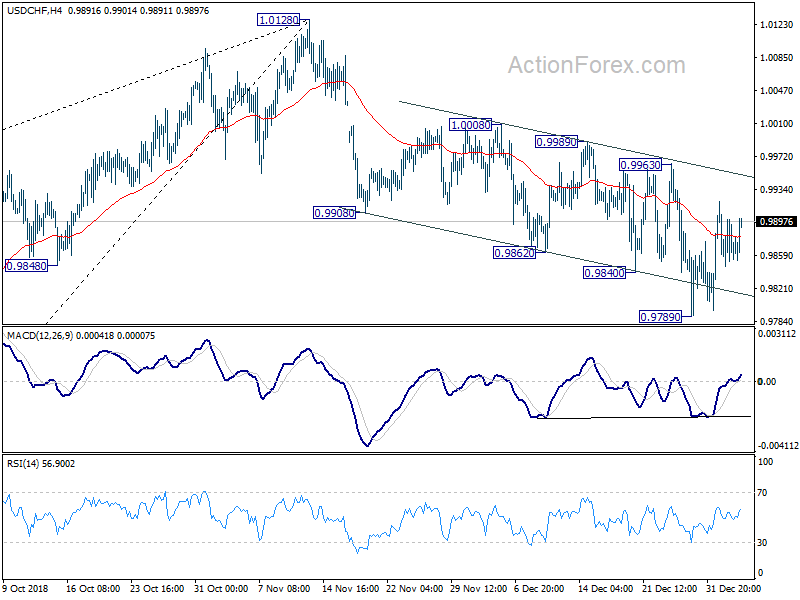
Intraday bias in USD/CHF remains neutral for the moment. With 0.9963 resistance intact, another decline is mildly in favor. Below 0.9789 will target 0.9765/8 (61.8% retracement of 0.9541 to 1.0128 at 0.9765, 38.2% retracement of 0.9186 to 1.0128 at 0.9768). We'll look for bottoming signal again there. On the upside, break of 0.9963 will suggests that the pull back from 1.0128 has completed and will turn bias back to the upside for this resistance.
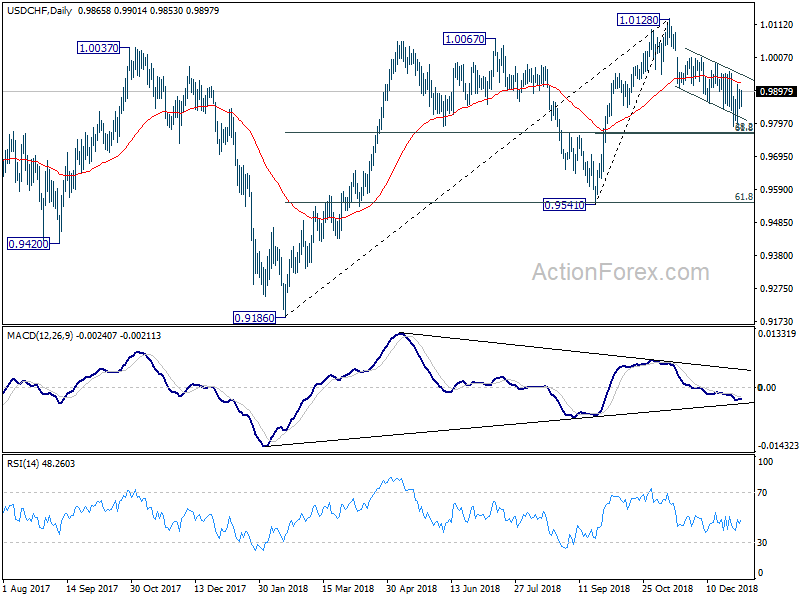
In the bigger picture, the deeper than expected fall form 1.0128 argues that medium term rally from 0.9186 might have completed at 1.0128 already, on bearish divergence condition in daily and weekly MACD. Break of 0.9541 key support will confirm this bearish case. More importantly, the corrective three wave structure will in turn argue that long term corrective pattern from 1.0342 (2016 high) is extending. In that case, 0.9186 will be the next target.
GBP/USD Mid-Day Outlook
Daily Pivots: (S1) 1.2503; (P) 1.2575; (R1) 1.2711; More....
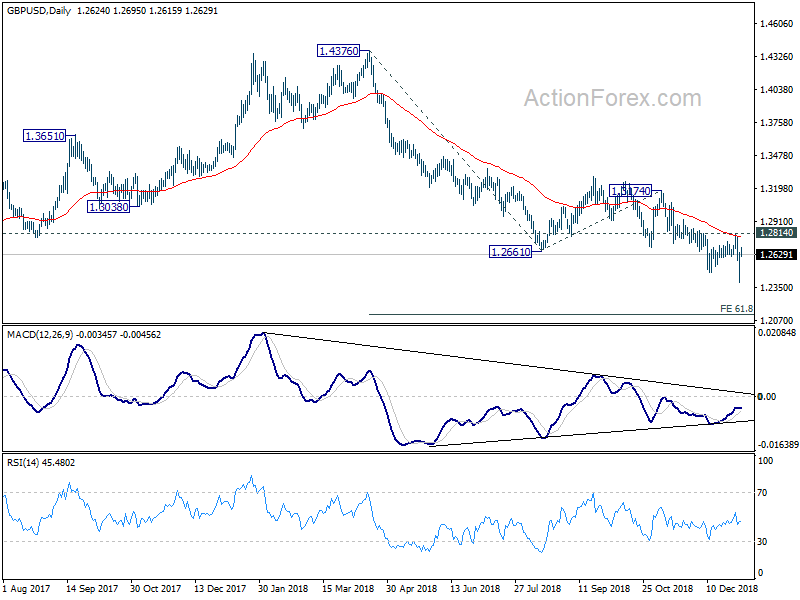
Intraday bias in GBP/USD remains neutral and more consolidation could be seen. But outlook will stay bearish as long as 1.2814 resistance holds. On the downside, below 1.2550 minor support will turn bias to the downside for retesting 1.2391 first. Break will extend the down trend from 1.4376 and target 61.8% projection of 1.4376 to 1.2661 from 1.3174 at 1.2114 next.
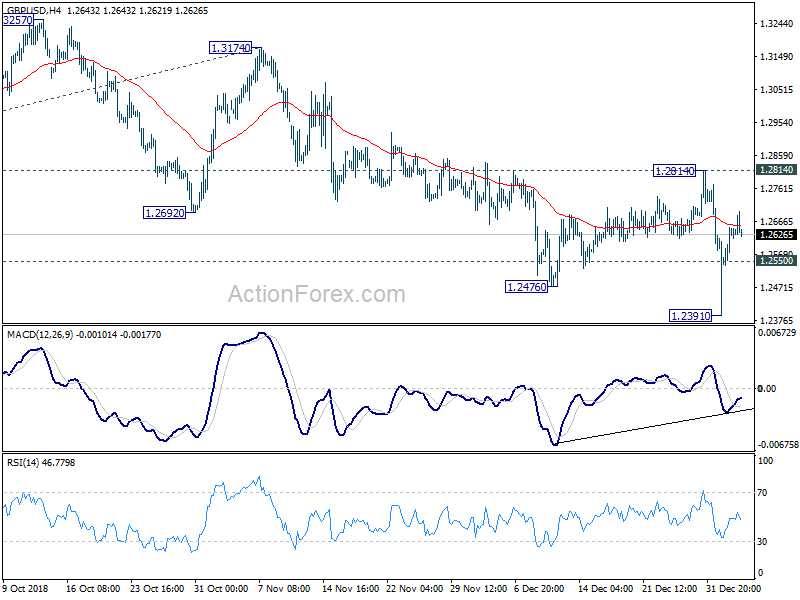
In the bigger picture, whole medium term rebound from 1.1946 (2016 low) should have completed at 1.4376 already, after rejection from 55 month EMA. The structure and momentum of the fall from 1.4376 argues that it's resuming long term down trend from 2.1161 (2007 high). And this will now remain the preferred case as long as 1.3174 structural resistance holds. GBP/USD should target a test on 1.1946 first. Decisive break there will confirm our bearish view.
Canadian Labour Markets End 2018 on a Softer Note
9.3k more Canadians were working, on net, in December 2018. The unemployment rate remained at 5.6%, as roughly the same number of Canadians joined the labour force.
The quality of the gains was somewhat lacking. The net increase was driven by part-time jobs (+28.3k), as full-time employment pulled back (-18.9k). The increase was entirely down to self-employment (+46.4k), as both private and public sector employment fell on net (-20.0k and -17.1k respectively).
Older Canadians again drove employment gains. Core aged (25-54) employment rose 16.7k, and employment for those aged 55+ was up 8.8k. Net employment fell 16.2k for those aged 15 to 24.
Breaking it down by industry, manufacturing led the way, adding 23.9k net positions in December, while the service sector (-13.3k) was held back by trade (-26.1k). Among the provinces, Ontario shone, as its unemployment rate fell 0.2 percentage points to 5.4%, offsetting softer performances elsewhere.
Wages have been a soft spot of late, and remain so: average hourly earnings for permanent employees were up just 1.5% year-on-year (y/y) in December – breaking a 6 month deceleration trend, but only matching November's pace. Aggregate hours worked were effectively flat.
Stepping back from the monthly noise, the trend in labour markets is healthy. The six-month trend in hiring stands at 30k per month, and year-on-year employment growth was 0.9% in December, driven by full-time gains (+1.2%) and largely by private employment (+0.8%).
Key Implications
Call this one 'less than meets the eye'. The headline unemployment rate may have defied expectations to remain at a record low 5.6%, but the way we got there was less encouraging. Not only were the job gains entirely in part-time work, they were also driven by self-employment as both private firms and the public sector shed jobs in December. This left aggregate hours worked unchanged – hardly encouraging, even if it does come after a sizeable rise in the month prior.
Perhaps most importantly, the deceleration of wage growth came to an end, for a month at least, but there was no acceleration to be seen as the key measure remained at just 1.5% year-on-year. So, while many measures would suggest the we have a tight labour market, the signal from wages says otherwise. Without this pre-condition, it is difficult to see much in the way of fundamental upward pressure on Canadian inflation.
Indeed, we suspect that behind the scenes, the Bank of Canada is also a bit puzzled by the combination of healthy trend employment gains and decelerating wages. At the moment, there are more pressing matters impacting the Canadian economy. However, wages are near the core of the Bank's mandate. It is definitely not our base case, but without bottom-up wage pressure, further monetary tightening is clearly not urgent.
US: 2018 Job Market Goes Out Like a Lion with 312k New Jobs in December
Hiring activity rebounded sharply in December, with hiring up 312k positions – the biggest increase since February 2018. The strong reading comes on top of significant upward revisions to the prior two months (+58k in total).
The unemployment rate did move up to 3.9%, but it was for all the right reasons. More people entered the labor market in December, taking the labor force participation rate up two tenths to 63.1%, 0.4 percentage points higher than a year ago. There are currently 6.3 million unemployed Americans compared to 6.6 million a year ago.
Hiring activity bounced back for both the goods and services sectors after a soft November. Areas of strength included healthcare (+50k), food services and drinking places (+41k), construction (+38k), manufacturing (+32k), and retail trade (+24k).
The closely watched measure of wage growth – average hourly earnings – rose an above-consensus 0.4% on the month. On a year-on-year basis, wages were up 3.2% in December, marking the third straight month of above 3% growth.
Key Implications
If this number doesn't cheer markets up a little bit, nothing will. Shorter-term Treasury yields were up a few basis points in the wake of the release. Business confidence may be starting to show a few cracks thanks to slowing global growth and trade tensions, but the U.S. consumer is on very solid ground, with spending supported by a strong job market and decent wage gains.
With the books closed on the 2018 jobs numbers, all in it was a pretty good year. Average monthly job creation was 201k jobs, higher than 2017. The job market is one area of the economy the Federal Reserve is not worried about. We will hear from Fed Chair Powell a bit later this morning in a Q&A with his predecessors, Janet Yellen and Ben Bernanke, at the annual meeting of the American Economic Association. He is likely to emphasize once again that the Fed is not on a pre-set course. But, that it will take on board the incoming data and update its forecasts, and monetary policy setting accordingly. Markets will be listening closely to any hints he gives on how the Fed is interpreting the latest data.
As outlined in our recent forecast we expect the pace of growth in the U.S. economy to slow over the course of 2019, but to remain above the economy's trend pace. That will help keep inflation near 2%, and is consistent with two more 25 basis point rate hikes – a far more gradual pace than the four hikes over the course of 2018.
Strong Employment Report Makes Powell’s Job Harder to Turn Cautious
Employment remains robust for the US economy. The non-farm payroll report for December beat expectations with a 312,000 reading, way above the 184,000 forecast and the prior reading which was revised higher to 176,000. Wages are stellar, also rising to 0.4% from 0.2% and above the eyed 0.2%. The unemployment rate rose from 3.7% to 3.9% as the participation rate jumped to 63.1%.
Stocks traded slightly lower following the data release and the dollar rallied against its major trading partners.
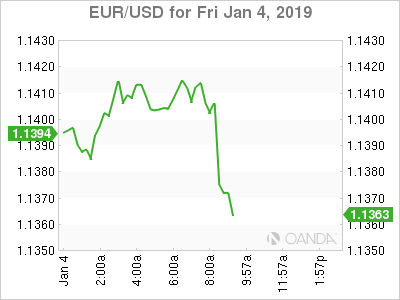
The stage is now set for Fed Chair Powell, who many were hoping to turn cautious at today’s American Economic Association’s Annual Meeting. It will be difficult following this strong report, but Powell should still be able to deliver cautious tone.