

Sample Category Title
EUR/USD – Euro Shrugs Off Soft CPI Estimate, U.S Nonfarm Payrolls Next
EUR/USD has posted small gains in the Friday session. With key events still to come on both sides of the pond, traders should be prepared for stronger movement from the pair. Currently, the pair is trading at 1.1402, up 0.06%. On the release front, Friday is packed with events. German and eurozone services PMIs disappointed, as both slipped in December and missed their estimates.CPI Flash Estimate fell to 1.6%, down from 2.0% in the previous release. This was shy of the estimate of 1.8%.
In the U.S., the markets are expecting gains from both wage growth and nonfarm payrolls. On Thursday, ADP nonfarm payrolls surged to 271 thousand, crushing the estimate of 179 thousand. Will the official nonfarm payrolls follow through with a stellar reading?
The markets will be paying close attention to remarks on Friday from Fed Chair Jerome Powell, who will participate in a panel discussion in Atlanta. The Fed faced criticism for its overly hawkish rate statement at the December meeting, when the Fed raised rates for the fourth time in 2018. The statement unnerved investors and contributed to sharp losses in the equity markets. Powell may use this opportunity to reassure investors by sending a dovish message. The Fed is currently forecasting two rate hikes next year, but many analysts are concerned that continuing to tighten policy when there are signs of an economic slowdown could be a serious mistake.
It was an abbreviated holiday week, but that didn’t prevent the euro from plunging on Wednesday, when the currency fell over 1%. The catalyst for the slide was a stunning announcement from Apple, which cut its sales forecast for this quarter, blaming a drop in sales of iPhones in China. This was more negative fodder for investors, who are increasingly worried about the economic toll of the ongoing U.S-China trade war, which is has already caused a slowdown in China. The Apple announcement panicked investors, sending the safe-haven yen sharply higher, and the fallout pushed the euro and other currencies sharply lower. However, the euro has since recovered some of these losses.
GBP/USD Outlook: Extended Rebound Pressures Strong Fibo Barrier Ahead Key Events
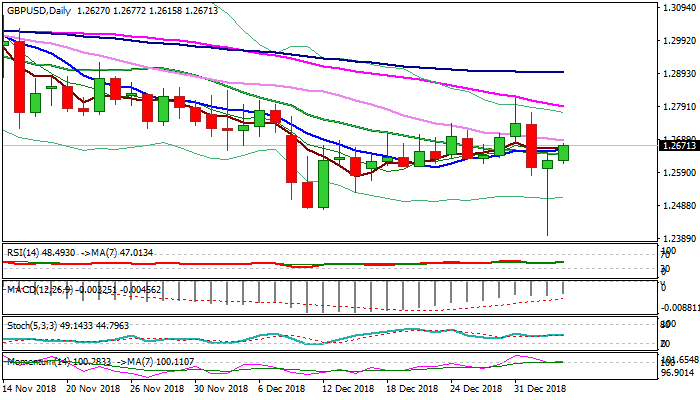
Cable remains constructive and extends recovery after Thursday’s flash crash and extends recovery towards pivotal Fibo barrier at 1.2694 (38.2% of 1.3174/1.2397 descend) in early European trading on Friday.
Strong downside rejection at 1.2400 zone left Hammer candle on Thursday and could be positive signal, along with revived bullish momentum, however, near-term performance is expected to be highly influenced by data.
UK Services PMI needs to beat forecast at 50.7 (Dec) to generate fresh signal, which would be confirmed by sustained break above 1.2694 Fibo barrier (reinforced by 30SMA).
US jobs data and speech of Fed’s Powell are the highlights of the US session.
Thick hourly cloud (1.2605/1.2549) marks solid support and only break below would weaken near-term structure.
Res: 1.2694, 1.2772, 1.2792, 1.2814
Sup: 1.2646, 1.2615, 1.2605, 1.2549
Market Looking For Direction At The US Employment Report
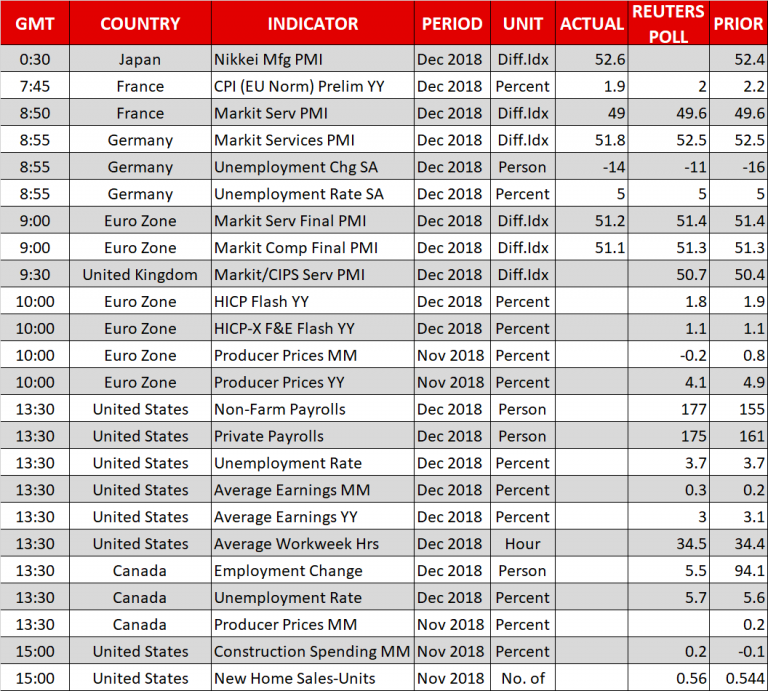
Nervous markets are expected to focus on the release of the US employment report for December, today at 13:30 (GMT) for further direction. After the “flash crash” during the Asian session yesterday and the weak US Mfg PMI for December the bearish mood surrounding the USD strengthens. Analysts point out that the markets seem to be pricing in, no rate hikes by the Fed in 2019 and a possible rate cut in 2020. Also it should be noted, that Dallas Fed President Kaplan in an interview yesterday at Bloomberg, stated that the bank should allow for some time without action until some issues are resolved. The US employment report is expected to show an increase in the NFP figure raising it to 177k if compared to prior reading of 155k, average earnings ticking down to +3.0% yoy vs. prior reading of +3.1% yoy and an unchanged low unemployment rate at 3.7%. Should the market get more confident about a possible tightening of the US labour market by the data we could see the USD getting some support, while should the market perceive the data release as a threat to inflationary pressures and the Fed's rate hike path we could see the USD weakening. EUR/USD strengthened yesterday, clearly breaking the 1.1385 (S1) resistance level (now turned to support). We see the case for the pair to be sensitive to the release of the US Employment report for December, Fed Chairman Powell's speech as well as the release of the preliminary HICP rate of the Eurozone for December. Should the pair continue to rise, we could see it breaking 1.1425 (R1) resistance line and aim for the 1.1465 (R2) resistance hurdle. Should the pair on the other hand, come under the market's selling interest, we could see it breaking the 1.1385 (S1) support line and aim for the 1.1345 (S2) support barrier.
US and China to hold trade talks
China and the US are expected to hold trade talks at a vice-ministerial level on the 7th and 8th of January in Beijing according to media. We do not see the case for a final resolution of the two countries differences to surface right now, however we could be seeing negotiations of substance. Weak financial data earlier this week could be signalling that both economies show signs of losing momentum, hence there might be more leverage for the two sides to reach an agreement or mark some progress. Analysts point out that the main issue remains whether the Chinese side will yield to key US demands and note a March deadline for a resolution or else the US may proceed with harsher tariffs. USD/JPY rose during today's Asian session, breaking the 108.25 (S1) resistance line (now turned to support). We see the case for the pair to be sensitive regarding the release of the US employment report for December as well as any further headlines regarding the US-Sino trade talks. Should the bulls dictate the pair's direction we could see it breaking the 109.20 (R1) resistance level, while if the bears take over, we could see the pair breaking the 108.25 (S1) support line and aim if not break the 107.40 (S2) support barrier.
In today's other economic highlights:
In today's European session, we get UK's Nationwide HPI rate, France's preliminary CPI (EU Normalised) rate, Germany's unemployment data, Eurozone's final Composite PMI, UK Services PMI and Eurozone's [preliminary HICP rate all for December. In the American session, besides the release of the US Employment report for December, we get Canada's employment data for December as well as the EIA crude oil inventories figure and the Baker Hughes oil rig count. Please note that Fed Chairman Jerome Powell, Atlanta Fed President Bostic and Richmond Fed President Barkin speak.
USD/JPY H4
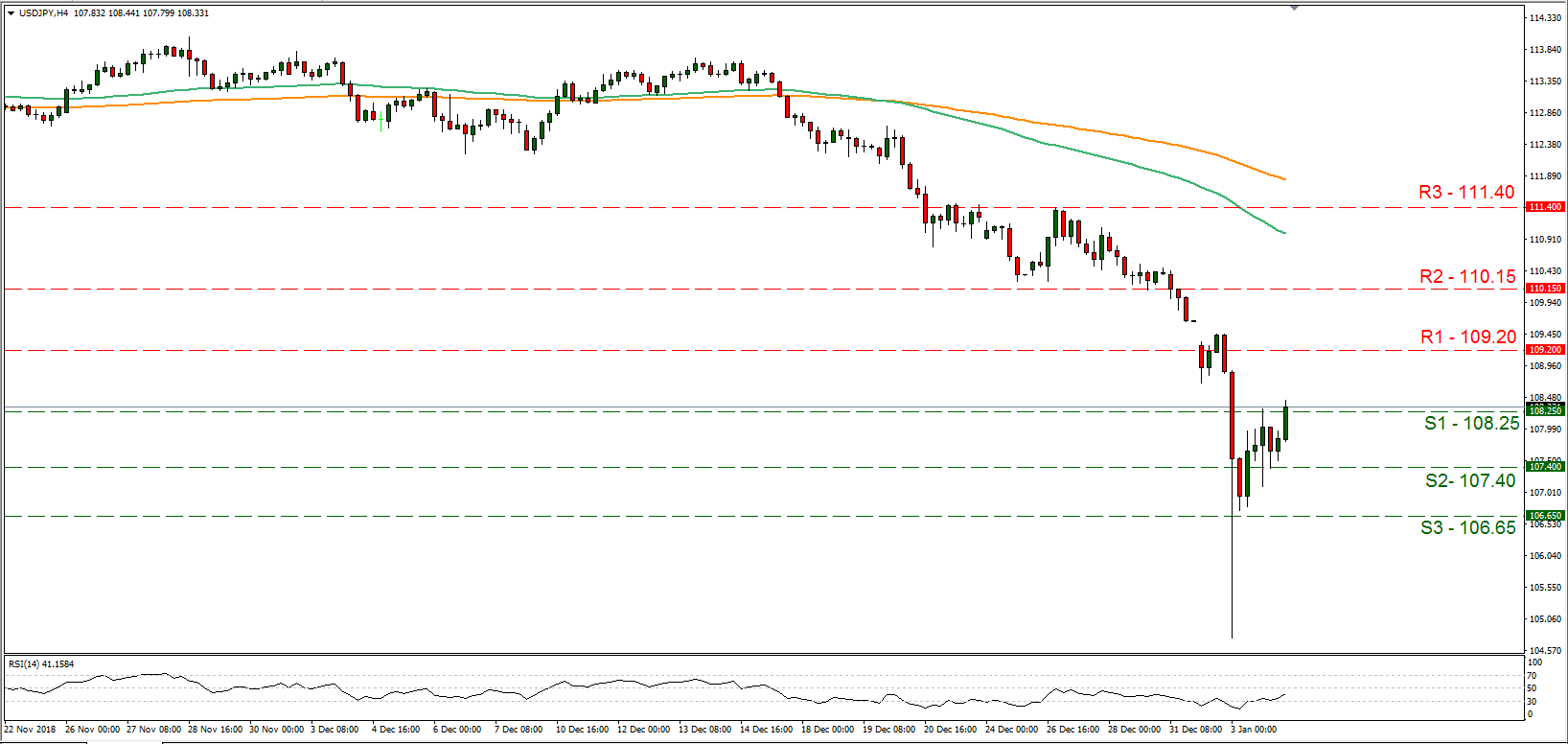
Support: 108.25 (S1), 107.40 (S2), 106.65 (S3)
Resistance: 109.20 (R1), 110.15 (R2), 111.40 (R3)
EUR/USD H4
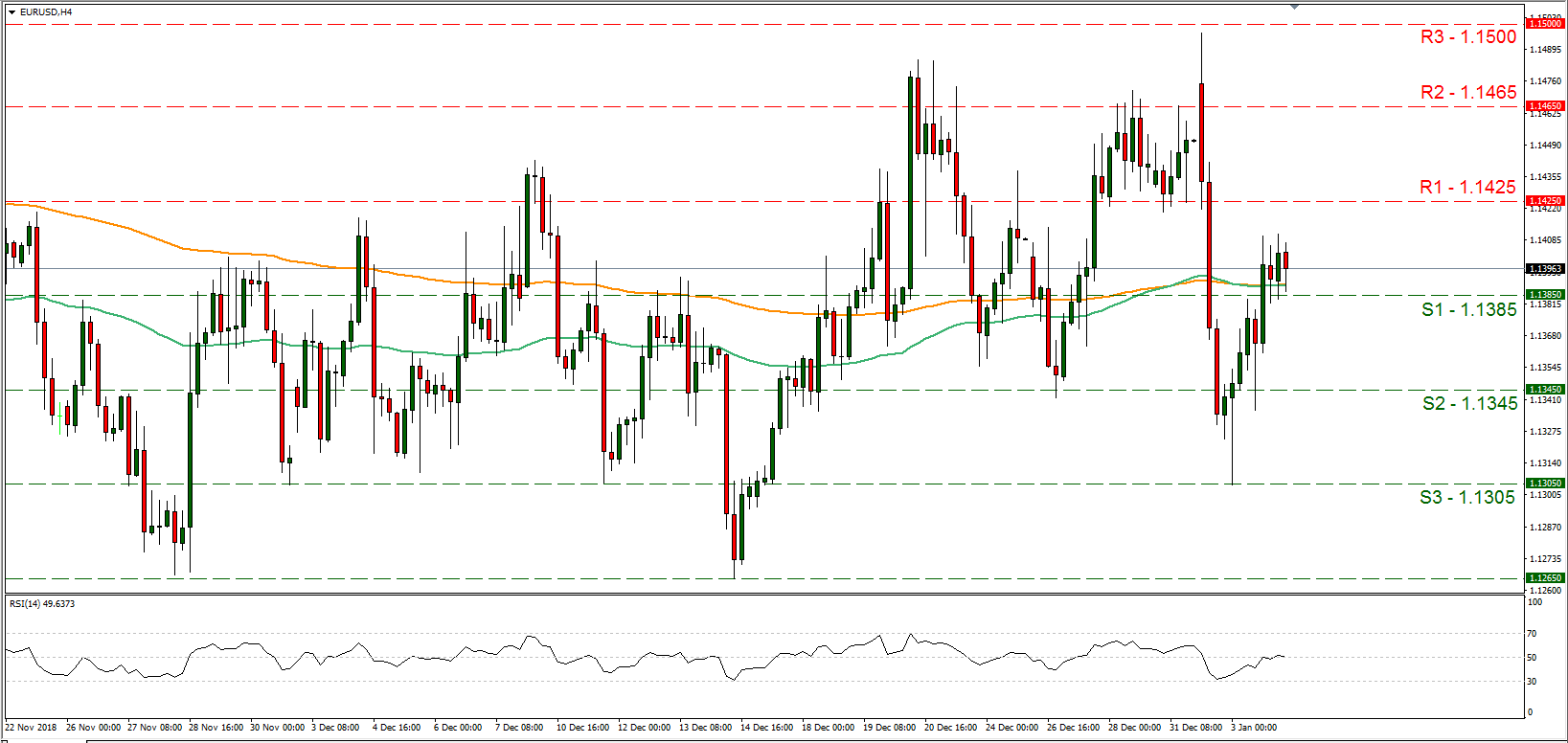
Support: 1.1385 (S1), 1.1345 (S2), 1.1305 (S3)
Resistance: 1.1425 (R1), 1.1465 (R2), 1.1500 (R3)
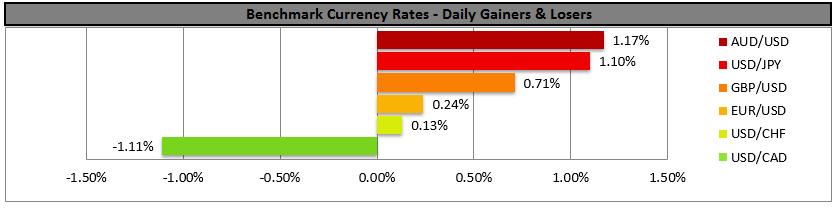
The Analytical Overview Of The Main Currency Pairs
The EUR/USD currency pair
Technical indicators of the currency pair:
Prev Open: 1.13461
Open: 1.13925
% chg. over the last day: +0.67
Day's range: 1.13832 – 1.14116
52 wk range: 1.1214 – 1.2557
EUR has recovered the majority of the losses after a sharp descend on Wednesday. At the moment the quotes are consolidating at 1.13800-1.14100, you should open positions from these levels. The investors are waiting for the US labour report for December. Keep in mind that the forecasted and real values can be different.
The Economic News Feed for 04.01.2019:
Labour Market Report (GER) – 10:55 (GMT+2:00);
Consumer Price Index (EU) – 12:00 (GMT+2:00);
Labour Market Report (US) – 15:30 (GMT+2:00);
You should also keep an eye on the statements by the head of Federal Reserve.
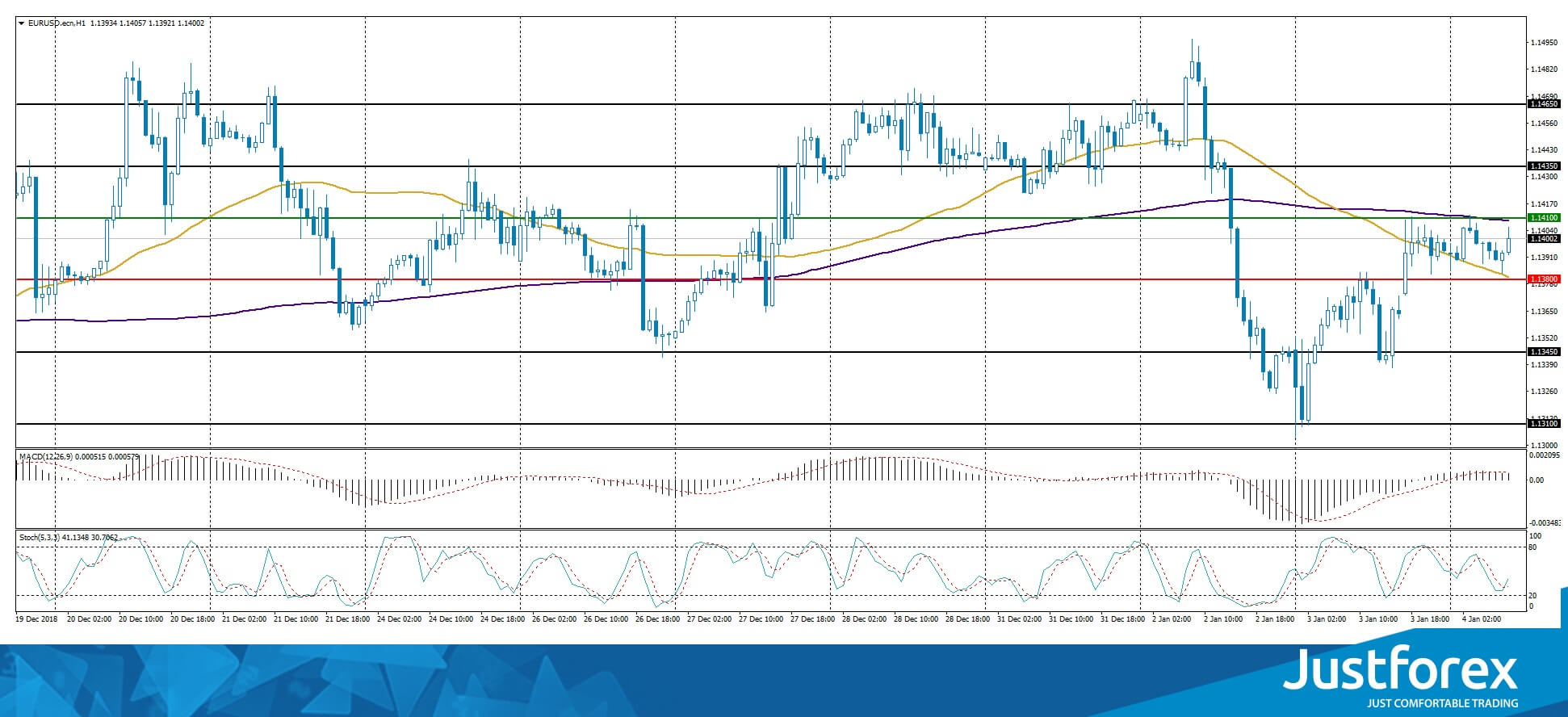
Indicators do not provide precise signals, the price has crossed 50 MA and 200 MA.
The MACD histogram is in the positive zone, but below the signal line, which gives a weak signal to buy EUR/USD.
The Stochastic Oscillator is in the neutral zone, the %K line is crossing the %D line. There are no signals at the moment.
Trading recommendations
Support levels: 1.13800, 1.13450, 1.13100
Resistance levels: 1.14100, 1.14350, 1.14650
If the price fixes below the mirror support of 1.13800, expect the quotes to fall toward 1.13500-1.13200
Alternatively the quotes can correct toward 1.14500-1.14700.
The GBP/USD currency pair
Technical indicators of the currency pair:
Prev Open: 1.25984
Open: 1.26211
% chg. over the last day: +0.89
Day's range: 1.26156 – 1.26572
52 wk range: 1.2438 – 1.4378
The pound has started to recover after a sharp downfall before. The financial market participants are waiting for fresh news regarding Brexit. The GBP/USD quotes are consolidating. The key trading range is 1.26000-1.26500, you should open positions from these levels. Keep an eye on the US Labour Market report.
At 11:30 (GMT+2:00) the UK will publish the Service PMI.
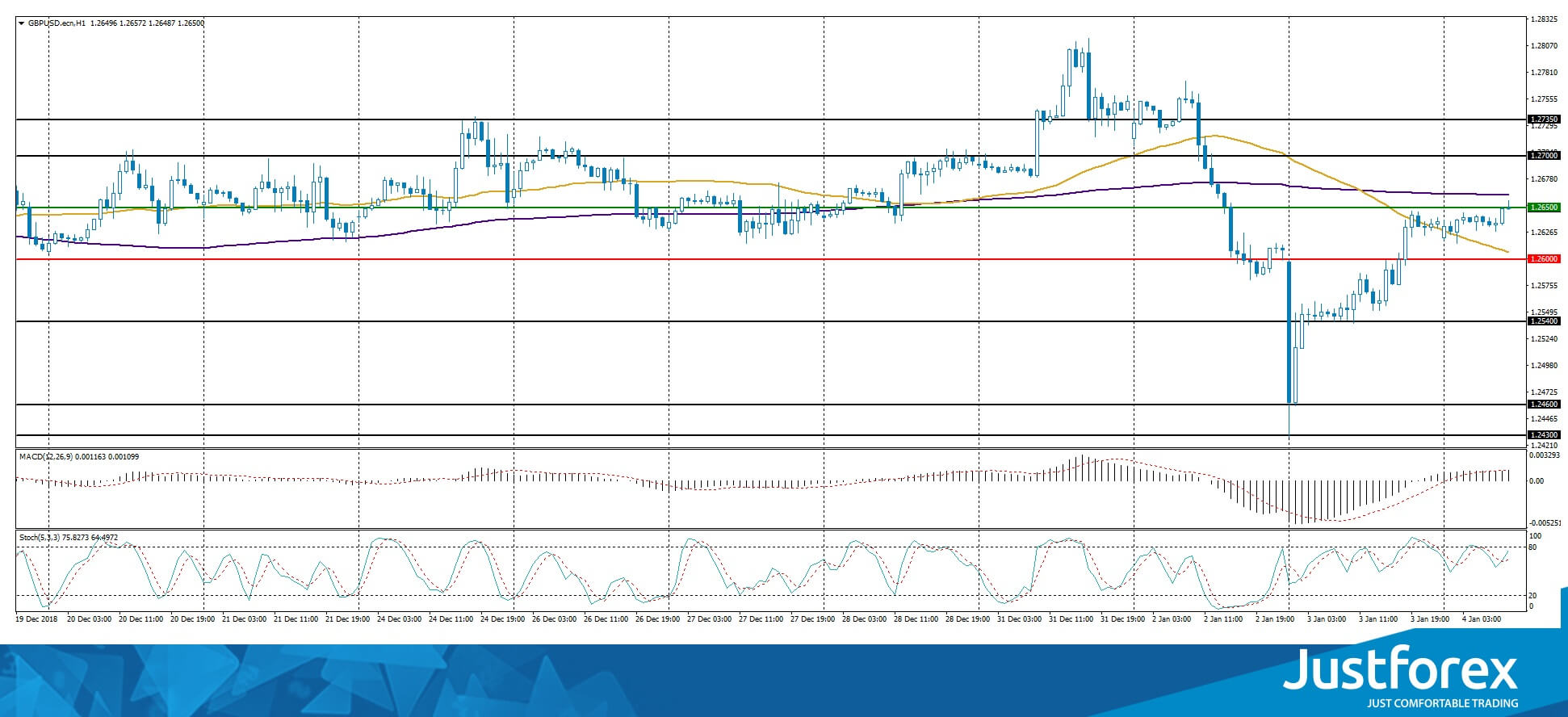
The indicators do not provide precise signals, the price has crossed 50 MA and 200 MA.
The MACD histogram is in the positive zone and keeps rising, which points toward a bullish sentiment.
The Stochastic Oscillator is in the neutral zone, the %K line is crossing the %D line. There are no precise signals.
Trading recommendations
Support levels: 1.26000, 1.25400, 1.25000
Resistance levels: 1.26500, 1.27000, 1.27350
If the price fixes above 1.26500, expect the further correction of the GBP/USD toward 1.27000-1.27400.
Alternatively the quotes can correct toward 1.25500-1.25000.
The USD/CAD currency pair
Technical indicators of the currency pair:
Prev Open: 1.35840
Open: 1.34850
% chg. over the last day: -1.14
Day's range: 1.34449 – 1.34956
52 wk range: 1.2248 – 1.3664
USD/CAD is showing an aggressive sell-off. During the last two days, the quotes have fallen by 130 points. The CAD has updated the local minimums despite being supported by the positive oil quotes trend. The key range is 1.34450-1.34850, you should open the positions from these levels. The currency pair has prospects for further descend, based on the Labour Market reports for US and Canada.
At 15:30 (GMT+2:00) Canada will publish the Labour Market report.
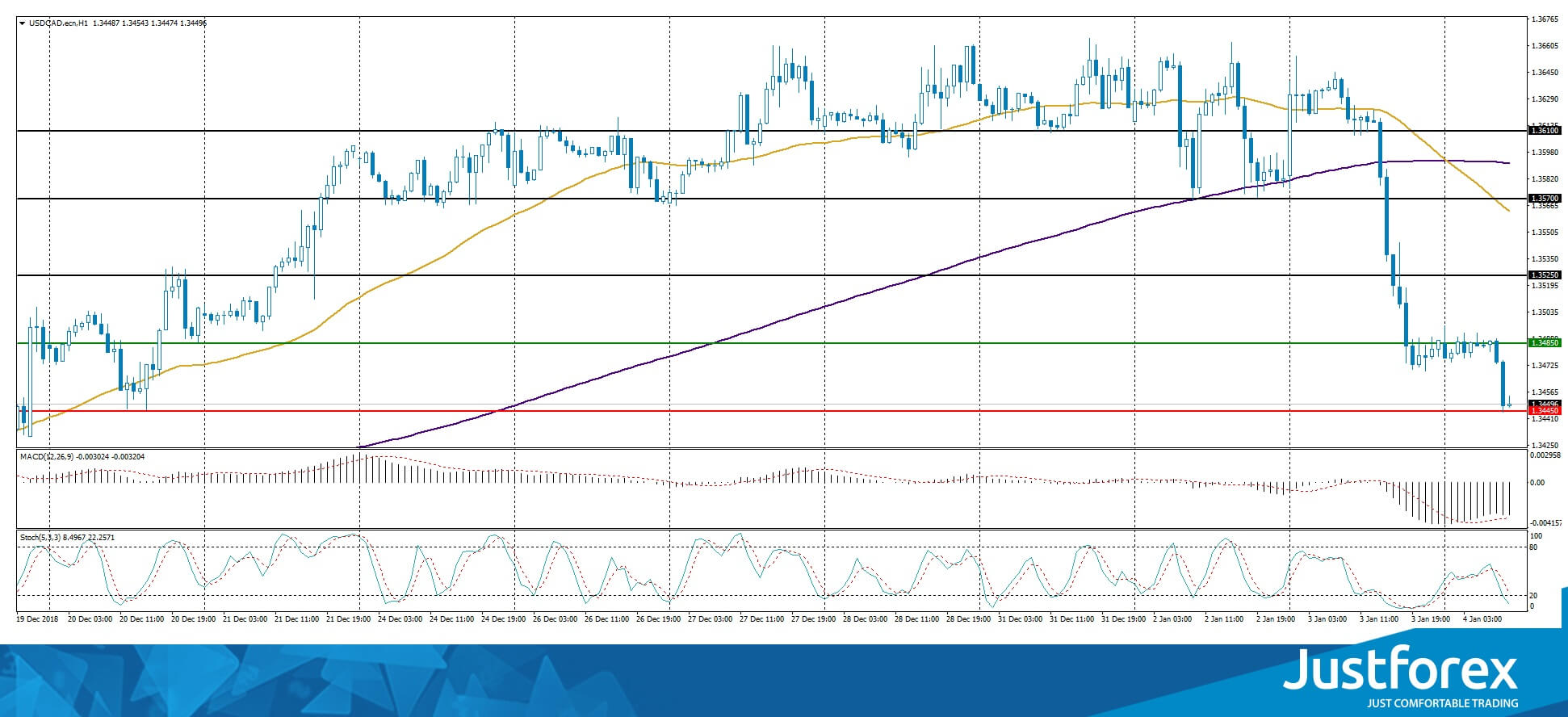
The price fixed below 50 MA and 200 MA which indicates the power of the sellers.
The MACD histogram is in the negative zone, but above the signal line, which gives a weak signal to sell USD/CAD.
The Stochastic Oscillator is around the oversold zone, the %K line is below the %D line, which also indicates a bearish sentiment.
Trading recommendations
Support levels: 1.34450, 1.34000
Resistance levels: 1.34850, 1.35250, 1.35700
If the price fixes below 1.34450, expect the quotes to fall further toward 1.34000.
Alternatively the quotes can rise toward 1.35000-1.35250.
The USD/JPY currency pair
Technical indicators of the currency pair:
Prev Open: 108.863
Open: 107.649
% chg. over the last day: +0.38
Day's range: 107.512 – 108.445
52 wk range: 104.56 – 114.56
The USD/JPY currency pair is consolidating after a long fall. There is no defined trend. The key support and resistance levels are 107.400-108.400. A tecnical correction is possible soon. The US labour market report is in the spotlight.
The Economic News Feed for 04.01.2019 is calm.
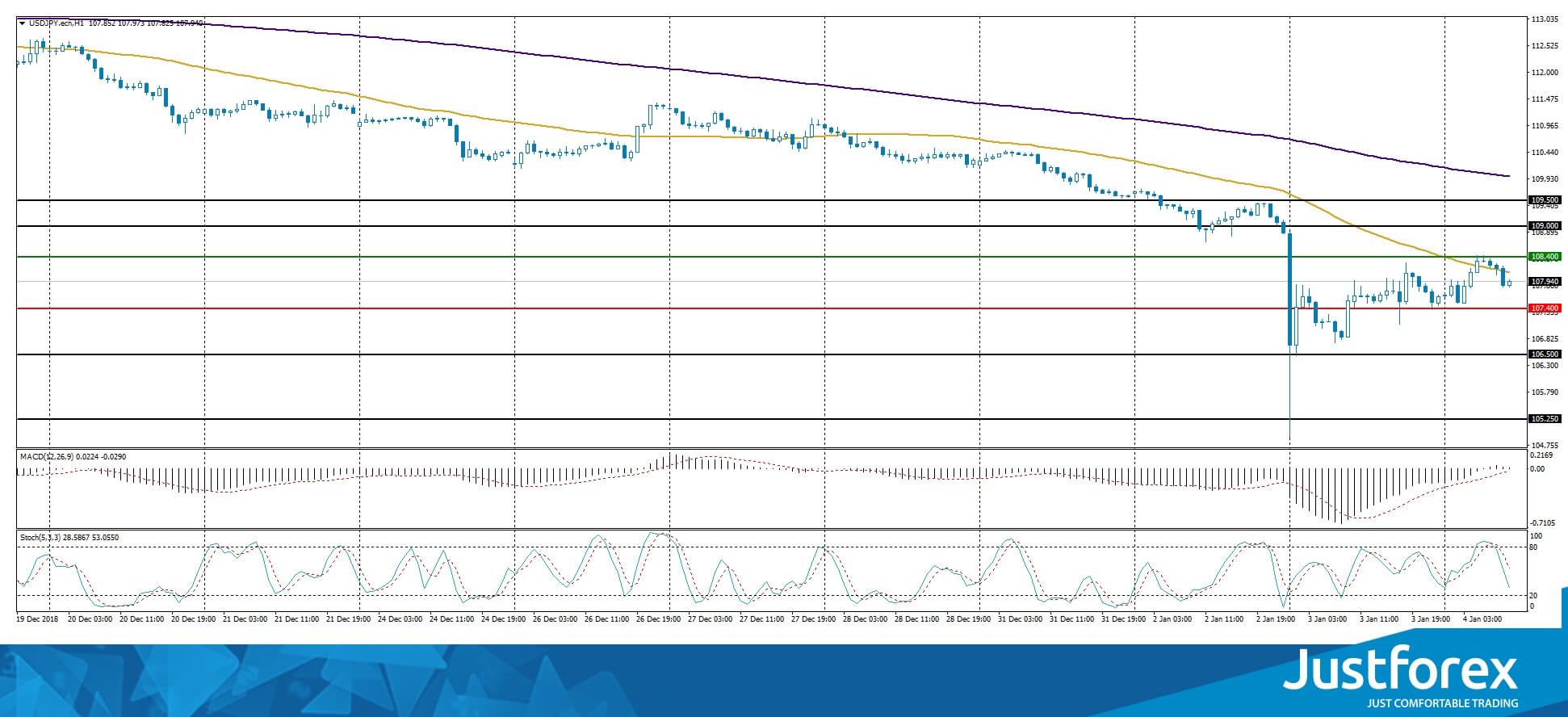
The indicators do not provide precise signals, the price has crossed 50 MA.
The MACD histogram is close to 0.
The Stochastic Oscillator is in the neutral zone, the %K line is below the %D line, which points toward the fall of the USD/JPY quotes.
Trading recommendations
Support levels: 107.400, 106.500, 106.00
Resistance levels: 108.400, 109.000, 109.500
If the price fixes above 108.400, expect the quotes to correct toward 109.000-109.500.
Alternatively, the quotes can fall toward 107.000-106.500.
Trade Hopes Remove Some Risk-Off Ahead Of NFP Report
- Japanese stocks close in the red on global growth fears in their first trading day of 2019
- US Nonfarm payrolls and Powell’s remarks to affect bearish sentiment
- Euro and pound recover with caution
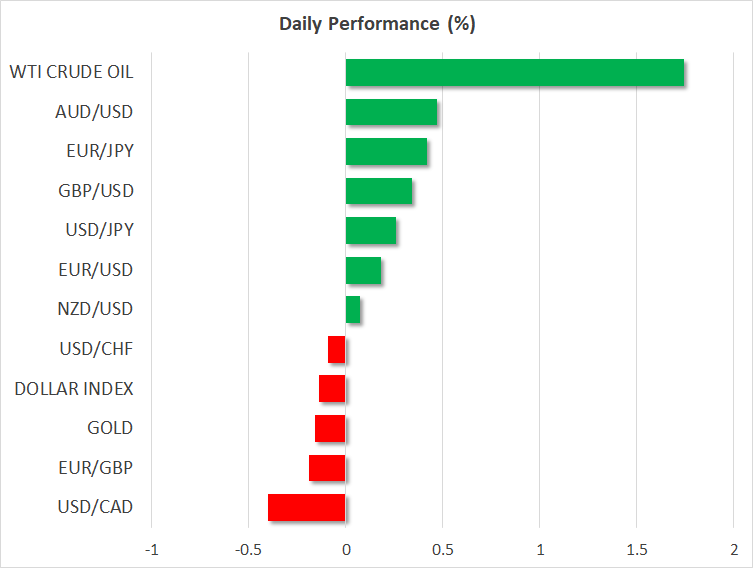
- Loonie hits two-week highs as oil prices surge
Japanese stocks join harsh sell-off, yen down on trade news
Japan’s stock market returned from the New Year’s holiday with a negative appetite as traders had to swallow the bitter global growth warnings which markets tasted in the previous days. With the tech-giant Apple cutting its quarterly forecasts thanks to lower sales in China on Thursday and fundamentals across the globe showing persisting weakness, the likes of Japan’s Nikkei tumbled by more than 2.0%, while the Topix also suffered as investors grew more certain that corporate profits may weaken this year.
The yen which benefitted the most from safe-haven demand, rallying to nine-month highs against the dollar, traded lower early on Friday on hopes that the discouraging data releases could push China and the US to reach a trade agreement sooner than later to avoid further negative consequences. Gold was also weaker, slightly below the 6 ½-month highs it registered yesterday. Details about next week’s trade talks boosted optimism even further after China’s Commerce Ministry announced on Friday that the two sides will hold vice-ministerial level meetings in Beijing on January 7-8. Chinese equities turned green in the wake of the news, while futures tracking US indices such as the S&P 500 and Dow Jones which closed strongly down on Thursday are pointing to some recovery later today.
Dollar awaits December’s jobs report and Powell’s comments
Meanwhile in the US, the new year started on the wrong foot, with Apple’s sales shortfall in China and a sudden pullback in the ISM manufacturing PMI ringing bells that the Fed may not hike interest rates in 2019 and possibly cut them in 2020 if the data continue to disappoint. Concerns elevated even further after the two-year Treasury yield dropped to 2.4%, reaching parity with the Fed’s fund effective rate for the first time since 2008. The funds effective rate moves within the Bank’s key policy range of 2.25-2.5%.
While the fresh trade news, alleviated some of the risk aversion on Friday, helping the dollar to gain some ground today, the sentiment remains bearish overall. Moreover, it would be interesting to see whether the greenback can retain upside in the remainder of the day as the all-important nonfarm payrolls report for the month of December will be closely scrutinized for any signs of slowdown at 1330 GMT, while speeches from several FOMC members including the Fed’s chief Jerome Powell will be in focus for any dovish remarks.
Eurozone flash CPI and UK’s Services PMI in focus
Euro/dollar managed to climb back above 1.14 on Friday, thought it still has some way to go to erase Wednesday’s steep freefall and December’s flash CPI figures could help the pair achieve this. Note that despite the loose monetary policy, the European Central Bank failed to drive core inflation towards its 2.0% price goal in 2018, reporting that a rate spike could only come after the summer of 2019. Therefore, should the preliminary core CPI appear stronger than analysts anticipate,supporting the Bank’s hopes that inflation will head to the target, the euro could extend the rebound and vice versa.
Pound/dollar is also slowly paring losses today, clouded by Brexit uncertainties and particularly concerns about whether the British Parliament will approve May’s deal with the extra assurances the prime minister is working to achieve with the EU in the week starting January 14. With clarity missing around the withdrawal terms and expectations for a BoE rate rise in 2019 standing low, there is no reason for investors to allocate more funds into the pound. Markit/CIPS Services PMI for the month of December could move the currency on Friday.
Employment report and oil prices to drive loonie
The Canadian dollar is among the best performers today and is set to post its first weekly gain after two months. An upbeat employment report later on Friday could add more sparkle to the loonie and lift the price above two-week highs, while additional buying interest for oil, which is currently trading higher by 1.70% could also boost confidence in the market. Yet the latter depends on the outcome of the EIA report on US oil inventories (1600 GMT) and the number of active US oil drillings by Baker Hughes (1800 GMT) due later today.
China PBoC lowers RRR by 100bps to support the economy
The People's Bank of China announced to lower the reserve requirement ratios (RRR) by 100 basis points to "support the development of the real economy, optimize the liquidity structure, and reduce financing costs". The RRR will be lowered by 0.5% on January 15 and another 0.5% on January 25. Currently, the RRR stands at 1.4% for large banks and 12.5% for smaller banks. Additionally the Medium Term Lending Facility will not be renewed after expiry in Q1.
In the statement, PBoC pledged to "continue to implement a prudent monetary policy, maintain a moderate degree of tightness, not engage in flooding, reorientation and regulation, maintain a reasonable and sufficient liquidity, maintain a reasonable growth in the scale of money and credit and social financing, stabilize macro leverage, and balance internal and external balances.
UK PMI services rose to 51.2, economy grew at just 0.1% in Q4
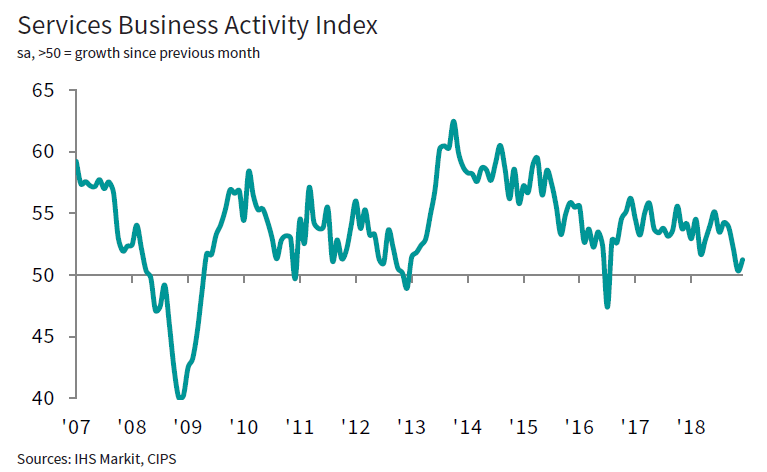
UK PMI services rose to 51.2 in December, up from 50.4 and beat expectation of 50.8. Markit noted "modest rises in business activity and new work", "job creation eases to 29-month low", " business confidence at second-lowest level since 2009".
Chris Williamson, Chief Business Economist at IHS Markit, which compiles the survey:
"The service sector typically plays a major role in driving economic growth, but is now showing worrying signs of having lost steam amid intensifying Brexit anxiety. The final two months of 2018 saw the weakest back-to-back expansions of business activity since late-2012 and highlight how clarity on Brexit is needed urgently in order to prevent the economy sliding into contraction.
"Combined with disappointing growth in the manufacturing and construction sectors, the meagre service sector expansion recorded in December is indicative of the economy growing by just 0.1% in the closing quarter of 2018.
"Although increased preparations for a potentially disruptive 'no deal' Brexit are helping to boost business activity in some cases, notably in manufacturing, heightened Brexit uncertainty is compounding a broader economic slowdown. Measured across all sectors, business optimism is down to the third-lowest since comparable data were first available in 2012.
"Even the current slow growth of business activity is only being achieved by firms eating into back orders, suggesting that operating capacity could be reduced in coming months unless new order inflows pick up. Employment growth is already faltering as firms took a more cautious approach to hiring. Both manufacturing and services have seen previously solid hiring trends stall to near-stagnation, underscoring how the uncertainty faced by businesses will inevitably feed through to households as the job market deteriorates."
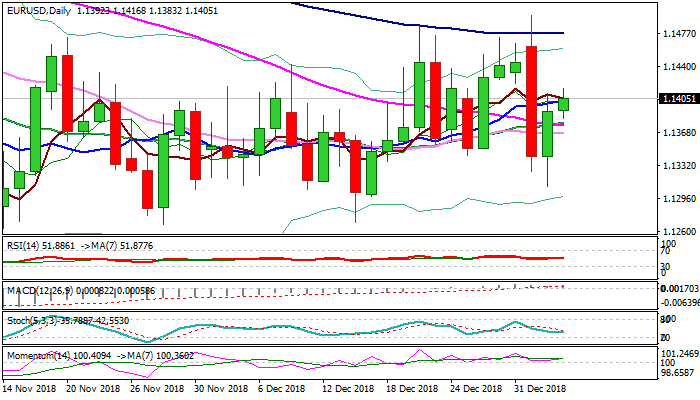
EUR/USD Outlook: Positive Tone Ahead Of US NFP/Fed Powell
The Euro stands at the front foot in early Friday's trading and extends recovery from previous day's 2 1/2 week low at 1.1309.
Recovery probes above 1.1400 barrier, marking 50% retracement of Wednesday's over 1% fall and keeping near-term focus at the upside, as momentum on daily chart turns north and created bull-cross and MA's turning to bullish setup.
Strong barrier at 1.1444 (Fibo 38.2% of 1.1815/1.1215) which was cracked several times but without clear break higher, is coming under pressure and sustained break would generate bullish signal for retest of recent highs at 1.1485/95 zone and daily cloud top at 1.1515 in extension.
Solid supports at 1.1379/75 (converging 20/55SMA's which created bull-cross) are expected to hold and guard lower pivot at 1.1363 (daily cloud base), loss of which would be bearish.
Markets remain highly volatile and awaiting today's key events which start with German Services PMI and labor data, followed by US NFP and speech of Fed chief Powell.
Positive signal came from upbeat US private sector data (ADP report showed 271K new jobs in Dec vs consensus for 179K) which could indicate possible surprise in today's Non-Farm Payrolls report (Dec 178K f/c vs Nov 155K), however Dec AHE is expected to ease (3.0% f/c vs 3.1% prev) which could diminish positive impact from expected strong NFP data.
Res: 1.1416, 1.1444, 1.1477, 1.1495
Sup: 1.1383, 1.1375, 1.1363, 1.1309
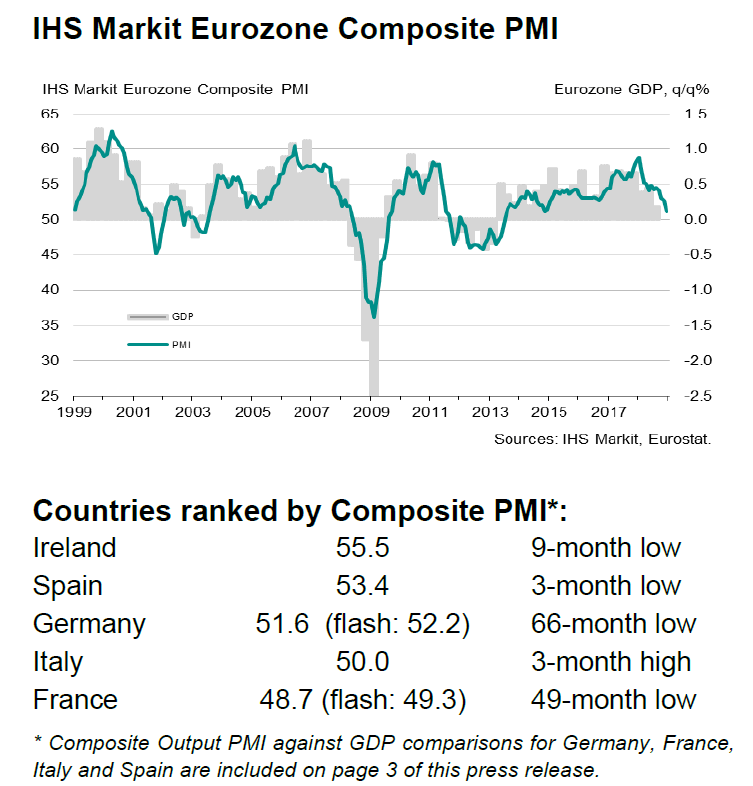
Eurozone PMI composite at over four-year low, moved down another gear
Eurozone PMI services was finalized at 51.2 in December, down from November's 53.4. PMI composite dropped to 51.1, down from prior month's 52.7. It's also the lowest level in over four years. Among the countries, France PMI composite worsened further to 48.7, a 49-month low. Germany PMI composite dropped to 51.6, 66-month low. Italy, on the other hand, recovered to 50, a 3-month high.
Chris Williamson, Chief Business Economist at IHS Markit said:
"The eurozone economy moved down another gear at the end of 2018, with growth down considerably from the elevated rates at the start of the year. December saw business activity grow at the weakest rate since late-2014 as inflows of new work barely rose. Levels of unfinished business are now falling for the first time in nearly four years as previously-received orders are not being fully replaced with new work.
"The data are consistent with eurozone GDP rising by just under 0.3% in the fourth quarter, but with quarterly growth momentum slowing to 0.15% in December.
"While a drop in business activity in France could be partly blamed on the 'yellow vest' protests, the rest of the region lacks any such mitigating factors, albeit with the recent weakness of the autos sector hopefully a temporary set-back.
"Importantly, with expectations of output dropping to the lowest for over four years, companies are not anticipating any imminent revival in demand. Worries reflect multiple headwinds from trade wars, Brexit, heightened political uncertainty, financial market volatility and slower global economic growth.
"Employment growth has already taken a knock as companies take a more cautious approach to hiring in the face of weaker order books. Jobs growth has hit a two-year low.
"Better news came in the form of an easing in price pressures to the lowest for over a year, which should provide some breathing space for the European Central Bank to review its policy guidance."
The US Currency Has Beed Declining
The US dollar weakened against a basket of major currencies after the publication of ambiguous data. Thus, the ADP nonfarm employment change counted to 217K in December and was better than the forecasted value of 179K, while the previous data were revised downward from 179K to 157K. However, the initial jobless claims rose to 231K, while investors expected 220K. The ISM manufacturing PMI counted to 54.1 in December and was worse than the expected value of 57.7. The dollar index (#DX) closed yesterday in the negative zone (-0.60%).
The British pound recovered a significant part of the losses. At the same time, the UK currency is still under pressure. The economic activity index in the construction sector counted to 52.8 in December and was worse than the forecasted value of 52.9. Also, investors are closely monitoring the situation concerning Brexit. It became known that the European Union did not plan to hold new negotiations or change the agreement on the exit of Great Britain from the EU. The European Commission believes that they have proposed the best and only possible agreement on Brexit.
The "black gold" prices have been growing. At the moment, futures for the WTI crude oil are testing the mark of $47.85 per barrel. At 18:00 (GMT+2:00), a report on the US crude oil inventories will be published.
Market Indicators
- Yesterday, aggressive sales were observed in the US stock market: #SPY (-2.39%), #DIA (-2.85%), #QQQ (-3.27%).
- The 10-year US government bonds yield continues to show negative dynamics. Currently, the indicator is at the level of 2.57-2.58%.
The news feed on 04.01.2019:
- German unemployment change at 10:55 (GMT+2:00);
- The index of economic activity in the UK services sector at 11:30 (GMT+2:00);
- The consumer price index in the Eurozone at 12:00 (GMT+2:00);
- Data on the US labor market at 15:30 (GMT+2:00);
- Data on the labor market in Canada at 15:30 (GMT+2:00).