

Sample Category Title
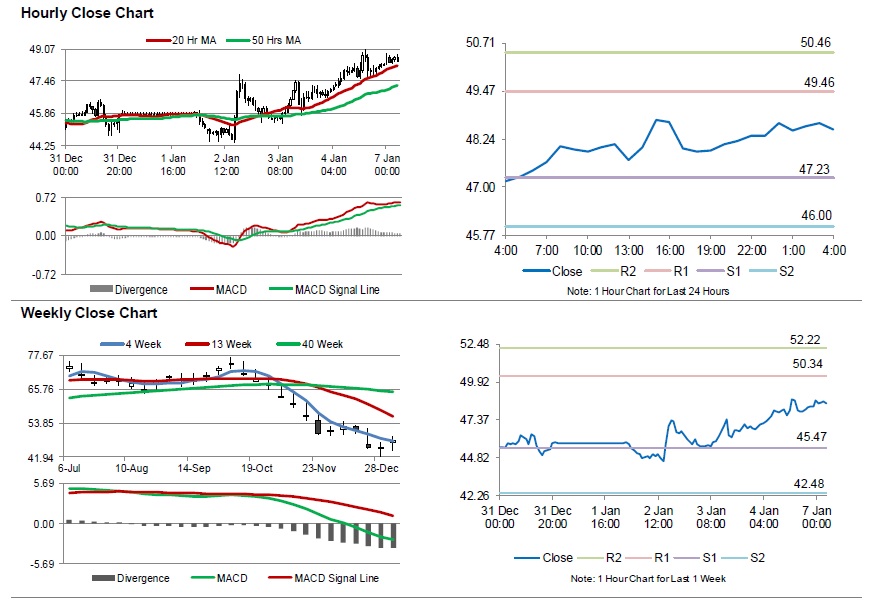
Crude Oil: Oil Trading Higher In The Asian Session
For the 24 hours to 23:00 GMT, Crude Oil rose 2.17% against the USD and closed at USD48.09 per barrel on Friday, amid upbeat US economic data and renewed optimism over US-China trade talks. Additionally, fresh figures from Baker Hughes disclosed that the number of active oil rigs fell by 8 at 877 in the week ended 28 December.
Meanwhile, the Energy Information Administration (EIA) report indicated that US crude oil stockpiles rose 7000 barrels to 441.4 million barrels in the week ended 28 December.
In the Asian session, at GMT0400, the pair is trading at 48.47, with oil trading 0.79% higher against the USD from Friday’s close.
The pair is expected to find support at 47.23, and a fall through could take it to the next support level of 45.50. The pair is expected to find its first resistance at 49.46, and a rise through could take it to the next resistance level of 50.46.
Crude oil is trading above its 20 Hr and 50 Hr moving averages.
USD/CHF Daily Outlook
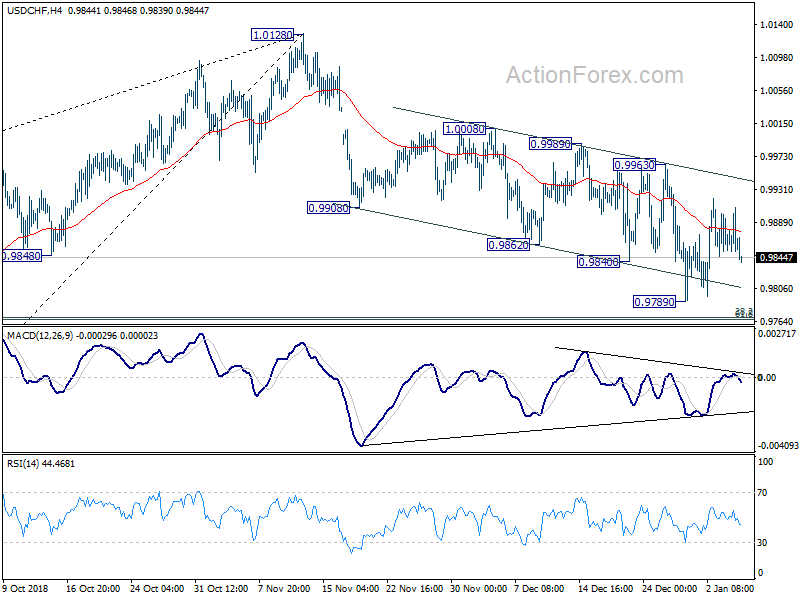
Daily Pivots: (S1) 0.9842; (P) 0.9876; (R1) 0.9899; More...
Intraday bias in USD/CHF remains neutral at this point. Fall from 1.0128 is seen as a correction. Thus, in case of another decline, downside should be contained by 0.9765/8 cluster support (61.8% retracement of 0.9541 to 1.0128 at 0.9765, 38.2% retracement of 0.9186 to 1.0128 at 0.9768) to bring rebound. On the upside, break of 0.9963 resistance will suggest that such correction has completed and turn bias to the upside for retesting 1.0128 resistance. However, sustained break of 0.9765/8 will bring deeper fall back to 0.9541 support next.
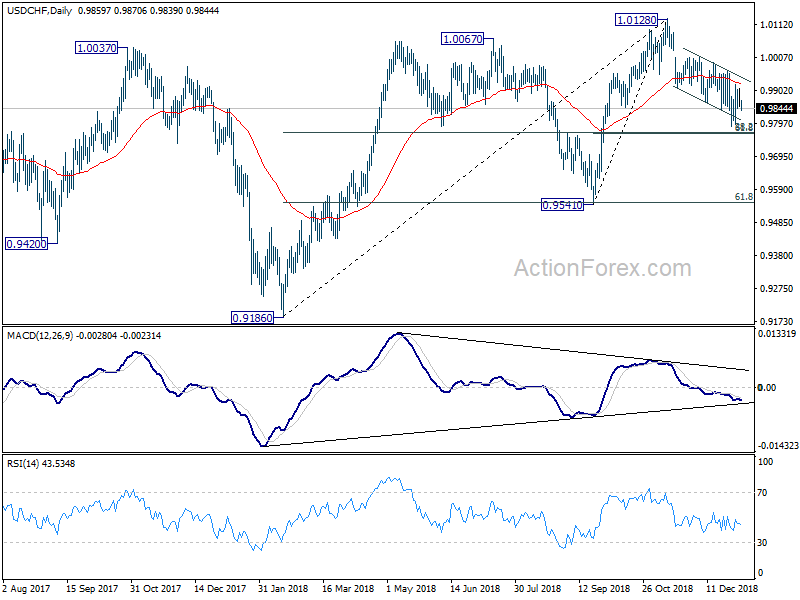
In the bigger picture, while the fall from 1.0128 was slightly deeper than expected, the structure suggests it's a corrective move. As long as 0.9765/8 cluster support (61.8% retracement of 0.9541 to 1.0128 at 0.9765, 38.2% retracement of 0.9186 to 1.0128 at 0.9768) holds, we'd expect up trend from 0.9541 and 0.9186 to resume later through 1.0128. However firm break of 0.9765/8 will argue that the trend has reversed. Further break of 0.9541 support will confirm this bearish scenario and bring deeper fall back to 0.9186 low.
Asia Cautious About Bullish Mood
Currency safe havens in demand
Safe haven assets saw some demand in relatively slow Asian trading this morning, retracing some of the moves seen Friday, as USD/JPY slid 0.37% to 108.11 and gold advanced 0.4% to 1,289.60. Equity markets fared a little bit better, though most indices gave up early gains to trade marginally in the red. China shares underperformed as the reserve ratio cut boost faded quickly. The China50 index slumped 1.48% to 10,463 after the 100-moving average on the four-hour chart proved to be stubborn resistance.
US-China trade talks restart as China's economy slows
The first mid-level trade negotiations since the 90-day tariff truce came into effect start today. While no groundbreaking progress or announcements, the sit-down comes as US President Trump commented Friday that China's weakening economic growth puts the US in a strong position. He feels China “sort of have to” come to a deal.
More PBOC liquidity easing to come?
Hot on the heels of the central bank's reserve ratio cut on Friday, the fifth in a year, the China Daily newspaper ran an opinion piece today suggesting China has room for more cuts, while it reiterated that policymakers are studying new ways to give small companies access to cheaper financing.
Will other Fed speakers echo Powell?
Fed's Bostic speaks later today, the first of eight scheduled speeches by Fed members this week, the bulk of which come on Thursday. We would need to hear the message of flexible, data-driven response on the rate trajectory this year for the current risk-on mood to extend.
Market Turmoil To Continue Until Growth Stabilises
Today I discuss the recent financial market turmoil, what it says about the economy and how the future looks. I primarily focus on the US, as it is at the centre of recent volatility. In the week before Christmas, volatility in financial markets rose sharply and US inflation expectations collapsed. The market now expects the Fed to cut rates over the coming 18 months. Over the past week, markets reversed sharply with equities rebounding, credit spreads tightening and the oil price rising. What is going on? In my view, we are currently at an inflexion point. I view this in the framework of George Soros’s reflexivity. Market participants do not base their decisions on the actual state of the economy, but on their perception of reality. Market participants’ decisions influence the economy, which in turn affects the policy response, which feeds back into markets. Those feedback loops occur constantly but may be more powerful now, as there could be a larger discrepancy between market participants’ perception of reality and the true state of the economy.
What is the market’s perception of the current state of the economy? Historically, US equities and credit markets weaken just before a recession, while government bonds rally during disinflationary stagnations. However, equities and high-yield bonds also tend to fall and government bonds rally when the economy slows, even if it is not heading for a recession. US equity prices are currently 13-14% below the peak in early October last year, US government bonds (7-10Y) have delivered around 5-6% return in the same period, while US high-yield bonds have lost close to 8%. The current sell-off in the US equity and credit markets and the rally in government bonds are substantially smaller than the ones experienced around the recession in 2001 and during the global financial crisis in 2008-09. The current correction is also smaller than several other corrections over the past 30 years driven by shocks and slowdowns, such as in 1998 (Russian default, long-term capital management) and 2011-12 (European debt crisis). That said, the recent equity correction is relatively large in a historical context and is similar in depth to the equity sell-off during July 2015-February 2016, but the recent credit correction and government bond rally are substantially smaller than at that time. As such, the market does not expect an imminent US recession but clearly a slowdown.
What does reality look like? We expect the global manufacturing cycle to weaken further over coming months. The trade war is hurting in particular China’s export/industrial cycle (see this piece by our China economist, Allan von Mehren). The spill-over from China and the trade war are weighing on the manufacturing cycle in the US and Europe. Meanwhile, tighter financial conditions in the US dampen investments. We expect China and the US to reach a trade deal, but that will only lift data from early Q2. Hence, I believe that the manufacturing/export part of the US economy is set to slow further near term, but that a large part of the domestic economy, including private consumption and the labour market, is set to hold up well. What are the likely policy responses? I believe the Fed this week signalled that it is on hold for now and China cut the banks’ reserve requirement ratio. We expect further easing from the Chinese authorities in coming months, which eventually should put a floor under growth expectations in China, supporting the global economy.
What does this imply for markets and the economy? In late November, I argued that risk premiums across asset classes should edge higher over the next couple of months, but fall back when growth expectations stabilise and/or the Fed pauses. I do not believe that growth expectations have stabilised yet, but the Fed is signalling a pause. During recent monetary policy cycles, equities have weakened during Fed easing and strengthened during Fed tightening. As such, the economic cycle has dominated the monetary policy cycle for equities. In the current correction, I believe that equities are key and we may need to see a stabilisation in growth expectations before equities stabilise and head higher. In December, I argued that core European government bonds would underperform in 2019 and that European equities would outperform. This is still my view, but it is more of a Q2-Q4 story - not a Q1 one. In December, equity and credit markets weakened and government bonds rallied. Historically, there tends to be a positive correlation between December performance and the following Q1 performance, but a negative correlation between December performance and next year’s performance. I expect this to be same this time.
Finally, I want to flag our quarterly Nordic Outlook, which we published on Friday. The current slowdown in the global manufacturing cycle is set to hit Sweden more than Norway. This supports our expectations of a growth outperformance of Norway relative to Sweden, feeding into our market views on those economies.
GBP/USD Bounced Back While USD/CAD Nosedived
GBP/USD bounced back sharply and broke the 1.2700 resistance. USD/CAD declined heavily and it broke the 1.3450 and 1.3400 support levels to move into a bearish zone.
Important Takeaways for GBP/USD and USD/CAD
- The British Pound recovered nicely and broke the 1.2700 pivot level.
- There was a break above a major bearish trend line with resistance at 1.2650 on the hourly chart of GBP/USD.
- USD/CAD declined below the 1.2450 and 1.2400 support levels to set the pace for more losses.
- The pair is following a crucial bearish trend line with resistance at 1.3425 on the hourly chart.
GBP/USD Technical Analysis
The British Pound found support near the 1.2445 level after a massive decline against the US Dollar. The GBP/USD pair started a solid recovery and moved above the 1.2550 and 1.2640 resistance levels.
The pair even close above the 1.2700 pivot level and 50 hourly simple moving average. Buyers pushed the pair further higher and a new intraday high was formed above the 1.2740 level on FXOpen.
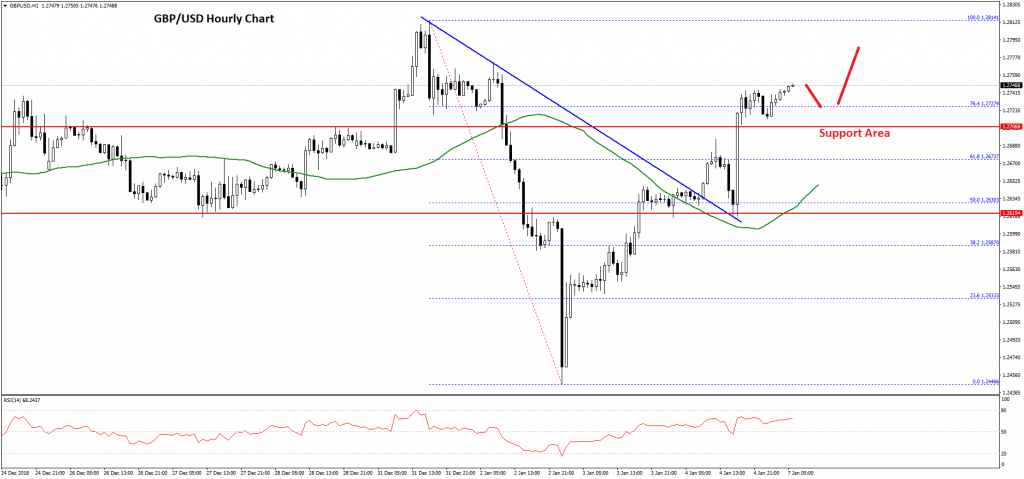
During the rise, the pair broke many resistances, starting with 1.2640 and 1.2700. There was also a break above a major bearish trend line with resistance at 1.2650 on the hourly chart of GBP/USD. The pair even broke the 61.8% Fib retracement level of the last decline from the 1.2814 high to 1.2446 low.
The pair is now trading well above the 1.2720 level, the 50 hourly simple moving average, and the 76.4% Fib retracement level of the last decline from the 1.2814 high to 1.2446 low.
Therefore, there are chances of more gains towards the 1.2800 resistance levels in the near term. On the other hand, if there is a downside correction, the pair may find support near 1.2700 or 1.2680.
Overall, GBP/USD recovered nicely and the current price action indicates more gains above the 1.2750 and 1.2780 levels.
USD/CAD Technical Analysis
The US Dollar failed to break the key 1.3660-1.3670 resistance area against the Canadian Dollar. The USD/CAD pair started a major decline and broke the 1.3600, 1.3500 and 1.3450 support levels.
There was even a break below the 1.3400 support and the 50 hourly simple moving average. The pair traded below the 1.3380 level recently to move further into a bearish zone. Clearly, sellers are in control below 1.3400 and the 50 hourly simple moving average.
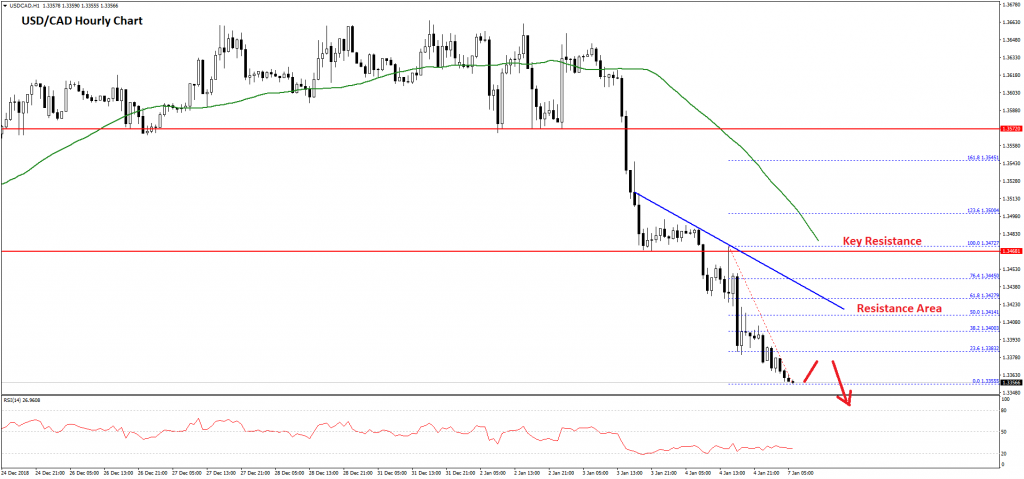
If there is a downside extension, the pair may trade towards the 1.3340 and 1.3310 support levels. On the other hand, if there is an upside correction, an initial resistance is near the 23.6% Fib retracement level of the recent decline from the 1.3472 high to 1.3355 low.
There is also a crucial bearish trend line in place with resistance at 1.3425 on the hourly chart. The trend line coincides with the 50% Fib retracement level of the recent decline from the 1.3472 high to 1.3355 low.
Therefore, if the pair corrects higher from the current levels, it is likely to face sellers near 1.3380, 1.3400 and 1.3425. A proper close above the 1.3425 level may push the price towards the 1.3470 resistance area. On the downside, the main supports are at 1.3350, 1.3320 and 1.3300.
BOC Preview – No Change in Rates, Dovish Stance Accompanied by Modest Forecast Downgrades
We expect BOC to leave the policy rate unchanged at 1.75% at the upcoming meeting this week. Besides releasing the statement and Monetary Policy Report, the central bank would also update the economic forecasts and host a press conference. The focus of the meeting would be possible downward revisions on the growth outlook and forward guidance on the policy stance. We expect the central bank to maintain the dovish tone lain down in the December meeting.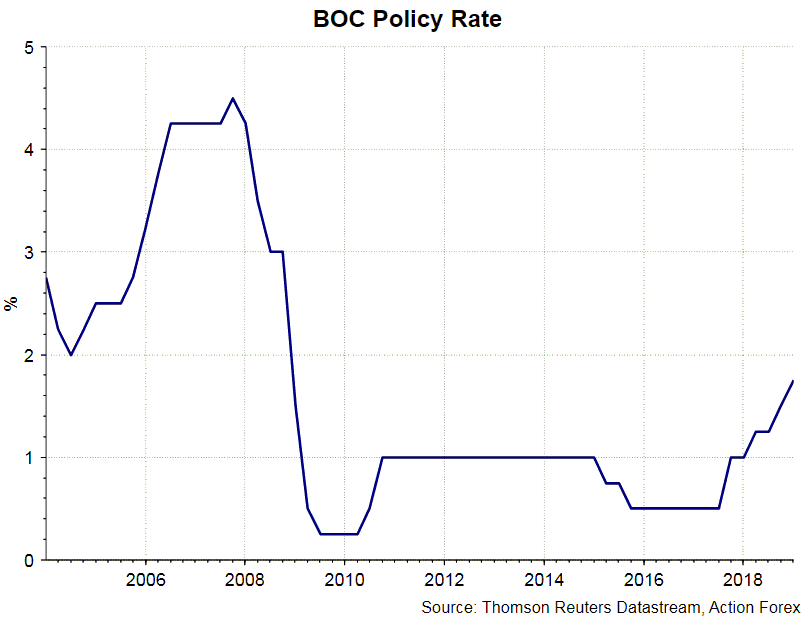
Latest Economic Developments
Canada’s job market remained resilient. The number of payrolls gained +9.3K in December, not retreating after the exceptionally strong month of November and beating consensus of +5K. The unemployment rate steadied at 5.6%. The downside in the report is that all of the increase in job positions was driven by part-time jobs (+28K) while full- time jobs actually contracted -19K last month. Meanwhile, both public and private sectors showed decline in positions while the number of self-employed soared +46K. The structure of the job market (increase in part-time and self-employed jobs) probably explains the sluggish wage growth, which is in fact a key reason for benign inflation. Headline CPI plunged to +1.7%, lowest since October 2017, amidst energy price slump. Core CPI was at +1.5% in November, a benign level that does not call for a rate hike. The momentum for future price increase is not strong, at all.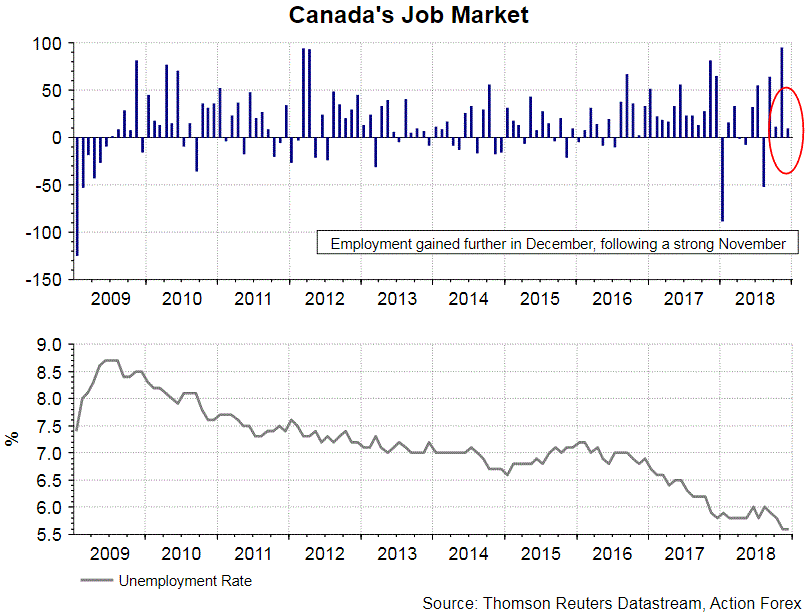
Markit’s manufacturing PMI dropped -1.3 points to 53.6 in December, the lowest since January 2017. Both “output” and “new orders” sub-indices were disappointing. As the agency suggested in the statement, “December data signaled a loss of momentum for manufacturers at the end of the year” as “stagnating export sales and softer energy sector demand” are the key reasons for the slowdown. It added that “global trade tensions have led to greater risk aversion”, resulting in diminished expectations for output growth in 2019.
BOC to Trim Forecasts
We expect BOC to trim its inflation forecast due to lower energy prices. Last week’s rebound in oil price was mainly driven by the Saudi-led production cut and US-China trade talk. We believe the boosts to oil prices are short-lived. Global economic slowdown this year is prone to limit demand for oil, limiting the rally in oil prices. BOC should also downgrade its GDP growth estimate modestly. In the near- term growth would be dampened by Alberta’s compulsory reduction in oil output, effective in the New Year. In the longer-term, the country’s economic growth would be affected by the overall slowdown in the global economy.
Forward Guidance
BOC would likely maintain the forward guidance indicated in December, noting that the policy rate would “need to rise into a neutral range to achieve the inflation target”. The central bank would also retain the stance that “the persistence of the oil price shock, the evolution of business investment, and the Bank’s assessment of the economy’s capacity will also factor importantly into our decisions about the future stance of monetary policy”.
USD/JPY Daily Outlook
Daily Pivots: (S1) 107.82; (P) 108.21; (R1) 108.90; More..
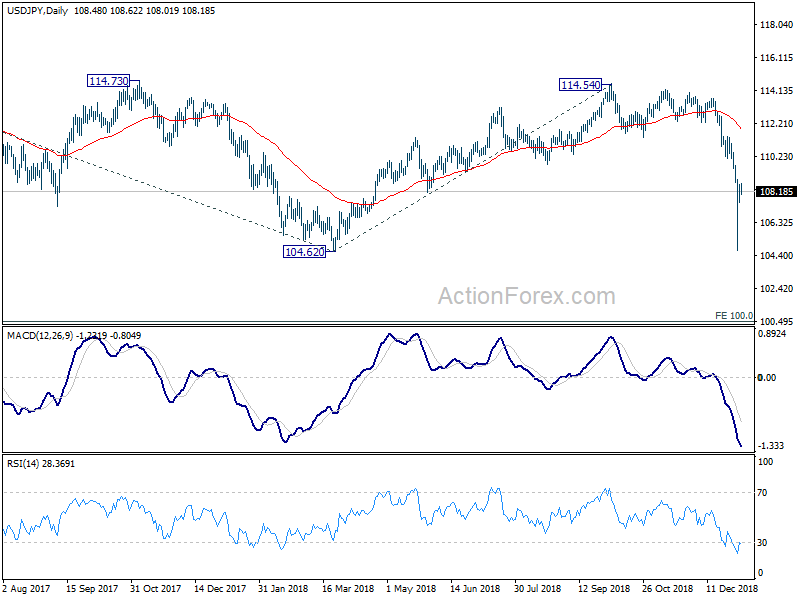
USD/JPY retreats mildly today but intraday bias stays on the upside. Rebound from 104.69 might extend higher. But upside will likely be limited by 109.46 minor resistance. On the downside, below 106.74 minor support will turn bias to the downside for 104.62 low. Overall, larger downtrend from 118.65 (2016 high) is expected to resume finally through 104.62 after current consolidation from 104.69 completes.
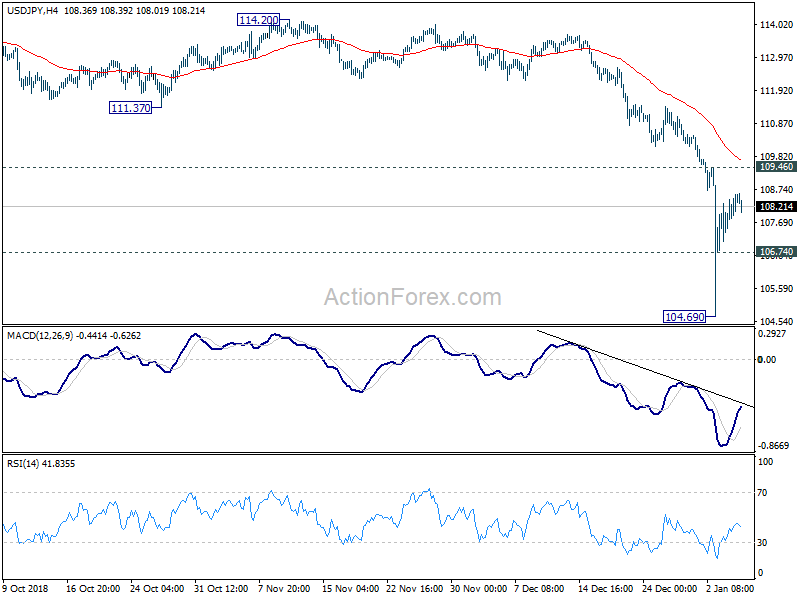
In the bigger picture, price actions from 125.85 (2015 high) are seen as a long term corrective pattern, no change in this view. Apparently, such corrective pattern is not completed yet. Fall from 114.54 is seen as part of the falling leg from 118.65 (2016 high). Break of 104.62 will target 100% projection of 118.65 to 104.62 from 114.54 at 100.51, which is close to 100 psychological level. But in that case, we'd expect strong support from 98.97 to contain downside to bring reversal. Also, this bearish case will remain the preferred one as long as 114.54 resistance holds.
Dollar Broadly Lower on Cautious Fed Powell, US Government Shutdown Continues
Riding on the strong rally in the US on Friday, Asian opened the week generally higher. While major Asian indices maintain gains, there is no follow through buying seen. There seems to be enough risks to keep investors' hands tied, including the result of the vice ministerial level US-China trade negotiations, which starts in Beijing this week. On the other side of the planet, parliamentary debate on Brexit agreement will resume this week and there is no sign of breakthrough yet. And across the Atlantic, partial US government shutdown is in its third week, with no end in sight.
In the currency markets, Yen is trading as the strongest one for today but gain is limited. Euro and Australian Dollar follow as second and third strongest. Dollar is the weakest one, under broad based pressure. Fed Chair Jerome Powell said Fed will be patient to see how the economy evolves. More important, Powell said Fed is "always prepared to shift the stance of policy". Fed funds futures are pricing in nearly no chance of a rate hike in first half of 2019, and around 25% of a rate cut by December. Canadian Dollar and Sterling follow as second and third weakest.
In Asia, Nikkei is currently up 2.73% and Singapore Strait Times is up 1.27%. But Hong Kong HSI is up 0.67% only. China Shanghai SSE is up 0.44%. Japan 10 year JGB year stays negative at -0.011.
Trump threatens radical move over border wall, but offers concession too
The partial US government shutdown is now in its third week without any resolution in sight. Trump repeated his threat of a radical move to get funding for his border wall, but at the same time offered concession over the weekend. He warned on Sunday "I may declare a national emergency dependent on what's going to happen over the next few days." He also added, "The barrier, or the wall, can be of steel instead of concrete, if that helps people. It may be better."
Later Trump also tweeted that Vice President Mike Pence had a "productive meeting with the Schumer/Pelosi representatives". And, ."We are now planning a Steel Barrier rather than concrete. It is both stronger & less obtrusive."
But so far, the Democrats showed little interest in the "concession."
UK PM May repeated her warnings over no-deal Brexit
UK Prime Minister Theresa May repeated her warning that voting down her Brexit agreement in the parliament will put the UK into "uncharted territory". And she added, "I don't think anybody can say exactly what will happen in terms of the reaction that we'll see in Parliament."
She also reiterated that the Irish backstop "is not intended to be used in the first place, and if it is, it's only temporary". And, "ensuring that we actually get the future relationship in place to replace the backstop if it's used is actually a crucial element of this."
May also reiterated her opposition to a second referendum as that would "divide our country" and require a delay to Brexit.
Separately, a cross party group of Conservative and Labour MPs are seeking to amend the government's Finance Bill to ensure the "no deal" provisions in it can only be implemented if Parliament votes to allow it.
Debate on the Brexit agreement will resume this Wednesday, with the vote due in the week beginning January 14.
IMF Lipton: World is not well prepared to deal with recession
IMF first deputy managing director David Lipton warned that "the next recession is somewhere over the horizon, and we are less prepared to deal with that than we should be", and "less prepared than in the last" crisis in 2008.
And he urged that "given this, countries should be paying attention to keeping their economy on a level trajectory, building buffers and not fighting with each other."
Lipton also noted that "China is clearly slowing down — we think China's growth has to slow, but keeping it from slowing in a dangerous way is an important objective."
Looking ahead
BoC rate decision will be the main event among central bank activities this week. For now, its seems most analysts lean towards the case of holding rate unchanged at 1.75%. But this is not a total consensus. There could be some surprises in rate decision, the statement and new economic projections. FOMC and ECB meeting accounts, however, will likely provide little news to the markets.
On the data front, main focuses will be on US ISM services and CPI, UK GDP and productions, Australia retail sales and trade balance.
Here are some highlights for the week:
- Monday: German factory orders; Swiss foreign currency reserves; Eurozone Sentix investor confidence, retail sales; Canada Ivey PMI; US ISM services
- Tuesday: Australia trade balance; Japan consumer confidence; Germany industrial production; Swiss retail sales; Canada trade balance; US trade balance
- Wednesday: Japan average cash earnings; Australia building approvals; Germany trade balance; Swiss CPI; Eurozone unemployment rate; FOMC minutes; BoC rate decision
- Thursday: China CPI and PPI; Japan leading indicators; ECB meeting accounts; Canada building permits, new housing price index; US jobless claims
- Friday: New Zealand building permits; Japan household spending, current account; Australia retails sales; UK GDP, trade balance, productions; US CPI
USD/JPY Daily Outlook
Daily Pivots: (S1) 107.82; (P) 108.21; (R1) 108.90; More..
USD/JPY retreats mildly today but intraday bias stays on the upside. Rebound from 104.69 might extend higher. But upside will likely be limited by 109.46 minor resistance. On the downside, below 106.74 minor support will turn bias to the downside for 104.62 low. Overall, larger downtrend from 118.65 (2016 high) is expected to resume finally through 104.62 after current consolidation from 104.69 completes.
In the bigger picture, price actions from 125.85 (2015 high) are seen as a long term corrective pattern, no change in this view. Apparently, such corrective pattern is not completed yet. Fall from 114.54 is seen as part of the falling leg from 118.65 (2016 high). Break of 104.62 will target 100% projection of 118.65 to 104.62 from 114.54 at 100.51, which is close to 100 psychological level. But in that case, we'd expect strong support from 98.97 to contain downside to bring reversal. Also, this bearish case will remain the preferred one as long as 114.54 resistance holds.
Economic Indicators Update
| GMT | Ccy | Events | Actual | Forecast | Previous | Revised |
|---|---|---|---|---|---|---|
| 21:30 | AUD | AiG Performance of Manufacturing Index Dec | 49.5 | 51.3 | ||
| 23:50 | JPY | Monetary Base Y/Y Dec | 4.80% | 5.80% | 6.10% | |
| 7:00 | EUR | German Factory Orders M/M Nov | -0.20% | 0.30% | ||
| 8:00 | CHF | Foreign Currency Reserves (CHF) Dec | 749B | |||
| 9:30 | EUR | Eurozone Sentix Investor Confidence Jan | -2 | -0.3 | ||
| 10:00 | EUR | Eurozone Retail Sales M/M Nov | 0.20% | 0.30% | ||
| 15:00 | CAD | Ivey PMI Dec | 58.1 | 57.2 | ||
| 15:00 | USD | ISM Non-Manufacturing/Services Composite Dec | 59.4 | 60.7 |
EUR/USD Primed To Retest 1.1500 Resistance
Key Highlights
- The Euro found support near the 1.1300 level and recovered against the US Dollar.
- There is a major bullish trend line formed with support at 1.1385 on the 4-hours chart of EUR/USD.
- The US Nonfarm Payrolls in Dec 2018 increased 312K, more than the 177K forecast.
- Today in the US, the Factory Orders figure for Nov 2018 will be released, which is forecasted to rise 0.7% (MoM).
EURUSD Technical Analysis
The Euro opened the New Year with a bearish tone and declined heavily against the US Dollar. Later, the EUR/USD pair formed a support base near 1.1300 and recovered above 1.1380.
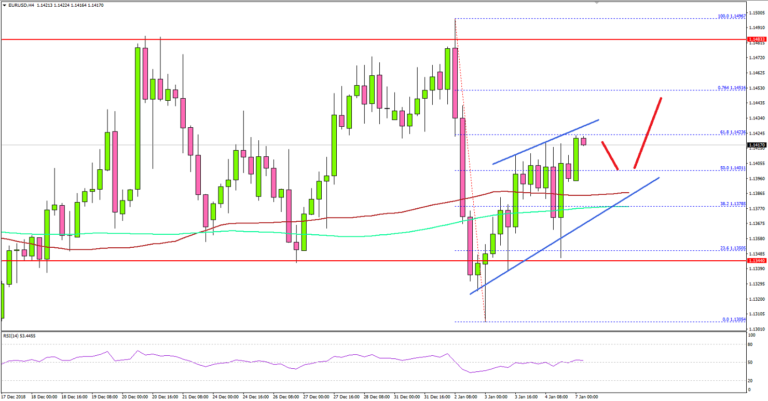
Looking at the 4-hours chart, the pair traded as low as 1.1305 and later settled above the 1.1350 resistance plus 100 simple moving average (red, 4-hours). Buyers were successful in clearing the 50% Fib retracement level of the recent decline from the 1.1497 high to 1.1305 low.
The pair is currently trading well above the 1.1400 level and the 200 SMA (green, 4-hours), with a bullish angle. It must break the 1.1435 level and a connecting resistance trend line for a solid upward move towards the 1.1500 resistance.
An intermediate resistance is at 76.4% Fib retracement level of the recent decline from the 1.1497 high to 1.1305 low at 1.1451.
On the downside, there is a major bullish trend line formed with support at 1.1385 on the 4-hours chart of EUR/USD. The trend line is close to the 100 and 200 SMA, which are likely to act as strong supports near 1.1385.
Recently in the US, the Nonfarm Payrolls report for Dec 2018 was released by the US Department of Labor. The market was looking for an increase of 177K in jobs, more than the last 155K.
However, the result was positive as there was a sharp increase in the US NFP to 312K. Moreover, the last reading was revised up to 176K. On the flip side, there was a rise in the unemployment rate from 3.7% to 3.9%.
Overall, both EUR/USD and GBP/USD are likely to recover in the near term unless the US Dollar bulls take back control.
Economic Releases to Watch Today
- German Retail Sales for Nov 2018 (MoM) – Forecast 0.3%, versus -0.3% previous.
- German Retail Sales for Nov 2018 (YoY) – Forecast -0.9%, versus 5.0% previous.
- German Factory Orders for Nov 2018 (MoM) – Forecast -0.5%, versus +0.3% previous.
- US Factory Orders Nov 2018 (MoM) – Forecast +0.7%, versus -2.1% previous.
IMF Lipton: World is not well prepared to deal with recession
IMF first deputy managing director David Lipton warned that "the next recession is somewhere over the horizon, and we are less prepared to deal with that than we should be", and "less prepared than in the last" crisis in 2008.
And he urged that "given this, countries should be paying attention to keeping their economy on a level trajectory, building buffers and not fighting with each other."
Lipton also noted that "China is clearly slowing down — we think China's growth has to slow, but keeping it from slowing in a dangerous way is an important objective."