Sample Category Title
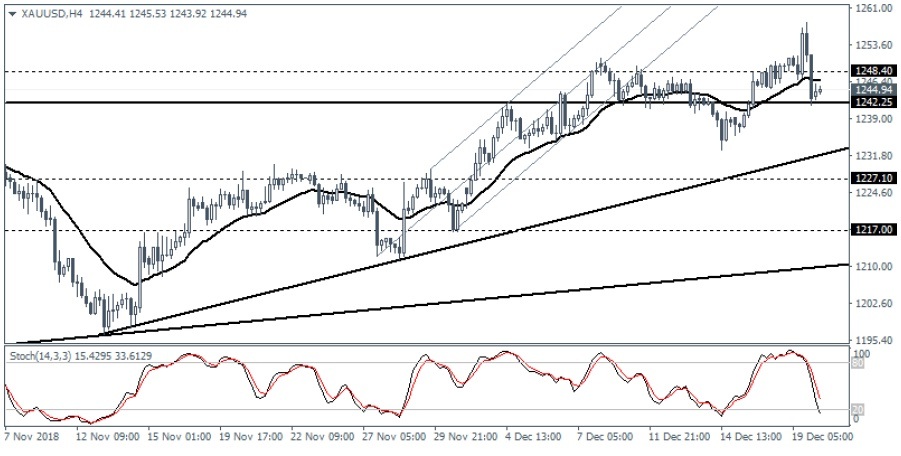
Gold Spot Target 1239.00
Pivot (invalidation): 1247.00
Our preference Short positions below 1247.00 with targets at 1241.50 & 1239.00 in extension.
Alternative scenario Above 1247.00 look for further upside with 1251.00 & 1254.00 as targets.
Comment The RSI is bearish and calls for further decline.
Fed More Dovish, But Markets Hoped For More
- Fed hikes policy rate by 25 bps to 2.25%-2.50%
- Fed delivers expected 'dovish' rate hike, but markets hoped for more softness
- Committee still sees 'further gradual increases' as consistent
- Median growth and inflation forecasts for 2019 are downgraded modestly
- Markets are disappointed and return to risk-off. The US yield curve flattens further
The Fed hiked its policy rate yesterday as largely anticipated by 25 bps from 2%‐2.25% to 2.25%‐2.50%. Markets focusesd more on the new economic and monetary projections than on the interest rate decision itself. The median rate projections for the 2019‐2021 period were revised lower by one full rate hike across the policy horizon compared to the September dots. The median dots are hinting at two additional rate hikes next year (2.75%‐ 3.00%), a 'final' rate hike for this cycle is seen in 2020 (3.00%‐3.25%). The policy target range is expected unchanged over 2021 (3.00%‐3.25%). Interestingly, Fed members also eased their view on the long run neutral policy rate from 3.0% to 2.75% (was upwardly revised in September from 2.875 to 3.0%). As was already the case for the September dots, the dispersion of the Fed governors' forecasts for the policy rates and for the neutral policy rate remains large. The balance sheet run‐off ($50bn/month from Q4 2018 onwards) continues on its pre‐set course. At the press conference, Powell said that that the impact of this balance sheet run‐off has been small so far and that he didn't see it creating problems. The Fed has currently no intention to change this process.
Regarding the economic variables, the Fed reduced the growth outlook for 2018 from 3.1% to 3.0% and for next year to 2.3% (from 2.5%). The growth outlook for 2020 (2.0%) and 2021 (1.8%) was left unchanged. The unemployment rate (cycle low at 3.5% next year) stays well below NAIRU (4.4% from 4.5%). Inflation is seen marginally softer but continues to oscillate very close the 2% target
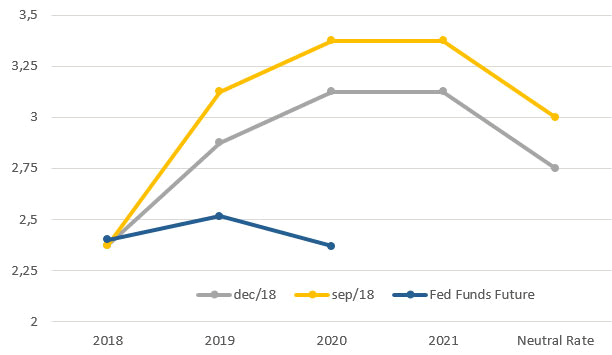
New Fed dot plot (grey), September dots (orange) and Fed Funds future curve (blue): Fed lowers 'projected' rate hike path but stays far away from market pricing. Source: Bloomberg
A 'not-that-that dovish' rate hike
The FOMC made some changes to the policy statement with regards to the September script, but the changes are rather limited given recent market developments and the intensive market debat on what future Fed policy will have to look like.
The economic assessment was almost unchanged, except for the Fed taking notice that the unemployment rate declined even further since September. Based on a similar economic view compared to September, the Fed concluded that 'some' further gradual increase in the target range for the Federal funds rate will be consistent with the Fed's aim of sustained expansion of economic activity, strong labour market and inflation near the Committee's symmetric 2 percent objective over the medium term. The FOMC still jugdges that risks to the economic outlook are roughly balanced. However, the Fed added it will continue to monitor global economic and financial developments and assess their impact on the economic outlook. One can see this as the Fed giving a sign to markets that it is well aware of recent economic and monetary developments.
In the press conference, the Fed Chairmain indicated that the FOMC still expects solid growth on 2019 after exceptionally strong growth in 2018, the best year since the financial crisis. The median growth projection for 2019 was downwardly revised from 2.5% to 2.3%, but is still wel above the long run neutral growth rate (seen at 1.9%). Powell admitted that there is some mood of angst about growth, but recent develoments haven't fundamentally altered the Fed's outlook. The US economy doesn't need policy to be accommodative at this time. Howewer, the reduction in the 2019 growth forecast, among others, mirrors recent tightening of financial conditions. In this respect, the lower 'dot plot' should counterbalance and support the economy. The Fed Chairman said that neither the pace nor the destination of monetary policy is predetermined. However, the reference to a strong economic context, suggests that the Fed still sees some upward tendency in the Federal funds rate as the more likely scenario. In this respect, yesterday's Fed approach is less data‐ (and market)‐dependant than many market participants had hoped for.
Markets and Fed continue to stay apart
Indeed, in the run‐up to yesterday's Fed decision, there was a big discrepancy between the Fed September dots and market expectations/hope on a much softer policy normalization going forward. In this context, the risk was a violent market reaction if the Fed didn't come close enough to what the market hoped for. This is exactly what happened. The US yield curve flattened aggressively further.The 2‐yr yield rose a meagre 1.9 bps. The 30‐y yield dropped 8.7 bps. The 10‐year yield (2.75%) is now testing the 2.81%/2.76%/2.7150 support area. A sustained break would suggest a fundamental shift in markets' assessment of the economic and monetary environment. It would suggest that the market grows ever more convinced that Fed tightening might kill the economic cycle soon and much sooner than the Fed anticipates. The 10y/2y yield spread dropped to a cycle low of 11 bps. Despite yesterday's Fed guidance, the market only sees a 40% change of an additional Fed rate hike by September next year! US equity markets started the day with an optimistic bias and showed gains of about 1.5% going into the Fed decision. However, the Fed holding on to a scenario of 'some' further rate hikes, almost immediately turned investors sentiment risk‐off again.
US equity markets closed the session with losses between 1.49% (Dow) and 2.17% (Nasdaq). The Fed's intention to continue policy normalization and the risk‐off sentiment also supported a limited comeback of the US dollar. The second reason probably was more USD supportive than the first one. The trade‐weighted dollar rebounded back above the 97 handle. The dollar also reversed earlier intraday gains against the euro and the yen but both cross rates remain well within the established ranges. The EUR/USD 1.1187/1.1621 range remains solidly in place
GBP/JPY Daily Outlook
Daily Pivots: (S1) 141.46; (P) 142.00; (R1) 142.41; More...
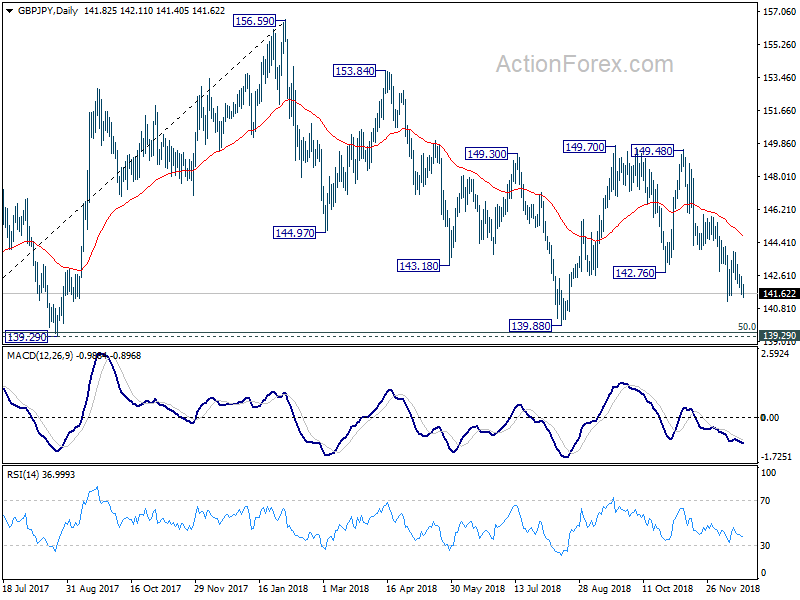
GBP/JPY drops further today but stays in consolidation above 141.17 support. Intraday bias remains neutral first. In case of another recovery, upside should be limited by 144.02 support turned resistance to bring fall resumption. On the downside, below 141.17 will resume the fall from 149.70 and target 139.29/47 key support zone. However, considering bullish convergence condition in 4 hour MACD, decisive break of 144.02 will suggest near term reversal. Stronger rally should then be seen to 55 day EMA (now at 144.73) and above.
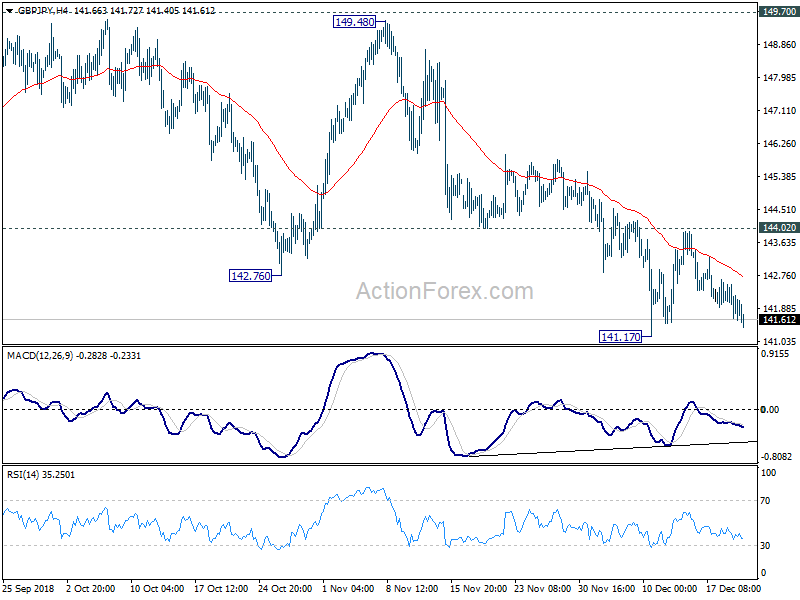
In the bigger picture, as long as 139.29 cluster support (50% retracement of 122.36 to 156.59 at 139.47) holds, up trend from 122.36 (2016 low) could still extend beyond 156.69 high. However, decisive break of 139.29/47 will suggest that such up trend is completed and turn outlook bearish. In that case, next target is 61.8% retracement at 135.43.
Currencies: Markets Flunk The Fed
- Rates: Fed doesn’t live up to market expectations
The Federal Reserve delivered a ‘dovish hike’ yesterday: a policy rate hike of 25 bps but a lower median rate forecast for 2019 with 25 bps. Investors clearly hoped for more, pushing US Treasuries substantially higher with the US yield curve bull flattening. Today’s risk sentiment will be dominated by the Fed aftermath with the US 10-yr yield testing key support. - Currencies: Markets flunk the Fed
Markets expected the Fed to at least sugarcoat its 25bps rate hike but got disappointed. The Fed’s rather upbeat assessment and determination to continue policy normalization at only a slightly slower pace sent equity markets and US yields tumbling. We expect risk-off sentiment to spur further market repositioning today.
The Sunrise Headlines
- Wall Street wasn’t impressed by yesterday’s FOMC outcome. The Fed’s dovish shift remains too hawkish for the street. Main indices turned +1% gains into -1.5% losses. Asian indices record smaller losses apart from Japan (yen strength).
- The Fed hiked its policy rate to 2.25%-2.5%, but now expects 2 instead of 3 rate hikes next year. More gradual rate hikes will be necessary given US economic strength, but the FOMC warns for possible dark clouds ahead.
- The Bank of Japan kept its policy rate, yield curve-control program and asset purchases unchanged this morning with limited changes in the statement. They reaffirmed their economic recovery view in light of rising global uncertainties.
- The PBOC eased policy this morning by announcing a targeted medium term lending facility which looks a lot like the ECB’s TLTRO’s: lower-cost liquidity for up to 3 years for banks willing to lend more to SME’s.
- New Zealand GDP rose by 0.3% Q/Q in Q3, down from 1% in Q2 and below 0.6% forecasts. It’s the weakest pace in almost five years. NZD weakness and US strength pulled NZD/USD to the low 0.67s.
- The US Senate passed a short-term spending bill to avoid a near-term partial government shutdown. The bill keeps the government running until early February. The House is expected to pass the bill today.
- Today’s economic calendar contains central bank meetings in Sweden, the UK and the Czech Republic. UK retail sales, Philly Fed Business Outlook and weekly jobless claims spice the agenda.
Currencies: Markets Flunk The Fed
Markets flunk the Fed
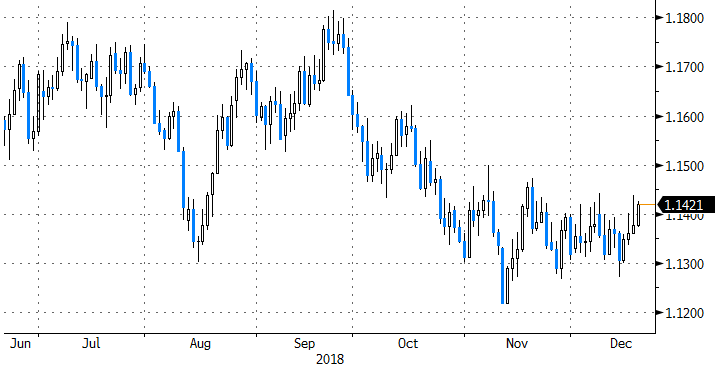
Cautious risk-on prevailed on markets going ahead of a keenly awaited Fed policy meeting yesterday. Global equity markets trended higher while the EC’s decision not to start the excessive debt procedure against Italy, spurred euro buying. USD stayed in the defensive. Markets hoped for the Fed to sugarcoat its 25bp rate hike, but got dissapointed. The Fed has its December dots hinting at 2 more hikes in 2019 instead of 3 in September and left hiking expectations for 2020 (+1) and 2021 (flat) unchanged. The central bank continues its balance sheet roll-off at the current $50bn/m pace. Growth and inflation forecasts were brought down only marginally. The numbers fit the Fed’s forward guidance (of “some further gradual increases” while “monitoring global economic and financial developments”) and the tone it struck during the press conference. Powell admitted there some mood of angst about growth but said the outlook hasn’t fundamentally changed. The economy doesn’t need policy to be accommodative. His rather upbeat assessment was perceived too hawkish by markets, who called for a much softer normalization path going forward. Risk-off returned. US equities and yields slumped, the dollar strengthened to EUR/USD 1.138 (down from an intray high at 1.144). USD/JPY remained relativily stable close to 112.4 but slips below the 112-handle during Asian trading hours. Risk off also flushes Asian markets. Japan underperforms on the back of a stronger yen despite the BoJ leaving rates unchanged and leaving the door open for more easing if needed. China is considering a new round of “substantial” tax cuts and the PBOC announced a sort of TLTRO’s. Today’s economic calendar is thin and in any case of secondary importance as sentiment dominates. We expect further repositioning during European dealings in the aftermath of yesterday’s Fed meeting. US yields are heavily testing key support levels. A sustained break is in theory dollar negative. However, the current risk off sentiment traditionally favours USD over the euro. We expect EUR/USD volatility within the established trading range. EUR/USD 1.15 should be a very tough nut to crack.
EUR/GBP trended higher yesterday as the euro was well bid. The pair closed at 0.902, up from 0.899. Today’s focus will be on the Bank of England. No major surprises are expected, but we will watch for Carney’s comments on the brexit stalemate. As the British Parliament’s recess kicks off today, the pound might enter calmer waters. Nevertheless, we remain cautious on sterling exposure
EUR/USD: risk-off to provide dollar new support?
EUR/JPY Daily Outlook
Daily Pivots: (S1) 127.56; (P) 127.97; (R1) 128.39; More....
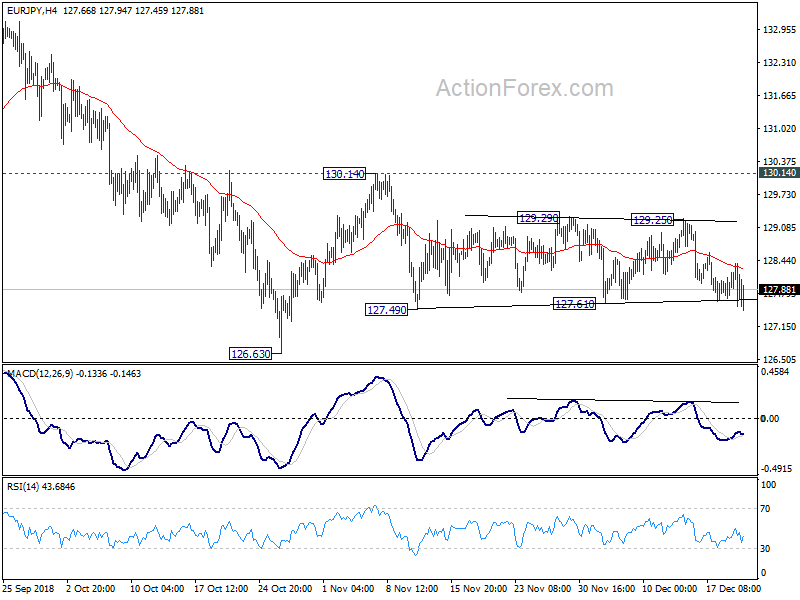
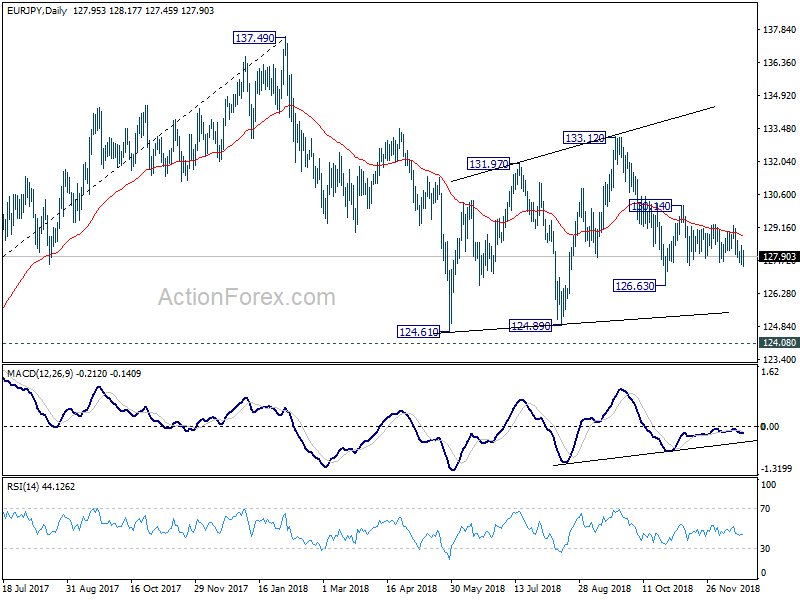
EUR/JPY breached 127.49 support briefly but recovered. Intraday bias remains neutral first. On the downside, firm break of 127.49 support will resume the fall from 130.14 and target 126.63 support first. Break there will then resume the whole decline from 133.12 to 124.08/89 support zone. Overall, consolidation from 126.63 could still extend. But even in case of another strong recovery, outlook will stay bearish as long as 130.14 resistance holds.
In the bigger picture, as long as 124.08 key resistance turn supported holds, larger up trend from 109.03 (2016 low) could still resume. Firm break of 137.49 structural resistance will target 141.04/149.76 resistance zone next. However, decisive break of 124.08 will argue that such rise from 109.03 has completed and turn outlook bearish. In that case, deeper fall would be seen to 61.8% retracement of 109.03 to 137.49 at 119.90.
USDJPY Declines To 3-Week Low, Shifts Outlook To Neutral
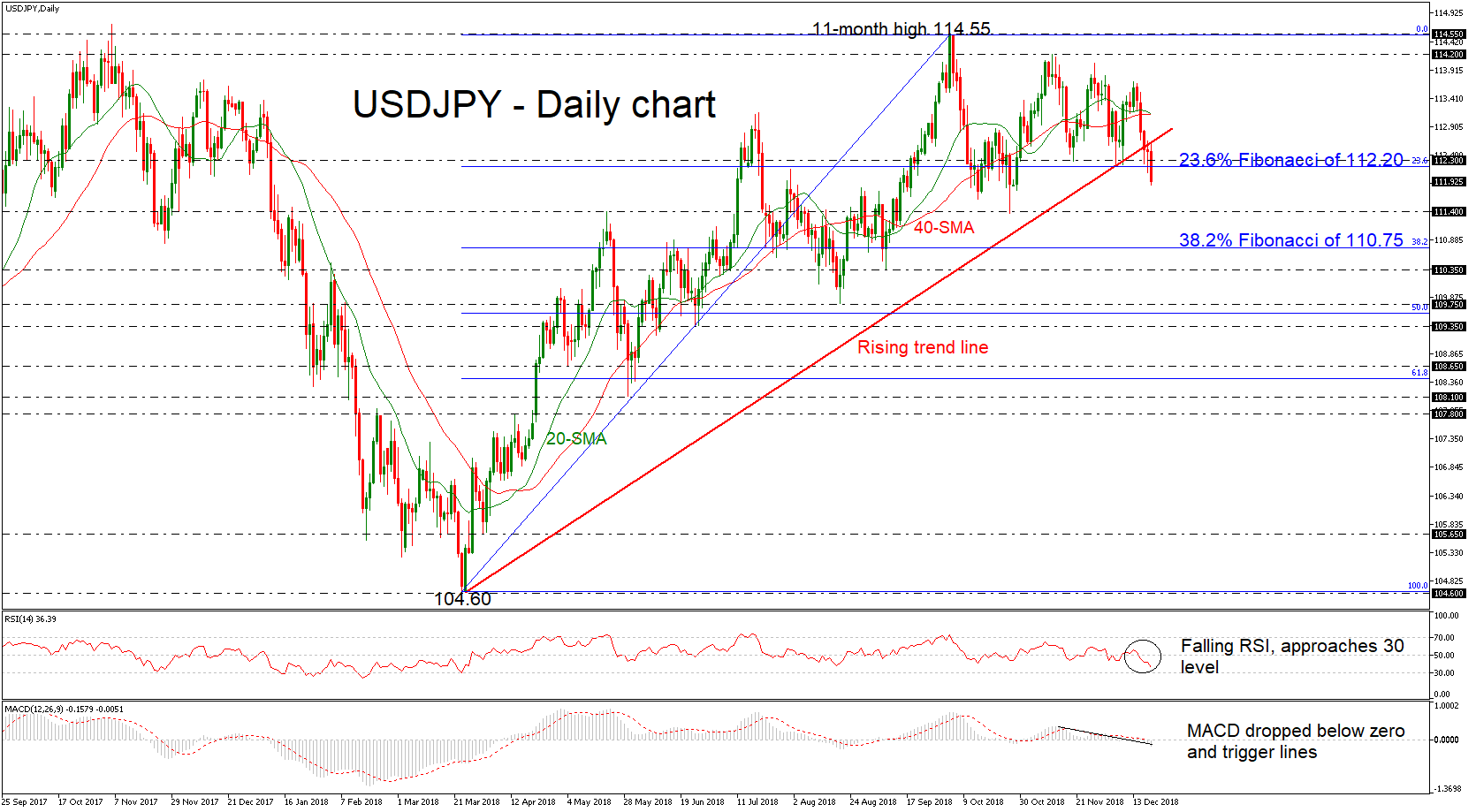
USDJPY extended its losses early on Thursday and is set to complete the fifth consecutive red day. The pair plunged below the ascending trend line in the daily chart and the 23.6% Fibonacci retracement level of the upleg from 104.60 to 114.55, near 112.20, reaching a new three-week low around 111.86. According to the MACD, negative momentum could push for further losses in the short-term as the indicator picks up steam below its red signal line. The RSI is also falling and is relatively close to the 30 oversold threshold.
In the negative scenario, where the price continues to expand below today’s low, a new trough could be formed around the 111.40 support level, taken from the bottom on October 26. If the market manages to overcome that area, traders could look for support at the 38.2% Fibonacci region of 110.75 before steeper bearish actions take the price down to the 110.35 area.
A reversal to the upside could stall at the 112.20 – 112.30 resistance zone before touching again the rising trend line. Further up, the bearish cross of the 20- and 40-simple moving averages (SMAs) currently in formation at 113.10 could be the next level to focus on. Any violation of this point could potentially trigger further buying interest in the market, probably leading the price up to 114.20, identified by the high on November 12.
Regarding the medium-term picture, the bullish outlook has switched to neutral after the break below the nine-month uptrend line.
EUR/GBP Daily Outlook
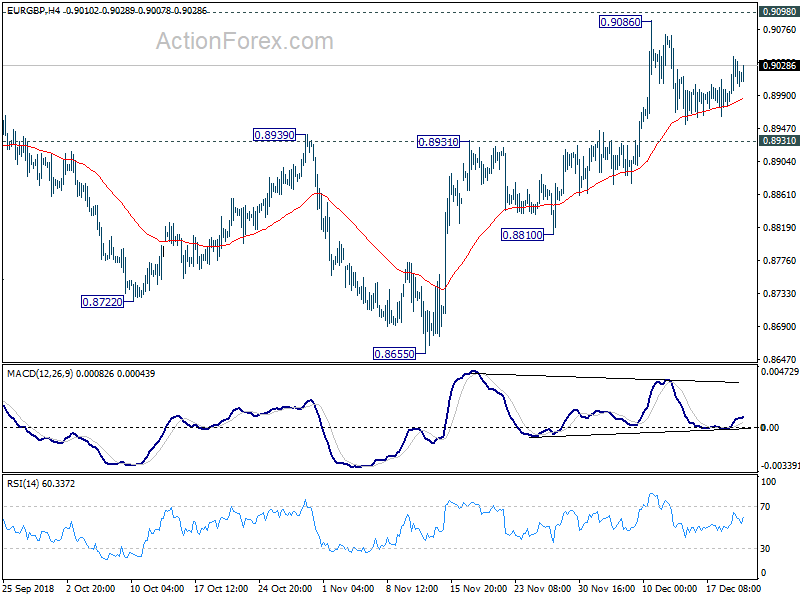
Daily Pivots: (S1) 0.8965; (P) 0.8989; (R1) 0.9014; More...
EUR/GBP is staying in consolidation from 0.9086 and intraday bias remains neutral at this point. As long as 0.8931 resistance turned support holds, further rise is expected. On the upside, decisive break of 0.9098 resistance will extend the rally from 0.8655 and target 0.9304 key resistance next. However, considering bearish divergence condition in 4 hour MACD, firm break of 0.8931 will indicate near term reversal and target 0.8810 support and below.
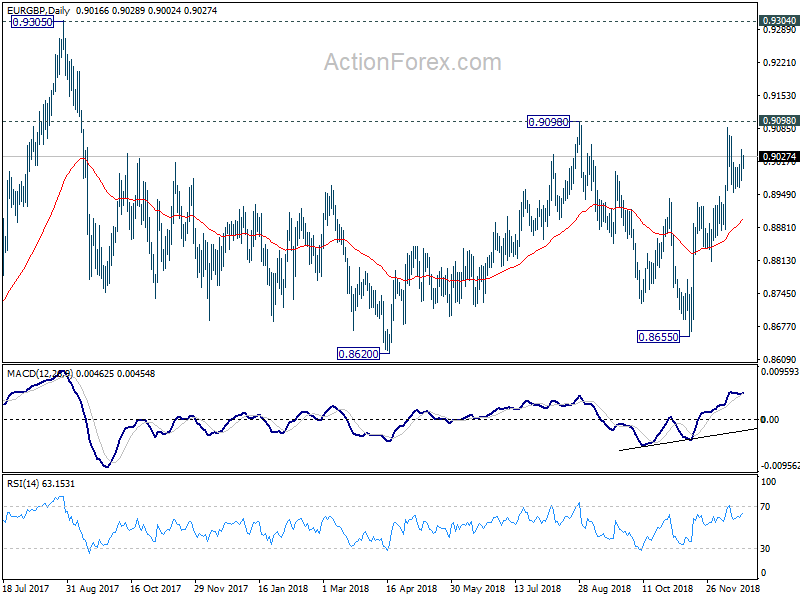
In the bigger picture, EUR/GBP is seen as staying in long term range pattern started at 0.9304 (2016 high). It should be in medium term rising leg for 0.9304. Meanwhile, in case of another fall, down side should be contained by 0.8620/55 support zone to bring rebound.
How Did Powell Upset The Markets?
Equity investors didn't like what they heard from Fed Chair Jerome Powell on Wednesday. After trading more than 350 points higher intraday, the Dow Jones Industrial Average took a dive after the Federal Reserve raised interest rates and continued to decline throughout Powell's press conference, in one of the worst market reactions to an interest rate hike in more than two decades. Tech and Consumer Discretionary sectors were hit the most driving the S&P 500 1.54% lower for the day, and the heavy weighted Tech index, the NASDAQ Composite, ended the day 2.17% lower.
The decision to raise interest rates by 25 basis points was widely anticipated and priced in most asset classes, so it is not the rate hike itself that upset investors. Investors were expecting a more dovish tone from Powell given the sharp fall in equity markets and challenging global macroeconomic conditions. All they got was a less hawkish tone.
Despite many signs of global economic growth slowing, the Fed does not seem to be very concerned at this stage suggesting that monetary policy will continue to tighten albeit at a slower pace than previously projected. What appeared to be even more concerning to equity investors is that Powell is not onlyignoring Trump's calls to pause the tightening cycle, but he is also not listening to them. In answering a journalist's questions related to market volatility, Powell said that “we don't look at any one market. We look at a really big range of financial conditions and what matters for the broader economy is material changes in a broad range of financial conditions that are sustained for a period of time”.
Powell's answer may simply be interpreted as not to expect a ‘Powell Put' to save equity markets from further declines. That is likely to continue hurting market confidence which over the past decade relied so heavily on monetary policymakers to intervene when asset prices plunge.
Another concern forfinancial markets is the unwinding of the Fed's balance sheet. Powell mentioned that balance sheet reduction would remain on autopilot, suggesting that the Fed is inflexible in this regard. That's likely to lead to continued tightening of financial conditions, which could lead to further downside risk.
Markets are just not convinced that growth is as strong as projected by the FOMC, otherwise we wouldn't have seen the 10–2 Year Treasury spread shrinking below ten basis points today. With such conditions, expect risk to remain skewed to the downside for the few remaining days of 2018.
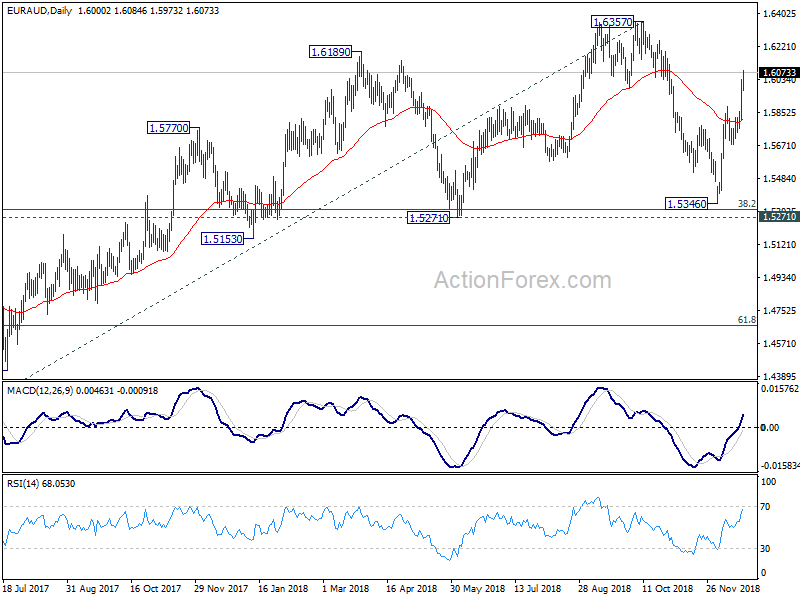
EUR/AUD Daily Outlook
Daily Pivots: (S1) 1.5851; (P) 1.5947; (R1) 1.6099; More....
EUR/USD's rally continues today and reaches as high as 1.6084 so far. Intraday bias remains on the upside and, with 1.5984 support turned resistance broken, further rise should be seen to retest 1.6357 high next. At this point, we'd be cautious on topping around there to bring pull back. On the downside, break of 1.5887 resistance turned support is needed to indicate short term topping. Otherwise, near term outlook will remain bullish in case of retreat.
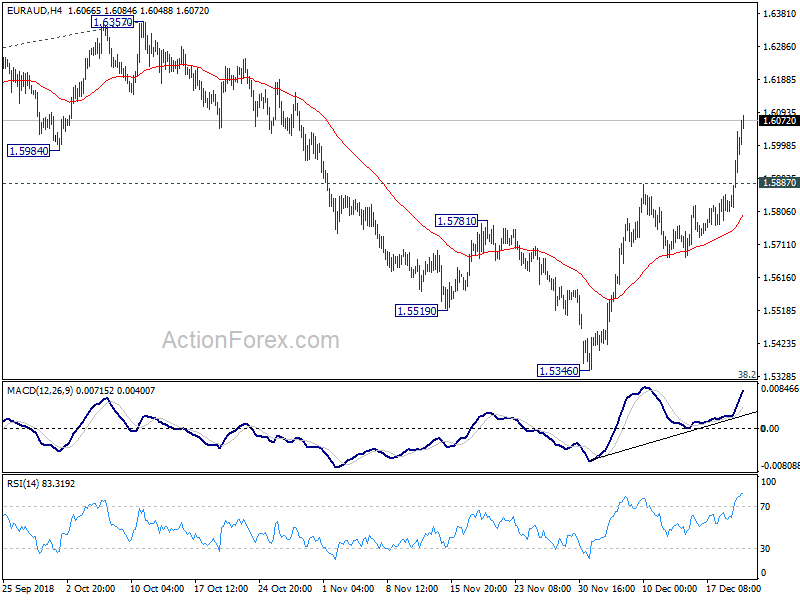
In the bigger picture, no change in the view that 1.6357 is a medium term top. But the strong rebound ahead of 1.5271 cluster support (38.2% retracement of 1.3624 to 1.6357 at 1.5313) suggests price actions from 1.6357 are developing into sideway consolidation, rather than a deep correction. The range of 1.5271/6357 is likely set for the consolidation. And we don't expect a break of the range any time soon. But decisive break of 1.6357 will resume the larger up trend from 1.3624 (2017 low) to 1.6587 (2015 high).
XAUUSD Intraday Analysis
XAUUSD (144.94): Gold prices briefly tested the highs of 1250 before giving up the gains. Price action, however, retesting the support at the 1240 handle. As long as this support holds, the bias in gold remains to the upside. Yet, if the support at 1240 fails, gold prices could be extending the declines. The lower support at 1227.10 remains a key support area that is pending retest.