Sample Category Title
NASDAQ Futures Calling For Further Decline
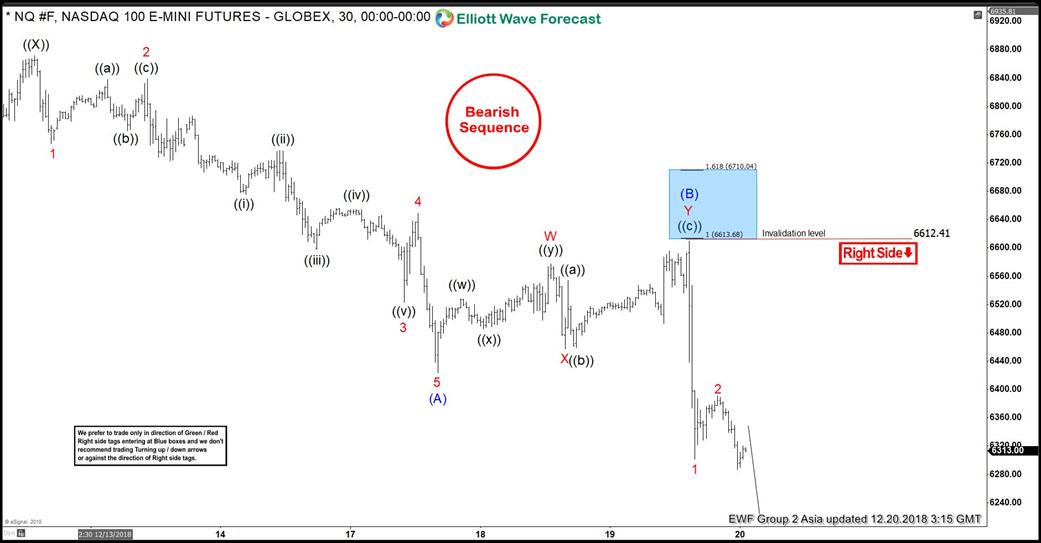
NASDAQ ticker symbol: $NQ_F short-term Elliott wave view suggests that a bounce to $6897 high ended Primary wave ((X)). Down from there, the decline is unfolding as a zigzag structure within primary wave ((Y)) where an initial decline to $6772.25 low ended Minor wave 1. Minor wave 2 bounce ended at $6864.75 high, Minor wave 3 ended in lesser degree 5 waves at $6523 low. Then a bounce to $6649 high ended Minor wave 4. Finally a push lower to $6423.25 low ended Minor wave 5 & also completed the intermediate wave (A) in 5 wave impulse structure.
Above from there, the index made a 3 wave bounce higher & completed the intermediate wave (B) at $6612.41 high. The internals of that bounce unfolded as double three structure where Minor wave W ended at $6577.50 high. Minor wave X ended at $6457 low and Minor wave Y ended $6612.41 high. Down from there, the index has made a new low below $6423.25 low confirming the intermediate wave (C) lower. Also, with this break lower the cycle from 12/12 peak ($6897) has become incomplete to the downside favoring more downside. Near-term, while bounces fail below $6612.41 high expect index to extend lower. We expect bounces to get failed against $6612.41 high in 3, 7 or 11 swings for further downside.
NASDAQ 1 Hour Elliott Wave Chart
Euro-Zone’s Construction Output Declined In October
For the 24 hours to 23:00 GMT, the EUR rose 0.11% against the USD and closed at 1.1384, after Italy and the European Commission reached a new budget deal.
Macroeconomic data indicated that the Euro-zone's seasonally adjusted construction output retreated 1.6% on a monthly basis in October. In the prior month, construction output had recorded a revised rise of 2.1%.
Separately, in Germany, the producer price index (PPI) rose to a 19-month high level of 3.3% on an annual basis in November, higher than market expectations for a rise of 3.1%. The PPI had registered a similar rise in the prior month.
The US dollar declined against Euro, following the US Federal Reserve's (Fed) rate hike decision.
The Fed, in its December monetary policy meeting, raised its benchmark interest rate by 25 basis points to a range of 2.25% to 2.50%, marking its fourth hike this year and amid robust labour market and strong growth momentum. However, the central bank lowered its 2019 interest rate projection to two hikes, compared to three rate increases previously forecasted. The central bank also lowered its forecasts for real GDP growth in 2018 and 2019 to 3.0% and 2.3%, respectively.
In the US, data showed that the US existing home sales unexpectedly climbed by 1.9% on monthly basis, to a level of 5.32 million in November, defying market expectations for a level of 5.20 million. In the preceding month, existing home sales had recorded a reading of 5.22 million. On the other hand, the nation's mortgage applications declined 5.8% on a weekly basis in the week ended 14 December 2018, following a gain of 1.6% in the previous week.
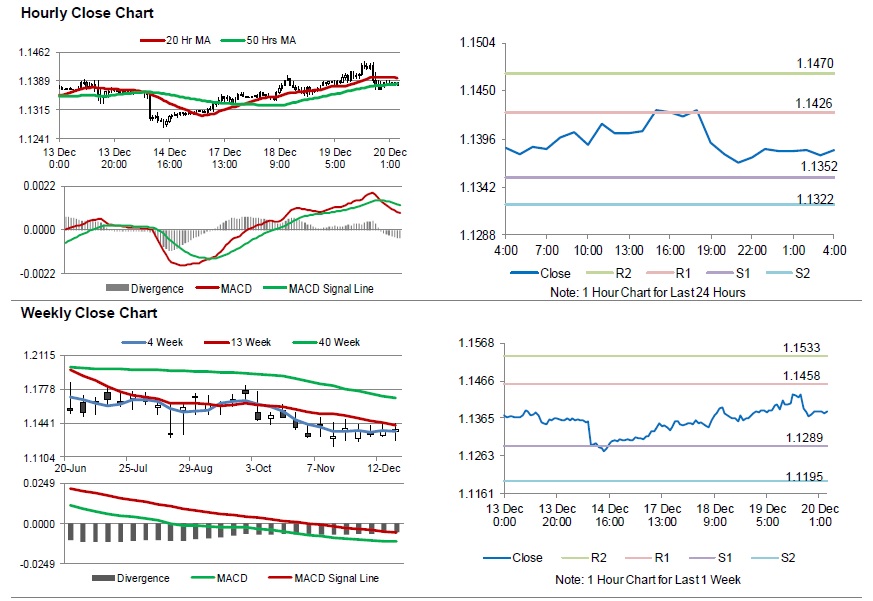
In the Asian session, at GMT0400, the pair is trading at 1.1383, with the EUR trading a tad lower against the USD from yesterday's close.
The pair is expected to find support at 1.1352, and a fall through could take it to the next support level of 1.1322. The pair is expected to find its first resistance at 1.1426, and a rise through could take it to the next resistance level of 1.1470.
Going forward, traders would await the Euro-zone's current account balance for October, set to release in a few hours. Later in the day, the US Philadelphia Fed business outlook for December and the leading index for November followed by initial jobless claims, will be on investors radar.
The currency pair is trading below its 20 Hr moving average and showing convergence with its 50 Hr moving average.
Britain’s Inflation Slid To A 20-Month Low Level In November
For the 24 hours to 23:00 GMT, the GBP declined 0.20% against the USD and closed at 1.2621.
In economic news, UK's consumer price index (CPI) eased 2.3% on an annual basis in November, marking its lowest level in 20-months and at par with market consensus. In the previous month, the CPI had advanced 2.4%. Additionally, the non-seasonally adjusted output price inflation slowed to 3.1% on an annual basis in November. In the prior month, the output producer price index had registered a rise of 3.3%. Further, the nation's retail price index fell 3.2% on an annual basis in November, meeting market expectations. In the prior month, the index had registered a rise of 3.3%. Moreover, the house price inflation eased to 2.7% on a yearly basis in October, compared to a revised gain of 3.0% in the preceding month. Meanwhile, the CBI trends total orders dropped to a level of 8.0 in December, less than market expectations and compared to a level of 10.0 in the previous month.
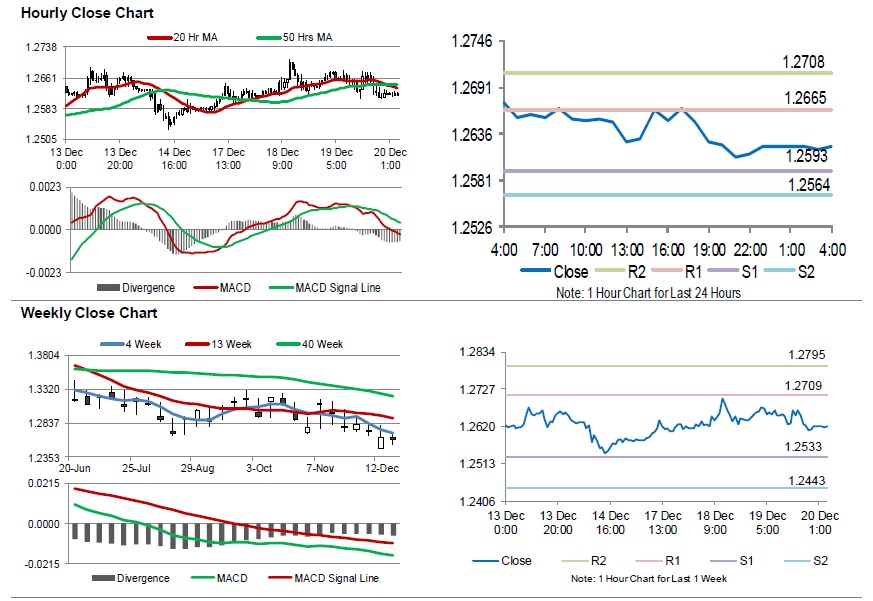
In the Asian session, at GMT0400, the pair is trading at 1.2622, with the GBP trading slightly higher against the USD from yesterday's close.
The pair is expected to find support at 1.2593, and a fall through could take it to the next support level of 1.2564. The pair is expected to find its first resistance at 1.2665, and a rise through could take it to the next resistance level of 1.2708.
Moving ahead, investors would keep an eye on the Bank of England's interest rate decision along with UK's retail sales for November, slated to release in a few hours.
The currency pair is trading below its 20 Hr and 50 Hr moving averages.
Japanese Yen Trading Slightly Higher In The Asian Session
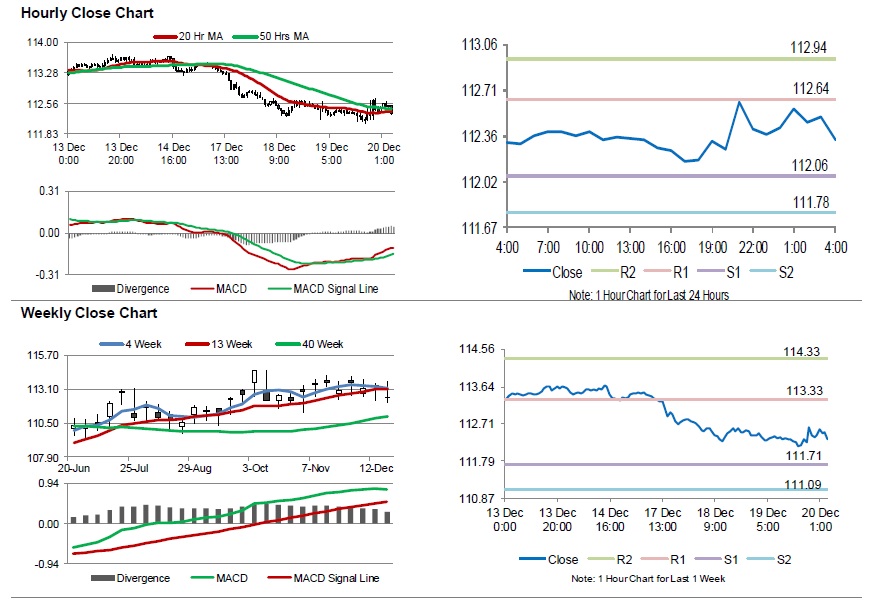
For the 24 hours to 23:00 GMT, the USD declined 0.06% against the JPY and closed at 112.37.
In the Asian session, at GMT0400, the pair is trading at 112.33, with the USD trading marginally lower against the JPY from yesterday’s close.
The pair is expected to find support at 112.06, and a fall through could take it to the next support level of 111.78. The pair is expected to find its first resistance at 112.64, and a rise through could take it to the next resistance level of 112.94.
Going forward, traders would loosely monitor Japan’s machine tool orders for November, set to release in a while.
The currency pair showing convergence with its 20 Hr and 50 Hr moving averages.
Swiss Franc Extends Its Losses In The Asian Session
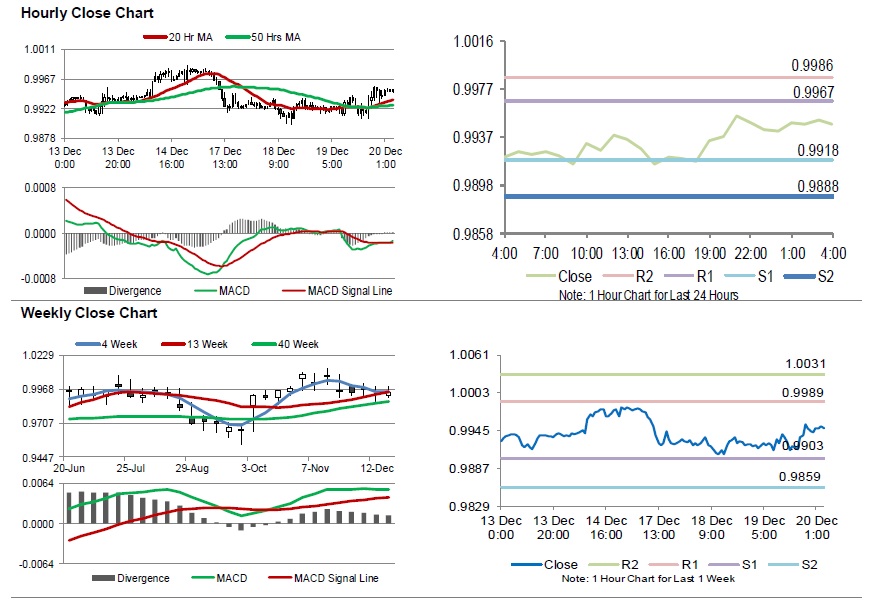
For the 24 hours to 23:00 GMT, the USD rose 0.19% against the CHF and closed at 0.9943.
In the Asian session, at GMT0400, the pair is trading at 0.9948, with the USD trading 0.05% higher against the CHF from yesterday’s close.
The pair is expected to find support at 0.9918, and a fall through could take it to the next support level of 0.9888. The pair is expected to find its first resistance at 0.9967, and a rise through could take it to the next resistance level of 0.9986.
Trading trend in the Swiss Franc today is expected to be determined by Switzerland’s trade balance data for November, scheduled to release in a while.
The currency pair is trading above its 20 Hr and 50 Hr moving averages.
Canada’s Consumer Price Inflation Slowed In November
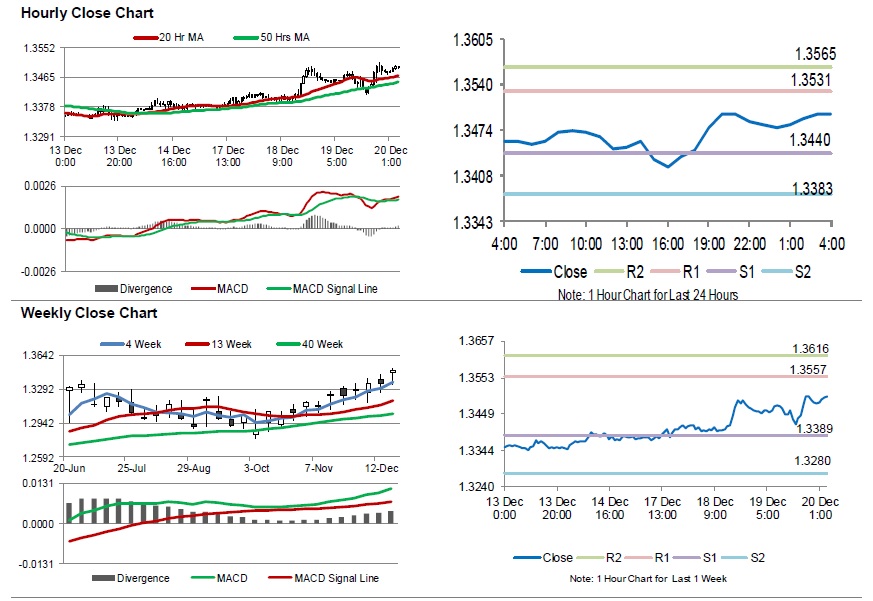
For the 24 hours to 23:00 GMT, the USD rose 0.13% against the CAD and closed at 1.3483.
On the macro front, Canada's consumer price inflation slowed to 1.7% on an annual basis in November, marking its weakest level since January 2018. In the previous month, the CPI had registered a gain of 2.4%.
In the Asian session, at GMT0400, the pair is trading at 1.3498, with the USD trading 0.11% higher against the CAD from yesterday's close.
The pair is expected to find support at 1.3440, and a fall through could take it to the next support level of 1.3383. The pair is expected to find its first resistance at 1.3531, and a rise through could take it to the next resistance level of 1.3565.
Amid lack of economic releases in Canada today, traders would focus on global macroeconomic events for further direction.
The currency pair is trading above its 20 Hr and 50 Hr moving averages.
Australia’s Unemployment Rate Surprisingly Jumped In November
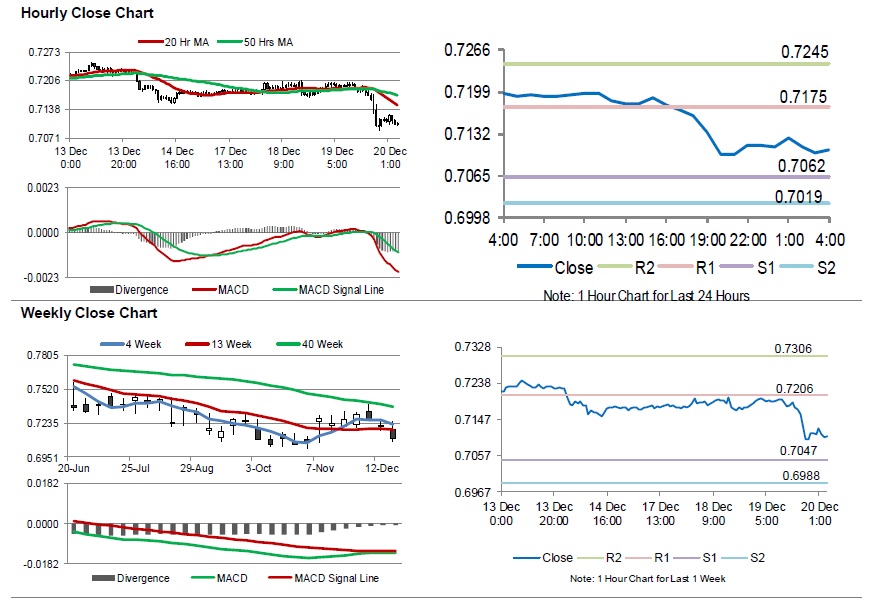
For the 24 hours to 23:00 GMT, the AUD declined 0.96% against the USD and closed at 0.7113.
LME Copper prices declined 0.9% or $56.0/MT to $5987.0/MT. Aluminium prices declined 0.6% or $12.0/MT to $1928.0/MT.
In the Asian session, at GMT0400, the pair is trading at 0.7106, with the AUD trading 0.10% lower against the USD from yesterday's close.
Overnight data showed that Australia's seasonally adjusted unemployment rate unexpectedly climbed to 5.1% in November, cofounding market anticipation for an unchanged reading. In the preceding month, the unemployment rate had recorded a rate of 5.0%.
The pair is expected to find support at 0.7062, and a fall through could take it to the next support level of 0.7019. The pair is expected to find its first resistance at 0.7175, and a rise through could take it to the next resistance level of 0.7245.
The currency pair is trading below its 20 Hr and 50 Hr moving averages.
Gold: Yellow Metal Reverses Its Losses In The Asian Session
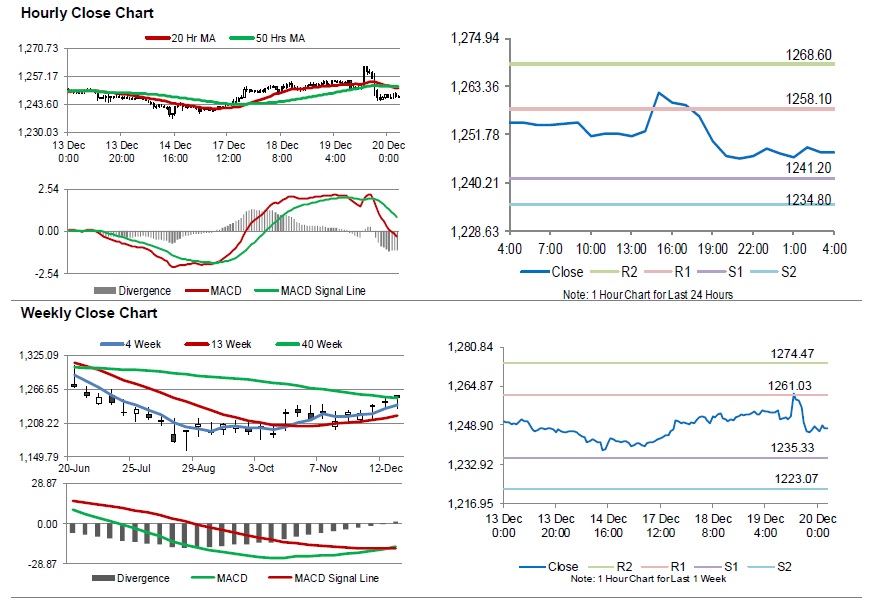
For the 24 hours to 23:00 GMT, Gold declined 0.57% against the USD and closed at USD1246.70 per ounce.
In the Asian session, at GMT0400, the pair is trading at 1247.60, with gold trading 0.07% higher against the USD from yesterday’s close.
The pair is expected to find support at 1241.20, and a fall through could take it to the next support level of 1234.80. The pair is expected to find its first resistance at 1258.10, and a rise through could take it to the next resistance level of 1268.60.
The yellow metal is trading below its 20 Hr and 50 Hr moving averages.
Silver: White Metal Trading On A Weaker Footing This Morning
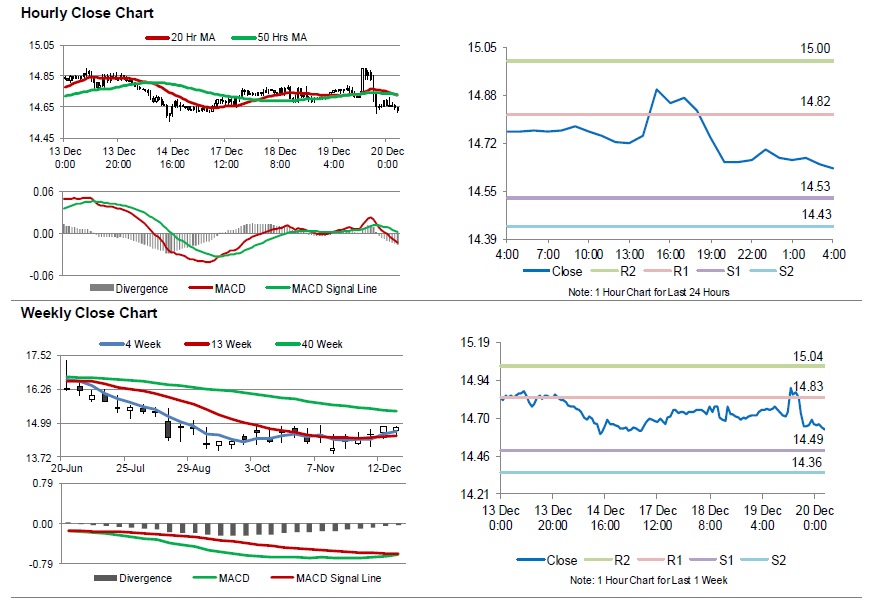
For the 24 hours to 23:00 GMT, Silver declined 0.14% against the USD and closed at USD14.70 per ounce, tracking losses in gold prices.
In the Asian session, at GMT0400, the pair is trading at 14.63, with silver trading 0.44% lower against the USD from yesterday’s close.
The pair is expected to find support at 14.53, and a fall through could take it to the next support level of 14.43. The pair is expected to find its first resistance at 14.82, and a rise through could take it to the next resistance level of 15.00.
The white metal is trading below its 20 Hr and 50 Hr moving averages.
Crude Oil: Oil Trading Lower In The Morning Session
For the 24 hours to 23:00 GMT, Crude Oil rose 2.71% against the USD and closed at USD47.41 per barrel, after the Energy Information Administration (EIA) report indicated that US crude oil stockpiles fell by 0.5 million barrels to 441.5 million in the week ended 14 December.
In the Asian session, at GMT0400, the pair is trading at 47.28, with oil trading 0.27% lower against the USD from yesterday’s close.
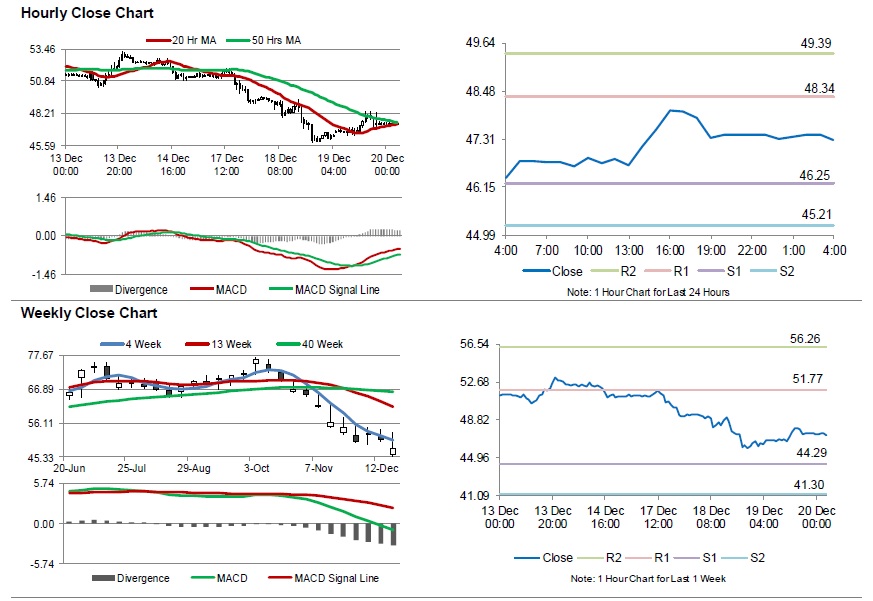
The pair is expected to find support at 46.25, and a fall through could take it to the next support level of 45.21. The pair is expected to find its first resistance at 48.34, and a rise through could take it to the next resistance level of 49.39.
Crude oil is showing convergence with its 20 Hr and 50 Hr moving averages.