

Sample Category Title
Dollar rebounds despite Fed’s dovish economic projections
Dollar rebounds after Fed's rate hike, in particular against Aussie Yen also strengthens together against Euro and Swiss Franc. Meanwhile, Stock pares back some initial gains. The driving force for Dollar's rebound is to be investigated. But overall, Fed's new projections are quite dovish. (Yet, a possible reason might be..... Fed is not stopping after today's hike yet).
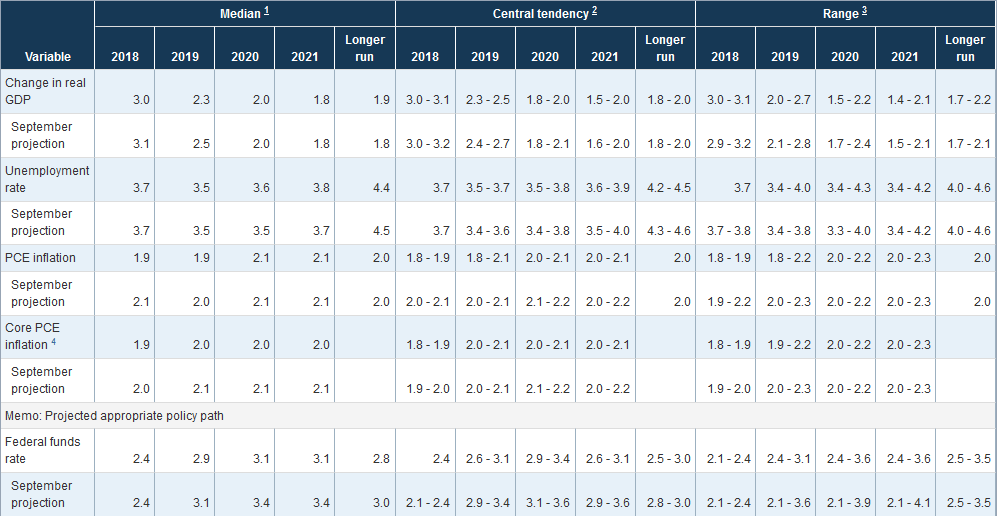
First and most important on longer run federal funds rate, seen as Fed's view on neutral:
- Median - revised to 2.8%, down from 3.0%
- Central tendency - revised to 2.5-3.0%, somewhat down from 2.8-3.0%
- Range - unchanged at 2.5-3.5%
For 2019
- Median - revised to 2.9%, down from 3.1%
- Central tendency - revised to 2.6-3.1%, down from 2.9-3.4%
Overall, the revision argues that Fed might have one or at most two more rate hikes in 2019, rather than three as implied in September projections.
On growth:
- 2019 median growth projection was revised to 2.3%, down from 2.5%
- 2020 median growth projection was unchanged at 2.0%
On unemployment:
- 2019 median unemployment rate projection was unchanged at 3.5%
- 2020 median unemployment rate projection was revised to 3.6%, up from 3.5%
On core inflation:
- 2019 median core PCE projection was revised to 2.0%, down from 2.1%
- 2020 median core PCE projection was revised to 2.0%, down from 2.1%
Fed hikes by 25bps to 2.25-2.50% by unaimous vote, full statement
Fed raised federal funds rate by 25bps to 2.25-2.50% as widely expected. The decision was made by unanimous vote.
Full statement below.
Federal Reserve Issues FOMC Statement
Information received since the Federal Open Market Committee met in November indicates that the labor market has continued to strengthen and that economic activity has been rising at a strong rate. Job gains have been strong, on average, in recent months, and the unemployment rate has remained low. Household spending has continued to grow strongly, while growth of business fixed investment has moderated from its rapid pace earlier in the year. On a 12-month basis, both overall inflation and inflation for items other than food and energy remain near 2 percent. Indicators of longer-term inflation expectations are little changed, on balance.
Consistent with its statutory mandate, the Committee seeks to foster maximum employment and price stability. The Committee judges that some further gradual increases in the target range for the federal funds rate will be consistent with sustained expansion of economic activity, strong labor market conditions, and inflation near the Committee's symmetric 2 percent objective over the medium term. The Committee judges that risks to the economic outlook are roughly balanced, but will continue to monitor global economic and financial developments and assess their implications for the economic outlook.
In view of realized and expected labor market conditions and inflation, the Committee decided to raise the target range for the federal funds rate to 2-1/4 to 2‑1/2 percent.
In determining the timing and size of future adjustments to the target range for the federal funds rate, the Committee will assess realized and expected economic conditions relative to its maximum employment objective and its symmetric 2 percent inflation objective. This assessment will take into account a wide range of information, including measures of labor market conditions, indicators of inflation pressures and inflation expectations, and readings on financial and international developments.
Voting for the FOMC monetary policy action were: Jerome H. Powell, Chairman; John C. Williams, Vice Chairman; Thomas I. Barkin; Raphael W. Bostic; Michelle W. Bowman; Lael Brainard; Richard H. Clarida; Mary C. Daly; Loretta J. Mester; and Randal K. Quarles.
(FED) Federal Reserve Issues FOMC Statement
Information received since the Federal Open Market Committee met in November indicates that the labor market has continued to strengthen and that economic activity has been rising at a strong rate. Job gains have been strong, on average, in recent months, and the unemployment rate has remained low. Household spending has continued to grow strongly, while growth of business fixed investment has moderated from its rapid pace earlier in the year. On a 12-month basis, both overall inflation and inflation for items other than food and energy remain near 2 percent. Indicators of longer-term inflation expectations are little changed, on balance.
Consistent with its statutory mandate, the Committee seeks to foster maximum employment and price stability. The Committee judges that some further gradual increases in the target range for the federal funds rate will be consistent with sustained expansion of economic activity, strong labor market conditions, and inflation near the Committee's symmetric 2 percent objective over the medium term. The Committee judges that risks to the economic outlook are roughly balanced, but will continue to monitor global economic and financial developments and assess their implications for the economic outlook.
In view of realized and expected labor market conditions and inflation, the Committee decided to raise the target range for the federal funds rate to 2-1/4 to 2‑1/2 percent.
In determining the timing and size of future adjustments to the target range for the federal funds rate, the Committee will assess realized and expected economic conditions relative to its maximum employment objective and its symmetric 2 percent inflation objective. This assessment will take into account a wide range of information, including measures of labor market conditions, indicators of inflation pressures and inflation expectations, and readings on financial and international developments.
Voting for the FOMC monetary policy action were: Jerome H. Powell, Chairman; John C. Williams, Vice Chairman; Thomas I. Barkin; Raphael W. Bostic; Michelle W. Bowman; Lael Brainard; Richard H. Clarida; Mary C. Daly; Loretta J. Mester; and Randal K. Quarles.
Gold Climbs to 5-Month High as Dollar Feeling Squeeze ahead of Fed
Gold continues to move higher this week. In Wednesday’s North American session, the spot price for one ounce of gold is $1252.76, up 0.27% on the day. On the release front, there are no major events out of United States. The markets are expecting the Federal Reserve to raise rates by a quarter-point. On Thursday, the U.S. publishes the Philly Fed Manufacturing Index and unemployment claims.
The U.S. dollar is under pressure, and gold has taken full advantage, gaining 1.3% this week. Earlier on Wednesday, gold touched a high of $1258, its highest level since mid-July. The gold rally could continue if Fed policymakers deliver a dovish message in the rate statement. With the U.S. economy showing signs of slowing and the stock markets showing sharp losses of late, the Fed may temper the rate hike by sounding dovish about the economy and future rate hikes.
A rate hike on Wednesday is widely expected, but is by no means a given. Just one week ago, the CME Group set the odds of a rate hike at 80%, but this has fallen to 69%. This concoction of a rate hike served with a dovish stance could shake up the U.S. dollar, so traders should treat the Fed statement as a market-mover. If the Fed statement is more dovish than expected and unnerves investors, investors could flock to safe-haven assets like gold and keep the current rally alive.
US Home Sales Turn in Another Month of Gains in November
Existing home sales rose for a second straight month, up 1.9% to 5.32 million units (annualized) in November. The improvement in sales defied the median consensus forecast for a 0.4% pullback.
By component, single-family sales rose 1.9% on the month, while the condo/co-op segment rose 1.7%. Overall, sales up 3.3% from their low in September, but are still down 7% from year-ago levels, with single-family down 6.7% and condo/co-ops down 9.0% year-over-year.
The number of homes available for sale fell to a seasonally unadjusted 1.74 million units from 1.85 million in October, which at the current sales rate, puts supply at just 3.9 months (down from 4.3 in October).
Median existing home prices were up 4.2% from a year ago, accelerating from 3.7% in October.
Key Implications
This is an encouraging report. Expectations for home sales have been beaten down by several months of declines. While far from easy street, the market appears to be stabilizing.
The good news is that the majority of the adjustment in mortgage rates appears to be in the rear-view mirror. Assuming a more staid pace of increases from the Federal Reserve, we expect only a modest 20 basis points in additional rate increases over the next year, small change compared to the 90 basis points that have occurred in the past year.
Inventory levels that remain near historical lows will continue to be a constraint to housing activity, and keep upward pressure on prices even with relatively modest demand. This should also encourage more housing construction and economic activity over the next year.
Canada: Consumer Price Inflation Eases on Back of Lower Energy Prices
Canadian consumer price inflation lost momentum in November, slowing to 1.7% year-on-year (y/y), from 2.4% in November. The reading came in a hair below the consensus forecast for 1.8%. Adjusted for seasonal patterns, prices declined 0.2% month-on-month.
The bulk of the slowdown in inflation was due to energy prices. With gasoline prices falling 9.4% on the month, the energy price index was down 1.3% relative to its level a year ago (compared to a 7.9% gain in October). Excluding energy, inflation edged lower to 1.9% y/y from 2.0% last month.
Price growth slowed in six out of eight major categories with only food, alcohol & tobacco bucking the trend. The largest slowdown was in household operations (0.9% y/y from 1.3%), clothing and footwear (0.6% y/y from 1.3%) and recreation and education (1.2% from 1.8% y/y).
Among broader aggregate categories, prices of goods grew substantially slower than a month ago, advancing by just 0.5% y/y (compared to 2.2% growth in October). Meanwhile, services sector price growth remained steady at 2.7% y/y.
Two of three of the Bank of Canada's core measures edged lower on the month, with CPI-median and CPI-trim slowing to 1.9% (from 2.0% and 2.1%, respectively). CPI-common was unchanged at 1.9%, the level it has been at since February.
Key Implications
Markets were expecting headline inflation to soften in November, and soften it did. Much of the slowdown can be chalked to decline in energy prices, but inflationary pressures were subdued elsewhere.
Looking beyond inflation, a downshift in energy prices and oil output curtailment in Alberta are expected to have negative implications for economic growth in both Canada and Alberta. The direct impact to Canadian real GDP growth in 2019 is estimated to be a reduction of about 0.15 percentage points, with only a partial recoup expected in 2020. For Alberta, the impact is larger, at 0.9 percentage points. For more details, please check our latest provincial and national economic forecasts.
The Bank of Canada is not done raising rates, but with both core and headline price growth appearing soft and risks to the economy skewed to the downside, there is little urgency. As such, we expect just two rate hikes in 2019, with the next increase likely not coming until the spring
British Pound Steady as CPI Matches Forecast
GBP/USD is unchanged in the Wednesday session. In North American trade, the pair is trading at 1.2652, up 0.10% on the day. On the release front, British CPI dipped to 2.3% in November, down from 2.4% a month earlier. This matched the estimate. There are no major U.S. releases on the schedule, but investors will be busy, keeping a close eye on the Federal Reserve, which is expected to raise rates to a range between 2.25 and 2.50 percent. On Thursday, the U.K. releases retail sales and the Bank of England is expected to maintain rates at 0.75 percent. The U.S will publish the Philly Fed Manufacturing Index and unemployment claims.
With Brexit in the headlines on a daily basis, the markets will shift focus on Thursday to economic releases. Investors will be hoping for a rebound from retail sales, which has posted two straight declines. The forecast for November stands at 0.3 percent. This will be followed by the Bank of England rate decision. The bank is expected to stay on the sidelines and maintain rates at 0.75 percent.
Brexit will not be on the backburner for very long. Earlier this week, Prime Minister May announced that parliament will vote on the Brexit withdrawal agreement in mid-January, and with a no-deal scenario a very real possibility, traders can expect further volatility from the British pound in the coming weeks.
The markets are expecting the Federal Reserve is expected to raise interest rates on Wednesday, which would mark the fourth rate hike in 2018. The odds of a rate hike have dropped sharply – only last week, the odds of a hike stood at 77%, but are currently at 66%. A key factor in the drop is the recent sell-off in global stock markets. Rate hikes are unusual when stock markets are in a downward spiral, but the Fed is likely to press the rate trigger. At the same time, the Fed may try to soothe the nervous markets with a cautious message about further tightening next year, which has sent the U.S. dollar lower ahead of the Fed meeting. Just a few months ago, there was heady talk of three or four rates in 2019, but analysts are now predicting just one hike, as the U.S economy is showing signs of slowing down.
Canadian Inflation Falls Below BOC’s Target
The Canadian dollar pared gains against the greenback after the November inflation came under the Bank of Canada’s (BOC) target and at the slowest pace in 10 months. The annual reading fell to 1.7% and was primarily reflecting recent declines in gasoline prices, excluding gasoline, the CPI rose 1.9% in November.
Expectations for the BOC to raise rates at the January 9th meeting has completely changed over the past month. The markets have now completely erased the 25 basis point hike that was fully priced in November. The next hike has been pushed towards the summer.
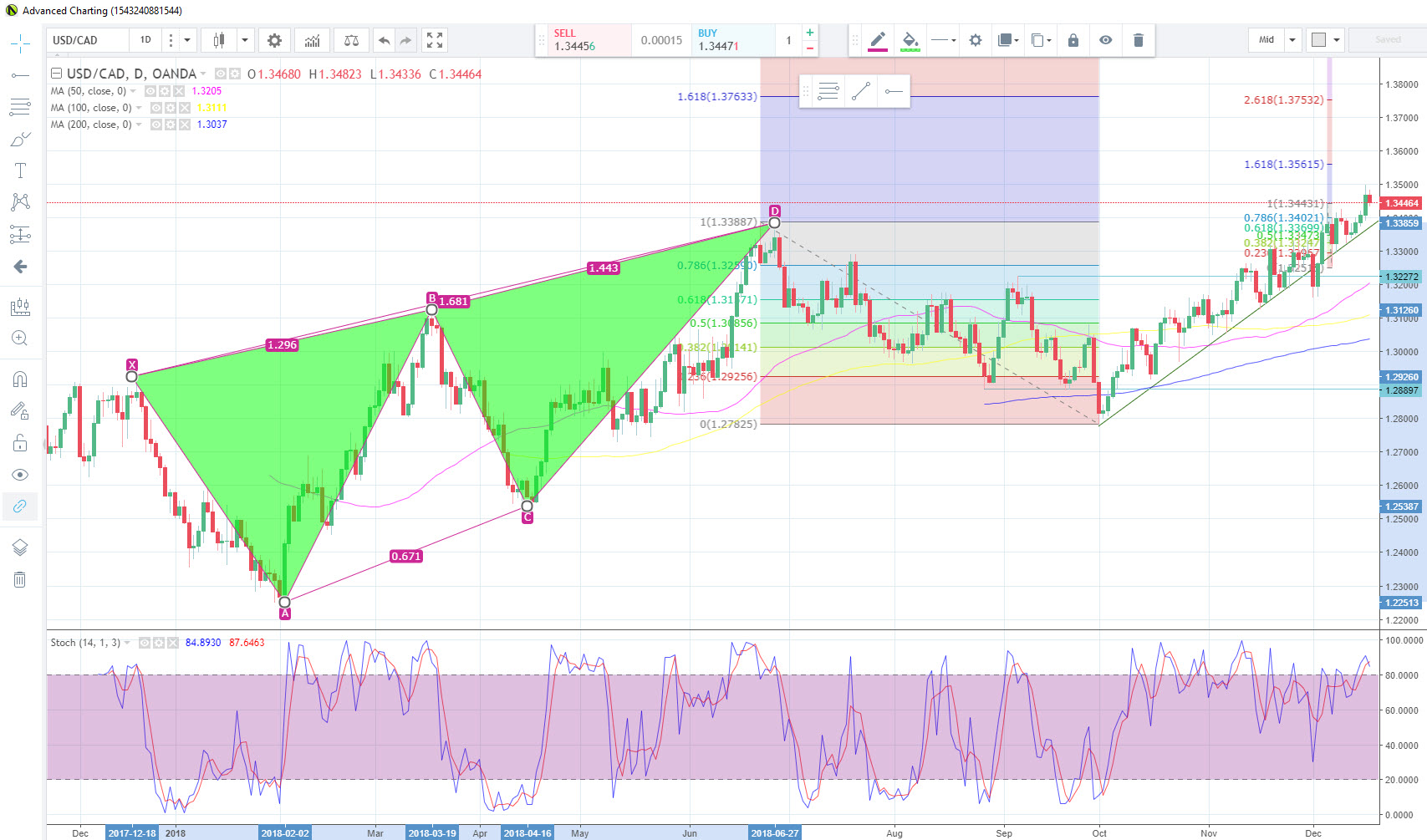
Price action on the USD/CAD daily chart show that 1.3500 level remains critical resistance. If we do see the Fed bring down expectations for future hikes, we could continue to see the loonie extends its gains here. To the downside, 1.3250 remains initial support, followed by 1.3125.
Yen Hits 6-Week High as Greenback Retreats ahead of Fed
The Japanese yen rally continues to climb this week. In Wednesday’s North American session, USD/JPY is trading at 112.20, down 0.24% on the day. Earlier in the day, the pair dropped to its lowest level since late October. On the release front, Japan’s trade deficit widened for a fourth straight week, ballooning to 0.49 trillion yen, much higher than the previous month’s deficit of 0.30 trillion. The estimate stood at 0.31 trillion yen. In the U.S., there are no major indicators. The spotlight is on the Federal Reserve, which is expected to raise rates to a range between 2.25 and 2.50 percent. The Bank of Japan will also set interest rates and release a rate statement.
The U.S. dollar is broadly weaker on Wednesday, ahead of the Federal Reserve rate statement and anticipated hike in interest rates. With the U.S. economy showing signs of cooling and equity markets enduring a dismal December, the markets are expecting a dovish message from policymakers. A rate hike, which would be the fourth of the year, is widely expected, but a hike is certainly not a shoo-in. Just one week ago, the CME Group had set the odds of rate hike at 80%, but this has fallen to 69%. The Fed usually avoids rate hikes when the markets are in turmoil, so policymakers may “compensate” the markets with a dovish statement, while delivering a rate hike. This concoction could shake up the U.S dollar, so traders should treat the Fed statement as a market-mover.
The BoJ is expected to maintain rates at its meeting on Wednesday. Investors will be closely attuned to the tone of the rate statement, which is expected to be dovish, as the global trade war continues to take a toll on the Japanese economy. Japanese Final GDP in Q3 declined 0.6%, the second decline in three quarters. The well-respected Japanese Tankan Manufacturing index remained steady at 19 points in the third quarter. However, recent manufacturing indicators have pointed downwards, pointing to slower activity in the manufacturing sector. This is attributable to slower global economic conditions, which has taken a bite out of Japanese exports and manufacturing. With Japanese exports to the U.S. and China facing higher tariffs, it’s not surprising that recent manufacturing reports have been soft.
New Zealand GDP to Slow in Q3 But Things Looking Up for Kiwi
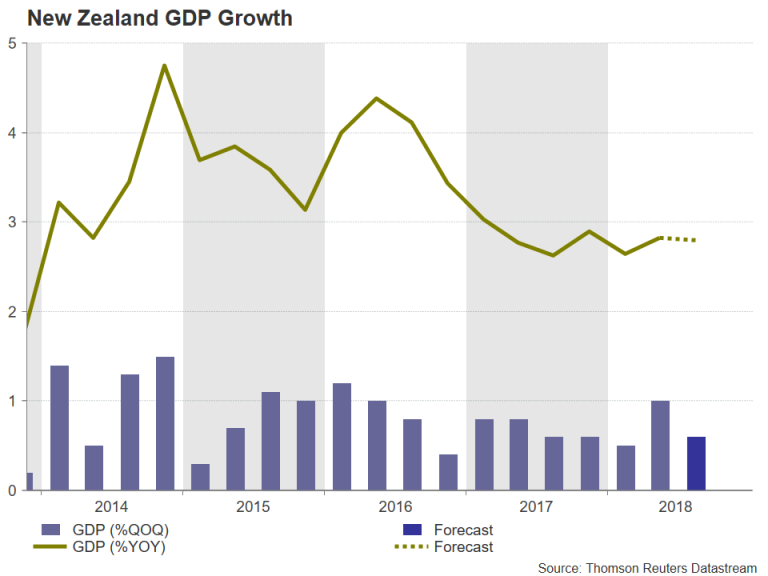
New Zealand will be the last of the major advanced countries to publish its third quarter GDP estimates on Thursday local time (Wednesday, 21:45 GMT). The economy is expected to have cooled somewhat from the previous quarter. However, the local dollar has been in a bullish mood since October and could extend its latest upswing as business confidence recovers and the US dollar falls out of favour with investors.
After growing by a robust 1.0% in the second quarter, New Zealand’s economy is forecast to have expanded by a more moderate 0.6% quarter-on-quarter in the three months to September. Economic data for the period have been mostly positive with employment increasing far more strongly than expected and exports continuing to rise. But GDP growth was likely held back from flat retail sales during the quarter and a deterioration in the country’s terms of trade as import prices rose faster than export prices.
The Reserve Bank of New Zealand governor, Adrian Orr, signalled at the last policy meeting in November that a rate cut had not been taken off the table despite the economy performing better than anticipated in Q2. The central bank is concerned that the weakness in business confidence could prove a drag on growth and also sees downside risks to inflation. The annual rate of CPI picked up to 1.9% in the third quarter, but this is below the middle of the RBNZ’s 1-3% target band. Wage growth was also stuck below 2% in the third quarter.
However, there’s few indications so far in the fourth quarter that growth is slowing further. The closely-watched ANZ business confidence index rebounded sharply in December (though it remains in negative territory). In addition, dairy prices have been on the up in December after months of declines, boding well for New Zealand’s important dairy industry.
The positive trends, along with the easing in US-China trade tensions, have helped the New Zealand dollar recover from August’s 32-month low of $0.6422 set in early October. The kiwi has since appreciated by more than 6% versus the greenback and could gain further if the GDP numbers beat analysts’ expectations and/or the US currency posts a sharper pullback.
Kiwi bulls could initially target the 50% Fibonacci retracement of the February-October downleg from 0.7436 to 0.6422, at 0.6929. Not too far above this level is December’s 5½-month top of 0.6969, which if successfully challenged, would signal a resumption of the uptrend that began in October. Further up, resistance could come at the 61.8% Fibonacci at 0.7049.
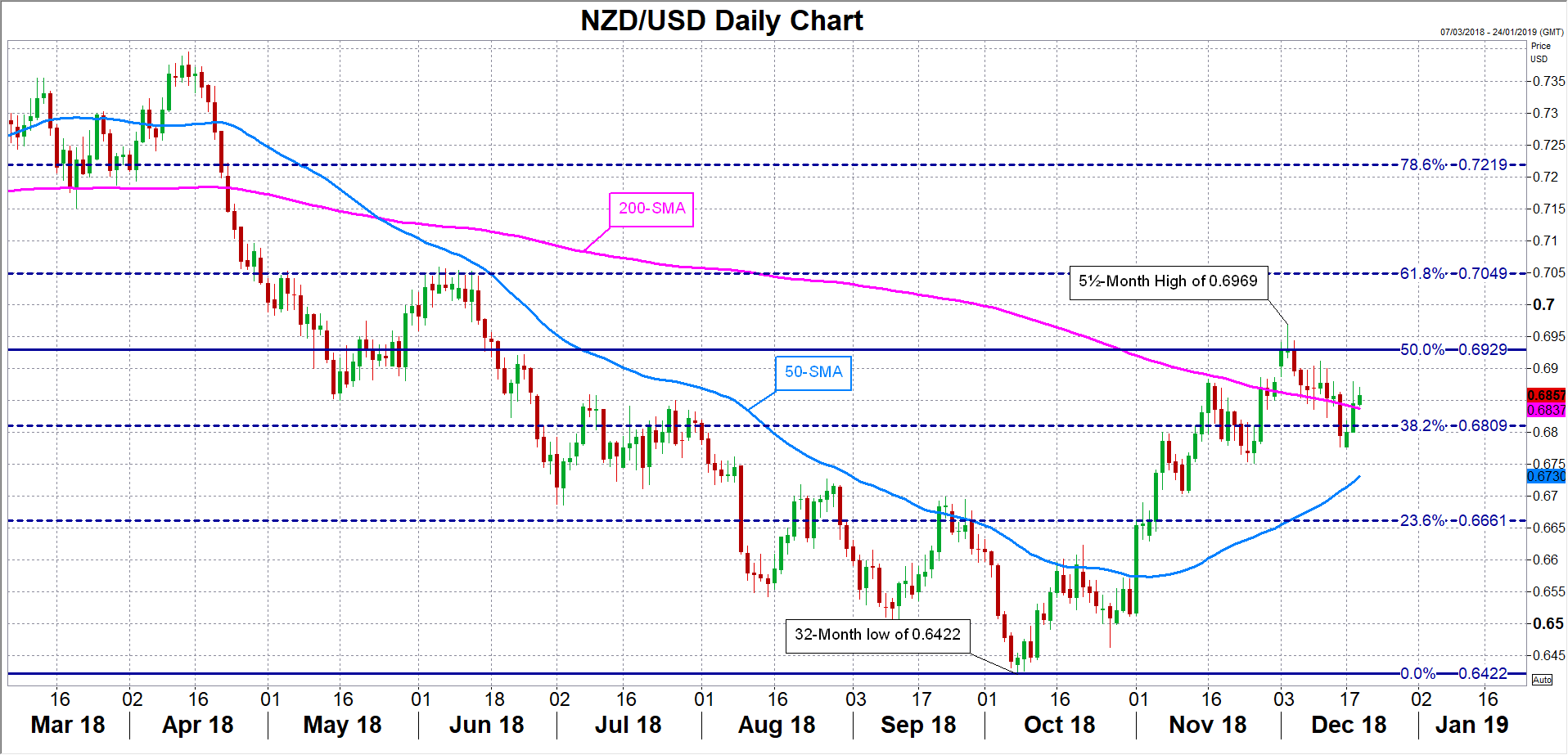
However, a miss in the GDP figures could see the kiwi seeking support at the 38.2% Fibonacci retracement at 0.6809. A break below the 0.68 handle would open the way for the 50-day moving average at 0.6730, while further falls would turn the focus on the 23.6% Fibonacci at 0.6661.