Sample Category Title
WTI Oil Outlook: Bears Take a Breather Before Final Push Towards $45.46 Target
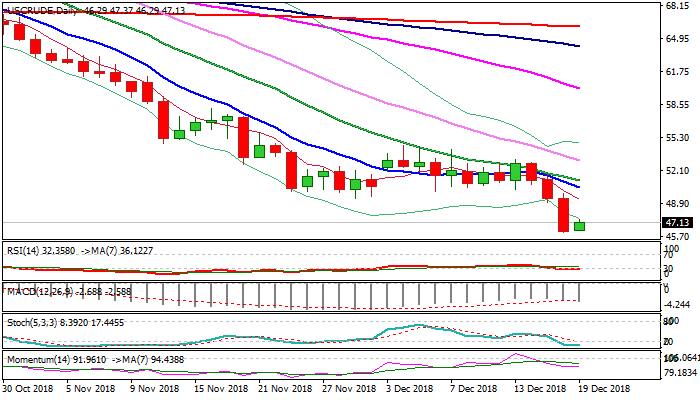
WTI oil consolidates above new 16-month low at $46.10, posted on Tuesday after daily fall of 7.5%, while oil prices were down 12.6% in past three days and down 40% in steep fall which commenced in early October. Renewed negative sentiment on fears that slowing global economy would depress demand and global oversupply, pushed oil price below psychological $50 level, after bears failed in initial attack in late November and subsequent recovery attempts quickly ran out of steam. Fresh bears were boosted by strong build in US crude stocks (API report on Tuesday showed build of 3.4 mln bls vs previous week's draw of 10.1 mln bls). Focus turns towards today's EIA report (2.4 mln bls draw f/c vs 1.2 mln bls draw previous week) which could add to negative sentiment if release disappoints. Profit-taking and oversold conditions are the main factors that paused bears, but upticks could be seen as positioning ahead of final push towards target at $45.46 (Fibo 61.8% of $26.04/$76.88 ascend) loss of which would open way towards June 2017 trough at $42.04 and unmask psychological $40 support. Former low at $49.40 and broken $50 pivot now mark solid resistances which are expected to cap, with falling 10SMA ($50.47) to limit extended upticks and keep bears intact. Alternative scenario requires break above 10SMA and nearby falling 20SMA ($51.17) to ease bear pressure, but break above 05 Dec recovery high at $54.54 is needed to sideline bears and signal stronger correction.
Res: 48.06; 49.40; 50.00; 50.47
Sup: 46.10; 45.46; 44.26; 42.04
Sunset Market Commentary
Markets
Global core bonds were mixed but little changed today. Risk sentiment turned cautiously positive as the Fed policy meeting is lined up for tonight. Asian markets performed mixed with Chinese and Japanese indices underperforming. European equities, however, opened all higher. US Treasuries opened neutral. With safe haven flows fading, German Bunds moved south, but intraday losses were paired to hover near opening levels at the time of writing. The economic not able to move investors, as risk sentiment ahead of the Fed meeting steered traders. With the worst performance of US equities ahead of a Fed decisive meeting since the 1980’s, investors are puzzled on what to expect. A ‘dovish hike’, a rate hike of 25 bps combined with a more dovish tone on future hikes (2 rate hikes next year instead of 3), is most likely. The US yield curve flattened with limited changes in a range of -1.2 bps (30-yr) to +0.4 bps (2-yr). The Italian government and the European Commission have ended their long-lasting budget feud as they agreed on Italy’s spending plans for 2019. Italian BTP’s rallied on the news, pushing the spread between the Italian and German 10-yr yield down with 15 bps. The German yield curve is little changed at the time of writing with changes varying between -0.4 bps (30-yr) to +0.3 bps (2-yr).
The dollar stayed in the defensive going into a keenly awaited Fed decision this evening. At the same time, the EC confirming that it won’t start an excessive debt procedure against Italy, removed a pending factor of uncertainty for European markets and supported some by default euro-buying. The recent decline on global equity markets took a further breather as investors hoped for the Fed to bring some kind of ‘dovish’ rate hike, potentially signaling slower policy normalization next year. This anticipated/hope for dovish Fed kept dollar bulls sidelined. Contrary to recent interest rate narrowing, interest rate differentials between the US and EMU/Germany were little changed today. In Europe, Italy and the EC reached a ceasefire on the rift over the Italian budget. Credit fundamentals of Italy are not restored and will remain an issue in the future. However, both parties avoiding an open battle is a (temporary) euro positive factor. EUR/USD is trading in the low 1.14 area (compared to a start of 1.1360 in Asia). USD/JPY is going nowhere hovering in the 112.30 area. Will Powell and co pull the trigger for a real USD trend-move after recent mainly sideways price action?
Sterling lost further ground against the euro but also against a broadly weaker dollar. There was little high profile Brexit news, but multiple headlines on all kinds of entities readying ‘no-deal-Brexit’ plans didn’t help sterling. UK November inflation (headline declining to 2.3%, core to 1.8%) was largely as expected, but was below what the BoE anticipated. So, there is no reason for the BoE to take any action as Brexit uncertainty persists. EUR/GBP rebounded north of 0.90 (currently 0.9025 area). Cable hovers up and down in the 1.26 big figure.
News Headlines
The European Commission officially decided not to launch the excessive debt procedure against Italy, which would have been the first in history. Parties have agreed a fiscal deficit of 2.04%, down from 2.4% earlier. The Italian 10y yield declined a whopping 15 bps. Italy’s stock exchange (+1.5%) outperforms its European peers.
Canadian headline inflation slipped from 2.4% YoY in Oct. to 1.7% in Nov. as oil prices slid further. Core measures showed also signs of slowing, easing from 2.0% to 1.9%. The BoC suggested a hiking pause at its latest policy meeting. Rate hikes expectations have diminished significantly since then and slipped further after the inflation report.
Canadian Consumer Price Growth Slowed in November
Highlights:
- CPI inflation eased to 1.7% in November from 2.4% in October.
- Ex-food & energy price growth slowed to 1.7% from 2.1% year-over-year. The Bank of Canada’s preferred core measures moderated, on balance, with the ‘median’ and ‘trim’ measures ticking down to 1.9%.
Our Take:
The bulk of a drop in the headline year-over-year CPI rate to 1.7% — the first reading below the Bank of Canada’s 2% inflation target since January — was accounted for by a largely as-expected pullback in gasoline prices. Underlying trends outside of some of the more volatile components held largely intact, although with some moderation in ’core’ measures. Price growth excluding food & energy products eased to 1.7% from a year ago from 2.1% in October. The Bank of Canada’s preferred ’trim’ and ’median’ core measures edged down slightly to 1.9%, with the ’common’ measure holding unchanged from October, also at 1.9%. The tick lower in the median and trim measures was also not entirely unexpected with above-trend month-over-month increases a year ago falling out of the year-over-year calculations. The core measures still leave underlying price trends running right around the Bank of Canada’s target inflation rate.
Energy prices will continue to weigh on the headline CPI measure with oil prices holding below year-ago levels. Looking through monthly wiggles, there is little indication of shifting underlying inflation trends, which seem to remain right around the central bank’s target. At the same time, there is little evidence of significant upside pressures building. Lower energy prices have created concern about near-term economic growth and higher interest rates and regulatory measures to-date already seem to have been effective at slowing household spending. We continue to expect further gradual rate hikes will ultimately be necessary, but recent softer growth numbers reinforce that the next increase probably won’t come from the Bank of Canada’s January policy decision.
AUD/USD Remains Vulnerable To The Downside Short Term
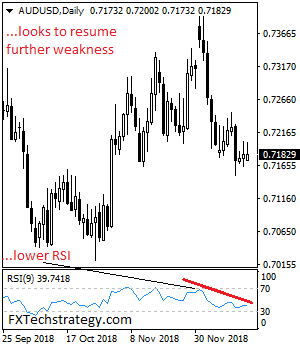
AUDUSD remains vulnerable to the downside short term as it looks to resume its broader weakness. On the upside, resistance lies at the 1.7250 level. A cut through here will turn attention to the 0.7300 level and then the 0.7350 level where a violation will set the stage for a retarget of the 0.7400 level. Support resides at the 0.7150 level where a breach will aim at the 0.7100 level. Below here will set the stage for a run at the 0.7050 level with a cut through here targeting further downside pressure towards the 0.7000 level. On the whole, AUDUSD faces further downside threats.
EUR/AUD Mid-Day Outlook
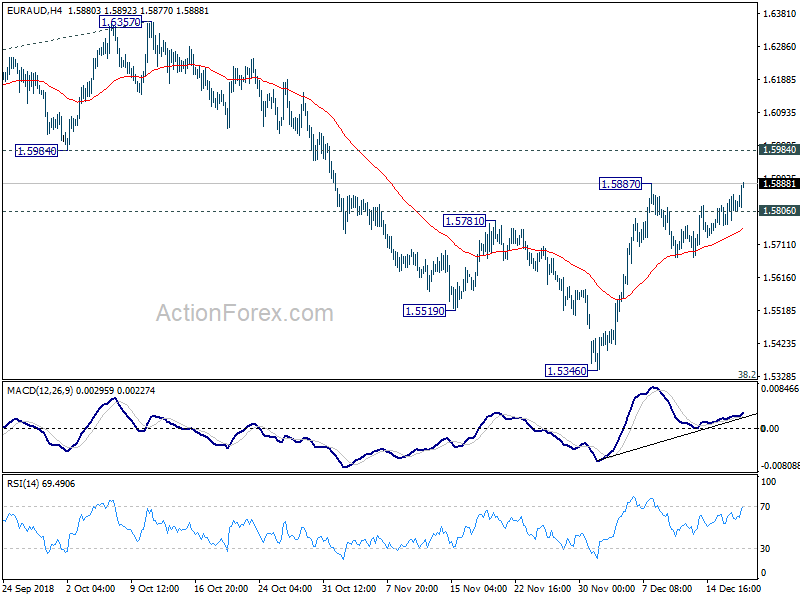
Daily Pivots: (S1) 1.5769; (P) 1.5814; (R1) 1.5861; More....
EUR/AUD's breach of 1.5887 resistance indicates resumption of rise from 1.5346. Intraday bias is back on the upside for 1.5984 support turned resistance first. Break will pave the way to retest 1.6357 high next. On the downside, break of 1.5086 minor support will delay the bullish case and extend the consolidation from 1.5887 with another fall.
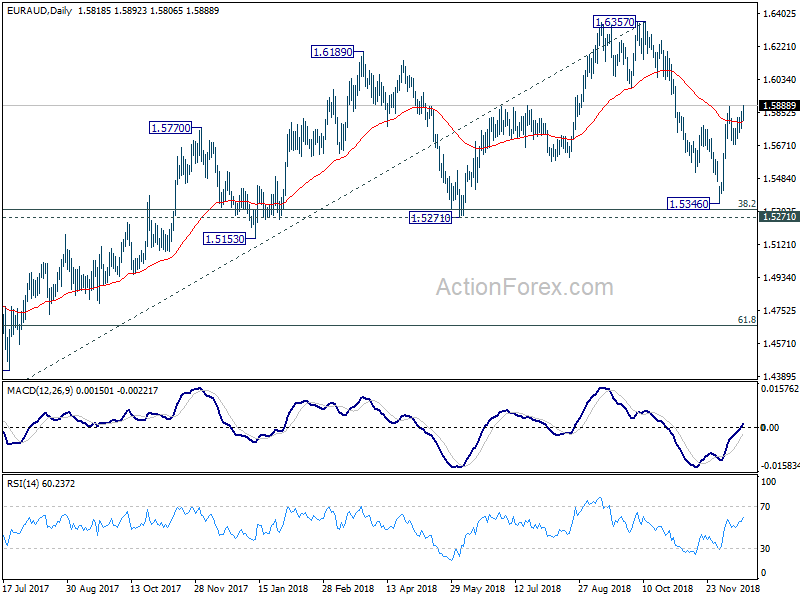
In the bigger picture, no change in the view that 1.6357 is a medium term top. But the strong rebound ahead of 1.5271 cluster support (38.2% retracement of 1.3624 to 1.6357 at 1.5313) suggests price actions from 1.6357 are developing into sideway consolidation, rather than a deep correction. The range of 1.5271/6357 is likely set for the consolidation. And we don't expect a break of the range any time soon. But decisive break of 1.6357 will resume the larger up trend from 1.3624 (2017 low) to 1.6587 (2015 high).
EUR/USD Mid-Day Outlook
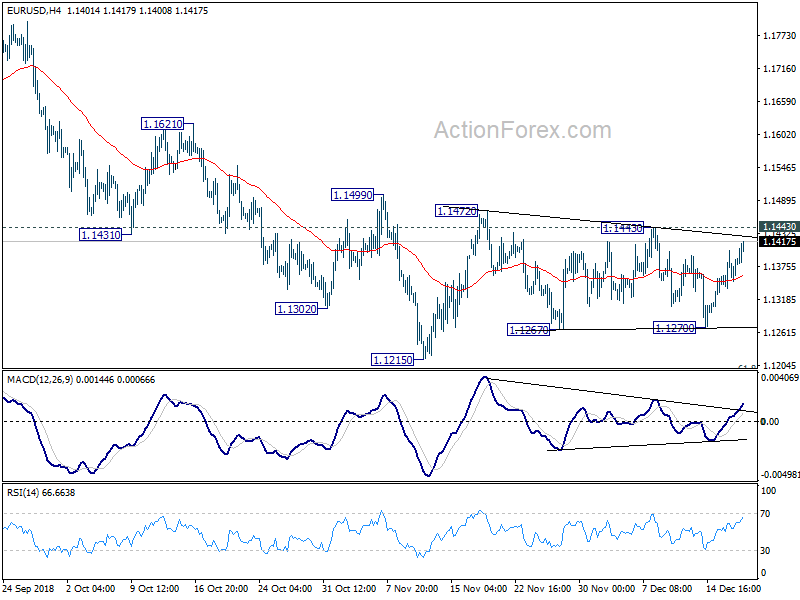
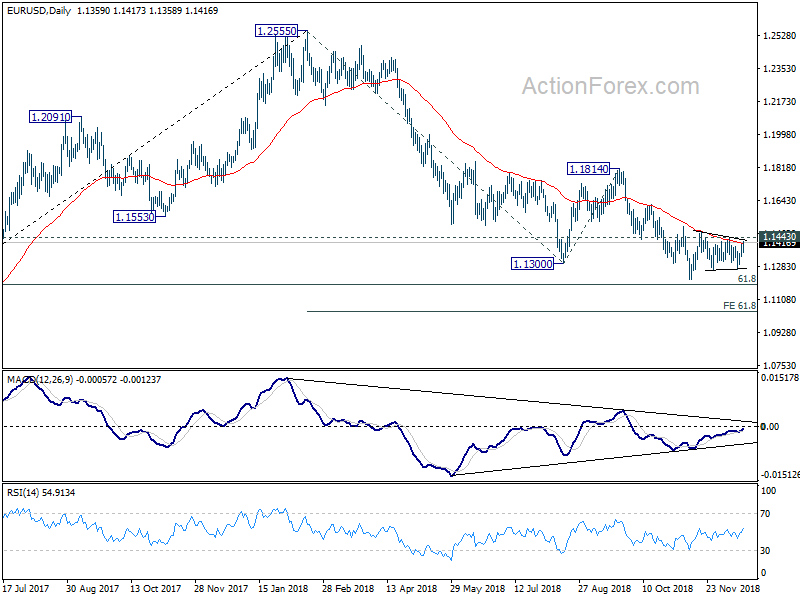
Daily Pivots: (S1) 1.1334; (P) 1.1368; (R1) 1.1400; More.....
EUR/USD's rebound from 1.1270 extends higher today but it's still bounded in range of 1.1270/1443. Intraday bias remains neutral at this point. As long as 1.1443 resistance holds, we'd favor a downside breakout. On the downside, break of 1.1270 will argue that larger fall is resumption should target 1.1251 low next. Decisive break there will confirm this bearish case. EUR/USD should drop through 1.1186 fibonacci level to 61.8% projection of 1.2555 to 1.1300 from 1.1814 at 1.1038 next. However, firm break of 1.1443 resistance will indicate near term reversal and turn focus back to 1.1814 resistance.
In the bigger picture, as long as 1.1814 resistance holds, down trend down trend from 1.2555 medium term top is still in progress and should target 61.8% retracement of 1.0339 (2017 low) to 1.2555 at 1.1186 next. Sustained break there will pave the way to retest 1.0339. However, break of 1.1814 will confirm completion of such down trend and turn medium term outlook bullish.
GBP/USD Mid-Day Outlook
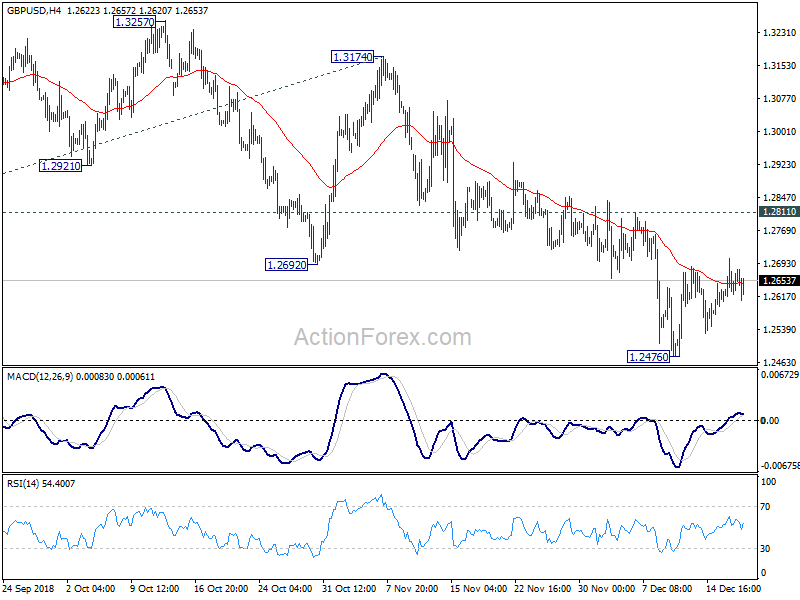
Daily Pivots: (S1) 1.2574; (P) 1.2611; (R1) 1.2650; More...
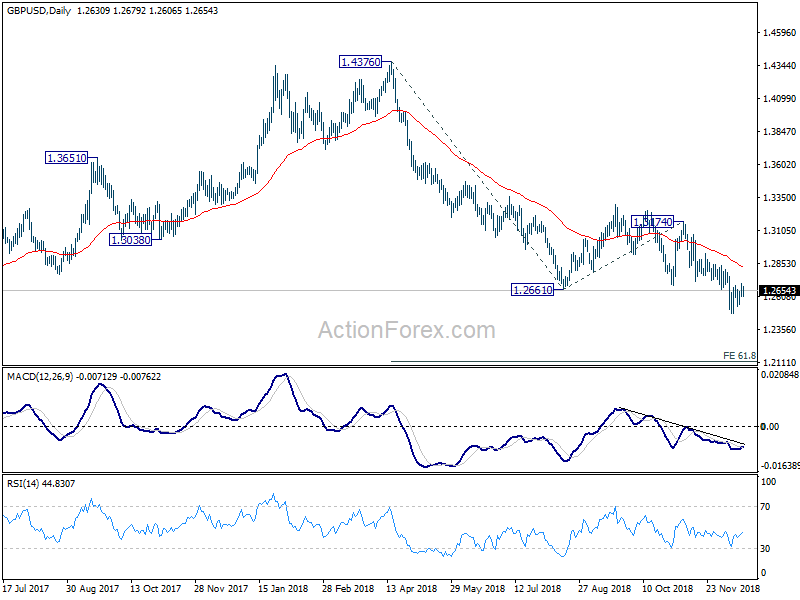
Intraday bias in GBP/USD remains neutral as consolidation from 1.2476 is extending. In case of stronger rise, upside should be limited by 1.2811 resistance to bring fall resumption. On the downside, break of 1.2476 will extend larger down trend from 1.4376 to 61.8% projection of 1.4376 to 1.2661 from 1.3174 at 1.2114. However, firm break of 1.2811 will be an early signal of trend reversal and turn focus back to 1.3174 resistance.
In the bigger picture, whole medium term rebound from 1.1946 (2016 low) should have completed at 1.4376 already, after rejection from 55 month EMA. The structure and momentum of the fall from 1.4376 argues that it's resuming long term down trend from 2.1161 (2007 high). And this will now remain the preferred case as long as 1.3174 structural resistance holds. GBP/USD should now target a test on 1.1946 first. Decisive break there will confirm our bearish view.
USD/CHF Mid-Day Outlook
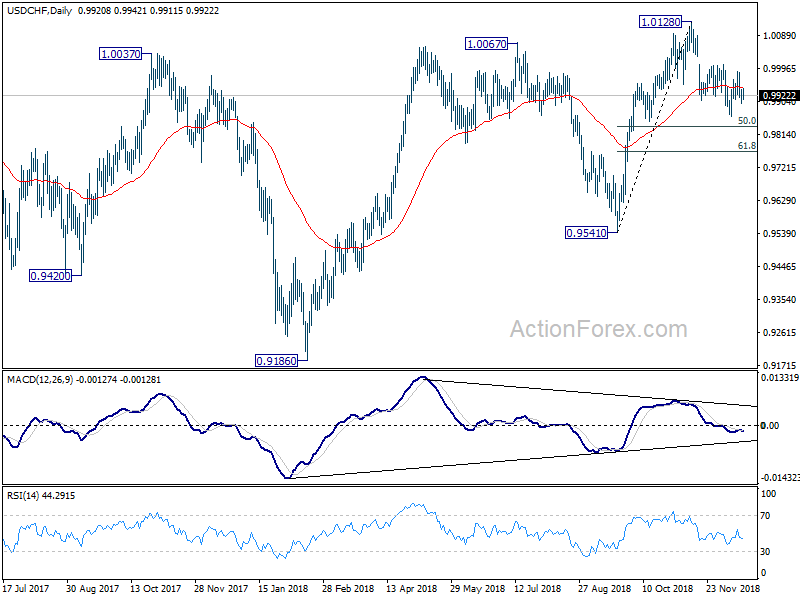
Daily Pivots: (S1) 0.9903; (P) 0.9925; (R1) 0.9951; More...
Intraday bias in USD/CHF remains mildly on the downside at this point. Correction from 1.0128 is possibly extending. But downside should be contained by 0.9848 support to bring near term reversal. On the upside, above 0.9989 will turn bias back to the upside. Break of 1.0008 will target a test on 1.0128 high.
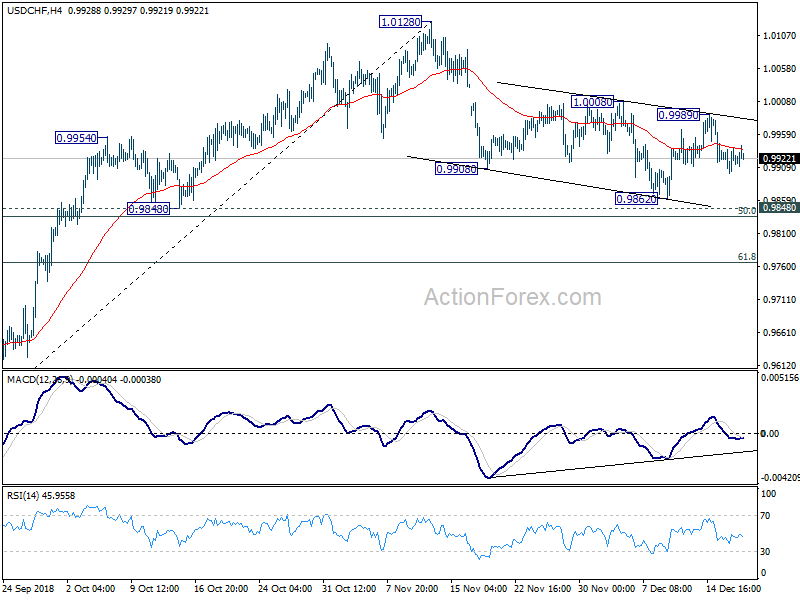
In the bigger picture, current development suggests that the medium term rally from 0.9186 hasn't completed yet. Break of 1.0128 will target 1.0342 key resistance next (2016 high). On the downside, break of 0.9848 support will dampen this bullish view and turn focus back to 0.9541 key support instead.
USD/JPY Mid-Day Outlook
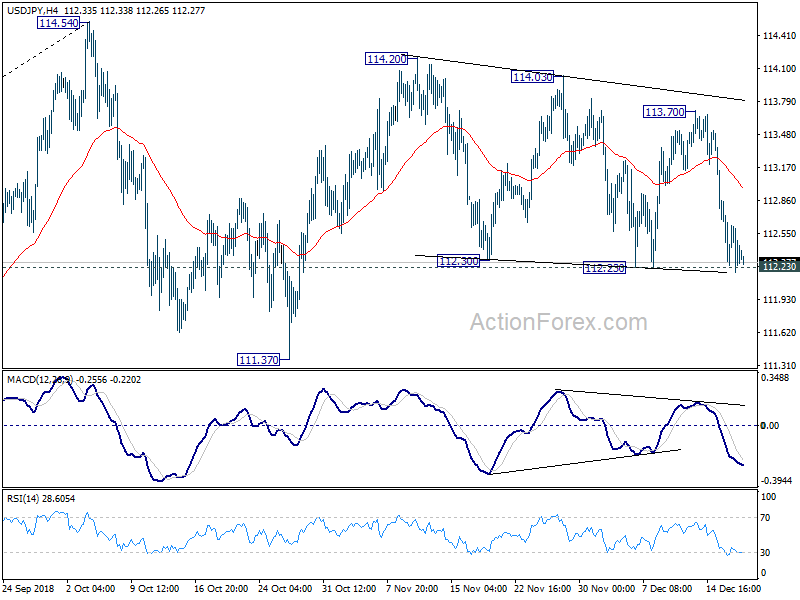
Daily Pivots: (S1) 112.23; (P) 112.55; (R1) 112.85; More..
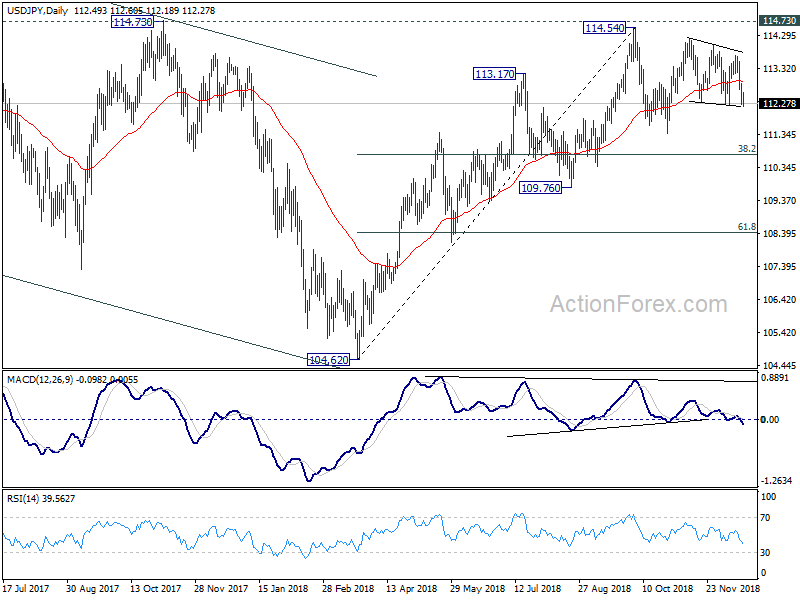
Focus remains on 112.23 support in USD/JPY. Decisive break will extend the corrective pattern from 114.54 with deeper decline to 111.37 and below. On the upside, above 113.70 will target 114.20 resistance first. Break there will resume the rise from 111.37 and target 114.73 key resistance next. Overall, price actions 114.54 are seen as a consolidative pattern. In case of deeper fall, downside should be contained by 38.2% retracement of 104.62 to 114.54 at 110.75 to bring rebound. Larger rise from 104.62 is expected to resume later.
In the bigger picture, corrective fall from 118.65 (2016 high) should have completed with three waves down to 104.62. Decisive break of 114.73 resistance will likely resume whole rally from 98.97 (2016 low) to 100% projection of 98.97 to 118.65 from 104.62 at 124.30, which is reasonably close to 125.85 (2015 high). This will stay as the preferred case as long as 109.76 support holds. However, decisive break of 109.76 will dampen this bullish view and turns outlook mixed again.
Italian Politics Monitor: Budget Balancing Act
In the endless Italian budget feud, the government has finally struck an agreement with the European Commission (EC) on its 2019 budget. After lengthy negotiations, the two sides have agreed on a deficit target of 2.04% (from 2.4% originally), bringing the structural deviation down to zero (from a deterioration of 0.8pp previously). Underlying the budget are more realistic GDP growth assumptions, further public real estate sales and a delayed implementation of the pension reform and citizen income to March, but the fiscal effort heavily relies on the re-activation of the safeguard clauses (VAT hikes) for 2020 and 2021. Although an excessive deficit procedure (EDP) is off the table for now, the EC will continue to monitor fiscal developments in Italy and in case of deviations from the agreement, additional safeguards of EUR2bn could be activated to keep the deficit at bay. The budget is expected to face a final vote in the Italian parliament in the coming week.
We think recent changes in the wider European political landscape were a key factor behind the Commission's budget leniency. In response to the recent Yellow Vest protest, French President Macron announced a range of income boosting measures worth EUR10bn, which could bring France's 2019 deficit up to 3.4% and thereby be in breach of the EU's 3% limit. Commissioner Moscovici hinted that due to the general anti-austerity mood, the EC has chosen dialogue instead of rule rigidity, but there is no doubt that Macron's policy shift has weakened the Commission's hand in the Italian budget fight.
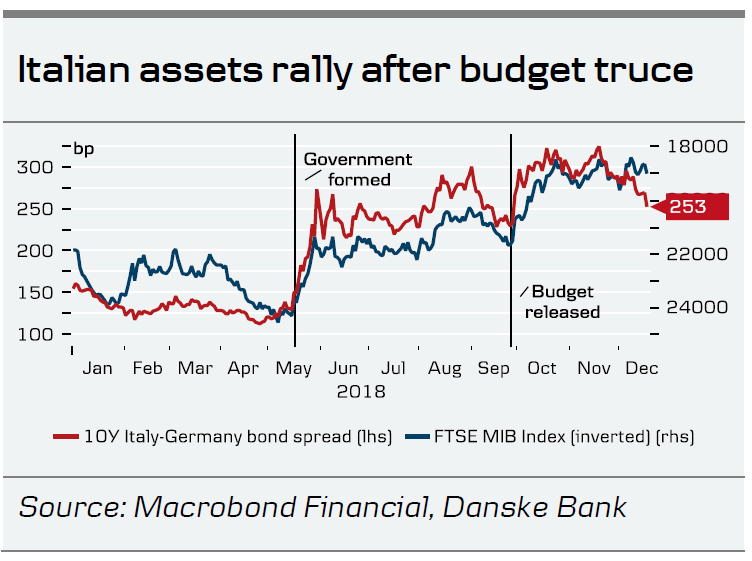
The Italian budget truce should be supportive for global risk sentiment. After the news hit the wires, the Italian curve steepened and 10Y Italian yields dropped c.12bp at open, breaking through levels reached at the end of September when the budget figures were first released. With most stumbling stones – including rating decisions and the EU stand-off – now behind us, this creates more room for spread convergence between Italy and core-EU markets. However, in light of a modest rise in net supply of Italian government bonds in 2019 and less support for Italy from ECB reinvestments going forward, we think a risk premium will remain on Italian government bonds relative to core-EU bonds and it is difficult to see the 10Y spread between Italy and Germany falling back below 200bp (i.e. pre-election levels).
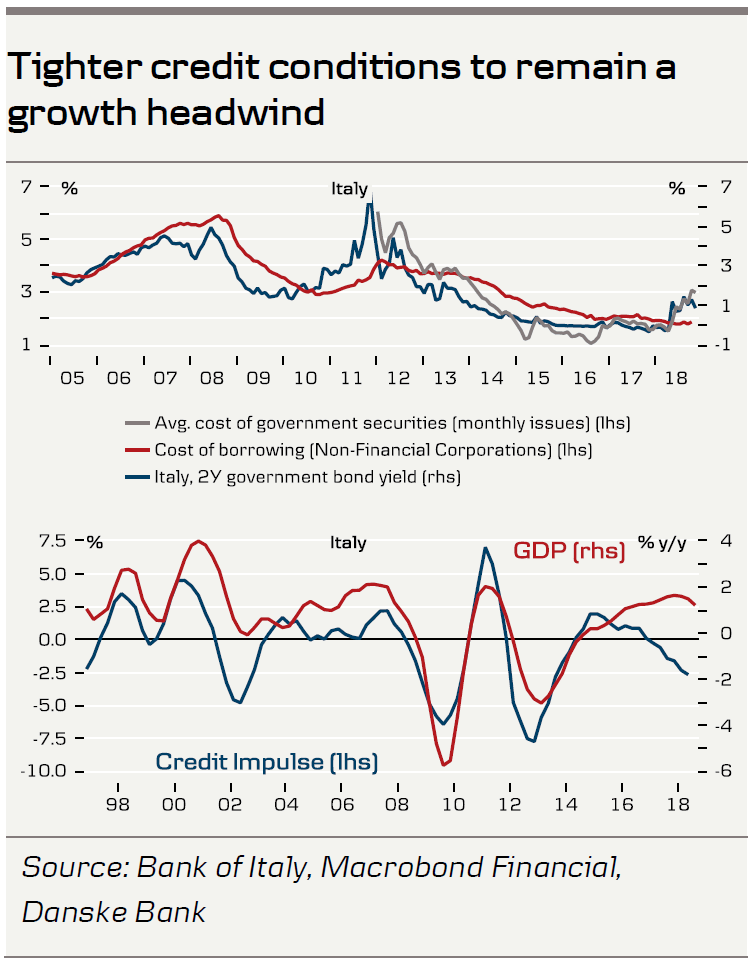
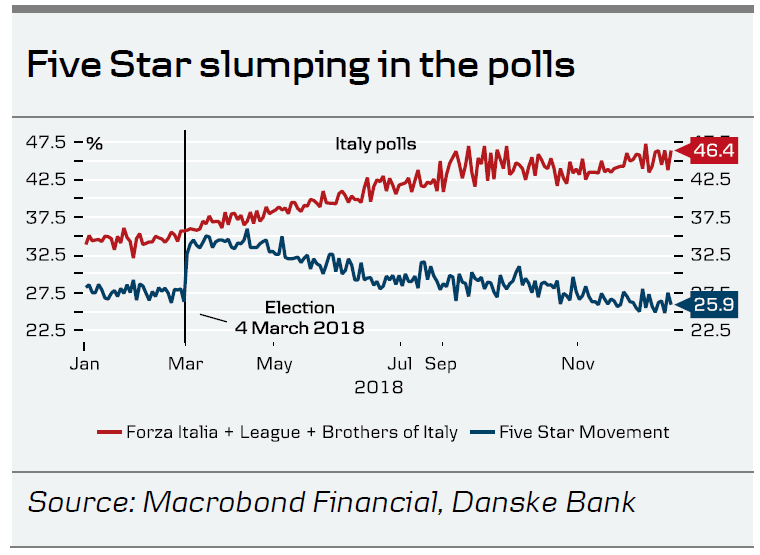
Although we expect Italian risks to move into the background near term, many fundamental questions remain unresolved. The Italian economy continues to 'flirt' with a recession and the effect of higher borrowing costs and tighter credit conditions will continue to linger as a headwind for the real economy. Structural weaknesses will remain unaddressed and even if the government's expansionary measures can prevent a downturn, it is difficult to become too optimistic on the growth and debt outlook in light of low potential growth below 1%. Furthermore, the fact that the Italian government has eventually yielded to pressure from the EU and markets indicates that the balance of power in the ruling coalition has changed, with the League increasingly setting the agenda. With support for the Five Star Movement steadily dwindling in the polls, a strong performance by the League at the EU election in May could well heat up discussions of a snap election in H2 19, opening up the possibility of a centre-right coalition.